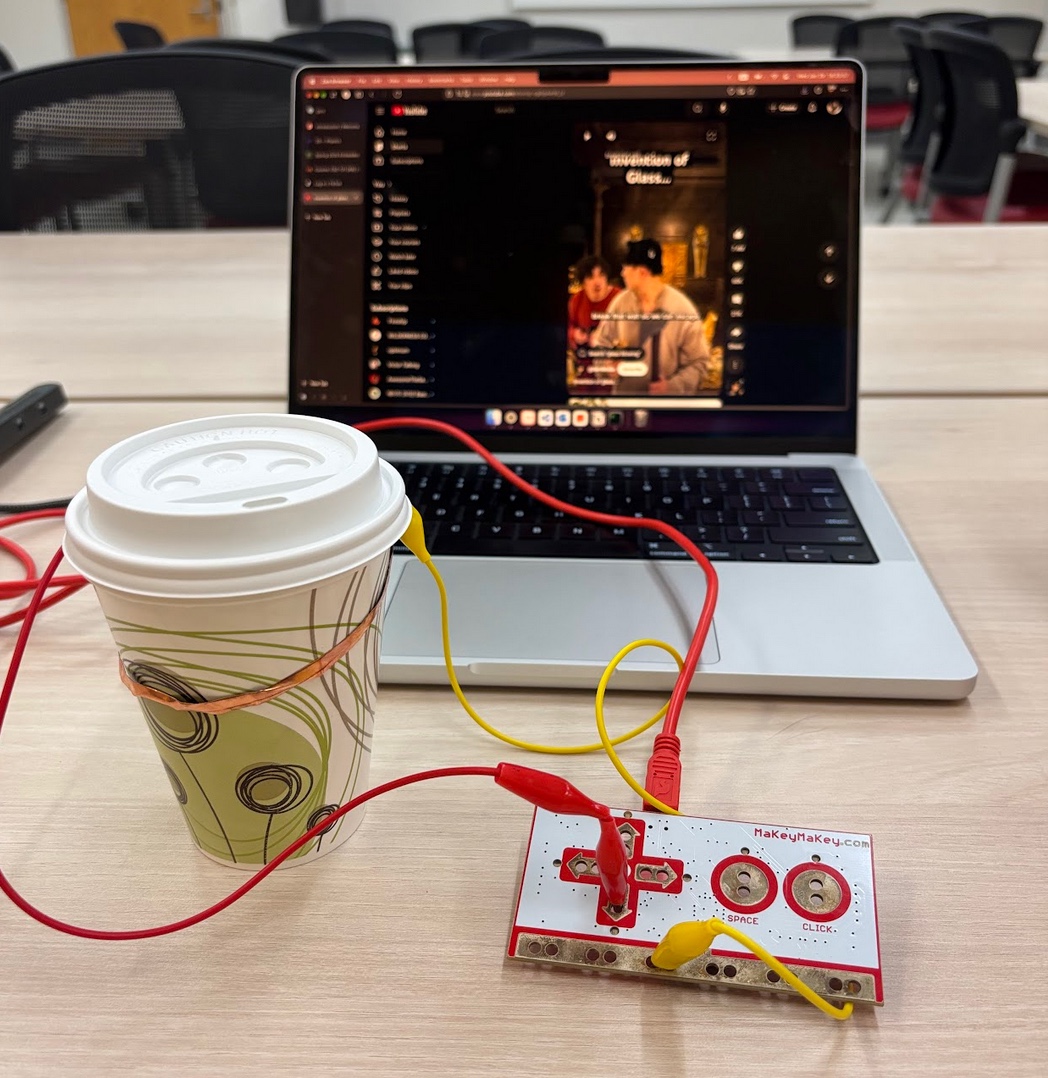
Hack #1 that was assigned for this course wanted us to use the MakeyMakey device in a creative way. At first, I was unsure of what to create because I thought my ideas were too simple and predictable. However, after looking at the examples that were provided on the MakeyMakey webpage, I began thinking of ways in which the MakeyMakey could be used for fun, thinking similarly to more expensive games such as consoles like the Nintendo Switch & the Xbox 360’s Kinect. The MakeyMakey made it possible to elevate a free game and provide a new experience for users that they previously would not have been able to experience. As was mentioned in class, this usage of the system provided accessibility for people who may not have the opportunity to purchase a high end device such as the Nintendo Switch, since the MakeyMakey can be purchased for $50 + tax (which could be seen as expensive but is quite a price cut from the hundreds more that are needed to purchase a more advanced setup.
The Roblox game I used to create the “gaming system”The set up of the MakeyMakey in order to work with the Roblox game chosen
Trial & Error
This hack was a bit difficult for me and I presented late because of the fact that I was sick and unable to work on it during the initial work period. However, once I recovered I was able to work more on my idea and hash out any issues. Another issue I had was working by myself. Since I was still recovering and didn’t want to get anyone else sick, I had to do trial and error by myself, making things a bit difficult as observation of another person would have been much easier than trying to test the device while also taking notes. Finally, I feel as though there wasn’t much help on the official website for the device to help make changes such as changing which letter would correspond to which arrow or so forth (though I probably could have searched on YouTube), so it was just up to my intuition to figure it all out.
Changes or Elevations
At the end of my presentation, I was asked how I would elevate my project if I had more time and one thing that I feel would help is to develop better aesthetics for it. The wiring being exposed takes away from the game and can even make it feel less fun. Originally, I had created colorful sheets of paper to act as the pads players would step on to signal the step in the game, but this caused issues with the detection, so I had to make changes. However, if I had more time to try and change this, I would try and make the pads colorful and maybe even incorporate lights to make the game feel fun and entice people to play.
In developing my Makey Makey hack, I sought to explore how play is integrated into our daily cultural practices, with a particular focus on the realms of self-help and wellness. This project emerged from my personal experience: while I have never naturally gravitated toward “games” or “tricks” as a means to improve my mood or mental state—preferring instead the reflective nature of journaling or deep conversation—I recognize the immense market and cultural appeal these self-help games hold. My experiences with such tools have been paradoxical; while they often facilitate introspection and self-awareness, they can also serve as a stark mirror reflecting past struggles. For example, features like Apple’s mental health section in the Health app invite users to track their emotions daily. Initially, this can be a beneficial act of self-reflection, yet over prolonged periods marked by stress or burnout, it can feel like a competition—a performance where one “wins” only when already happy, and “loses” when the chart indicates otherwise.
Inspired by the readings of Huizinga and Caillois, I decided to ground my project in a deliberate contradiction: using a seemingly light-hearted and non-serious medium to address the gravely serious topic of mental health. Huizinga’s discussion of the fluid boundary between play and seriousness (as noted on page 103) provided a theoretical framework that resonated deeply with my intent. I found it fitting to adopt a non-serious visual and scoring system—a deliberate aesthetic that disguises the heavy undercurrents of self-assessment and mental wellbeing. In this way, my hack becomes a playful yet pointed commentary on the inherent contradictions of self-help culture.
Inspired by the readings of Huizinga and Caillois, I decided to ground my project in a deliberate contradiction: using a seemingly light-hearted and non-serious medium to address the gravely serious topic of mental health. Huizinga’s discussion of the fluid boundary between play and seriousness (Huizinga 103) provided a theoretical framework that resonated deeply with my intent. I found it fitting to adopt a non-serious visual and scoring system—a deliberate aesthetic that disguises the heavy undercurrents of self-assessment and mental wellbeing. In this way, my hack becomes a playful yet pointed commentary on the inherent contradictions of self-help culture.
Caillois’s ideas further influenced my work, particularly his notion that play occupies a “pure space” separate from the production of material goods and that it is fundamentally unproductive (Caillois 125-128). Many self-help games, by contrast, are designed with the explicit goal of producing something tangible—namely, an improved state of wellbeing. This dichotomy troubled me. I observed that such tools, while marketed as mechanisms for self-improvement, can inadvertently lead to feelings of failure when one’s emotional state does not meet the “winning” criteria. To embody this tension, my hack simultaneously claims to offer help and yet reveals itself as an impersonal and potentially damaging device.
In designing the project, I played with various dimensions of play as categorized by Caillois—most notably, agon and mimicry. The element of agon is evident in the way my hack can be misinterpreted as fostering toxic competition among users, pitting friends against each other in a contest of who is the “happiest.” Conversely, the aspect of mimicry is reflected in how the digital component of the game seeks to externalize inner thoughts and feelings, transforming them into tangible objects or representations for each day. Additionally, the element of alea, or chance, underpins the game’s recognition that life is inherently unpredictable—acknowledging that no one is to blame for having an off day.
The physical manifestation of my project—a board with a minimalistic interface—was crafted with intentional simplicity. Initially, I toyed with the idea of a vibrant, colorful design. However, I eventually opted for a more restrained, colorless representation. This decision was deliberate: by stripping away the distractions of color and ornamentation, each symbol on the board is allowed to speak for itself. The act of interacting with the board—reaching up when feeling high and reaching down when feeling low—embodies the raw, unadorned actions that underpin our emotional experiences.
The accompanying digital game maintains this minimalist aesthetic. Its rudimentary look and flat scoring system, complete with emotionless summary messages, serve as a stark commentary on the coldness of “winning” and “losing” cultures, particularly in the context of mental health. The game’s design underscores the often impersonal nature of self-help tools, highlighting how an overemphasis on productivity and measurable outcomes can detract from the genuine, messy process of emotional well-being.
Ultimately, my project is a meditation on the interplay between play and mental health. By subverting the conventional expectations of self-help games, I aim to provoke a critical reflection on how we conceptualize and pursue happiness. Through this playful yet critical lens, the hack challenges us to reconsider the cost of equating emotional wellbeing with a game—a game that might promise self-improvement but, in its very structure, risks reinforcing harmful narratives about success and failure in our personal lives.
LF
Works Cited
Caillois, Roger, and Norbert Elias. “The Classification of Games.” Sport: Readings from a Sociological Perspective, edited by Eric Dunning, University of Toronto Press, 1971, pp. 17–39. JSTOR, http://www.jstor.org/stable/10.3138/j.ctt1gxxrtw.9. Accessed 4 Feb. 2025.
Huizinga, Johan. Homo Ludens: A Study of Play-Element in Culture. Routledge, 2002.
“Log Your Moods and Emotions and Take Mental Health Assessments.” Apple Support, support.apple.com/en-us/105000. Accessed 4 Feb. 2025.
For our first Hack, we decided to work with a game that made us reminisce on games we played as children. To capture this feeling within us, we settled on creating a control interface similar to Dance Dance Revolution. We found a game online called, “Friday Night Funkin’,” that worked great with our idea that we brainstormed. To play this game, there are arrow keys moving from the bottom to the top of the screen, and then to score points the player has to press the corresponding arrow keys on the keyboard at certain points of the game. To make this game even more fun, we decided to program our Makey, Makey board to where you could step on arrows on the floor to control the game rather than just clicking the arrow keys on the keyboard.
For this idea to become a reality, we had to cut out four arrow-shaped pieces of aluminum foil and connect them to the circuit board. Obviously, we connected these arrows to the arrow keys on the keyboard. We positioned the aluminum foil cutouts in a position on the floor so that they matched up with the keys that they were connected to. In order for the current to be complete when stepping on the arrows, we had to tape pieces of aluminum foil to the bottoms of our shoes. It was sometimes difficult to be able to keep the wires clipped onto our shoes as we were moving around playing the game, but other than that, we got the game and our new control system to run smoothly.
This project was extremely fun to work on. I have never been assigned a project like this before. The only guidelines we received were for it to be fun and creative. When my partner and I were assigned this task, we instantly thought of trying to use a game that was similar to ones we played in our childhood. We also wanted it to be one where it could feel more interactive and immersive playing. That is why we decided for it to be so movement based. If we just made it to where you tap an object or one of the wires with your hands, I feel like it would not have captured that same sense of childhood play that we wanted. We wanted it to really feel like the player was playing Dance Dance Revolution in an arcade. One of the biggest areas we have talked about so far in this course is the idea of play. Obviously to different people, play has numerous different definitions. In our class discussion about play, many of us said that in order for a game to be considered “playful,” it must be not serious but also competitive at the same time. I feel like the version of the game that we created fits these two descriptions perfectly. Obviously it is competitive because it is hard to do well at and no one wants to lose to the computer generated player in a game, but at the same time it is not serious at all when you realize you are dancing and stepping on aluminum foil arrow shaped cutouts. This game paired with the controller interface that we created allows for a fun experience for the player to feel as though they are alone, just having a good time dancing to the music of the game.
For Hack #1, Brett and I set out to create a Makey Makey version of the classic arcade game Dance Dance Revolution. We used aluminum foil to make touchpads for the four directional arrows—up, down, left, and right—and connected them to the Makey Makey. To complete the circuit, we placed small pieces of aluminum foil on the soles of our shoes and conncted them to “earth,” so each step on the arrows would register as an input. This setup allowed us to control the game by physically stepping on the arrows, just like in the original arcade version, but with our own creative twist. The simplicity of our materials made it a fun and interactive way to bring an arcade game home.
When we think about play, competition is often the first thing that comes to mind. We wanted to include that competitive element in our project since games like Dance Dance Revolution are exciting because players challenge each other (and because we got inspired by Dr. Sample’s version of Tetris). However, making a multiplayer version with our setup was difficult, so we found an online game that still made it feel competitive. We used Friday Night Funkin’, a rhythm-based game that requires quick clicks (or in our case, foot taps) to win. This fits with Roger Caillois’ idea of agon, a type of play focused on skill and challenge. Even though we weren’t directly playing against each other, the game’s built-in player allowed us to compete by trying to be better than it.
Besides competition, our project also had an element of paideia, which is a more free-spirited and playful type of game. Unlike serious or structured games, our setup encouraged improvisation and fun. Friday Night Funkin’ made this even better with its silly characters, upbeat music, and quirky animations. What made the experience even more playful was how we interacted with our DIY dance pad. Our movements weren’t always perfect, and they didn’t need to be. Whether we were stepping carefully or just moving however we could to keep up, the real goal was to have fun.
The era of short-form content has quite literally rewired the brain, according to Xie, Jin et al. in “The effect of short-form video addiction.” Platforms like TikTok, Instagram Reels, and YouTube Shorts have capitalized on the addictive nature of short-form content, which has had a major impact on viewers’ attention spans. The rapid scrolling featured in the platforms previously listed shares similar principles that make gambling addictive, something deemed “random reinforcement.”
I found this concept of random reinforcement to echo a classification of games found in Caillois’s Taxonomy of Games, namely Alea, a category that classifies games of chance. In the text, Caillois states: “Alea signifies and reveals the favor of destiny. The player is entirely passive; he does not deploy his resources, skill, muscles, or intelligence. All he need do is await, in hope and trembling, the cast of the die.” In a an article by Nathan Crispo, he discusses a study that extends this Alea to short-form content: “Brain scans of Chinese college students using a TikTok equivalent showed that areas of the brain involved in addiction were highly activated in those who watched personalized videos, and some people had trouble even controlling when to stop watching.” I considered this to be no different than gambling; it is addicting, and people have trouble stopping. The dopamine rush associated with gambling can be similar to that of short-form content. While this might not be scientifically accurate (as far as dopamine release), I found my idea to be further supported by Dr. Julia Albright in “Digital Crack Cocaine: The Science Behind TikTok’s Success,” in which she states: “Sometimes you win, sometimes you lose. And that’s how these platforms are designed… they’re exactly like a slot machine. Well, the one thing we know is slot machines are addictive. We know there’s a gambling addiction, right? But we don’t often talk about how our devices and these platforms and these apps do have these same addictive qualities baked into them.”
Considering the power of short-form content, I wondered if it would be possible to turn infinite scrolling toward an avenue of health? In “The effect of short-form video addiction,” it is discussed how “short-form video addiction poses a new risk to people’s mental health and social life.” The paper reaches deeper, explaining how short-form content can cause emotion-regulation issues and reduced feelings of well-being.
To address this dampening of mental health, I sought to create a solution to an extension of poor mental health – self-care. When being caught up in endless videos, it can be easy to forget simple acts of self-care, such as staying hydrated. One could find themselves going hours without drinking water, too focused on “just one more video” while a water bottle sits untouched. Perhaps this same captivating format could instead remind us to take care of these basic needs, rather than distract from them.
My first hack seeks to take a step in the right direction to offer care while scrolling. Taking a sip of water causes the next video to appear; a person touching the water completes the circuit and causes the MakeyMakey to input a down-arrow keystroke, scrolling to the next video. Albeit a very simple and amateur attempt at solving a much bigger problem, I hope it can serve as a reminder to not get too engrossed in play. Balance in all things is always a necessity, and play is no exception.
Xie, Jin et al. “The effect of short-form video addiction on undergraduates’ academic procrastination: a moderated mediation model.” Frontiers in psychology vol. 14 1298361. 15 Dec. 2023, doi:10.3389/fpsyg.2023.1298361
I love poetry, but this has not always been the case. For a long time, I found it hard to relate to and felt like I was unequipped to actually understand the deep complexities of it. This served as the inspiration for my first hack, where I wanted to think about how the makey-makey could poke fun at the usual seriousness and pretentiousness associated with poetry and make it more attainable to a wider audience.
I created a poetry generation game where the player uses a console to build a poem composed of randomly generated poetry lines coming from Shel Silverstein and Edgar Allen Poe. Poe because he is a critically acclaimed poet for his genius and artistry, yet darker themes. This contrasts Silverstein, who is taken less seriously and known for his childlike uses of language and themes. I wanted to understand if these two poets’ words, put together, could still generate poetry that appears to have meaning or fits into the category of poetry.
From my many experiments generating poems, I find that generally the Silverstein and Poe work somewhat well together to create a sort of sensical and interesting poem. A serious student of poetry would probably be somewhat appalled by these poems, but that is part of the way in which the game pokes fun at the eliteness associated with poetry, where a poet so different from Edgar Allen Poe can still have their verse fit together with his somewhat well.
I was thinking about Caillois’ ideas on chance games or Alea, where the player lacks control of the outcome. I thought this was interesting to incorporate into my game because the player can’t really choose what they are actually writing; they just get to choose who wrote the next line and when the poem is complete. In this way the player has some level of authorship to their poem, but the exact result is completely up to fate. In this way the game is an equalizer in creating poetry because it doesn’t matter who is the best with their words or most thoughtful, in the end the actual writing is up to chance.
I would hope with this game that it allows the player to feel like the world of poetry is not that far out of reach. I tried to continue this message through the craft-like enclosure I made that is meant to evoke childhood and fun. In this way, I wanted to create less seriousness centered around the poems and try to make them come across as a fun output, hence making poetry generation into a game itself.
Yet at the same time, while my game may show anything can be poetry it doesn’t necessarily mean everything should be. Even so, I think the opportunity to experiment with poetry through this game allows a user to learn it doesn’t have to be taken so seriously, which I hope would inspire future appreciation of the art form.
In my project, I converted a handheld board into a conductive surface, with a metal ball rolling inside it. The Makey Makey button is anything that is electrically separate from the board and can make contact with the ball. Having a free rolling ball capable of triggering Makey Makey buttons unlocked a surprisingly unique dimension of functionality.
When you use a Makey Makey, you imagine the buttons being pressed by a finger or arm or a direct movement that connects some limb to the conductor acting as a button. However, the fact that a metal ball that requires no direct touch or manipulation, except for it to be on a conductive handheld surface, eliminates the step of moving forward, mentally or physically, and initiating the interaction. Instead, you rotate and tilt the board, asking gravity to lead the ball where you intend. This renders the metal ball as an extension of the player’s limbs, although with a much larger set of physical and psychological limitations.
Instead of “willing” a physical pathway from the button-pressing object to the button, you have to visualize the fields of gravitational potential that would pull the button-pressing object (the metal ball) at ever-changing velocities and prevent it from reaching certain areas. Since there are magnetic obstacles in its path, you must also account for the ball’s interactions with the magnetic fields at play. This strikes an amazing contrast with the typical freedoms of bodily movement in human-computer interactions. We cannot ignore external forces and rely solely on the mind’s agency over its limbs to trigger the button; magnetism and gravity have entered the gameplay.
In such a design, you cannot trust that the button will be pressed. Controlling the tilt of the board to guide the ball requires incredible concentration and patience. The process of reaching the button becomes the main focus of play, rather than the outcome of the button press.
Such a form of play introduces another twist. You do not want the button to be pressed. If the ball collides with the obstacles in its path, they trigger an alert and signify the failure of the game. Magnetism and gravity dictate the rules of play: how close you can come to the magnets before being sucked into them, how fast you must go to bypass the magnetic pull, how much velocity you can summon at any point, ignore these natural forces at your peril. The objective of gameplay is isolated as a particular mental image: a rolling ball with an unhindered trajectory, as opposed to an image of successful or timely button-interactions that permeate the majority of Makey Makey implementations. The outcome of a successful button-press has been rendered undesirable.
This difference significantly flips the source of entertainment in the game, such that there is immediate, physical risk of failure. Once you grab the game board, the ball starts moving. The tiniest movement can lead the ball into an obstacle. Suddenly, your entire body is part of the game, forcing you to remain still and intentional with each motion, each breath, determined to defeat your treacherous opponents: magnetism and gravity. Play becomes serious, yet seriousness leads to the win and therefore the thrill.
Our Hack #1 idea came from from exploring play as both a nostalgic and unsettling experience. The inspiration came from our class on Tuesday where we saw a unique take on Tetris. This reinterpretation of a classic game as burying bodies transformed it from something playful into something unsettling. This unexpectedness intrigued us, leading us to consider how play can evolve and juxtapose, and challenge our understanding of childhood nostalgia.
For our hack we wanted to examine Caillois’ themes of agon and mimicry. These two elements are central to our experience with games and how we interact with play over time. We decided to base our project on 2048, a game that many of us remember being addicted to during our middle school years. The competitiveness to keep adding numbers and reach 2048 reflects with agon. This game fueled determination and competition to get a higher score than your previous one, and to beat your classmates.
However, instead of the traditional number-based 2048, we used an altered version of the game with horror elements instead of traditional numbers. This forces players to reconsider their relationship with games that once felt nostalgic fun and lighthearted. The juxtaposition of horror with a childhood game creates a sense of unease, mirroring how perceptions of play change as we grow older. What was once a simple and joyful experience could later be viewed through a different lens.
For the Makey Makey component we chose to use stuffed animals, as it evokes nostalgia and embodies child-like play. Stuffed animals are an essential part of childhood, representing comfort, imagination, and play. By using them as the conductors for the horror 2048 game, it helps evoke nostalgia and simultaneously question how childhood play has evolved and changed. This contrast between the warm, familiar experience of toys and the eerie, distorted gameplay of 2048 reflects the ways in which digital play has become increasingly tainted as one grows up. The mimicry part comes into play as when we were children, we used to play dress up and role play with stuffed animals. However nowadays children play online games such as 2048 and other video games.
Our hack ultimately raises questions of the evolution of play as we grow older, from playing dress up and roleplay with stuffed animals, to the norm now being phone and online games. This project opens doors to consider what play means and whether it is just an innocent, imaginative activity, or if it becomes tainted, unsettling and eerie. As children our play is unrestricted, free, and lighthearted, but at what point does it become something else? Overall, our project is not just a game but allows us to explore how play shapes us and how we shape play.
For the first “Hack” of this class, my partner, Marie, and I used a Makey Makey in order to test its limits and comment on border social concepts of play. By combining two completely opposite spectrums of “play,” I hoped to provide a criticism of the broader implications of technology. A Makey Makey is a fun alternative to using physical objects to replace digital keys or clicks on a form of technology. We decided to use stuffed animals to control the arrow keys on our keyboard. These fun, innocent plush toys, in combination with the Makey Makey, are then used to play a horrific, creepy version of 2048, which replaces the numerical blocks with pictures of serial killers. This “game” that we created involves two concepts of play addressed in Caillio’s Man, Play, and Games–Agon, and Mimicry. 2048 is a competitive game in which a player can win or use while playing with stuffed animals as a form of role-playing or make-believe.
In our current society, children play games on the internet just like they play with physical toys. As technology grows, the accessibility of content expands. A child with access to a phone, computer, or internet could play this 2048 game just as easily as they could play with stuffed animals. The combination of these contradictory things shows a concerning juxtaposition. In reality, stuffed animals do not come into contact with or are seen near violent horror characters. Through unsettling proximity, I hoped to provide further commentary on how we have accepted violence as normal. Games such as 2048 show that people seek out and find enjoyment through interacting with violence and terror. Not only is this available to play, but it is accessible to anyone on the internet. Children are confronted with this violence as a new normal. Increased interaction with games such as this 2048 desensitizes children to violence and horror.
This game ultimately represents the game industry and technology in America that is sold to children. With no restrictions, video and internet games allow children to play violent games because of their competitive nature, which makes them want to continue. In our “game,” the comfortable, sweet stuffed animals are used as the tools to play, and this competitive game matches the horror characters. By exaggerating the juxtaposition of these two elements, I hoped to make a broader comment on the complex nature and dangerous undertones of the expansion of technology on gameplay.
When we play with dolls, we assume it’s a one-way interaction: we project stories onto dolls, give them emotions, and move them through imaginary worlds. But what if the doll could react? What if, instead of being a passive object, it was an active participant?
This project explores the boundaries between play, subject and object. I connected different parts of the doll to Makey Makey. When these parts are touched, a pre-programmed response in Snap is triggered, making it seem as if the doll is reacting to human touch.
The responses may seem mundane – simple, everyday phrases – but the behavior the doll responds to upends our expectations. It is no longer just a toy, but an interactive subject.
Caillois categorized games into four types, one of which—Mimicry (roleplay and simulation)—is at the heart of this work. Typically, mimicry involves the human assuming a role, but here, the doll itself participates in mimicry, mimicking the act of conversation, even though its responses are pre-programmed. All the conversations of this doll are designed to be more colloquial, which can bring people a more intimate feeling. The parts I chose were her hair, belt, fingertips, and top of her head, Each meant to create a specific personality of the doll. When touching the belt, she would introduce the clue where she bought it, providing her life experience; when you touch the top of her head, she will ask you an interesting question, which represents her own thoughts and the sense of humor. And when you touch her finger, she’ll say “I won’t do the homework for you” but also hope she could hold your hand. These settings, which incorporate fragments of life experiences and seemingly autonomous emotional responses, make her feel more real and blur the traditional boundaries of Mimicry. Typically, in Mimicry-based play, the player assumes a role and projects life onto an object. Here, however, the doll itself mimics the act of engagement, reversing the expected dynamics of play. Normally, dolls are completely manipulable toys, and their “existence” depends on the player’s imagination. However, in my project, the doll does not just react—it initiates engagement, leading the player into unexpected interactions. The traditional power dynamic between player and object is reversed: is the doll still a toy, or has it become the one directing the play. This interactive system also serves as a metaphor for the relationship between humans and objects. When an object can “speak,” does it remain merely an object? Huizinga believes that play is not just entertainment, but an act of giving meaning to the world. In this project, the interaction between people and dolls creates a miniature magic circle – a boundary space where roles are reversed and the rules of the game are rewritten. However, in my project, the doll does not just react—it initiates engagement, leading the player into unexpected interactions. The traditional power dynamic between player and object is reversed: is the doll still a toy, or has it become the one directing the play? The doll, once an object of manipulation, has now become a seemingly autonomous entity that engages the player rather than being toyed with.
Beyond the realm of play, this project also questions the way we relate to technology and inanimate objects. We live in an era where AI chatbots, smart assistants, and interactive devices blur the line between human and non-human communication. When an object responds to us, we instinctively assign it some degree of agency. If a simple programmed response is enough to make us question whether an object has agency, what does that say about our interactions with AI, with technology, and even with each other? If play is about rewriting rules, then perhaps the greatest rule to be rewritten is what it means to be ‘alive.’
Our project is a reimagining of the Etch A Sketch, a classic children’s toy where knobs are used to draw an image on a small panel. When initially planning our hack we wanted to include ilinx in our final form of play. We considered using a rhythm game and making a controller that looked like a Dance Dance Revolution mat, but thought that while it included a lot of rhythm that played into our idea of using ilinx, that the mat would be too similar to the standard arrow key layout. We eventually settled on creating a controller that mimics an Etch A Sketch, and thought that the repetitive movements required to draw using an Etch A Sketch would be a great way to include ilinx in our controller. By recreating an existing toy we are also introducing mimicry to our hack, and this mimicry plays a big role in both how people will draw with the controller, and what they will draw. We had to carefully consider how we would impose the limitations of a traditional Etch A Sketch onto our reimagined version.
The base for our Etch A Sketch is the program Microsoft Paint, which when used as intended does not behave like an Etch A Sketch. To better mimic the Etch A Sketch we wired it so that the ground wire and ‘click’ wire are connected to the same part of the controller, thus making it so that you’re always ‘drawing’. This created an interesting problem we were unable to resolve, which is that the ‘click’ function sometimes bugs out and does not work as intended. It will instead ‘flicker’ and not actually click or draw anything. The only way we’ve found to resolve this problem is to unclamp the click wire and then reclamp it.
Another thing we tried to mimic was the ‘clear’ function of the traditional Etch A Sketch. While we didn’t know how to get the controller to respond to being shaken, we found that running a background script that remaps a single keystroke to a series of keystrokes was a satisfactory solution to the problem. It unfortunately caused additional problems with the clicking issue, as it will sometimes trigger the bug.
Traditionally, the Etch A Sketch also does not use any electronic technology. The dematerialization of the traditional Etch A Sketch followed by the rematerialization of the toy in the form of a controller is an interesting commentary on how technology is sometimes used unnecessarily to fix issues that never existed. This Etch A Sketch controller has no real reason to exist, it’s less practical than all other solutions to drawing digitally, and it’s not even a perfect copy of the original Etch A Sketch. Despite this it is quite fun to play with, and its existence is just for fun’s sake.
For my Hack #1, I used the Makey Makey to challenge the inherent functions and uses of musical instruments. As a society, we are taught that many objects, especially instruments, have a sole function and purpose, and that they should only be used in that specific way. Chairs are meant for sitting, wheels are meant for turning, and clothes are meant for wearing. In reality, however, many use chairs to reach dead light bulbs, many swing from tires hung by rope, and many (well maybe not many) attend nude beaches. While countless other objects have been used in unconventional, unintended ways, musical instruments, on the other hand, are almost always used as expected. While musicians and their instruments tend to have symbiotic relationships, giving personality and vitality to their sonic productions, there seems to be only one way an instrument can be played. A piano’s keys must be pressed, a guitar’s strings must be plucked, and a snare drum must be struck. As a result, musical instruments have quite a low cognitive friction, a concept coined by researcher Alan Cooper. He describes in his work, The Inmates Are Running the Asylum: Why High Tech Products Drive Us Crazy and How to Restore the Sanity (2004), that cognitive friction is “the resistance encountered by a human intellect when it engages with a complex system of rules that change as the problem changes” (Cooper 2004, 19). Essentially, Cooper understands that designers and developers “should create objects that ease tasks for their users and also ease the relations between objects and users” (Sicart 93). The ideal object has a use or a function that is easy to understand by its users, which is precisely why musical instruments have such a low cognitive friction. Anyone can intuitively understand that to play a piano means to press its keys. With all this being said, my Makey Makey Hack uses a guitar and a bass to produce sounds from instruments that are wildly different from a guitar or a bass. I have mapped the Makey Makey so that when a guitar string is plucked (or simply touched), a piano chord will play. Similarly, when a bass string is plucked (or simply touched), a drum kick will play. With these new connections and mappings, the user can play the piano and drums by playing the guitar and bass, exhibiting a playful and insightful look into what instruments and their native sounds actually mean. I was primarily inspired by our divergent thinking activity on our very first day of class as it made me wonder how “incorrectly” someone can play an instrument (much like how “incorrectly” someone can use a brick). Indeed, there are savants who can play the drums, bass, and melody on a single guitar, but I’ve never heard of anyone who can play the trumpet on a piano.