I am writing this flog because I would like to write all 16 flogs. We are discussing right now the correct number of flogs, and it has become quite confusing. Supposedly we’re supposed to have 10 flogs, but this is now my 14th one! I am really quite confused but I hope Dr. Sample sorts this out.
Author: David
Hack #5
My fifth hack builds significantly on my first hack of short-form content consumption and its psychological effects, but takes a more interactive dive into addressing the physiological neglect that can result from digital addiction. Inspired by Maslow’s Hierarchy of Needs, I focus specifically on the foundational, physiological needs – hydration, nourishment, and rest – that often go ignored during extended sessions of media consumption.
In my first hack, I considered short-form platforms like TikTok and YouTube Shorts, exploring their addictive characteristics as described by Xie et al. in their research on short-form video addiction. I previously connected this to Roger Caillois’s concept of Alea from his taxonomy of games, drawing parallels between random reinforcement seen in gambling and the mechanics of endless scrolling. These early explorations framed digital scrolling as passive, compulsive behavior.
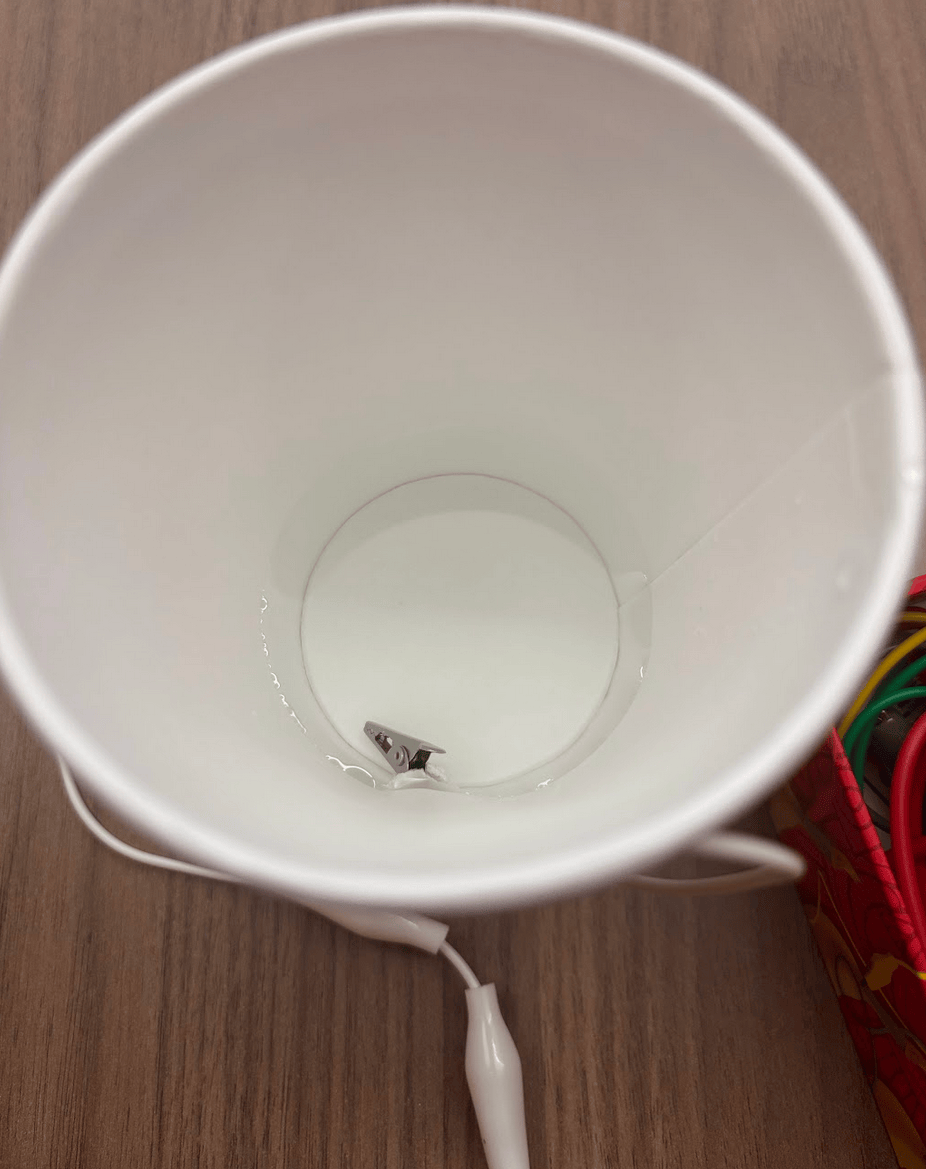
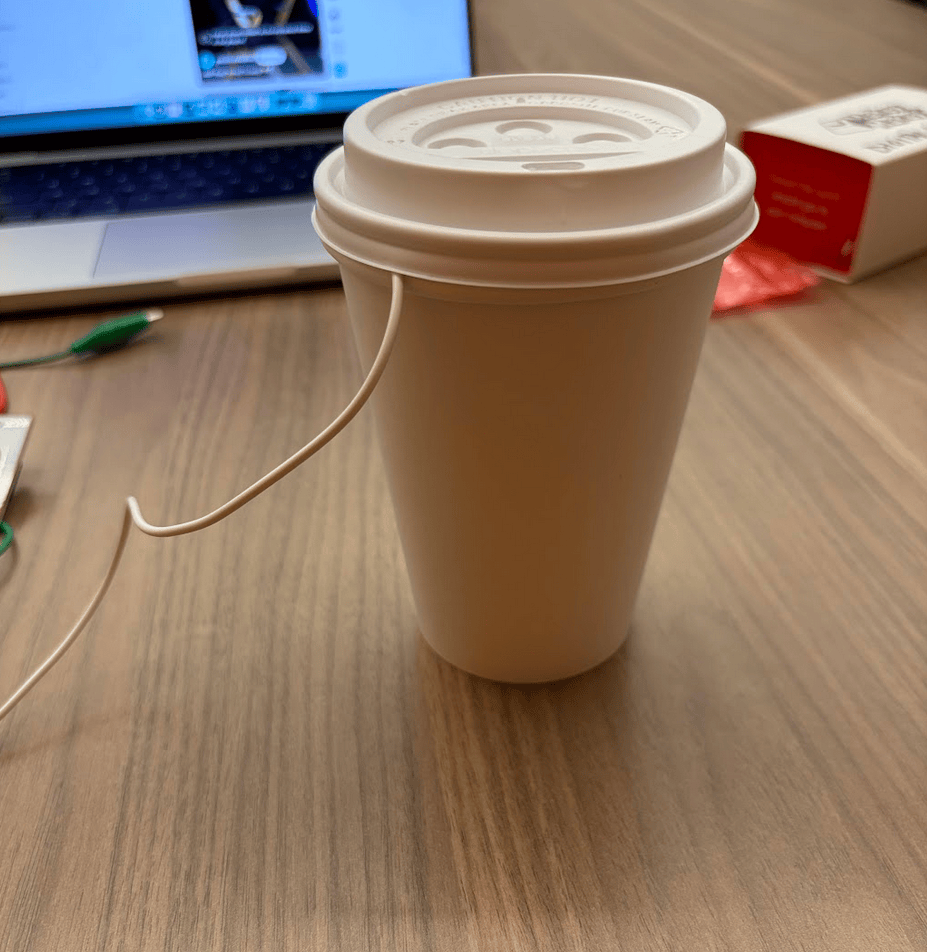
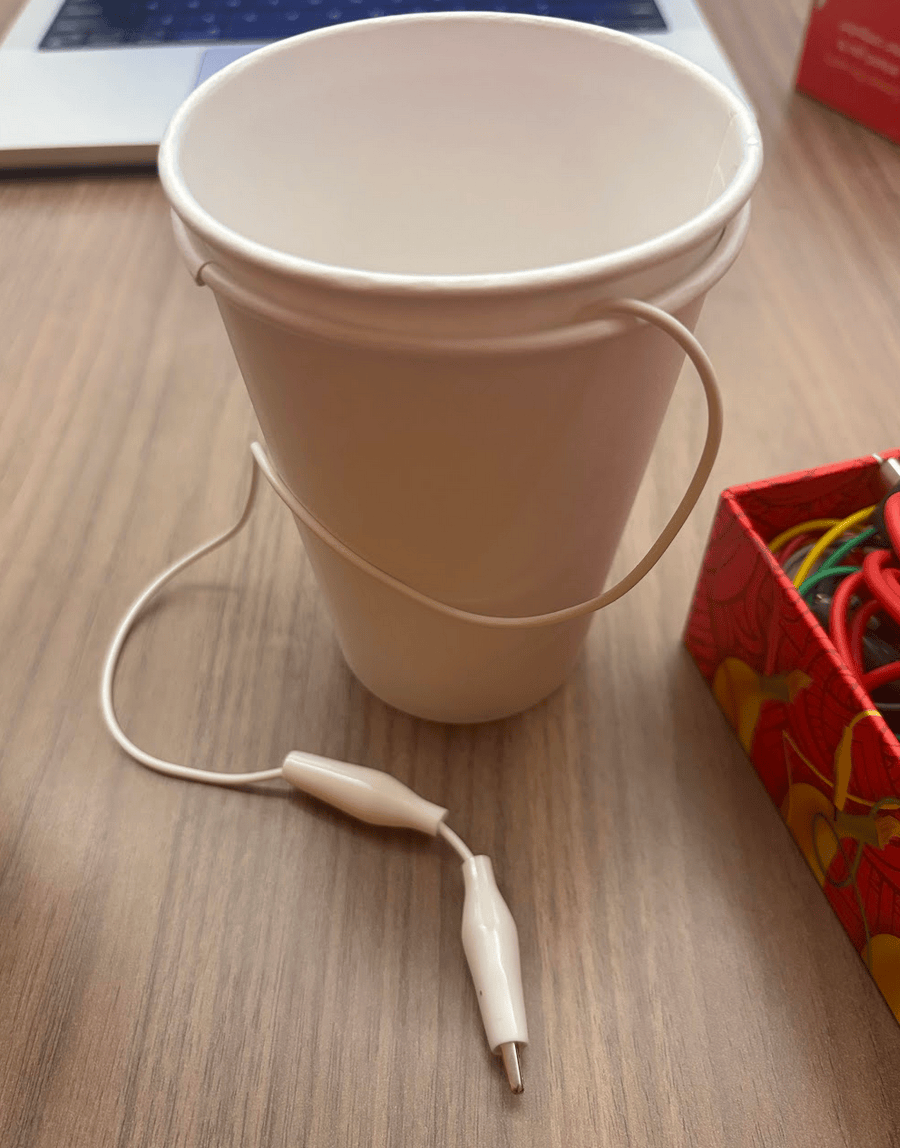
In my alpha iteration, I attempted to leverage this addictive nature toward health-conscious behavior. By creating a physical interaction through a MakeyMakey and a water cup, scrolling required users to hydrate – completing an electrical circuit to trigger the next video. This simple interaction introduced a mindful break into an otherwise passive experience.
While this initial hack proved to be conceptually intriguing, it only addressed one facet of self-care – hydration. Recognizing the limitations of this first approach, I aimed to reimagine and significantly expand my beta iteration by encompassing a more comprehensive range of physiological needs.
This hack includes three distinct physical interactions designed explicitly to address hydration, hunger, and energy:
Hydration: I maintained my original method, a water cup connected to the MakeyMakey via an alligator clip. Drinking water completes a circuit, prompting the next video to appear.
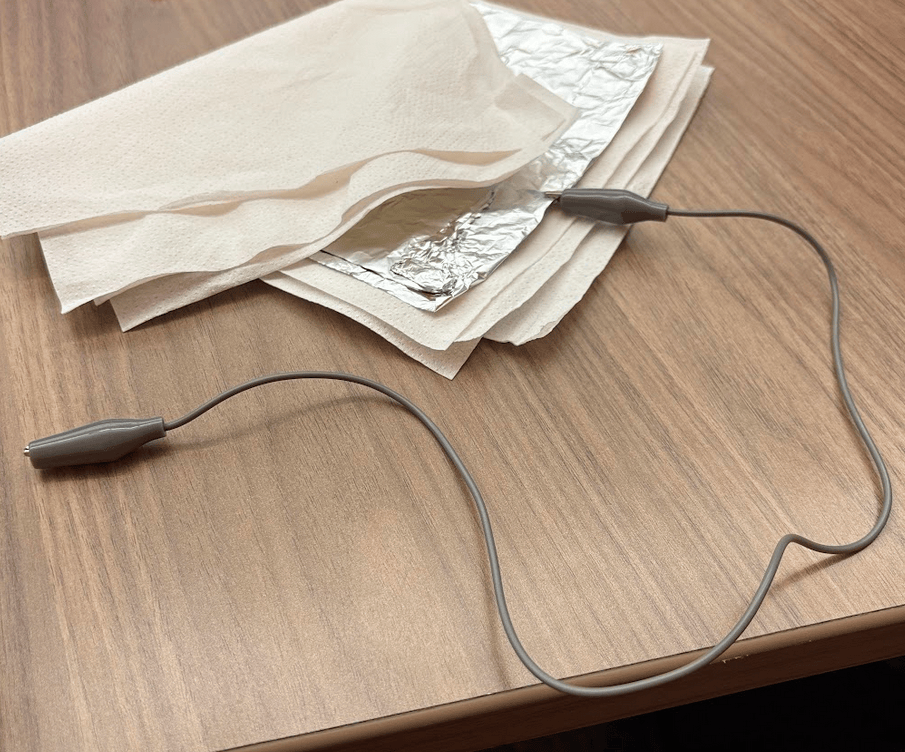
Energy: To symbolize rest, I incorporated a napkin layered with aluminum foil attached to the MakeyMakey. Touching one’s mouth with this napkin pauses the video (shortcut key K), enforcing a mindful moment of rest from constant digital stimuli.
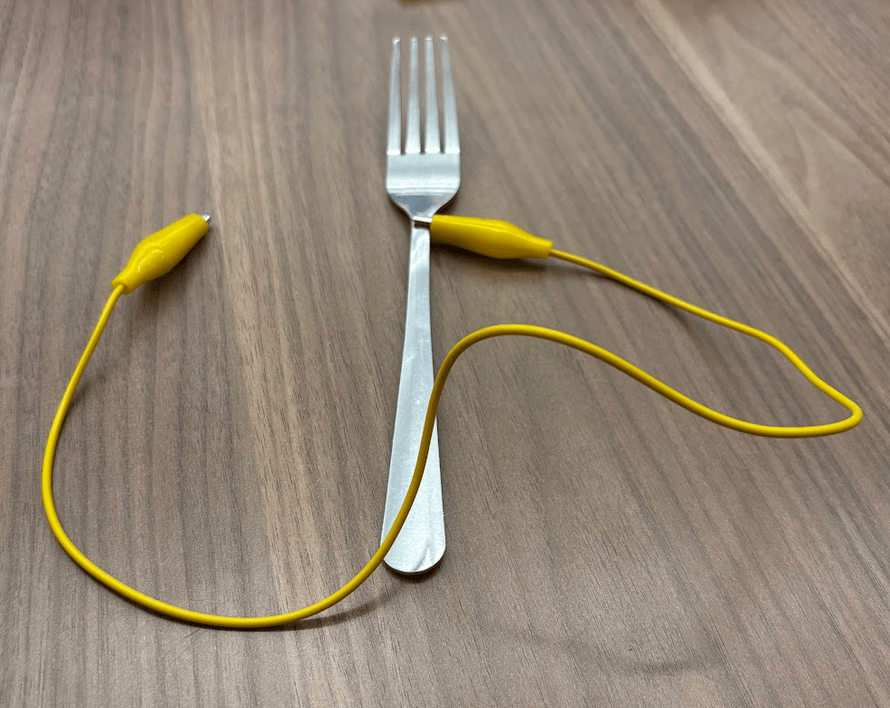
Hunger: The third interaction involves using a fork connected to the MakeyMakey. Touching the fork to one’s mouth completes the circuit and inputs a “like” to the current video (shortcut key L, utilizing a YouTube shortcut Chrome extension), metaphorically connecting engagement with nourishment.
To further strengthen the user’s awareness and interaction with their physiological state, I developed a Chrome extension that visually gamifies these needs. The extension displays three interactive progress bars for hydration, hunger, and energy, which diminish over time as users consume short-form videos. Each physical interaction described replenishes the corresponding visual meter, creating an immediate feedback loop that highlights bodily needs, prompting users to maintain balanced self-care habits.
Further, informed by the embodied interaction theory explained by Paul Dourish, my hack emphasizes how physical interactions can foster mindfulness and heightened self-awareness. In addition, it employs B.F. Skinner’s principles of behavioral psychology, harnessing positive reinforcement techniques to recondition digital behavior toward healthier outcomes.
Overall, my fifth hack synthesizes various psychological frameworks into an experience that encourages users to evaluate their relationship with technology. By transforming the compulsive act of digital scrolling into purposeful, health-conscious behavior, I aim to disrupt passive habits and promote a mindful integration of digital and physiological well-being.
References:
Caillois, Roger. “Man, Play, and Games.” University of Illinois Press, 2001.
Dourish, Paul. “Where the Action Is: The Foundations of Embodied Interaction.” MIT Press, 2001.
Xie, Jin et al. “The effect of short-form video addiction on undergraduates’ academic procrastination: a moderated mediation model.” Frontiers in psychology vol. 14 1298361. 15 Dec. 2023, doi:10.3389/fpsyg.2023.1298361
Flog #13
Hello Flog.
I am writing this on Saturday, I forgot to write this on Friday. I’m not even sure if we are supposed to be writing these because they are not listed in the schedule. But I’d like to write 16 Flogs, one for every week.
My failure for this week was a. not doing this Flog on time. And b. I didn’t work enough on my hack! I would have liked to work on it more, but I still have 3 days to flush things out. I am happy with my progress, but I have so much to do this week. I really hope the showcase we have to create for the class is not too difficult.
I’m also slowly getting burnt out. It’s been a long semester but I’m excited to see these projects through.
Flog #12
I write this flog while at a Cat cafe, my girlfriend works here and I am outside looking at some cats. It is a good day. Good Friday actually. There were not many failures this week, fortunately. I was a little upset on Tuesday though, because we did not have class. This is my one little fun class during the week and missing it did not feel right. I’ve grown a lot of appreciation for the discussion we have for those 75 minutes.
I suppose a failure of mine this week was the readings…. I merely skimmed over them and didn’t really have many thoughts. The discussions on utopias were interesting though!
Also, I think I’ve figured out what I’ll do for hack 5. I feel my first hack had a lot of room for improvement, so I’m going to start thinking of some ideas to expand its capabilities. But more of that next week….
Flog #11
WRITTEN ON 4/11
This was possibly the hardest week I’ve had to face. I had this assignment, and another paper due on the same day, and spreading my time between the two was very difficult. However, I am very happy with how my hack turned out; I spent the entire day on Sunday working on it, and Monday turning out the final touches. I hadn’t edited in some time, other than my previous hack (where I used AE), so it was difficult to get a sort of creative flow going. Originally, I wanted to keep my focus on the design aesthetics of the early 2000s, but it was too broad a subject, and it started to cross into other “generations” such as Vaporwave. I wanted to find a specific niche that the majority of us could feel nostalgic about, but one that could support my argument. After some discussion with my friends and family about the hack and my current ideas, I came across the conclusion that it is in fact, our environment, that makes us “grow” faster.
A big indicator of this was actually my little sister and her friends. She’s 12 years old, yet is aware of many more social things that I wasn’t aware of when I was her age. I notice this is the same situation for other kids her age, and I think this is because technology (namely social media) makes information much more accessible (and because parents are less privy to keeping their children off devices).
I hope my hack made sense to those viewing it, and I hope the argument was visible. Now, the next challenge is figuring out what Hack 5 should be…
Hack #4
In this current day and age, when prompted with mentions of “contemporary cultural concern,” my thoughts gravitate toward technology. I’d like to think that this hack completes some sort of a technological trilogy in my previous hacks: my first hack addressed short-form content’s impact on attention spans; my second examined the exploitation of resources for technological advancement; and now this piece offers a reflection on technological evolution and the phenomenon of what I like to call “compressed time.”
I’ve attributed Gen Z’s fascination with the past to our position as “Digital Natives” – those who have grown up with technology and the internet as integral parts of our lives. Unlike previous generations who witnessed the gradual introduction of new technologies, we were born into an already-digital world that continues to accelerate at an unprecedented pace. This creates a unique paradox where we experience nostalgia for technologies that existed barely a decade ago.
This compressed nostalgia exists because our technological environment evolves at a pace never before experienced in human history. When devices or interfaces that defined our childhood become obsolete within 3-5 years rather than decades, nostalgia accelerates correspondingly. The traditional time required for something to become “vintage” or “retro” has collapsed for our generation. What once took 20-30 years to become nostalgic now takes a mere 5-10 years, creating a temporal dissonance unique to our generational experience.
Consider how rapidly the smartphone evolution occurred: from the revolutionary first iPhone (2007) to the refined iPhone 4 (2010) to the larger-screened iPhone 6 (2014). Each represented not just incremental improvements but distinct cultural moments. The original iPhone’s interface with its glossy buttons and realistic textures created an entirely different emotional response than the design introduced with iOS 7 in 2013. Apple’s iOS 6 featured realistic leather textures, paper fibers, and drop shadows that mimicked physical objects, while iOS 7 suddenly eliminated these in favor of minimalist, flat design principles. Microsoft made a similar leap from the dimensional Aero interface to the completely flat Metro UI in Windows 8. Yet both exist within the same compressed decade, each evoking its own form of nostalgia.
The implications of this compression create both challenges and opportunities for Digital Natives. Unlike Millennials who largely share memories of the same technologies spanning their childhood and adolescence, Gen Z’s technological memories vary dramatically even among those born just 3-4 years apart. A person born in 1997 might remember MySpace and Windows XP, while someone born in 2005 has never known a world without iPhones. This creates a sort of mini generational divide within Gen Z itself.
I have taken some time to reflect on potential positives of this. In particular, I believe that being a generation experiencing technological acceleration, we may be equipped to navigate the inevitable disruptions of the future. Perhaps our nostalgia for rapidly obsolete technologies isn’t trivial, but functions as a necessary emotional processing of constant change. We’ve developed a sort of resilience to technological evolution that previous generations had to acquire more gradually. When multiple “eras” of technology can exist within a single decade (from the iPod in 2003 to the Apple Watch in 2014), our very concept of what constitutes a historical period requires reconsideration.
To explore this phenomenon, I deliberately focused my remix on a compressed time frame (2003-2014) that demonstrates how rapidly technology evolved during Gen Z’s formative years. By beginning with McCullough’s critique of Frutiger Aero nostalgia, I acknowledge skepticism about the legitimacy of Gen Z’s nostalgic impulses. His perspective represents an older generation’s view that our nostalgia is somehow less authentic because of its compressed timeframe.
The technology timeline that follows serves as my counterargument, employing what Virginia Kuhn calls “digital argument” – “using remixed elements to make claims and provide evidence.” By documenting the rapid succession of technological changes within this brief period, I demonstrate how our generation experienced multiple “eras” within a decade. Each technological shift represents not just a product release, but a distinct cultural moment with its own aesthetic language, behavioral norms, and emotional associations.
Kenneth Goldsmith’s concept of “textual ecosystem” helps explain our relationship with technological interfaces. Just as he observes that all digital media is ultimately composed of text-based code beneath its surface, our timeline reveals that seemingly superficial interface changes actually represent profound shifts in our digital experience. Each interface pattern functions as an environment of interaction that generates its own nostalgic response. This approach to remix allows me to construct what Goldsmith would call an “uncreative” perspective – one that reveals truth precisely by reframing existing material rather than generating original content. As he argues in “Uncreative Writing,” the most profound insights often come not from creating new material, but from reconfiguring what already exists. My work arranging these technologies across a compressed timeline creates meaning through context and arrangement rather than original creation.
I found the evolution within this technology timeline to be especially evident in UI design trends. The progression from Windows XP (2004) with its rounded buttons and nature imagery, to Vista’s (2007) translucent “Aero” design, to Windows 7’s (2009) refined transparency, to Windows 8’s (2012) radical flat tiles wasn’t merely aesthetic evolution. Each represented a fundamentally different “language” through which we interacted with technology, creating different emotional imprints and cultural associations.
These design languages reflect broader cultural shifts as well. The glossy, reflective surfaces of Vista’s Aero interface embodied early-2000s optimism about technology – transparent, impressive, but still somewhat separate from daily life. The “flattening” n in the early 2010s coincided with technology becoming more invisible, seamless, and integrated into every aspect of our lives. The interface became less about impressing the user and more about disappearing into the background of our lives.
Within my remix, I wanted to add to this evolution. I thought this would emphasize how “long ago” these bits of technology felt. I deliberately applied a film grain effect to the early footage that gradually lessens and eventually disappears as the timeline advances toward 2014. This visual technique serves as a metaphor for technological advancement – the “old” grainy footage giving way to the crisp, clean aesthetic of newer technologies. The evolution of the video itself mirrors the evolution of the technologies it documents, my editing style helping communicate the general message of the entire work.
I found that my relationship with technology provides an emotional foundation for this remix. I’ve always gauged time by the technologies present at different moments of my life – getting my first computer at age 7, receiving my iPhone 6s in 7th grade (2015), and upgrading to the iPhone SE2 in 2020 at the beginning of the pandemic. Because of how I gauge time, this project has forced me to examine whether my nostalgia is genuinely about the products and technologies themselves or about the developmental stages they represent. Perhaps I’m not nostalgic for Windows Vista’s button design so much as I’m nostalgic for the person I was when those interfaces framed my experiences.
This personal technological timeline exists within a broader context of accelerated obsolescence that shapes our entire generation’s relationship with the past. The rapid succession of devices, interfaces, and digital environments has created layers of technological memory that accumulate at unprecedented rates. Our generation doesn’t just experience nostalgia for distant childhood memories, but for the continuous parade of technological eras that have defined even our recent past.
When we express nostalgia for iOS 6’s skeuomorphic design or Windows Vista’s Aero interface, we’re not just fixating on superficial aesthetics. We’re also processing the emotional impact of constant technological disruption and transformation. Our nostalgia serves as a psychological mechanism for integrating these rapid changes into our sense of self and history.
By cataloging and arranging these technological markers, I’m engaging in what is Goldsmith’s “uncreative writing” – finding value not in originality but in selection, arrangement, and framing of existing materials. The juxtaposition allows me to make an argument about Gen Z nostalgia that would be impossible through traditional creative expression alone. Through this remix, I hope to validate the authenticity of “compressed time” and nostalgia, while exploring its characteristics in our accelerated digital age.
I’ve concluded that our nostalgia isn’t a shallow or premature response to recent technologies, but a necessary adaptation to technological acceleration. By acknowledging and examining this phenomenon, we gain insight not just into our relationship with specific technologies but into how technology shapes our very experience of time, memory, and generational identity in the digital age.
Ideally, I would have tied in the advancements in AI, and how the increase in ability for these AI systems has been exponential. However, I wasn’t quite sure how to add this into the video as I was focused much more on hardware and design, and not so much the ability of a chatting interface. This may be something to explore outside of the class though, looking at how AI will affect younger generations in the long run.
Find the hack here or watch below.
References:
Gillis, Alexander S. “Digital Native.” TechTarget, 8 Dec. 2020, https://www.techtarget.com/whatis/definition/digital-native.
Goldsmith, Kenneth. Uncreative Writing: Managing Language in the Digital Age. Columbia University Press, 2011.
Kuhn, Virginia. “The Rhetoric of Remix.” Transformative Works and Cultures, no. 9, 15 Mar. 2012, https://doi.org/10.3983/twc.2012.0358.
Flog #10
I happened to forget to write my flog on the day it was due. This has happened twice now, and I’m not very happy about it. I’ve been pretty scrambled recently, so I’ve forgotten several assignments.
Regardless, I’ve taken a lot of time to think about this hack, and I’ve found it difficult to start. This hack is very open ended, which I assume is a test of our adaptability and etc. I *think* what I plan to do is valid and hosts an argument on something other than a simple remix, and I hope I can execute it well.
I took some time to read Dr. Bill Wolff’s Video Mashup Assignment that Dr. Sample said he borrowed from to hopefully get some more pointers. My commentary is not much of a critique on anything, but more so an appraisal/appreciation of the past, specifically 2000s-2010s. More will be said in my artist statement, and as of now, I feel I have more to put into words than put into video.
Flog #9
Like last week, this was not the most eventful week. Other than the introduction of the newest hack, the idea of remixing was mostly discussed. I didn’t have many failures, but I did feel that I had some trouble getting through the readings. I made sure to get the main idea of the readings, but I don’t think I had a deep understanding.
Once the hack was announced, I spent some time thinking about what I would do…. but nothing came to mind. With something so broad and requiring different forms of media, I found myself veering off into a direction that wasn’t the hack. It will definitely take some more work shopping, but I think I will eventually figure out an idea. I want to have one before (preferably) the weekend is over. I may scrounge up some old Minecraft game play footage of mine from years ago, or even take some time to find songs and videos that remind me of earlier times — the year 2012 is a target I’d want to replicate.
Actually, while writing this Flog, I’m started to get some ideas… hopefully they turn into something. I think story boarding will be a necessity here. We will see.
Flog #8
Not much happened this week, but the readings were quite extensive. The readings for Tuesday were very long and difficult to get through. While I found them interesting, there was a lot, and I found myself forgetting what I was reading… it became hard to focus. The reading for Thursday was much better, probably because it was comic based.
I’m excited for the next hack. The topic of remixing has been interesting, but I don’t really agree with the notion that there are no “original” ideas or words anymore. I think there is more to it, but I’m not quite sure what that is. I assume the next hack will be to remix something, but that is quite open ended. I hope there are some more specific requirements to it.
Flog #7
I did not work on much this school week, but I worked a lot over the previous weekend. My task was to put together some sort of song on After Effects, something I had not done before. However, I have had experience in the past with varying DAWs, so it did not seem like it would be too difficult. It was more fun than challenging, and I really enjoyed the process.
But it’s not something I would do again.
The process was quite time consuming, and I spent a lot of time working. Listening back to the song over and over again became repetitive, and it got to a point where it just sounded like noise, nothing intelligible or composed.
I took a break after that point, obviously, but I suppose I could call that a fail of the week. I overworked myself and did not realize it until after the fact.
Writing the artist statement wasn’t that difficult, I had many things to speak upon creating music and I hope it serves as a valid argument for the artist statement.
Beyond that, it’s been a busy week. I’ve had a midterm type of assignment due in every class and I’m quite burnt out. Excited for break, and excited for the next hack.
Hack #3
The Wikipedia definition of Adobe After Effects is: “a digital visual effects, motion graphics, and compositing application developed by Adobe Inc.; it is used for animation and in the post-production process of film making, video games and television production.” While the definition also states that it “also functions as a very basic non-linear editor [and] audio editor,” not much is stated about its ability to manipulate audio, or use it as a Digital Audio Workstation (DAW).
I’ve been using After Effects since I was a freshman in high school, making edits of (mostly) video games and other content that I would gather (family gatherings, friends hanging out, etc). Video creation in general has been a hobby of mine since middle school; it is a large creative outlet I have, and one I still use to this day. Despite having a visual creative outlet, I have always wanted to be creative musically, but this has not always panned out well. My musicality does not span very far – I took piano lessons for eight years, but it never really clicked; I was just doing as my mom wanted. My mom was often quite critical of my piano playing, and the things I created visually did not receive much praise; so I thought perhaps music would be another avenue that would receive some.
But because of this, music almost became a sort of spite of mine.
There have been times in the past where I attempted to create music, downloading a free DAW (namely LMMS), but I spent minimal time actually learning the tool. Unlike with After Effects, where I genuinely enjoyed the learning process, with music I mostly watched tutorials without putting forth an effort. My motivation for learning music production came from external validation – wanting to please others – rather than from my own intrinsic interest. When I struggled with LMMS, I blamed the tool instead of my approach, which led me to pirate professional software like FL Studio and Ableton Live. I convinced myself these higher-end DAWs would somehow make creativity easier, just as After Effects had come naturally to me. But this was just an excuse – the real issue was that I was afraid to invest time in something where I might not immediately succeed. Simply put, I was scared of not being naturally good at music creation, so I never gave myself the chance to truly learn.
The point of this preamble is to provide an explanation of my relationship with After Effects and music creation. Using the tool I have sunk hundreds of hours into to create something I have not before – something I have been scared to even attempt to create – serves as a great motivator behind this hack. To me, it is addressing a creative block and expanding the boundaries of the tool I’ve been using for over half a decade.
Because of this motivator, I drew many connections to Frank Chimero’s The Shape of Design, namely chapter three, “Improvisation and Limitations.” This creative block I faced reflects what Frank Chimero describes: “The creative process, like a good story, needs to start with a great leap of lightness, and that is only attainable through a suspension of disbelief.” My pursuit of music creation was weighed down by objectives – pleasing others, achieving immediate proficiency – rather than embracing the process itself. As Chimero suggests, I needed to “put those objectives in a drawer” to allow myself to begin to create.
What changed my approach was realizing that I could use these limitations as a baseline for my creation. In Chimero’s writing, he states: “Limitations allow us to get to work without having to wait for a muse to show up.” By choosing to create music within After Effects – a tool designed primarily for visual effects – I imposed a significant limitation on myself. This limitation became quite freeing rather than restrictive. Instead of facing the blank page of a professional DAW, I could work within the familiar environment of After Effects.
I found this similar to yet another example within Chimero’s work, particularly his discussion of Miles Davis. To summarize, Miles Davis made great contributions to jazz with his album Kind of Blue. Davis didn’t provide his musicians with fully formed compositions but rather gave them “a small slip of paper where he had written down a description of their part.” The musicians were constrained by these minimal instructions but freed to explore within those boundaries. Similarly, the limitation of using After Effects as a music creation tool provided both structure and freedom.
The “Yes, and…” principle of improvisation that Chimero discusses became prevalent in my process. I had to accept the limitations of After Effects’ audio capabilities and build upon them rather than fighting against them. For example, when I discovered that pitching audio was deemed impossible by Adobe forums, I used the “time stretch” feature to slow down the audio, then adjust the length of the audio selection, to form a sort of change in pitch. It felt that many limitations presented to me led to different sorts of solutions.
I feel as if the hack result embodies Yosa Buson’s haiku that Chimero references: “Lighting one candle with another candle – spring evening.” I’ve taken the light of my experience with After Effects and it has led me to a new creative outlet. This hack has taught me that creativity can also flourish by constraints, not be hindered by them. By using a tool “wrongly,” I’ve discovered new possibilities both in the software and in myself. As Chimero puts it, “The process and the limitations suggest the first few steps; after that, the motion of making carries us forward.” That forward motion has taken me beyond my creative block and opened up new avenues for creation, something I am constantly looking for.
The original sample used in this song was not created by me. It can be found here: https://www.youtube.com/watch?v=Ebqmk96YSGg.
The final hack 3 song can be found here: https://jmp.sh/XJElHdjH
“Adobe After Effects.” Wikipedia, The Free Encyclopedia, Wikimedia Foundation, https://en.wikipedia.org/wiki/Adobe_After_Effects.
Chimero, Frank. “Improvisation and Limitations.” The Shape of Design.
TODO: Add screenshots
Flog #6
This week was not very eventful. I spent a lot of time thinking about what my next hack would be. I couldn’t come up with many ideas, and it felt like everything I had thought of had either been done before, or was too simple. I thought about making a calendar in Terraria, perhaps building something in Fortnite. Maybe I could build something in Minecraft; I wasn’t sure. Most of my ideas surrounded video games, but I didn’t feel to confident in them.
I took some time to write down all the software that I knew how to use. This consisted of everything, from my note taking apps, to the browser I used (which varied often), to the media player I used on my Macbook. The list was long, yet I took my time writing out all of the uses for these software, and then wrote uses that were similar between them. I wanted to find a common ground between the uses that were different, in order to find a software that may work for my intentions. I finally landed on the Adobe Suite, and the technologies to offer.
That is where I will leave the flog on my Hack 3. I enjoyed the readings this week quite a bit, particularly The Shape of Design. A lot of ideas within the text resonated with me, and I look to read more on my own for enjoyment.
Flog #5
This was an eventful week for Hack #2. I am extremely proud of the outcome, but it did not come easily. We encountered issues over the weekend when DACE was closed, and we didn’t have access to any of the needed materials. We decided to check out the small art center in the union, but they were missing essential items: a box cutter and tape. Fortunately, Davis Cafe saved us – I asked a worker for a box cutter, and the union front desk had some painter’s tape.
Our next challenge arose when we needed tin foil. Davis Cafe didn’t have any, and we couldn’t find any in the union. We headed to Nummit in search of it, but they didn’t have any either! We then went to Ksig and raided the kitchen, emerging successful with foil in hand.
Writing the artist statement for the second hack gave me some trouble. I had many thoughts about Elon Musk but didn’t want to detract from the actual meaning of the hack. Finding a proper balance and flow for my argument took quite some time, and I worried I wouldn’t finish in time. There were moments when I’d fall into rabbit holes researching Musk and his family. Sometimes I’d end up in obscure Twitter (X) threads that led to nothing but speculative discussions about Musk’s origins.
I found the reading this week quite interesting, although I had trouble getting through it. It was dense, with many abbreviations whose meanings I kept forgetting. I took many breaks while reading but still didn’t fully grasp it. Only after some class discussion did things start to make more sense. It was interesting to see the evolution of the computer from places outside the grandiose settings of MIT or Silicon Valley.