Artist Statement #2

Who doesn’t love Go Fish? And even better—what if we added a twist?

For this hack, my partner, Brett, and I decided to tackle a major inequality—specifically, healthcare disparities in the United States. Our idea for modifying Go Fish was inspired by a concept Dr. Sample mentioned—how a student in his previous class explored Settlers of Catan and how the allocation of resources could relate to conquest, unfairness, and inequality. Additionally, a deck of cards was the only resource we had available, so we worked with what we had!

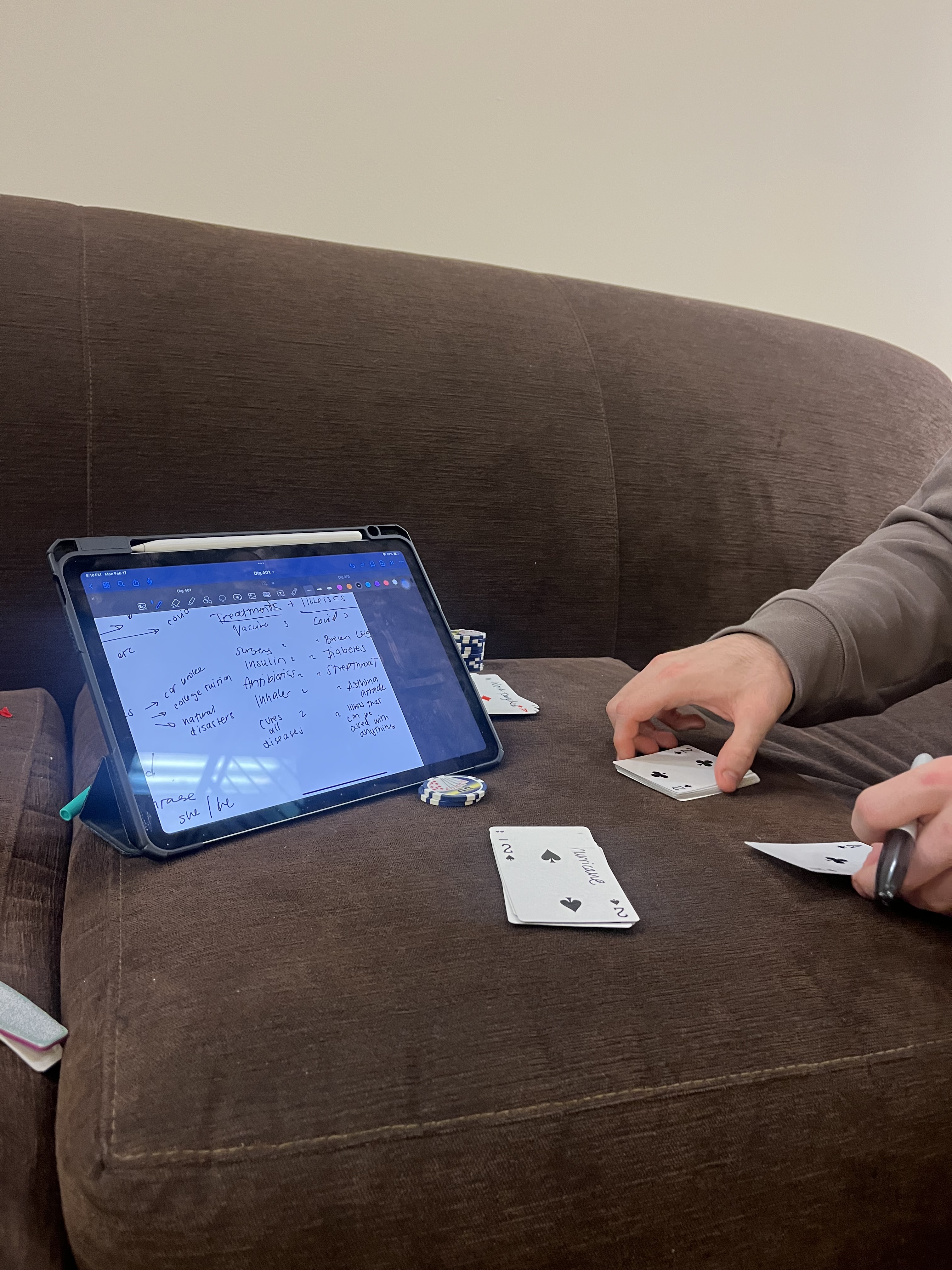
Our version, Go Fix, is similar to Go Fish but introduces a layer of complexity to reflect healthcare inequalities. Instead of forming “books” of four matching cards, players must pair two related cards: an illness (♥) with its corresponding treatment (♣) while trying to avoid bad luck (♠) cards, which increase costs, and hoping to draw good luck (♦) cards, which provide financial relief. You might be wondering, what does this mean? Let me explain.

x

This is a two-player game, with each player taking on the role of either the insured player or the uninsured player, reflecting the real world. Both players start with five random cards and ten tokens, or chips, representing money. However, the uninsured player is at a significant disadvantage. When a player successfully matches an illness (♥) with its treatment (♣), the insured player only pays one token to the bank, while the uninsured player must pay three tokens.

In addition to illnesses and treatments, the deck contains good luck (♦) and bad luck (♠) cards, which affect each player’s financial situation. Good luck cards allow players to gain tokens, offering just a small financial relief. Examples include: “Job raise! Gain 1 token” or “You receive financial aid for your child’s college—gain 1 token,” representing financial stability that allows players to focus on treating illnesses. Bad luck cards, on the opposite side, take away tokens, reflecting the unpredictability of life. Examples include: “Hurricane—pay 1 token” or “Car crash—pay 1 token,” highlighting real-world emergencies that create unexpected financial burdens.

There is also one special good luck card that is highly valuable: “You won the lottery! Gain 3 tokens!” Because this card is a game-changer, both the insured and uninsured players are actively searching for it in the deck. To keep things simple, players must immediately pay or gain their tokens as soon as they draw a card, ensuring that no one forgets to do so later.

Once you understand these rules, playing Go Fix is just like playing Go Fish. Players take turns asking their opponent for a specific card in hopes of forming a match. For example, one might ask: “Do you have the vaccine to treat COVID?” or “Do you have antibiotics for strep throat?” If your opponent has the requested card, they must give it to you; if not, they say “Go Fix” and you must draw from the deck. However, pairs only work if they match the correct illness and treatment. Some of the correct pairs include:

  • COVID-19 = Vaccine
  • Strep Throat = Antibiotics
  • Diabetes = Insulin
  • Broken Bone = Surgery
x

This modification also extends the game’s duration, since the chances of drawing an illness (♥) or treatment (♣) card are only 1 in 4, making it more challenging to form matches. The first player to match three illnesses with treatments wins!

As I mentioned in class, one of the most shocking things to me was the complexity of the U.S. healthcare system. During my first year here, I got really sick, and accessing good doctors and adequate care was extremely difficult. It felt as if the system was intentionally complicated and inaccessible, designed so that only the “smartest” and “richest” people could navigate it successfully. Fortunately, I had insurance provided by my college, but this experience made me consider what it would be like for those without insurance. Access to quality healthcare and the ability to live a healthy life should be a right, yet, as an outsider and international student, it seems that everything in the United States is political.

A good example of this is when Brett and I were testing our game. Even though I was the insured player, I ended the game with fewer tokens but was still able to match three pairs of illnesses with their treatments. We debated whether the winner should be the player with the most money or the player who successfully treated their illnesses. Ultimately, we decided that the winner should be the player who treated more illnesses because, in reality, what is the point of being rich if you can’t access healthcare and cure yourself?

With that being said, this version of Go Fish engages with both of Flanagan’s concepts: subversion and intervention. Firstly, let’s start with subversion. As Flanagan defines it, “an action, plan, or activity intended to undermine an institution, event, or object” (Flanagan 10), our Go Fix game challenges and exposes the harsh realities of the U.S. healthcare system. By making it harder for the uninsured player to win, the game mirrors how financial barriers often determine a person’s ability to receive adequate medical care. It forces players to confront the unfair structure of healthcare access, revealing that success in the game, just like in real life, is not purely based on skill but on pre-existing advantages like insurance coverage.

A clear example of this occurred when Brett and I found ourselves questioning who the real winner was during our test run. Was it the player who had the most money left? Or the player who successfully treated their illnesses? The fact that we even had to debate this reflects the real-world uncertainty and unfairness of the healthcare system. In reality, financial wealth does not always guarantee survival if someone cannot access or afford treatment. Our final decision, that the winner should be the player who successfully treated their illnesses, was a direct critique of the system, challenging the idea that financial stability alone ensures good health. This moment of uncertainty reinforced the broken and unpredictable nature of the system we were trying to represent, making Go Fix a subversive tool for revealing these injustices through play.

Additionally, Flanagan’s definition of intervention aligns with our work in this Hack, as she defines it as “a ‘stepping in’ or interfering in any affair, so as to affect its course or issue” (Flanagan 11). We are intervening by immersing ourselves in a system that is inherently unfair. Reflecting on my own experience, when I got sick during my first semester, I was fortunate to have insurance that covered all my expenses. However, even with that safety net, navigating the healthcare system was a stressful and uncertain process. There were so many unknowns—waiting for approvals, dealing with unclear costs, and the overwhelming complexity of the system. If this experience was stressful for someone with insurance, I can only imagine how much worse it would have been without it.

One thing I now realize is that I should have switched roles with Brett at some point while testing the game. I always played the insured player, which gave me an advantage, but it also limited my perspective. If I had experienced the game from the perspective of the uninsured player, I would have gained a deeper understanding of just how unfair the system truly is. This realization directly connects to Sicart’s idea of cognitive friction, where players expect a familiar experience but are instead confronted with unexpected challenges and systemic inequalities.

(This is a link to watch the videos of us playing! They were too heavy to upload them to this blog: https://drive.google.com/drive/folders/1xuB8uJL2FIf_ysWn-f8VqxNcV-D5rGrt?usp=drive_link)

In Go Fix, we are used to the standard rules of Go Fish, where every player has an equal chance of winning. But here, the unfairness is already part of the rules—no matter how well the uninsured player strategizes, they always face higher risks. Even if a player gets the “You won the lottery!” good luck card, it only provides temporary relief.

xx

Artist’s Statement- Hack 2 – Summa Cum Ludo

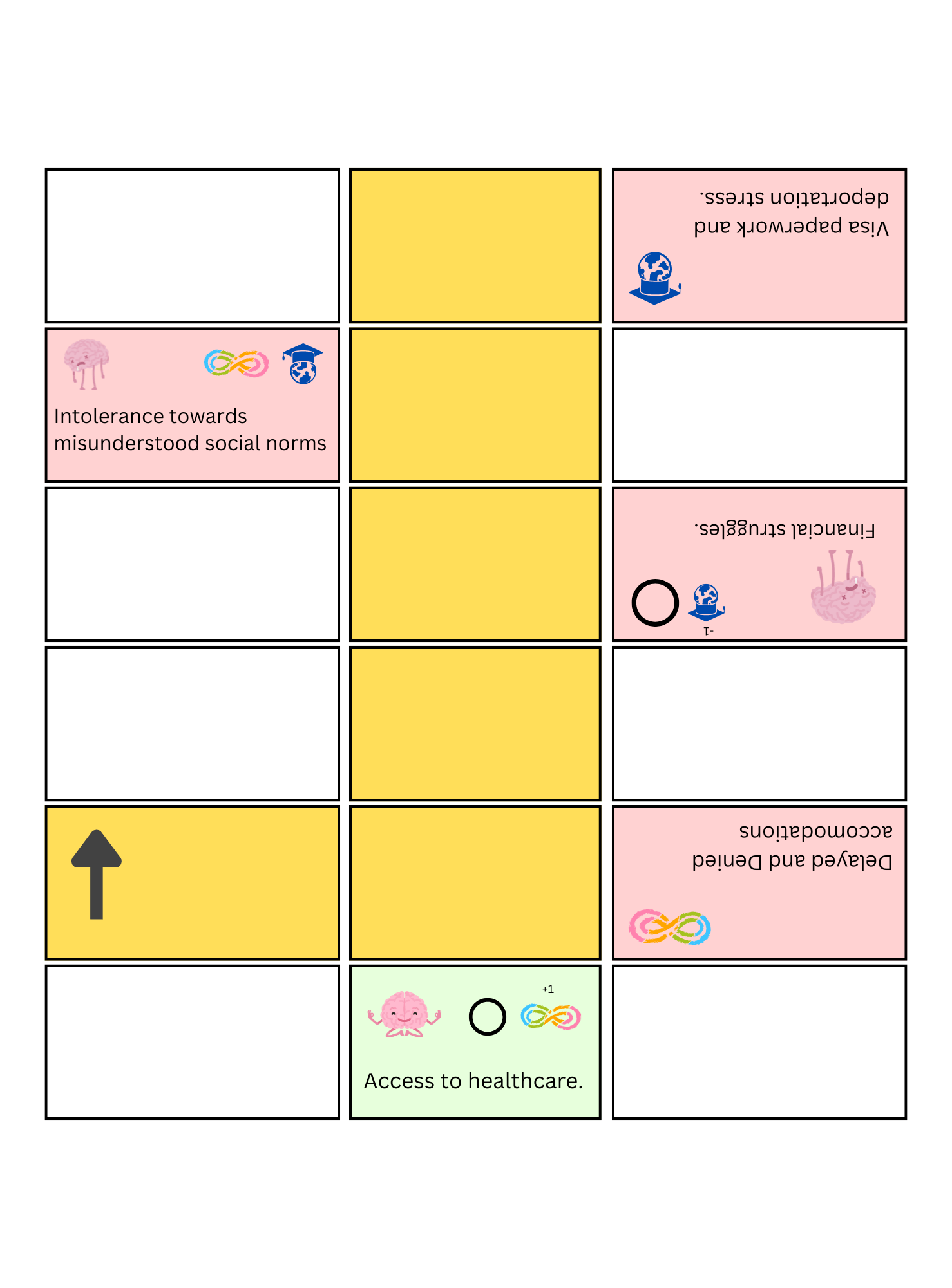
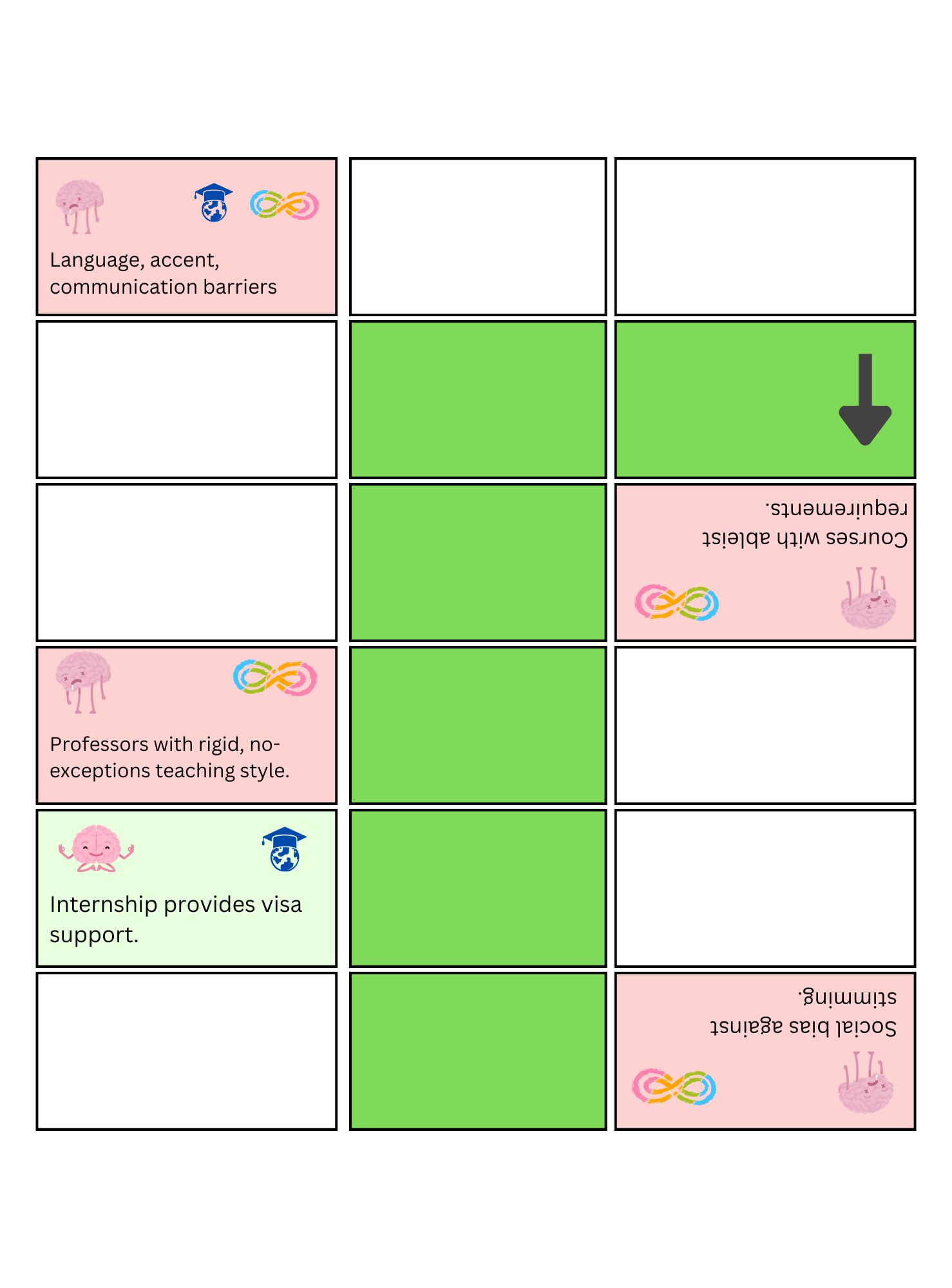
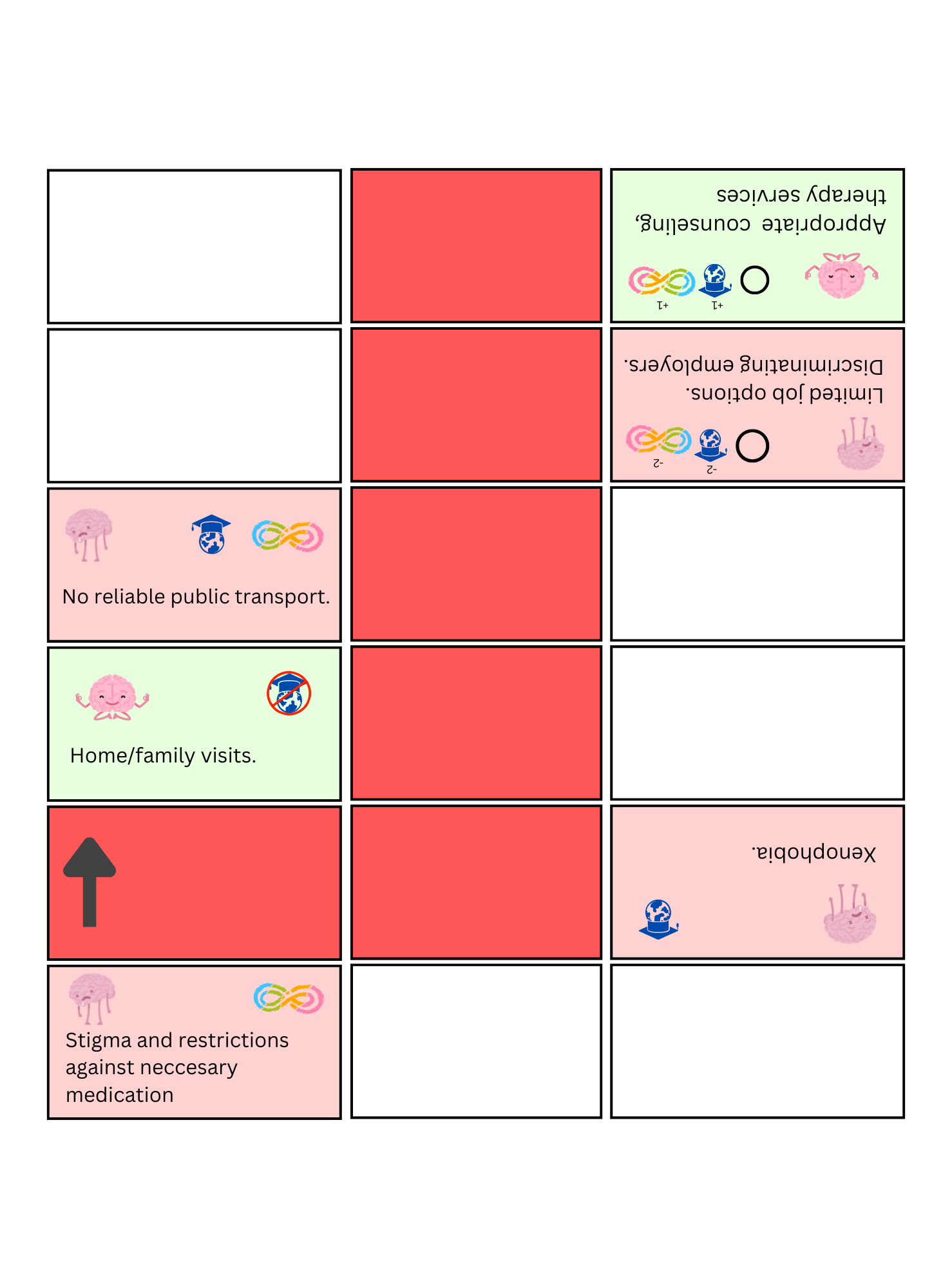
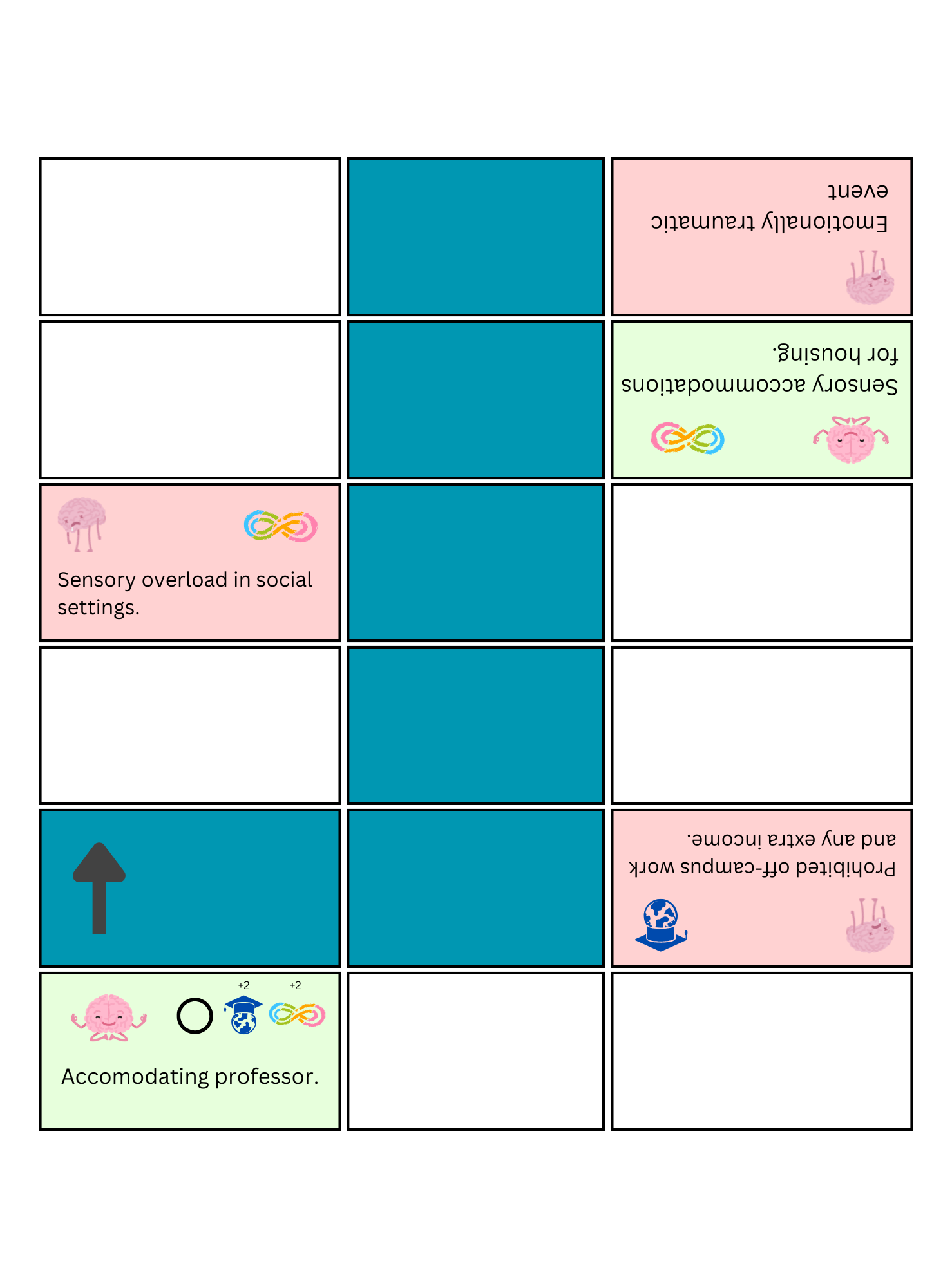
Ludo is a popular board game in South Asia and regions across the globe, originating from the Ancient Indian game Pachisi. In my hack, I reskinned the board to create Summa Cum Ludo, rewriting the narratives around the pieces to reflect a journey through college, and how it differs significantly for minority demographics like international or neurodivergent students.

In the original Ludo, 2-4 players, each represented by a different color, move their pieces along squares that set up a route around the board, aiming to be the first to finish their cycle and reach “home” in order to win. The movement of the pieces in each turn is determined solely by the roll of a die. In Summa Cum Ludo, the 4 players are college students, each headed towards graduation instead of a “home,” and the route of the pieces reflects their journey through four years of college. However, the pieces are distinguished not only by a color, but also by the demographic they belong to within the college student population. I chose a 2×2 player design to represent four possible demographics: American-Neurotypical, American-Neurodivergent, International-Neurotypical, and International-Neurodivergent, utilizing the affordance of Ludo’s red-green-blue-yellow player aesthetic. 

By distinguishing pieces in this way, Summa Cum Ludo enables a jarring shift in play. Dice are no longer the only alea element; where you were born and who you were born as are facts determined by chance long before the game started, but are now part of the play by directly influencing the trajectory and outcomes of the game. Such a shift allows us to meaningfully revisualize real-world structures, such as college, where each player appears to have a similar destination (graduation) and a similar path (taking courses, building a resume, applying for jobs, etc.) but is not actually in the same boat as other students. Not all squares in Summa Cum Ludo are blank, neutral steps. They are inscribed either with a cost or a benefit, which may affect only one, some, or all of the students depending on the demographic they’re in. The costs represent exhausting obstacles or disadvantages that influence students’ path towards graduation, such as financial struggles or emotionally traumatic events, and benefits represent events or experiences that support their journey, such as accommodating professors, therapy, etc. 

Under Roger Caillois’ frameworks of play, classic Ludo is a combination of alea, agon and ludus. The dice are the main determinants of outcome, and the game is played primarily for fun. Summa Cum Ludo, however, transitions into the realm of mimicry in multiple ways. First, to have your pieces belong to a particular demographic of college students as you move on the board invites the players’ imagination into the same role. Since the squares directly reference player demographics when imposing cost or benefit, the player must come to see themself as part of that demographic in order to successfully navigate the board. In addition, the player must be conscious of the roles of other pieces, their demographics, their privileges. 

In Ludo, the agon attitude is spurred by the rule that a player can “kill” another player’s progress by landing on the same square as them, forcing them to restart the piece’s journey. Players derive their enjoyment from hurting each other’s progress, even though the ability to do so is primarily determined by the die rolls. In Summa Cum Ludo, there is no such rule. If a student lands on the same square as another, the only harm done to either comes from the square itself, and whether their demographic is vulnerable to that obstacle. The players’ energy counter (i.e. a health bar) is what keeps track of such harm during the game, and once the energy runs out, the student cannot continue anymore. This choice more closely reflects the dynamics of students in college, without removing the possibility of harm in the gameplay. Such a form of mimicry also sparks what Miguel Sicart calls cognitive friction. If students are moving towards graduation, overcoming not the collisions with each other but rather the obstacles determined by life, then what is the meaning of reaching graduation first? Is play thrilling when you beat other students who were faced with greater disadvantages? Should the winner be proud because they reached the destination first, or because they reached the destination at all, in which case each student who reaches graduation has won. Are those who got burned out and never reached graduation considered losers? One extra rule turns this ethical dilemma into a wicked problem: if a player lands on another’s piece, they can choose to offer them energy by lowering their own. In doing so, a student may counter the unfairness of the system. Will any player help another, and if so, which demographic, and which not? Will they make decisions based on energy, identity, progress, or something else? Will they hold grudges for not being helped by another?  

Mimicry, in this case, has forced agon and alea into a confrontation, igniting the ethical consciousness of players and tempting them to use moral thinking to solve an undefined ethical problem, which is exactly what constitutes a wicked problem. Under this wickedness, Summa Cum Ludo becomes a form of ethical gameplay. As Sicart puts it, ethical gameplay is “the experience of a game by players who make choices that are based on morality considerations that are derived from their understanding of the game system.” Summa Cum Ludo offers exactly this experience. It shifts the player’s attention away from other players and towards the board itself, breaking the perceived neutrality of the original gameplay, where the board favored noone. The route is no longer uniform, even though it is composed of the same number of squares for each player. Instead, the board has four layers overlapped onto one route. If you are an American-Neurotypical student, the number of squares that exhaust your energy are far fewer than an International-Neurodivergent student’s, and your path to graduation is by all measures a different path entirely, and the destination (graduation) holds a different meaning for you, yet the bird’s eye view of the journey only sees 4 equal players on a single board. The players must question the meaning of the path, the structure of the system, and why they are competing at all.

Ultimately, the bird’s eye view of Ludo is that of administrators, faculty, policy makers who decide what education is, how it should be implemented, standardized, and regulated, and it sees little of the layered complexity of student journeys. Colleges and all systems that rely on college metrics like GPA, graduation timelines, etc., disregard the differences in effort required to reach graduation. The concept of “fairness to other students” is often cited as a justification for standard policies around courseload, class structure, deadlines, etc., as if each student is moving to the rhythm of the same dice rolling in present-time. The reality is more like Summa Cum Ludo. The rolls of dice that happened at birth (will you be neurodivergent, will you need to leave your country to seek better higher education?, etc.) influence the outcome far more than single events along the way, and make graduation a non-generalizable, unique event for each student, that cannot be compared across groups of students to make judgments about individual ability, worth, and character. Summa Cum Ludo’s ethical gameplay directly questions the assumed fairness of such structures.

Design – using Canva

Construction

Artist Statement #2

For this hack, we were supposed to take an existing game and make some form of modifications for it to fit into Mary Flanagan’s categories of critical play in chapters 1-3 of Critical Play: Radical Game Design (2009). As Flanagan states in chapter 1, critical play is a “careful examination of social, cultural, political, or even personal themes that function as alternates to popular play spaces” (Flanagan, 2009). Essentially, we were tasked with changing a game to challenge some sort of issue or problem that we feel is necessary to call upon. This could be either by unplaying, reskinning, or rewriting a game (Flanagan, 2009). Mariana and I decided to go the rewriting route. We decided to rewrite and manipulate the rules and a few other aspects of “Go Fish!”

Initially, we wanted to completely reskin a game, but we did not have any board games readily accessible and we just were not sure how we would even want to change how a game looks to push across our topic. So to make sure our topic got across, we decided to just change the rules and add new elements to the classic game of “Go Fish!” The topic that we wanted to address is the health care system. By this we mean that we want to challenge the health care system and bring attention to how it is not great. We wanted to point out how unfair the healthcare system is. This system heavily favors the wealthy and preys on the less fortunate. Health insurance can be extremely expensive and can be easier or harder to access for people depending on a person’s employment. Oftentimes, people who come from low income households cannot afford treatments that are necessary for them to be able to live healthy lives. These treatments and doctors are already very expensive, but then with no health insurance, those prices sky rocket. At times, this system can even be completely unfair for all parties of people. Even people and families that are well off can still have trouble getting treatments and seeing doctors strictly off the availability of these things. These are some of the main areas we tried to hone in on and depict with our rendition of “Go Fish!”

Instead of sticking with the class name of “Go Fish!”, we changed the title of the game to fit our theme. Instead, we decided to name it “Go Fix!” The main function of the game is still very similar to the original, we just made a few small changes. The first change that we made was making each of the four types of cards represent a certain task or scenario. The hearts represented health treatments, the diamonds represented a health issue or illness, the club represented some sort of bad luck scenario such as unexpected costs, and the spades represented a good luck scenario. The goal of the game is to match up your health issue/illness care to the desired treatment for your problem. The bad luck and good luck cards come into play with our newly designed money system that we added into the game. This money system was incorporated to make it so that one player had an advantage and the other was at a disadvantage. Essentially, there are two roles when you play this game, one player is “insured” and the other is “uninsured.” Both players start off with the same amount of money. Each player gets ten dollars, represented by poker chips, to start off the game. The roles come into play when a player matches a health issue card to a treatment card. When these two types of cards match, each player has to pay for their treatment, so the “insured” player only has to play 1 chip, as where the “uninsured” player has to play $3 chips. This makes it to where the “insured” player is naturally at a greater advantage than the “uninsured” player. We wanted to simulate how the system favors those with a great financial situation. The money system in the game also comes into play with the good luck and bad luck cards. If a player draws a bad luck card, then they have to pay 1 chip from their pile. If a player draws a good luck card, then they get 1 chip to add to their pile of money. There is one good luck card that reads, “You won the lottery,” that card is worth 3 chips if you pull it. This portion of the game is meant to represent how even though those who are wealthier and insured, it can still be very difficult to get the treatments that are needed, it can still be very hard for individuals and their families to get the proper care they need. There are unforeseen circumstances that occur on just about a daily basis for everyone in the world. Doctors and other health care professionals can also be difficult to get a hold of and are not readily available a lot of the time. In order to win or lose this game one of two things must happen. If a player matches 3 treatment and health issue cards and is able to pay them all off, then they win. If a player runs out of all their chips and goes into debt, then they lose. 

Our manipulation of the game “Go Fish!” challenges a massive issue that so many people struggle with not just in the United States, but all around the world. When most people think of “Go Fish!” I’m sure they associate the game with wholesome childhood memories of playing a game almost solely based on luck, but our rendition of the game makes players have to think deeper while they play the game. “Go Fix!” challenges the whole idea of the healthcare system around the world. The whole point of the changes we made to this game was to draw attention to how unfair the healthcare system is. We wanted players to realize how hard this harsh reality can really be for some people. Obviously the feeling of losing the game and dealing with the struggles of being uninsured is nowhere near the same as actually having to face these struggles in real life, but it at least gives the player some sort of sense of how hard and unfair the healthcare system can be. Good health and care is something that everyone in this world is deserving of having readily available to them at all times, but this is obviously not the case in today’s world. This is exactly what Flanagan talks about when she brings up the idea of critical play. Taking such an innocent game and redesigning it to challenge and tackle a real world issue. This idea of critical play can be crucial to taking a step in the right direction to many issues going on around the world. This concept and methodology coined by Flanagan is extremely powerful and something a lot of people can take advantage of.

Hack #2

In our real world, society is like a precisely built tower, where countless individuals at each level support the stable operation of the levels above them. “Class Jenga” uses this metaphor as its foundation. By modifying the traditional Jenga rules, it allows players experience power imbalance, class immobility, labor exploitation, and the fragility of social structures during gameplay. This work draws from Mary Flanagan’s Critical Play theory, aiming to help players feel the invisible rules of society through seemingly simple game decisions, and understand how these rules shape people’s lives, limit their choices, and ultimately affect how the whole society works.

The main component of this game is a Jenga set that includes blocks in purple, blue, green, yellow, pink, and red colors. Purple represents the wealthiest people, blue and green represent the middle class, while yellow, pink, and red represent the lower classes. Purple players pull one block per game or none, green and blue players pull one block per game, and the bottom yellow, pink, and red players pull two blocks per game. Players of higher social classes can pull blocks from their own level and any levels below them, while players of lower classes cannot pull blocks from levels above their own. And if one person lets the tower fall, everyone else in his class loses.

Unlike traditional Jenga where everyone plays equally, players are randomly assigned to different classes at the start of the game. Players in lower classes bear more responsibility and face more restrictions while having fewer choices. Apparently, since Jenga’s game rules are “whoever pulls the blocks that cause the tower to fall loses”, the lowest yellow-pink-red player is more likely to lose the game, while the purple player has almost nothing to worry about. This creates a clear parallel with real society: capital is concentrated in the hands of very few people. They can lead a rich life, while workers in the lower class must not only work hard to maintain their own livelihood but also support the normal operation of the entire social system. The most striking demonstration of social power imbalance is shown through the power to make rules in the game. Players in higher classes can not only choose to pull fewer blocks but can also freely modify the rules, forcing lower-class players to take on extra tasks such as “pink and red players must pull an additional block.” This symbolizes how the wealthy continuously adjust the rules of the game through lobbying, legislation, and policy influence to secure their existing benefits while making survival conditions more harsh for the lower classes. Lower-class workers usually cannot decide their own fate that their way of life is restricted by established systems that often serve the interests of the upper classes. Even more ironically, in the game mechanics, higher-class players can keep making new oppressive rules without having to bear any actual labor burden themselves. When facing increasing labor burdens, lower-class players can choose to unite and go on strike. If all lower-class players reach a consensus, the new rules made by upper classes become invalid. However, this mechanism is extremely difficult to achieve because of the “scab” mechanism in the game – each round secretly selects one lower-class player and gives them a chance to “betray.” If they choose to betray the strike action, they can gain immunity in the next round and temporarily avoid pulling blocks. Players must make choices under this dilemma: should they betray their companions for short-term personal benefit, or persist in collective action to fight the oppression? However, even if betrayers gain temporary immunity, they can still be overruled by higher-class players and return to their exploited state. This gameplay reveals the limitations of individualism under capitalism. Capitalists may give benefits to individual workers, but the class as a whole remains unable to change its situation. These game rules directly correspond to the dilemmas faced by real-world labor movements: capitalists often divide worker groups by offering short-term benefits (like bonuses or promotion opportunities) to undermine solidarity and make strikes unsuccessful. Meanwhile, capitalists always retain the final authority even if individual workers are bought off, the overall social rules won’t truly change. The strike mechanism lets players experience the conflict between individual and collective interests during gameplay, revealing why it’s so difficult for the lower classes to form truly effective resistance.

In traditional Jenga, the player who makes the tower fall is usually seen as the loser. While in “Class Jenga,” this logic is completely reversed. When the tower falls, the winner isn’t the higher-class players who avoided labor and made rules, but rather the player who pulled the most blocks and bore the heaviest labor burden. This fact isn’t revealed until the game ends, so during gameplay, players will still assume the rules are like traditional Jenga and try hard to avoid being the one who makes the tower fall, which motivates them to pull fewer blocks. This victory condition carries strong irony by revealing the true pillars of real society are the workers, not the capitalists. Capitalists don’t create actual goods and services; they accumulate wealth by manipulating market rules, monopolizing resources, and exploiting labor. In the real world, we often think “success” means having wealth, power, and status, but in fact, society’s normal functioning depends on millions of ordinary workers. Without workers, production lines cannot run; Without deliverymen, a city’s logistics system would collapse; If there were no farmers, people would not have access to food. It is not bankers, investors, or entrepreneurs who truly support society, but the people who work every day. Yet workers are in the most precarious and insecure positions. Their labor is the cornerstone of the functioning of society. They are the first to be exploited, the easiest to replace, and the least recognized. In “Class Jenga”, the stability of the tower relies on the building blocks of the lower class instead of the upper class. This setting clearly expresses the core contradiction of the real society: the more wealth, the less labor; The more work, the lower the social status. Workers bear the burden of the system, but the ultimate social recognition belongs to those who control capital. Once the bottom can no longer be supported, the entire social system will collapse.

The game is not just a physical challenge, it is a metaphorical experiment in social structures. It uses Jenga as a game carrier to let players personally experience the social injustice, the powerlessness of labor exploitation, the complexity of the labor movement, and the reality that capital controls the society. Each game segment reflects a different aspect of real society: class division reflects the solidification of wealth and social inequality; rulemaking power reveals how capital manipulates policy to keep those at the bottom exploited. At the end of the game, the player is not only victorious through strategy, but their more important achievement is to think: if the real society is also a Jenga tower, then our class determines our fate. Is the predicament of those at the bottom really unchangeable? If the tower eventually collapses, have we already seen the inevitable outcome of social injustice? In this way, Class Jenga is not just a game, it is a critical narrative, a visual representation of the unjust structure of the present society, and a meditation on the future of society.

Artist Statement #2

Redesigning a Board Game to Form a Critique

For Hack #2, I decided to use the board game, “Mouse Trap,” and redesign it to focus on the life of Immigrants residing in the United States. I used my own experience as having parents in this exact situation in order to influence my decisions for the design of the board game. I renamed my board game as, “House Gap” which could be misleading as someone may think am trying to discuss the issue of homelessness in America. However, I chose this name because Latinos tend to create a shelter, or “house,” out of their situations, but America is not their “home” per se. The goal of the game is to create a home, however that may be. For some Latinos, this means returning to their home country with the wealth and knowledge they were able to obtain in the US whereas for others, this means creating a space of belonging in the US because they have rooted themselves and their families in a new space and are finally comfortable. I also chose to use the word gap for the name because there is this deep sense of not belonging amongst Latinos living in the United States. They feel as though they are living in between two different worlds, too different for either one. Gap is defined as a “break in barrier” which relates to the physical break once Latinos cross the border between Mexico and the United States, but also with the idea of “a separation in space,” because of this unified feeling of not belonging and being within two different cultures while also trying to navigate other aspects of everyday life.

CONTEXT: How To Play the Original Mouse Trap

Trial & Error

For my second hack, I had originally decided that I would focus on the board game, “Operation,” as the structure for my reskin because I had been focusing on the idea of looking deeper in the illegal organ trafficking that is not talked about as much as other forms, such as sex trafficking, and yet is still an issue. The World Health Organization highlights that this form of trafficking has increased immensely in the past few years, and sometimes even goes hand-in-hand with sex trafficking. However, I decided against this topic and board game for my hack because I felt as though I wouldn’t be able to convey my ideas clearly enough or successfully in order to reskin “Operation” to the best of my ability.

An issue that I ran into when completing this hack was trying to redesign the actual board and box of the board game. My topic is serious, and the design of the board game is heavily marketed towards young children, so it is quite fun and whimsical. I wanted to create this redesign in a respectful manner, so trying to make decisions that keep the feel of the original game while also showcasing a serious topic caused me a bit of trouble.

Works Cited

Artist Statement #2

For my second hack, I chose to redress the popular children’s game “Chutes and Ladders” to a game called “Fuck the Meritocracy.” You move forward in the game by first drawing cards with movement instructions. Each card also has a small blurb about a privilege statement. For example, “I got into an elite college that one of my relatives attended.” If that is true for the player, then they climb the nearest ladder. Lack of privilege makes a player move backwards or down the nearest chute. The final product is adversarial design because I think playing it makes players reckon with the privilege they have and sometimes the privileges they wish they had. First, I think there’s a tendency for a lot of extremely privileged people (specifically the ultra-rich) to downplay the resources they have and how those resources propel them to the top of society. Fuck the Meritocracy does not allow for that: if a card is true for you, you have to move. It might even motivate those people to admit ultra-privilege out loud so that they win a game. The game also forces those people to think critically about their advantages. If they got to the top of the board in four cards while everyone else is lagging behind, then they can see the inequality in a tangible way. Those who can (unfortunately) relate to every other inequity card and those who acknowledge their privilege probably don’t need a game to demonstrate this. 

The game is also directly adversarial to the attitude that you can “pull yourself up by the bootstraps and life will be awesome.” You’ll get the job you want since you’ve worked so hard. You’ll earn a bountiful living that provides for you and your family’s dreams. Right? No. The project also channels Carl DiSalvo’s “Agonism,” particularly something he said about it in an interview in 2012. When DiSalvo was asked what Agonism is, he said “Agonism is the truth that your neighbor already knows. Legislation doesn’t solve anything. The conflicts continue regardless; it’s just the nature of politics.” In the same vein, I argue that every person who has worked in the past 10 years knows that the idea of pulling yourself up by your bootstraps is no longer the case. For a lot of marginalized groups, it was actually never the case. Asserting that everyone is on an equal playing field in life only obscures the systemic inequities people face. Dunne and Raby talk about “Speculative Design” as design that imagines different possibilities in the future. I aim to demonstrate how the bootstrap and meritocracy attitudes are one possible way to view life, but that is bullshit, so we should pick a different possibility. This game is especially relevant in a political landscape where the federal government is trying to get rid of the programs that try to level the playing field for everyone.

Sources:

“Agonizing over ‘Agonism’: Exploring How Difference Can Fuel Democracy.” n.d. Accessed February 18, 2025. https://walkerart.org/magazine/agonism-politics-consensus-art-democracy.

Carl DiSalvo, “Design and Agonism” from Adversarial Design (2012)

Anthony Dunne and Fiona Raby, “A/B” and “Design as Critique” from Speculative Everything: Design Fiction and Social Dreaming (2013) 

Artist Statement #2

In my opinion, one of the most devastating impacts of the current Trump Administration is the cut to funding for international aid and development. The reality of these cuts is that it puts people’s lives at risk and ignores how U.S. economic interests have directly harmed the lives of people in other countries. A big advocate for this mass defunding is Elon Musk, the richest person in the world and  figurehead of the Trump Administration. It is important to note his wealth because a lot of it has come from taking advantage of the exploitation of resources, which can particularly be recognized in the continent of Africa. Specifically, his dad profited from questionable Emerald mining and Elon relies on the problematic mining of cobalt to power his rockets and electric cars. Therefore, it becomes ironic that Musk advocates for cuts to international development because the same communities he exploited to gain his unimaginable wealth he is now leaving behind. This inspired the question that drove the development of David and I’s critical game: how do some of the world’s richest people become wealthy and how does it come at the expense of others?

In order to explore this question, David and I decided to work with the classic childhood game ‘Operation.’ We wanted to reskin the traditional play of the game like Flanagan describes in Critical Play: Radical Game Design where we disguised the game board, so it is no longer a human body, but instead a map of Africa (33). Additionally, we disguised the objects meant to be taken out of the body, so they were instead natural resources. We also engaged in rewriting aspects of the games by “revising the narrative” when a player touches the metal edges with the tweezers, so instead of losing their turn it counts as a human rights violation (Flannagan, 33). Then, if a player gets three violations we decided that they would get sanctioned by the UN and therefore no longer able to extract any resources. This works to point out the ways in which there are some sort of regulations attempting to hold businesses in-line, but ultimately they are not super effective as shown by each player having three chances. Additionally we revised the role of the player, so they are no longer acting as a surgeon, but instead a business tycoon trying to make money. In this way, the goal of the game is to be the business tycoon who makes the most profits off of Africa. 

The player has the opportunity to choose between being one of four individuals that are directly based off of real life businessmen who actively profit off of exploiting African resources: Errol Musk, Elon Musk, Yevgeny Prigozhin, and Dan Gertler. For each of these businessmen we designed a player card that briefly describes their motivations and how they make their money off of natural resources. We chose to keep a child-like whimsy in the characterization of these people because we didn’t want the dark realities of what the players are doing to be inherently apparent to the players at first. However, the jovial tone of the character descriptions is contrasted with the dark underbelly to the true processes in which resources are extracted from African countries. 

In addition to basing the characters off of real life, David and I identified 10 lucrative resources that are prevalent in Africa to serve as the resources that the players are ‘extracting’: wood, coal, ivory, copper, emeralds, cobalt, gold, diamonds, petroleum, and gypsum. For each of these materials we mimicked the original operation game by designing a little card that describes the reason why these materials would be considered valuable to a businessperson and we assigned each of them a value loosely based on these materials real world values. Part of the motivation for describing the use of each material was to demonstrate how many of these resources are parts of our everyday lives emphasizing our reliance on Africa for its resources. We also were thoughtful to locate all of the resources on the African continent in a location relative to where these resources are most heavily extracted. The physical board shows the location of these resources exist all over the continent of Africa speaking to the vastness of this problem.

After playing the games with some friends, I was better able to understand the reality of the game is that players aren’t really thinking about the consequences of what they are doing because their ultimate goal is to win. This speaks to the motivations of the businessmen our game is criticizing because their motivations for profits outweigh their thought for the environment and communities they are harming with their actions. It is only after the game finishes that I think the reality sets in on what the players were actively doing speaking to influences of the capitalist mindset. 

While I do think this game is a successful commentary on billionaires profiting off of the  exploitation of African resources, I think there is more that could be done to contribute to this ‘critical play’ experience. For one, I feel like more could be done to emphasize the actual impacts that come from taking resources. I think this could maybe be done through a penalty card system, where players draw a card if they touch the metal edges and it describes a direct impact on the environment or community that their actions had. I also think it would be interesting to more involve companies as a part of the criticism because the game emphasizes that individuals are responsible for the resource draining and fails to account that it is many businesses as well. I also think in general it was challenging deciding how much context to provide, for example we wondered if we should mention specific countries and their relationship to resource extraction or just keep the game more broad. These are all questions to consider, if we choose to develop this project in the future. 

*We would like to note that we used Chat GPT for rewriting the instructions of ‘Extraction.’ We did this because the original instructions were quite long, so we thought it would be a better use of our time to have an artificial intelligence write out the entirety of the  instructions instead. We then went back and made edits to make sure that the instructions were still conveying the original message we intended with our game. We acknowledge the inherent problems with AI and that it is not necessarily accurate information, but we believed for writing the instructions it would not be directly presenting direct facts to our audience, instead the rules for play based on our shorter instructions for game play.

Works Cited

Mary Flanagan, Critical Play: Radical Game Design (2009)

“Rewrite the instructions of Operation based on this attached document where we have reskinned the game to be a commentary on resource extraction in Africa” prompt. ChatGPT, 18 Feb. version, OpenAI, 8 Mar. 2025, chat.openai.com/chat.

Put the Bullet Through the CEO

Image of my game

(Image not displaying link: https://dig401.limilano.dcreate.domains/wp-content/uploads/2025/02/IMG_4539-2-scaled.jpg)

For Hack #2 I decided to focus on the interventionist strategies ‘reskinning’ and ‘rewriting’ introduced by Mary Flanagan in Critical Play: Radical Game Design, as well as engaging with the concept of ‘folk ambivalence’ described by Whitney Phillips and Ryan M. Milner. The game I have chosen to reskin is the classic children’s game Pin the Tail on the Donkey. This nostalgic party game is simple: the objective is to stick a ‘tail’, usually a sticker, onto the rump of a donkey poster while wearing a blindfold. 

In the original game, the person who is closest to the natural position of the tail wins; however, my reskin of the game adds a twist to the rules. Drawing from recent memes and pop culture, the ‘donkey’ is now the former CEO of UnitedHealthcare, Brian Thompson, and the ‘tail’ is a red ‘x’ indicating where the player has shot. Unlike the original game, you now have two choices when placing your shot. You can either try to aim for the two red crosshairs on the drawing of Thompson, effectively killing him, or intentionally miss. Either way, your shot may hit one of the many innocent civilians behind him in the scene. I did this to illustrate the potential unintended consequences of assassinations that are often ignored. For example, in July 2024 the assassination attempt on Donald Trump in Pennsylvania resulted in two people in the crowd being shot and critically injured, and both were in the hospital for more than 10 days. 

These unintended victims often have a smaller presence in the news cycle, though they are extremely common. A 2023 study found that “pediatric firearm injuries are the leading cause of death among American children” and that “72% of victims were shot outdoors by an unknown shooter, the motivation of which was unknown in 93% of cases. 36% of these shootings were “drive-by” ” (Bernardin et al.). By placing Thompson outside of a school, a place he could have been as he did have kids, I include the potential of gun violence against children in the game. 

I picked this specific shooting due to the public reaction it received. Similar to the Columbine example Phillips and Milner discuss, Thompson’s killer quickly gained ‘folk ambivalence’, as people were both outraged and excited about the assassination. The level of engagement and memeification it received quickly amplified the public reaction, directly inspiring Riley English’s attempted assassination of billionaire investor Scott Bessent in Washington, D.C. (Kunzelman). While her assassination attempt wasn’t successful, it illustrates how the memeification of events like Thompson’s assassination can lead to both folk ambivalence and amplification of public opinion. I wanted to express this in the silly way my game is presented. The clear objective created by the red crosshairs and somewhat funny title make it feel like a joke on the surface, but once you take the setting into account the full gravity of what many have been picking fun at is realized. 

Flanagan’s concept of reskinning played a major role in my game, as I changed all the visuals that are typical to Pin the Tail on the Donkey. I did this to subvert your expectations of how you’re going to feel playing the game, as unlike the original my game encourages you not to play it at all. The macabre setting of the game also rewrites the rules, as some may be inclined to intentionally try not to hit Thompson, which is the opposite objective of the original game. The setting could also inspire cognitive friction with what is considered a ‘justified’ killing, if Thompson had been shot outside of a school while picking up his kids instead of on the street would the public reaction have been the same? 

Sources Cited

Mary Bernardin et al., Child Firearm Injury Circumstances and Associations With Violence Intervention Program Enrollment (2023)

Mary Flanagan, Critical Play: Radical Game Design (2009)

Michael Kunzelman, Mass. woman arrested at Capitol said she was inspired by CEO slaying, prosecutors say (2025)

Whitney Phillips and Ryan M. Milner, The Ambivalent Internet: Mischief, Oddity, and Antagonism Online (2017)

Hack #2

Tradlife: The Game of Reality

For my second Hack of this class, I decided to add a bit of a twist to The Game of Life. This idea first came to me when we were exploring adversarial design, as presented by Carl DiSalvo in his Adversarial Design. The notion of creating designs that are intended to provoke critique, discussion, and even disruption really spoke to me. On February 4th, the class discussed different ways the game Cops and Robbers could be reskinned in order to make a broader, more important critique or play on a serious matter. In the middle of this discussion, my brain somehow landed on reskinning The Game of Life. Although I was unsure of how I wanted to comment or critique, I knew I wanted to make an important assertion about the disparities in expectations for men and women in the trajectory of their lives. This ties right into Mary Flanagan’s definition of critical play, which she explains to be a “careful examination of social, cultural, political, or even personal themes that function as alternates to popular play spaces” (6).

I sat down with the game and began brainstorming. The creators of the board game have updated it since I last played, making it more inclusive to nontraditional lifestyles, which is great; however, I believe it does not accurately reflect the pressures and beliefs in society. The game has become more progressive, yet it does not actively consider the slow-changing nature of real life. In order to accurately portray the way that society still views adulthood, marriage, familial relationships, and the workplace, I needed to reskin the game.    

To begin, with the very first step of the game, I wanted to expose one of the biggest and most important barriers that remain between males and females – the pay gap. The player randomly chooses one occupation from their gendered stack and one occupation from the either gendered stack. They then get to decide which occupation they want to have. The male “gendered” occupations all require graduation from high school and hold the prestige of “high-paying jobs” (pictured below). On the other end of the spectrum, females are allowed to pick from low-level jobs that require no education. Lastly, the either gendered stack includes four jobs; however, the pay gap is reflected in the job’s respective salaries. This reflects a harsh but true reality: Not only are women typically kept out of work in areas such as science and math, but they typically receive less pay than men for the same job when they are equally qualified.

After starting the game, the players who chose to be female are hit yet again with another obstacle. Only men have the option to not get married. Although this is not completely realistic, it accurately reflects the general sentiments society poses about marriage. If a woman in her forties is not married, it is viewed as weird and frowned upon. However, if a male counterpart is similarly single, there is no comment or second thought. Additionally, the game explains that once married, the women must quit their jobs to become stay-at-home wives. This is another typical assumption of women. Although women today are doing a great job at breaking this stereotype, it is still considered traditional for women to be caretakers and stay at home. I also made the rule that women then receive the average amount of salary that their theoretical husband would be making ($100,000). This is more than any possible job a female player could make in the game (based on how I designed it). I did this to show that no matter how much a woman does, they often receive and are viewed as less than men. These female players are now just as profitable as a man because they receive their salary; however, they do not have the freedom of decision, which they will soon find out.

As the game progresses, the female players encounter their next hurdle. If they land on a “baby, pet, or none” space and their car is not full – representing that their family is not complete based on societal standards – they must have another baby and have no option. On the other hand, the male players have free will to choose any of the three they please. As I alluded to above, the female players wish they would have just chosen to be male from the beginning because they would have been more successful and had more autonomy over their lives. Additionally, I thought requiring the women to have a baby provided a cheeky commentary on women and unwanted pregnancies. If a man were to accidentally get a woman regent, he could just disappear and never suffer any consequences. However, women do not have that option. The responsibility falls completely on them, and they can not simply “get rid of it” (I am not going to get into politics here, but they have to deal with their decision either way). Society pressures women to have babies and continue producing offspring no matter their story or what they actually want. It is by a man’s doing that a woman gets pregnant, yet a woman has to deal with everything and suffer any consequences that come as a result. 

The last modification I made to the game was to change the “investment” squares into “reality check” spaces. Ten of them are shown below. These cards correspond to the stage of life the players are in during the game. They serve as commentary on the assumed standard of women and the role of moms. Most of these have two “checks,” one for male players and one for female players, with the female players being disparately impacted by having to skip a turn or lose a significantly greater number of women.   

I chose not to make these stipulations apparent until the users started the game in order to confront them with reality head-on like a person experiences in the real world. Women do not get a “trigger warning” that allows them to avoid these obstacles and unfair standards that society poses. My game took a confrontational or intervention approach to critical play (Flanagan 11). Through my creation, I hoped to take a fun game of endless possibilities and put it into the realm of real life: Life is not actually a game of endless possibilities. The constraints, standards, and disadvantages that society yields to women do not allow for the same upward mobility and magical life that men can experience with ease. This game forces the aspect of critical play as it confronts users and requires them to think about actual life trajectories.   

Works Cited:

Carl DiSalvo, “Design and Agonism” from Adversarial Design (2012), pages 1-26

Mary Flanagan, Critical Play: Radical Game Design (2009)

Hack 2: Battleship, a Losting Game

“Battleship” has long framed the gravity of military conflict into an accessible game of strategy and luck. Within this transformation lies a problematic glossing over of war’s human cost. My modification of a vintage Battleship game does not completely reimagine this classic game but amplifies and reveals meanings that existed but remained overlooked. The simple addition of physical representations of civilian casualties to one player’s board creates a space for moral questioning about how we engage with war through play.

After an unsuccessful digital prototype, I chose a vintage Battleship set for its timeless aesthetic—a quality that parallels the enduring impact of war. The central modification involves placing three small baby figures on one player’s board alongside their ships. This asymmetrical design, in which only one player hosts these civilian figures, deliberately mirrors the way real-world civilian tolls often remain abstract to those not directly affected, while also highlighting inherent imbalances.

The modification itself introduces subtle but significant structural changes. On the opponent’s board (the player without the baby figures), a discreet warning states “1 hit for a casualty” beneath the standard menu of hits required to sink ships. Each baby figure occupies four spaces but needs only one hit to “sink”—a stark commentary on how mass civilian deaths are commonly reduced to a single, devalued statistic. I made minimal alterations to the instructions, merely noting “3 special” surprises for one opponent, thereby preserving the game’s functionality while introducing moral weight.

In designing this hack, I considered Rittel and Webber’s characteristics of “wicked problems,” as discussed in Sicart’s analysis of ethical gameplay (Sicart 95). More specifically I focused on how wicked problems resist simple solutions; any attempt at resolution can create new complications. By modifying Battleship, I aimed to engage with these complexities in several ways.

First, I address how the civilian cost of war cannot be easily resolved or morally quantified. Placing the baby figures on only one player’s board generates an informational asymmetry that parallels real-world conflicts: one side remains unaware of the magnitude of their actions until after inflicting damage. This design choice reflects the incomplete or contradictory knowledge often central to wicked problems, echoing the lingering ethical questions about war throughout human history.

Second, the adaptation illuminates how attempted solutions to wicked problems spawn fresh ethical dilemmas. I drew further inspiration from the “Men Against Fire” episode of Black Mirror, where soldiers are visually manipulated to perceive specific civilians as monsters, thus enabling violence without remorse, and asserting and dangerous message about the true threat of genocide. Although this technology is ethically fraught, it is not impossible that it could be justified under a purported “greater good,” demonstrating that solutions to wicked problems can never be purely good or bad but often create their own complications.

My game modification aimed to align with Flanagan’s discussion how of critical play creates space for “careful examination of social, cultural, political, or even personal themes” (Flanagan 6). However, rather than disrupting the play space completely, it operates through what I call an intervention of amplification – stepping in to heighten awareness of meanings already present in the game’s structure. Thus, the subversive elements in this project operate on multiple levels. Rather than fully reskinning or rewriting the game’s narrative, my intervention intensifies existing nuances. While adding baby figures highlights the tragedy of civilian deaths in a straightforward manner, this modification also draws attention to how the game already abstracts the thousands of lives represented by the ships themselves. This dual critique underlines both the loss of innocent lives and our acceptance of military casualties as mere game pieces.

This design engages Sicart’s concept of ethical gameplay provides crucial theoretical grounding for the project by establishing a complex interplay between the procedural mechanics and representational elements of play. By introducing deliberate tension between these layers, the modification creates a meaningful cognitive dissonance for players. The hidden warning about civilian casualties and the intentionally asymmetric distribution of knowledge between players serves to disrupt the traditional flow of gameplay satisfaction. This disruption manifests as a form of cognitive friction – where players must simultaneously navigate their desire to succeed at the game while processing the moral implications of their actions. The uneven information landscape forces players to confront uncomfortable realizations about civilian casualties only after damage has been inflicted, mirroring real-world scenarios where the human cost of military action often becomes apparent too late. This careful design choice compels players to engage in deeper moral contemplation about warfare and its consequences, pushing beyond the surface-level abstraction present in the original game to consider the profound human impact in a way that the standard version deliberately avoids or minimizes. Moreover, this consideration evolves as the player reflects on the nature of the original game, extending the possible remorse of guilt they felt for the baby casualties to the theoretical lives carried on each ship.

Moreover, as a game that has been played through many generations, I also hoped that a sense of nostalgia for the players would help invoke reflective or meditative thought about the game. The vintage set I chose deliberately taps into this familiarity, allowing players to first approach the game with comfortable recognition before encountering the modification’s moral implications. This nostalgic connection creates an additional layer of cognitive friction – players must reconcile their childhood memories of Battleship as innocent entertainment with a new awareness of how the game has always abstracted the human cost of warfare. By building on players’ existing emotional connection to the game, the modification gains power from the contrast between remembered playful engagement and newfound ethical consideration. The familiar grid, plastic pieces, and classic “hit or miss” mechanics take on new meaning when players discover the presence of civilian casualties, transforming nostalgic comfort into critical reflection.

Overall, my goal in this Hack was not transform the game’s meaning completely, but to create space for moral consideration within its existing framework. Adding physical representations of civilian casualties while maintaining the game’s core mechanics highlights how war games simultaneously engage with and abstract away from the human cost of conflict. I hope project demonstrates how subtle interventions can reveal layers of meaning in familiar play spaces, encouraging critical reflection on how we engage with serious themes through play.

Works Cited

Mary Flanagan, Critical Play: Radical Game Design (2009)

Jaime Lee Kirtz, “Beyond the Blackbox: Repurposing ROM Hacking for Feminist Hacking/Making Practices” from Ada: A Journal of Gender, New Media, and Technology (2018)

Miguel Sicart, Beyond Choices (2013)

LF

Hack #2: Critical Play – Artist Statement

Uno – Inequality Edition

This project is a critical play hack of the classic card game Uno, designed to highlight systemic inequality through altered rules. When approaching this project, the way Dunne and Raby reading encapsulated what critical design is and what it means to be critical resonated with me, as they quote, “critical designs are testimonials to what could be, but at the same time, they offer alternatives that highlight weaknesses within existing normality” (Dunne and Raby, 35).

I applied this concept to Uno, where instead of reskinning an entire game, I challenged what it stands for in order to evoke thinking through design. I created this version where different players have different rules based on privilege. By assigning players different social roles such as: The Elite (Rich Player), Middle Class, and Working Class (Poor Player), this version of Uno transforms from a game of equal competition into a frustrating and thought provoking experience of unfair advantage and structural disadvantage. Inspired by Flanagan’s concept of subversive play (Flanagan, 10), this hack is an “intervention” that demonstrates how minor systemic imbalances add up over time, making success nearly impossible for some while others benefit from built in privileges. The game operates as a wicked problem (Sicart, 99) because there is no clear way to “win” for certain players, echoing real life economic and social disparities. The goal is to show how structural disadvantages (wealth disparity, racial and gender inequities, and other systemic injustices) affect opportunities and success in ways that are often unfair but normalized.

In this edition of Uno, the Rich Player enjoys advantages such as ignoring penalties, discarding extra cards, and manipulating other players’ actions. Meanwhile, the Poor Player faces disadvantages, such as being forced to draw extra cards and following stricter rules. Even the Middle Class Player, who plays by mostly normal rules, occasionally experiences setbacks, which symbolizes the precarious nature of middle class stability in modern society. Each player is randomly assigned a role at the beginning of the game, such as: The Elite (Rich Player) who has advantages like skipping turns or reversing plays, the Middle Class, who plays mostly by regular Uno rules but has minor setbacks, and the Working Class (Poor Player), who faces constant disadvantages, making it nearly impossible to win.

The game contains modified rules such as:

  • Rich Player Advantages:
    • Can play two cards at once
    • Can ignore Draw 2 or Draw 4 penalties
    • Can “buy” an extra turn by discarding any two cards
  • Middle Class Player Rules:
    • Plays by normal Uno rules
  • Poor Player Disadvantages:
    • Must always draw an extra card when drawing any penalty card
    • Can only play one card per turn, even if they have multiple playable cards
    • Cannot call “Uno” on their last card unless they roll a die and get an even number or flip a coin and get heads

The game also introduces thematic rule changes, such as:

  • “Taxation” Rule: Every few rounds, all players lose their best card except the Rich Player, who thus, gains an extra advantage.
  • “Bailout” Rule: If the Rich Player is losing, they can redistribute the burden by forcing someone else to draw additional cards.
  • Justification: The Rich Player must defend their advantages by saying, “That’s just how the system works,” reinforcing the normalization of inequity.

These mechanics create a dissonance (Sicart, 96) between the expected fairness of a game and the frustrating reality of systemic barriers.

The intent behind this hack is to evoke frustration, unfairness, and critical reflection. Players in disadvantaged roles often feel the effects, experiencing real time injustice as they struggle against unbalanced rules. This frustration is similar to but not to the same degree as real life experiences of economic inequality, where rules appear neutral but actually favor the privileged. This allows players to tangibly experience the struggles that many people in this world face. Some players may even resist or attempt to break the rules, an act of interventionist play (Flanagan, 11), mirroring real world protests against unfair systems. Others may justify the game’s unfairness, highlighting how privilege can feel “natural” when one benefits from it.

By modifying a simple, well-known game, this hack transforms Uno into a tool for social commentary, illustrating the often invisible forces that shape opportunity and success. Uno: Inequality Edition is not designed to be “fun” in the traditional sense, but rather to provoke discussion, discomfort, and critical thinking about fairness, privilege, and systemic injustice. This modified game forces players to experience the frustrations of systemic inequality firsthand. The Rich Player dominates with advantages that seem minor at first but stack up, making the game unfair in ways that reflect real world disparities. Meanwhile, the Poor Player struggles under disadvantages, which mirrors how marginalized groups often face extra hurdles in everyday life. This disrupts the fairness of the game, highlighting social inequities in a simple but frustrating way. Overall, this hack takes the game of Uno a step further, forcing the players and the audience to dive deeper into underlying meanings and truly reflect on the current state of the world. It is hard to fully understand and be empathetic from just reading about issues online if you are not personally affected by it, but this game aims to put people into these shoes and experience these disparities and provoke thoughtful discussions about its implications.

Here is an image of the Rich Player Turn where they are able to discard 2 cards.

Here is an image of the Middle Class Player where they are playing by the normal rules.

Here is an image of the Poor Player where they have to draw an extra card on the Draw 4 card, highlighting the perpetuated injustice and how they are unable to ever reach a certain level because they keep getting set back.

The result of this game play shows how the Rich Player is consistently in the lead, the Middle Class Player following, and then the Poor Player is struggling. These modified rules highlight this critical game play, allowing players to feel what it actually feels like to be in this position in the real world.

Hack #2

Despite their societal notions of having whimsical, frivolous characteristics, many video games contain, or have the ability to contain, underlying critical implications. While some video games, like The Last of Us (2013), Detroit Become Human (2018), and Mouthwashing (2024), offer more explicit commentaries on societal concepts, other iconic franchise titles, like New Super Mario Bros (2006), Call of Duty: Black Ops 3 (2015), or NBA 2K16 (2015), appear superficial when thinking about their critical arguments. However, when situating some of these titles within the framework of ROM hacking, “an ‘umbrella term’ referring ‘to the direct manipulation of commercially released video-game program data to alter the original gameplay, graphics and sound or level designs,’ and involves deconstructing the physical game cartridge and circuit board as well as altering the ROM itself” (Kirtz 2-3), seemingly insubstantial games can offer impactful critiques on societal issues. 

For instance, the NES video game series, Donkey Kong, initially appears to be a simple game with an objective to rescue a damsel in distress, Pauline, from the giant gorilla, Donkey Kong. Players control the main character, Mario, to jump on platforms, climb ladders, and avoid obstacles. When viewed more closely, however, this game (and franchise as a whole) embodies hegemonic masculinity through its objectives, reinforcing the idea of male consumerism, power, and dominance. In response to this unproductive masculinity, “Mike Mika created a Donkey Kong NES hack [in 2012] that places Pauline in the protagonist role that is usually occupied by Mario” (Kirtz 2). While the ROM hack was initially created for Mike’s daughter, it gathered vast public attention through both news outlets and social media platforms for its critiques on masculinity. The hack represented large video game communities “where there often is ‘a lack of interest or even outright derision regarding games about domesticity and girlhood’” (Kirtz 2). Mika’s gender swapping revealed concentrations on hegemonic video-game culture, assumptions on video-game gender, and the marginalization of feminine and women centric video game players and creators. This hack proves that even the most seemingly “basic” video games like Donkey Kong contain underlying themes of society and power. 

Similar to Mike Mika, I altered at another seemingly “innocent” game for my Hack #2: Pokémon Ruby Version. Pokémon is without a doubt one of the most iconic, worldwide, and influential franchises in entertainment for its thousands of different creatures. With over 200,000 distinct trading cards, 122 different video game titles, and even its own live action movie, Pokémon is widely accepted and enjoyed by millions of fans. Despite these various mediums and large influences, Pokémon remains true to its defining factor of combat. The objective of Pokémon is simple: to train your creatures (Pokémon) to best other, opposing creatures in battle. While the franchise makes this premise out to be lighthearted, playful, and impressive, Pokémon, at its core, is a glorified representation of animal cruelty and animal fighting. Most also tend to gloss over this fact due to the cute, loveable nature of some Pokémon designs. Iconic Pokémon like Eevee, Jigglypuff, and Squirtle (to name a few) are designed to spur wholesome feelings, blinding fans from their inevitable combat with one another. With that being said, I used hex editing software named “Hex Maniac Advance,” to rewrite, redesign, and recontextualize the Gameboy Advance title, Pokémon Ruby Version. Hex editing, which Kirtz explains as programs that “display the software code or data in a hexadecimal notion that can then be directly manipulated by the hacker/user,” allowed me to alter various Pokémon sprites in the game to more explicitly represent the underlying animal cruelty that the franchise exalts (13). 

While many ROM hacks often redesign sprites to completely new ones, I, instead, altered the sprites to create a larger argument and impact. To reskin the Pokémon sprites completely, (like to real life animals for instance) would certainly exhibit the nature of animal cruelty and animal fighting within the game. However, the slight alterations and additions to the sprites allow their designs to remain within the “Pokémon Universe,” offering a larger critique on the franchise itself. Essentially, the complete reskin of the Pokémon sprites is nowhere near as impactful as keeping and altering the original sprites. My changes are haunting, forcing players to think more critically about the premise of the game. The adorable starter Pokémon, Treecko, Torchic, and Mudkip, have traces of their loveable designs, only masked by the chain leashes, bloody eyes, and violent gashes that I added. By adding these features, users are able to both recognize the original qualities of the game (and franchise as a whole), all while viewing them from a new, critical lens on animal cruelty. The sprite alterations completely recontextualize the combat aspect of the game, unveiling the truths of what players are actually participating in. 

To inform these redesigns, I drew primarily from the critical play concept of “re-dressing” or “reskinning,” coined by Mary Flanagan in her first two chapters of Critical Play: Radical Game Design (2009). She describes that re-dressing or reskinning, a principal type of critical play, occurs when “players make alternative arrangements and disguise their dolls for subversive roles, altering the appearance or the presentation of dolls in a way that allows dolls to enter the forbidden scene. Dolls could merely change costumes, or they could be reskinned with makeup or masks to literally efface the surface of the body” (Flanagan 33). Essentially, doll reskinning creates new opportunities and contexts for critique that were not otherwise accessible and possible. Of course, dolls in this context are rudimentary and situational to childhood play, but can be interchangeable with practically any form of play. Thus, my Hack #2 similarly recontextualizes what the Pokémon franchise exhibits, exalts, and commercializes, unveiling new, deeper implications of animal cruelty.

Informed by:

Mary Flanagan, chapters 1 and 2 from Critical Play: Radical Game Design (2009), pages 1-62

Jaime Lee Kirtz, “Beyond the Blackbox: Repurposing ROM Hacking for Feminist Hacking/Making Practices” from Ada: A Journal of Gender, New Media, and Technology (2018) [Direct Link to PDF]

Documentation: