For me, the hardest part of class this week was figuring what changes needed to be made to my Hack #3 in order for me to really expand upon my first rendition of it. It was challenging for me to try to expand upon my previous project because in order for me to really grow this project, I felt like I needed a lot of other people to interact on it as well, that it could really simulate a social media platform. Unfortunately, I could not get people to help me out and interact with my project as the people I asked for help were very busy with finals work of their own. Instead of just making it “bigger,” I decided to take a step back and look at the main principles of my project. Initially, I wanted to make Google Docs in to a social media platform by utilizing its more playful features. I wanted to do this because I feel like oftentimes, Google Docs is seen in a very serious and professional light. In my first go-around at this project, I realized that in doing this, I completely ignored the whole professional side of Google Docs. I felt like instead of repurposing Google Docs, I completely ignored all of its original features and tools, which is not what I wanted to do at all.
When coming back to this project a second time, I wanted to incorporate features that cater to all types of users. I did some more playing around in the software and discovered even more tools that Google Docs has to offer. I came across the feature called “Smart Chips” that offers so many different types of things to add. Users can tag other people by linking their email addresses, set a timer, add in real locations, make checklists, and more. I decided to utilize most of these features as it allows for users to express themselves freely in just about any they please to, no matter how serious or playful. That is what makes this repurposing so special. Not many other social media platforms allow for this as it is often just intended for a completely social purpose. I really wanted to hit home this message in my revisiting of this project.
In Speculate Everything: Design Fiction and Social Dreaming (2013) by Anthony Dunne and Fiona Raby they explain speculative design as having an “A” and a “B” side. The “A” side of the process follows a clear, predetermined path with a specific purpose, while the “B” side is more exploratory, allowing for speculation, new ideas, and consideration of alternative approaches (Dunne & Raby, 2013). As I mentioned in my first rendition of this hack, “B was not intended to replace A but to simply add another dimension, something to compare it to and facilitate discussion” (Dunne and Raby, 2013). I feel as though in my initial model of this hack, I did the complete opposite of this. My intention was to take Google Docs, the “A” side, and make it into a social media platform with numerous uses, the “B” side, but I initially failed at doing this. I wanted to make Google Docs more playful and social by making it into a form of social media, but I completely made it lose all forms of seriousness by neglecting most of its features. This second time around, I wanted it to have both a sense of professionalism and playfulness. I want users to have a choice between how they want to use the platform. That is what separates it so much from other forms of popular social media that already exist.
Dr. Mark Sample summarizes Nick Monfort’s five layers of digital media in Platform Studies as Historical Inquiry; or, Videogames Bleed History (2011). In this we see that at the base of all digital media is the platform. This is essentially just the hardware that runs whatever software platform you want to use. For example, in the case of repurposing Google Docs, our laptops and computers would be our platform. Next is the code and the form and functioning of our software. This refers to the set of rules the software follows and the main mechanics for how the software is used (Sample, 2011). This is then followed by the interface of the software and hardware. This refers to the keyboard you use, how the program you are working with physically looks, etc. (Sample, 2011). Lastly, reception and operation is at the top. This is how people interact with and perceive the software. This is how users make sense of what they are working with (Sample, 2011). Most of the time when discussing the five layers of digital media, people are referring to videogames, but I feel as though they apply to make a project of repurposing Google Docs as well. All of the layers of Google Docs remain the same when I am repurposing the software platform, except for reception and operation. Nothing about the platform is physically changing or being recoded, I am simply applying the features that are already available in Google Docs to make the software platform be seen in a new, creative light.
In my revisiting of this hack, I wanted to encapsulate both the main features of Google Docs that we all know and use on a daily basis, but also the features that get completely overlooked as we do our professional work. I obviously wish I could expand upon this hack even more and have many of my friends interact with it and have much more variety in responses as real people test it out, but unfortunately it was only me who got the chance to interact with it as many of my friends were busy with their own work during finals period. I would love to see how real people would interact on this platform because I feel like Google Docs really has all the tools and features to be able to cater to all types of users. In order to discover a lot of these features, I honestly was just playing around with Google Docs and clicking on almost every little feature it had. When doing this, I stumbled across this feature called “Smart Chips.” There are so many tools in the “Smart Chips” feature. I found that you can put the specific location of a place, link real peoples’ email addresses, set a timer, create a checklist that you can interact with in real time, set dates, create polls for people to vote, and many more. I implemented most of these features as they felt they would be extremely useful for people to be able to express themselves. Some of these features felt more playful, and others felt more professional. To give users that choice between either a more social or professional use of the software, I added features that caters to both types of users. This truly allows for such a wide variety of uses for all users. People have the ability to freely express themselves in any way possible, no matter how serious or jokingly it is. I feel like the second time around, I did a better job at this. Again, that is what makes this repurposing of Google Docs so special and unique.
This week the hardest task for me was putting together my video for my fourth hack. I have next to no experience using video editing software, so it was definitely difficult for me to be able to figure out how to use the software and make the video still look well put together. I ended up decided to use CapCut after some quick researching on the available forms of video editing software on the internet that are free to use. CapCut ended up being fairly easy to upload various types of media sources into and was very simple to make edits with. It was also difficult to find all the different types of media that I wanted. It took me a long time just scouring the internet trying to find the perfect videos, images, and audio clips to go together. I felt like they all needed to fit together very well in order to make my video flow well and get the proper message across that I actually wanted to covey to the audience. For hours, I looked all over YouTube, Wikipedia, archive.org, and many other places to find what I thought needed to be in the video. I was also struggling at first trying to figure out what editorial moves I should make to help get my message across better, but I ended up decided to keep the editing to a minimum and make it more straight forward. This was intentional as the topic of my video was very serious and I felt like it would have been disrespectful to make a ton of edits to my video that would add comedy or something of that nature. I thought it was best for my message to get pushed through with less editing. In the end, I think my video turned out pretty well, especially considering it was my first time using a software like CapCut. I feel like the order in which my clips were mashed up really got the message across as well.
All sources are linked in the description of my YouTube video.
Growing up in the age of technology and social media, I have always been surrounded by remixes of all different forms of media throughout my whole life. So many of my favorite music artists remix songs from other artists, my favorite YouTubers create parodies and reactions to other videos on YouTube, influencers all over socials are doing the same trends with their own personal touch, people are constantly editing photos, and so on. Remixing someone else’s work has always been a popular phenomenon in various forms of media, but it has become especially prevalent in today’s age with social media and the continuous rapid rise of technology, including newfound forms of editing software (Kuhn, 2012). With this new age, remixing comes in all different forms. At first I was a little confused on what a remix was because I thought it had to be some complicated, really well put together form of art, but that is not necessarily true. As I mentioned, a lot of the popular media we consume are remixes, whether we know it or not. Anything that is combining a new piece of media with another already existing piece of media, or even putting together numerous pieces of already existing media, in order to strengthen or contrast the message in that media. These messages can be very serious or very playful, it does not matter.
For this fourth hack, we were tasked with making a remix of our own. At first I was caught up on the idea of the remix being heavily edited with complicated software, but once I looked back at our class discussions, I reminded myself that this was not the case. I also wanted to make sure I built upon a message that is both prevalent and meaningful in today’s society. In order to achieve this, I decided to center my hack around protests in the United States. More specifically, I wanted to compare how protests against racial discrimination have changed from the past with the Civil Rights movement during the 1960s to the Black Lives Matter movement that took place during 2020. In order to really capture the similarities and differences between these two movements, I gathered images, audio, and video clips from various digital commons spaces and compiled them together in order to hone in on the messages that the philosophical teaching from Martin Luther King Jr. (MLK) have been lost as our protests today continue to grow more and more violent. According to Lizzie O’Shea, “the digital commons is the space where projects are worked on, where historical context allows integration with more recent initiatives. It allows people to scour the history of human endeavor to look at how problems have been solved in the past and how this thinking might usefully be applied to modern conundrums. It also facilitates the freedom for people to work in different ways, to spend varying amounts of time and energy on various elements of a particular project. The capacity to work in this way is diminished when the information commons is privatized” (O’Shea, 2019). Essentially, these spaces known as digital commons are places where people on the internet can have free access to past information for just about any topic that they may want to look into. These spaces are extremely useful when gathering information and learning about the past events. Spaces like these are the reason I was able to turn my ideas for my remix into a reality.
My source material for a project like this consisted of a lot of past news footage, interviews with past Civil Rights activists, actual footage of both past and present protests, etc. As I mentioned earlier, I focused on two distinct time periods for this remix; those include the Civil Rights movement and the Black Lives Matter movement. To really highlight the similarities and differences of these time periods, all the sources I gathered for this project were either from or about those two time periods. The sources that I looked at first focused more on the Civil Rights movement. First, I gathered real footage from the MLK’s march on Washington. The footage showed that peaceful protests could be successful and it displayed MLK’s true philosophy on protests. I next found an interview on YouTube with one of the activists that marched with MLK that day in Washington. In this interview, he speaks about how nonviolence and peaceful protests was the method behind the Civil Rights act. I thought this interview paired really well with the footage from the march on Washington, so I decided to extract a portion of the audio from that interview and have that play while the real footage was being displayed. This was a good way to start off my video as it captured the main ideology behind many of the protests in the 1960s. Although protests were civil a lot of the time, the police and Whites during that time were still extremely violent towards African Americans. A few weeks after MLK’s march, massive violence from the police force and Whites struck in Birmingham, Alabama as a church was bombed. I got real images of the damage and violence caused by this horrible act of violence from Wikipedia and archive.org. As these images were displayed on the screen, I played an audio clip of an interview I found on YouTube that was from two victims that were there that day in Birmingham. One of the people being interviewed spoke about how horrifying it was being a part of an incident such as that one, and the other spoke about how it was very hard to remain peaceful during that time and how many African Americans wanted to retaliate despite MLK’s method for change. I thought this was an amazing transition into the protests during 2020.
The 2020 protests were filled with lots of violence. Many individuals felt that the issues at hand were too harsh and severe to be able to just sit back and not take action, so because of this, violence struck all over the country. As time went on, it grew tougher and tougher for people during the Civil Rights movement to remain peaceful as well. At a certain point, enough was enough and violence slowly started to grow. To show this massive wave of violence due to racial injustice in the United States, I gather a bunch of video clips off YouTube from the riots, looting, and violence from the protests in 2020. For context for the viewer, I played the audio from a news broadcast from archive.org explaining what happened to start this movement. At the end of my video, I played the audio of an interview I found from a Civil Rights activist explaining the main differences between the protests during the Civil Rights movement compared to those during the Black Lives Matter movement. I felt like this was the perfect way to tie the two time periods together and really put into words what my video was trying to convey to the audience. Throughout the whole video you can see the progression from peaceful to violent protests in the United States, but then at the end, the audience is able to take a step back and think about the two different time periods together at once.
I intentionally ordered every clip in the manner that I did. I arranged them in a way where the viewer can get some historical background and also see the progression of protests, but then in the end, have the opportunity to compare the two and process the two different ideologies from different generations. I felt like it was important to bring it back to the Civil Right movement again at the end of the video because I wanted the viewers to be able to get a reflection period to have to think deeper about the message at hand. I also strategically put audio clips over video clips that way the viewer could have background context on the historical events, but also see how horrible the protests were and make them emotionally feel for the victims. I initially wanted to edit the video in a manner that was more fun and engaging, but I felt like with a topic as harsh and serious as this one, more simplistic stc editing was needed. It did not feel appropriate to add music and comedic cuts when bringing attention to a topic that had such a negative impact on so many people in the United States. I think with a message such as the one being conveyed in this video, the simpler the better. I was aiming to be straightforward and make my message very clear, and I honestly think that I accomplished this goal of mine.
When people think of protests these days, they often think of them all being extremely violent, but this was not always the case. Obviously one of my goals was to just compare protests and depict how they have changed, but the main goal of my video was to remind people that protests can be peaceful, although that can be very hard to do at times. I really do feel as though my video can bring this to the attention of all people. With so much political and governmental disagreements in the United States, I think it is of extreme importance to remind citizens of our country that we do not need to always be violated in order to provoke change.
This week, by far the most difficult task for me was thinking of an idea for our fourth hack. For a while, I think I was overthinking what a “remix” truly is. When I think of remix, I think of it being this dramatically different piece of art, when it reality, that is not always the case. I got caught up on this idea that I had to combine a ton of different sources of media with all these complicated editing skills and platforms. This thought processes that I had made me get stuck mentally for a while as I felt like I was not capable of creating something that is truly a “remix.” While being stuck, I went back and review a lot of the remixes we had looked at in class and what the definition of a “remix” really was in the context of this class. In doing this, I found that a “remix” can essentially be anything when it comes to putting together various types of existing media or even just putting a little spin on an already existing form of media. Changing any form of existing media to modify the message or even amplify the message is what constitutes as a “remix.” Looking back at previous readings and examples really helped me realize that I wanted to continue to build upon a message on an already existing media form and enhance that message. To do this, I decided I wanted to hone in on a more serious issue in the world and spread a meaningful message.
Similar to last week, the concept I struggled the most with was deciding what is original and what is not. For example, the iconic poster of Barack Obama that went viral during his first campaign. Shepard Fairey created a poster of Obama during his first campaign that read, “HOPE,” across the bottom of it. This poster was a photo of Obama with a ton of different shades of red, white, and blue making up the shading of his face and the background. After this poster came out, it was established that this photo in this poster was based on a photo taken by an AP freelance photographer, Mannie Garcia. Garcia received no credit whatsoever for this poster that went extremely viral during Obama’s campaign. This then brought up a huge debate about whether or not Garcia should have received some form of credit and been able to reap some benefits from the photo she had taken. Personally, I think she should receive a great deal of credit. Majority of my classmates in class agreed with my thought process on the whole deal. One of my classmates brought up a great point that sort of put the nail in the coffin for me in believing that Garcia should receive almost all the credit. My classmate pointed out that in the original photo, all of the shading is the same, just in black and white. This made us realize that it almost looked as if a filter was put over the original photo and that was it. To me, this made it seem like Garcia practically did all the work in designing that poster, but gained nothing from it.
Another concept that I sort of struggled with was deciphering what was a digital commons and what was not. At first, I thought that just any open, digital forum was a considered to be a digital commons, but this is not the case. For example, I thought sites such as eBay and Etsy were forms of a digital commons, but they are not. I was informed that was are more so just considered digital marketplaces. They do not fit the free and openness categories of a digital commons as people are often competing again one another to either buy or sell particular items. Oftentimes in digital commons, users help each other out and support one another with even asking.
For me, the hardest thing about this week was deciding what is considered to be creative and original versus what is considered to be uncreative writing. Similarly, we were trying to tackle the debate of if “uncreative writing” is considered to taking an influence from something and what is stealing and copyright. To look at specific examples of this, we looked at textual mashups through Markov chains. This tool that we were using in class allows us to be able to put in various texts, and it combines them into a shorter length (chosen by the user), to then get a completely new text that uses a random combination of text you selected. For example, Dr. Sample put in a bunch of random Taylor Swift lyrics, and it essentially created a whole new song with already existing Taylor Swift lyrics. Half of the time, the text generated make no sense as they are a random combination of phrases, but I still consider this to not be creative writing as the user is not producing any new writings.
Another specific example of this debate that we looked at was some music copyright cases. Some of my classmates and I looked into Led Zeppelin’s “Stairway to Heaven,” versus Spirit’s “Taurus.” Spirit filed a copyright dispute claiming that Led Zeppelin stole the opening guitar riff from their song “Taurus.” Eventually, Led Zeppelin won the dispute and the court ruled that the riff was not stolen. Personally, I think the right decision was made as it was only one small portion of the song that was inspired by another small portion of Spirit’s song. I do think that when this happens in music though, the artist taking inspiration must contact the other artist and see how they feel about it. I can definitely see both sides and am sort of split on how I feel. This is definitely a debate that will continue to go on for a long time. The more music that is made, the more difficult it will be to come up with completely original melodies and rhythms.
This week the by far the biggest thing that I struggled with was coming up with a an idea for my Hack #3. At first, it was tough for me to think of ideas to do because there are not many forms of software that I am familiar with and that I use on a daily basis. For me, I really only use Google Docs, Slides, and Sheets and then I also use Microsoft Word, PowerPoint, and Excel. Other than those few, I am not very well versed when it comes to forms of software. Because of this, I decided to use the one that I was the most familiar with: Google Docs.
This was only half of the battle though, as I was still unsure of what to do with Google Docs, but then I got to thinking. Whenever I use Google Docs, it is always for school, work, college applications, etc. I only ever use this software for very serious manners. Whenever I sit down and type on Google Docs, I have to form well thought out ideas and really pay attention to what I am typing, I wanted to make Google Docs have more of a different feel. To make this form of software become more fun and relaxing, I decided to turn Google Docs into a new form of social media.
At first this seemed like it would be somewhat of a daunting task as I felt like there were not many feature within Google Docs that would provide much versatility apart from just typing on a blank document, but once I got to playing around more and diving deeper into the feature of this software, I found that this was not true. I discovered that you can change the background color of a document; that way it is not just boring, plain white. The colorful background that I added helped make the software not seem so serious and professional. Next, I found that the comment section was very good for replying to posts that “users” can make on the actual main document. I knew this feature was already an existing thing, but I did not realize that multiple people could add comments to the same text over and over again. The other feature that I thought really helped add to a more fun environment to the software was the emoji reactions. I did not know this was a feature of Google Docs until I started messing around on the platform. This feature was really nice because it made it where “users” can add quick reactions to posts and comments without having to sit down and type out full responses. The comment and emoji features were crucial in the process of creating this prototype social media platform. It made it to where “users” can have the option of either typing out well thought out responses to posts, reply with a short, funny, and relatable message, or simply just quickly reply with an emoji. The features of Google Docs allow for a lot of fun aspects that really never get tapped into because I feel as though users are constantly user the platform for more professional forms of work.
For this hack, we were tasked with taking a form of software that we are already familiar with and repurposing it from its original design and making it have some type of a different use than it did before. We had to think outside of the box and find a way to make the software that we selected to make it do something it is not technically supposed to be able to do. This idea of repurposing is really interesting as Anthony Dunne and Fiona Raby have an interesting way of mapping this process out in Speculate Everything: Design Fiction and Social Dreaming (2013). They claim that when thinking about speculative design, you can look at it as A/B. The “A” side of this process is a more set path with one single defined use. As the “B” path is where you are more open to speculation and ideas and try to look into different versions (Dunne and Raby, 2013). To be more specific about the relationship between “A” and “B” in this speculative design process they state, “B was not intended to replace A but to simply add another dimension, something to compare it to and facilitate discussion” (Dunne and Raby, 2013). For this project, we essentially have to take a software, that is the A, and to add on to it and create some new way for it be used by users, that is the B. At first I was really struggling with trying to come up with an idea for this project as I do not interact with many other forms of software besides the most basic ones needed for school. The extent of my daily software usage consists of Google software for school, Microsoft Word, Excel, Discord, iMessage, social media, and Moodle. Because of this, I wanted to use the one that I was most familiar with; Google Docs.
Google Docs is a software that I use every single day of my life. Everytime that I use this product though, it is always in a super professional manner. When using it, I am always writing essays, research papers, completing graduate school applications, taking notes for class, etc. I feel like this is the case for most other people in the world that use this application as well. Google Docs is always viewed in such a serious light that a lot of its creative features rarely get used by most users. Every time I am taking a break from the stressors of my life, I am away from this software application. After noticing this, I wanted to repurpose the features of this application to have a more fun and carefree experience. I was trying to think of when I am the most calm and worry free, and I found that oftentimes it is honestly when I am relaxing in my bed and on my phone. Most of the time when I am on my phone, I am probably on some form of social media. Because of this, I decided I wanted to repurpose Google Docs into a social media application. Some of the creative features of this software made this process of turning my idea into a prototype relatively easy.
I did not want to create a traditional form of social media that is the exact same as the ones that we all use every single day. I wanted to create one that could feel both serious when needed, but mainly more fun. I also wanted it to involve more actual typing than others. This is because I wanted to utilize the main feature of Google Docs: writing. Essentially, I wanted to create a social media platform where you can talk about just about anything you want. There were also a lot of other features in Google Docs that I was unaware of that helped create a fun environment for people to chat with each other on. I wanted to make sure to add in a lot of these features to really make it feel like a complete different use and purpose behind Google Docs.
The basis of my platform was to sort of be like a forum board for a bunch of topics. There is a main home page that has numerous topics listed with a link to another document where people can share whatever they want about that particular topic. For the prototype that I created for this project, I had created five different topics. These topics include: “A Safe Place,” “Ask Anything,” “Game Talk,” “Sports,” and “Art.” In each of these documents for these topics, users can post images and write up posts about how they feel or a question they may have, and then other users can either react with several different emojis or they can reply to the post with their own personal thoughts and opinions. To add an emoji reaction, users can just hover over the text that they want to react to, click the smiley face icon, and then they will have their selection of over 3,700 different emojis. This allows for users to be able to think more mindlessly and react to a message/post without having to type out a full response. If users want to type out a response because they feel they have more to say, they can hover over the text that they want to reply to and click the text bubble with a + sign in it. When this is clicked, the user can reply to a post by adding a comment. These replies show up outside of the margins of the document. This feature is amazing because it allows users to either reply with well thought out messages, or just a simple “lol” or things of that nature. Another feature that added to creating a more fun environment was changing the page color. I had never known that this was a feature before. The plain white pages always seem so bland and give off such a serious feeling when looking at them. I decided to use all bright colors for each page. They do not serve any functional purpose for users’ processes within the app, but it definitely could affect their mood in a positive way when using the software application.
In conclusion, my whole goal with this repurposing was to make this program that is often only ever seen in a professional light. For many people, this can cause a lot of stress and make them not like the software because they associate it with school, work, etc. This is the “A” part of the manifesto that Dunne and Raby mention in their book. I wanted to challenge that feeling and make it out to be more entertaining (Dunne and Raby, 2013). To do this, I wanted to turn Google Docs into a new form of social media. This is the “B” portion of the Dunne and Raby manifesto. It is nice because it is up to the user how serious they want to make this software application to be (Dunne and Raby, 2013). They can make funny and silly posts to the community spaces, or they could be seeking real advice from others. Doing this made me learn a lot more about the features that Google Docs has to offer. I feel like these features are often ignored as users shut them out because they are only using the software to get their work done efficiently.
This week in class we did a lot of discussions and readings about remixing designs. A common theme was tools having many different purposes than their what their original designs were intended for. We looked at this with the Oregon Trail game that we played in class. This game initially came out on the Apple II E around 40 years ago, but is still something that we can play today, and I do not mean something that we play on the Apple II E. This game is something that each and everyone of us can play on just a regular laptop, computer, and even phones. With an emulator, we were able to play this game on our laptops in class. This emulator made it to where it seemed like we were played on old hardware and experiencing it like we would have 40 years ago. I do not think many people would have thought 40 years ago that we would have newly advanced technology that it essentially going back and time and replicating old, outdated technology. That was the intended purpose for this new technology at all, but yet it is still a thing, and a very popular thing at that. People are so creative, especially with technology, and create so many profound ideas with how to use technology each and every day. This is a process we have to go through for our next hack. This is something that I have really been struggling this week. I keep trying to think of new ways to use various forms of software that we use in our day-to-day lives, but I am struggling. Every time I have come up with a rough idea, it seems like it is a little too simple and does not truly go deep into the creative space that we should be going into for a project like this. I am going to keep researching and continue to think about an idea for this project that will allow me to reach intended goals behind this project.
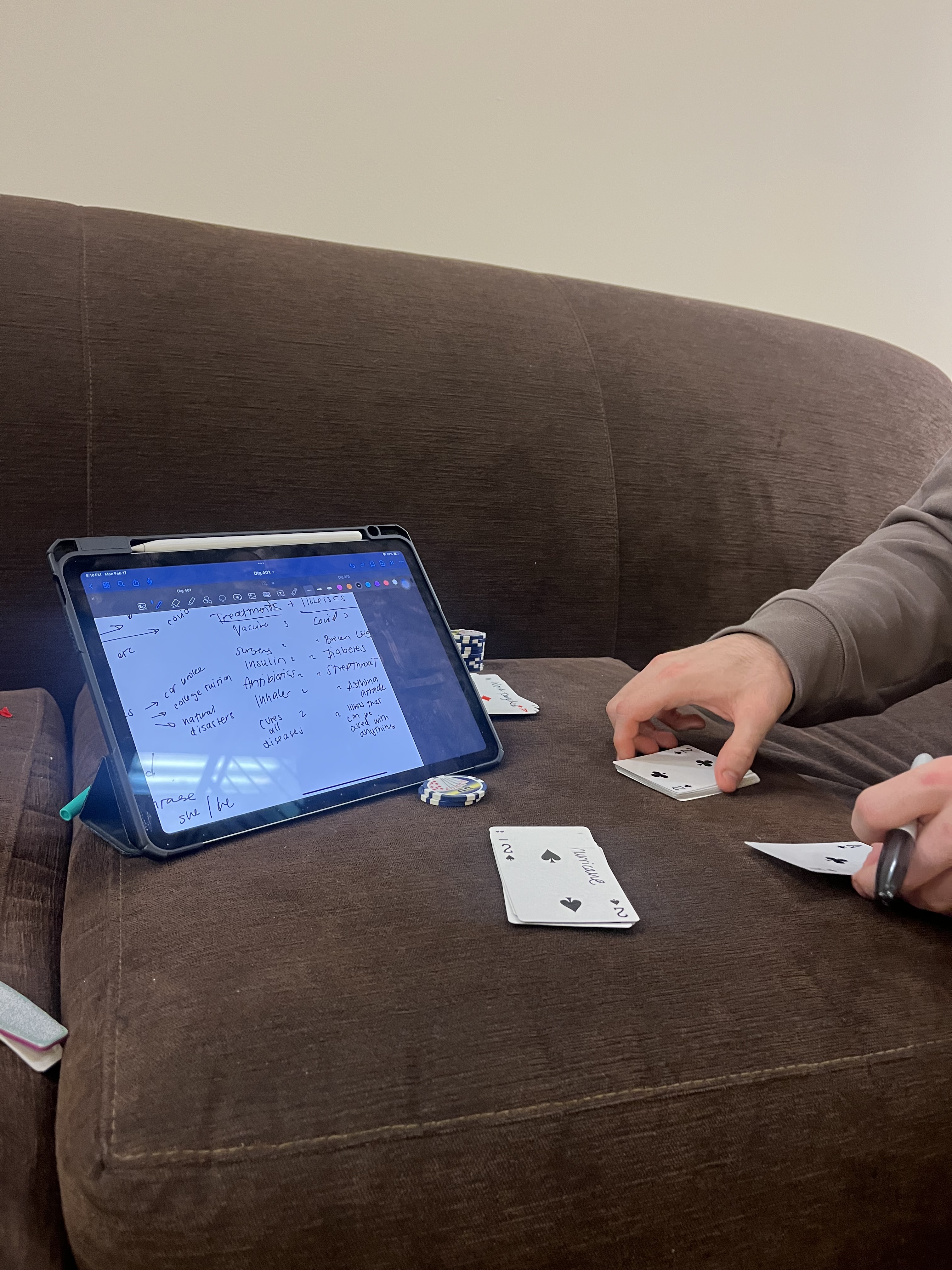
This week the biggest struggle for me was creating my hack. Mariana and I knew we wanted to attempt to tackle a large scale problem in the world, but we also did not want to focus on one that we felt like a lot of other people in class would center their hacks on. Because of this, we decided to focus our redesign of a game on the healthcare system. More specifically, how broken and unfair the healthcare system is. We wanted to highlight how the healthcare system heavily favors those who are rich and insured versus how it is works against those who are less fortunate and uninsured. Health care is something everyone should have readily available, and this clearly is not the case in this world. That is why we wanted to challenge this system.
The biggest challenge we faced is what game we were going to manipulate to get our message across. Mariana had a couple decks of cards with her, so we thought it could work good to use those. We did not know too many card games though as we did not play too many of those types of games growing up. One game that we both were familiar with the rules with was “Go Fish!” The ruleset of this game is fairly simple, so it felt like it would be easy to manipulate it how we wanted to. Although the ruleset was simple, we ran into many problems trying to add new elements to the game. We would add new aspects thinking they would work and run smooth, but then realized they would not work once we finally did trial runs of the game. There were more elements that we wanted to add than we had in our final product, but just could not figure out how to add them and have the game run smoothly.
We also really wanted to reskin a game, but we were not sure how to reskin a deck of cards and have it actually change how the game is played or the meaning behind the game. Instead, we settled on rewriting the game and just changing a few rules and adding a few new elements to the game. We ended up naming this game “Go Fix!” The general rules and function of the game is very similar to that of the original “Go Fish!” Each different type of card represented something different. One set was a health issue, one was different forms of treatment, one was bad luck cards, and one was good luck cards. The goal of the game is to match your health illness cards that you draw with its desired treatment. We added a money system to the game using poker chips. This was incorporated so that some players could be at an advantage and a disadvantage at the start of the game. To play this game, there is one player who is the role of an “insured” person and one who is the role of an “uninsured” player. When an insured player matched a treatment card to an illness card, they had to pay 1 poker chip. If an uninsured player matched these cards, they had to pay 3 poker chips. If player drew a bad luck card, they had to pay 1 poker chip. If they drew a good luck card, they were add 1 poker chip to their pile. To win this game, a player must match 3 treatment and illness cards and still have poker chips left over. A player can also lose this game by running out of poker chips and being in “debt.” This ruleset made it to where the insured player was at a heavy advantage to win this game. Every time we player, the insured player one.
This game shows how the healthcare system favors different groups of people, but also how it unfair to everyone still.
For this hack, we were supposed to take an existing game and make some form of modifications for it to fit into Mary Flanagan’s categories of critical play in chapters 1-3 of Critical Play: Radical Game Design (2009). As Flanagan states in chapter 1, critical play is a “careful examination of social, cultural, political, or even personal themes that function as alternates to popular play spaces” (Flanagan, 2009). Essentially, we were tasked with changing a game to challenge some sort of issue or problem that we feel is necessary to call upon. This could be either by unplaying, reskinning, or rewriting a game (Flanagan, 2009). Mariana and I decided to go the rewriting route. We decided to rewrite and manipulate the rules and a few other aspects of “Go Fish!”
Initially, we wanted to completely reskin a game, but we did not have any board games readily accessible and we just were not sure how we would even want to change how a game looks to push across our topic. So to make sure our topic got across, we decided to just change the rules and add new elements to the classic game of “Go Fish!” The topic that we wanted to address is the health care system. By this we mean that we want to challenge the health care system and bring attention to how it is not great. We wanted to point out how unfair the healthcare system is. This system heavily favors the wealthy and preys on the less fortunate. Health insurance can be extremely expensive and can be easier or harder to access for people depending on a person’s employment. Oftentimes, people who come from low income households cannot afford treatments that are necessary for them to be able to live healthy lives. These treatments and doctors are already very expensive, but then with no health insurance, those prices sky rocket. At times, this system can even be completely unfair for all parties of people. Even people and families that are well off can still have trouble getting treatments and seeing doctors strictly off the availability of these things. These are some of the main areas we tried to hone in on and depict with our rendition of “Go Fish!”
Instead of sticking with the class name of “Go Fish!”, we changed the title of the game to fit our theme. Instead, we decided to name it “Go Fix!” The main function of the game is still very similar to the original, we just made a few small changes. The first change that we made was making each of the four types of cards represent a certain task or scenario. The hearts represented health treatments, the diamonds represented a health issue or illness, the club represented some sort of bad luck scenario such as unexpected costs, and the spades represented a good luck scenario. The goal of the game is to match up your health issue/illness care to the desired treatment for your problem. The bad luck and good luck cards come into play with our newly designed money system that we added into the game. This money system was incorporated to make it so that one player had an advantage and the other was at a disadvantage. Essentially, there are two roles when you play this game, one player is “insured” and the other is “uninsured.” Both players start off with the same amount of money. Each player gets ten dollars, represented by poker chips, to start off the game. The roles come into play when a player matches a health issue card to a treatment card. When these two types of cards match, each player has to pay for their treatment, so the “insured” player only has to play 1 chip, as where the “uninsured” player has to play $3 chips. This makes it to where the “insured” player is naturally at a greater advantage than the “uninsured” player. We wanted to simulate how the system favors those with a great financial situation. The money system in the game also comes into play with the good luck and bad luck cards. If a player draws a bad luck card, then they have to pay 1 chip from their pile. If a player draws a good luck card, then they get 1 chip to add to their pile of money. There is one good luck card that reads, “You won the lottery,” that card is worth 3 chips if you pull it. This portion of the game is meant to represent how even though those who are wealthier and insured, it can still be very difficult to get the treatments that are needed, it can still be very hard for individuals and their families to get the proper care they need. There are unforeseen circumstances that occur on just about a daily basis for everyone in the world. Doctors and other health care professionals can also be difficult to get a hold of and are not readily available a lot of the time. In order to win or lose this game one of two things must happen. If a player matches 3 treatment and health issue cards and is able to pay them all off, then they win. If a player runs out of all their chips and goes into debt, then they lose.
Our manipulation of the game “Go Fish!” challenges a massive issue that so many people struggle with not just in the United States, but all around the world. When most people think of “Go Fish!” I’m sure they associate the game with wholesome childhood memories of playing a game almost solely based on luck, but our rendition of the game makes players have to think deeper while they play the game. “Go Fix!” challenges the whole idea of the healthcare system around the world. The whole point of the changes we made to this game was to draw attention to how unfair the healthcare system is. We wanted players to realize how hard this harsh reality can really be for some people. Obviously the feeling of losing the game and dealing with the struggles of being uninsured is nowhere near the same as actually having to face these struggles in real life, but it at least gives the player some sort of sense of how hard and unfair the healthcare system can be. Good health and care is something that everyone in this world is deserving of having readily available to them at all times, but this is obviously not the case in today’s world. This is exactly what Flanagan talks about when she brings up the idea of critical play. Taking such an innocent game and redesigning it to challenge and tackle a real world issue. This idea of critical play can be crucial to taking a step in the right direction to many issues going on around the world. This concept and methodology coined by Flanagan is extremely powerful and something a lot of people can take advantage of.
For me, there were two major aspects of class this week that I struggled with. The first being that it was tough to come up with an idea for Hack #2. Whenever we would have an initial idea, we would realize that it was not too feasible and would be difficult to complete. There were also some ideas that have already been done that thousands of people already play today and are wildly popular. Closer towards the end of the week, we had finally found an idea that seems like it could be the one.
The other part of class that I had trouble with was the idea of hacker ethics in Steven Levy’s chapters. It wasn’t necessarily the concept of the ethics that I couldn’t grasp. I understood these concepts, the reason behind them, and I even agreed with pretty much all of them. The part that was a struggled for me was when Dr. Sample proposed the question of, “What is the issue with some of these ethics?” As I just stated, I agreed with many of these and thought they help resolve many ethical problems with technology, so thinking about this question really tripped me up. I am still not really sure how many of them could be seen as negative. Up until we all shared our ideas as a large group, I didn’t have anything to say on this topic. There was one answer that I really agreed with though. One of the ethics was that all information should be free. My group and I saw this as the most important of all the other ethical rules. Then another group shared that all information should not be free and that this rule invades our privacy. They also stated that some information is meant to only be for specific groups of people. Some information is not for the mass majority of people as it could be unsafe. This opened up my thinking and changed my thought process when trying to think about all the rules of ethics mentioned in Levy’s chapter.