For this hack, we were supposed to take an existing game and make some form of modifications for it to fit into Mary Flanagan’s categories of critical play in chapters 1-3 of Critical Play: Radical Game Design (2009). As Flanagan states in chapter 1, critical play is a “careful examination of social, cultural, political, or even personal themes that function as alternates to popular play spaces” (Flanagan, 2009). Essentially, we were tasked with changing a game to challenge some sort of issue or problem that we feel is necessary to call upon. This could be either by unplaying, reskinning, or rewriting a game (Flanagan, 2009). Mariana and I decided to go the rewriting route. We decided to rewrite and manipulate the rules and a few other aspects of “Go Fish!”
Initially, we wanted to completely reskin a game, but we did not have any board games readily accessible and we just were not sure how we would even want to change how a game looks to push across our topic. So to make sure our topic got across, we decided to just change the rules and add new elements to the classic game of “Go Fish!” The topic that we wanted to address is the health care system. By this we mean that we want to challenge the health care system and bring attention to how it is not great. We wanted to point out how unfair the healthcare system is. This system heavily favors the wealthy and preys on the less fortunate. Health insurance can be extremely expensive and can be easier or harder to access for people depending on a person’s employment. Oftentimes, people who come from low income households cannot afford treatments that are necessary for them to be able to live healthy lives. These treatments and doctors are already very expensive, but then with no health insurance, those prices sky rocket. At times, this system can even be completely unfair for all parties of people. Even people and families that are well off can still have trouble getting treatments and seeing doctors strictly off the availability of these things. These are some of the main areas we tried to hone in on and depict with our rendition of “Go Fish!”
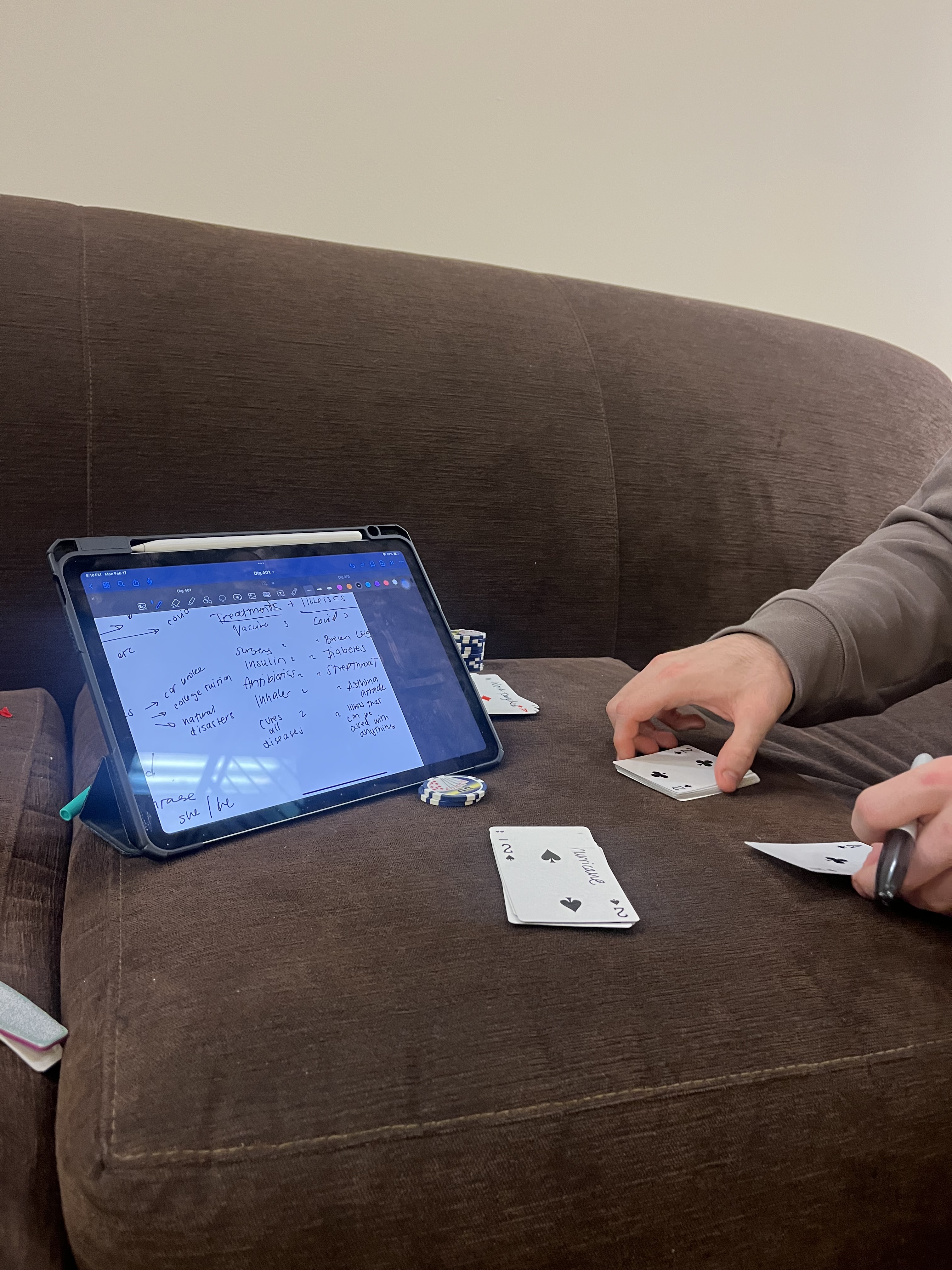

Instead of sticking with the class name of “Go Fish!”, we changed the title of the game to fit our theme. Instead, we decided to name it “Go Fix!” The main function of the game is still very similar to the original, we just made a few small changes. The first change that we made was making each of the four types of cards represent a certain task or scenario. The hearts represented health treatments, the diamonds represented a health issue or illness, the club represented some sort of bad luck scenario such as unexpected costs, and the spades represented a good luck scenario. The goal of the game is to match up your health issue/illness care to the desired treatment for your problem. The bad luck and good luck cards come into play with our newly designed money system that we added into the game. This money system was incorporated to make it so that one player had an advantage and the other was at a disadvantage. Essentially, there are two roles when you play this game, one player is “insured” and the other is “uninsured.” Both players start off with the same amount of money. Each player gets ten dollars, represented by poker chips, to start off the game. The roles come into play when a player matches a health issue card to a treatment card. When these two types of cards match, each player has to pay for their treatment, so the “insured” player only has to play 1 chip, as where the “uninsured” player has to play $3 chips. This makes it to where the “insured” player is naturally at a greater advantage than the “uninsured” player. We wanted to simulate how the system favors those with a great financial situation. The money system in the game also comes into play with the good luck and bad luck cards. If a player draws a bad luck card, then they have to pay 1 chip from their pile. If a player draws a good luck card, then they get 1 chip to add to their pile of money. There is one good luck card that reads, “You won the lottery,” that card is worth 3 chips if you pull it. This portion of the game is meant to represent how even though those who are wealthier and insured, it can still be very difficult to get the treatments that are needed, it can still be very hard for individuals and their families to get the proper care they need. There are unforeseen circumstances that occur on just about a daily basis for everyone in the world. Doctors and other health care professionals can also be difficult to get a hold of and are not readily available a lot of the time. In order to win or lose this game one of two things must happen. If a player matches 3 treatment and health issue cards and is able to pay them all off, then they win. If a player runs out of all their chips and goes into debt, then they lose.
Our manipulation of the game “Go Fish!” challenges a massive issue that so many people struggle with not just in the United States, but all around the world. When most people think of “Go Fish!” I’m sure they associate the game with wholesome childhood memories of playing a game almost solely based on luck, but our rendition of the game makes players have to think deeper while they play the game. “Go Fix!” challenges the whole idea of the healthcare system around the world. The whole point of the changes we made to this game was to draw attention to how unfair the healthcare system is. We wanted players to realize how hard this harsh reality can really be for some people. Obviously the feeling of losing the game and dealing with the struggles of being uninsured is nowhere near the same as actually having to face these struggles in real life, but it at least gives the player some sort of sense of how hard and unfair the healthcare system can be. Good health and care is something that everyone in this world is deserving of having readily available to them at all times, but this is obviously not the case in today’s world. This is exactly what Flanagan talks about when she brings up the idea of critical play. Taking such an innocent game and redesigning it to challenge and tackle a real world issue. This idea of critical play can be crucial to taking a step in the right direction to many issues going on around the world. This concept and methodology coined by Flanagan is extremely powerful and something a lot of people can take advantage of.


