
In her last blog entry, Merry closes her thoughts on The Possession with the statement, “Maybe I won’t be able to stop myself and I’ll just start watching the series from the beginning. Again (Tremblay 254).” This, for me, is perhaps the most horrifying part of the book. While it is certainly true that recording technology allows us to relive, or at least be reminded of, our fondest memories, it is easy to forget that it also allows us to do the same with some of our worst moments. The idea of Merry not only having the ability to rewatch her sister’s descent into mental illness, her family’s slow deterioration, and the events leading up to her killing her family is quite disturbing, but the fact that she chooses to do so, for me, was truly disturbing.
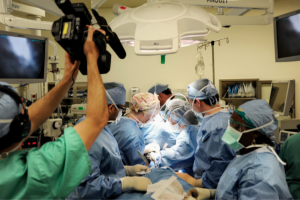
However, it also brought to mind some of the many news articles I have read about people who have been forced to relive personal tragedies because of news coverage, often watching family members be killed or injured. I thought of, in particular, a New York Times article, “Dying in the E.R., and on TV Without His Family’s Consent.” This article described a woman who came across video footage of her husband dying in the E.R. on a TV show, NY Med, and the show claimed that the family didn’t have to have provided consent because the man’s face was blurred out. While it is clear that the girls in The Possession didn’t have a real role in providing consent to be filmed, at least it was Merry’s choice to rewatch the show years later. Here, neither the man dying, nor his family, consented to his death being broadcast to the public, and his wife had no warning before seeing his death occur a second time. We have discussed in class several times the issue of consent to one’s image or information being used after death, but I think it is also important to consider the impact that has on one’s family. Both the news cycle’s continual portrayal of violent tragedies, as well as reality TV shows like NY Med, provide examples of how technology has the potential to create “digital ghosts,” but also how these reminders of the dead can “haunt” living friends and relatives without their consent and in a far more vivid way than was possible prior to recording technology.
Works Cited
Orstein, Charles. (2015, January 2). Dying in the E.R., and on TV Without His Family’s Consent. New York Times. Retrieved from www.nytimes.com/2015/01/04/nyregion/dying-in-the-er-and-on-tv-without-his-familys-consent.html.
Tremblay, Paul. (2015). A Head Full of Ghosts: A Novel. New York, NY: William Morrow. Print.
The NY Med case is a particularly horrifying example of being forced to relive a personal tragedy. Fatal police shootings caught on video seem to be another kind of tragedy that friends and family members of the victim are often forced to relive, without their consent. The race, class, and power dynamics of these examples are complicated and worth thinking about more.
I haven’t quite worked out the details in my head yet, but it seems that there is a kind of inversion of what Walter Benjamin talked about in “The Storyteller,” when he remarks that death is something that used to happen in every house, in every bedroom, but that it’s now been hidden from view, institutionalized in hospitals and hospices. Now in the 21st century, with digital media, death is once again everywhere we look, but now also very public.