
In A Head Full of Ghosts, Paul Tremblay alludes to external elements to convey deeper meanings about the internal state of his characters. This is especially apparent towards the end of the book when he explicitly explores temperature, equating certain scenarios with cold temperatures and others with hot. We are exposed to cold in detail during the morning of the exorcism when Merry wants to play soccer outside but Ken warns her of the frigid temperature. She goes outside anyway and to her dismay observes, “He was right. It was freezing out. My ball instantly became a hard rock that wasn’t fun to kick” (Tremblay 204). It is almost as if the cold doesn’t escape the Barrett residence because during the exorcism, which occurs soon after, Marjorie claims, “Wait. Please, wait. It’s me. I thought I could take the cold, but I can’t. I’m freezing. Please, Father” (Tremblay 222). Although it is normally cold during exorcisms, it is interesting to note how Marjorie rejects the cold weather, heightening her self-awareness and rendering her more human. Her stated discomfort with the cold contrasts with Merry’s unwillingness to voice any of her complaints. Although the sisters react to the cold in different ways, Tremblay clearly wishes to associate it with the Barrett household.
Warm temperatures are later explored outside of the Barrett household when Merry and Rachel meet for the last time in a coffee shop. Merry observes that it is “steamy and warm” inside and mentions that she and Rachel chat about “how nasty it is outside but how warm it is in the coffee shop” (Tremblay 256). This comment indirectly hints at the inconsistencies between internal and external worlds, a theme that is explored in Tremblay’s story. The warm temperature inside the shop becomes sweltering, which prompts Merry to ask the barista to turn down the heat. Soon after, the coffee shop becomes incredibly cold, making it seem as if cold always triumphs over hot. Interestingly enough, the barista claims, “heat’s off, but it wasn’t me” (Tremblay 282). The coffee shop becomes consumed with cold air, thereby merging the external and internal worlds and blurring the distinction between the two. Ending with a cold atmosphere and the final words, “…it’s cold enough that my breath is a visible mist” signifies the mystery behind whether or not the breath is an extension of Merry of if it is a ghost (Tremblay 284). This brings into question how many selves we have and whether or not our heads are truly filled with ghosts — a perfect conclusion to the story.
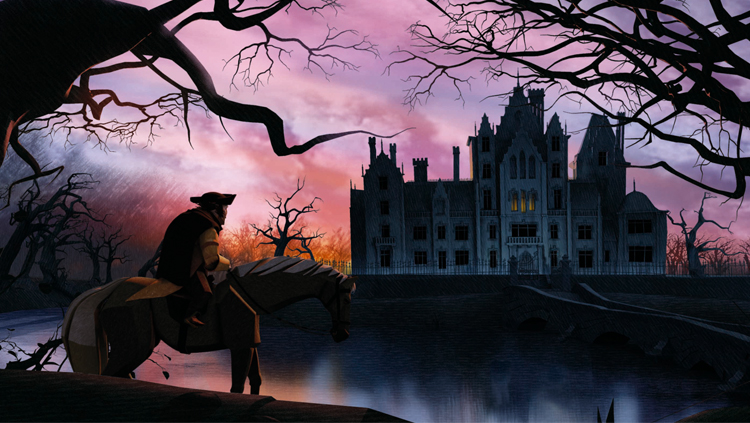
After close reading the dichotomy between hot and cold in Tremblay’s story, I was reminded of the function of weather in gothic texts. Similar to the way Tremblay uses temperature to mirror and magnify the feelings of his characters, gothic texts use weather or other external forces as elements to underscore the action of the story or hint at the inner conflicts within each character. For example, in the short story, “The Fall of the House of Usher,” Edgar Allan Poe describes external features of the house, including “bleak walls,” “vacant eye-like windows,” “rank sedges,” and “decayed trees” to convey the immediate pervasiveness of gloom and terror in the mind and body of the narrator (Poe 1). Aside from this, Poe’s story is also quite similar to Tremblay’s in its form. We are introduced to the idea that Roderick Usher is suffering from some sickness, or as Poe describes it, “an acuteness of senses” at the beginning of the story (Poe 4). Marjorie’s “sickness” is also the starting point of Tremblay’s story and drives the action in the text. Additionally, both stories occur in closed environments which place the “home” at risk. Roderick’s home is able to perceive certain things much like a human can and holds an inexplicable power over him. The Barrett home is not only corrupted by Marjorie’s mental illness but it more broadly represents the family unit that is at risk of being severed. Both texts culminate in the destruction of the home on some level — with the actual House of Usher crumbling to the ground after the death of Roderick and with the poisoning and eventual death of Merry’s family members. The similar forms of both texts as well as external descriptors such as temperature and weather make it evident that many of the important components of stories reside in the seemingly minute details or descriptors.
Works Cited
Poe, Edgar Allan. “The Fall of the House of Usher.” The Fall of the House of Usher – Poe’s Works | Edgar Allan Poe Museum. N.p., n.d. Web. 06 Feb. 2017.
Tremblay, Paul. A Head Full of Ghosts: A Novel. New York, NY: William Morrow, 2015. Print.