Privacy and Humanity: Reflective Post


Looking back through my past blog posts there were two themes that I seemed to revisit time and time again. The first was privacy and the digital world. The second was what defines us as human.

I tended to look at the idea of privacy in relation to the digital world by inserting myself into situations we read about and attempting to see how I would feel. A Head Full of Ghosts first sparked my thoughts on this issue, and I tied those ideas to an article I had read about a TV show that broadcast a man’s death in the ER without his family’s consent or knowledge. That blog post can be found here. After I considered how I would feel in that situation, I came to the conclusion that this was a particularly cruel thing to do because of loved ones that might see it. I wrote that many of the materials we had looked at thus far in class, “provide examples of how technology has the potential to create digital ghosts, but also how these reminders of the dead can “haunt” living friends and relatives without their consent and in a far more vivid way than was possible prior to recording technology.” I revisited this idea most clearly when I created a digital will for myself and detailed the experience in another post, found here. Here, I came to the conclusion that I didn’t particularly care what happened to my digital possessions unless they would help friends and family grieve. In that case I thought they should have access to them. Finally, I revisited this theme with a blog post on the way the stories of people’s deaths are often used in campaigns without their consent. That post can be found here. Just like in my first post, I put myself into the shoes of the woman who I wrote about and found, “While undoubtedly these campaigns have the potential to make a positive difference in many lives, I can’t imagine I would particularly want details of my private struggles to be used without giving it the ok.”

Since I was little all over the place in these blog posts, I tried to sum up my final thoughts on privacy in the digital age. Personally, I wouldn’t want anything I hadn’t shared with the online world during my life to be shared after my death. Moreover, I was primarily concerned with how the sharing of these things would impact those I loved. While I didn’t realize I had focused on this issue so much in my blogs until after I finished writing it, I also looked at privacy in my final project in relation to how it is portrayed in Station Eleven. By the end of the semester I had settled more firmly on the idea that the extent to which the digital world invades our privacy is not great. I concluded, “Mandel’s treatment of remembering in Station Eleven at least forces us to question if the extent of information provided by the digital age can be just as much a burden as it is a gift in remembering the dead.”

The second issue that I addressed frequently in my blog posts was what makes us human. In my first blog post, found here, I commented that zombies seem to be particularly horrifying because superficially they maintain much of the appearance of their human counterparts. At that point, I had difficulty coming up with a concrete definition of when something stops being human (and in retrospect I never really came up with a detailed definition). I revisited this idea when I looked in depth at an episode Dead Set. That blog post can be found here. I wrote, “While I watched, I felt as though this set the characters up for a rather bleak outcome no matter what: either they died because of their humanity, or in fighting “the other,” they lost what made them better, or at least different, in the first place.” From this, it seems that in part, I define humanity by the ability to empathize. I reiterated this is my second project, where my podcast used an episode of Supernatural in parallel with a Dead Set episode to look further into this idea. In that project I extended my claims further to the idea that, “empathy for the monstrous is what makes us human, though…this is not the easiest path to follow.”

To provide a final conclusion or sorts to these thoughts, I attempted to synthesize what I have learned from the two themes that I addressed the most frequently in class. I’ll be the first to admit it was kind of a stretch. But anyway, here it is: if I choose to define humanity by our potential for empathy, then technology has the ability to increase our humanity via facilitating human connection and understanding (an example of this is in my third project, Pictorial Memorial) or it can threaten it in a number of ways such as the numbing flood of excess information or even the invasion of privacy as I detail in a number of my blogs.

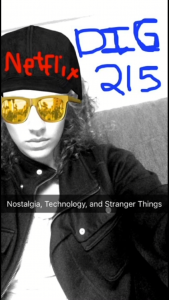
My snapchat project is the only one that didn’t get any love in this post, so here’s a cool selfie from my title page to finish out my digital studies career.

Recognizing the Flaws of the Pre-Apocalyptic World

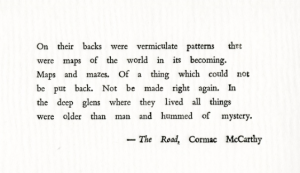
I haven’t seen or read a whole lot of post-apocalyptic narratives, but several years ago I read The Road by Cormac McCarthy and couldn’t help but compare it to what we have read thus far in Station Eleven. In The Road, a man and his son are traveling through a decidedly more brutal post-apocalyptic landscape than Station Eleven, with the two struggling to survive. Throughout the book, the man often thinks back to his wife and the son’s mother who committed suicide in order to escape what she saw as an inevitable end where she would be raped and murdered as they traveled. I felt particularly conflicted by aspect of the plot. While objectively for me this seemed like a reasonable decision, when reading the book I couldn’t shake a feeling of animosity towards this character, as though I had higher standards of bravery and morality of characters surviving the apocalypse. In contrast, when I read Frank’s suicide in Station Eleven, I had no sense of antipathy so I attempted to figure out why. After reflection, it was the line, “I remember thinking that I never wanted to see a war zone again, as long as I live (183),” that stuck with me. In contrast with other post-apocalyptic narratives, Station Eleven does not make out the world before the apocalypse to be a utopia. For Frank, the things he has already seen and lived through are likely just as bad as what is now happening, and this is probably the case for many people in the world. Even in a less drastic sense the pre-apocalyptic world for Arthur and even Miranda is distinctly un-idyllic. Kirsten’s reflections on the death that surrounded Shakespeare (57) also served as a reminder that gruesome deaths are not unique to the world after the collapse. For me, it was almost as though because Station Eleven recognized that the pre-collapse world was in many ways incredibly flawed, that it was acceptable for the characters to be more imperfectly human as well.

In contrast with Station Eleven, The Road’s reflections on the pre-apocalyptic world seem to only see the beauty of what was and never will be again.


Mandel, Emily St. John. Station Eleven : A Novel. First edition. ed., New York, Alfred A. Knopf, 2015.

McCarthy, Cormac. The Road. 1st Vintage International ed. ed., New York, Vintage Books, 2006.

The Darker Afterlife of Electronics

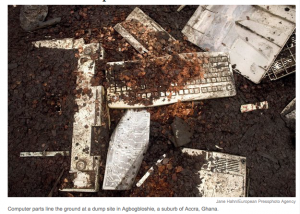
While the story behind “Landfill Legend,” and the dump of Atari E.T. games was charming, particularly with its myth-like status and cult following, I had always been warned that the life cycle of electronics as detailed by Raiford Guins had a far more nefarious end. My parents and older brother would chastise me about tossing batteries or electronics in the trash because of the environmental consequences. However, I recalled a NYT article I once read that argued the health risks of our electronic disposal system are more immediate than even their long-term environmental consequences. I tried to hunt it down, and whether it is the same article or not, I found one detailing the conditions of electronic dumps in third world countries. Leyla Acaroglu describes what happens to our digital devices after they’re dumped: “In India, young boys smash computer batteries with mallets to recover cadmium, toxic flecks of which cover their hands and feet as they work. Women spend their days bent over baths of hot lead, “cooking” circuit boards so they can remove slivers of gold inside.” Acaroglu paints a picture of the legacy of our electronic devices that is quite a bit darker than Guin’s statement of the legacy of the Atari dump: “the invisible presence of decaying matter deep below my feet attests to a complex life history, one pieced together and sustained by the various projects that refuse to forget (234).” While tracing the afterlife of our electronic devices certainly may tell us a lot about where they came from, it’s hard for me to focus on much other than the relatively gruesome health and environmental consequences.

An image of an electronic dump from “Where Do Old Cellphones Go to Die?”
www.nytimes.com/2013/05/05/opinion/sunday/where-do-old-cellphones-go-to-die.html%5B/caption%5D

Acaroglu, Leyla. “Where Do Old Cellphones Go to Die?” The New York Times. 4 May 2013. www.nytimes.com/2013/05/05/opinion/sunday/where-do-old-cellphones-go-to-die.html.

Guins, Raiford. “Landfill Legend.” Game After: A Cultural Study of Video Game Afterlife. USA: MIT Press, 207-235.


Pictorial Memorial: Time and Grief in the Digital World


Pictorial Memorial: Time and Grief in the Digital World

pictorialmemorial.wordpress.com

For many people, especially millennials, a large part of our lives is documented only on social media sites. Digital photographs serve as the core of many social media sites like Instagram and Facebook, where images document every aspect of our day-to-day life from college parties and vacations to graduation and family birthdays. While some sites are working on ways to address what happens to these accounts and images when we die, such as the ability to memorialize accounts on Facebook, many questions remains about exactly what role these photographs might play in the grieving process when a person passes away. My project, Pictorial Memorial, explores the issue of how the digital world has changed the grieving process and its relationship to time. Time and grief are addressed in two distinct ways within my project. First, the website Pictorial Memorial offers products created from social media photographs of the deceased and offers an example of how our desire to preserve our memories of the deceased might be commercialized in the future. Second, the way in which the timeline of the grieving process might be altered by the digital world is explored through the made up narrative of one of the deceased registered to the Pictorial Memorial website.

Both of these aspects of the project center around photography because of the important role that images of deceased loved ones play in the grieving process. Photographs serve to keep loved ones who have passed away alive in a certain sense by capturing something of that person, if only in a particular moment in time. By preserving memories, photography, “enables the past to be recalled and reinterpreted” (Riches and Dawson 122). When families grieve, photography helps, “transform obsession with the single event of the death into a broader acknowledgement of the meaning of his or her life” (Riches and Dawson 124). Moreover, the ease and affordability of taking digital photographs with phones means that we visually document our lives to an extent that we never have before. Thus, when people die, many now leave behind a collection of images that may allow grievers to feel as though they have a more complete representation of a dead loved one than ever before.

The website I created, Pictorial Memorial, capitalizes on our desire to hold on to memories of deceased loved ones. Pictorial Memorial is a mock-up of a website where after a loved one dies you can set up an account and friends and family can import photographs from various social media sites. While the website masquerades as a memorial website to collect photos of a loved one in a single place and to create a community of mourning, it also attempts to exploit grieving loved ones. This is done through offering the services of a team of artists to create a variety of what I intended to be relatively cringe worthy memorabilia of their loved ones. While the idea of exploiting grief for profit in such a way was meant to be slightly uncomfortable, such a campaign did not feel unrealistic to me. For many, the digital world feels impermanent and intangible in contrast with physical photographs or other physical keepsakes. In the article, “Family memories in the home: contrasting physical and digital mementos,” Daniela Petrelli and Steve Whittaker asked 16 individuals to give interviewers a tour of their home and discuss family mementos. The authors found that interviewees placed low perceived importance on digital artifacts (Petrelli and Whittaker 160). Moreover, the authors suggest that this is in part due to, “perceived fragility of the digital,” in contrast with, “a generic sense of physical objects as destined to last and in no real need of maintenance” (Petrelli and Whittaker 164). When a loved one passes away, we cling to whatever is left that reminds us of them. Pictorial Memorial is perhaps a little bit conniving in the extent to which it commercializes this desire but nonetheless offers those with grief a reminder of their loved one that feels more permanent than digital archives.

The other aspect of Pictorial Memorial that explores how the digital age has impacted the grieving process is through the saga of an invented person, Fred December. There were several important background details to Mr. December’s story that play a role in setting up the transgression of temporal grieving norms. Mr. December died relatively young and left behind a young son, James, with a wife, LouAnne, who he had met in New Zealand and had moved to the United States with him. After his death, Mr. December’s wife moved back to her home in New Zealand and took her son with her, thus separating the kid from those who knew his father well. Of the grievers who post on the memorial site, the one who appears to be most haunted by Fred’s death is the man who was with him when he died, Drew. This is demonstrated by Drew posting long after the other posters had stopped. Notably, Mr. December’s now grown son responds to Drew’s last post, offering an opportunity for the boy to learn about his dad and grieve for him with someone who still feels a similar sense of loss.

Here, Pictorial Memorial demonstrates how the digital world allows us to transverse geographical and temporal boundaries in ways not previously possible. In describing the temporal expansion of death in “Beyond the Grave: Facebook as a Site for the Expansion of Death and Mourning,” Brubaker et al. write that users of social media, “continue to engage with postmortem profiles, sharing memories, and speaking to the dead (160),” far more commonly than before grief entered the digital sphere. In my example, Drew and many other mourners continue to speak to Fred for years after his untimely death. Brubaker et al. also mention how grief has been expanded in the digital world through removing geographical barriers (160) and how online grieving has expanded the social circles of grieving. Brubaker et al. write, “friends from multiple social contexts-work, home, past, and present-are collapsed together.” I demonstrated this in part by having friends from many aspects of Fred’s life share photos and even in small details such as some friends referring to the deceased as Freddy instead of Fred showing how people from different times in our lives know different versions of us. Moreover, the connection between Drew and James in the last post demonstrates an intergenerational and international connection between two mourners that likely would not be possible without the digital world.

I also intended to use the posts about Drew to demonstrate how grief in the digital world has allowed for the period of grief to be extended past when it might in more traditional memorials. Graham et al. compared the roles of digital memorials and gravesites in Australia and found that online memorials allow for grief to be stretched out (50). Graham et al. write, “posts were often very personal and written years after the deceased’s death. There is little sense that the emotions associated with these posts run through stages or reach some kind of conclusion” (51). Through the character of Drew, and even James, I attempted to convey the extent to which the grieving process may be drawn out.

This temporal expansion of grief makes some uncomfortable. Brubaker et al. found that several interviewees though that the manner in which death and grief had the potential to pop up in their lives every day was at times distressing (157). I attempted to incorporate some of this confusion about the appropriate timeline of grief into the memorial of Mr. December primarily through posts by Mr. December’s wife LouAnne. Her posts slow over time, and end as she remarries. In her final post she expresses some discomfort at continuing to share romantic photos as she moves on to a new marriage. While no doubt there will always be a place for private grief of lost loved ones, the former Mrs. December recognizes that Pictorial Memorial is a space where displays of grief our captured and shared with others and thus may not be as acceptable after a certain extent of time. Additionally, I used automated posts from the Pictorial Memorial team alerting Drew that the account was no longer open and products no longer available to purchase to point to the way in which personal grieving processes may extend past what others find to be acceptable.

I also found the idea of Pictorial Memorial to be an excellent platform to illustrate how the digital sphere has impacted grief over time because of the way in which it provides a visual of someone essentially being forgotten. This is demonstrated through the influx of posts immediately after Mr. December’s death, and how this slows over time with eventually just one or two folks posting. While obviously the lessening of public grief occurs outside of the digital sphere as well, the manner in which the place for grief is publically visible and confined to one spot makes it more evident online. In “Grieving in the Internet Age,” Falconer et al. consider how online developments have changed the grieving process from a psychological perspective. They go as far as to suggest that, “those in mourning could become upset if they feel friends are no longer visiting a loved one’s site” (84). This leads to what is described as mourners close to the deceased having to live through a perceived second death, as they watch activity and interactions with a dead loved one online fade out (84). I attempted to portray this to some extent with Drew’s commentary on being the last one left posting, and visually through the variety of names on the early posts, slowing to just ones by Drew at the end of the project.

While Fred December is merely a made up character, the death of people whose lives have been documented extensively through social media is commonplace. The intangibility of the digital world then makes grieving those deaths particularly difficult as it feels as though we lose both their physical persona and their digital one. I addressed the desire for more permanent mementos of loved ones through the creation of Pictorial Memorial. While I am skeptical of how much these mementos may really aid the grieving process, the opportunities that Pictorial Memorial provides in allowing loved ones to share in the grieving process in ways they otherwise wouldn’t is something I believe to be a very real benefit of online memorials. While perhaps a little cheesy, ending my project with the start of communication between Drew and James represents what I feel to be one of the best ways in which the digital world has changed not just the grieving process but our lives in general: it allows us to make connections with people that we share some part of ourselves with across barriers that are far harder to breach in the physical world than online.

All images used in this project are public domain photos.

Works Cited

Brubaker, Jed R., Gillian R. Hayes, and Paul Dourish. “Beyond the Grave: Facebook as a Site for the Expansion of Death and Mourning.” The Information Society, vol. 29, 2013, pp. 152-163.

Falconer, Kimberly, Mieke Sachsenweger, Kerry Gibson, and Helen Norman. “Grieving in the Internet Age.” New Zealand Journal of Psychology, vol. 40, no. 3, 2011, pp. 79-88.

Graham, Connor, Michael Arnold, Tamara Kohn, and Martin R. Gibbs. (2015) “Gravesites and Websites: A Comparison of Memorialization.” Visual Studies, vol. 30, no. 1, 2015, pp. 37-53.

Petrelli, Daniela, and Steve Whittaker. “Family Memories in the Home: Contrasting Physical and Digital Mementos.” Personal and Ubiquitous Computing, vol. 14, no. 2, 2010), pp. 153-169.

Riches, Gordon, and Pamela Dawson. “Lost Children, Living Memories: The Role of Photographs in Processes of Grief and Adjustment Among Bereaved Parents.” Death Studies, vol. 22, no. 2, 1998, pp. 121-140.

Who Owns the Story of Your Death?

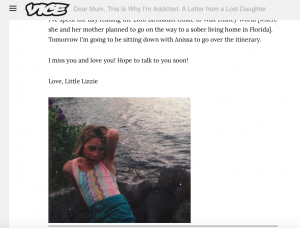
While reading, “Larger Than Life: Digital Resurrection and the Re-Enchantment of Society,” by Alexandra Sherlock, I was struck by the example that Sherlock used of Bob Monkhouse’s “resurrection” for use in a campaign for prostate cancer research. However, instead of celebrities that were famous for their work before death, I thought of when public awareness campaigns are formed around the deaths of ordinary people. Some of these stories go viral and the deceased become famous after death. An example of this I thought of was a letter that went viral this fall in which a woman shared a letter her drug addict daughter sent to her attempting to explain her addition to her mother. In reading the letter, I found it to be a compelling call for empathy and for the necessity of further access to care for those struggling with addiction. However, at the same time, I felt a little uncomfortable reading the letter. Sure, they had changed the woman’s last name, but otherwise this was an incredibly personal account of her life that she did not consent to being broadcast across the internet. There are many similar campaigns like this from parents, families, or friends where names are not changed and they become famous after their death for mistakes made during their lives. While undoubtedly these campaigns have the potential to make a positive difference in many lives, I can’t imagine I would particularly want details of my private struggles to be used without giving it the ok. Moreover, in contrast with the celebrities described in Sherlock’s piece, I can’t imagine laws being put in place that determine the fates of these people’s stories after their lives since money isn’t likely involved. I also can’t imagine that families already dealing with a crisis like alcoholism or addiction have much time for conversations about how private they wish their stories to remain if they are no longer around to lay claim to them.

A screenshot of the closing of a letter from a dead drug addict to her mother. www.vice.com/en_au/article/heroin-addiction-needles-exchange-lost-daughter-dear-mom

Works Cited

Elliot, Elizabeth. “Dear Mum, This Is Why I’m Addicted: A Letter from a Lost Daughter.” Vice, 3 Oct 2016. www.vice.com/en_au/article/heroin-addiction-needles-exchange-lost-daughter-dear-mom.

Sherlock, Alexandra. “Larger Than Life: Digital Resurrection and the Re-Enchantment of Society.” The Information Society, vol. 29, no. 3, pp164-176.

My Life & Wishes: An Archive for the Grievers, not the Deceased

While reading “Cyberspace While You’re Dead,” by Rob Walker, I was struck both by the author’s commentary regarding the number of Americans that don’t have a will, as well as the number that acknowledge that some sort of digital will would probably be a good idea but haven’t done that either. So I decided to see what the experience would be like. After a quick Google search, I came across the site, My Life and Wishes (www.mylifeandwishes.com), which calls itself “an online archive of everything you want your family to know after death.” As an added bonus, there’s a 30 day free trial before a subscription fee of $79 annually, so I signed up, setting the account to cancel after the free trial.

The website allows you to fill in everything from financial information and healthcare information to who should get your pet and what you want to be in your eulogy. You can also set exactly who should be able to see what information. For example I set my parents able to see financial information but my siblings to be in charge of determining where my cat ends up. Additionally, the way it prompted you for answers made me include things that I can’t imagine I would have in a real will, for example, what kind of food my pet eats.

An image from the dashboard of the My Life & Wishes account. (www.mylifeandwishes.com).

In reflecting on the experience of setting the whole thing up, I had a quite similar experience to Walker when he wrote about how his wife was relatively disturbed about receiving an email detailing her role as digital executor. My parents were both confused and slightly concerned when I explained what I up to. Knowing my parents would want little to do with it, I set up my roommate as in charge of my social media accounts. I asked her what she would do with them and she said, “absolutely nothing.” She also seemed slightly irritated that I was making her responsible for it, but that also could just be because I interrupted her Netflix to ask. Maybe in part because I don’t have a whole lot of financial information or any dependents, I felt like the whole thing was a little unnecessary. When my roommate asked me what I would want done with my social media accounts, I came to the realization I really didn’t care. I would want my friends and family to have access to whatever would help them grieve or come to terms with my death, but that’s the extent of my preferences. After all, I’d be dead, and whether my Facebook account remains active or not isn’t going to change that, but if it helps those who mean the most to me, why not let them do what they want with it.

Walker, Rob. “Cyberspace When You’re Dead.” The New York Times. The New York Times, 08 Jan. 2011. www.nytimes.com/2011/01/09/magazine/09Immortality-t.html.

Bowie, Lazarus, and Eulogies from the Dead

While reading, “A Resonant Tomb,” from The Audible Past, I was particularly intrigued by the stories of ministers recording their own eulogies. I imagine that Sterne would make the argument that this sort of thing would have little impact today, as he explains that neither the content nor the person being eulogized was what was mesmerizing about these particular sermons, but rather it was the spectacle of the dead preaching to the living (304). At first I thought that today this wouldn’t really be much of a spectacle at all. The dead speak to us constantly, and we hear them without second thought. To be honest, before reading this article, I had never even considered the fact that it’s odd that we listen to long dead musicians without really contemplating the fact that we’ve separated their voices from a body that no longer exists. Then I realized, that to some extent, this was because they are celebrities, and we don’t have a real connection to them. There is something a little eerie about hearing the voices of my grandparents who have passed away on old home videos or on a saved voicemail, but nothing of the sort when I listen to the music of those who have died. It is almost as though once a voice becomes a song in the form of a product to be sold, it is no longer tied to the singer themself. In this way, the fears expressed by early celebrities in “A Resonant Tomb,” regarding if they should allow their voices to be recorded and heard for future generations (Sterne 297) don’t seem unfounded.

Yet, when reading about the minister’s prerecorded eulogies, I also couldn’t help but draw a connection between them and the death of David Bowie earlier this year. Bowie had been diagnosed with cancer a little less than two years before his death, and many fans consider his last album, which was released only a few days prior to his death, to have been a sort of self-recorded eulogy. He addresses death pretty specifically, opening a song from the album, “Lazarus,” with “Look up here, I’m in heaven.” An ill or dying artist creating a work contemplating his or her own demise is certainly not unique to Bowie, to the music industry, or even to this year. As my dad has always been a Leonard Cohen fan, I learned that his final album You Want It Darker, released just a few weeks before his death this year, was of a similar vein: a contemplation on life and the end of life. Interestingly enough, these albums and others like them, are some of the few I listen to in which I find I am not capable of separating the voice from the singer. In the article, “The Year of the Goodbye Album,” Lindsay Zoladz writes that Bowie’s album wasn’t just a contemplation of his life, but, “his way of art-directing his own death.” Celebrities and famous singers may lose control of their voices and works after they die, but Bowie, Cohen, and others like them have taken advantage of an opportunity many of us won’t have: they created the story of their own death and shared it, and did so in a way that will likely last far longer than that of the ministers mentioned in a, “A Resonant Tomb.”

“Lazarus,” a single from David Bowie’s last album.

Works Cited

Bowie, David. “Lazarus.” Columbia. 17 Dec. 2017.

Sterne, Jonathan. The Audible Past: Cultural Origins of Sound Reproduction. “The Resonant Tomb.” United States of America: Duke University Press, 2003. Pages 287- 311. Print.

Zoladz, Lindsay. “The Year of the Goodbye Album.” The Ringer. 8 Dec. 2016. theringer.com/2016-goodbye-albums-david-bowie-leonard-cohen-phife-dawg-ecd56da12634#.lztntrbrs

Empathy for the Monstrous

Below is my podcast:

[soundcloud url=”https://api.soundcloud.com/tracks/310265778″ params=”auto_play=false&hide_related=false&show_comments=true&show_user=true&show_reposts=false&visual=true” width=”100%” height=”450″ iframe=”true” /]

And here’s my works cited:

Canavan, Gerry. “”We are the Walking Dead”: Race, Time, and Survival in Zombie Narrative.” Extrapolation, vol 51 no. 3, 2010, pp. 431-453.

“Halt & Catch Fire.” Supernatural, season 10, episode 13, The CW, 10 Feb. 2015.

Mezei, Sarolta. “Spectral Media Technology and the Vicious Brothers’ Grave Encounters.” HJEAS : Hungarian Journal of English and American Studies, vol 22 no. 1, pp. 167-180.

Pinedo, Isabel. “Recreational Terror: Postmodern Elements of the Contemporary Horror Film.” Journal of Film and Video, vol 48 no 1/2, 1996, pp. 17-31.

“Running.” Dead Set, season 1, episode 4, Zeppotron, 30 Oct. 2008.

Intelligence Isn’t Enough: Why the Housemates Lost to the Zombies

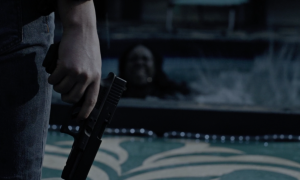
While watching Dead Set, I was struck by the scene in which Kelly watches zombie Angel flopping around in the pool, and comments that she believes the surviving humans will beat the zombies because the humans are smarter than them. It was apparent well before this that the zombies were not particularly brilliant, emphasized by the way in which they seem incapable of opening doors and spend most of their time scratching at them. Yet, both before this moment and in the following episodes, it is clear that the humans are not winning the fight against the zombies, so I considered why.

A screenshot from “Dead Set,” Season 1 Episode 3. Kelly prepares to shoot zombie Angel. Accessed via netflix.com.

I was drawn to the section of American Zombie Gothic in which Kyle William Bishop addresses how humans are in fact the biggest threat to each other in many zombie films. He writes, “The symbolic threat of the zombies remains a fundamentally frightening part of these films, but because the threats of bodily harm, rape, and murder are real-world potentialities, both in and beyond the zombies, such scenes become all the more terrifying by being inescapable in supposedly escapist movies (Bishop 24-25).” There certainly are aspects of this in Dead Set. For example, the cops threaten to shoot the survivors, Marky almost shoots Riq, and of course Patrick and Joplin’s scheme in the final episode is relatively treacherous. However, I also noted that in an equally real way the humans were threats to themselves. Since they are not mindless zombies, several characters show very human emotions such as empathy and fear that end up resulting in their own deaths. For example, Grayson was clearly struggling with the idea of having to kill his friend Angel, and his hesitation in stabbing her cost him his life. Alex and Riq also seemingly would have been safe staying in the farmhouse, but Alex’s connection to Riq, and Riq’s desire to see Kelly again both drive them to their eventual deaths. In some ways, it seems as if those who become most like their zombie counterparts and lose some of the defining features of humanity have the best chance of survival. While I watched, I felt as though this set the characters up for a rather bleak outcome no matter what: either they died because of their humanity, or in fighting “the other,” they lost what made them better, or at least different, in the first place.

Bishop, K. W. (2010). American Zombie Gothic: The Rise and Fall (and Rise) of the Walking Dead in Popular Culture. Jefferson, NC: McFarland & Company, Inc.

Brooker, C. (Producer). (2008). Dead Set. United Kingdom: Zeppotron.

Reliving Tragedy in the Digital Age

In her last blog entry, Merry closes her thoughts on The Possession with the statement, “Maybe I won’t be able to stop myself and I’ll just start watching the series from the beginning. Again (Tremblay 254).” This, for me, is perhaps the most horrifying part of the book. While it is certainly true that recording technology allows us to relive, or at least be reminded of, our fondest memories, it is easy to forget that it also allows us to do the same with some of our worst moments. The idea of Merry not only having the ability to rewatch her sister’s descent into mental illness, her family’s slow deterioration, and the events leading up to her killing her family is quite disturbing, but the fact that she chooses to do so, for me, was truly disturbing.

However, it also brought to mind some of the many news articles I have read about people who have been forced to relive personal tragedies because of news coverage, often watching family members be killed or injured. I thought of, in particular, a New York Times article, “Dying in the E.R., and on TV Without His Family’s Consent.” This article described a woman who came across video footage of her husband dying in the E.R. on a TV show, NY Med, and the show claimed that the family didn’t have to have provided consent because the man’s face was blurred out. While it is clear that the girls in The Possession didn’t have a real role in providing consent to be filmed, at least it was Merry’s choice to rewatch the show years later. Here, neither the man dying, nor his family, consented to his death being broadcast to the public, and his wife had no warning before seeing his death occur a second time. We have discussed in class several times the issue of consent to one’s image or information being used after death, but I think it is also important to consider the impact that has on one’s family. Both the news cycle’s continual portrayal of violent tragedies, as well as reality TV shows like NY Med, provide examples of how technology has the potential to create “digital ghosts,” but also how these reminders of the dead can “haunt” living friends and relatives without their consent and in a far more vivid way than was possible prior to recording technology.

An image of the reality TV Show “NY Med,” being filmed in an E.R. From the NYT article, “Dying in the E.R., and on TV Without His Family’s Consent.” Photographer: Donna Svennevik. www.nytimes.com/2015/01/04/nyregion/dying-in-the-er-and-on-tv-without-his-familys-consent.html

Works Cited

Orstein, Charles. (2015, January 2). Dying in the E.R., and on TV Without His Family’s Consent. New York Times. Retrieved from www.nytimes.com/2015/01/04/nyregion/dying-in-the-er-and-on-tv-without-his-familys-consent.html.

Tremblay, Paul. (2015). A Head Full of Ghosts: A Novel. New York, NY: William Morrow. Print.