
Being a zombie, with and without actually being dead.

The beginning of Dead Set was interesting to say the least. At first I did not think that the disasters all over the U.K. would be tied to zombies until we see the car driver get attacked. I am not a fan of scary/horror movies or shows, so being scared at first was a natural reaction. However, what came after that wave of emotions really surprised me. As I began to see more and more people getting attacked by the undead I began to think back to Marjorie’s violent actions in A Head Full of Ghosts. Every time a zombie takes a bite out of a human I picture Marjorie biting into the priest.

Zombies biting into human flesh, akin to Marjorie’s actions.

Following this method of thinking I can see how Marjorie herself might be similar to the zombies on the show. They are both not in a fully conscious(assuming zombies are different people than their human counterparts) or autonomous state. Their actions are influenced by factors out of their reach, and they are not the same person that they were before. I like to believe that Marjorie ultimately did suffer from a mental illness, and that led to her actions. I think this connection brings up the more important issue of how we deal with those that have mental illnesses. In the show we see that the human’s first action is to freak out, which is understandable because they are being attacked. However, when Marjorie begins to act strangely, her parent’s first reaction is to freak out as well. Mental illnesses are  highly overlooked and misunderstood in our modern day society. I think the lack of understanding allows those affected to become a “zombie” in a sense by being marginalized.

I’d like to keep developing the idea of what it means to be a “zombie” by tying it into the name of the class. I think that Death in the Digital Age is best embodied through Facebook’s “Remembering” feature. For those who are not aware this is a feature that allows for people’s Facebook profiles to remain online after they have passed. When one visits the deceased person’s profile there is a sign that reads “Remembering _______” with the blank space filled in by their name. As I am looking through several of these pages on my own Facebook account I realize that this too is a way that one can become a “zombie”. The deceased are no longer on this earth, yet their presences is still felt. We can see where they have been, what they have liked, and even what they looked like. Yet, they are gone. This is similar to how zombies  in the show are no longer living, yet continue to be present.

Facebook’s “Remembering” Feature

To a certain extent we can say that these Facebook profiles haunt us. We as friends of the deceased may not have asked to see the “Remembering” feature, yet it still there. We may never come across it, or may consistently encounter it. Regardless, the page exists and will trigger mixed feelings. Technology has allowed for all of us to become zombies once we have passed. Whether or not some of us approve of that is a question that should be brought forth. Should we consent to this feature? Should friends of the deceased be notified that this is happening and be asked if they are ok with viewing it in their feed? These are questions that should be discussed.
 

Reliving Tragedy in the Digital Age

In her last blog entry, Merry closes her thoughts on The Possession with the statement, “Maybe I won’t be able to stop myself and I’ll just start watching the series from the beginning. Again (Tremblay 254).” This, for me, is perhaps the most horrifying part of the book. While it is certainly true that recording technology allows us to relive, or at least be reminded of, our fondest memories, it is easy to forget that it also allows us to do the same with some of our worst moments. The idea of Merry not only having the ability to rewatch her sister’s descent into mental illness, her family’s slow deterioration, and the events leading up to her killing her family is quite disturbing, but the fact that she chooses to do so, for me, was truly disturbing.

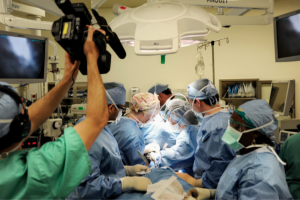
However, it also brought to mind some of the many news articles I have read about people who have been forced to relive personal tragedies because of news coverage, often watching family members be killed or injured. I thought of, in particular, a New York Times article, “Dying in the E.R., and on TV Without His Family’s Consent.” This article described a woman who came across video footage of her husband dying in the E.R. on a TV show, NY Med, and the show claimed that the family didn’t have to have provided consent because the man’s face was blurred out. While it is clear that the girls in The Possession didn’t have a real role in providing consent to be filmed, at least it was Merry’s choice to rewatch the show years later. Here, neither the man dying, nor his family, consented to his death being broadcast to the public, and his wife had no warning before seeing his death occur a second time. We have discussed in class several times the issue of consent to one’s image or information being used after death, but I think it is also important to consider the impact that has on one’s family. Both the news cycle’s continual portrayal of violent tragedies, as well as reality TV shows like NY Med, provide examples of how technology has the potential to create “digital ghosts,” but also how these reminders of the dead can “haunt” living friends and relatives without their consent and in a far more vivid way than was possible prior to recording technology.

An image of the reality TV Show “NY Med,” being filmed in an E.R. From the NYT article, “Dying in the E.R., and on TV Without His Family’s Consent.” Photographer: Donna Svennevik. www.nytimes.com/2015/01/04/nyregion/dying-in-the-er-and-on-tv-without-his-familys-consent.html

Works Cited

Orstein, Charles. (2015, January 2). Dying in the E.R., and on TV Without His Family’s Consent. New York Times. Retrieved from www.nytimes.com/2015/01/04/nyregion/dying-in-the-er-and-on-tv-without-his-familys-consent.html.

Tremblay, Paul. (2015). A Head Full of Ghosts: A Novel. New York, NY: William Morrow. Print.

Locating the True “Horror” in Head Full of Ghosts

***ENDING SPOILERS DON’T READ IF YOU HAVEN’T FINISHED THE BOOK***

Image still from YouTube by user cccomaaha in which a pastor explains how you can tell the difference between mental illness and “possession”

Where was the real horror located in Head Full of Ghosts? Marjorie’s struggles — true to postmodern style — blurred the boundaries between authentic/performed, paranormal possession/earthly illness.

During the final few pages of the book, we discover that the Barrett family’s fatal end was dealt by Merry’s small, childish hands. The demon was not a paranormal, external force that snuck up on the undeserving, innocent Barretts. The demons were entirely human and interior to the family. This aspect of the book is espeically postmodern (and therefore, makes for an not entirely surprising ending): the monster is already inside of us and we are to blame for the tragedy it deals.

There were several earthly demons — or modes of human “horror”– running rampant in the Barrett household. Merry experienced the final, ultimate possession by Marjorie’s manipulation, her older sister capitalizing on their sibling bond and Merry’s naiveté.

The rest of the characters were possessed by their own fatal flaws. Their father became possessed by religion at the hands of Father Waverley and failed to help his mentally ill daughter. His fragile ego and emasculating job loss blinded him to the fact that he could be wrong about Marjorie’s condition. The reality TV show producers and crew exploited this situation, using the Barrett’s financial woes to ensnare the parents and then escalate Marjorie’s illness.

Their mother tried to step up and get Marjorie more psychiatric help but ended up deferring to her husband’s insistence on first the TV show and then the exorcism. Whether from a combination of depression, exhaustion, or weakness of character, she was the only adult in the situation who could have actually helped Marjorie and she failed.

These adults all failed so miserably to help an extremely mentally ill teenager that I nearly cheered when they died — what useless, spineless parents!

For me, the true horror comes from acknowledging that there was never any possibility of paranormal possession in Marjorie’s case. She was mentally ill and it escalated out of control because all these demonic adults were possessed by the concept of possession itself.