
Merry- The Unreliable Narrator

One of the aspects in A Head Full of Ghosts that I have found to be the most compelling is the choice of the narrator being Merry Barrett. Something that we touched on in our earliest classes was whether Merry is a reliable narrator for the events of the novel. I do not feel that we spent enough time on this debate, especially after Merry’s big reveal to Rachel about how her family died in chapters 25 and 26.

In chapter 3, Merry says, “my memories mix up with my nightmares, with extrapolation, with skewed oral histories from my grandparents and aunts and uncles, and with all the urban legends and lies propagated within the media, pop culture, and the near continuous stream of websites/blogs/YouTube channels devoted to the show…so all of it hopelessly jumbles up what I knew and what I know now” (Tremblay 13).

This quotation called into question whether or not Merry is a reliable narrator, through Merry’s own admission. Throughout the novel, I forgot that Merry said this, and became fully trusting of her recounting. This trust was most likely brought on by Merry’s narration switching from her 23-year-old self to her 8-year-old self so seamlessly (even though, in the diegetic world, the 23-year-old Merry is saying what we are hearing the 8-year-old Merry says). However, once Merry revealed that she was the one who slipped the potassium cyanide into the pasta sauce that poisoned her sister and parents, this quotation popped back into my mind.

I am not sure that Merry made up the fact that she was the one who put the potassium cyanide in the sauce; I definitely do not think that someone would lie about that fact. Yet, I am not sure that I trust Merry admitting to the poisoning either Merry, however, goes on to say that, “I’ve never told anyone what I’ve admitted to you. The police, psychologists, my aunt; no one” (Tremblay 281) Merry thus shows that she has been lying for many years.

For some reason, this called a lot of the narrative into question—at least for me—that we are given because it is given to the reader by Merry, someone who I find to be an unreliable narrator, much like Pi from Life of Pi or Huck Finn from The Adventures of Huckleberry Finn. Can we trust what Merry has told us? Can we trust a 23-year-old woman recounting something that happened when she was 8? Even if it was something so traumatic, I think the answer is no.

Pi from Life of Pi is a great example of an unreliable narrator. Which version of his story is true?

Works Cited

Tremblay, Paul. A Head Full of Ghosts: A Novel. New York, NY: HarperCollins, 2015. Print.
Reliving Tragedy in the Digital Age

In her last blog entry, Merry closes her thoughts on The Possession with the statement, “Maybe I won’t be able to stop myself and I’ll just start watching the series from the beginning. Again (Tremblay 254).” This, for me, is perhaps the most horrifying part of the book. While it is certainly true that recording technology allows us to relive, or at least be reminded of, our fondest memories, it is easy to forget that it also allows us to do the same with some of our worst moments. The idea of Merry not only having the ability to rewatch her sister’s descent into mental illness, her family’s slow deterioration, and the events leading up to her killing her family is quite disturbing, but the fact that she chooses to do so, for me, was truly disturbing.

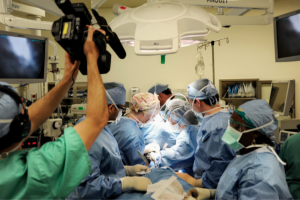
However, it also brought to mind some of the many news articles I have read about people who have been forced to relive personal tragedies because of news coverage, often watching family members be killed or injured. I thought of, in particular, a New York Times article, “Dying in the E.R., and on TV Without His Family’s Consent.” This article described a woman who came across video footage of her husband dying in the E.R. on a TV show, NY Med, and the show claimed that the family didn’t have to have provided consent because the man’s face was blurred out. While it is clear that the girls in The Possession didn’t have a real role in providing consent to be filmed, at least it was Merry’s choice to rewatch the show years later. Here, neither the man dying, nor his family, consented to his death being broadcast to the public, and his wife had no warning before seeing his death occur a second time. We have discussed in class several times the issue of consent to one’s image or information being used after death, but I think it is also important to consider the impact that has on one’s family. Both the news cycle’s continual portrayal of violent tragedies, as well as reality TV shows like NY Med, provide examples of how technology has the potential to create “digital ghosts,” but also how these reminders of the dead can “haunt” living friends and relatives without their consent and in a far more vivid way than was possible prior to recording technology.

An image of the reality TV Show “NY Med,” being filmed in an E.R. From the NYT article, “Dying in the E.R., and on TV Without His Family’s Consent.” Photographer: Donna Svennevik. www.nytimes.com/2015/01/04/nyregion/dying-in-the-er-and-on-tv-without-his-familys-consent.html

Works Cited

Orstein, Charles. (2015, January 2). Dying in the E.R., and on TV Without His Family’s Consent. New York Times. Retrieved from www.nytimes.com/2015/01/04/nyregion/dying-in-the-er-and-on-tv-without-his-familys-consent.html.

Tremblay, Paul. (2015). A Head Full of Ghosts: A Novel. New York, NY: William Morrow. Print.