- Why is the text plot shaped the way it is?
- What do the different colors mean?
- Whats the difference between secret and top-secret? How do we distinguish between the two?
Kissinger Questions
1. Why are the telcon and memcon textplots in different shapes?
2. How do you quantify the distance and placement of the different words being used in the textplots?
3. Does this improve the archive if the overall visualization is not easy for someone to comprehend it?
4. What do the lines between words mean?
Questions for Kaufman
- How does a database’s visual appeal relate to its argument?
- How does this project inform both historians and the general public?
- To what extent were the visualizations and their shapes a result of your own “tweaking”, and to what extent were they automatically generated by the program?
Kissinger In Class Questions

TABLE DISCUSSION
- How is word spacing determined in the textplots?
- Why? What is the motivation for this project?
- Are the colors in the textplots significant? What do they mean?
Spencer, Brandon, Drew, Max
Questions for Micki Kaufman Regarding “Quantifying Kissinger”
1. How do we apply these findings to present-day situations?
2. As a historian, did any of the revealed trends surprise you?
3. Why did you choose these particular text mapping visualizations (shape, color, formation)?
Kissinger Analysis: The Future
What will this network look like if Kaufman’s study is replicated 40 years from now?
Will this network grow (or shrink) at a linear or exponential rate?

The Unseen Slaves of History
The series of letters discussed in Klein’s “The Image of Absence” are beneficial to understanding how the style of communication used back then would affect the work of modern day researchers looking over the letters. The age in which Jefferson, Evans, and Hemings lived was not one in which it was easy to communicate easily between far-flung acquaintances. Therefore, the letters sent back and forth between Jefferson and Evans reveal the many issues that this form of communication cause for historians hoping to glean some information from these letters. For example, the very first correspondence between Evans and Jefferson never actually mentions the name of James Hemings, nevertheless his image is still brought up as Jefferson’s “former employee” and he cannot be overlooked since the letter revolves around Jefferson’s desire for James’s return. How can we fairly examine James Heming’s responses and decisions regarding Jefferson’s request, when we never truly see his own writing? This is reinforced by Klein’s assertion later that “in a listing of search results, these letters do little more than reinscribe the absence of James Hemings in the Jefferson archive”. By showing that Hemings is totally absent from Jefferson’s archive of direct correspondence, Klein is able to highlight the lack of a voice for slaves and ex-slaves within the historical perspective. This is extremely important for understanding how historians must formulate theories on the opinions and life perspective of slaves. Any sort of writing must be taken with a grain of salt that it was most likely altered or edited by a white man after first created by a slave.

Reducing Context Cluelessness
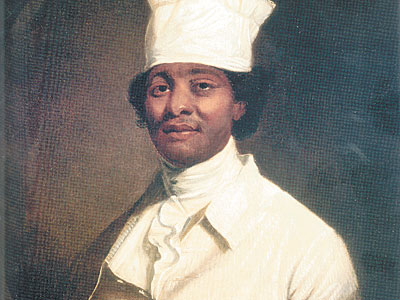
Typically, historians look to understand the happenings of the past exactly as they were. To understand the past, context is generally a high priority. In Lauren Klein’s paper regarding Thomas Jefferson’s letter collection, words and phrases were pieced together to form a new inscription about the identity of a previously unknown slave named James Hemings. Klein explained the recent discovery of Hemings’ identity as a result of “archival silence.” Because of gaps in archival record, Heming’s identity was lost deep in the annals of Jefferson’s literature. Without knowing the context and time period when Thomas Jefferson was writing his letters, the language can be confusing and misunderstood. It was taboo for someone of Jefferson’s position and status to write of slave laborers, so subtle hints had to be pieced together, much like a puzzle. Fortunately, through the use of text mapping, a new picture came to view, outside of the individual letters themselves.
One article from Technology Review revealed that text mapping can also explain changes in terminology used across time periods. The article made a point to state that terms can change meaning literally overnight. In an internet assessment run just after the release of the Microsoft operating system by researchers at Stoney Brook University, the term “windows” morphed into much more than just a common household feature. Technology changed the entire understanding of the word. Similar to the textplot software in Quantifying Kissinger, Google Trends and other similar features can offer a unique representation moments in history. Paired with the benefits of reducing “archival silence,” the use of text mapping software can help provide comprehensive historical pictures through inscription and representation that could be the future of historical archiving.
Data Collection Group 5
Tuesday:
People with beverages 7
People wearing t-shirts 5
People wearing blue to class 10
People wearing hat in class 4
Times written on the white board 5
People wearing glasses 3
People wearing stripes 2
Times we had group discussions with our table 1
Thursday:
People with beverages in class: 11
People wearing only t-shirts in the class 5
People wearing something blue to class 7
People wearing hat in class 2
Times written on the white board 2
People wearing glasses 5
People wearing stripes 0
Times we had group discussions with our table 2
Numbers of times students spoke up in class 26
Reading Between the Lines…of Data

Lauren F. Klein, in her analysis of Thomas Jefferson and his data-storing tactics, The Image of Absence, comments on multiple ideas regarding the collection and interpretation of data. The most prominent idea featured in Klein’s work is the idea of “archival silence,” an idea that can simply be defined as “gaps in an archival record.” Though Jefferson was meticulous in his record-keeping, he would also reduce mounds of data regarding his slaves into small bits. Klein uses a particular slave of Jefferson, James Hemings, as an example, saying “Jefferson himself was at times required to recognize, if not to redress, the flawed logic that reduced Hemings’s life to a line of data.” Klein views this particular lack of record-keeping by Jefferson as an unfortunate sign of the times, showing that Jefferson played a large role in the silencing and subjugation of African-American slaves.
At the same time, Klein presents the reader with ways to combat the problem of “archival silence,” saying the reader ought to “look to the pathways of connection between persons and among groups.” Klein then presents a graphic showing the patterns of correspondence between Jefferson and others, concerning James Hemings. This graphic is not unlike those presented by Micki Kaufmen and the “Quantifying Kissinger” Team. Both graphics attempt to piece together information that is not explicitly presented in the data collected and attempt to display patterns, or “presences” (as described by Stephen Best and Sharon Marcus), hidden within the data collected.
It is this uncovering of “archival silence” that seems to scare so many individuals today. Many Americans will not soon forget the Edward Snowden scandal, nor the subsequent report that showed the US government was in possession of millions of Americans’ phone records. Why did this scare so many people? Was it because people were afraid that the US Government knew who we were calling each and every day? The could be. But, maybe what is more important is what phone records don’t explicitly show. Maybe, by using Klein’s tactics to uncover archival silence, and by reading the patterns and “presences” within these phone calls, the US government can ascertain more information about the callers than is ever presented within the records themselves. Maybe what citizens have to fear most is not the uncovering of their data, but the patterns hidden behind that very data trail.