Post-Modern Horror: The Anxiety Never Ends

AGHHHHHHHHHHHH

We were warned that post-modern horror generally leaves loose ends and unresolved conflicts. We talked about these ambiguous elements in class and read about it in Isabel Pinedo’s Recreational Terror article. With all the time we spent discussing it, the readings, and everything we watched- I should have seen the ending to Tremblay’s A Head Full of Ghosts coming. I could not have found a better example of foreshadowing for what to expect from this novel, than the entire three weeks we have talked about post-modern horror. Honestly it’s embarrassing to admit that the ending left me as shocked and frustrated as it did.

I think the elements of ambiguity, vagueness, and lack of resolutions in post-modern horror are the most significant changes from the classic horror genre because of the effect that the ambiguity has on the audience. Post-modern horror has seemingly shifted away from the terrifying, monster-revealing moments, and turned its focus on creating an unwavering sense of anxiety for its audience. Like Pinedo says in her article,  horror films are like roller-coasters in that the “conviction that there is nothing to fear turns stress/arousal into a pleasurable experience” (Pinedo 25). The ultimate goal of horror is to stress out and create an anxious audience.

In classic horror films, there is generally a single moment/jump-scare that is the climax of the film (imagine Hitchcock’s 1960 film Psycho or the 1976 film Carrie, based off a Stephen King novel). Once this moment is over, however, the protagonist escapes/defeats the monster and lives to see another morning.  The John McCarty quote in Pinedo’s article references this as he said these were “the kinder, gentler days of horror” (Pinedo 25). While classic horror films create anxiety and then resolve it with a clear, and (generally) positive ending, post-modern horror uses jump-scare moments to provide temporary relief. After a jump-scare, the audience can take a breath and calm down, but the ending ultimately does not resolve itself and leaves the audience confused, angry, and frustrated.

A Head Full of Ghosts does a great job in creating a frustrating and ambiguous ending. Almost like an itch you cannot scratch, the reader is left at the end of the novel angry and shocked, demanding a clear ending (In some cases, the reader is so frustrated that he starts off his blog post with AGGHHHH). I think this frustration and anxiety defines the most significant aspect of post-modern horror because the stress remains unresolved long after you leave the movie theater/put down the book.


As a side-note Tremblay references the ending to the 1978 film, The Thing, while he was writing the ending to A Head Full of Ghosts in the notes for the last chapter as inspiration for its ambiguous ending. In the film, a shape-shifting monster fights a group of humans and imitates individuals to get closer to others. SPOILERS- in the last scene there is ambiguity on whether one of the last two surviving people are actually the monster in disguise. While there are theories that since you cannot see one of the men’s breath in the cold, he must be the monster, the ending is purposefully ambiguous and leaves the audience frustrated.


Works Cited

PINEDO, ISABEL. “RECREATIONAL TERROR: POSTMODERN ELEMENTS OF THE CONTEMPORARY HORROR FILM.” Journal of Film and Video, vol. 48, no. 1/2, 1996, pp. 17–31. www.jstor.org/stable/20688091.
The Thing. Dir. John Carpenter. Perf. Kurt Russell. Universal Pictures, 1982. Youtube- The Thing (1982) Excerpt. Movieclips, 27 May 2011. Web. 8 Feb. 2017. <www.youtube.com/watch?v=GA4Ozqt7338&gt;.
Tremblay, Paul. A Head Full of Ghosts: A Novel. New York, NY: William Morrow, an Imprint of HarperCollinsPublishers, 2015. Print.

Forgetting The Possession

Throughout A Head Full of Ghosts, I had always thought that adding “The Last Final Girl” blog chapters, which analyze the show and surrounding events directly, put more space between myself the reader and the supposed real events recanted by Merry in the book.  I was still unsure of what purpose it served within the story of A Head Full of Ghosts as a whole, other than to give us information about the Possession’s actual television episodes.  I had been wondering why Tremblay would create this alias (Karen Brissette) for Merry to write about the show, instead of just having her recall the episodes as they pertained to events that happened, drawing conclusions, comparing, and contrasting the two side-by-side, rather separating them.

Towards the end of the book, I learned of what happened to the family during the end of the show and post-production, i.e. the poisoning.  With this new information, I realized just how painful all of the memories related to the show must be.  It began to make more sense to me why Merry would create an alias to write about the show as if she had not experienced it.  It seemed to me like she was trying to convince herself that she had not lived those experiences, and I think Rachel puts it perfectly when she asks Merry how she found the “distance” (pg. 257) to write about the events of the show.  I believe that the blog was a way for her to create that distance.  In the blog “Karen,” while speaking about the dinner on the show the night of the exorcism, writes “Mmmm . . . Chinese Food. . .” as if the Merry behind those words had not recalled never being able to stand the taste of the Chinese duck sauce because of that night.

Merry writes the blog as Karen, in order to create a much-needed distance between herself and the events related to the show, in order to help her forgetfully remember the traumatic experiences.

Image from: here

Works Cited:
Tremblay, Paul. A Head Full of Ghosts: A Novel. New York, NY: William Morrow, an Imprint of HarperCollinsPublishers, 2015. Print.

Creeping Vines: The True Monster in Paul Tremblay’s “A Head Full of Ghost”

Creeping Vines on Brick Wall. Source: https://www.dreamstime.com/photos-images/creeping-vines-brick-wall.html

Marjorie warns Merry throughout the book that the person who is actually possessed is their father, John. In Marjorie’s “growing-things” story, John slowly poisoned their mother to death and was in the process of killing Marjorie. His last victim would be the young, innocent Merry. Marjorie insisted that the “growing-things” story was true stating, “That one’s mine. That one is – real. You still can’t ever forget that story, little Merry,”  (Tremblay 125).

When the new night routine is set up, Marjorie spends the entire night watching John through the open door. Marjorie reveals, “I think he might be the one who’s possessed… Hasn’t he been acting so strange? So over-the-top religious now, and always so angry? I’m scared. I think he thinks about doing bad things, really bad things, like in the growing-things story I told you,” (184).

Like the creeping vines in Marjorie’s “growing things” story, John chokes the life out of every person in the house. He becomes possessed with such religious fervour, that he exploits his daughter’s illness and tears the family apart.

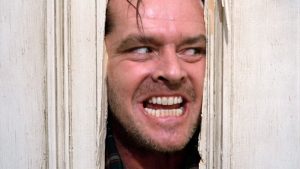
“The Shining” (Here’s Johnny Scene). Source: https://www.youtube.com/watch?v=d-ABIIZV3vA

John is depicted as irrational, violent, and on the verge of mental collapse. “He grew scarier by the day,” Merry recollected, as John turned to religious zeal to deal with his oldest daughter’s illness (192). Was he exploiting Marjorie to make money to support his family? Did he truly believe that his daughter was possessed by a demon?

When the family members were offered the chance to give individual commentary on camera, John “didn’t talk to the camera. He orated. He gave pep talks about how our family would overcome. He proselytised, working in Bible references,” whenever he could (188). John became deranged and was living somewhere between fiction and reality. He had no control over what was happening to his daughter, yet he tried everything he could to control it. There is no real explanation for Marjorie’s illness, but John is convinced that he can save her. His zeal fills him with energy and power, often erupting into violent outbursts and even resulting in an untimely arrest.

On the other hand, the mother, Sarah, slowly deteriorates. “She looked older with her puffy, bloodshot eyes. She gave me an unsure, sad smile. I thought about telling her that her teeth looked really yellow, that she was smoking way too much,” (140). Sarah collapses into a heap of guilt and becomes less emotionally stable, because she didn’t stand her ground against her husband’s wish of performing an exorcism and broadcasting it. As a result, she is alienated from her husband, Merry is bullied at school, protestors are lining the sidewalk, and Marjorie is disappearing altogether. The once put-together and sane mother continues to break down with each passing page, as if she were being slowly poisoned to death and buried alive beneath the weight of it all.

The cameras broadcasting Marjorie’s illness act as a public execution. Marjorie’s social life is completely dead and she is cut off from the outside world. Girls from her school start up an Instagram page and post images of Marjorie with disgustingly sexual captions and screenshots. Marjorie is unable to function even remotely as a normal teenager, and she is held prisoner in the hospital wards and church sermons. I have not finished the book, but I predict that the worse is yet to come.

Marjorie never asked for any of this. John is the one who offered up possession and exorcism as feasible diagnosis and treatment. John is the force behind it all, the one who pushes the family to the edge of destruction.


Marjorie as the Monstrous-Feminine

In addition to understanding the vines, this post intends to explore the relationship between Marjorie and Regan from The Exorcist. There are a number of notable similarities between the two characters. A few tie back to Barbara Creed’s “The Monstrous-Feminine.”

    1. “While the theme of spiritual decline is central to The Exorcist, it is secondary to the film’s exploration of female monstrousness and the inability of the male order to control the woman whose perversity is expressed through her rebellious body,” (Creed 34). Throughout the novel, John unsuccessfully attempts to control Marjorie’s illness. Unfortunately, he has zero control over her illness and even less control over her body as a whole. For example, when the family and crew bring Merry upstairs to confront her sister for the first time, Marjorie is topless. John wants Marjorie to cover up in front of the cameras, but he is unable to do so without the risk of interfering with Father Wanderly’s work. An almost incestual act has been involuntarily committed by John. The idea of control is central to Tremblay’s work, because there is a total lack of control. The father, the male figure, is trying to control the daughter’s body to no avail. John is unable to come to terms with this fact, and destroys his family in the process.
    2. There is a graphic association of the monstrous with the feminine body (37).  Marjorie’s body transformation mimics that of Regan. This includes the red marks on her stomach, the green vomit, the dingy hair and deranged eyes, and the multiple voices that are somehow still her own. She possesses a “body in revolt” (40). The source of this revolt, however, is unclear.
    3. While Marjorie represents Regan, Merry represents Regan’s mother. Merry is the only one who could pacify Marjorie as well as bring out her demons. Merry is the closest person to Marjorie, and Marjorie often confides her deepest secrets to her.

“DON’T PROFIT OFF THE DEVIL’S WORK”

www.blumhouse.com/2015/12/02/is-the-exorcist-movie-cursed/


Works Cited

Creed, Barbara. The Monstrous-Feminine : Film, Feminism, Psychoanalysis.London: Routledge, 1993. Print.

Tremblay, Paul. A Head Full of Ghosts: A Novel. New York, NY: William Morrow, an Imprint of HarperCollinsPublishers, 2015. Print.

A Head Full of Ghosts and cinematic haunting

I would like to preface this blog post by ashamedly admitting that I have watched every episode of A Haunting that the Discovery Channel has ever produced. A Head Full of Ghosts is an almost perfect critique of this style of television. From my grand experience as a consumer of this media, and my limited experience as a film boom-operator, I have surmised the following about reality film crews:

1. There is a set formula that sells, and the creative director will get what they need regardless of the family’s consent.

2. Efficiency is prioritized.

Despite reassurances from Barry, the film crew is here to take as much dramatic material as possible. This is epitomized during Marjorie’s pre-exorcism evaluation, where Barry does not allow a shirt to be put over Marjorie’s sports bra. This example is particularly disgusting, because it shows that Barry knows that is his artistic medium sex sells, even the sexual image of a schizophrenic fourteen year old girl. The film crew manipulates the events of the story through father Waverly, who takes complete advantage of John’s desperation and drives his marriage apart to ensure that the exorcism happens. Sex appeal, then shock value, then a climactic exorcism is the formula employed by the film crew. While they come off as being on the side of the family, they haunt the house in order to get what they need. When Marjorie sneaks into Merry’s room and wraps herself in blankets, the first thing Merry describes is the LED of her camera staring at her at the foot of her bed. The crew also loads a dresser drawer to slam open and shut during the actual exorcism. Their cameras are everywhere, and their influence stretches through the entire house.

The film crew as a whole is an unfeeling, uncaring specter that floats through the house, twisting events to most efficiently and reliably produce episodes. Barry has no interest in whether Marjorie gets better, and he lets this show during the time between the evaluation and the exorcism. Marjorie is finally acting normal, and while the family is watching TV together Barry shouts at the family to provide entertaining, dramatic content. Even this desperate act was calculated, in order to efficiently create content through domestic disputes. In this regard, series writer Ken is almost more guilty. He builds a relationship with Merry in order to obtain footage that may not have otherwise shared. All of these transgressions of trust compound to create an entity that in many ways terrorizes the Barretts.

If you do not know what I mean when I say “Reality Horror television” check out this opening of A Haunting:

The opening to A Haunting (2005) Narration by Tony Call.

A product of her environment or a product of possession? Both.

The one question that continues to arise in the novel, and in my head as I read said novel, deals with the source of Marjorie’s actions. Is she possessed? Is she mentally ill? What could be causing her to act this way? We are told that Marjorie has confided in Merry that she is acting in this manner in order to keep the reality TV show going, so that they do not suffer financial hardship. I do not agree with her statement as my personal analysis guides me to believe that there are more factors at play. Marjorie’s actions are a combination of the environment that she is forced to deal with, and possession.

The hostile environment is extremely evident in the actions of Marjorie’s parents. Throughout the recent readings we see that the Mother has turned to alcohol and the Father becomes very violent. I believe the Father being sent to jail was a catalyst for the  violent seres of events  that occurred during the exorcism in chapter 22. There are times where young Merry attempts to bring the family together, yet her efforts are fruitless. Her mother pushes her away physically and emotionally, while the father channels his inner anger towards her. The family situation was never perfect, but I believe the worsening conditions have lead to more outbursts from Marjorie. I for one did not believe that Marjorie could cause physical pain, yet she did so in chapter 22. What were once “weird” actions emanating from a young girl are now acts that can be considered threatening to the lives around her.


The father is cuffed and taken to jail after attacking protesters outside of his house. This image is representative of the pent up or “jailed” anger that he has inside.


While Marjorie believes that she is doing good by “acting” for the camera, I believe that this is also contributing to the detrimental environment. Students at the school are posting mean sexual Instagram pictures while her sister is being bullied for the show. Marjorie, who up until a certain point had unmonitored access to her laptop, has access to this cyberbullying. She can see the comments that are being made by those who are seeing her on TV, which does not help her mental health. If Marjorie does have mental health problems, it is best to not publicly display it on television for the entertainment pleasures of others.

Cyberbullying is a real threat in our modern day society, and Marjorie is being subjected to it.


This brings me to my final point: Marjorie’s actions are also due to her being possessed. By what? At this point in the novel I am not entirely sure that we can pinpoint a specific answer. On one hand I believe that the possibility of her being possessed by a demon is plausible. The strength that she demonstrated while being tied down to the bed during the attempted exorcism is unnatural for a girl her age. Merry describes her as “standing up like she wasn’t tied down.” I also believe in the possibility of Marjorie having a mental illness. Mental illnesses develop at different ages, and they manifest themselves in certain methods. I have studied psychology before and see several symptoms of psychosis in Marjorie. The most evident being her consistent claim to “hear voices” in her head and her cries for help during the exorcism. I believe that one can be possessed by a mental illness, as one does not have control of their actions. Their autonomy may sometimes be out of their reach.

This reading has put forth a couple of questions that I feel are necessary to talk about before continuing with the novel. Does the unwillingness of some overzealous religious humans to comply with medical treatment occur often in our society, or societies around the world? How can parents be more aware of the symptoms of a mental illness? Why does Marjorie believe her dad is possessed?

Victim or Villain: Marjorie’s Mental Illness

The other day in class, when Dr. Sample asked which of us thought Marjorie was actually possessed, I said “I hope she is.”  I felt that way for two reasons.  The first is that demonic possession is cool and scary and very entertaining to read about.  I find supernatural horror incredibly fun.   But the second is that if Marjorie is simply mentally ill (which is the conclusion I’ve arrived at upon finishing the book), I look at the entire story differently.  Instead of a creepy tale of demons and magic, we’re left with an incredibly sad story of severe mental illness wreaking havoc on a young woman and her family.   (That’s not to say that I didn’t enjoy this book – it was an incredibly fun read – but I found myself disturbed by Marjorie’s story).

Beyond being let down that this novel is more tragic than terrifying, I’m also conflicted about Tremblay’s portrayal of mental illness.  On one hand, I find it falling into the tired and problematic trope of mentally ill people as monsters.  But on the other, I think it raises awareness of the gross mistreatment of people with mental illnesses.

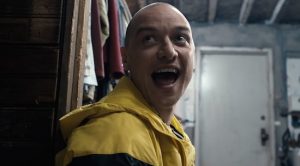
Statistically, people with mental illnesses are far more likely to be victims of violence than perpetrators of it, and any violence they do enact is most likely self-directed.  Nevertheless, mass media consistently portrays the mentally ill as murderous.  The recent movie, Split, drew a lot of criticism for sensationalizing Dissociative Identity Disorder and suggesting it to be a cause of violence.

James McAvoy as the DID patient in M. Night Shyamalan’s 2016 thriller, Split. Source

So Marjorie’s threats to her sister and graphically detailed attack on the priest during the exorcism somewhat strike me as playing into that stereotype.  She rips a chunk of flesh out of a man’s forearm with her teeth.  That’s a pretty horrifying, animalistic sort of violence.

However, I also see this book as a critique of the treatment of the mentally ill.  Marjorie is clearly unsatisfied with her care from Dr. Hamilton, whom she describes as having “the fastest prescription pad in the east” (124), and her illness is not discussed candidly among her family members.  Marjorie’s illness is treated as shameful and taboo, and she therefore lacks the familial support to recover, noting that her illness was probably caused by stress in the first place (124).

Therefore, despite Marjorie’s display of violence during the exorcism, I found that scene to be the culmination of the misunderstanding and mistreatment she faced during the novel.  Already seriously ill, she was restrained (as the mentally ill often are) and left cold and frightened.  Marjorie had, in comparison, far more abuse inflicted upon her than she inflicted upon others.

The true horror of A Head Full of Ghosts is not Marjorie’s illness, or even the shocking revelation in part 3, but a depiction of the very real cruelty, misunderstanding, and abuse people with serious mental illnesses experience all too frequently.

The Fall of the House of Barrett: An Inspection of Detail in “A Head Full of Ghosts”

In A Head Full of Ghosts, Paul Tremblay alludes to external elements to convey deeper meanings about the internal state of his characters. This is especially apparent towards the end of the book when he explicitly explores temperature, equating certain scenarios with cold temperatures and others with hot. We are exposed to cold in detail during the morning of the exorcism when Merry wants to play soccer outside but Ken warns her of the frigid temperature. She goes outside anyway and to her dismay observes, “He was right. It was freezing out. My ball instantly became a hard rock that wasn’t fun to kick” (Tremblay 204). It is almost as if the cold doesn’t escape the Barrett residence because during the exorcism, which occurs soon after, Marjorie claims, “Wait. Please, wait. It’s me. I thought I could take the cold, but I can’t. I’m freezing. Please, Father” (Tremblay 222). Although it is normally cold during exorcisms, it is interesting to note how Marjorie rejects the cold weather, heightening her self-awareness and rendering her more human. Her stated discomfort with the cold contrasts with Merry’s unwillingness to voice any of her complaints. Although the sisters react to the cold in different ways, Tremblay clearly wishes to associate it with the Barrett household.

Warm temperatures are later explored outside of the Barrett household when Merry and Rachel meet for the last time in a coffee shop. Merry observes that it is “steamy and warm” inside and mentions that she and Rachel chat about “how nasty it is outside but how warm it is in the coffee shop” (Tremblay 256). This comment indirectly hints at the inconsistencies between internal and external worlds, a theme that is explored in Tremblay’s story. The warm temperature inside the shop becomes sweltering, which prompts Merry to ask the barista to turn down the heat. Soon after, the coffee shop becomes incredibly cold, making it seem as if cold always triumphs over hot. Interestingly enough, the barista claims, “heat’s off, but it wasn’t me” (Tremblay 282). The coffee shop becomes consumed with cold air, thereby merging the external and internal worlds and blurring the distinction between the two. Ending with a cold atmosphere and the final words, “…it’s cold enough that my breath is a visible mist” signifies the mystery behind whether or not the breath is an extension of Merry of if it is a ghost (Tremblay 284). This brings into question how many selves we have and whether or not our heads are truly filled with ghosts — a perfect conclusion to the story.

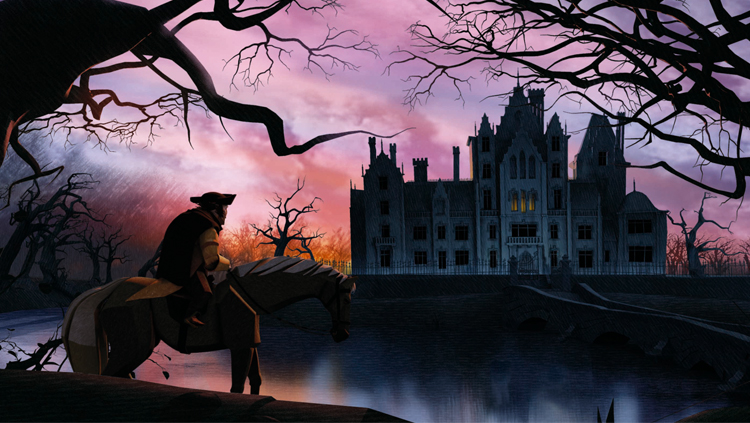
The House of Usher before it crumbles to the ground. Click on photo to view source material.

After close reading the dichotomy between hot and cold in Tremblay’s story, I was reminded of the function of weather in gothic texts. Similar to the way Tremblay uses temperature to mirror and magnify the feelings of his characters, gothic texts use weather or other external forces as elements to underscore the action of the story or hint at the inner conflicts within each character. For example, in the short story, “The Fall of the House of Usher,” Edgar Allan Poe describes external features of the house, including “bleak walls,” “vacant eye-like windows,” “rank sedges,” and “decayed trees” to convey the immediate pervasiveness of gloom and terror in the mind and body of the narrator (Poe 1). Aside from this, Poe’s story is also quite similar to Tremblay’s in its form. We are introduced to the idea that Roderick Usher is suffering from some sickness, or as Poe describes it, “an acuteness of senses” at the beginning of the story (Poe 4). Marjorie’s “sickness” is also the starting point of Tremblay’s story and drives the action in the text. Additionally, both stories occur in closed environments which place the “home” at risk. Roderick’s home is able to perceive certain things much like a human can and holds an inexplicable power over him. The Barrett home is not only corrupted by Marjorie’s mental illness but it more broadly represents the family unit that is at risk of being severed. Both texts culminate in the destruction of the home on some level — with the actual House of Usher crumbling to the ground after the death of Roderick and with the poisoning and eventual death of Merry’s family members. The similar forms of both texts as well as external descriptors such as temperature and weather make it evident that many of the important components of stories reside in the seemingly minute details or descriptors.

Works Cited

Poe, Edgar Allan. “The Fall of the House of Usher.” The Fall of the House of Usher – Poe’s Works | Edgar Allan Poe Museum. N.p., n.d. Web. 06 Feb. 2017.

Tremblay, Paul. A Head Full of Ghosts: A Novel. New York, NY: William Morrow, 2015. Print.

Reliving Tragedy in the Digital Age

In her last blog entry, Merry closes her thoughts on The Possession with the statement, “Maybe I won’t be able to stop myself and I’ll just start watching the series from the beginning. Again (Tremblay 254).” This, for me, is perhaps the most horrifying part of the book. While it is certainly true that recording technology allows us to relive, or at least be reminded of, our fondest memories, it is easy to forget that it also allows us to do the same with some of our worst moments. The idea of Merry not only having the ability to rewatch her sister’s descent into mental illness, her family’s slow deterioration, and the events leading up to her killing her family is quite disturbing, but the fact that she chooses to do so, for me, was truly disturbing.

However, it also brought to mind some of the many news articles I have read about people who have been forced to relive personal tragedies because of news coverage, often watching family members be killed or injured. I thought of, in particular, a New York Times article, “Dying in the E.R., and on TV Without His Family’s Consent.” This article described a woman who came across video footage of her husband dying in the E.R. on a TV show, NY Med, and the show claimed that the family didn’t have to have provided consent because the man’s face was blurred out. While it is clear that the girls in The Possession didn’t have a real role in providing consent to be filmed, at least it was Merry’s choice to rewatch the show years later. Here, neither the man dying, nor his family, consented to his death being broadcast to the public, and his wife had no warning before seeing his death occur a second time. We have discussed in class several times the issue of consent to one’s image or information being used after death, but I think it is also important to consider the impact that has on one’s family. Both the news cycle’s continual portrayal of violent tragedies, as well as reality TV shows like NY Med, provide examples of how technology has the potential to create “digital ghosts,” but also how these reminders of the dead can “haunt” living friends and relatives without their consent and in a far more vivid way than was possible prior to recording technology.

An image of the reality TV Show “NY Med,” being filmed in an E.R. From the NYT article, “Dying in the E.R., and on TV Without His Family’s Consent.” Photographer: Donna Svennevik. www.nytimes.com/2015/01/04/nyregion/dying-in-the-er-and-on-tv-without-his-familys-consent.html

Works Cited

Orstein, Charles. (2015, January 2). Dying in the E.R., and on TV Without His Family’s Consent. New York Times. Retrieved from www.nytimes.com/2015/01/04/nyregion/dying-in-the-er-and-on-tv-without-his-familys-consent.html.

Tremblay, Paul. (2015). A Head Full of Ghosts: A Novel. New York, NY: William Morrow. Print.

Locating the True “Horror” in Head Full of Ghosts

***ENDING SPOILERS DON’T READ IF YOU HAVEN’T FINISHED THE BOOK***

Image still from YouTube by user cccomaaha in which a pastor explains how you can tell the difference between mental illness and “possession”

Where was the real horror located in Head Full of Ghosts? Marjorie’s struggles — true to postmodern style — blurred the boundaries between authentic/performed, paranormal possession/earthly illness.

During the final few pages of the book, we discover that the Barrett family’s fatal end was dealt by Merry’s small, childish hands. The demon was not a paranormal, external force that snuck up on the undeserving, innocent Barretts. The demons were entirely human and interior to the family. This aspect of the book is espeically postmodern (and therefore, makes for an not entirely surprising ending): the monster is already inside of us and we are to blame for the tragedy it deals.

There were several earthly demons — or modes of human “horror”– running rampant in the Barrett household. Merry experienced the final, ultimate possession by Marjorie’s manipulation, her older sister capitalizing on their sibling bond and Merry’s naiveté.

The rest of the characters were possessed by their own fatal flaws. Their father became possessed by religion at the hands of Father Waverley and failed to help his mentally ill daughter. His fragile ego and emasculating job loss blinded him to the fact that he could be wrong about Marjorie’s condition. The reality TV show producers and crew exploited this situation, using the Barrett’s financial woes to ensnare the parents and then escalate Marjorie’s illness.

Their mother tried to step up and get Marjorie more psychiatric help but ended up deferring to her husband’s insistence on first the TV show and then the exorcism. Whether from a combination of depression, exhaustion, or weakness of character, she was the only adult in the situation who could have actually helped Marjorie and she failed.

These adults all failed so miserably to help an extremely mentally ill teenager that I nearly cheered when they died — what useless, spineless parents!

For me, the true horror comes from acknowledging that there was never any possibility of paranormal possession in Marjorie’s case. She was mentally ill and it escalated out of control because all these demonic adults were possessed by the concept of possession itself.


The Ghost in the Machine


Both The Exorcist and the Black Mirror episode “Be Right Back” share a common theme in questioning the meaning and nature of the “self”. What does it mean to be a person? What defines that person? Their memories? The memories others have of them? Both? Their physical self?
I would argue it’s not the physical self, meaning the person incarnate, and I believe many would agree. Our physical selves are constantly changing, reforming, like the Ship of Theseus. So if not in the physical plane, where does the “self” exist? It’s fascinating to think that such a crucial part of being human exists entirely outside of any measurable and quantifiable plane. As many questions as science has answered, and will answer in the future, it is entirely realistic to consider that maybe the “self”, the “consciousness”, the “ghost in the machine” will forever remain outside the reaches of any scientific method, and as such, outside the reaches of “solid evidence”. Maybe that makes sense. There is no solid evidence for something that doesn’t exist in any state, for something that hovers outside the reaches of all physicals laws. Are we looking for something that doesn’t exist? Can we just trust our instinct, our gut feeling that we do truly exist on another plane?

In Black Mirror we are shown an example of how a simulation of the “self” ultimately falls short of the true self. This is the very blatant point the show tries to make, but I like to point out something that I find much more interesting.

Let me begin by splitting the “self” in three categories. The “outer self”, the “inner self”, and the “deep self”. The outer self is a combination of everyone’s memories of us, how we exist in other “selves”. The “inner self” is our experience of ourselves and our life, which not only define us, but how we are going to live every next moment of our life. The “deep self” is the purely instinctual or the suppressed self which on extremely rare occasion surfaces.

In Black Mirror Ash has some of his outer self, very little of his inner self, and a substitute to his deep self in the form of generic behavioral patterns. Even if he had all of these fully transferred from Ash, he still wouldn’t be Ash. Not because he wouldn’t be convincing, but because his code can be traced back to its origin. This is the most defining factor of the “self” which goes beyond the aforementioned three categories and is the most important. The human “self” cannot be traced back, the code cannot be broken down and followed to its roots. Memories can change, as well as ideas, but the essence of consciousness is in its unique nature.

In The Exorcist we get another example of someone losing their “self” in the form of possession. I find this example a lot less intriguing as the girl has no recollection of her possession and as such only further emphasizes how the physical “self” doesn’t exist. While she was possessed, she was not herself, and when she returns, she reverts to her “self”.