Fear Thy Neighbor: The Monster Next Door in “Dead Set”

In the chapter “Monster Culture (Seven Theses),” of Monster Theory : Reading Culture, Jeffrey Jerome Cohen does exactly as his title suggests, interpreting seven different types of monsters as cultural embodiments of specific fears, taboos, and desires within cultures. His fourth thesis, titled “The Monster Dwells at the Gates of Difference,” struck me as particularly relevant to today’s global climate. In this thesis, Cohen claims that “The monster is difference made flesh,” a “dialectical Other” that represents “an incorporation of the Outside, the Beyond…” (Cohen 7). This cultural fear of the invasive, dangerous Outsider is highly applicable within the context of contemporary society where the widespread fear of the “Other” is linked directly to the fear of terrorism and the need for protection, whatever the cost.

However, as I watched Episodes 1 and 2 of the TV mini-series Dead Set and attempted to apply Cohen’s fourth argument to the violent zombies on the screen, I began to wonder if perhaps there was an important nuance to be made in this thesis. While the zombies were physically on the outside of the safe house and then further estranged as “Other” by their cannibalistic behavior, they still existed right next door. Kelly is separated from a zombie by only a door just as Patrick and Pippa are cloistered away in a room while a zombie bangs in frustration on its entrance.  Despite their positioning as Outsiders, the zombies’ close proximity put them in a different category all together: that of the neighbor (rather than the stranger).
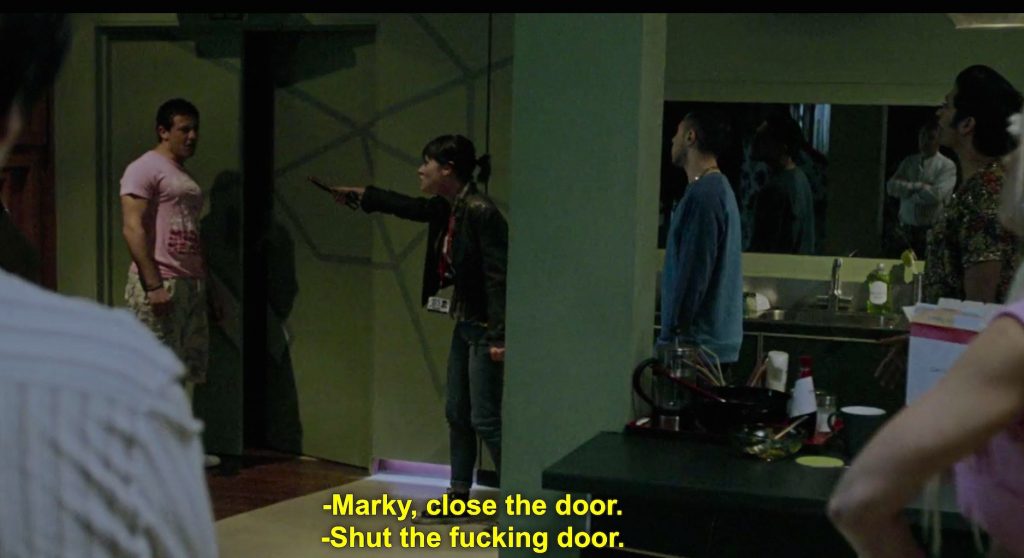
The only thing separating the “Big Brother” cast from the zombies is this door. Source: “Dead Set.” Season 1 Episode 2/5. Netflix.

This imagery of the neighbor is further reinforced by the fact that the reality show Big Brother is filmed within a constructed house reminiscent of Foucault’s panopticon in which the cast can’t see out but the film crew can see in. The physical and literal invocation of the house and surveillance immediately establishes a relationship between the inhabitants within and those on the outside. In one scene, Kelly taps on the one-way mirror and the audience sees what she cannot: a hungry zombie growling on the other side of the glass. In this moment, human and monster coexist next door to each other, only inches apart. The one-sided mirror serves the same delineative purpose as the traditional white picket fence that separates properties and neighbors. However, this barrier is soon penetrated when the zombie gets in through the door.

These zombies are violent, cannibalistic, wild, disgusting, and without any trace of humanity. What’s even more unsettling is that they still resemble the familiar faces of the cast and crew we met at the beginning of Episode 1 when they were human. The cinematic choice to maintain the physical identification of these original characters even as zombies is effective because it confuses the Familiar with the Other. The zombies are at once different because of their violence and familiar because of their faces. In this sense, the Other does not represent an Outsider from far away lands but rather the monster that’s living next door. I’ll title this eighth thesis, “The Monster Dwells at the Gates of…your own home.” One thing is certain, you can’t trust your neighbor. Time to get a bigger fence.

References: 

Cohen, Jeffrey Jerome. “Monster Culture (Seven Theses).” Monster Theory : Reading Culture. Minneapolis: University of Minnesota Press, 1996. Web.

Being a zombie, with and without actually being dead.

The beginning of Dead Set was interesting to say the least. At first I did not think that the disasters all over the U.K. would be tied to zombies until we see the car driver get attacked. I am not a fan of scary/horror movies or shows, so being scared at first was a natural reaction. However, what came after that wave of emotions really surprised me. As I began to see more and more people getting attacked by the undead I began to think back to Marjorie’s violent actions in A Head Full of Ghosts. Every time a zombie takes a bite out of a human I picture Marjorie biting into the priest.

Zombies biting into human flesh, akin to Marjorie’s actions.

Following this method of thinking I can see how Marjorie herself might be similar to the zombies on the show. They are both not in a fully conscious(assuming zombies are different people than their human counterparts) or autonomous state. Their actions are influenced by factors out of their reach, and they are not the same person that they were before. I like to believe that Marjorie ultimately did suffer from a mental illness, and that led to her actions. I think this connection brings up the more important issue of how we deal with those that have mental illnesses. In the show we see that the human’s first action is to freak out, which is understandable because they are being attacked. However, when Marjorie begins to act strangely, her parent’s first reaction is to freak out as well. Mental illnesses are  highly overlooked and misunderstood in our modern day society. I think the lack of understanding allows those affected to become a “zombie” in a sense by being marginalized.

I’d like to keep developing the idea of what it means to be a “zombie” by tying it into the name of the class. I think that Death in the Digital Age is best embodied through Facebook’s “Remembering” feature. For those who are not aware this is a feature that allows for people’s Facebook profiles to remain online after they have passed. When one visits the deceased person’s profile there is a sign that reads “Remembering _______” with the blank space filled in by their name. As I am looking through several of these pages on my own Facebook account I realize that this too is a way that one can become a “zombie”. The deceased are no longer on this earth, yet their presences is still felt. We can see where they have been, what they have liked, and even what they looked like. Yet, they are gone. This is similar to how zombies  in the show are no longer living, yet continue to be present.

Facebook’s “Remembering” Feature

To a certain extent we can say that these Facebook profiles haunt us. We as friends of the deceased may not have asked to see the “Remembering” feature, yet it still there. We may never come across it, or may consistently encounter it. Regardless, the page exists and will trigger mixed feelings. Technology has allowed for all of us to become zombies once we have passed. Whether or not some of us approve of that is a question that should be brought forth. Should we consent to this feature? Should friends of the deceased be notified that this is happening and be asked if they are ok with viewing it in their feed? These are questions that should be discussed.


Zombies, the abject, and the idea of haunting in “Dead Set”

The most disturbing element of Dead Set was certainly the gore, at least in my experience. I’m not a horror fan, and thus turn my head or close my eyes during the inevitably violent moments of my favorite TV shows or movies. Watching Dead Set, a TV series with a pair of undoubtedly gory opening episodes, I began to wonder what the appeal of this horror was.

As Jefferey Jerome Cohen gets into in his article “Monster Culture (Seven Theses),” part of this horror has to do with the abject. According to Kristeva, the abject (in this case, the blood and guts of human bodies as zombies devour them, and the excrement of the survivors trapped in the house) is “tempting as it is condemned” (19).

This push and pull between attraction and disgust is obviously very relevant when explaining the appeal of the horror genre in general, especially violence and gore. The use of zombies plays into the idea of the abject quite effectively, as they are essentially the walking abject–humanoid figures completely devoid of humanity.

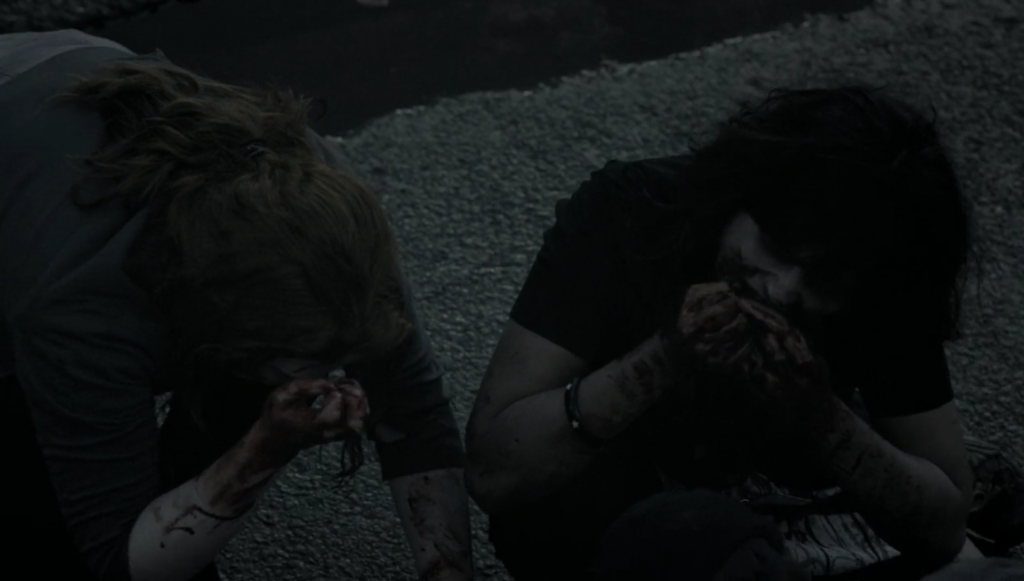
Claire, a former Big Brother employee, devours one of her victims. Source: Netflix

Another aspect of the zombies that I found interesting was the way in which they carry “haunting.” This occurred to me in the context of Claire and Kelly’s relationship. Shortly before the zombie apocalypse set in, Claire revealed that she had also slept with the man that Kelly cheated on her boyfriend with. Claire’s body now holds two sorts of haunting to Kelly: a reminder of the mistake she made in cheating on her boyfriend (she destroyed the zombie of the guy himself, which is interesting), and also the imminent haunting of death should Claire catch up to her. I’ll be interested to see how this zombie haunting continues as more people ostensibly succumb to zombiehood.

It’s Never About the Zombies … So Who Is It About?!

I tend to couch my admission that I’m a raging fan of The Walking Dead with “but it’s not about the zombies!” It’s never about the zombies. Once I realized this, I became much more receptive to watching and reading other works in the Zombie Apocalypse genre. Typically, works of zombie or living dead horror center on the humanity and relationships of the living characters. Zombies are horribly one-dimensional. Some are more frightening than others (seriously, fast zombies are the WORST), but ultimately they function more as props than as characters.

The real story emerges as we follow the living and their attempt to both survive and retain compassion for other living humans and a sense of right and wrong. We feel for the characters we meet as we come to appreciate their humanity in the face of so much gruesome and horrifying death. The best part of any zombie story is attaching ourselves to likable characters and watching their journey unfold as they struggle to survive.

A few of the survivors look on at a world turned upside down. Source: Channel4

So, what struck me as terribly odd in the first two episodes of Dead Set is how little I liked ANY of the characters. The members/participants of Big Brother are all presented as obnoxious. The producer is a giant jerk. Kelley is clearly supposed to be the object of most of our sympathy — but we find out quickly that she is cheating on her seemingly otherwise innocent (and adorable) boyfriend. So far, I do like the boyfriend (Rick), but he is a very minor character at this point.

I’m trying to understand what exactly the intent of the character development might be. Are we supposed to find the good in otherwise off-putting people in the face of disaster? Is the show remarking on the good of people even within the ugliest portrayals of humanity? Seriously, Dead Set — throw us a bone!

Manipulation of the Innocent

After finishing A Head Full of Ghosts, I couldn’t help but feel sympathy for the multitudes of times innocent characters were taken advantage of and manipulated.  For starters, the most obviously manipulated character can be seen as child Merry; she always feels tricked by her sister, she gets roped into an entire TV show exploiting her young life, and the producers themselves almost seem like they’re only using her too. Perhaps the most shocking manipulation was the very end when Merry was tricked into poisoning her family. This also happens to be the part that I’m unsure who the manipulator actually is. I have doubts that the father actually had the poison in his possession ever, yet how would Marjorie get a hold of it on her own? And if it was from Marjorie, then why would she eat the sauce too?? My best option here is to guess at a couple things about Merry:

Potassium Cyanide …. found here
  1. Merry is not recounting the events correctly at all. For example, she even claims she knows the police report says how they found her with curled next to her mom, yet still has a vivid memory of the doors being open and her aunt finding her. Also, older Merry says police found no traces of searches for poison on the family computer’s hard drive-> how can this be if Marjorie showed her images of it from an internet search?? (pg. 272)
  2. Merry might also suffer from an undiagnosed mental illness. I find this theory very provoking because familial links in disorders runs much higher than the prevalence in the general population. Also, how could any child raised in the environment Merry was in, end up completely ‘normal’.
  3. Maybe Merry’s sister and dad were both ill. That would explain him having the poison and the different ‘tricks’ that her sister did throughout the book. (Note here that I am a complete skeptic about possession and such and look for ways to explain these phenomenon through science).

If my last guess is true, would that not make all of them (Merry, her sister, and her dad) innocent? If they are all innocent of blame because they truly did not know better or what they were causing, then who is the real manipulator or the cause of the family’s deaths in the end? It is this manipulation of the innocent that made me keep thinking and pondering this book long after I had finished the last word.


Nothing Burns Quite Like The Cold

Living in Kazakhstan and now Chicago I feel connected to Frozen’s Elsa “The cold never bothered me anyway”, I would yell out walking over to the bus stop while freezing Lake Michigan wind tried to find any uncovered skin. There is something sinister about “cold”; even saying the word makes one shiver. Cold is unforgiving-if you forget a hat or gloves then you’re SOL. Cold is desolate and lonely-how many people outside do you see in the middle of winter? But can cold be evil or can cold be fake?

Merry, in the last chapters of the book becomes obsessed with the temperature both outside and inside the coffee shop. Initially the coffee shop is warm, toasty, steamy. After reading the email exchange between her father and the baptist(in which it is alluded that her father killed the family), she actually becomes too hot and asks the barista to turn the heat down, but he can’t. The temperature changes significantly after Merry tells of her possible involvement in the murder of her family. It becomes cold in the coffee shop. After being questioned more about what happened with her family, Merry doesn’t want to talk anymore. The most striking part about the entire scene is when she walks over to the door, blaming the cold on the door not being fully shut by the couple that entered a little bit ago. Both Merry and Rachel, however, noticed the cold way before the couple came, thus the cold wasn’t the door’s fault. The last sentence of the book also mentions that it was cold enough in the coffee shop that Merry’s breath was a visible mist.

In her blog, Merry/Karen also make big of temperature during the exorcism. She argued that the window was open in Marjorie’s room explaining the dropping temperature and visible breath. The “live” shots of the thermometer dropping is to trick the audience into believing that there is an actual demon present in the room. The two scenes are paralleled due to the fact of the ajar window or door. Merry has a reason for both occasions as to why it is cold inside. This could have two meanings: that there is something evil or otherworldly present in both the exorcism and after Merry’s confession; or that Merry is lying about her involvement in the murder. As Merry herself pointed out, the window and the cold is a trick or a lie could she be suggesting through the door and the the cold in the coffee shop that her story is a lie? Thus, cold is either fake or evil.

The Cold Never Bothered Me Anyway. Perf. Idina Menzel. YouTube. TOZChatPanel, 23 Dec. 2013. Web. 9 Feb. 2017. <The Cold Never Bothered Me Anyway>.

The End…..or is it?

One of the most famous horror tropes is the “surprise cliffhanger” ending. You’ve seen it before. The camera zooms in on the supposedly-dead body of the villain when suddenly the eyes of the monster spring open, the murderer’s fist breaks through the rubble or grave they were buried under, the fingers of what is supposed to be the corpse of the serial killer begin to twitch. It’s not quite a twist or a cliffhanger in the traditional sense, in that it doesn’t really affect the plot or character development in any way, but it does do just enough to shift the ending away from the nice traditional “happily ever after” side of things (if you have a lot of time to waste, I recommend looking at the TVtropes page about this, linked here).

While in actuality the purpose of these little twists is probably to ensure the sustainability of a film franchise, enabling studios to make more sequels and therefore more profits, but I think there is something to be said for the fact that a lot of times, horror doesn’t resolve. It goes on. Even A Head Full of Ghosts is not immune to this trope.  In the very last chapter, Tremblay gives us just enough to think that perhaps everything is not quite over. There’s the confusion about the fingerprints on the jar of poison, for example, or the way Merry’s breath hangs in the air in the last sentence, reminiscent of Marjorie’s possession “performance.”  The story is quite clearly wrapped up, yet there are still those loose threads, those little details that do just enough to keep your hair standing on end long after the book has ended.

My question is, what is the reason for this trope? Where does it come from? Maybe it’s for shock value, maybe its for future profits, but I think the answer is something simpler than that. Horror, by its own definition, can’t fully “end,” at least not in the way we normally expect stories to end. The whole point is to unsettle, to disturb, to shock. A simple resolved ending, much like real life, does none of those things. Horror is paradoxically the furthest and yet the closest genre to everyday life. On the one hand, we deal with things like ghosts, zombies, vampires, demons, and the like, creatures and beings far outside the world we feel control over. Yet at the same time, horror doesn’t just…end. It goes on. Just like life, sometimes it wraps up, sometimes it doesn’t. Either way you have to leave the theater, close the book, or turn off the tv.

tvtropes.org/pmwiki/pmwiki.php/Main/TheEndOrIsIt

Merry- The Unreliable Narrator

One of the aspects in A Head Full of Ghosts that I have found to be the most compelling is the choice of the narrator being Merry Barrett. Something that we touched on in our earliest classes was whether Merry is a reliable narrator for the events of the novel. I do not feel that we spent enough time on this debate, especially after Merry’s big reveal to Rachel about how her family died in chapters 25 and 26.

In chapter 3, Merry says, “my memories mix up with my nightmares, with extrapolation, with skewed oral histories from my grandparents and aunts and uncles, and with all the urban legends and lies propagated within the media, pop culture, and the near continuous stream of websites/blogs/YouTube channels devoted to the show…so all of it hopelessly jumbles up what I knew and what I know now” (Tremblay 13).

This quotation called into question whether or not Merry is a reliable narrator, through Merry’s own admission. Throughout the novel, I forgot that Merry said this, and became fully trusting of her recounting. This trust was most likely brought on by Merry’s narration switching from her 23-year-old self to her 8-year-old self so seamlessly (even though, in the diegetic world, the 23-year-old Merry is saying what we are hearing the 8-year-old Merry says). However, once Merry revealed that she was the one who slipped the potassium cyanide into the pasta sauce that poisoned her sister and parents, this quotation popped back into my mind.

I am not sure that Merry made up the fact that she was the one who put the potassium cyanide in the sauce; I definitely do not think that someone would lie about that fact. Yet, I am not sure that I trust Merry admitting to the poisoning either Merry, however, goes on to say that, “I’ve never told anyone what I’ve admitted to you. The police, psychologists, my aunt; no one” (Tremblay 281) Merry thus shows that she has been lying for many years.

For some reason, this called a lot of the narrative into question—at least for me—that we are given because it is given to the reader by Merry, someone who I find to be an unreliable narrator, much like Pi from Life of Pi or Huck Finn from The Adventures of Huckleberry Finn. Can we trust what Merry has told us? Can we trust a 23-year-old woman recounting something that happened when she was 8? Even if it was something so traumatic, I think the answer is no.

Pi from Life of Pi is a great example of an unreliable narrator. Which version of his story is true?

Works Cited

Tremblay, Paul. A Head Full of Ghosts: A Novel. New York, NY: HarperCollins, 2015. Print.

Is Postmodernism a catch-all dead end?

Postmodernism has been at the center of discussion in two of my classes this semester, and its elusive nature begs the question of whether or not postmodernism encapsulates all other movements of history and of those to come. In the most basic sense, postmodernism means to question everything: to not accept grand statements just because they come from authorities, to decenter ourselves from the very truths around which we revolve. Maybe it’s my own naiveté, but living in a postmodern world has made me question whether or not any authority can, or should, be accepted from here on out.

In Recreational Terror, Pinedo says that postmodernism encapsulates “a profound loss of faith in master narratives,” and “the breakdown of moral clarities.” In a world in which things are less certain than ever, in which indeterminacy reigns, it seems unlikely that a bold, new narrative will be able to unite our trains of thought once again. The second law of thermodynamics states that things will only ever get more complicated, that entropy is always increasing. In other words, once a plate breaks, it is very unlikely that the laws of physics will make that plate fall back into place, and postmodernism seems to have broken the plate.

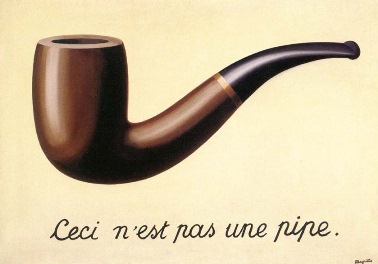
René Magritte, The Treachery of Images. Wikipedia. 1928-29. Oil on Canvas. en.wikipedia.org/wiki/The_Treachery_of_Images

The image above was introduced to me the first time I heard of postmodernism way back in my days as a freshman in high school. The caption translates into “This is not a pipe,” and the knee-jerk reaction is to disagree. The artist’s point, however, is that this is not in fact a pipe, it is merely the image of one.  All in all, in a world that has taught us to not accept anything and that more or less has taught us that our own interpretation is valid as long as we have the evidence and logic to back it up. So, in a world in which master narratives are meant to be thrown out, how can a new one be established?

1000 Ways to Die

There’s a lot of gross scenes in A Head Full of Ghosts. Marjorie oozes green slime out of her mouth onto her spaghetti, urinates and defecates on the floor, bleeds on the bed, and practically bites a man’s arm off. Any number of these gory scenes, or ones like it, could have been connected to the death of Merry’s family.

But poison? What an interesting choice. Especially potassium cyanide, a poison that in the book kills quickly and without much apparent gory side effects. According to the CDC, potassium cyanide is typically odorless, ships in easy tablets or pellets, and is rapidly fatal – so, at least in this part of the novel, the information is accurate.

Picture of potassium cyanide granules, perhaps similar looking as to what Merry mixed into the spaghetti sauce. Picture from BioPrepWatch

What is so surprising to me is the lack of gore involved. Merry’s family twitch and convulse for a brief time and then collapse dead to the ground – no oozing, bleeding, gushing, bursting – no nothing. Merry even keeps asking Marjorie when she is going to wake up after she has already fallen to the floor dead, perhaps because she still looks so normal she could just be sleeping.

After the gruesome deaths and moments in The Exorcist, including people being thrown out of high windows and splattering on the ground below with their necks turned 180 degrees, I expected a more dramatic ending for the three other members of the Barrett family. In that sense, the poison was an anticlimax for me, as I had been expecting from reading the book that the moments when the whole family was together, things often became disgusting, but not the case here. On the other hand, because I was not anticipating the poison, it was also quite a plot twist, ending that plot line much different than I thought it would.

Of all the ways that Marjorie, the mom, and the dad could have died, I wasn’t expecting poison to be one of them. Compared to a demon possessing you, poison seems almost laughable.