
Postmodernism has been at the center of discussion in two of my classes this semester, and its elusive nature begs the question of whether or not postmodernism encapsulates all other movements of history and of those to come. In the most basic sense, postmodernism means to question everything: to not accept grand statements just because they come from authorities, to decenter ourselves from the very truths around which we revolve. Maybe it’s my own naiveté, but living in a postmodern world has made me question whether or not any authority can, or should, be accepted from here on out.
In Recreational Terror, Pinedo says that postmodernism encapsulates “a profound loss of faith in master narratives,” and “the breakdown of moral clarities.” In a world in which things are less certain than ever, in which indeterminacy reigns, it seems unlikely that a bold, new narrative will be able to unite our trains of thought once again. The second law of thermodynamics states that things will only ever get more complicated, that entropy is always increasing. In other words, once a plate breaks, it is very unlikely that the laws of physics will make that plate fall back into place, and postmodernism seems to have broken the plate.
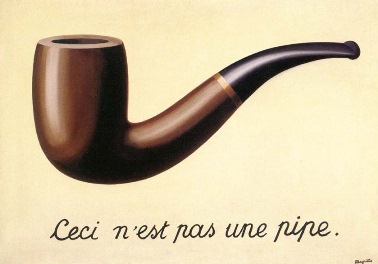
The image above was introduced to me the first time I heard of postmodernism way back in my days as a freshman in high school. The caption translates into “This is not a pipe,” and the knee-jerk reaction is to disagree. The artist’s point, however, is that this is not in fact a pipe, it is merely the image of one. All in all, in a world that has taught us to not accept anything and that more or less has taught us that our own interpretation is valid as long as we have the evidence and logic to back it up. So, in a world in which master narratives are meant to be thrown out, how can a new one be established?
It’s interesting that our opinions differ entirely. I too have talked about post-modernism in a few of my classes, and I am under the impression that it’s dead. In its place however, is something that is hard to currently put a finger on, maybe one day we can look back and find a proper definition.
As Dr Alan Kirby says “postmodernism is dead and buried. In its place comes a new paradigm of authority and knowledge formed under the pressure of new technologies and contemporary social forces.”
Published in 2006, Kirby was in my opinion definitely right in saying that, but his views in the rest of the paper The Death of Postmodernism and Beyond are sometimes too heavily influenced by what seems to be a cynical view of today’s generations.
My view is that with the rise of the digital age and the internet (whose effects Kirby couldn’t possibly foretell), we have all become “artists” (whatever that means). We all have access to numerous mainstream and accessible methods of self-expression. Everyone is a storyteller and world-changer today. Everyone has a platform, ranging from a handful of people, to the entire digital world (billions of people).
With so much information reaching everyone, it is only natural that the market is saturated and the value of everything diminished. Viral posts, videos, and images come as quickly as they go. Consumers enjoy things for brief moments, moving onto the next viral “things” the moment they arise, and they know they will. As such, the consumer can afford not to cherish and store ideas and works, but instead to go through them because there are and will be an endless amount. As a result, the standard for what is considered great today has shifted greatly from skill, to temporal effect I guess. It’s not about the mastery in a field, but the one-time shock effect that a funny video, interesting image, or thoughtful post might have. We place a tremendous value of views, something which seemed impossible to quantify once, now has a number, and a calculable value.
All this has caused a kind of shallow global mindset, but not because the cyberspace is saturated with information, but because it is truly in its infancy. For the first time ever, everyone is included in the world of self-expression, everyone has a platform. Information and ideas now reach deeper into society than ever, the “elitist” barriers of the past now seem to be collapsing, and all of this past knowledge is trickling down to the most common of folk. This is why it might seem like we’re regressing, because we’re covering once again ideas that have been covered in the past, but we aren’t, we’re covering ideas again because now everyone has access to them. We’re closer to a collective consciousness than ever, a world where the “other” and xenophobia are slowly becoming a thing of the past. Of course the pendulum swings (as it did with Trump and the general global shift towards extremist politics) but it always swings back (as long as we don’t destroy ourselves in the process, which due to its rapid change, makes society much less stable and much more volatile, vulnerable to dramatic outcomes more so than ever). We can only hope that the pendulum keeps swinging in a controlled manner, where we can continue to progress and share ideas until we’ve reached a similar point across the board. Where disparities in knowledge and awareness are not as great. It’s a very optimistic view, and I realize fully all the obstacles in the way of this change, but one can only hope right?