Looking back through my blog posts from over the past fifteen weeks, I noticed that I tended to use the readings to talk about a larger relationship between humans and technology, using a smaller detail to talk about a trend or something else it reminded me of. For me, I enjoyed that our readings covered many different manifestations of our relationship with technology, but I used the blog post to speak to my personal experience or opinions on the weekly readings’ themes.
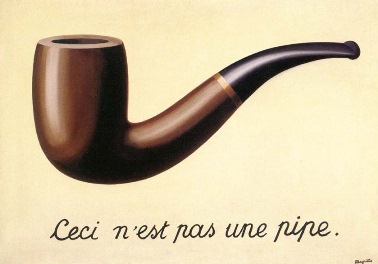
In my first blog post, I reflected on how technology fell short in both Head Full of Ghosts and The Exorcist, and in both cases the families tried to turn to religion to solve their problems instead. In my second blog post, I used René Magritte’s The Treachery of Images an an example of how post-modernism has left me questioning “truths” to this day. I disagreed with the readings most in my third and fifth blog posts, frustrated that Kocurek did not go further in her analysis of video games and I basically ripped on QR codes later.
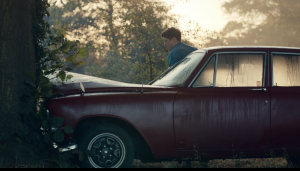
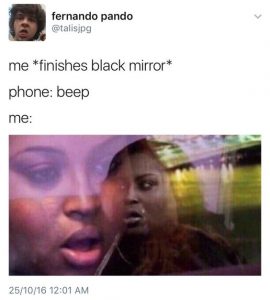
Throughout a few of my posts and projects, I analyzed and thought more about various episodes of Black Mirror. Having watched a decent amount of episodes outside of class, I think the show does a great job of not only envisioning different forms of technology, but showing how much technology can shape the human experience (often in very scary or disturbing ways). While the show presents extremes, it does show in a believable way, and it pushed me to question how real forms of technology, primarily self-driving cars, have the opportunity to drastically change our society – a topic I touched on in my sixth blog post and explored more thoroughly in my final project.
Despite, the class focusing on many representations of death, I stayed away from that topic for the most part. All of the readings still provided lots to think about, and when the time comes, I’ll definitely be thinking a lot more about the digital life I’ll eventually leave behind.
I imagine that my grandkids will laugh at the idea that I wasted an hour and a half of my day in the car actively driving myself back and forth to high school everyday. And with automakers aiming to release fully autonomous cars by 2018, maybe grandkids is even thinking too far in the future. Driving is the most dangerous thing we do on a daily basis – a fact we very often forget, but we are far away from cars doing all of the work for us.
Jack Stewart’s article detailing the legal conundrum following the death of Tesla-driver Joshua Brown led me to another Wired article, which outlined three different levels of autonomous driving. While level three is a completely autonomous system that removes the driver from the equation completely, Tesla’s Autopilot system falls into level 2, somewhere in between complete autonomy and the need for driver intervention. These levels reminded me of a different article I read a while back detailing the new system Mercedes is rolling out, one that The Verge claims will give Tesla a run for its money and that seems to be more self aware of its position in level two autonomy.
Ignore the system too long, and the car will bring itself to a stop. Courtesy of The Verge.
The name of Tesla’s system itself implies a higher level of autonomy, but Mercedes’s system is intentionally imperfect in order to demand more of the driver’s attention. Sure, the name Drive Pilot isn’t much better, but Mercedes seems to understand that we are not at a place of full autonomy yet. The car requests feedback via a touch of the steering wheel every ten seconds, slowing the vehicle to a stop if the warnings go ignored. Turning on the turn signal slows the vehicle to an appropriate turning speed. The car resists staying perfectly in the middle of the lane, partly avoiding bumps and partly in order not to put the driver too at ease. The system demands a relationship between the car and driver. Tesla’s system may be a bit more futuristic with an eye towards a driver-less highway system, but that’s a future a world full of shitty drivers is not ready for.
Last Friday, Netflix released its adaptation of Jay Asher’s 2007 Novel Thirteen Reasons Why. The show centers around a a group of high school students dealing with the aftermath of a girl who committed suicide, who recorded thirteen tapes before she died, each one addressing a particular person and detailing how they influenced her decision to end her own life. The show expands to deal with a variety of topics, including high school relationships, substance abuse, sexual assault, and suicide, but the show immediately struck me with the two ways it marries technology and death.
The first and obvious way the show and book marries death and technology is with the tapes that Hannah records before she kills herself. Clay, who the show mostly centers around as it moves between past and present as he works his way through the tapes, initially receives them in an ambiguous package, only to pop in the tapes and hear Hannah addressing him seemingly from the beyond. The premise reminded me of the spirit phone even though we know Hannah is very much dead. While the book came out the same year as the iPhone, Netflix updates the technology for today’s high schools, but stays true to Hannah’s decision to use tapes – an outdated form or recording – to address her classmates. There are a few exchanges surrounding this decision: Clay struggles at first to find something to listen to the tapes on, and there is a scene in which one of Hannah’s friends tells her mixtape are a lost art. Just like how burning someone a CD in high school rather represented a thoughtful act rather than just sharing a playlist with someone, the nostalgia and intimacy of the tapes seem to be a more appropriate medium for a posthumous address. While the technology is modern enough for Hannah to address her classmates after death, they seem to represent the fact that these students are haunted by their past, and I do not believe a simple recording on an iPhone or a purely digital medium would have had the same effect.
The show also speaks to how technology has affected high school relationships and friendships and how it exacerbates a lot of problems people that age already face: cliques, rumors, and reputations. Hannah’s downward spiral begins when she’s on a date and a playful photo taken at a playground ends up becoming a photo of the view up her skirt. The boy’s friends see it and quickly spread it, and by the next class period all of the phones in Hannah’s class are pinging off with the photo, and suddenly like a virus the rumor spreads that they did a lot more than just kiss. This rumor haunts her as she tries and forms friendships at her new school, and if you believe in the butterfly effect, a single photo ended up driving a girl to kill herself. The show can be tough to watch at points given some of its content, but definitely still worth watching.
On September 12th, 2008, David Foster Wallace ended his own life by hanging himself on the patio of his home in Claremont, California, shortly after writing a two and a half page note to his wife and neatly arranging the manuscript and pages of edits for The Pale King under the light of the desk he worked from in his air-conditioned garage. In an interview for the guardian, his wife, Karen Green, said, “It all turns him into a celebrity writer dude, which I think would have made him wince, the good part of him,” but nonetheless she followed through on what seemed to be one of her husband’s last wishes and saw through the publication of The Pale King. As Taylor Marshall remarks in an analysis of the unfinished novel, “David Wallace’s 2008 suicide ignited intense public devotion to the man, both within and without the academy” (113).
David Foster Wallace’s suicide was the result of a long battle with depression that he ultimately lost after trying to switch, and then wean himself off the antidepressants he had been living on. He had earned a national audience and celebrity-author status with the publication and success of Infinite Jest a decade earlier, but his death brought him an even larger cult following and attention, even if he did not want or anticipate that. I was initially introduced to DFW’s writing through a friend who directed me to the graduation speech he wrote for Kenyon College in 2005 called “This is Water.” With it, I was introduced to DFW’s tendency to dole out advice for getting through life, specifically finding beauty in boredom (granted, it was a graduation speech). Within the mammoth of a novel that is The Pale King, DFW offers similar anecdotes, harping again and again on tedium, boredom, and little snippets of life advice.
The reason I was drawn to DFW for the Haunted Media project was exactly for his ability to offer a way through the monotony and bleak aspects of life while he himself was unable to overcome them. He wrote a story called “The Depressed Person” and even wrote a short blurb sympathizing with those who commit suicide. In retrospect, his suicide seems obvious and expected. The Pale King itself provides a particularly interesting case to work with. The mock memoir structure that DFW creates further casts the novel as a haunting piece of literature. At two different points he addresses the reader, saying, “Author here,” and going out to clarify in a footnote that “I won’t keep saying this each time that I, the living author, am actively narrating” (258). There are moments like this throughout the novel, moments where we’re abruptly reminded of the fact that DFW is not, in fact, a living author anymore, yet this book still seems to breathe. In his analysis of the novel, Robert Hamilton says, “In short, this is hardly the first of Wallace’s works to stop short in an abrupt and at least superficially unsatisfying manner,” and notes how the novel has been read as “(merely) a last will and testament” (169). In In the editor’s note prefacing the novel, Michael Pietsch refers to book as “an unfinished novel,” and said, “Although not by any measure a finished work, The Pale King seemed to me as deep and brave as anything David had written. Working on it was the best act of loving remembrance I was capable of” (xi).
Inspired by Megan Garber’s “Enter the Grief Police,” and Alexandra Sherlock’s piece on re-enchantment, I was interested in conflating the immense project of assembling the novel that Pietsch took on as an act of grief and the “google-able” quotes that DFW’s legacy has largely become. So who is right? Is Pietsch hiding an economic incentive behind what Garber’s Grief Police would call crocodile tears? There may not be a digital recreation of DFW, but how is his legacy complicated by the fame that his death and posthumous publication brought him to? Should an unfinished novel be thought of as the author’s last word? Sherlock makes the case that fame is a gateway to immortality, so despite DFW’s widow saying he would have hated to become so famous after his death, his suicide seems to have had the opposite effect, allowing him to transcend death rather than embrace it.
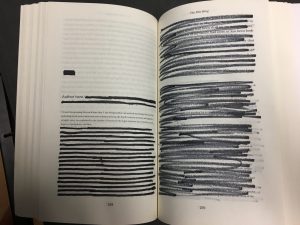
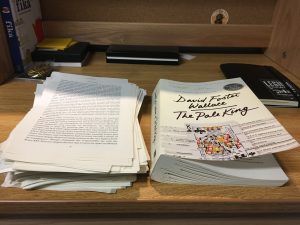
Plug in “The Pale King Quotes” – or anything followed by the word “quotes” for the matter – and you will almost always be greeted with a link to goodreads.com at the top of the page. For this project, I’ve taken every quote listed on Good Reads and a few from other websites (sifting through a lot of overlap) and have “highlighted” them in the text by blacking out every other word on the page. Pages without any quotes? Ripped out. Within the 549 pages of the novel, there are (not surprisingly) an incredibly small number of sentences left. Some of the pages are nearly covered in black, a single line or two buried within other pages not deemed worthy by Good Reads users. I chose to blackout certain elements of the paratext, underscoring his suicide while also getting rid of any plot description (there wasn’t much plot left after I roped out hundreds of pages). I chose to leave all of the opening pages that included blurbs, forewords, and legal information in order to highlight both the commercial nature of the project and the impact it had across the world of writing. I blacked out sections in two distinct ways. Some of the sections’ black lines run crisply in line with the sentences to evoke classified documents and parallel the tedium represented in the novel’s I.R.S. paperwork-content. Furthermore, blacking out sentences in such a way provides tedious work in itself, and as DFW says, “If you are immune to boredom, there is literally nothing you cannot accomplish” (440). Other sections are furiously scribbled out in swathes of black sharpie ink, speaking to the frustration of DFW’s decade-long editing process and his inability to finish the work, as well as provide an image symbolic of depression.
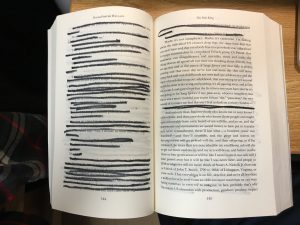
There were a few things that happened during the process of creating this artifact, this carcass of a book, that I did not expect going into it. First, I did not anticipate just how creepy some of the quotes would be in light of his death, and at points I had to step away from the project. Page 145 has only three lines blacked out, the rest consisting of a long anecdote all about our inevitable deaths and our attempt to distract ourselves from the fact that “we’re all less than a million breaths away from an oblivion more total than we can even bring ourselves to even try to imagine” (145). There were times that I so closely identified with a quote that my I had that beautiful moment of recognition of seeing my own feelings I didn’t know others felt written so eloquently put into words, and then throwing the book away from me after realizing its writer was unable to overcome these feelings. (Now is a good a place as any to note that while DFW wrote often about depression in a fictional sense, he never openly wrote about his own struggles).
Pgs 144-145, a rather bleak outlook on life. Or death, rather.
Secondly, and maybe it’s just my liberal arts English major speaking, but I couldn’t help but feel I was vandalizing the book. Of course DFW doesn’t care, he’s dead! But it felt a little bit like burning a photograph at a funeral. Sure, there are millions of copies out there and I even have the digital Kindle version, but the novel’s unfinished state and posthumous publication gave it a sense of delicacy that gave me unease more so than if I had taken a sharpie to any standard high school summer reading assignment (ripping pages out felt like straight blasphemy).
Thirdly, Good Reads may have a monopoly when it comes to Google-searching for quotes, but scrolling beyond the most “famous” quotes revealed a hidden intimacy between DFW and his readers. Good Read sorts the quotes based on likes from user profiles. The most-liked quote, “How odd can it be that I have all this inside me and to you it’s just words?” is ranked with 633 likes, but the numbers quickly drop. Scroll to the bottom of the page and you’re down to just 15 likes, and the last two pages of results are quotes uploaded and liked by a single user. Given DFW’s harping on loneliness and the sadness surrounding his death, there was something comforting in these singularly-liked quotes.
What I was ultimately left with was a haunted artifact that conflated the physical and digital legacies of an author published posthumously. In the digital age of clickbait and short attention spans, DFW’s The Pale King makes for both a good headline (suicidal author’s posthumous publication) and offers plenty of easily digestible quotes (because who has time to read that long of a book?). In an article for The New Yorker, D.T. Max argues that The Pale King “would show people a way to insulate themselves from the toxic freneticism of American life. It had to be emotionally engaged and morally sound, and to narrate boredom while obeying the physics of reading,” yet ironically most the of famous quotes on good reads are not the optimistic pieces of advice but rather the anecdotes that highlight the toxicity Max references. This haunted artifact serves as a conflation of literary and digital grief for the author, and while I was left with a skeleton of a quote book, I was also left with hundreds of torn, untouched pages that a man had poured his soul into.
Works Cited
Garber, Megan. “Enter the Grief Police.” The Atlantic. 20 Jan, 2016.
Hamilton, R. C. ““Constant Bliss in Every Atom”: Tedium and Transcendence in David Foster Wallace’s The Pale King.” Arizona Quarterly: A Journal of American Literature, Culture, and Theory, vol. 70 no. 4, 2014, pp. 167-190. Project MUSE, doi:10.1353/arq.2014.0029
Marsh, S. T. “Self-Sacrifice in the Autobiographical Narration of David Foster Wallace’s The Pale King.” Biography, vol. 39 no. 2, 2016, pp. 111-128. Project MUSE, doi:10.1353/bio.2016.0025
Sherlock, Alexandra. “Larger Than Life: Digital Resurrection and the Re-Enchantment of Society.” The Information Society, 29: 164-176, 2013.
I would like to consider myself good with technology. I am the go-to in the family for technology questions – mostly Wifi troubleshooting – and when my resume reads “proficient in Microsoft Excel” it really just means I’m good at Googling how to do something until I figure it out. But never in my life have I encountered a useful QR code. The first time I saw them (probably late middle school) it was a fun thing to try out, a party trick at best, and that’s where my relationship with QR codes began and ended. I thoroughly enjoyed the link to WTF QR Codes that Tamara Kneese provided in her piece, because to me I have always found them uncomfortable and out of place.
One of my favorite post to WTF QR Codes, courtesy of Tumblr (a QR Code for an Auto repair shop, plastered to the side of a building).
Sure, QR codes may be more graceful than tiny.urls or anything that starts with “http://,” but in my opinion they are still the ugly step-sibling next to the elegant barcode. There’s just something uncomfortable about all those tiny boxes lined up, like a puzzle piece forced into a spot where it didn’t belong. Even more uncomfortable, though, is Kneese’s point that, “When the advertising campaign ends or a company nosedives and disappears, the QR code itself may endure on these materials.” And maybe that’s why I have a thing against them, they just seem so useless. I don’t care if it’s plastered in gold, I do not want any gimmicky technology looking out of place on any tombstone of mine. Furthermore, Kneese’s argument that the commercial nature of QR codes feels unnatural in a serious presence like a graveyard really hit home for me.
To me, graveyards are a place to be alone with the memory of whoever you may be visiting, not a place to whip out your phone and check Facebook while trying not to get distracted by all the other notifications. Using a phone to scan a QR code feels a bit like pulling your phone out during a funeral and watching old videos of the two of you together. Like: I get it, the sentiment is there, but it just does not feel right.
Both the Gravesites and Websites and Beyond the Grave pieces make it apparent that online profiles and our digital lives are going to be yet another space that we will need to figure out what to do with after we die. But what happens if technology becomes so advanced that our digital profiles allow us to “live” on beyond our body’s lifetime? It may sound hypothetical, but if you combine the technology from “Be Right Back” with another Black Mirror episode that I analyzed in my Snapchat Horror Story, “The Entire History of You,” it suddenly seems like a question we need to confront now.
In “Be Right Back,” we see Martha struggle with how to deal with Ash’s death, and while she’s able to preserve some of his memory through chat-bots and the grow-in-a-bath-body, the technology falls short when it can’t figure out how Ash would have behaved. In “The Entire History of You,” a device implanted in the brain records every single memory, even from birth if parents decide to give their baby one (which happens). If you combined these two technologies – persona replication based on digital information with an entire digital log of how the individual behaved and what they said and how they said it etc. – then it seems that you could make a perfect replica of a dead person. Pair this with some good AI and off your digital persona goes for eternity.
A possibility of what our future “Graves” could look like, i.e. a lot of hard drives. Courtesy of Digital Buzz Blog
The ethics of such technology are obviously questionable, and thus the entire series of Black Mirror, but both the series and the pieces we’ve read demand that we start to explore how technology can handle death in more nuanced ways, and these episodes give us one take on how that could look. And while it may seem like a big can of worms, the possibility that the digital place will be just another space to curate through a will and testament makes the problem seem a bit less overwhelming. I at least, would rather decide for myself.
The BBC science-fiction series Black Mirror and the comedy podcast “My Favorite Murder” are very different in form, but both use their medium to confront the cultural anxiety surrounding their subjects. The final episode of Black Mirror’s first season, “The Entire History of You,” takes a proleptic look at how technology could affect human relationships and exacerbate negative human emotions like jealousy, while a particularly gruesome episode of “My Favorite Murder” uses the “I Survived” account of Mary Vincent to take a retrospective look at an actual account of human sadism. However, both Black Mirror and “My Favorite Murder” use their entertainment value and effectively utilize their mediums to fight against and quell the cultural anxiety surrounding their subjects.
The subject of “My Favorite Murder” is, you guessed it, murder. Hosted by Karen Kilgariff, a comedy writer, and Georgia Hardstark, a host of multiple Cooking Channel shows and webseries, the podcast consists of the two true-crime obsessed women narrating an account of their favorite murder of the week to the other. Each episode may center around a theme – child-murderers or ‘90s murders or unsolved murders – but many episodes contain retellings of “I Survived” stories. Episode 18, or “Investigateighteen Discovery” is one such episode, telling the story of Mary Vincent, a 15 year-old hitchhiker who was raped, had her arms hacked off (literally), and was thrown off a cliff by Lawrence Singleton (You can find her episode of “I Survived” here).
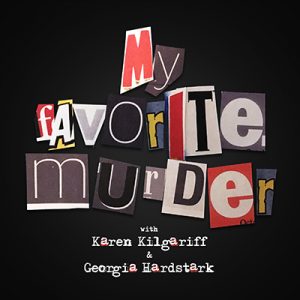
The horrific details surrounding Mary Vincent’s mutilation and her miraculous survival story are encapsulating, and the monster figure of Lawrence Singleton is obvious. What’s less obvious is that “My Favorite Murder” is categorized as a comedy. Comedy and the macabre have a long history, and “My Favorite Murder” does not make jokes about the murders they explore, but the comedy stems from the hosts’ own self-awareness surrounding their unprofessionalism and strange-obsession with true-crime. The cover art plays on genre stereotypes, featuring wording in the style of a ransom-letter. The podcast features no non-diagetic sound, no interviews, no soundtrack, and for the most part remains uncensored. Instead, the show simply consists of the two women sharing conversation while sprawled on couches, gabbing about their days or botox injections or clarifying points from the last episode. In the 1hr and 7min of episode 18, they take over twenty minutes to get settled before going into the murders they’ve chosen to talk about for the week. Karen says early in the episode, “We’re trying to make sure our mics – we’re trying to make sure the sound quality is legit.” But in other episodes, they say call attention to their illegitimacy, saying things like, “We are not professionals” or “If this was a professional podcast…” They swear a lot, referring to murderers as motherfuckers or assholes, but remain serious and react appropriately with gasps or “oh my god”s when finding out the gory details of their counterpart’s story.
But Kilgariff and Hardstark’s “unprofessionalism” has garnered the podcast a large following. Kilgariff and Hardstark are upfront about their odd fascination with the macabre genre of murder, but their “unprofessionalism” has allowed them to openly discuss their own mental health issues. While reclining on couches talking about murder, they also discuss their therapy, anxiety, alcoholism, and drug abuse. As Andrea Marks writes in The Atlantic, the podcast has largely come to double as a mental-health support group. Marks says,
My Favorite Murder exposes listeners to two taboo subjects: murder, of course, and mental health. At the same time, it empowers listeners by offering practical advice for survival and self-care and by using comedy to deflate the scariness of these topics.
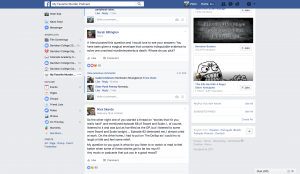
So while the podcast blurs the lines between comedy and horror, professional podcast and support group, taboo subjects are able to come to the forefront of discussion. Kilgariff and Hardstark’s conversational tone and openness – what they consider as unscripted and unprofessional in the podcast world – has led to much of the podcast’s success, helping it reach the number one spot in comedy podcasts and number 10 overall on iTunes. The podcast has a Facebook fanpage with over 100,000 followers, with people posting links to more murders to read about and also sharing mental health or murder-avoidance tips.
In email to Marks, Hardstark writes, “it’s a lot like exposure therapy, where you have to confront your fear to prove that it can’t actually hurt you.” A fellow fan describes listening to the podcast as a way to “exorcise that anxiety” about possibly being murdered. In research on exposure therapy, Stewart Elyse puts forth that “Anxiety is actively reduced by increasing the patient’s perceived level of self-efficacy. Higher self-efficacy should yield a decrease in threat perception, which consequently reduces anxiety” (304). Thus, by combining comedy and horror while subverting our expectations of a podcast, “My Favorite Murder” acts as a window to horrific moments in the past, exposing them and bringing them into the light as to ease our present day fears, making us realize the distance between our dark imaginations and actualities.
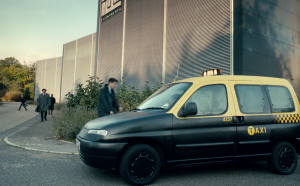
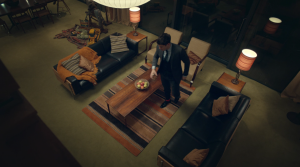
On the surface, the last episode of Black Mirror’s first season is very different than Kilgariff and Hardstark’s podcast. The show is meticulously crafted, and is by no means unprofessional, but by using its medium as its subject matter – screens and technology – Black Mirror brings a self-awareness to itself in a similar manner as “My Favorite Murder” in order to accomplish the same goal of easing the anxiety surrounding the shows topic. While “My Favorite Murder” talks about horrific scenes from the past in modern rhetoric in order to relieve listeners’ fear of murder, Black Mirror conjures up a “what-if” scenario using science-fiction to explore the hot-button topic of how technology is affecting our interpersonal relationships. In Season 1 Episode 4, “The Entire History of You,” everyone has access to a device that records everything they see, hear, and do. Black Mirror implies the “Willow Grain’s” ubiquity by showing airport security measures and making an oddity of a woman without one, but the world imagined within “The Entire History of You” remains remarkably contemporary. The “Willow Grain” technology clearly supersedes technology we have today, but the homes the characters live in and the food they eat and the clothes they wear and the cars they drive look no different than our own, despite the very different world this technology has created:
The taxi Liam hails at the beginning of the episodeHis very average, non-tech living roomThe car he drives
The implications surrounding the willow grain are disturbing, but the lack of futuristic elements outside of the willow grain put the audience at ease by highlighting that this world is a “what-if” scenario, not a prediction (although you can watch me argue here that snapchat has put us on a similar trajectory as the willow grain). The willow grain encapsulates what Freud calls the “uncanny,” or something that is at once both foreign and frightening and familiar. Freud argues that “an uncanny effect is often and easily produced by effacing the distinction between imagination and reality, such as when something that we have hitherto regarded as imaginary appears before us in reality” (15). This is more or less the premise of every Black Mirror episode, but memory, the focus of “The Entire History of You,” highlights another juxtaposition Freud touches on, something we have an intimate, emotional connection with but little scientific understanding of (13). This allows “The Entire History of You” to capitalize on our anxiety surrounding memory by twisting it just enough to be terrifying yet simultaneously believable.
Liam’s rejection of the willow grain at the end of the episode – either out of spite of his wife or as a realization that the technology has ruined his life – remind us that we do not bear the weight a lifetime’s worth of memories, but only the computer on our laps. The “uncanniness” of the willow grain simultaneously causes and eases our anxiety by showing a scary “what-if” situation, while highlighting the “if.” Like Liam is left facing himself in the mirror, grain-less, Black Mirror leaves us staring at ourselves through our screens at the end up the episode.
In “Recreational Terror,” Isabel Pinedo argues that “The postmodern horror genre constructs an unstable, open-ended universe in which categories collapse, violence constitutes everyday life, and the irrational prevails.” In “My Favorite Murder,” Karen Kilgariff and Georgia Hardstark simultaneously subvert the conventions of a podcast (professional sound editing, expert opinions, a story line or narrative arch) and the seriousness of murder, and the “monster” of a murderer comes to stand in as an embodiment of the anxiety and fear that their listeners have everyday. Black Mirror uses screens in order to depict what can go wrong when we rely on them too much. “My Favorite Murder” and Black Mirror both serve first and foremost to entertain us, but they also serve to capture their audience anxieties, then show them in their extremities in order to caution and also protect us against them. “My Favorite Murder” captures the general stranger-danger and fear of death we all have, and while the gruesome stories they share are real, they allow potential victims to live out their fear without the stakes being high. The nature of the podcast allows us to kick back our heels and recline along with them, and we feel more like we’re on a conference call than listening to a podcast. Black Mirror uses a fictionalized account of how technology could implode our interpersonal relationships and communication, capturing the growing anxiety over how far our relationship with technology should go, and by using technology to deliver this message, it makes us all the more wary.
Pinedo concludes by saying horror “is a welcome release from the fiction that life is ordered and safe. Horror affords us the opportunity to express our fear of living in a minefield or, perhaps more accurately, the opportunity, to dance through it” (29). Ultimately, both “My Favorite Murder” and Black Mirror afford their audience the opportunity to flirt with our worst nightmares while remaining safely behind our screens or earphones.
Hardstark, Georgia; Kilgariff, Karen. Audio blog post. “Investigateighteen Discovery.” Feral Audio, May 27, 2016.
Black Mirror – The Entire History of You. Dir. Brian Welsh. Perf. Toby Kebbell. Black Mirror. BBC, 18 Dec. 2011. Web. 1 Mar. 2017.
Marks, Andrea. “How a True-Crime Podcast Became a Mental-Health Support Group.” The Atlantic, Feb. 21, 2017. Web.
Pinedo, Isabel. “Recreational Terror: Postmodern Elements of the Contemporary Horror Film.” Journal of Film and Video, vol 48 no 1/2, 1996, pp. 17-31.
Stewart, Elyse, et al. “Exposure Therapy Practices and Mechanism Endorsement: A Survey of Specialty Clinicians.” Professional Psychology: Research and Practice, vol. 47, no. 4, Aug. 2016, pp. 303-311. EBSCOhost, doi:10.1037/pro0000094.
Kocurek’s piece thoughtfully makes the argument that on-screen violence perpetuates violent realities by playing off of our cultural anxieties, dehumanizing marginalized or “othered” groups – but her article remains fairly narrow minded. I am inclined to agree with her argument that video games and alternative blood reflect deeper and problematic fears, but after reading her piece, I’m not sure who to blame for this digital and real-world violence.
Kocurek only mentions parents once in the article, outlining Serious Sam’s five different ‘blood modes’ and stating that “The ease with which the player may move between these modes makes clear that they are included for player amusement and not as any kind of parental controls” (83). I agree with Kocurek’s statement, but what of the actual parental controls that are made available? On iPhones, which are far and away the most popular gaming device available today, there are a wide array of parental controls that can be set, including age restrictions or access to the app store at all. In that case, is it up to the parents to know these restrictions are available? Up to Apple to appropriately categorize and rate games? In terms of console devices, well, one could just not buy their children certain video games. Kocurek’s piece sounds somewhat like children have unfettered access to these violet video games, which if my childhood is any indication, is far from true. There was one day my mom found out I was playing Halo at a friends house, and I was accosted and did not return.
Restrictions available on iOS, per Apple’s own guidelines.
I would also like to see more research done in terms of the variety of video game available, for example, if arcade style video games with faux guns perpetuate violence more so than handheld devices, and if console games lie somewhere in the middle.
Ultimately, I am in the boat that parents must monitor and decide what games are appropriate for their children to play. The great thing about the digital age is that while it is brining us into a period of anxiety and unknown territory, it can only exist so long as the batteries last. Kocurek makes a strong argument against video game violence, but I don’t think it paints the whole picture.
Postmodernism has been at the center of discussion in two of my classes this semester, and its elusive nature begs the question of whether or not postmodernism encapsulates all other movements of history and of those to come. In the most basic sense, postmodernism means to question everything: to not accept grand statements just because they come from authorities, to decenter ourselves from the very truths around which we revolve. Maybe it’s my own naiveté, but living in a postmodern world has made me question whether or not any authority can, or should, be accepted from here on out.
In Recreational Terror, Pinedo says that postmodernism encapsulates “a profound loss of faith in master narratives,” and “the breakdown of moral clarities.” In a world in which things are less certain than ever, in which indeterminacy reigns, it seems unlikely that a bold, new narrative will be able to unite our trains of thought once again. The second law of thermodynamics states that things will only ever get more complicated, that entropy is always increasing. In other words, once a plate breaks, it is very unlikely that the laws of physics will make that plate fall back into place, and postmodernism seems to have broken the plate.
The image above was introduced to me the first time I heard of postmodernism way back in my days as a freshman in high school. The caption translates into “This is not a pipe,” and the knee-jerk reaction is to disagree. The artist’s point, however, is that this is not in fact a pipe, it is merely the image of one. All in all, in a world that has taught us to not accept anything and that more or less has taught us that our own interpretation is valid as long as we have the evidence and logic to back it up. So, in a world in which master narratives are meant to be thrown out, how can a new one be established?
Despite that William Friedkin’s The Exorcist and Paul Tremblay’s A Head Full of Ghosts are set over twenty-five years apart, much of the horror in each stems from the inability of technology and science to overcome the symptoms of the possessed. While we have not seen the Barretts approach doctors within the first five chapters of Tremblay’s novel, we know from the novel’s paratext that Marjorie is schizophrenia and that her family only approaches a Catholic priest after doctors “are unable to stop Marjorie’s bizarre outbursts and subsequent descent into madness.” Similarly, Regan remains possessed even after undergoing the gruesome medical procedures prescribed to her.
“Le dernier exorcisme,” uploaded to Wikimedia Commons by user Onenna59 on January 23, 2015.
Within the first five chapters of A Head Full of Ghosts, we do learn of the tension religion has caused in the parents’ marriage, and despite Marjorie’s diagnosis as schizophrenic, her ailment remains to be treated in a spiritual way. The term “schizophrenic” was coined in 1908, but even Tremblay’s title implies that something supernatural is happening in Marjorie’s head, something that even early 21st century technology is unable to solve. While I’ll be interested to see where Tremblay’s novel goes from here, if it follows a similar trajectory to The Exorcist, then turning to religion will be the family’s only choice. I was raised Catholic myself, and while admittedly a CEO (Christmas-Easter only), I still understand religion as an attempt to explain beyond what science is able to. I am eager to see how Tremblay’s contemporary take on an exorcism story – the word “smartphone” is used by the end of the first chapter – will put the intersection between religion and technology into conversation. There is no doubt that technology has profound effects on our mental and physical health (and I’m not just talking about freaking yourself out while trying to self-diagnose on WebMD), but I will be interested to see if technology has an affect on a spiritual ailment such as possession, or if such a thing even has relevance in our society today.