
The BBC science-fiction series Black Mirror and the comedy podcast “My Favorite Murder” are very different in form, but both use their medium to confront the cultural anxiety surrounding their subjects. The final episode of Black Mirror’s first season, “The Entire History of You,” takes a proleptic look at how technology could affect human relationships and exacerbate negative human emotions like jealousy, while a particularly gruesome episode of “My Favorite Murder” uses the “I Survived” account of Mary Vincent to take a retrospective look at an actual account of human sadism. However, both Black Mirror and “My Favorite Murder” use their entertainment value and effectively utilize their mediums to fight against and quell the cultural anxiety surrounding their subjects.


The subject of “My Favorite Murder” is, you guessed it, murder. Hosted by Karen Kilgariff, a comedy writer, and Georgia Hardstark, a host of multiple Cooking Channel shows and webseries, the podcast consists of the two true-crime obsessed women narrating an account of their favorite murder of the week to the other. Each episode may center around a theme – child-murderers or ‘90s murders or unsolved murders – but many episodes contain retellings of “I Survived” stories. Episode 18, or “Investigateighteen Discovery” is one such episode, telling the story of Mary Vincent, a 15 year-old hitchhiker who was raped, had her arms hacked off (literally), and was thrown off a cliff by Lawrence Singleton (You can find her episode of “I Survived” here).

The horrific details surrounding Mary Vincent’s mutilation and her miraculous survival story are encapsulating, and the monster figure of Lawrence Singleton is obvious. What’s less obvious is that “My Favorite Murder” is categorized as a comedy. Comedy and the macabre have a long history, and “My Favorite Murder” does not make jokes about the murders they explore, but the comedy stems from the hosts’ own self-awareness surrounding their unprofessionalism and strange-obsession with true-crime. The cover art plays on genre stereotypes, featuring wording in the style of a ransom-letter. The podcast features no non-diagetic sound, no interviews, no soundtrack, and for the most part remains uncensored. Instead, the show simply consists of the two women sharing conversation while sprawled on couches, gabbing about their days or botox injections or clarifying points from the last episode. In the 1hr and 7min of episode 18, they take over twenty minutes to get settled before going into the murders they’ve chosen to talk about for the week. Karen says early in the episode, “We’re trying to make sure our mics – we’re trying to make sure the sound quality is legit.” But in other episodes, they say call attention to their illegitimacy, saying things like, “We are not professionals” or “If this was a professional podcast…” They swear a lot, referring to murderers as motherfuckers or assholes, but remain serious and react appropriately with gasps or “oh my god”s when finding out the gory details of their counterpart’s story.

But Kilgariff and Hardstark’s “unprofessionalism” has garnered the podcast a large following. Kilgariff and Hardstark are upfront about their odd fascination with the macabre genre of murder, but their “unprofessionalism” has allowed them to openly discuss their own mental health issues. While reclining on couches talking about murder, they also discuss their therapy, anxiety, alcoholism, and drug abuse. As Andrea Marks writes in The Atlantic, the podcast has largely come to double as a mental-health support group. Marks says,
My Favorite Murder exposes listeners to two taboo subjects: murder, of course, and mental health. At the same time, it empowers listeners by offering practical advice for survival and self-care and by using comedy to deflate the scariness of these topics.
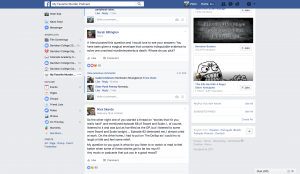
So while the podcast blurs the lines between comedy and horror, professional podcast and support group, taboo subjects are able to come to the forefront of discussion. Kilgariff and Hardstark’s conversational tone and openness – what they consider as unscripted and unprofessional in the podcast world – has led to much of the podcast’s success, helping it reach the number one spot in comedy podcasts and number 10 overall on iTunes. The podcast has a Facebook fanpage with over 100,000 followers, with people posting links to more murders to read about and also sharing mental health or murder-avoidance tips.
In email to Marks, Hardstark writes, “it’s a lot like exposure therapy, where you have to confront your fear to prove that it can’t actually hurt you.” A fellow fan describes listening to the podcast as a way to “exorcise that anxiety” about possibly being murdered. In research on exposure therapy, Stewart Elyse puts forth that “Anxiety is actively reduced by increasing the patient’s perceived level of self-efficacy. Higher self-efficacy should yield a decrease in threat perception, which consequently reduces anxiety” (304). Thus, by combining comedy and horror while subverting our expectations of a podcast, “My Favorite Murder” acts as a window to horrific moments in the past, exposing them and bringing them into the light as to ease our present day fears, making us realize the distance between our dark imaginations and actualities.
On the surface, the last episode of Black Mirror’s first season is very different than Kilgariff and Hardstark’s podcast. The show is meticulously crafted, and is by no means unprofessional, but by using its medium as its subject matter – screens and technology – Black Mirror brings a self-awareness to itself in a similar manner as “My Favorite Murder” in order to accomplish the same goal of easing the anxiety surrounding the shows topic. While “My Favorite Murder” talks about horrific scenes from the past in modern rhetoric in order to relieve listeners’ fear of murder, Black Mirror conjures up a “what-if” scenario using science-fiction to explore the hot-button topic of how technology is affecting our interpersonal relationships. In Season 1 Episode 4, “The Entire History of You,” everyone has access to a device that records everything they see, hear, and do. Black Mirror implies the “Willow Grain’s” ubiquity by showing airport security measures and making an oddity of a woman without one, but the world imagined within “The Entire History of You” remains remarkably contemporary. The “Willow Grain” technology clearly supersedes technology we have today, but the homes the characters live in and the food they eat and the clothes they wear and the cars they drive look no different than our own, despite the very different world this technology has created:

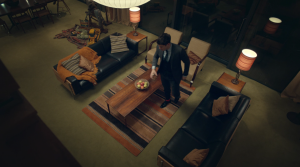

The implications surrounding the willow grain are disturbing, but the lack of futuristic elements outside of the willow grain put the audience at ease by highlighting that this world is a “what-if” scenario, not a prediction (although you can watch me argue here that snapchat has put us on a similar trajectory as the willow grain). The willow grain encapsulates what Freud calls the “uncanny,” or something that is at once both foreign and frightening and familiar. Freud argues that “an uncanny effect is often and easily produced by effacing the distinction between imagination and reality, such as when something that we have hitherto regarded as imaginary appears before us in reality” (15). This is more or less the premise of every Black Mirror episode, but memory, the focus of “The Entire History of You,” highlights another juxtaposition Freud touches on, something we have an intimate, emotional connection with but little scientific understanding of (13). This allows “The Entire History of You” to capitalize on our anxiety surrounding memory by twisting it just enough to be terrifying yet simultaneously believable.
Liam’s rejection of the willow grain at the end of the episode – either out of spite of his wife or as a realization that the technology has ruined his life – remind us that we do not bear the weight a lifetime’s worth of memories, but only the computer on our laps. The “uncanniness” of the willow grain simultaneously causes and eases our anxiety by showing a scary “what-if” situation, while highlighting the “if.” Like Liam is left facing himself in the mirror, grain-less, Black Mirror leaves us staring at ourselves through our screens at the end up the episode.
In “Recreational Terror,” Isabel Pinedo argues that “The postmodern horror genre constructs an unstable, open-ended universe in which categories collapse, violence constitutes everyday life, and the irrational prevails.” In “My Favorite Murder,” Karen Kilgariff and Georgia Hardstark simultaneously subvert the conventions of a podcast (professional sound editing, expert opinions, a story line or narrative arch) and the seriousness of murder, and the “monster” of a murderer comes to stand in as an embodiment of the anxiety and fear that their listeners have everyday. Black Mirror uses screens in order to depict what can go wrong when we rely on them too much. “My Favorite Murder” and Black Mirror both serve first and foremost to entertain us, but they also serve to capture their audience anxieties, then show them in their extremities in order to caution and also protect us against them. “My Favorite Murder” captures the general stranger-danger and fear of death we all have, and while the gruesome stories they share are real, they allow potential victims to live out their fear without the stakes being high. The nature of the podcast allows us to kick back our heels and recline along with them, and we feel more like we’re on a conference call than listening to a podcast. Black Mirror uses a fictionalized account of how technology could implode our interpersonal relationships and communication, capturing the growing anxiety over how far our relationship with technology should go, and by using technology to deliver this message, it makes us all the more wary.

Pinedo concludes by saying horror “is a welcome release from the fiction that life is ordered and safe. Horror affords us the opportunity to express our fear of living in a minefield or, perhaps more accurately, the opportunity, to dance through it” (29). Ultimately, both “My Favorite Murder” and Black Mirror afford their audience the opportunity to flirt with our worst nightmares while remaining safely behind our screens or earphones.
[UPDATED: April 17th, 2:23pm]Works Cited
Freud, Sigmund. “The “Uncanny”.” Trans. Alix Strachey. Sammlung (1919): 1-21. Academic Search Complete [EBSCO]. Web.
Hardstark, Georgia; Kilgariff, Karen. Audio blog post. “Investigateighteen Discovery.” Feral Audio, May 27, 2016.
Black Mirror – The Entire History of You. Dir. Brian Welsh. Perf. Toby Kebbell. Black Mirror. BBC, 18 Dec. 2011. Web. 1 Mar. 2017.
Marks, Andrea. “How a True-Crime Podcast Became a Mental-Health Support Group.” The Atlantic, Feb. 21, 2017. Web.
Pinedo, Isabel. “Recreational Terror: Postmodern Elements of the Contemporary Horror Film.” Journal of Film and Video, vol 48 no 1/2, 1996, pp. 17-31.
Stewart, Elyse, et al. “Exposure Therapy Practices and Mechanism Endorsement: A Survey of Specialty Clinicians.” Professional Psychology: Research and Practice, vol. 47, no. 4, Aug. 2016, pp. 303-311. EBSCOhost, doi:10.1037/pro0000094.