If I were to choose one line that resonated with me the most, it would be where Joquin quotes the King James version of Revelation 20:13, saying
“And the sea gave up the dead which were in it; and death and hell delivered the dead which were in them: and they were judged every man according to their works.”
While I still dislike the way in which he presented this, I think he hit the nail on the head when it comes to summarizing the situation. Dead Set shows us an apocalyptic zombie outbreak through the lens of a screen society, and I prefer to believe Joquin when he says that everything may be happening because a God “is judging our culture, and smiting us accordingly.” Let’s face it, in the show and in today’s world, screens are everywhere, and society can seem to revolve around staring at a screen for long periods of time. I’d venture to say that we’re all already somewhat zombie-like, and condemning society to literal zombification for eternity might not be that big of a change(on a large scale of course, for you and I being a zombie might shake things up a bit). The participants of society are simply changing form, and they’re continuing to do the same things that they were doing before, staring at screens.
For me, Dead Set creates an all appropriate, and terrifying, ending for the screen culture of today.
Kelly turns to the television in an attempt to find out what is happening. Captured from Dead Set episode 1 via Netflix
Sources:
Bishop, K. W. (2010). American Zombie Gothic: The Rise and Fall (and Rise) of the Walking Dead in Popular Culture. Jefferson, NC: McFarland & Company, Inc.
Brooker, C. (Producer). (2008). Dead Set. United Kingdom: Zeppotron.
~~~~~~~~~~~~~~~~~~~~~~~~~~~~~~~~~~~~~~~~~~~~~~~~~~~~~~~~~
Totally aside from the ideas above, isn’t the idea of a life-and-death battle with the dead pretty cool, less cool if the dead win I suppose
Captured from Kabaneri of the Iron Fortress Episode 2
Faced with the news of the complete collapse of society, the characters are faced with dismal fates based on their transgressions relating to their participating in the reality show Big Brother.
Most in line with the blunt zombie symbolism is Riq. Riq sees love beyond his initial safe house. He sees a viable future, even if it means leaving the safety of the farm house. It is also established that Riq doesn’t watch Big Brother. The zombie infection is a poison which the show defines as coming from the Big Brother TV show, and Riq is by all measures immune to it. Riq doesn’t have that ugliness inside of him that enjoys watching shows like Big Brother, which essentially makes him immune to the zombie plague. I know that comes off as kind of a leap, but Riq is the only person who doesn’t die at the hands of a zombie. Furthermore, when Joplin opens the gates they all run past Riq, not stopping to feed on him. Of all the characters, Riq is one of the few that never ends up turning.
Patrick Getting eaten in the final episode of Yann Demange’s 2008 series Dead Set.
I make a point to say that Riq is “one of the few” that doesn’t turn because Patrick also doesn’t turn. Perhaps it is because Patrick is just too dismembered (a lovely bit of narrative symmetry there) to be able to become a zombie, but more likely is that Patrick’s disdain for his own program kept him from turning. Patrick’s production created the outbreak (on a figurative level, of course) yet he shows nothing but disdain for the cast and crew. In one particularly disturbing scene, Patrick cheers on the zombies as he feeds them with his own flesh, possibly analogous to him feeding the violent, tribal instinct which keeps reality shows like Big Brother on the air?
Finally, I’d like to give a big shout-out to Joplin for realizing the existential meaningless of what he has helped create. It is up to the viewer as to what was going through Joplin’s head when he opened the gate, but I like to think it went a little something like:
“I’m going to escape these horrible people who don’t like me and called me Gollum.”
“The horrible crowd of zombies (Big Brother fans) are similarly awful. This is a factor that in my previous rage blinded me to.”
“Patrick just killed an innocent, non-infected man. Perhaps I have once again been manipulated.”
“Well, if you can’t beat ’em, eat ’em!” *opens gate*
As I began to analyze the violence present in the episodes we watched of Dead Set, I realized that in addition to the killer zombies, we encounter many other destructive devices. Characters use scissors, knives, axes, and even lamp posts to protect themselves and to kill the flesh-hungry zombies that come their way. The most notable weapon that the characters use, however, is the gun. Guns are not only crucial to the survival of many of the characters, but they are also integral to the progression of action throughout the series. Without guns, many of the main characters in the show could have been killed at the outset. In a sense, the presence of the gun enhances their chances of survival which enables the viewer to create a deeper relationship with each character. In turn, when each character subsequently dies, the viewer experiences the loss in a more genuine way. Guns are significant because they provide the characters with control and agency over the situation — when paired with a gun in hand, the zombie becomes the victim. Guns also serve as a plot device as they fuel an overall warlike tone and frame much of the action in the story.
The show also succeeds in showing the implications of abusing the power of the gun. We see that when Alex encounters Riq she assumes that he is a zombie and shoots at him right away. Additionally, the police officers utilize the gun to shoot freely at innocent characters. Although Alex and the police officers use the weapon as a means of protection, they submit themselves to the power of the gun and in a sense, let it control them. Another important scene involving guns occurs towards the end of the series when Patrick and Joplin steal the weapons in order to execute their escape plan. This results in the shooting of Riq and the eventual downfall and destruction of the other characters. In this instance it is evident that the abuse of the gun serves as a device to advance the plot and make the action more dramatic. The presence of the gun in this scenario made Patrick and Joplin seem like the zombies, giving them full control as the other characters submit to their power. This leads me to question if Charlie Brooker (creator of Dead Set) intended to make a statement about gun violence and its role as a destructive force since its presence is so crucial to the storyline.
The possible hidden meaning involved in the presence of guns also leads me to question whether the show works to represent a “reaction to the greater cultural consciousness — primarily social and political injustices” which Kyle William Bishop claims zombies do (Bishop 15). As I was thinking about zombies and guns I found myself humming the tune to “Zombies” by the Cranberries, a famous Irish rock band. Fitting, right?! The song was written in 1994 in response to the IRA (Irish Republican Army) bombing of Warrington, England in 1993. The lyrics reflect the turbulent political situation in Northern Ireland at the time as well as a cry for peaceful protest. I find the intersection between bombs/ gun violence and zombies in this song interesting, as it can potentially relate to some similar ideas regarding destruction in Dead Set. As Bishop writes, the “popularity of the zombie has continued to flourish in other media,” which can be seen through the utilization of zombies and the metaphors they evoke in song form (Bishop 17). For instance, the extensive violence occurring between Britain and Ireland fueled an emotional void that made society become zombie-like. Additionally, the repetition of the words “in your head, in your head” represents how war has also become zombie-like through its inescapable and terrifying nature. By using zombies as a metaphor for the painful reality of war, it can be implied that war is not only inhuman, but it consumes human emotions.
If we were to look at Dead Set through the same lens, there may be a deeper meaning associated with the presence of weapons as a destructive force and whether the series intends to tackle the social and political injustices associated with gun violence. Has the gun in a sense become a zombie? As you think about it, be sure to tune into the aggressive and haunting tone evoked by the Cranberries powerfully evocative song, “Zombies.”
Works Cited
Bishop, Kyle William. American Zombie Gothic: The Rise and Fall (and Rise) of the Walking Dead in Popular Culture. McFarland & Company, Inc., Publishers, 2010. Print.
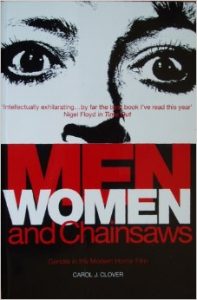
We’ve discussed the trope of the Final Girl a few times in class – basically, she’s the last survivor of the horror film (typically, but not always, a slasher film). Conveniently, she’s usually a virgin (unlike the sexually active women, whose deaths many scholars interpret as punishments for sexual transgressions) and brunette (again, possibly interpreted as displaying more innocence/less sexuality). Although she doesn’t fit the paradigm exactly (she’s not a virgin), when Kelly was trapped in the diary room after the rest of the characters had died, I immediately thought “Final Girl!” While Kelly isn’t a virgin, she’s certainly less sexual than the other female characters, who are built like models and appear to rely on their looks and sex appeal as reality TV stars. Kelly is the most rational, down to earth (read: masculine) woman on the show, so it’s fitting for her to assume the role of the Final Girl.
The term “Final Girl” was first coined in 1992 by Carol J Clover in this book. Source: amazon.co.uk
After I finished the last episode, I went to tvtropes.org to read up on the Final Girl (that’s where I learned the bit about her usually being a brunette, which I had never heard before). If you’re a regular consumer of media/pop culture, tvtropes.org is a very easy rabbit hole down which to fall. As I usually do when on the website, I found myself with about a dozen tabs open, reading up on different tropes and seeing how they fit Dead Set.
I’ll come out and say it: I don’t think Dead Set was a particularly original zombie show. The reality TV element was interesting, and it was certainly enjoyable and well-written, but especially after seeing how many major horror tropes it fits, it strikes me as pretty standard zombie fare. Here are some horror/zombie tropes I found while browsing tvtropes.org, and how they fit Dead Set. (Tropes are all linked to their pages on the website both for citation purposes and in case you’re interested in doing any further reading).
The Zombie Apocalypse trope page reflects many elements seen in Dead Set: the collapse takes place quickly, people lose their humanity in the fight for survival, and there isn’t a happy ending.
The tropes entitled Black Dude Dies First and Bury Your Gays are pretty self explanatory: Angel, a black woman, is the first of the housemates to die and become reanimated, and Grayson follows not soon after.
Not Using the “Z” Word is another standard zombie trope displayed in Dead Set. The characters never say the word “zombie” and act as if they exist in a world without them (like we mentioned in class). This trope is an awfully common one called Genre Blindness.
Room Full of Zombies occurs, unsurprisingly, when a character enters a room flooded with zombies, like Kelly does when exiting the diary room. The trope of Our Zombies Are Different, in which zombies depart from the usual shambling, reanimated corpses, covers the zombies’ speed. The zombies also fit the tropes of Flesh-Eating Zombie and Plague Zombie.
I could keep going, but this post is already long enough. What I’m trying to illustrate is that in terms of plot and characterization, Dead Set doesn’t strike me as very original. While I didn’t find the show predictable, it was certainly familiar, and didn’t depart much from the mainstays of the zombie genre.
(If you’re looking for a somewhat weird, extremely creative and original zombie movie, I recommend Pontypool. It’s on Netflix, it’s pretty short, and it’s like no zombie movie you’ve seen before.)
The zombie narrative is about reveling in the destruction of all our institutions. Society collapses and what little life is left turns into raw survival. The military, law and order, or the police can’t save us; the government is in ruins; everyone you know and love is dead. You’re on your own.
In this way, zombies actually fit neatly into Susan Sontag’s critique of 1950s and 60s science fiction films. Within the “aesthetic enjoyment of suffering and disaster,” she argues, one can see “…the hunger for a ‘good war,’ which poses no moral problems, admits of no moral qualifications…” (The Imagination of Disaster, 215 & 219).
Zombie Kelly stares into a camera within the Big Brother house and is broadcast across television screens in Dead Set, directed by Charlie Brooker.
While the scenarios zombies force living characters to confront may seem tinged with moralistic shadows, it does not actually seem ambiguous or complex to me. Sure, characters may wring their hands over whether to put a bullet in a friend who has just been bitten — but when it really comes down to it, if survival is the name of the game, there is only one choice.
The zombies are stripped completely of their humanity, rendered into feral inhuman beasts. So, again, when a character wrings their hands over whether there’s “any trace of them left in there” — we already know the answer and the outcome. There’s not any trace. They’re already gone, and either you will kill them or they will kill you. It’s an easy bullet to fire despite initial shock and reluctance. Moralistic deliberating is shelved in the interest of survival.
For a genre that seems at first to be soaked in the postmodern, I’m surprised that zombies actually seem utterly black and white. We want ultimate bad, we want easy answers but tough, gory, wartime-esque survival story along the way. We want to be able to see mass destruction and zombies getting blown up without that tinge of moralistic guilt — finally, an enemy who really deserves it no matter what. It doesn’t matter if Jane was a sweet lady when she was alive. She’s a zombie now and it doesn’t matter. One man for himself. Screw the system.
In American Zombie Gothic, Kyle Bishop presents zombies as “valuable cultural indictors” that “cathartically, yet perhaps more destructively,” re-create modern social anxieties on the screen. (26).
Watching the system and the public be torn to shreds is thrilling and satisfying and yes, many times cathartic. The zombie as monster does take on metaphors for our postmodern anxieties; they objectify our anxieties about mass infection, terrorist infiltration, the total destabilization of society — but it doesn’t offer any way to then channel those anxieties into something else. How does our consumption of zombies as monster change the way we interact with the everyday, real monsters (institutionalized marginalization, Muslin bans, internment camps, the terrifying triumphs of neoliberalism, etc etc etc etc etc)?
If anything, zombie narratives render me even more hopeless to combat these corrupted systems. Zombies, as Kyle Bishop points out, remind us of our proximity to inevitable death. (American Zombie Gothic, 21). So what’s the point of trying to change anything? Time to either become a brainless zombie or a gun wielding survivalist. It boils down to a morbid, delightfully easy choice — A or B — which is perhaps what we crave most growing up in a postmodern landscape with a multiplicity of choices.
In this way, I think zombies could actually be damaging to how we understand our individual influence in society and our perception of “the public.” The key to resistance and enacting social, institutional, and societal change don’t arise out of the landscapes destruction porn presents: the masturbatory media equivalent of watered down anarchism (with all the flash but none of the well articulated socio-political theory).
So consuming zombies is really about consuming the easy way out of the system. It strains our social contracts to their breaking points. When those amorphous, tenuous contracts finally break — a sigh of relief! — release from the postmodern soup. The life then actually becomes very uncomplicated: survival. That’s it.
I understand how and why the zombie has become a powerful symbol. However, I’m unimpressed by the quality of popular zombie works: it is destruction porn with vague societal commentary that barely rises above the horror visuals. The zombie medium has the potential to, as Jeffrey Cohen wrote in Monster Culture (Seven Theses), prompt us to reflect on how we interpret the world and “re-evaluate our cultural assumptions.” (20).
But the zombie only makes it half-way around to showing us the nature of our own society and what it could be instead; it get stuck in the reveling of destruction and the same old science fiction/horror tropes Sontag critiqued. It’s a fantastical catharsis but doesn’t push us further. Show me more zombie content that goes beyond the cheap, easy shot of critiquing the “public” or “consumerism.”
The zombie needs to show us more meaningful messaging to be a truly powerful societal mirror and crucible of change. We already know we’re suffering, exploited by neoliberalism and overwhelmed by the postmodern condition — now what do we do aboutit?
Zombies at the mall in 2004 film Dawn of the Dead, directed by Zach Snyder.
In Black Mirror we witnessed an episode that fired up our imagination to its limit, mostly because we consider the science behind the episode to be in the relative future. Martha and Ash were a somewhat generic married couple until the day that Ash died in the tragic car accident. On the day of the funeral, one of Martha’s friends told her that she could diminish her pain and suffering through the use of some new software. The software collects all the data that a person ever published online. The sources online include social media, and mostly public information, but then a more personal source which includes emails. At first Martha’s reaction to the suggestion was very negative (to say the least), but only within a couple of days of dealing with the grief of her husband’s death, she found out she was pregnant and succumbed to the temptation of speaking to her husband again. Her decision to use the software led her to live a life along the boundary of the real and digital world. The software goes through three upgrades, from a kind of chatbot, to a voice chatbot, to a full-blown faux body with Ash’s memories and behavioral patterns. At first, Martha welcomed the new Ash, who was much like the old Ash. As time went by however, Martha began to realize the lack of details that were unique to Ash that the new Ash lacked. She comes to face reality once again, Ash is never coming back, and nothing can replace him.
I found it very intriguing that Martha missed the negative aspects of Ash’s personality which would cause arguments and tension in the relationship, which speaks to the fact that positive without negative is not really positive any more. It is evident through the show, but through common sense as well, that when one has complete control over another’s free will, then a relationship cannot exist. I’ve come to a conclusion, both after watching the show and after thinking on my own, that we will never be able to create a conscious creature. It seems that divine intervention is the only way consciousness will ever be recreated, in the case that it would be.
While watching Dead Set, I was struck by the scene in which Kelly watches zombie Angel flopping around in the pool, and comments that she believes the surviving humans will beat the zombies because the humans are smarter than them. It was apparent well before this that the zombies were not particularly brilliant, emphasized by the way in which they seem incapable of opening doors and spend most of their time scratching at them. Yet, both before this moment and in the following episodes, it is clear that the humans are not winning the fight against the zombies, so I considered why.
A screenshot from “Dead Set,” Season 1 Episode 3. Kelly prepares to shoot zombie Angel. Accessed via netflix.com.
I was drawn to the section of American Zombie Gothic in which Kyle William Bishop addresses how humans are in fact the biggest threat to each other in many zombie films. He writes, “The symbolic threat of the zombies remains a fundamentally frightening part of these films, but because the threats of bodily harm, rape, and murder are real-world potentialities, both in and beyond the zombies, such scenes become all the more terrifying by being inescapable in supposedly escapist movies (Bishop 24-25).” There certainly are aspects of this in Dead Set. For example, the cops threaten to shoot the survivors, Marky almost shoots Riq, and of course Patrick and Joplin’s scheme in the final episode is relatively treacherous. However, I also noted that in an equally real way the humans were threats to themselves. Since they are not mindless zombies, several characters show very human emotions such as empathy and fear that end up resulting in their own deaths. For example, Grayson was clearly struggling with the idea of having to kill his friend Angel, and his hesitation in stabbing her cost him his life. Alex and Riq also seemingly would have been safe staying in the farmhouse, but Alex’s connection to Riq, and Riq’s desire to see Kelly again both drive them to their eventual deaths. In some ways, it seems as if those who become most like their zombie counterparts and lose some of the defining features of humanity have the best chance of survival. While I watched, I felt as though this set the characters up for a rather bleak outcome no matter what: either they died because of their humanity, or in fighting “the other,” they lost what made them better, or at least different, in the first place.
Bishop, K. W. (2010). American Zombie Gothic: The Rise and Fall (and Rise) of the Walking Dead in Popular Culture. Jefferson, NC: McFarland & Company, Inc.
Brooker, C. (Producer). (2008). Dead Set. United Kingdom: Zeppotron.
Dead Set: Season 1 Episode 1 (2008). 13 Feb. 2017 via Wonder Alliance
Perhaps it’s just me, but I find myself stuck in postmodern-analysis mode, so I couldn’t help but focus that lens on the first two episodes of Dead Set. As part-time of zombie-aficionado, I found myself wondering: have any of the characters on Dead Set ever seen a zombie movie? It seems as if zombie-media doesn’t exist in the universe of the show (although Big Brother certainly does, and Big Brother “stars” have cameos throughout these two episodes). Many other zombie narratives take a similar approach, separating their characters from the cultural zeitgeist of zombies–even in parodies of the genre like Shaun of the Dead (2004) and Zombieland (2009) that revel in the fact that they are zombie movies. Maybe this is my inner armchair-zombologist speaking or maybe it’s the requisite irrationality of the horror genre or maybe it’s even the stupidity of some of the characters but, quite frankly, the characters on Dead Set make some pretty dumb decisions during the zombie apocalypse.
Such lack of knowledge would indicate an unfamiliarity with the zombie subgenre. Yet the characters seem intimately familiar (if not obsessed) with TV and the medium as whole. The fictional show takes place partially on the set of a real-life TV show, and the characters playing the crew reference past seasons and characters from the same TV show. Plus Dead Set plays on Big Brother’s audience and the nature of reality tv itself, depicting the audience’s shallowness and distance from reality before slaughtering them in one big “fuck you” (in the show’s parlance) to the devotees of the reality game show. And if that isn’t enough, they bring up real-world TV shows repeatedly, ranging from a brief mention of I’m a Celebrity to a distraction technique inspired by One Man and His Dog.
The kicker however, comes in the beginning of the second episode. Here, they rattle off zombie-movie tropes, blaming bioterrorism (“loony gas”), unbridled scientific ambition from the government or military (“GM foods”), and finally the dreaded “Wi-Fi” for the outbreak. With this moment, Dead Set cements styles itself with some of the self-awareness that characterized the horror-comedies mentioned above. Though the infection itself is played much straighter than those of Shaun of the Dead and Zombieland, the show itself doesn’t shy away from some of the darkly funny moments that accompany its death and destruction, using this balance to help viewers focus on other messages of the show (which we have yet to see completely) rather than just the horror or comedy that’s used to communicate them.
So far in my viewing of the first two episodes of Dead Set, a British television series about filming a Big Brother TV show during a zombie apocalypse, no one has used the word “zombie”. The characters use vague pronouns like “it” or “them” of “things”, but never settle on a name for the undead* monsters.
Devina as a zombie. Source: Zombie Guide Magazine
Why not use the z-word? As a novice to the zombie apocalypse genre, perhaps referring to the monsters as “things” and not “zombies” is common. This does add to the confusion and heightens the terror around the monsters. By not calling them “zombies”, a well-known and defined category of monster, the audience is left more uneasy and does not know (entirely) what to expect from the creatures – like these creatures, which are fast-moving zombies (who can’t climb gates, or swim, apparently).
Another reason could be that in the world of the show, the idea of a zombie doesn’t exist. As a result, the characters have never seen horror films or TV shows with zombies and don’t have that familiar classification for the undead.
Since we knew several of these characters before they changed, perhaps the show avoids “zombie” because referring to them as an other is dehumanizing. Often the characters still refer to known zombies by their given names, such as the producer Peter and contestant Pippa when talking about the (now zombie) host Davina. By still using their names, killing them has an emotional aspect since the characters still associate their human versions with the creatures.
Whatever reason the writers used, not using the term “zombie” irked me as a viewer and resulted in several fumbling “th-th-those THINGS” in the dialogue.
* Shakespeare frequently used “un” words to draw certain emphasis to the opposite of the word or the revocation of a verb, such as “unking” or “unbroke” (both from Richard II). Since one becomes a zombie after dying from a zombie’s bite and returning to “life”, using a Shakespearean interpretation of “undead” makes the for an interesting analysis of the zombification process. Terming them “undead” reflects their transformation back through a reversed process of dying.
Zombies have become such a popular concept in popular culture that it is now ubiquitous as an entire genre of media: be it literature, film, or interactive. However as a tool for effective storytelling, different zombies serve different purposes. Rarely are the zombies the actual cause for discussion, rather we tend to focus on characters that have yet to become zombies. Interestingly, when Dr. Sample assigned the first two episodes of Dead Set to us, he remarked that it involved ‘fast zombies’. The development of the zombie genre has allowed for a crude classification of these undead flesh eaters. The immense diversity in zombie depictions have created film classics such as Shaun of the Deadand 28 Days Later, two movies that could not possibly be more different in tone.
Dead Set’s zombies would appear somewhere along the bottom right. Photo courtesy of visual.ly.
So ‘zombie’ serves as a sort of umbrella term. Judging whether zombies are haunted or not might not be as simple as one might expect. In determining this, one must consider not only the zombies themselves, but also how they are depicted in the medium as well. Did the viewer/reader know the infected before they turned? Are there vivid descriptions of their faces, their eyes, and other things that one would normally associate with being human? If so, the answer is likely yes. Some of the most disturbing depictions of zombies are when the zombie itself retains a part of their former life, such as particular idiosyncrasies– a facial twitch, a walking gait, or a particular location. The undead husk invokes memory of the once living human, and both the remaining characters and the viewer are haunted.
In Shaun of the Dead, the zombies are slow and dumb, and are often dispatched with cricket bats blows to the head. While the viewer sees former friends turned zombies, the interactions are brief, which perhaps contributes to the levity of the film. The zombies simply serve as a plot device that spurs character development, which also agrees with the generally comical tone of the film. On the other hand, Consider Dead Set. The viewer is given at least a brief introduction to quite a few characters before they turn–this feature is a privilege that an episodic format allows due to its longer total length compared to say, standalone films. Perhaps this is why one of the most critically acclaimed zombie works, The Walking Dead, is a television show while the best zombie movies tend to slashed-type hack ’em ups. One thing is for certain–when you talk about zombies, be sure you know exactly what you’re talking about.