Humans vs. Monsters: Who decides who dies?

The article by Kocurek brought up a very interesting argument that I could argue two different ways. On the one hand, to say that a specific group in a game is lesser than and equate them to monsters is a very dehumanizing and God-like way of choosing who gets to die. Kurocek hits the nail on the head when she closes her argument with this quote:

“History has provided enough examples of the efficacy of propaganda in legitimising the abuse and marginalisation of various groups of people that we should be wary in endorsing practices that bear the markers of propaganda”

By giving the game player the ability to kill off only the “wrong” type of human like or other characters in a game, it gives them the God-like type of power I mentioned earlier. No one should have that much power as to decide and kill an entire race of marginalized people, even if it is a just video game.

Now, the other side of this argument is also very compelling to me. To play devils advocate against Kurocek, videos games have been studied to an unfathomable extent. From this article published in 2015, the authors looked at the links between violent video games and risk factors on social behaviors (including violence. Ultimately they found that seeing and hearing violence at home or in their real environment resulted in a significantly higher propensity for violence in the participant group, not video game violence.

While this is just one study arguing another, this is a debate that really interests me. If there was a way to decrease violence in the real world and it was possible to do that through less violent video games, then that would be an amazing technique. The problem is that there is so much contradictory research that no one knows how to interpret it. An interesting turn in research will be with virtual reality. Will killing and violence in games become more prone to violence in real life when using a technology as advanced as vr and what are those future implications?

www.youtube.com/watch?v=xuxcNmk7Qmw

Above is an example game for virtual reality killing games found here.

Rambo vs. Call of Duty

I should start off by saying that I am more than  little biased when it comes to video games and their popular perception. I have been in love with video games from the day i first picked up a Nintendo 64 controller, and that love has continued to this day (at the expense of my bank account and social life). So, whenever I read commentary or criticism like that of Kocurek, I tend to get a little defensive. Okay. With that out of the way, on to my actual post.

One question I had when reading the article was what about movies? It seems to me there is a difference in perception as to how we judge violence in movies versus violence in video games. Why is it okay for Bruce Willis or Tom Cruise to kill/injure/generally maim wave after wave of generic “bad guys” in action movies, yet it’s not okay when I do it at home on the couch? We don’t question any of that. We just assume they’re “bad guys”, because obviously they’re somehow working for the antagonist. The level of violence and bloodshed is still there, sometimes even more so, but because it’s in a movie, not a video game, it’s somehow more acceptable. Here’s a video showing Sylvester Stallone’s killcount in the fourth Rambo movie (I know, I thought they stopped at three too):

www.youtube.com/watch?v=huejDD4znaE

As you can see, bloodshed is not unique to video games. So why the focus on them? One obvious answer is the factor of player choice. Instead of being a passive audience, gamers (a term I really dislike, but that’s another discussion) make conscious, active decisions that directly affect the game world. When you play a game like Call of Duty or Halo, you quite literally make the decision as to whether or not to pull the trigger. In that regard, I can see why people might have reservations about allowing young children to play particularly violent games. Yet as Peter mentioned in his post here, is that the child’s fault? There is already a rating system in place for video games, much like the one for movies, and you can’t legally buy a “Rated M” game (the equivalent of a rated R film) without showing ID. Kids will always want to play what’s cool or new, but isn’t it the parents’ job to filter and decide what content is suitable for their children?

I stated this at the beginning of the post, but I’m obviously pretty biased here. To me, the notion that playing first-person shooter games when I was younger (or even playing them now) somehow has caused me to become more violent in real life is ludicrous. I play NBA 2k and Madden NFL, I don’t suddenly become a better athlete; I play car racing games, I don’t break 100 mph on the way to Chipotle. To me, Kocurek’s article felt like it was written specifically to scare suburban soccer moms into throwing away their children’s gaming systems. I’m exaggerating of course, but at the end of the day what Kocurek calls “the monstrous” in video games, I just call “obstacles”, or “part of the plot”. You have to create some challenge for the player to overcome in order to advance, that’s the entire point of the medium. Whether it’s demons in DOOM, natives in Lego Indiana Jones, or zombies in Red Dead Redemption, I find no difference between the “bad guys” in video games and the “bad guys” in movies. So why are we only concerned about one of them?


Sympathy for Monsters

While reading Carly Kocurek’s “Who Hearkens to the Monster’s Scream? Death, Violence, and the Veil of the Monstrous in Video Games,” I had a problem with one of Kocurek’s main assertions. In her essay, Kocurek states that in video games,

“Monstrousness heightens the dehumanisation of in-game enemies and justifies their execution. Players are right not to feel sympathy for the monsters… they are, by design, unsympathetic characters, mere impediments to game victory” (86).

Thinking about my own experience with videogames, I thought of one of my favorite games to play when I was a child: Kingdom Hearts. Though the game takes place in a rather complex universe, the series focuses on a young man named Sora who fights creatures known as Heartless with a mystical weapon called the keyblade.

This image shows Sora with his keyblade.

The Heartless are creatures born from the darkness in people’s hearts. Once an individual is consumed by darkness, they become corrupted and turn into Heartless, as seen in the clip below (32:00-32:20).

Throughout the game, Sora is thus battling corrupted individuals: humans turned into monsters. Though the enemies of the game were once human, the player is justified in killing the Heartless, because of their now monstrous form, just as Kocurek describes in her essay.

When I was a child I readily accepted my need to kill the monsters and felt no remorse for doing so. The Heartless were inherently evil, so it was my job as the hero to kill them. Now, however, when I look at the backstory of the Heartless I cannot help but feel sorry for the creatures. I am sure that these humans do not wish to be consumed by darkness and become Heartless, yet the spreading darkness throughout the world causes them to become monsters. The keyblade frees the hearts from darkness, allowing the player to become a savior– killing the Heartless is an act of mercy rather than an act of violence. If we are mercifully killing monsters, do Kocurek’s assertions still stand? What does it mean when a player actually sympathizes with the monsters that they are trying to kill?


There’s Always the Power Button

Kocurek’s piece thoughtfully makes the argument that on-screen violence perpetuates violent realities by playing off of our cultural anxieties, dehumanizing marginalized or “othered” groups – but her article remains fairly narrow minded. I am inclined to agree with her argument that video games and alternative blood reflect deeper and problematic fears, but after reading her piece, I’m not sure who to blame for this digital and real-world violence.

Kocurek only mentions parents once in the article, outlining Serious Sam’s five different ‘blood modes’ and stating that “The ease with which the player may move between these modes makes clear that they are included for player amusement and not as any kind of parental controls” (83). I agree with Kocurek’s statement, but what of the actual parental controls that are made available? On iPhones, which are far and away the most popular gaming device available today, there are a wide array of parental controls that can be set, including age restrictions or access to the app store at all. In that case, is it up to the parents to know these restrictions are available? Up to Apple to appropriately categorize and rate games? In terms of console devices, well, one could just not buy their children certain video games. Kocurek’s piece sounds somewhat like children have unfettered access to these violet video games, which if my childhood is any indication, is far from true. There was one day my mom found out I was playing Halo at a friends house, and I was accosted and did not return.

Restrictions available on iOS, per Apple’s own guidelines.

I would also like to see more research done in terms of the variety of video game available, for example, if arcade style video games with faux guns perpetuate violence more so than handheld devices, and if console games lie somewhere in the middle.

Ultimately, I am in the boat that parents must monitor and decide what games are appropriate for their children to play. The great thing about the digital age is that while it is brining us into a period of anxiety and unknown territory, it can only exist so long as the batteries last. Kocurek makes a strong argument against video game violence, but I don’t think it paints the whole picture.

Freedom of Speech and Public Decency Collide (With a Spray of Green Blood)

Carly Kocurek’s argument is one centered around the continuous battle between free speech and public decency. Gratuitous violence, sex, and illegality usually drive up the demand for video games, especially for younger players. Sex sells, as the saying goes, and it doesn’t change for video games. She argues that dehumanizing violence in video games devalues the lives of in-game targets and the individuals or groups they may represent.

War propaganda, in a similar way, dehumanizes enemies under the guise of cartoons and unwavering patriotism. They make you forget that you are fighting your neighbor, but rather remind you to think of the enemy abstractly. Kocurek believes that Propaganda’s legitimizing the abuse and marginalization of various groups is present in these video games and produces similar results.

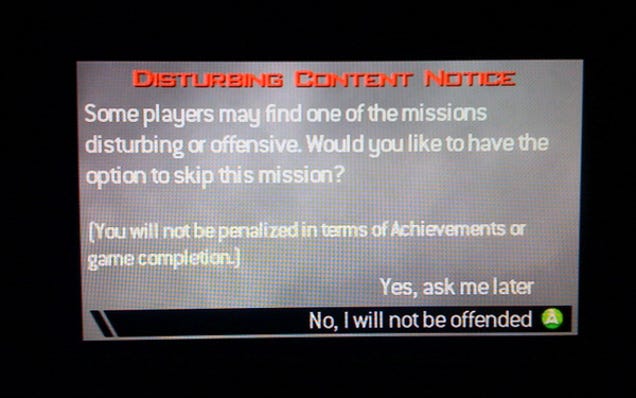
I do not often criticize free speech, however I understand the public decency angle with video games. Imagine a 14-year-old boy in middle school who goes home everyday to play the massively successful, blockbuster, genre-defining Call of Duty franchise. In 2009, the franchise released the game Modern Warfare 2, which depicted a war between Russia and the United States. Starting the game, the 14-year-old boy sees the following warning-

Warning in Modern Warfare 2, screenshot provided by Kotaku.com

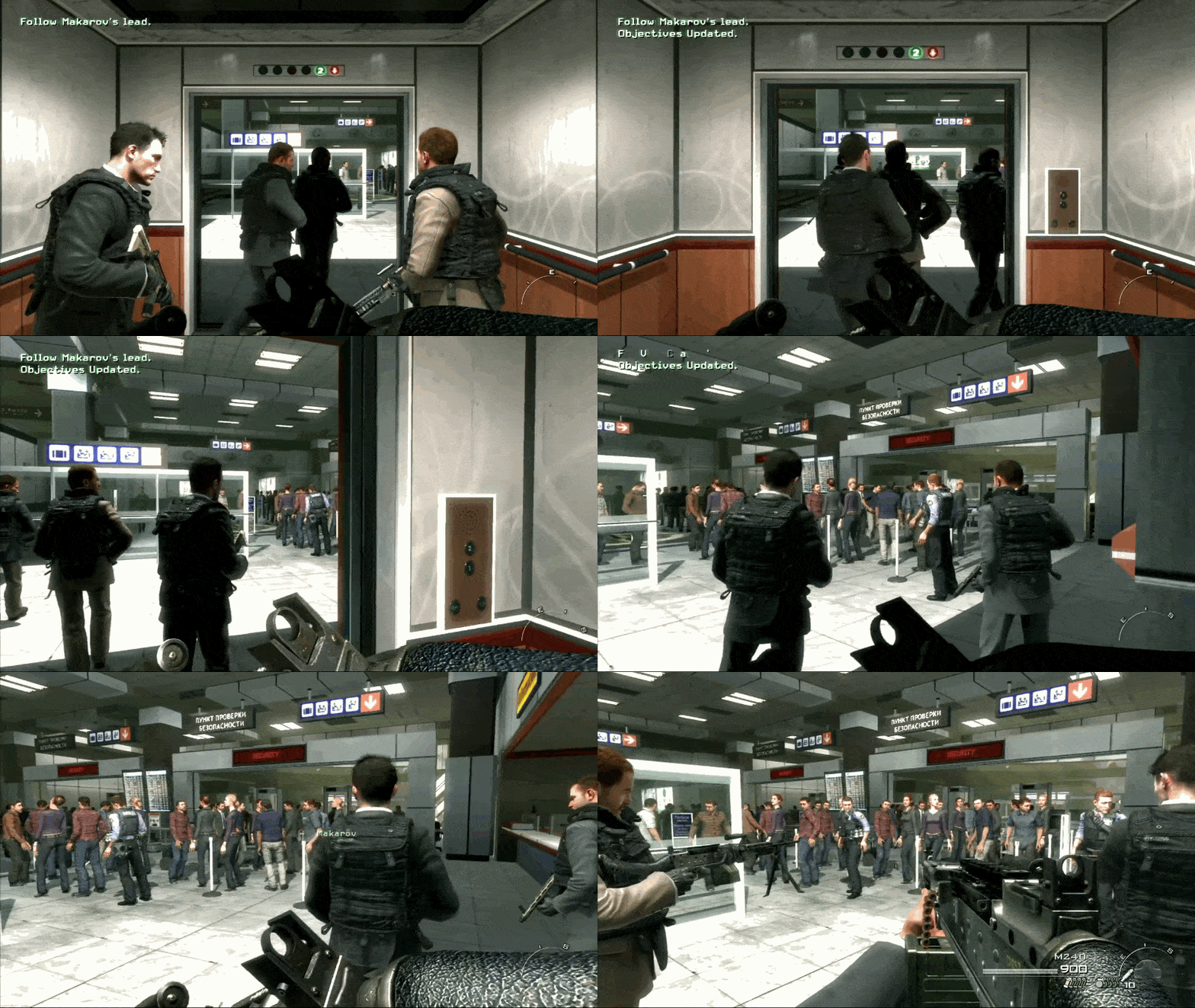
OK- you’re 14, you just convinced your parents to buy you this game since it is rated M for mature. You have played the last three Call of Duty games, and you can handle anything. Right? That’s absolutely what I thought at 14. The level in the game that the warning is referencing is called “No Russian” and there was unprecedented controversy when the game was released. Rather than tell you what happens…

Modern Warfare 2’s “No Russian” level, gif provided by Kotaku.com

It’s confusing trying to work out what is happening from a small clip, but this was the most “PG” graphic that I could find. Players around the country were horrified when they found themselves taking part of a terrorist attack in an airport. Seconds after the gif ends, the player begins shooting into the crowd. For the next 15 minutes, the player commits a mass-shooting without any resistance until the level is finished.

While I completely agree with Kocurek’s argument that video game violence should be less censored and dehumanized, I can speak first-hand on the psychological mark and disgust I feel looking back on that level. Public decency must come into effect somewhere along the way.

At the very least, there has to be better regulation of material like that. It’s a running joke in the gaming community that 14-year-old’s make up Call of Duty’s audience. Essentially, the studio advertises blatantly to their age group. At what point do public decency and freedom of speech collide? While I agree that video games dehumanize murder and violence, and may propagate caricatures of other cultures, there is clear psychological damage that video games inflict. It is unrealistic to ban all gratuitous violence and sex from games, so where is the middle ground?

Zombies, more than just horror?

Image result for zombies as dwarfs www.pinterest.com/pin/446982331737365000/%5B/caption%5D

I’ve always wondered what the appeal is in the zombie apocalypse. I think beyond the horror, action, thriller, and drama, we watch it as a kind of way to vicariously experience anarchy. I believe that somewhere within, every person enjoys the idea of breaking rules, no matter how small or meaningless. Think about it, going to Chipotle for the thousandth time, you must have been tempted to pour root beer in a water cup – maybe you did (you criminal). But regardless, in the rigid world of protocol we live in today, I feel that everyone experiences moments where they simply want to break away. I imagine these little (or sometimes larger) moments of temptation manifest themselves in the form of brief fantasies, where in the world of our imagination, we can break all rules. It’s one of those moments where you say to yourself “How funny/fun/entertaining/crazy would it be if I/someone –“(did something really inappropriate (don’t get any ideas).

I feel that the huge obscure appeal of the zombie apocalypse is the manifestation of these fantasies in one continuous narrative. It’s like putting together all these moments that tempt us, and releasing them into one coherent scenario. Basically, anarchy, without any guilt, because the fault is always that of the “other” (the zombies). Anarchy usually (and rightfully I guess) feels wrong, so when the blame is not on any one person, but a legion of monsters, then everything is justified, and one can go crazy breaking every rule that once used to exist.

I’m sure everyone loves those scenes when characters finally make it to a supermarket, or some kind of storage with food and supplies. It’s like every consumer’s dream come true, running (away) through isles and isles of free things. Consume as much as you want, with no repercussion, it’s finally okay to steal (lol). By virtue of still being alive in the zombie apocalypse, you have earned the right to everything you can get your hands on.

You can imagine how this extends beyond consumerism to every basic instinct we have as humans. Instincts for violence, romance, anything really. The zombie apocalypse is the perfect place for the real “you” to surface, without any negative feedback, everything is allowed. It’s like truly being naked, or something.


Peace,
Duka

When It All Becomes Too Real

When I look at video games now, I remember how old I am in comparison to this technology. When I was a kid, I was navigating a pixilated Frogger across a congested roadway and completing secret missions in an animated James Bond game. I would sit with my brother on the couch facing the bulky old TV, holding PlayStation controllers with wires that often tangled. It was easy to see it was all fake.

Today, it seems that technology has graphics that match the real world and is taking them to the next level through more interactive means. Virtual reality technology has brought a new method of interacting with the horror, violence, or whatever theme is represented in the game.

This YouTube video is gameplay from a horror game using the virtual reality gaming technology called Oculus Rift, which makes a variety of very interactive virtual reality games that truly transport the user to the world of the game.

While this game relates to how more real and scary horror can become through a video game, this same type of virtual reality system can also be used to put yourself into war situations, holding a fake gun that is incorporated into the virtual reality experience.

Virtual reality gaming allows the user to fully immerse into the gameplay, turning you into the main character, violence and all. Photo can be found here

You are no longer playing as a character in the game – you are the character. This is your gun that you are shooting and killing people in the game with. Yet, even with the added reality effects, killing people still doesn’t seem to be a problem. That is what you are supposed to do, and even if the death might look real (with real blood color), it will never actually simulate the feeling of shooting someone and watching them die in front of you. The larger media industry would never allow that sort of reality.

So you have video game technology that is incredibly realistic in almost every sense, except that it is still easy to kill people. Players are still, as Kocurek argues in her article, dehumanizing the targets because their deaths do not carry the full emotional impact that killing a person must entail. Are video games making kids more violent? I think that in these interactive video games where the point is to kill your way to the end, the gaming industry is making it pretty easy for gamers to pull the trigger.

Bad guys?

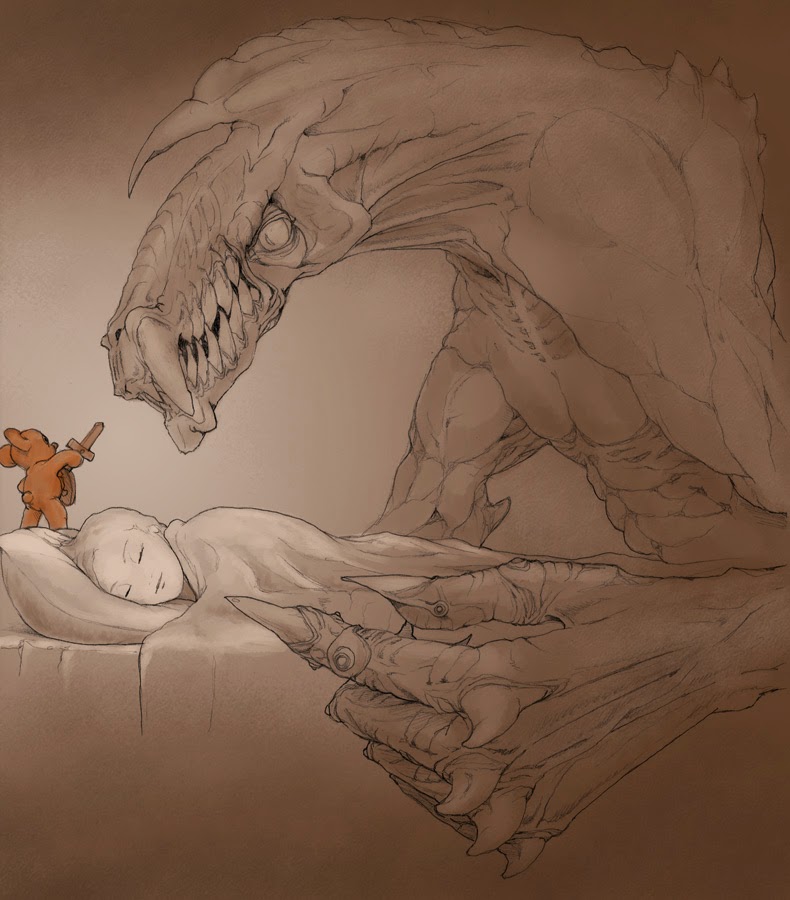
Image picked up from crhserenity.blogspot.com/2014/05/bed-time-stories-legend-of-boogeyman.html%5B/caption%5D

After reading Kocurek’s paper, I was compelled to expand the point of the paper into a broader, more extensive topic. I decided to explore the role and nature of antagonists in video games. I read through papers, articles, interviews, blogs, and forums to try and find some common ground or some idea which was worth investigating. The idea that I find most troubling which seems to surface in every work I read, and that Kocurek’s paper covers is “bad guys”.

The term “bad guy” is used with kids as a shortcut when explaining that some person shouldn’t be trusted, is dangerous, or is generally just someone a child should stay away from. It’s a way of avoiding any explanation and analysis about a situation that a child is usually not capable of at their age, or lacks the experience to connect the pieces even if an explanation was provided.

So why do adults use it in English? (I say in English, because there’s no such thing in either Serbian or Greek, however my knowledge of languages does not extend beyond these three languages, so I can only speak for English) I hear adults use the term all the time, even on TV. I’m sure I recall times when journalists use it to cut to the chase. And it’s a little problematic. As adults, and capable individuals, we shouldn’t ever fall back to such a juvenile way of thinking (it’s not about the term itself, it’s about the connotation of the word and its usage). Are we not capable of understanding another person’s reasons, feelings, and circumstances? To cut to the chase, at its core it displays a lack of empathy (something that children learn to develop over time as they begin to understand their role in the world) (something adults should already have).

There is no such thing as a bad guy. No person is born evil, and no one person is purely evil. Any such belief will only further divide us and create nothing but tension, distrust, and ultimately conflict between people. There are evil acts (acts that violate the rights of others), and people are capable of them. It is still important to evaluate all situations for what they are, setting aside any absolute views and ideas that are purely subjective (bad guys).

“The presentation of military conflict – particularly military conflict based on real – world historical events– as a conflict with monstrous others can be particularly disturbing as it echoes long-standing military propaganda strategies.” – Kocurek
As a person of Slavic descent (with no noticeable accent) that grew up in Eastern Europe, I used to wonder why all “bad guys” had accents like my parents when they spoke English. My parents are great people (that’s an understatement, they are some of the best people), but why do so many villains in both video games and movies have these accents. As a kid I didn’t understand, but I was soon introduced to the reality of the Cold War (which is very much alive, and I believe very heavily perpetuated by this very portrayal of Slavic people as inherently violent, tyrannical, and Communist – all of which are entirely false). My point being that the media usually does a terrible job of showing any kind of empathy, instead opting for a more profitable mainstream popular view (remnants of various propaganda).
In summation, Kocurek is right, and even beyond his point, all media has an incredible power to “other” others, to create even larger cultural and ideological gaps, and even to control our way of thinking. I think it’s important for any individual who believes themselves to be analytical and aware, to see beyond tropes, stereotypes, and ideologies. Behind the scars and hard Slavic accents of my parents, are some of the warmest hearts you will ever get a chance to meet – if you give them a chance in the first place.

And the Terror Rained Down

I am an avid podcast consumer, and I was walking and listening to one particular podcast that struck me as postmodern horror happening in the real world way before its time.

The podcast I was listening to was Radiolab by NPR, the episode entitled “Fu-Go”. You can listen to it here.

The story is about the Japenese hoping to rain terror down on the United States as retribution for some air force attacks the US conducted after Pearl Harbor. The Japenese military was stretched so thin during WWII that they couldn’t commit troops to go and attack the U.S., so they put their minds to work, and came up with this:

A historical image of the Fu-Go balloon bombs made by the Japenese. Photo found here.

A bomb, a very special bomb. The huge helium balloon is big enough to carry it in the Jet Stream, a tunnel of air that can take objects from Japan and carry them all the way over to the West Coast of the U.S. Attached are sandbags, which loosen when the balloon floats too low, allowing it to stay in the wind current. When all the sandbags were gone, it dropped bombs.

Here’s a map of how the balloons got to the U.S. and where they were found or seen in North America. Imagine the horror of the people felt seeing the balloons and watching them cause explosions. No one knew where they were coming from until scientists analyzed the sand inside the sandbags and the fabric used for the balloons.

Map of the path the balloons took across the Pacific from Japan to the US and where they were found or seen in North America. Courtesy of National Geographic.

While these bombs never created the true terror that the Japenese were hoping for, in its own way, they are a kind of technological monster that follows some of the disaster scenarios that Susan Sontag lays out in her essay. This thing, this strange balloon, arrives, but no is sure quite what it is or what it does. And it was not until the bombs start blowing up near big cities that the military took it seriously and started investigating where they came from. There is also a hero of some kind in this story: a sheriff that sees one of the balloons and wrangles it to stop it from flying away, which finally allows the military to find out what it is. And while there is no ultimate weapon needed to attack Japan, this real-life version of creating a disaster horror does follow some of the main points typically seen only in fiction.

Similarly, these bombs can fit into Cohen’s “Monster Culture” essay, in Thesis IV, which describes how history itself can become a monster, incorporating the events of real life into a kind of monster. As revenge for America’s destruction to their cities, Japan hoped to introduce their own technologically advanced, mysterious, deathly monster to the United States.

To learn more about the Fu-Go bombs, visit NPR History, the History Channel, and Project 1947.


Death in Dead Set

Death in Dead Set breaks some of the fundamental rules of film.  Actually, the entire series as a whole breaks some – if not all – of the rules in the 5 phases of disaster located in Susan Sontag’s “Against Interpretation.” Although this is fits into the horror genre, it contains certain sci-fi elements.

These include (Sontag 209-210):

  1. The arrival of the thing
  2. Confirmation of the hero’s report by a host of witnesses to a great act of destruction
  3. Conferences between scientists and the military take place, with the hero lecturing
  4. Further atrocities, the hero’s girlfriend is put in grave danger
  5. More conferences, whose motif is: “They must be vulnerable to something.”

Most importantly, “The films reflect world-wide anxieties, and they serve to allay them,” (225).

So why did Dead Set go with the ending it had? Why was there no explanation behind the disease? Why didn’t we get a close up of any scientists working in the background? Why was the ending so abysmal? All of these could be answered by the fact that this show is a giant metaphor, but still… the unexpected bleakness of the ending was totally shocking and somewhat unsatisfying.

Here’s a few things that riled me up, because I wasn’t expecting them:

NO ONE SURVIVES – not even the main heroine!

www.mediafactory.org.au/michael-liberale/2015/08/13/dead-set-and-zombie-audiences/%5B/caption%5D

“The rule, of course, is that his horrible and irremediable form of [disaster] can strike anyone in the film except the hero,” (222). Whelp. That’s thrown out of the window!

Those who commit heinous acts or sexually transgress make it to the FINAL episode, while the innocent die almost immediately (minus Riq).

In horror movies, who dies first? THE ONES WHO DO BAD THINGS! Even the ones who sexually transgress – i.e. commit adultery, lose virginity, etc – are typically thrown out of the window. Didn’t anybody watch Scream?

www.tes.com/lessons/Mt2fWMCEz9-7oA/scream%5B/caption%5D

Nevertheless, who dies before the scum of the show? Alex and Riq, the two most innocent characters.

The ONLY two likeable characters in the entire show are Alex and Riq. Alex dies somewhere halfway, while Riq is shot by Patrick in the end.  Matt points out that Riq is the only character that is not eaten or killed by a zombie. Even when all hell breaks loose and the gates open, the zombies jump over Riq to get to the other people. He was the only one who didn’t watch the show. He was the only uncorrupted protagonist.

On the other hand, who gets to live?

  1. The guy in the pink shirt who opened the door and got one of the members killed in the first place
  2. The piece of crap, Patrick, who stays on until the end. Admittedly, this made his death even more satisfying (though I couldn’t watch it!). Never has there been a character that I hated more than him.
  3. Gollum, the perverted old fool, lives long enough to kill everybody by opening the gate. Was this an act of revenge on the group for making fun of him? He was corrupted since the beginning, but he made it to the final episode. Yay.
  4. Kelly is a dear, but didn’t she cheat on her boyfriend? According to Jeffrey Cohen’s “Monster Culture (Seven Theses)”, those who commit sexual transgressions are doomed to die or become an outcast. Kelly turns this on it’s head, because not only does she survive the longest – she is one of the leaders in the group.

Something that was less surprising was this…

The bodies of the ONLY two minority characters are mutilated, plus they are the first two who die in the main group. Not sure if this is worth pointing out, but it did come to mind almost immediately. Another metaphor?

dawningcreates.com/tag/dead-set/%5B/caption%5D


Works Cited

Brooker, Charlie. Dead Set. E4. directed by Yann Demange. Netflix. 

Cohen, Jeffrey Jerome. Monster Culture (Seven Theses). 4-25. 

Sontag, Susan. Against Interpretation and Other Essays. New York: Delta-Dell, 1966. 209-225.