The Yellow Wallpaper and A Head Full of Ghosts

“The Yellow Wallpaper” (1892), Charlotte Perkins Gilman via Wikipedia

In the opening pages of A Head Full of Ghosts, author Paul Tremblay invokes Charlotte Perkins Gilman’s “The Yellow Wallpaper,” a 19th-Century short story that grapples with the complicated themes of feminism, mental health and healthcare, and (possibly) evil spirits. The short story comes as the journal of a woman confined to a single yellow-wallpapered room and“treated” via rest cure for hysteria. However, due to the lack of stimulation required by the so-called cure (a solution prescribed especially to women for an obscenely gendered “disease”), the woman fixates on the yellow wallpaper, going as far as seeing several women trapped within it and eventually believing herself to number among them.

Interpretations of the short story differ greatly. Gilman talked about the semi-autobiographical elements of her story–namely, her own personal experience as a patient. Gilman was diagnosed with hysteria–a nervous disorder originally thought to stem from problems with the uterus–and was placed under the care of Dr. Silas Weir Mitchell. Mitchell would become the champion of the rest cure, which he hoped would cure this almost uniquely feminine issue with isolation, lack of activity, and lack of mental stimulation. Sounds like a dubious at best cure for mental illness like depression or bipolar disorder, right? Gilman thought as much, as she crafted this story to fight against the dismissive (and severely ineffective treatment) she was forced to endure.

Feminist critics have decided to shift their critical gaze away from the explicit topic of mental health and instead talk about how the story exemplifies the patriarchal dominance of  society, especially within the medical field. They note the extreme gendering of the events of the story, namely focusing on how the male-prescribed rest cure sought to “cure” the uniquely feminine condition of the protagonist with a level of stimulation and activity more suited to the supposedly simpler female mind. They then view the protagonist’s eventual insanity as a kind of victory over male dominance.

Others can choose to take the tale more literally as a ghost or horror story. Gilman writes with enough ambiguity to allow the chilling events of the story to be ascribed to ghosts or even possessive spirits. The room the protagonist is confined to is supposedly a former nursery, but there are numerous details about it that could indicate otherwise (bars on the windows, rings on the walls, nailed-down bed, and the eponymous yellow wallpaper). Additionally, the protagonist describes the room in oddly violent terms, and even indicates she feels something off about the house when she first moves there for the summer. And then there’s the ending, of course, which at best could point to ghost-induced insanity and at worst a case of genuine possession.

On that note, it seems best to turn back to Tremblay’s A Head Full of Ghosts. Given all this information, the epigraph, and the numerous references made so far (mainly in reference to the “confessional room”), I thought that Gilman’s short story at least deserved some kind of mention. The story’s themes certainly seem to inform Tremblay’s story up to this point (and I suspect will rear their heads again in the coming chapters too). We see the issue of mental health arise with poor Marjorie, who complains to Merry that her condition has been mishandled by parents, psychiatrist, and priests–everyone. Additionally, we see the feminist perspective with Karen Brissette/Merry’s analysis of the family’s TV series. And finally, we see an ambiguity  similar to that which Gilman created, raising doubts as to whether Marjorie suffers from schizophrenia or something much more sinister.
The descent into madness, as recorded by camera

Psychosis is a morbidly fascinating subject present throughout the genre of horror. What makes it so captivating might be the sickening display of otherworldliness that the mentally ill are capable of producing. Their actions are so irrational and nonsensical that they become the source of horror themselves–partly why word salad may be so creepy. We like to see ourselves in control, and seeing such behavior might induce the fear of losing this control, to succumbing to some of sort of dormant, even alien, influence.

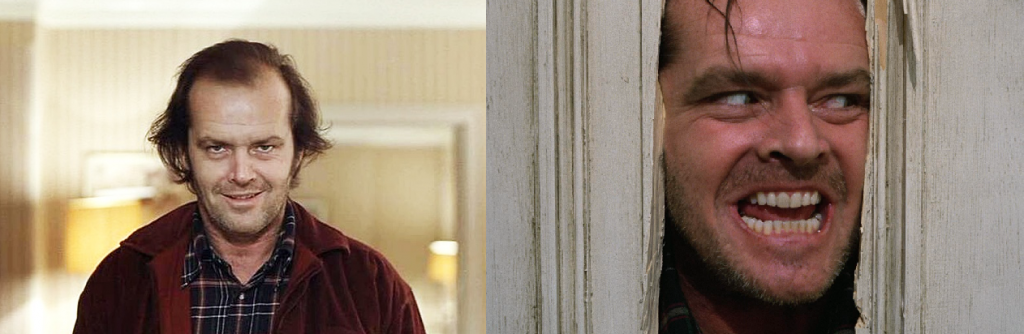
However, the most popular horror feature of them all seems not to be the psychosis itself, but rather the process of losing one’s sanity. There is something about the ‘descent into madness’ that is even more fascinating. So many famous pieces of literature and art explore this journey. Famous examples in literature include Charlotte Perkins Gilman’s “The Yellow Wallpaper” and various works of Edgar Allen Poe. This subject is even more popular in film, with movies such as The Shining (which itself was originally a novel) having a special place in the ‘inexplicably terrifying journey of watching an everyman turn insane’ category.

Jack Torrance of Kubrick’s The Shining, before and after his descent into madness. Photos courtesy of keywordsuggest.org and gamespot.com, respectively.

In Paul Tremblay’s A Head Full of Ghosts, we see young teenage Marjorie slowly fall victim to mental illness from the perspective of her young sister Merry. This is recorded not only by Merry’s early childhood memories but also a small digital camera that she receives from Ken, a friend on the set of the reality TV  show that preys on her family’s unfortunate predicament. There is a compelling juxtaposition of what Merry is able to see hear and what the camera is able to capture. While at times both Merry and the reader are left unsure of what exactly she has seen, the one occasion in which she shows what she recorded to Ken reveals solid truth. With Marjorie falling into what appear to be schizophrenic tendencies, it is difficult to take any part of Merry’s recollection as undistorted by time, outside influences, and even her own desires.

The digital camera obviously contrasts starkly to the organic, shifting nature of memory. However, according Merry she and her sister apparently manipulate it into ‘evidence’ that she is possessed. While the advent of digital technology and recording devices seems to beckon the doing away with drifting memory and bias, we instead see the opposite: digital technology has provided a means of influencing perspective that has become even more convincing than before.


How Do you Remember it? The Construction of Truth in “A Head Full of Ghosts”

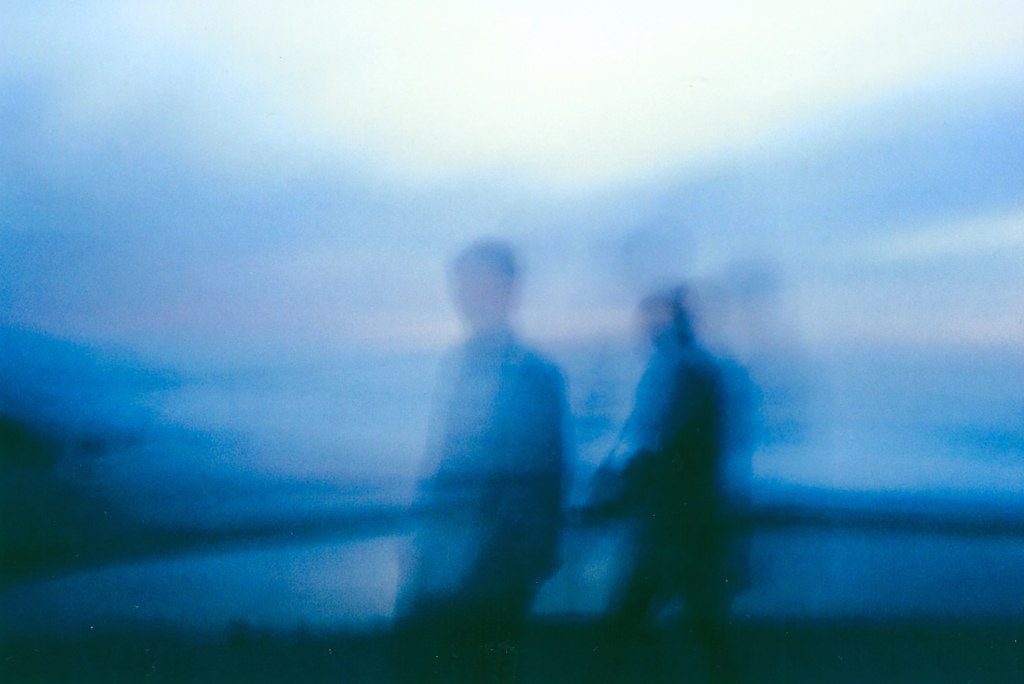
In A Head Full of Ghosts, Paul Tremblay destabilizes the belief that there exists one version of reality, providing instead various conflicting accounts and retellings of one event to highlight the subjective and constructed nature of truth. When multiple “correct” versions of a situation exist, anything becomes possible; both logical and irrational explanations (mental illness versus a spirit possession) have equal authority. Horror is achieved through the realization that there are no limits, only different sides to the same story.

The concept of truth is less tangible and exact than we want to believe. Different versions blur together. Takemoto, Akio. Blurry People. 2015. Flickr. Web. 2 Feb. 2017.

The characters in A Head Full of Ghosts struggle to find the “true” story of Marjorie. Rachel makes it her mission to locate “An accurate account of what happened” (Tremblay 111) and Merry’s mother documents events in a red notebook (46). Merry grapples with this struggle for the “correct” version of events as well, questioning her memory each time it contradicts the accounts of those around her and the TV show’s interpretation.  Merry undermines the validity of her memories by acknowledging that they ““…were mixed together with what other people told [her] about what had happened, and [she] included pop culture and media”” as influences (Tremblay 112). She often hesitates as she recounts her experience, offering excuses each time her memory differs from recorded happenings including “misremembering” (Tremblay 72) and the possibility that she blocked out the trauma or even confused reenactment with reality (73). Self-doubt, amplified by the 15 years that have passed since the incident, cause Merry to falter in her conviction.

Merry’s hesitation introduces a central dilemma: what happens when we can’t remember and when our memory fails us? In his article “The Storyteller: Reflections on the Works of Nikolai Leskov,” Walter Benjamin describes memory as a “…tradition which passes a happening on from generation to generation” (Benjamin 371). However, in A Head Full of Ghosts, the memory of what happened to Marjorie is passed via technology—the camera and the tape recorder. This shift from human memory to technological storage removes the human responsibility of “…reproducing the story” through memory (Benjamin 370). Technology serves as a vault of memories and traumas that will never be fully processed or interpreted outside of their factual value as information or cheep entertainment.

It is perhaps more accurate to say that technology preserves rather than remembers. Memories are rooted in emotion, tied to the feelings experienced in the moment. Because they are tied to emotion, memories are physical experiences that allow us to relive a situation in the past. Technology, however, can’t capture feeling, only fact. For example, when Merry uses her video camera to capture Marjorie’s invasion of her room one night, she is disappointed re-watching it, noting, “It didn’t look as scary as I remember it” (Tremblay 149). The video is unable to address Merry’s fear and anger, and as a result, it’s literal depiction no longer represents the truth. Without Merry’s emotional response, the recording fails to capture the integrity of the event.

This limitation in technology’s “memory” is reminiscent of Black Mirror. In her grief, Martha finds solace in the thought that Ash can be forever preserved, his memory left intact. The fear of forgetting him is removed as a burden. However, not unlike humans, technology has a selective memory and we soon realize that the synthesized version of Ash is missing the very qualities that made him who he was when living. Just like the cameras of the reality TV show The Possession in Tremblay’s book, Marjorie and Ash are remembered through their exterior, public construction of themselves. This concept of remembrance circles us back to the Benjamin reading, which introduces the term to signify what we remember and preserve of a person when they are dead or gone. Benjamin uses the example of the “Man…who died at thirty-five [who] will appear to remembrance at every point in his life as a man who died at the age of thirty-five. In other words, the statement that makes no sense for real life becomes indisputable for remembered life” (Benjamin 373). In the context of A Head Full of Ghosts, the confusion and hesitation of the real-life trauma experienced by the Barrett family is distorted into a single, condensed and indisputable account of the event by the single lens of technology. This one incident in Marjorie’s fourteen years on earth becomes her entire essence and identity in her absence.

Works Cited:

“Be Right Back.” Black Mirror, season 2, episode 1,  Netflix. 

Benjamin, Walter, and Hannah Arendt. “The Storyteller: Reflections on the Works of Nikolai Leslov.” Illuminations. Trans. Harry Zohn. New York: Harcourt, Brace & World, 1968. 83-109. Print.

Tremblay, Paul. A Head Full of Ghosts: A Novel. New York, NY: William Morrow, 2015. Print.


Managing and Creating Fear Via Technology

Chapter 17 of A Head Full of Ghosts was the most frightening chapter to me so far. I was especially struck by the suspense that is created leading up to the blanket scene in which Marjorie seemingly has a demonic episode (or perhaps it really is just a performance) and Merry captures it all on camera. While this was the most frightening moment in the book for me, Merry seemed to be handling the suspense fairly well, considering her circumstances. I wondered why this might be and recognized that throughout the scene she was managing the situation and her own experience by using her video camera as an intermediary.

Instead of experiencing the terror of the blanket scene firsthand, she watched it through the camera display, distancing herself from what was happening right in front her. This prompted me to ponder how else we go about managing fear through our use of technology. When I looked into it further I found that companies have found a way to use this tactic in reverse — using the camera to bring us closer to terror.

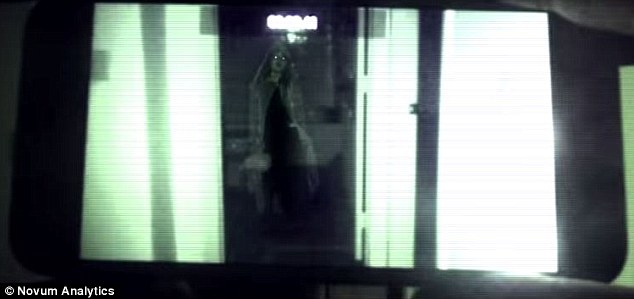
A ghost is presented just in front of the “Night Terrors” player through the screen of a smartphone. Source: Dailymail.co.uk

A new game, called “Night Terrors,” uses the camera on your smartphone in conjunction with the accelerometer and GPS to create a map of your house and overlay horrific images of demons and zombies into the comfort of your own home. This augmented reality video game uses algorithms to configure the dimensions of your house and then to place monsters and ghosts on the screen as if they are standing in front of the player. Coupled with surround sound headphones that make it seem as if floorboards are creaking or someone is breathing right behind you, it could be quite the fright!

How else have we intentionally designed technology to mediate or fuel our fear?

From Scared to Sympathetic

As I have continued reading A Head Full of Ghosts, the evolution of Marjorie’s schizophrenia constantly changes how I view the horror in the book. Throughout the story, Marjorie has been the cause of the majority of the terrifying events but the lens through which I view these has shifted from fear to pity. My perspective shifted in chapter 16, simultaneously with Merry’s view of her sister, when Marjorie explains, “I’ve been faking it… What do you mean why?… then I started hearing the voices, stress induced probably, yeah, but still it sort of freaked me out… I decided I’d just keep pushing it, see how far I could go… You guys should be thanking me. I saved the house. I saved us, all of us, and I’m going to make us famous” (124-25).

As artist Louis Wain’s schizophrenia progressed, the image of a cat becomes more difficult to discern.

Marjorie’s elaborate story comes across as fake and her pretense of control makes Merry realize she “was afraid for her instead of being afraid of her” (125). Merry’s pity humanizes Marjorie. Marjorie is no longer some wild animal, lurking around the house, whose behavior is erratic and unsettling (to say the least). Now that she has talked about her behavior and has some memory and understanding of the damage, Marjorie is elevated from her status as a rabid, mindless, demon-possessed monster to a human recognizing her behavior as her own (not the act of a demon). As readers, we can now evaluate future scenes and recall previous scenes and question how Marjorie’s strange behavior is influenced in combination by her schizophrenia, her own theatrics, and her own fears. Terrifying as reading these scenes may be, imagining being Marjorie is much more painful.


The evolution of analog to digital cameras in the first 140 pages of “A Head Full of Ghosts”

An image camera made out of cardboard boxes from Flickr.

Throughout the first part of A Head Full of Ghosts, Merry’s imaginary play-camera shifts to a real, digital one. On page 29 of the novel, Merry, our debatably reliable narrator, mentions that, “[she] didn’t feel 100 percent safe so [she] built motion-detecting surveillance cameras and a laptop computer out of cereal boxes.” Her feelings of unease are brought about by her sister Marjorie’s revelation that she has been sneaking into her little sister’s room every night and playing slightly sinister pranks on her. Her desire for safety-enforcing surveillance technology, imaginary or not, is understandable.

By page 139, one of The Possession’s producers, Ken, has given Merry her own camera (a “Merry-cam,” as he dubs it), and she is so obsessed with it that “[she] placed the camera where [she] could see it from [her] bed because [she] wanted to see when the light would turn to green” while she tries to fall asleep.

The idea of surveillance within the space of Merry’s room has turned on its head; professionals are now attempting to document every movement of each person on the house, and Merry, instead of using fake cameras as a safeguard, is using real cameras for a form of self-surveillance. On page 140, Merry films herself covering her play house with a blanket—the setup for the next terror scene in the novel in which Marjorie supposedly performs for Merry’s camera. Certainly, Marjorie admits that the show she put on was for the benefit of her little sister’s footage, but there remains the question of the extent to which all of the captured footage of Marjorie is performance.

At this point in the novel, the difference between real and fake, analog and digital, is still being teased out, and I image that Tremblay will continue to play with this as he introduces more of Merry’s disturbing blog entries (perhaps another sort of twisted self-surveillance).

Female Adolescence: The True Horror Show

Many of us remember our awkward adolescent years, in which a hair grows somewhere one didn’t think possible, or a zit pops up right before the big dance(or was it just me)? I can only speak as man, yet, going through puberty was tough. Being somewhat of a late grower, all of my friends, it seemed were six feet tall, when I was barely 5 feet 5 inches tall. Bodies were changing, muscles were developing, and boys and girls became interested in each other.  In The Exorcist, we watch a demon posses a girl going through puberty. Puberty, itself can be seen as this demon: that changes your body, emotions, appetite and sexuality. For females, it is also the beginning of their menstruation. Sight of blood, is terrifying for most people, since it is a signal that something is wrong. The body, while menstruating, hurts adding to the horror of puberty. In puberty, one also finds their sexuality. In many comedic movies or television shows, the young boy going through puberty is often times shown to be spending a lot of times in his room, bed or bathroom obviously drawing to the conclusion of masturbation. However, it has always been a taboo to show younger girls and women as sexual as their male counterparts in puberty. Thus, adds the great surprise and true horror of seeing Regan masturbating with a crucifix. The “abjectness” of menstrual blood is not lost in The Exorcist, adding to the horror when Regan, forces her mother’s head down to her bloody genitals. In this sense, Regan’s body, personality and sexuality have transformed not only by the demon, but by puberty.

In the ever increasing Digital Age, parents are frightened that their children send and receive sexual messages. Parents are terrified of their moral houses being invaded by hyper sexual outsiders.

Although it must be frightening for Regan to undergo a possession, the movies was made to terrify people in connection to Regan and the audience. We always see Regan and her exponentially increasing possession with others, witnessing what her mother, doctors or Father Damien witness. Although, Regan is possessed by a demon, her language is troublesome to her mother and Father Damien. It is terrifying and infuriating to see someone so innocent to use such sexually explicit language. Adding to the notion, of a fatherless house, The Exorcist brings about the fear of raising a child immorally. In puberty, as bodies transform so does the language around bodies and sexuality, transform. Boys and girls become more aware of their sexual urges and it may be hard sometimes to come up with the perfect way to express one’s sexuality into words. In the Digital Age, adolescents have access to the internet and each other, like never before. The Digital Age also introduces a new way to communicate these sexual thoughts yet, parents are always terrified of their children’s sexuality and constantly try to suppress it, and even punish it. For instance, it was a common occurrence for my friends and I to have our cell phones taken and read by our parents and then receiving lectures about morality and sexuality. One of those times, my parents also took my sister’s phone, and read lewd, eerily similar to The Exorcist messages from a boy she liked. This not only terrified my parents, it outraged them. They were immediate contact with the boy’s parents and grounded my sister for who knows how long. They were terrified of this boy’s advances towards a Catholic “morally raised” adolescent girl, and were terrified that this boy will somehow “possess”, their daughter and cause her to say and do these repugnant sexual fantasies. After that, both of our phones were forced to undergo downloads after download until my parents sense of terror and shock were subdued. What wasn’t frightening to my sister, a boy showing interest in her, to my parents was the most horrifying event, an unknown entity-a teenage boy filling my sister’s head with “impurities”. Thus for parents, adolescence in the Digital Age, is the True Horror Show.

The picture is taken from “https://cybercaution.wordpress.com/contact-us/”, a  Cyberbullying blog. Ahmed Mahmoud, is said to be in charge of posting pictures and videos on the Blog.

Regan: Why Her???

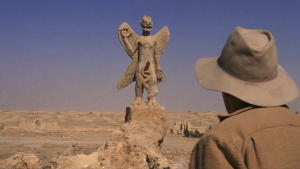
While watching The Exorcist, I had many grossed out moments but overall had two main thoughts that remained after the final scene. First, The Exorcist  had a very interesting beginning to me. While watching it, I was trying to figure out the whole time what the connection would be between the archaeological site and this little home of mother and daughter in D.C. and I don’t think my question was ever answered (although Barbara Creed drew some very nice parallels between the women in both places as witches in The Monstrous Woman). The very end of the movie showed a superimposed image of the weird bat-like demon statue that was at the archaeological site, but my main question was how did this demon choose this seemingly  innocent child to begin with?

Demon (Pazuzu) statue in Exorcist found here.

Father Merrin seems to be the link between the two physical places but it still feels odd as to why the child was possessed. For cinematic purposes, an innocent child that is still young enough for the words that she uttered and actions she performed while possessed had a very disturbing impact. The only reason I can think that Regan was chosen  was because of talking to “captain howdy” on the Ouija board she found in a closet but even then, in a city that big and populated, there has to be more than one Ouija board being messed around with. Maybe I am just being too cynical and unwilling to believe the impossible (meaning demonic possession) which brings me to my second observation.

I couldn’t help but think back to “Be Right Back” at certain points in this film because of the impossibility of certain actions. For example, when Regan moved her head in a complete circle, could stab herself without feeling the pain, or live seemingly without food because no one could go near her or her mouth, it drew a parallel to the human but not body of the replacement Ash in Black Mirror. Both films use human bodies in ways that are abnormal and impossible to conceive as reality in a truly “human” concept and instead force the viewer to see them as an other and come up with a different explanation of the actions taken before their eyes, possibly lending to the horror of the genres.

Schizophrenia: The Modern Day Demon?

Even though I’ve enjoyed what we’ve read of A Head Full of Ghosts so far, I’ve  found myself most interested by the title and what it implies. In both The Exorcist and A Head Full of Ghosts, the possibility that the “possessed” character simply has schizophrenia is brought up. That got me thinking about schizophrenia itself, more specifically how we conceptualize it and how it relates to the idea of “possession.”  If we define possession as an entity taking control or root in a host body of another, separate entity, then could we conceivably call schizophrenia a type of possession?

www.abc.net.au/radionational/programs/allinthemind/invisible-intruders-e28093-the-voices-in-my-head/5117208, uploaded December 1, 2013

Tremblay’s title, taken from a Bad Religion song, creates the imagery of an individual whose head is filled with identities not their own, of someone who is “carrying” separate individuals within themselves. It feels obvious to me that what people in past centuries called “demonic possession” was in reality something along the lines of schizophrenia, but if there can be modern “technological ghosts” (along the lines of Bob Ross), is there a “modern technological” equivalent of possession? If someone is hearing and being influenced by voices locked within their own head, is that any less terrifying or uncanny than some supernatural force entering their body? I think by and large schizophrenia gets categorized as simply “hearing voices” or “seeing things”, and to do so is to drastically take away from what is actually occurring, and how frightening it can be.

Exorcism: Religion Picking Up where Science Leaves Off

Despite that William Friedkin’s The Exorcist and Paul Tremblay’s A Head Full of Ghosts are set over twenty-five years apart, much of the horror in each stems from the inability of technology and science to overcome the symptoms of the possessed. While we have not seen the Barretts approach doctors within the first five chapters of Tremblay’s novel, we know from the novel’s paratext that Marjorie is schizophrenia and that her family only approaches a Catholic priest after doctors “are unable to stop Marjorie’s bizarre outbursts and subsequent descent into madness.” Similarly, Regan remains possessed even after undergoing the gruesome medical procedures prescribed to her.

“Le dernier exorcisme,” uploaded to Wikimedia Commons by user Onenna59 on January 23, 2015.

Within the first five chapters of A Head Full of Ghosts, we do learn of the tension religion has caused in the parents’ marriage, and despite Marjorie’s diagnosis as schizophrenic, her ailment remains to be treated in a spiritual way. The term “schizophrenic” was coined in 1908, but even Tremblay’s title implies that something supernatural is happening in Marjorie’s head, something that even early 21st century technology is unable to solve. While I’ll be interested to see where Tremblay’s novel goes from here, if it follows a similar trajectory to The Exorcist, then turning to religion will be the family’s only choice. I was raised Catholic myself, and while admittedly a CEO (Christmas-Easter only), I still understand religion as an attempt to explain beyond what science is able to. I am eager to see how  Tremblay’s contemporary take on an exorcism story – the word “smartphone” is used by the end of the first chapter – will put the intersection between religion and technology into conversation. There is no doubt that technology has profound effects on our mental and physical health (and I’m not just talking about freaking yourself out while trying to self-diagnose on WebMD), but I will be interested to see if technology has an affect on a spiritual ailment such as possession, or if such a thing even has relevance in our society today.