Possession in The Exorcist and “Be Right Back”

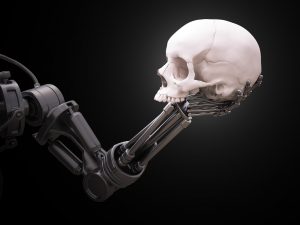
While reading Barbara Creed’s “Woman as Possessed Monster” from The Monstrous Feminine I could not help but draw parallels between Creed’s examples from The Exorcist and the Black Mirror episode “Be Right Back.” Creed actually drew me to make this comparison when she pointed out that part of the horror of The Exorcist stems from Regan’s possession creating an other out of an otherwise known character. Though The Exorcist deals with the possession of a young girl by a demonic entity, “Be Right Back” showcases a different kind of “possession” through Ash’s online persona inhabiting the body of a robot modeled to look exactly like him.

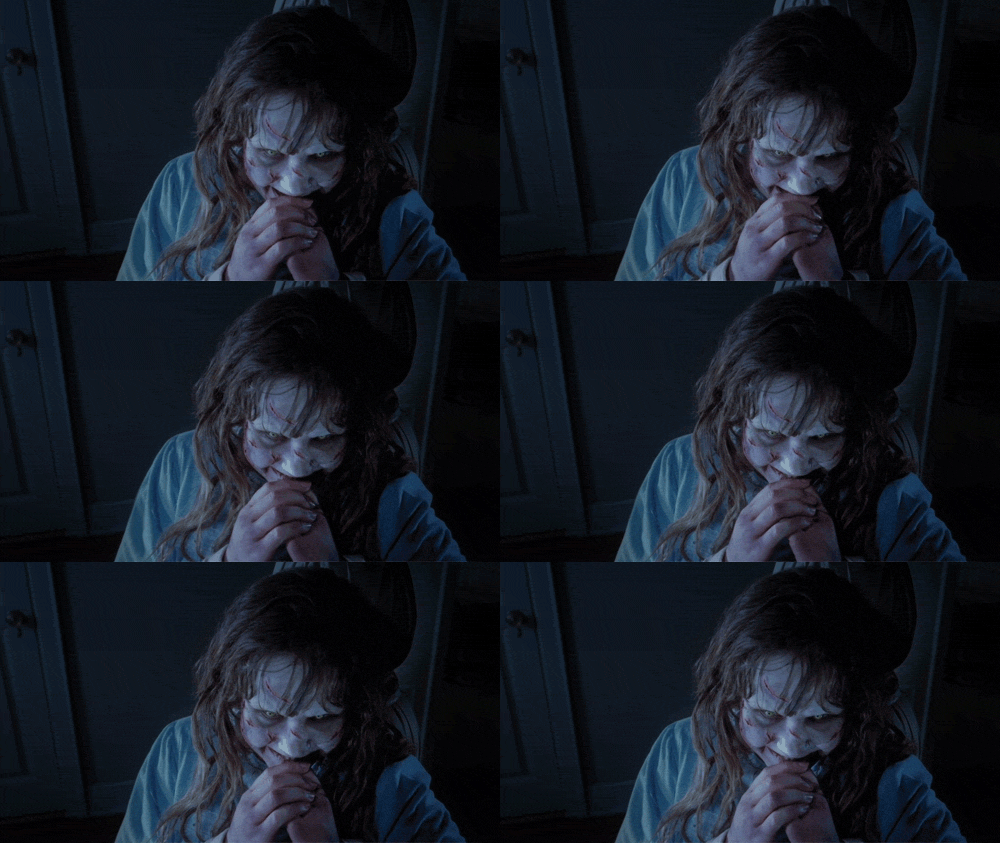
To Creed, “the possessed or invaded being is a figure of abjection in that the boundary between self and other has been transgressed” (32). In The Exorcist, the abjection is seen through a female body, as Creed claims it is most often (32). However, in “Be Right Back,” the abjection is seen through the workings of the male body. This can be seen simply in Regan and Ash’s “bodily excretions,” something Creed claims, “must be treated as abject” (38). In The Exorcist, Regan’s possession leads her to urinate publicly and projectile vomit, something that places a distinction between the self—the true Regan, who would not commit these actions—and the other—the demon controlling Regan. In “Be Right Back,” the creators take the opposite approach. Ash’s robotic form need not ever have bodily excretions, and this lack of bodily excretions illustrates the possession and thus abjection. By manipulating the bodily excretions of Regan and Ash, the viewer is forced to recognize the fact that these characters have become an other, and thus something to fear.

Seen here in The Exorcist, Regan’s excretion of bodily fluid marks her as an other.

Regan and Ash’s “otherness” can also be seen in the sexuality brought on by their possession. While Regan’s possession plays on an incestuous mother-daughter relationship, all of Regan’s sexuality is brought to the viewer’s attention by the fact that she is possessed by a demon, which causes her to shout obscenities and her desire to act on her sexual impulses. Regan’s otherness is created by her manifestation of sexual desire, but Ash was a sexual being before his possession. His possession,  gives increased autonomy and skill with regards to sex, something real Ash lacked, thus classifying him as an other or possessed being.

Works Cited

Creed, Barbara. “Woman as Possessed Monster: The Exorcist” The Monstrous-Feminine: Film, Feminism, Psychoanalysis. New York: Routledge, 1993. 31-42. Print.

Image Citation

horrordigest.blogspot.com/2010/01/pukeapalooza-best-vomit-in-horror.html

Mixing Horror and Reality: The Exorcist in DC

I was born and raised in Washington, DC, within the actual limits of the city (so not Virginia, not Maryland – I have a DC address and a DC phone number). The city itself is not very large, so when a movie or show is filmed in DC, I can usually tell at least what neighborhood the scene was shot in.

I had never seen The Exorcist before this viewing, but I was struck by the extensiveness of the filming in DC. The famous steep set of stairs that Father Damien falls down to his death near the end of the movie are stairs that I am very familiar with. I remember hiking up and down them with my friends to get from Georgetown down to the Potomac waterfront. I remember climbing them in the dark with my parents after watching the July 4th fireworks from Key Bridge, crossing the Potomac below Georgetown. I have memories of these steps rooted in my actual experiences.

The Exorcist steps in DC, from Wikipedia

Now, however, since I have seen The Exorcist, a new layer of memories and emotions has been added in my mind when I think of these steps, a layer that is no longer rooted in physical experience.

The setting of this movie in DC, a place so familiar and important to me, has served to influence my emotional response to the death of Father Damien more so maybe than for my classmates. If this movie was set anywhere else in the world, I would not have this same mixing of reality and horror in my mind as I do now. In the future, I’ll stand on that middle landing and think about both a dead man and a stunning fireworks show, even though only one of those events is real.

DC has taken extra lengths to integrate reality and horror in this place. In October of 2015, the Mayor of DC, Muriel Bowser, declared that these steps would be a DC Tourist Site. You can watch the video of her doing so in a news segment by ABC here. These places are firmly linked, a blending of physical and fake, and now a set of stairs that will always have two layers of memories for me, all because of my deep connection to Washington, DC.


The “What if…?” Moments of Good Horror

Many movies released in the last few years, like the Resident Evil or The Purge franchises, use dystopian or apocalyptic settings to create worlds where the events of the movie become believable. These settings ask the viewer to suspend their disbelief because the events of the film couldn’t possibly be or become true, but only exist in these fantasy landscapes. Other horror films immerse their audience in a familiar, routine setting to distort feelings of comfort and safety.

Our discussion of the word “uncanny” fits in nicely with this second category of horror, because the most successful horror works rely on their uncanny moments. It forces the audience to rethink elements they take for granted in everyday life. Hit horror movies from The Exorcist– now almost 45 years old- up to the Paranormal Activity franchise have used this approach to become more successful than their jump-scare counterparts and stay relevant in the horror genre years after their initial release. These are the movies that leave us thinking about what we might do if we found ourselves vulnerable in comfortable, familiar situations. I believe these “what-if” moments form the basis for what makes horror successful and memorable.


In 1973, many movie-goers were likely terrified by the idea that their children, or sisters, could become possessed like Reagan in The Exorcist. A sweet, happy girl in the beginning of the film, suddenly turned into the creature shown here. Source- Giphy.com | Full link found here 


In the same way as these hit movies, horror novels force readers to suspend their disbelief in a crafty, underhanded way because authors cannot set a tone through actors, music, lighting, or a visual set. Successful horror books do not rely on jump-scares, or terrifying costumes- they must subvert their readers’ ideas about the world and disrupt a sense of safety. While reading through A Head Full of Ghosts, this idea kept coming back to me. What elements made the novel scary rather than gimmicky? What made it successful as a horror book? I want to talk about two elements in the first five chapters that Paul Tremblay did well.

One of the first things I noticed as I started reading A Head Full of Ghosts was how jarring the novel begins. It’s not unusual that the novel starts off in a distant future looking back on the events of the book, but the novel leaves you in the dark as you figure out what is happening. Paul Tremblay found a great way to suspend our disbelief by allowing us to look back with the reporter on Merry’s childhood. However, it takes a few chapters to get used to the idea that we are looking back on past events through Merry’s perspective. On top of that, the blogs and message-board passages draw us in by alluding to events they assume we are familiar with, and this makes us curious and pulls us in farther. Once I got past the hurtle of understanding how Paul Tremblay was setting up the story, it became easier to follow- but maybe this is the literary version of an introductory jump-scare. Beginning the novel by confusing the reader forces us to focus on understanding what is happening rather than criticizing horror tropes or studying the text for foreshadows or other hints. It draws us in to care about the family and the people, and humanizes the situation.

Second, the relationship between Merry and her sister form the basis for why the novel is uncanny- and why it is successful as a work of horror. By aligning ourselves with Merry and seeing the story through her perspective, her actions seem perfectly understandable and logical. Yes, Merry might have built a fort and wants only to read stories with her older sister, but knowing that she is eight years old excuses her actions and creates a sense of innocence. When Merry’s relationship with her sister begins to change, with the story about the Boston Molasses Disaster and the note about sneaking into Merry’s room, we place ourselves in Merry’s position and think about our own siblings.

Since this is a horror novel, mostly innocent actions like Marjorie holding Merry’s nose shut while she is sleeping seems more foreboding than the normal sister-sister relationship. What makes this successful, I think, is the way that normal sibling interactions are warped and threaten the innocence of Merry’s character. It makes us think of our own siblings or family and places us in this uncanny situation as we relate with and fear for Merry. I think the most successful works of horror, either films or novels, make the audience ask themselves what-if questions. I absolutely found myself thinking, “What if this happened in my own family?” and  “What would I do if I were in Merry’s position?”


Artificial Intelligence as a Cultural Monster

thecreepyfactor.com/wp-content/uploads/2015/11/scifi-horror.jpg%5B/caption%5D

In Isabel Pinedo’s essay on postmodern horror, she asserts that violence in the horror genre “must be situated in the context of monstrosity, culturally defined as an unnatural force” (21). In several of my past and current English courses, we’ve analyzed various literature through the lens of monster literary theory, and I want to add this framework to the discussion started in the previous blog posts. Both Jasmine and Elise’s posts examined robot Ash from Black Mirror in relation to the idea of the postmodern monster (or zombie), discussing how Ash blurs the lines between the human and the nonhuman. Anxiety surrounding technological advances in modern society, especially those pertaining to artificial intelligence, has become a popular theme in science fiction, to the point where it has created somewhat of a subgenre (i.e. robots taking over the world). Stephen Hawking even said that advanced artificial intelligence could potentially bring about the end of human civilization. Could AI be the epitome of the postmodern monster? Why do we fear it so? Much of monster literary theory suggests that monsters are so terrifying to us because we see ourselves in them. This idea ties back to the concept of the uncanny, or the strangely familiar, that we talked about in class the other day. In his essay, “Monster Culture,” Jeffrey Cohen writes that “monsters are our children”(20). He discusses several distinguishing characteristics of what makes a monster, but one of these particularly struck me in light of AI. Cohen explains how monsters are “disturbing hybrids,” dangerous because they are “a form suspended between forms that threatens to smash distinctions”(6). We often ask, what makes a human distinctly a human? Is there such thing as a “soul”? If AI can reason and even experience emotion, traits that have been considered uniquely human throughout the history of mankind, do the lines become blurred? Perhaps one of the most disturbing aspects of AI is that it transcends humanity. It takes away human error. It doesn’t require basic needs like food and sleep. Could it potentially be immortal? On a closing note, as I thought about these questions, I realized that despite his many unsettling components, I found robot Ash from Black Mirror oddly refreshing because he demonstrated the ways in which artificial intelligence falls short of humanity.


Cohen, Jeffrey J. “Monster Culture (Seven Theses).” Monster Theory: Reading Culture. Minneapolis: University of Minnesota Press, 1996. Web.

Feminist representation in postmodern horror

Pinedo’s in her essay references the role which reason plays in both classical and postmodern horror. She explains how rationality is defined through classical horror as a distinctly male trait, where irrationality and disorder are distinctly feminine. In many classical horror films, those who exercised logic and reason were members of fields which were dominated by men, which assisted in creating a skewed definition of what reason really is. However, within the demented universe of postmodern horror films, much of the horror comes from the inability to apply reason to a given situation. The limited definition of “reason” created by classical horror is shattered by postmodern horror. Since this essay was written, I feel that postmodern horror has done much to remove the limitations on feminism which the article cites.

The film that comes to mind is The Babadook (2014). The Babadook fulfills all the requirements for postmodern horror presented in the article.  There is violent disruption of the normal world caused by a creature from a book gaining consciousness. There are transgressions of boundaries in the way the protagonist abuses her child who has a behavioral disorder, which is a transgression that would not be tolerated of a protagonist in classical horror. There is a violation of rationality in the ways which the creature manifests itself throughout the film. There is no plot resolution, as the protagonist at the end of the film can only defeat the Babadook by keeping it locked in her basement. The film puts an ironic spin on the victim-role which female lead characters often fall into. It is ultimately about the female protagonist dealing with the terrifying thoughts and feelings that accompany mental illness, but it’s post modern bent allows the female protagonist to display her flaws without receiving the seal of moral degeneracy that classical horror would award their female protagonists for similar behavior.

Pictured below is The Babadook’s horrifying monster.

A scene from The Babadook (2014) directed by Jennifer Kent. The picture shows one of the film’s main motifs, where the events of the plot are depicted by the monster within a haunted children’s book.

While the most recent films which could fall into the postmodern horror genre could not explicitly be called feminist, films such as The Babadook set up interesting character roles within the genre which prevents the limited social power Pinedo cites. The role of the protagonist herself as a non-sexualized, flawed mother shows the evolution of the female role in postmodern horror since the time this essay was written.

Examining “Be Right Back” under a postmodern lens

Ash

Black Mirror’s “Be Right Back” holds several elements of postmodern horror. The most notable is the creation of Ash, the monster. Similar to the classical monster found in Mary Shelley’s Frankenstein, the postmodern monster is one who, “violates the social norm and blurs the lines between ‘me/not me, human/nonhuman, life/death,'” (Pinedo 21). Some obvious questions include:

  • How human is the new Ash?  What is the line between man and machine?
  • In a world where it is almost second-nature to document each passing moment electronically, do we ever truly die? If  robot Ash could repossess ALL of Ash’s memories – and not just the digital ones – could he escape death?

The existence of such an uncanny character, as evidenced by many previous posts, is difficult to outright commend or vilify. Ash’s existence “blurs the boundaries between good and evil, normal and abnormal,” and leaves us feeling unsettled (21). Nevertheless, Ash’s existence is not immediately condemned in other posts on this thread. For example, Aaron uses his post to claim that, “temporary rebirth would allow the grieving person to better their emotional state,” as in the case of the pregnant Martha. Although Ash’s replacement is essentially a “monster,” he made Martha feel better. Therefore, having a temporary ‘partner’ could potentially benefit society. There is, however, an emphasis on temporary since this situation seems unnatural.

Martha

Similar to Nancy in A Nightmare on Elm Street, Martha “survives because she rejects the rational belief that dreams are not real and instead puts her faith in the irrational premise that collapses dream and reality,” (22). Martha decides that she cannot live without Ash even if he is in a synthetic form. She couldn’t push robot Ash over the edge of the cliff, because his very existence blurred the lines between reality and fiction. Martha survives by choosing to live in this fiction and putting aside rational thought (that being: turn the poor robot off, follow the five stages of grief, and get back to normal life – maybe even meet someone new?). The irrationality of her actions in the end are exactly what save her. Imagine if she had pushed the sobbing, begging image of her husband to its death? Wouldn’t the consequences have been much worse? How could she live with herself?

“Nothing is what it seems to be in a postmodern horror,” (22). Truly, nothing is what it seems. I wonder if Martha dates or has other people come over to her home. I wonder if she still has contact with her family, or if she completely abandoned them. In the end, all we are left with are the images of Martha, Ash, and their daughter alone in their home.

Death

“Horror exposes the terror implicit in everyday life: the pain of loss, the enigma of death, the unpredictability of events… terror is a routinely repressed aspect of everyday life,” (26).

Why is death such a foreign concept for us? Death is a natural part of life, but we rarely see it in a modernized world. The only times we encounter death on a daily (if daily) basis is through the news where it’s linked to violence, disease, or accidents. Even Ash died in an accident and in the end Martha couldn’t let him go… Any thoughts?


Works Cited

“Be Right Back.” Black Mirror, season 2, episode 1, Channel 4, 1 Feb. 2013. Netflix. 

Pinedo, Isabel. “Recreational Terror: Postmodern Elements of the Contemporary Horror Film.” Journal of Film and Video48.1/2 (1996): 17-31.

Universal Studios. An image of Frankenstein’s monster (Boris Karloff), Wikipedia, 1935.

Zombies as Boundary Breakers in Postmodern Horror

Of the films that Isabel Pinedo uses to help illustrate the characteristics of the contemporary horror film, I found the most compelling to be Night of the Living Dead, in particular because of the way in which zombies seem to easily fit within her definitions of postmodern horror. Pinedo describes that in contemporary horror, the margins between living and dead and good and evil are sometimes indistinguishable (20) and that uniquely, “the postmodern horror film locates the horror in the contemporary everyday world (20).”

It is clear that a zombie disrupts the boundaries between what is living and what is dead, but perhaps more strikingly the idea of a zombie brings into question what is human and what is not. The zombies of Night of the Living Dead clearly have no recollection of who they were, nor do they seem to have any complex motivations beyond to kill and destroy whatever they come across. Yet, when they have the same bodies as the people that they were when they were alive, it becomes hard to distinguish whether they are victim or villain. For me, as a viewer, this makes the zombies’ deaths feel not so much like a wholesome victory, but rather creates further horror at the violence the protagonist must participate in to survive. Pinedo writes that this is another distinguishing characteristic of the horror film (20).

Moreover, when the people who became zombies were previously known to the remaining human characters in the film, it adds a further element of the breakdown of traditional roles. For example, the young girl who becomes a zombie in Night of the Living Dead is depicted as eating her father and slaughtering her mother. This speaks to Pinedo’s description of postmodern horror occurring in the everyday. There is nothing more mundane than family and friends, and so when the little girl becomes the monster, it feels almost more horrifyingly possible than a mysterious monster might. Moreover, while the zombie girl’s fate is never specifically addressed, the protagonist of the film is forced to kill the girl’s parents as they begin to reanimate as zombies. Here, again it is hard to stomach because the zombies are in many ways inseparable from the devoted, if stubborn, parents they were before they were killed.

Below is the clip of the young girl as a zombie eating her father from Romero’s Night of the Living Dead:

[Movieclips]. (2016, Oct. 27). Night of the Living Dead (9/10) Movie CLIP – Get in the Cellar (1968) HD. Retrieved from www.youtube.com/watch?v=komxaWgJ8O4.

Finally, in considering the zombie as an excellent example of postmodern horror, I could not help but notice that in many ways, robot Ash from Black Mirror fits several of these characteristics. First, he is particularly unsettling specifically because he retains many of the superficial aspects of what Ash was like, but clearly is not Ash, just as the zombies in Night of the Living Dead appear superficially the same before and after reanimation. Additionally, robot Ash is not some foreign entity, but rather a conglomeration of something so familiar to Martha and something that is distinctly not human. While he appears strikingly similar to Ash, just as the zombies lost their human motivations and memories, robot Ash reveals himself to be creepily single minded in his desire to keep Martha happy. Also, in the same way that killing off the zombies in Night of the Living Dead is bit morally murky, Martha struggles to order robot Ash off the edge of the cliff because he retains just enough of the real Ash to remove the moral and emotional clarity of the situation.

Grieving 2.0: Can we ever move on?

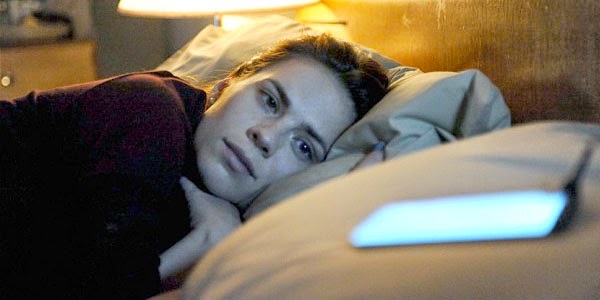
While Episode 1, Season 2 of Black Mirror explores the desire to fill the emotional void associated with the death of a loved one, it more deeply examines how the process of grieving has changed due to advances in technology. As someone who has witnessed a lot of death in her life, I tried to connect Martha’s grieving process to Elisabeth Kübler Ross’ five stages of grief model: shock, denial, anger and guilt, despair and depression, and acceptance. Although I could easily identify some signs of grief in Martha’s behavior, I had trouble determining whether she arrived at the final stage, acceptance. It appears as if Martha is unable to accept Ash’s death because she never really let him die. This raises the question: how does the process of “mourning,” or “lamenting for the dead” occur when the person who died isn’t actually gone (OED)? Technology’s ability to keep Ash “alive” obstructed the grieving process for Martha, thereby bringing her more suffering and pain in the end.

Black Mirror: Season 2 Episode 1. N.d. Billie Doux Reviews. Web. 25 Jan. 2017

When the police officers arrive to inform Martha of Ash’s passing, there is no dialogue; all we see is Martha open the door, look at the officers and the flashing lights outside, and close the door in their faces. These actions make it seem as if the audience is in Martha’s head. Just as she slams the door before the officers can inform her of Ash’s death, her mind simultaneously slams the door on the possibility that he is gone. This is a clear indication of denial, one of the stages of grief. Additionally, when Sarah informs Martha of a technology that would enable her to speak with Ash, Martha screams, “Shut up!” which brings her emotions to a public level. The anger present in this instance also represents yet another stage of grief. At first, Martha grieves in “normal” ways, but it is not until she develops an unhealthy attachment to the technological replica of Ash that her grieving process truly goes astray.

One especially poignant moment in the episode occurs after Martha’s ultrasound when she drops her phone containing Ash’s voice on the ground. We see that the phone shatters and his voice disappears, leading Martha to believe that she has lost him forever. Immediately after she hears from Ash on her newly purchased device, she apologizes profusely for “breaking him.” It is almost as if watching the phone crack and die was like experiencing Ash’s death all over again, which does not help Martha progress in terms of her grieving process. This moment exemplifies how technology can intervene and intrude in the grieving process in ways that make it even harder to let go. Ash’s statement, “Calm down. I’m not going anywhere,” also masks the possibility that he could very well be lost again due to the fragility of technology.  

Martha’s unwillingness to accept Ash’s passing becomes more apparent as she explores her relationship with his replica. She rejects many of his actions and identifies flaws in his behavior, claiming that the real Ash would not behave in ways the replica did. Although at times she wants to get rid of the replica, she is unable to because she is to some extent addicted to it. The addictive nature of this technology makes the acceptance stage of grief unattainable. Confining Ash to her attic confronts the idea that her grieving process will never be complete and more broadly hints at the implications technology has on grief in society today.

In today’s world it has almost become ritualistic to grieve publicly. For instance, funeralOne, a technology company, provides funeral homes with webcasting services and streams videos of funerals online for people to watch wherever and whenever. Watching a funeral on one’s cellular device has now become a common occurrence which poses a threat to the traditional funeral industry. You can now light virtual candles for loved ones on memorial websites, utilize online funeral home guest books, and address the dead in Facebook comments. With the amount of technology increasing within the realms of death and loss, we can put a hold on our grief and mourning processes because we are able to interact with the deceased in unprecedented ways. Will we ever be able to move on after a loved one passes? This episode of Black Mirror and advances in technology surrounding death reaffirm the need to reassess the stages of grief and the places we mourn as we enter a rapidly evolving digital climate.

Postmodern Politics: Post-truth, Putin, and Power

“Under what circumstances do we think things are real?” -William James, 1950

Postmodernism is about the break down of traditional boundaries, whether between fact/fiction, subject/object, high brow/low brow, man/woman, producer/consumer. As Isabel Pinedo points out, “categories break down, boundaries blur, institutions fall into question, master narratives collapse, the inevitably of progress crumbles, and the master status of the universal (read: male, white, married, heterosexual) subject deteriorates.” (Recreational Terror, 18).

While Pinedo goes on to explore how horror films reflect these postmodern elements, I am more interested in the postmodern horror of everyday life. Postmodernism compels us to see systems and relationships as complex and contradictory — even paradoxical in many cases — so it is important to note that while this particular exploration is focused on the negatives, there are positive aspects that emerge out of the liminal spaces that the postmodern condition makes rooms for.

A particular timely postmodern horror of everyday life is the break down of shared reality and facts. As boundaries blur and our conceptions of “truth” become tenuous, we live in perpetual uncertainty — what sociologist Ulrich Beck terms the “risk regime” of everyday life.

I say that this is timely due to events like Oxford Dictionaries naming “post-truth” the word of the year after witnessing Trump’s presidential campaign run on deceptions, half-truths, and blatant lies. Last week when the new White House released “alternative facts” marked another slippage into the uncertain realm between truth and falsehood.

Postmodern power figures are those who can manipulate reality in order to best cling to power. Putin provides an effective template by keeping Vladislav Surkov close by. Vladislav Surkov, Deputy Prime Minister and Putin’s “grey cardinal” actually came from a theatre and PR background and in turn, runs Russia like a political theatre.

Vladislav Surkov and Vladimir Putin in 2006 (Sergei Karpukhin/Reuters)

He funds anti-fascism youth groups and then neo-Nazis in the same day; he takes over film companies; controls TV presenters; funds anti-Putin political parties  — the difference, however, is that he does so publicly. The result is a confused populace who are never really certain of the true motives and intentions of any group or the veracity of any broadcaster or creative. This type of postmodern knowledge paralysis is extremely effective at making it difficult for any dissenting figure or group to enact change or challenge power.

This presents one of the characteristic contradictions of postmodernism — perhaps some institutions do crumble. But the emergence of post-truth and Surkovian theatre politics also make it easier for powerful figures who understand how to bend and destabilize shared reality to retain indefinite power.

Rosemary’s Baby as Postmodern Horror

In one of the opening paragraphs of the article, Pinedo defines contemporary horror films as those produced after 1968, and I don’t think it’s a coincidence that Rosemary’s Baby was released June 12 of that very year.  I watched the film last semester with a friend who’s an avid horror fan, and as I was reading the article, I was struck by how many qualities of postmodern horror the film embodies.

Pinedo claims that postmodern horror often supplants the male expert protagonist with “an ordinary victim who is subjected to high levels of explicit, sexualized violence, especially if the victim is female” (20).  Rosemary is that victim.  She is an ordinary, sweet housewife who is drugged and restrained by her neighbors and husband and raped and impregnated by the devil.  The scene is not necessarily explicit – it occurs in a half-drugged dream sequence – but the violence is blatantly sexual.

Embodying another aspect of postmodern female horror protagonists, Rosemary relies on intuition as opposed to facts and expert opinions.  While her husband, neighbors, and doctor assure her nothing is wrong, she instinctually knows that her pregnancy is not a normal one.  At a dinner party, female friends hear about the symptoms she is experiencing and immediately agree that something is amiss.  As Pinedo explains, the Cartesian philosophy suggests that rationality is male and intuition is female.  It is her intuitive female friends rather than male doctors who see through the facade.

Ultimately, I believe Rosemary’s Baby most strongly embodies Pinedo’s category of “Lack of Narrative Closure” (24).   Below is the final scene of Rosemary’s Baby.  Rosemary finally lays eyes upon her child, realizes he is the antichrist, and is left with the decision either to reject or accept him.  Initially she rejects the child, claiming that it isn’t her baby.  However, the final sequence of the film involves her soothing the crying baby, staring contemplatively into the distance while eerie music begins to play.  It is unclear whether Rosemary accepts her child or not at the end of the film.  The conclusion is left ambiguous and the antichrist remains in the world.

(The clip was accessed from the Youtube channel Movieclips and depicts the final scene of Roman Polanski’s Rosemary’s Baby).

While Rosemary’s Baby lacks certain aspects of the genre, such as graphic violence, it departs so significantly from classical horror that I argue it may be one of the first instances of postmodern horror.