Celebrity Funerals: As Seen on TV

While reading Lex Berko’s article “Death on the Internet: The Rise of Livestreaming Funerals,” I immediately thought of a similar trend that had arisen in society: televised celebrity funerals. To my knowledge, the most recent instance of this phenomenon would be Whitney Houston’s funeral on February 18 2012.

In a way, I suppose that these televised funerals are nothing more than livestreamed funerals that are available to a wider audience. However, I feel that there is more of divide. A livestreamed funeral, though accessible to many, seems more private than a televised funeral service that is accessible to millions. The fact that the funeral is televised also seems to make a spectacle out of something that should be cathartic and intimate.

I agree with Berko that having a funeral livestreamed can be beneficial in allowing distant relatives to take part in the service, but televising a celebrity’s funeral is different. Since we are in the age of celebrity, with social media and paparazzi constantly following celebrities’ every move, we do build a closeness to our favorite celebrities. However, we do not know the true person that hides behind the façade presented in a celebrity’s media image.

For example, while many of the viewers of Houston’s funeral enjoyed Houston’s music and loved her persona, they did not know the true Whitney Elizabeth Houston. These viewers never saw behind the curtain. The person they were saying goodbye to is not the same person to whom Houston’s close friends and family were saying goodbye. I am interested to hear the rest of the classes thoughts on televised funerals. Do we think that the fact that the funeral takes place on television takes away from the service? Is it beneficial or detrimental to have death viewable to such a wide audience? How do televised funerals relate to Berko’s discussion of livestreamed funerals?
Respecting the Dead

The name Emma Johnson doesn’t show it, but I have a Polish background. My grandfather on my mother’s side was Polish, a Polish Jew. Rudy Horenstein was born in a small town in Poland in 1923 and was just a teenager when the war started. Threatened with the invasion of Germany, my grandfather fled to Russia under a false identity, was imprisoned, forced into a labor camp, and was almost marched to his death in a bitter winter until he was liberated by U.S. forces.

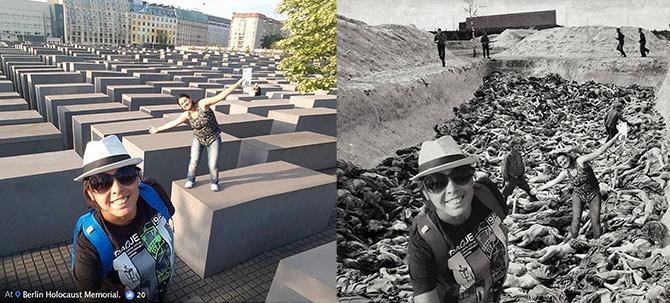
Needless to say, then, the Yolocaust project strikes an emotional cord in me. I’ve visited the Holocaust memorial in Berlin, and I’ve seen many of the same selfies and silly photos being taken there as the ones Shahak Shapira used on his website. The apparent thoughtlessness and insensitivity of these photos surprises me, as the gray blocks inspired in me a sense of dread and confusion instead of a background for artistic or fun photos.

An example of the photoshopping used in the Yolocaust project, reframing the selfies and funny shots at the Holocaust memorial around footage from concentration camps. Photo courtesy of EuroNews.

I think this speaks to the role of technology in shaping how we interact with a place. Are we less respectful of places now because of smartphones? Are we more concerned with how we can get more “likes” rather than the substance of the thing we are photographing? Without smartphones, would people not have done yoga on the blocks, or posed on them, or climbed on them? People might have continued those activities, but maybe that action would have been seen by only five other people rather than thousands of strangers on the internet.

I am biased in many ways concerning this story. I also don’t have a smartphone, and I’m a believer that smartphones prevent you from fully experiencing a place in the way that it was designed to be experienced. How can you recognize the uncertainty of walking over the uneven path, or fear the darkness from the towering stones above you when you are glued to your screen and its light is shining your way?

Of course, not everyone agrees with me. The anti-Semitic ones lashed back at Shapira with comments about being a “dumb Jew” and wishing he would die in a concentration camp. Others thought the original photos were just a funny joke. Regardless, it is unclear if technology simply the vehicle for sharing our actions with the wide world of the internet or if technology is truly changing the way we interact with the sacred and somber places in the world.

Public vs. Private Grief in Social Media

One part of mourning and the grieving process that sometimes gets overlooked is the social aspect, how people navigate the complicated customs, mores, and traditions we associate with death and funerals, while also trying to find time to personally grieve. There are two clearly-defined sides of grieving, the public and the private, the outward and the inward. We expect a grieving family to behave a certain way at the funeral, at the memorial service, in the immediate days afterward. It can be hard to find time to mourn on one’s own, to work to begin the difficult process of grief and letting go.

Questia.com, uploaded May 9, 2016

Social media complicates all that even more. Take Facebook. When someone with an account dies, it’s pretty common for people to post goodbye messages on his/her wall, not anything too in depth, just something to serve as an outlet for their personal grieving process. Now, I want to stress that this is not necessarily a good or a bad thing, just a complicating factor. For one thing, the nature of social media is public. By posting these personal messages on  a public social networking site, people are blurring the boundaries between the private and public sides of grieving. They are opening up their mourning to others, showing them how they are feeling and what they are going through. At least, in theory that’s what they’re doing. In reality, everything people post on Facebook (for the most part) is edited and created with a specific lens in mind. Are people posting for themselves, or for other Facebook users? Not to be too cynical, but I would find it hard to believe that there isn’t a certain percentage of people who  spend a lot of time crafting their post to hit just the right chords, to get just the right amount of likes and comments.

Part of this is natural, people like to make good impressions, there’s nothing wrong with that. Yet doesn’t it feel a little…off? We like to think of grieving as an intensely personal experience, something raw and honest, unique to each person. So if someone begins to manufacture or reframe their grief, it feels a bit like cheating, like they’re commercializing something sacred.  Maybe I’m just being too emotional or naive here, but at least for me, my grief is not easily put into words, or summarized with a few pithy lines, a couple emojis, and a picture of my dead friend smiling. I’m being overly harsh, but you get my point. Facebook, along with other social media sites, complicate the grieving process, force the public and private sides to merge in new and often uncomfortable ways. As is typically the case, technology continues to surge ahead, while culture struggles to catch up.

With the right tech, can we really die?

Both the Gravesites and Websites and Beyond the Grave pieces make it apparent that online profiles and our digital lives are going to be yet another space that we will need to figure out what to do with after we die. But what happens if technology becomes so advanced that our digital profiles allow us to “live” on beyond our body’s lifetime? It may sound hypothetical, but if you combine the technology from “Be Right Back” with another Black Mirror episode that I analyzed in my Snapchat Horror Story, “The Entire History of You,” it suddenly seems like a question we need to confront now.

In “Be Right Back,” we see Martha struggle with how to deal with Ash’s death, and while she’s able to preserve some of his memory through chat-bots and the grow-in-a-bath-body, the technology falls short when it can’t figure out how Ash would have behaved. In “The Entire History of You,” a device implanted in the brain records every single memory, even from birth if parents decide to give their baby one (which happens). If you combined these two technologies – persona replication based on digital information with an entire digital log of how the individual behaved and what they said and how they said it etc. – then it seems that you could make a perfect replica of a dead person. Pair this with some good AI and off your digital persona goes for eternity.

A possibility of what our future “Graves” could look like, i.e. a lot of hard drives. Courtesy of Digital Buzz Blog

The ethics of such technology are obviously questionable, and thus the entire series of Black Mirror, but both the series and the pieces we’ve read demand that we start to explore how technology can handle death in more nuanced ways, and these episodes give us one take on how that could look. And while it may seem like a big can of worms, the possibility that the digital place will be just another space to curate through a will and testament makes the problem seem a bit less overwhelming. I at least, would rather decide for myself.

Standing the Test of Time

Deaths on the internet have a funny relationship with time. A Facebook page of someone who died is a snapshot of their life right before they died – their existing profile picture that captures their pre-death self, the posts from friends and family perhaps mixed with the deceased’s own status updates.  Year after year, if no one changes the content, this page will look the same. It will not look older with each passing year, nor will it be changed by the passing of the seasons. In some ways, an online memorial is a time capsule that preserves the moment of the death just as it was when it first happened, so visiting the site again could seem almost as if the person just died.

Something important is lost in preserving this person’s memory when time is put aside, however.   A gravestone weathers with each passing year, the edges erode, the letters fade. A gravestone shows a history, a context of a time and a place that a website is unable to transmit to the viewer. While the Brubaker et al. article argues that “Digital content can continue to persist without such decay, thereby expanding the reach of mourning and memorializing” (158), I believe that regardless for how long the site stays open, without the decay, the concept of time is warped.

A cemetery of old and new gravestones in Queens, New York. Photo courtesy of Wikipedia

Additionally, the online memorial sites will never be able to replicate the sense of place that accompanies that passage of time in a physical location. At a cemetery, you walk by the other graves, feel the somber atmosphere, experience the passage of time in each season you go, leave tokens on the grave as memories, and feel the emotions more viscerally than through a computer screen. Immersed in place and time, the gravesite, I would argue, has a stronger emotional pull and generates a more powerful connection than a site lost in the endless pages of the internet.

Humans vs. Monsters: Who decides who dies?

The article by Kocurek brought up a very interesting argument that I could argue two different ways. On the one hand, to say that a specific group in a game is lesser than and equate them to monsters is a very dehumanizing and God-like way of choosing who gets to die. Kurocek hits the nail on the head when she closes her argument with this quote:

“History has provided enough examples of the efficacy of propaganda in legitimising the abuse and marginalisation of various groups of people that we should be wary in endorsing practices that bear the markers of propaganda”

By giving the game player the ability to kill off only the “wrong” type of human like or other characters in a game, it gives them the God-like type of power I mentioned earlier. No one should have that much power as to decide and kill an entire race of marginalized people, even if it is a just video game.

Now, the other side of this argument is also very compelling to me. To play devils advocate against Kurocek, videos games have been studied to an unfathomable extent. From this article published in 2015, the authors looked at the links between violent video games and risk factors on social behaviors (including violence. Ultimately they found that seeing and hearing violence at home or in their real environment resulted in a significantly higher propensity for violence in the participant group, not video game violence.

While this is just one study arguing another, this is a debate that really interests me. If there was a way to decrease violence in the real world and it was possible to do that through less violent video games, then that would be an amazing technique. The problem is that there is so much contradictory research that no one knows how to interpret it. An interesting turn in research will be with virtual reality. Will killing and violence in games become more prone to violence in real life when using a technology as advanced as vr and what are those future implications?

www.youtube.com/watch?v=xuxcNmk7Qmw

Above is an example game for virtual reality killing games found here.

Rambo vs. Call of Duty

I should start off by saying that I am more than  little biased when it comes to video games and their popular perception. I have been in love with video games from the day i first picked up a Nintendo 64 controller, and that love has continued to this day (at the expense of my bank account and social life). So, whenever I read commentary or criticism like that of Kocurek, I tend to get a little defensive. Okay. With that out of the way, on to my actual post.

One question I had when reading the article was what about movies? It seems to me there is a difference in perception as to how we judge violence in movies versus violence in video games. Why is it okay for Bruce Willis or Tom Cruise to kill/injure/generally maim wave after wave of generic “bad guys” in action movies, yet it’s not okay when I do it at home on the couch? We don’t question any of that. We just assume they’re “bad guys”, because obviously they’re somehow working for the antagonist. The level of violence and bloodshed is still there, sometimes even more so, but because it’s in a movie, not a video game, it’s somehow more acceptable. Here’s a video showing Sylvester Stallone’s killcount in the fourth Rambo movie (I know, I thought they stopped at three too):

www.youtube.com/watch?v=huejDD4znaE

As you can see, bloodshed is not unique to video games. So why the focus on them? One obvious answer is the factor of player choice. Instead of being a passive audience, gamers (a term I really dislike, but that’s another discussion) make conscious, active decisions that directly affect the game world. When you play a game like Call of Duty or Halo, you quite literally make the decision as to whether or not to pull the trigger. In that regard, I can see why people might have reservations about allowing young children to play particularly violent games. Yet as Peter mentioned in his post here, is that the child’s fault? There is already a rating system in place for video games, much like the one for movies, and you can’t legally buy a “Rated M” game (the equivalent of a rated R film) without showing ID. Kids will always want to play what’s cool or new, but isn’t it the parents’ job to filter and decide what content is suitable for their children?

I stated this at the beginning of the post, but I’m obviously pretty biased here. To me, the notion that playing first-person shooter games when I was younger (or even playing them now) somehow has caused me to become more violent in real life is ludicrous. I play NBA 2k and Madden NFL, I don’t suddenly become a better athlete; I play car racing games, I don’t break 100 mph on the way to Chipotle. To me, Kocurek’s article felt like it was written specifically to scare suburban soccer moms into throwing away their children’s gaming systems. I’m exaggerating of course, but at the end of the day what Kocurek calls “the monstrous” in video games, I just call “obstacles”, or “part of the plot”. You have to create some challenge for the player to overcome in order to advance, that’s the entire point of the medium. Whether it’s demons in DOOM, natives in Lego Indiana Jones, or zombies in Red Dead Redemption, I find no difference between the “bad guys” in video games and the “bad guys” in movies. So why are we only concerned about one of them?


Sympathy for Monsters

While reading Carly Kocurek’s “Who Hearkens to the Monster’s Scream? Death, Violence, and the Veil of the Monstrous in Video Games,” I had a problem with one of Kocurek’s main assertions. In her essay, Kocurek states that in video games,

“Monstrousness heightens the dehumanisation of in-game enemies and justifies their execution. Players are right not to feel sympathy for the monsters… they are, by design, unsympathetic characters, mere impediments to game victory” (86).

Thinking about my own experience with videogames, I thought of one of my favorite games to play when I was a child: Kingdom Hearts. Though the game takes place in a rather complex universe, the series focuses on a young man named Sora who fights creatures known as Heartless with a mystical weapon called the keyblade.

This image shows Sora with his keyblade.

The Heartless are creatures born from the darkness in people’s hearts. Once an individual is consumed by darkness, they become corrupted and turn into Heartless, as seen in the clip below (32:00-32:20).

Throughout the game, Sora is thus battling corrupted individuals: humans turned into monsters. Though the enemies of the game were once human, the player is justified in killing the Heartless, because of their now monstrous form, just as Kocurek describes in her essay.

When I was a child I readily accepted my need to kill the monsters and felt no remorse for doing so. The Heartless were inherently evil, so it was my job as the hero to kill them. Now, however, when I look at the backstory of the Heartless I cannot help but feel sorry for the creatures. I am sure that these humans do not wish to be consumed by darkness and become Heartless, yet the spreading darkness throughout the world causes them to become monsters. The keyblade frees the hearts from darkness, allowing the player to become a savior– killing the Heartless is an act of mercy rather than an act of violence. If we are mercifully killing monsters, do Kocurek’s assertions still stand? What does it mean when a player actually sympathizes with the monsters that they are trying to kill?


There’s Always the Power Button

Kocurek’s piece thoughtfully makes the argument that on-screen violence perpetuates violent realities by playing off of our cultural anxieties, dehumanizing marginalized or “othered” groups – but her article remains fairly narrow minded. I am inclined to agree with her argument that video games and alternative blood reflect deeper and problematic fears, but after reading her piece, I’m not sure who to blame for this digital and real-world violence.

Kocurek only mentions parents once in the article, outlining Serious Sam’s five different ‘blood modes’ and stating that “The ease with which the player may move between these modes makes clear that they are included for player amusement and not as any kind of parental controls” (83). I agree with Kocurek’s statement, but what of the actual parental controls that are made available? On iPhones, which are far and away the most popular gaming device available today, there are a wide array of parental controls that can be set, including age restrictions or access to the app store at all. In that case, is it up to the parents to know these restrictions are available? Up to Apple to appropriately categorize and rate games? In terms of console devices, well, one could just not buy their children certain video games. Kocurek’s piece sounds somewhat like children have unfettered access to these violet video games, which if my childhood is any indication, is far from true. There was one day my mom found out I was playing Halo at a friends house, and I was accosted and did not return.

Restrictions available on iOS, per Apple’s own guidelines.

I would also like to see more research done in terms of the variety of video game available, for example, if arcade style video games with faux guns perpetuate violence more so than handheld devices, and if console games lie somewhere in the middle.

Ultimately, I am in the boat that parents must monitor and decide what games are appropriate for their children to play. The great thing about the digital age is that while it is brining us into a period of anxiety and unknown territory, it can only exist so long as the batteries last. Kocurek makes a strong argument against video game violence, but I don’t think it paints the whole picture.

Freedom of Speech and Public Decency Collide (With a Spray of Green Blood)

Carly Kocurek’s argument is one centered around the continuous battle between free speech and public decency. Gratuitous violence, sex, and illegality usually drive up the demand for video games, especially for younger players. Sex sells, as the saying goes, and it doesn’t change for video games. She argues that dehumanizing violence in video games devalues the lives of in-game targets and the individuals or groups they may represent.

War propaganda, in a similar way, dehumanizes enemies under the guise of cartoons and unwavering patriotism. They make you forget that you are fighting your neighbor, but rather remind you to think of the enemy abstractly. Kocurek believes that Propaganda’s legitimizing the abuse and marginalization of various groups is present in these video games and produces similar results.

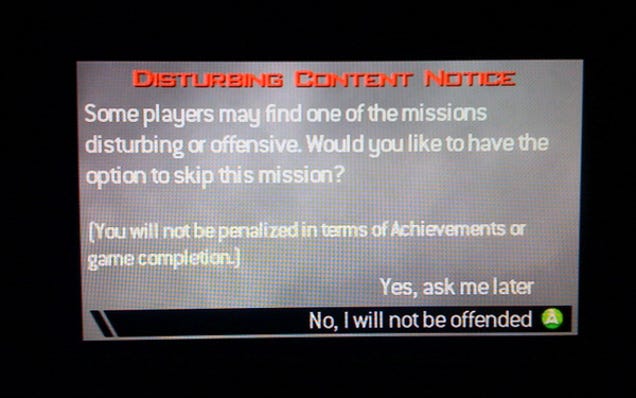
I do not often criticize free speech, however I understand the public decency angle with video games. Imagine a 14-year-old boy in middle school who goes home everyday to play the massively successful, blockbuster, genre-defining Call of Duty franchise. In 2009, the franchise released the game Modern Warfare 2, which depicted a war between Russia and the United States. Starting the game, the 14-year-old boy sees the following warning-

Warning in Modern Warfare 2, screenshot provided by Kotaku.com

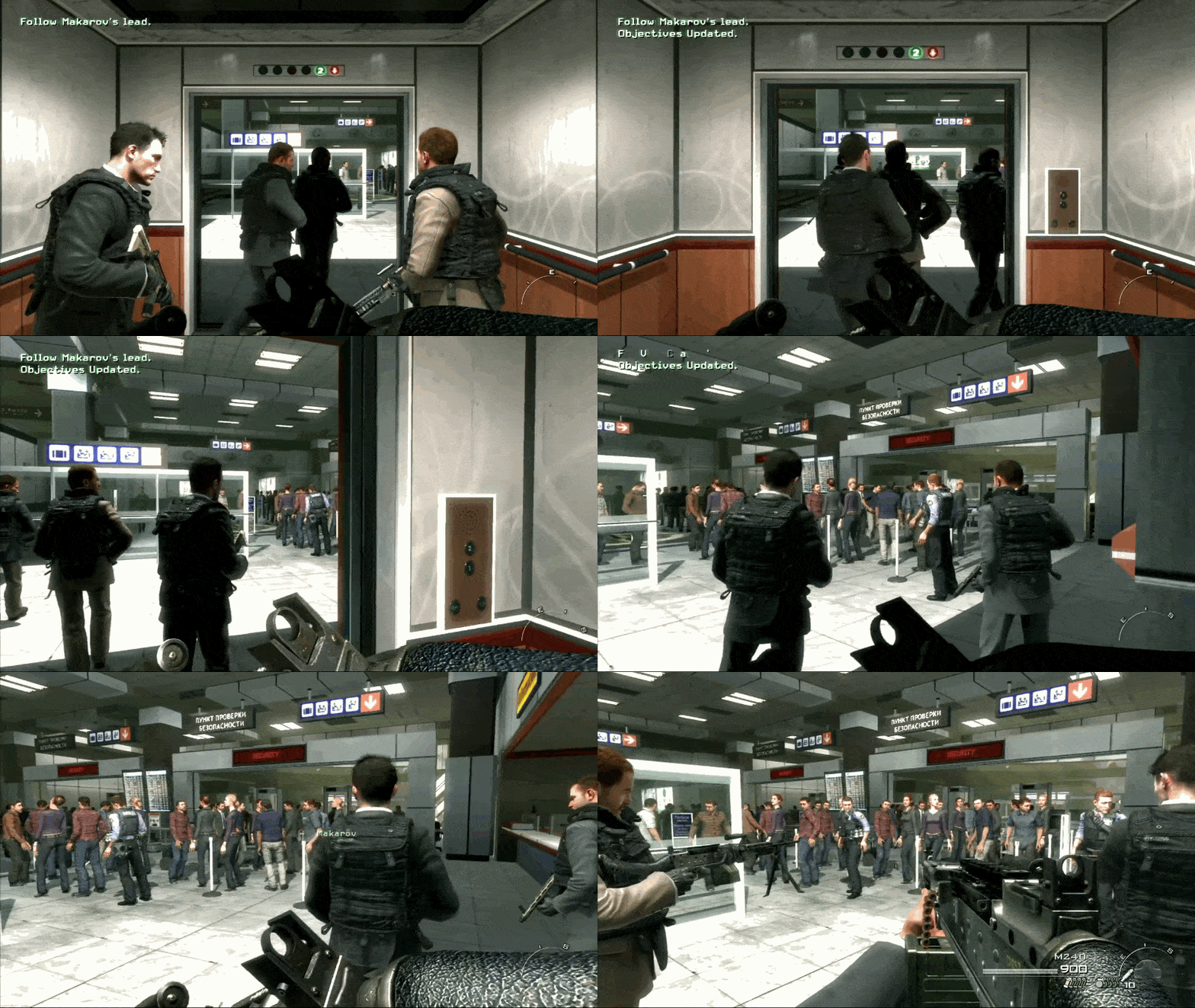
OK- you’re 14, you just convinced your parents to buy you this game since it is rated M for mature. You have played the last three Call of Duty games, and you can handle anything. Right? That’s absolutely what I thought at 14. The level in the game that the warning is referencing is called “No Russian” and there was unprecedented controversy when the game was released. Rather than tell you what happens…

Modern Warfare 2’s “No Russian” level, gif provided by Kotaku.com

It’s confusing trying to work out what is happening from a small clip, but this was the most “PG” graphic that I could find. Players around the country were horrified when they found themselves taking part of a terrorist attack in an airport. Seconds after the gif ends, the player begins shooting into the crowd. For the next 15 minutes, the player commits a mass-shooting without any resistance until the level is finished.

While I completely agree with Kocurek’s argument that video game violence should be less censored and dehumanized, I can speak first-hand on the psychological mark and disgust I feel looking back on that level. Public decency must come into effect somewhere along the way.

At the very least, there has to be better regulation of material like that. It’s a running joke in the gaming community that 14-year-old’s make up Call of Duty’s audience. Essentially, the studio advertises blatantly to their age group. At what point do public decency and freedom of speech collide? While I agree that video games dehumanize murder and violence, and may propagate caricatures of other cultures, there is clear psychological damage that video games inflict. It is unrealistic to ban all gratuitous violence and sex from games, so where is the middle ground?