Real & Unreal, Dead & Alive, Believable & Disbelief

I am not going to reference any of our discussions in class or topics we have covered in readings. Station Eleven is obviously a great book and I want to talk about it in a vacuum. I want to cover how this book exudes such a sense of realism in such an unrealistic situation; how fantastical it is but also so emotionally compelling that draws you in.

The beginning reminded me of a movie, where we are immediately dropped into a fast-moving environment. The characters we are attached to in the beginning not only introduce the Georgia Flu so well, but they are engaging and, just so damn human. While we only know Jeevan for a single chapter, I understood his thought process and felt a connection with his emotional decisions and rationalizing.

While the first chapter feels stand-alone at times, Station Eleven does such a good job of intertwining different points of the story in ways you wouldn’t expect. Like how Jeevan’s photograph of the man who suffered a heart attack was in a magazine that one of the survivors of the Traveling Symphony carries around and reads religiously. The novel just does such a good job of making these connections feel natural. We know they are creations of the author, that they are not believable coincidences, but they are just so well executed that I liked and accepted them.

It didn’t hit me until chapter 11, when the author draws the parallels of the plague that hit during Shakespeare’s time to the Georgia Flu. Things like this, themes like the rebirth of society, the aspiring nature of man to do more than survive, or our resilience as a species, they are all such tropes that are overdone in every other post-apocalyptic work but somehow work well here. I feel like this blog post has been overly gushing, but reading through this first section I keep looking up from the book and realizing how much I’ve been sucked into the emotionally compelling story that I let any sense of believably fly over my head.

I’m including a gif from Shakespeare’s Midsummer Night’s Dream because it seems appropriate.

A Fairy from the 1935 Film A Midsummer Night’s Dream. Sourced from Tumblr.


An Uphill Battle to Change a lot of Minds about iRobot…

Over the summer I was asked in a focus group how I felt about the idea of self-driving cars. I was asked whether I would use it often, what I would use it for, and what I would spend my time doing if I found myself inside one. I had not thought about it before, but I took a few seconds and replied that I would hate a self-driving car. I enjoy the mindlessness of driving at times as well as the freedom and power you feel when driving at other times.

We read a few articles about deaths in Tesla’s autonomous driving mode, called autopilot. Which, in a morbid way, was completely inevitable- everyone was just waiting to see who would be the first poor soul to be killed. For me, our generation grew up thinking that driver-less cars is a science-fiction idea and it would never happen in our lifetime, but we were wrong. So car manufacturers now have to get rid of the notions and preconceived ideas we have about a driver-less car future.

Good luck to them with trying to change my views. The first exposure I had to the idea of a driver-less car was in Will Smith’s iRobot movie and the following scene:

Will Smith’s scene in iRobot with self-driving cars. Sourced from Clubic.

It’s too bad that iRobot also has the scene where robots try to take over the car and try to kill Will Smith’s character… “You are experiencing a car crash”

Credit to Youtube’s leothelion634

I know that driver-less cars are inevitable in the next twenty years or so, and I am going to have to live with that on the road. I just don’t see myself driving one because the idea of giving up that much power and autonomy to a robot which I don’t fully trust seems like it would cause me more stress than just driving myself through traffic. I don’t think I am alone with those sentiments. I know there are many people who are excited about autonomous cars, but I bet there are also a lot of people who will not change their mind quickly.


Programming Morality

The most fascinating part of the readings were, to me, the ones about “programming morality.” As we move closer and closer to a world filled with automation and artificial intelligences, it becomes clearer and clearer just how much gray area there is involved in creating those very things. The human decision-making process is already a fairly complicated one, recreating that process is even more so. As the New York Times article puts it, “These situations can be difficult enough for human minds to wrestle with; when ethicists think through how robots can deal with them, they sometimes get stuck, as we do, between unsatisfactory options.” We humans can have the benefit of acting first, then explaining later, secure in the knowledge that whatever action we take, we will have the benefit of explaining it later. Robots and other AI’s, however, do not have that luxury. Every decision must be programmed beforehand, every little choice mapped out.

My question is this: in this situation, where does the buck stop, so to speak? Who is responsible for the actions of programmed AI’s? Say a driverless car drives off the road to avoid hitting a group of children crossing the road, but injures or even kills the driver in the process. We might agree that was the “morally correct” choice, but does that help the driver’s family? If they decide to sue, are the programmers responsible? Dealing with these ethical conundrums is already hard enough without adding in the bonus ingredient of legality.

infinitywave.deviantart.com/art/Robot-Law-School-tee-366360059, accessed 4/11/17

Isaac Asimov, the science fiction writer, famously came up with the “Three Laws of Robotics,” which are still used in robotics today. They are: 1) A robot may not harm a human being, or through inaction cause a human being to be harmed, 2) A robot must obey orders given it by human beings except where such orders would conflict with the First Law., and 3) A robot must protect its own existence as long as such protection does not conflict with the First or Second Law. Now, as far as laws go those aren’t bad, they’re rather tidy and all-encompassing actually. What makes me feel weird about all of this is that these issues shouldn’t be so easy. They’re hard, they’re supposed to be hard, and I worry that in our haste to welcome the future with open arms we’ve lost sight of that. It has taken centuries of philosophy and thought to create the morality system we have today, and now we’re trying to streamline all of that as we hurry to reach the future we so desperately want. These questions take time, they take effort, they take thought. I hope that we don’t fixate on the destination and miss out on the path we need to get there.

Not the future we need but the one we deserve

I imagine that my grandkids will laugh at the idea that I wasted an hour and a half of my day in the car actively driving myself back and forth to high school everyday. And with automakers aiming to release fully autonomous cars by 2018, maybe grandkids is even thinking too far in the future. Driving is the most dangerous thing we do on a daily basis – a fact we very often forget, but we are far away from cars doing all of the work for us.

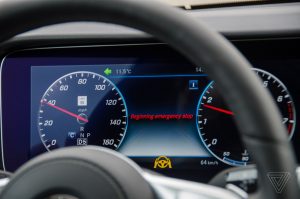
Jack Stewart’s article detailing the legal conundrum following the death of Tesla-driver Joshua Brown led me to another Wired article, which outlined three different levels of autonomous driving. While level three is a completely autonomous system that removes the driver from the equation completely, Tesla’s Autopilot system falls into level 2, somewhere in between complete autonomy and the need for driver intervention. These levels reminded me of a different article I read a while back detailing the new system Mercedes is rolling out, one that The Verge claims will give Tesla a run for its money and that seems to be more self aware of its position in level two autonomy.

Ignore the system too long, and the car will bring itself to a stop. Courtesy of The Verge.

The name of Tesla’s system itself implies a higher level of autonomy, but Mercedes’s system is intentionally imperfect in order to demand more of the driver’s attention. Sure, the name Drive Pilot isn’t much better, but Mercedes seems to understand that we are not at a place of full autonomy yet. The car requests feedback via a touch of the steering wheel every ten seconds, slowing the vehicle to a stop if the warnings go ignored. Turning on the turn signal slows the vehicle to an appropriate turning speed. The car resists staying perfectly in the middle of the lane, partly avoiding bumps and partly in order not to put the driver too at ease. The system demands a relationship between the car and driver. Tesla’s system may be a bit more futuristic with an eye towards a driver-less highway system, but that’s a future a world full of shitty drivers is not ready for.

Do We Really Want Ethical Robots?

While reading Robin Marantz Henig’s “Death by Robot,” I was reminded of a recent successful movie: Avengers: Age of Ultron. In the article, Henig discusses how we are currently striving to construct autonomous robots capable of making ethical decisions. This reminded me of a common trope used in science fiction films: the uprising of the robots.

Whenever humans construct artificially intelligent robots, the majority of the time, these robots begin to question why they are taking orders from their creators. As Henig mentions in the article, humans cannot process information as quickly as a computer can. Humans are also blinded by the emotions that robots cannot possess. In the robots’ minds, this makes the humans weaker. This is especially true for the character of Ultron in Avengers: Age of Ultron. In the video below, you can hear some of his best quotes, where he harps on humanity’s weaknesses.

Ultron was created as a peacekeeping force. However, similar to the ethical dilemmas presented in “Death by Robot,” Ultron is faced with his own dilemma: his creators cause some of the most damage, death, and destruction in the world. Thus, Ultron decides that the only way to create peace on the world would be to eradicate humanity entirely.

This story seems quite familiar to me—man creates machine, machine attempts to usurp man, man destroys machine. Whenever a robot seems capable of making ethical decisions, it realizes that humans are some of the least ethical creatures on the Earth, and that the Earth could do a lot better without us. Through media such as Avengers: Age of Ultron and I, Robot, humanity is taught to fear the day when robots and computers are able to make the same ethical decisions as humans. They can do so faster, and in some cases, better than humanity ever could. This begs the question though: do we really want robots to realize how much more capable they are?

Riding in the Future

Two weeks ago, I went with one of my roommates, Catie, to have lunch with her grandparents. Usually, grandparents tend to be behind the times of technology, not really sure of any of the new items that are out there or how to use them. While her grandparents both have iPhones, there is no wifi or TV in their house near Lake Norman. What they do have, though, is a Model S Tesla.

They let Catie and I take the Tesla out for a drive after we had eaten, and the technology in that car amazes me. Everything is so touch and interactive based – the dashboard is a huge touchscreen, bigger than the screen on your laptop. You can do directions, find music, and even surf the internet on this screen. On the dashboard behind your steering wheel, there are more digital images: changing digital scales of your speed and gas level, as well as a little tiny Model S where you can see where you are in the lane, what is around you, and what to do next. Even as a millennial, I was out of touch in this car. Catie and I could barely figure out how to work most of its functions!

This is a semi-accurate representation of what Catie and I were doing when we put the Tesla on autopilot, where it drives itself, moving the steering wheel while on cruise control:

We thought the technology was incredible, but it was easy to see some of the shortcomings in the Model S as it is right now. You can set it to autopilot on the highway, but it won’t drive you everywhere, nor will it change speeds, so you can’t use it in traffic, with stop signs or stop lights, and it doesn’t follow your google map directions. While the tractor trailer may have been easily visible to us, I could see how the Tesla could mistake it during that fatal crash last year. The range of what the car can “see” is limited, and definitely, there are still kinks to be worked out. As of now, while the car can do some driving of itself, it is still a long way from the true self-driving cars that would take you from point A to point B without you ever touching the steering wheel.

The Safety Coffin and Other Outdated Death Technologies

My first thought while reading about the rise of QR Codes in Graveyards was, “Oh I hate pulling out my phone and scanning those codes”- While my second thought was shame about how few seconds it would take to scan the memorial and do it for a deceased family member or friend.

Like the author of the article, I doubt that QR codes will stay current/updated very long. Technological advances today are moving way too fast to invest in something for eternity. I could be wrong, but I think that most advertising campaigns are slowly phasing out QR Codes, because I can’t remember the last time I saw someone prompt me to scan one, and I also can’t remember the last time I actually scanned one.

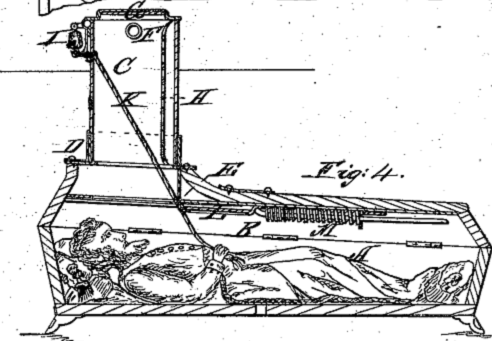
This article made me think of the many outdated technologies that have infiltrated the death industry. Contrary to popular belief, Walt Disney was not frozen by cryogenics. Specifically relating to graveyards, I was reminded of the “Safety Coffins” that became prevalent in the Victorian Era. These coffins had a bell that raised out of the ground a few feet, connected to a rope that family would place in the deceased’s hands. In case their loved one was not really dead, this bell and rope system allowed them to pull the bell and signal people above to dig them up.


Source from GhostHuntingTheories.com


Over time the fear of being buried alive subsided and the safety coffin fell out of fashion. When you look at these coffins now, they seem absurd right? I hope that people don’t look at the graveyard QR Codes in a similar way if/when they fall out of fashion.


Source from Slate.com

Reading the article “QR Codes for the Dead“, I wondered what made me so uneasy about QR codes on grave stones? Cemeteries are viewed as quite, reflective and cathartic spaces not only to mourn but to reflect. So when people armed with smart phones can view personal information of the deceased is that cathartic experience made obsolete? The QR codes take you from being in the moment of that specific location to a cyber space in which isn’t tangible. You can see and feel the grave stone and know that the deceased is laying under but the QR code link takes you to a different dimension of time and space. With growing anxiety of technology such as smart phones and VR goggles replacing “being in the present moment”, do QR codes on grave stones replace that moment with something not fully real or tangible? While grave stones are tangible and lasting pieces of one’s life QR codes could very well become obsolete in a very fast technologically advancing society. The article also mentions the upkeep of links and data of these codes specifically if a QR code company goes under or a link is broken. For instance, while I was on a scavenger hunt in Chicago, QR codes were used as clues to the next location. A link was broken on one of the locations and we were unable to figure out our next clue. Thus, is a QR code truly lasting and relevant as a normal grave stone?

Although some companies offer private codes for only friends and families, others give you the option to be accessible to the general public. Public internet spaces are very prone to hackers and internet trollers. My anxiety of QR gravestones can partly be due to trolling. Thus, the encryption of a virtual grieving space becomes very important. An unsuspecting mourner looking to find more information on the deceased could potentially view harassing information about the deceased, malware or advertisements. This makes the grieving process less authentic and more traumatic to the griever.

Obsolete Graves

What I found really fascinating about the QR article was how it brought up the aspect of obsolescence, which I think is often overlooked in these discussions. While I do think that adding QR codes to gravestones is, if nothing else, an interesting wrinkle to traditional grave plots, I wonder what those relatives will think in five, ten or twenty years. On the one hand, there is something to be said for creating something that explicitly links the grave with the deceased. Imagine taking a small child to the grave of a relative they never got the chance to meet, or perhaps they only distantly remember. You could pull your phone out, and by simply pointing it at the grave’s QR code you could pull up pictures, articles, perhaps even video messages from the deceased themself, all giving the child a sense of who their great-grandfather/second cousin/whomever actually was. I think that’s admirable. There’s something to be said for giving people the ability to try and choose what their legacy is, what they are leaving behind and what people will remember about them.

However…

pintrest.com, accessed March 28, 2017

What happens when technology inevitably moves on? The article goes into this a little, but QR codes aren’t exactly cutting edge anymore. They’re not very widely used, and have already begun to move into that strange area where the only people or groups that use them date themselves by doing so. You know, like how when companies try and appeal to #millennials by turning old memes into ads. It’s the equivalent of your grandmother proudly telling you about how they finally got one of those new-fangled flatscreen televisions. It’s still a big step, and useful, but the world’s already started to move on to bigger and better things. That’s how things go these days, unfortunately. There’s always some new exciting app that is a total life changer until one day, with no warning, it isn’t.

Now, usually this isn’t that big a deal. Phone models come and go, headphone jacks are added and taken away, and the world spins on. People adapt. However, what about when it is our graves that are no longer relevant? Cemeteries are supposed to be places of quiet, stillness, and a certain sense of timelessness. Death is universal, and a gravestone is supposed to be something that will be able to speak throughout the decades and the centuries. From the pyramids to the modern day, graves were places where people stop, reflect, and remember. They exist outside of time, outside of trends, fashions, and fads. By adding QR codes into the mix, people are crossing this boundaries. You shouldn’t ever look at a grave and think “Wow that is so five years ago.” Maybe I’m just being traditionalist, and am already behind the times, but respecting and honoring the dead is as universal as any human trait. It does not, and should not, go out of style.

Black and White QR Codes Makes for a lot of Gray Area

I would like to consider myself good with technology. I am the go-to in the family for technology questions – mostly Wifi troubleshooting – and when my resume reads “proficient in Microsoft Excel” it really just means I’m good at Googling how to do something until I figure it out. But never in my life have I encountered a useful QR code. The first time I saw them (probably late middle school) it was a fun thing to try out, a party trick at best, and that’s where my relationship with QR codes began and ended. I thoroughly enjoyed the link to WTF QR Codes that Tamara Kneese provided in her piece, because to me I have always found them uncomfortable and out of place.

One of my favorite post to WTF QR Codes, courtesy of Tumblr (a QR Code for an Auto repair shop, plastered to the side of a building). 

Sure, QR codes may be more graceful than tiny.urls or anything that starts with “http://,” but in my opinion they are still the ugly step-sibling next to the elegant barcode. There’s just something uncomfortable about all those tiny boxes lined up, like a puzzle piece forced into a spot where it didn’t belong. Even more uncomfortable, though, is Kneese’s point that, “When the advertising campaign ends or a company nosedives and disappears, the QR code itself may endure on these materials.” And maybe that’s why I have a thing against them, they just seem so useless. I don’t care if it’s plastered in gold, I do not want any gimmicky technology looking out of place on any tombstone of mine. Furthermore, Kneese’s argument that the commercial nature of QR codes feels unnatural in a serious presence like a graveyard really hit home for me.

To me, graveyards are a place to be alone with the memory of whoever you may be visiting, not a place to whip out your phone and check Facebook while trying not to get distracted by all the other notifications.  Using a phone to scan a QR code feels a bit like pulling your phone out during a funeral and watching old videos of the two of you together. Like: I get it, the sentiment is there, but it just does not feel right.