Female Adolescence: The True Horror Show

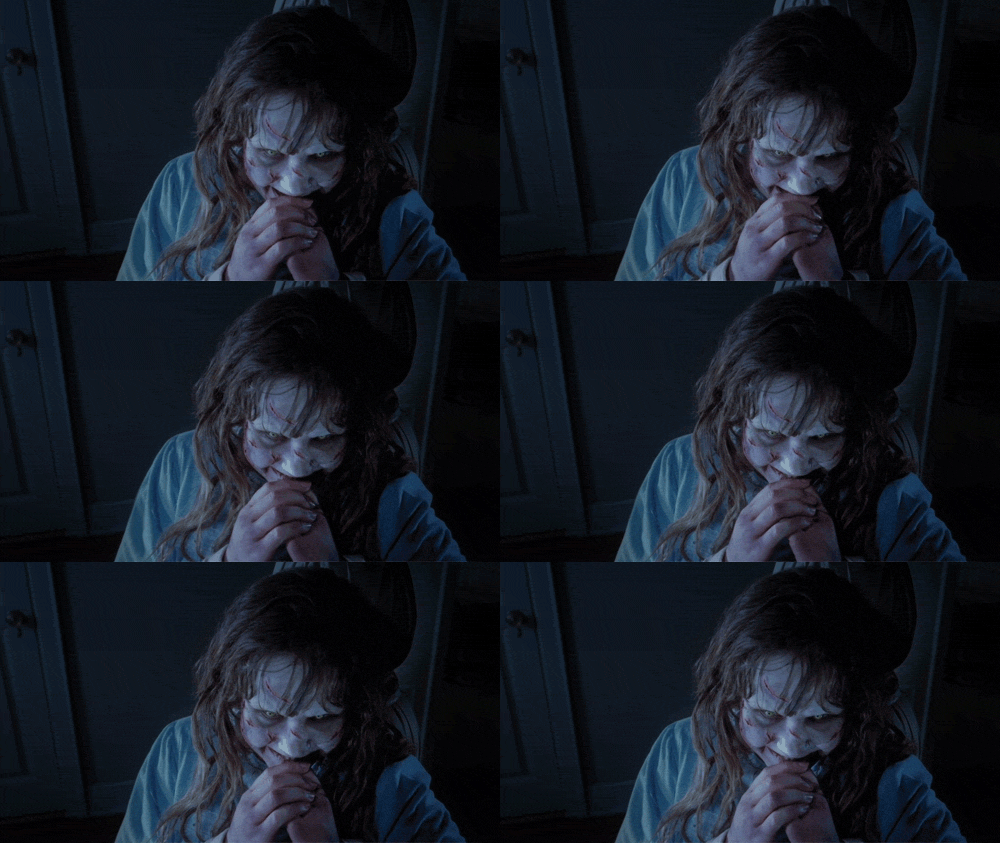
Many of us remember our awkward adolescent years, in which a hair grows somewhere one didn’t think possible, or a zit pops up right before the big dance(or was it just me)? I can only speak as man, yet, going through puberty was tough. Being somewhat of a late grower, all of my friends, it seemed were six feet tall, when I was barely 5 feet 5 inches tall. Bodies were changing, muscles were developing, and boys and girls became interested in each other.  In The Exorcist, we watch a demon posses a girl going through puberty. Puberty, itself can be seen as this demon: that changes your body, emotions, appetite and sexuality. For females, it is also the beginning of their menstruation. Sight of blood, is terrifying for most people, since it is a signal that something is wrong. The body, while menstruating, hurts adding to the horror of puberty. In puberty, one also finds their sexuality. In many comedic movies or television shows, the young boy going through puberty is often times shown to be spending a lot of times in his room, bed or bathroom obviously drawing to the conclusion of masturbation. However, it has always been a taboo to show younger girls and women as sexual as their male counterparts in puberty. Thus, adds the great surprise and true horror of seeing Regan masturbating with a crucifix. The “abjectness” of menstrual blood is not lost in The Exorcist, adding to the horror when Regan, forces her mother’s head down to her bloody genitals. In this sense, Regan’s body, personality and sexuality have transformed not only by the demon, but by puberty.

In the ever increasing Digital Age, parents are frightened that their children send and receive sexual messages. Parents are terrified of their moral houses being invaded by hyper sexual outsiders.

Although it must be frightening for Regan to undergo a possession, the movies was made to terrify people in connection to Regan and the audience. We always see Regan and her exponentially increasing possession with others, witnessing what her mother, doctors or Father Damien witness. Although, Regan is possessed by a demon, her language is troublesome to her mother and Father Damien. It is terrifying and infuriating to see someone so innocent to use such sexually explicit language. Adding to the notion, of a fatherless house, The Exorcist brings about the fear of raising a child immorally. In puberty, as bodies transform so does the language around bodies and sexuality, transform. Boys and girls become more aware of their sexual urges and it may be hard sometimes to come up with the perfect way to express one’s sexuality into words. In the Digital Age, adolescents have access to the internet and each other, like never before. The Digital Age also introduces a new way to communicate these sexual thoughts yet, parents are always terrified of their children’s sexuality and constantly try to suppress it, and even punish it. For instance, it was a common occurrence for my friends and I to have our cell phones taken and read by our parents and then receiving lectures about morality and sexuality. One of those times, my parents also took my sister’s phone, and read lewd, eerily similar to The Exorcist messages from a boy she liked. This not only terrified my parents, it outraged them. They were immediate contact with the boy’s parents and grounded my sister for who knows how long. They were terrified of this boy’s advances towards a Catholic “morally raised” adolescent girl, and were terrified that this boy will somehow “possess”, their daughter and cause her to say and do these repugnant sexual fantasies. After that, both of our phones were forced to undergo downloads after download until my parents sense of terror and shock were subdued. What wasn’t frightening to my sister, a boy showing interest in her, to my parents was the most horrifying event, an unknown entity-a teenage boy filling my sister’s head with “impurities”. Thus for parents, adolescence in the Digital Age, is the True Horror Show.

The picture is taken from “https://cybercaution.wordpress.com/contact-us/”, a  Cyberbullying blog. Ahmed Mahmoud, is said to be in charge of posting pictures and videos on the Blog.
Regan: Why Her???

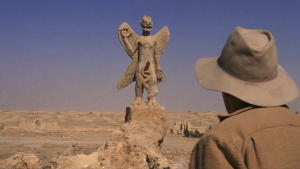
While watching The Exorcist, I had many grossed out moments but overall had two main thoughts that remained after the final scene. First, The Exorcist  had a very interesting beginning to me. While watching it, I was trying to figure out the whole time what the connection would be between the archaeological site and this little home of mother and daughter in D.C. and I don’t think my question was ever answered (although Barbara Creed drew some very nice parallels between the women in both places as witches in The Monstrous Woman). The very end of the movie showed a superimposed image of the weird bat-like demon statue that was at the archaeological site, but my main question was how did this demon choose this seemingly  innocent child to begin with?

Demon (Pazuzu) statue in Exorcist found here.

Father Merrin seems to be the link between the two physical places but it still feels odd as to why the child was possessed. For cinematic purposes, an innocent child that is still young enough for the words that she uttered and actions she performed while possessed had a very disturbing impact. The only reason I can think that Regan was chosen  was because of talking to “captain howdy” on the Ouija board she found in a closet but even then, in a city that big and populated, there has to be more than one Ouija board being messed around with. Maybe I am just being too cynical and unwilling to believe the impossible (meaning demonic possession) which brings me to my second observation.

I couldn’t help but think back to “Be Right Back” at certain points in this film because of the impossibility of certain actions. For example, when Regan moved her head in a complete circle, could stab herself without feeling the pain, or live seemingly without food because no one could go near her or her mouth, it drew a parallel to the human but not body of the replacement Ash in Black Mirror. Both films use human bodies in ways that are abnormal and impossible to conceive as reality in a truly “human” concept and instead force the viewer to see them as an other and come up with a different explanation of the actions taken before their eyes, possibly lending to the horror of the genres.

Schizophrenia: The Modern Day Demon?

Even though I’ve enjoyed what we’ve read of A Head Full of Ghosts so far, I’ve  found myself most interested by the title and what it implies. In both The Exorcist and A Head Full of Ghosts, the possibility that the “possessed” character simply has schizophrenia is brought up. That got me thinking about schizophrenia itself, more specifically how we conceptualize it and how it relates to the idea of “possession.”  If we define possession as an entity taking control or root in a host body of another, separate entity, then could we conceivably call schizophrenia a type of possession?

www.abc.net.au/radionational/programs/allinthemind/invisible-intruders-e28093-the-voices-in-my-head/5117208, uploaded December 1, 2013

Tremblay’s title, taken from a Bad Religion song, creates the imagery of an individual whose head is filled with identities not their own, of someone who is “carrying” separate individuals within themselves. It feels obvious to me that what people in past centuries called “demonic possession” was in reality something along the lines of schizophrenia, but if there can be modern “technological ghosts” (along the lines of Bob Ross), is there a “modern technological” equivalent of possession? If someone is hearing and being influenced by voices locked within their own head, is that any less terrifying or uncanny than some supernatural force entering their body? I think by and large schizophrenia gets categorized as simply “hearing voices” or “seeing things”, and to do so is to drastically take away from what is actually occurring, and how frightening it can be.

Exorcism: Religion Picking Up where Science Leaves Off

Despite that William Friedkin’s The Exorcist and Paul Tremblay’s A Head Full of Ghosts are set over twenty-five years apart, much of the horror in each stems from the inability of technology and science to overcome the symptoms of the possessed. While we have not seen the Barretts approach doctors within the first five chapters of Tremblay’s novel, we know from the novel’s paratext that Marjorie is schizophrenia and that her family only approaches a Catholic priest after doctors “are unable to stop Marjorie’s bizarre outbursts and subsequent descent into madness.” Similarly, Regan remains possessed even after undergoing the gruesome medical procedures prescribed to her.

“Le dernier exorcisme,” uploaded to Wikimedia Commons by user Onenna59 on January 23, 2015.

Within the first five chapters of A Head Full of Ghosts, we do learn of the tension religion has caused in the parents’ marriage, and despite Marjorie’s diagnosis as schizophrenic, her ailment remains to be treated in a spiritual way. The term “schizophrenic” was coined in 1908, but even Tremblay’s title implies that something supernatural is happening in Marjorie’s head, something that even early 21st century technology is unable to solve. While I’ll be interested to see where Tremblay’s novel goes from here, if it follows a similar trajectory to The Exorcist, then turning to religion will be the family’s only choice. I was raised Catholic myself, and while admittedly a CEO (Christmas-Easter only), I still understand religion as an attempt to explain beyond what science is able to. I am eager to see how  Tremblay’s contemporary take on an exorcism story – the word “smartphone” is used by the end of the first chapter – will put the intersection between religion and technology into conversation. There is no doubt that technology has profound effects on our mental and physical health (and I’m not just talking about freaking yourself out while trying to self-diagnose on WebMD), but I will be interested to see if technology has an affect on a spiritual ailment such as possession, or if such a thing even has relevance in our society today.

Possession in The Exorcist and “Be Right Back”

While reading Barbara Creed’s “Woman as Possessed Monster” from The Monstrous Feminine I could not help but draw parallels between Creed’s examples from The Exorcist and the Black Mirror episode “Be Right Back.” Creed actually drew me to make this comparison when she pointed out that part of the horror of The Exorcist stems from Regan’s possession creating an other out of an otherwise known character. Though The Exorcist deals with the possession of a young girl by a demonic entity, “Be Right Back” showcases a different kind of “possession” through Ash’s online persona inhabiting the body of a robot modeled to look exactly like him.

To Creed, “the possessed or invaded being is a figure of abjection in that the boundary between self and other has been transgressed” (32). In The Exorcist, the abjection is seen through a female body, as Creed claims it is most often (32). However, in “Be Right Back,” the abjection is seen through the workings of the male body. This can be seen simply in Regan and Ash’s “bodily excretions,” something Creed claims, “must be treated as abject” (38). In The Exorcist, Regan’s possession leads her to urinate publicly and projectile vomit, something that places a distinction between the self—the true Regan, who would not commit these actions—and the other—the demon controlling Regan. In “Be Right Back,” the creators take the opposite approach. Ash’s robotic form need not ever have bodily excretions, and this lack of bodily excretions illustrates the possession and thus abjection. By manipulating the bodily excretions of Regan and Ash, the viewer is forced to recognize the fact that these characters have become an other, and thus something to fear.

Seen here in The Exorcist, Regan’s excretion of bodily fluid marks her as an other.

Regan and Ash’s “otherness” can also be seen in the sexuality brought on by their possession. While Regan’s possession plays on an incestuous mother-daughter relationship, all of Regan’s sexuality is brought to the viewer’s attention by the fact that she is possessed by a demon, which causes her to shout obscenities and her desire to act on her sexual impulses. Regan’s otherness is created by her manifestation of sexual desire, but Ash was a sexual being before his possession. His possession,  gives increased autonomy and skill with regards to sex, something real Ash lacked, thus classifying him as an other or possessed being.

Works Cited

Creed, Barbara. “Woman as Possessed Monster: The Exorcist” The Monstrous-Feminine: Film, Feminism, Psychoanalysis. New York: Routledge, 1993. 31-42. Print.

Image Citation

horrordigest.blogspot.com/2010/01/pukeapalooza-best-vomit-in-horror.html

Mixing Horror and Reality: The Exorcist in DC

I was born and raised in Washington, DC, within the actual limits of the city (so not Virginia, not Maryland – I have a DC address and a DC phone number). The city itself is not very large, so when a movie or show is filmed in DC, I can usually tell at least what neighborhood the scene was shot in.

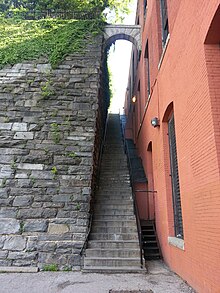
I had never seen The Exorcist before this viewing, but I was struck by the extensiveness of the filming in DC. The famous steep set of stairs that Father Damien falls down to his death near the end of the movie are stairs that I am very familiar with. I remember hiking up and down them with my friends to get from Georgetown down to the Potomac waterfront. I remember climbing them in the dark with my parents after watching the July 4th fireworks from Key Bridge, crossing the Potomac below Georgetown. I have memories of these steps rooted in my actual experiences.

The Exorcist steps in DC, from Wikipedia

Now, however, since I have seen The Exorcist, a new layer of memories and emotions has been added in my mind when I think of these steps, a layer that is no longer rooted in physical experience.

The setting of this movie in DC, a place so familiar and important to me, has served to influence my emotional response to the death of Father Damien more so maybe than for my classmates. If this movie was set anywhere else in the world, I would not have this same mixing of reality and horror in my mind as I do now. In the future, I’ll stand on that middle landing and think about both a dead man and a stunning fireworks show, even though only one of those events is real.

DC has taken extra lengths to integrate reality and horror in this place. In October of 2015, the Mayor of DC, Muriel Bowser, declared that these steps would be a DC Tourist Site. You can watch the video of her doing so in a news segment by ABC here. These places are firmly linked, a blending of physical and fake, and now a set of stairs that will always have two layers of memories for me, all because of my deep connection to Washington, DC.


The “What if…?” Moments of Good Horror

Many movies released in the last few years, like the Resident Evil or The Purge franchises, use dystopian or apocalyptic settings to create worlds where the events of the movie become believable. These settings ask the viewer to suspend their disbelief because the events of the film couldn’t possibly be or become true, but only exist in these fantasy landscapes. Other horror films immerse their audience in a familiar, routine setting to distort feelings of comfort and safety.

Our discussion of the word “uncanny” fits in nicely with this second category of horror, because the most successful horror works rely on their uncanny moments. It forces the audience to rethink elements they take for granted in everyday life. Hit horror movies from The Exorcist– now almost 45 years old- up to the Paranormal Activity franchise have used this approach to become more successful than their jump-scare counterparts and stay relevant in the horror genre years after their initial release. These are the movies that leave us thinking about what we might do if we found ourselves vulnerable in comfortable, familiar situations. I believe these “what-if” moments form the basis for what makes horror successful and memorable.


In 1973, many movie-goers were likely terrified by the idea that their children, or sisters, could become possessed like Reagan in The Exorcist. A sweet, happy girl in the beginning of the film, suddenly turned into the creature shown here. Source- Giphy.com | Full link found here 


In the same way as these hit movies, horror novels force readers to suspend their disbelief in a crafty, underhanded way because authors cannot set a tone through actors, music, lighting, or a visual set. Successful horror books do not rely on jump-scares, or terrifying costumes- they must subvert their readers’ ideas about the world and disrupt a sense of safety. While reading through A Head Full of Ghosts, this idea kept coming back to me. What elements made the novel scary rather than gimmicky? What made it successful as a horror book? I want to talk about two elements in the first five chapters that Paul Tremblay did well.

One of the first things I noticed as I started reading A Head Full of Ghosts was how jarring the novel begins. It’s not unusual that the novel starts off in a distant future looking back on the events of the book, but the novel leaves you in the dark as you figure out what is happening. Paul Tremblay found a great way to suspend our disbelief by allowing us to look back with the reporter on Merry’s childhood. However, it takes a few chapters to get used to the idea that we are looking back on past events through Merry’s perspective. On top of that, the blogs and message-board passages draw us in by alluding to events they assume we are familiar with, and this makes us curious and pulls us in farther. Once I got past the hurtle of understanding how Paul Tremblay was setting up the story, it became easier to follow- but maybe this is the literary version of an introductory jump-scare. Beginning the novel by confusing the reader forces us to focus on understanding what is happening rather than criticizing horror tropes or studying the text for foreshadows or other hints. It draws us in to care about the family and the people, and humanizes the situation.

Second, the relationship between Merry and her sister form the basis for why the novel is uncanny- and why it is successful as a work of horror. By aligning ourselves with Merry and seeing the story through her perspective, her actions seem perfectly understandable and logical. Yes, Merry might have built a fort and wants only to read stories with her older sister, but knowing that she is eight years old excuses her actions and creates a sense of innocence. When Merry’s relationship with her sister begins to change, with the story about the Boston Molasses Disaster and the note about sneaking into Merry’s room, we place ourselves in Merry’s position and think about our own siblings.

Since this is a horror novel, mostly innocent actions like Marjorie holding Merry’s nose shut while she is sleeping seems more foreboding than the normal sister-sister relationship. What makes this successful, I think, is the way that normal sibling interactions are warped and threaten the innocence of Merry’s character. It makes us think of our own siblings or family and places us in this uncanny situation as we relate with and fear for Merry. I think the most successful works of horror, either films or novels, make the audience ask themselves what-if questions. I absolutely found myself thinking, “What if this happened in my own family?” and  “What would I do if I were in Merry’s position?”