When It All Becomes Too Real

When I look at video games now, I remember how old I am in comparison to this technology. When I was a kid, I was navigating a pixilated Frogger across a congested roadway and completing secret missions in an animated James Bond game. I would sit with my brother on the couch facing the bulky old TV, holding PlayStation controllers with wires that often tangled. It was easy to see it was all fake.

Today, it seems that technology has graphics that match the real world and is taking them to the next level through more interactive means. Virtual reality technology has brought a new method of interacting with the horror, violence, or whatever theme is represented in the game.

This YouTube video is gameplay from a horror game using the virtual reality gaming technology called Oculus Rift, which makes a variety of very interactive virtual reality games that truly transport the user to the world of the game.

While this game relates to how more real and scary horror can become through a video game, this same type of virtual reality system can also be used to put yourself into war situations, holding a fake gun that is incorporated into the virtual reality experience.

Virtual reality gaming allows the user to fully immerse into the gameplay, turning you into the main character, violence and all. Photo can be found here

You are no longer playing as a character in the game – you are the character. This is your gun that you are shooting and killing people in the game with. Yet, even with the added reality effects, killing people still doesn’t seem to be a problem. That is what you are supposed to do, and even if the death might look real (with real blood color), it will never actually simulate the feeling of shooting someone and watching them die in front of you. The larger media industry would never allow that sort of reality.

So you have video game technology that is incredibly realistic in almost every sense, except that it is still easy to kill people. Players are still, as Kocurek argues in her article, dehumanizing the targets because their deaths do not carry the full emotional impact that killing a person must entail. Are video games making kids more violent? I think that in these interactive video games where the point is to kill your way to the end, the gaming industry is making it pretty easy for gamers to pull the trigger.
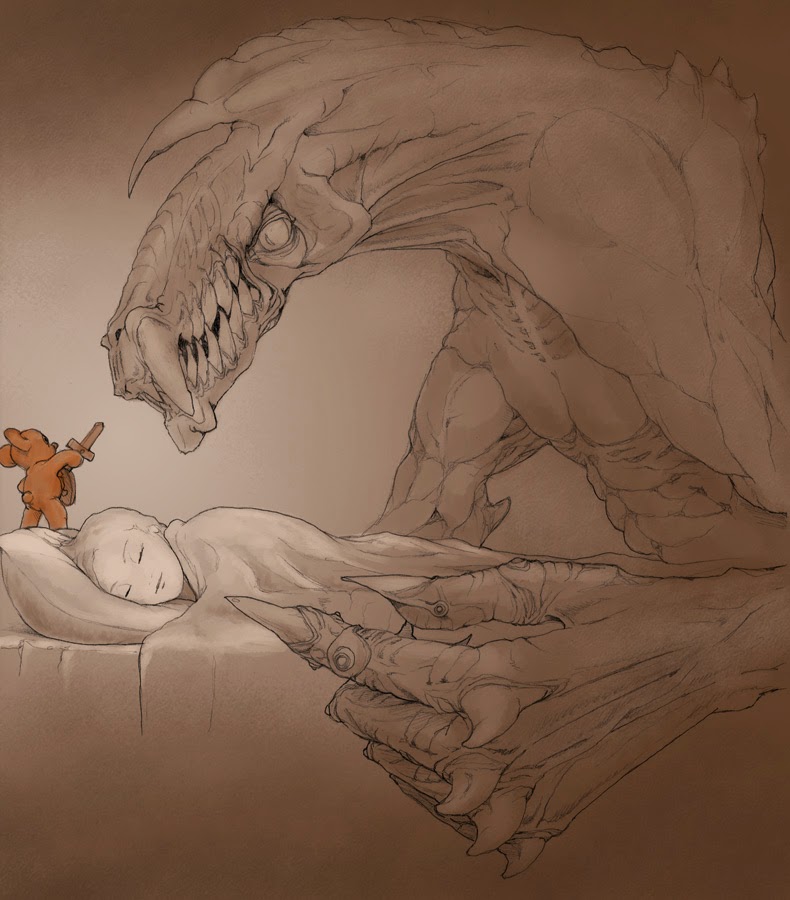
Bad guys?

Image picked up from crhserenity.blogspot.com/2014/05/bed-time-stories-legend-of-boogeyman.html%5B/caption%5D

After reading Kocurek’s paper, I was compelled to expand the point of the paper into a broader, more extensive topic. I decided to explore the role and nature of antagonists in video games. I read through papers, articles, interviews, blogs, and forums to try and find some common ground or some idea which was worth investigating. The idea that I find most troubling which seems to surface in every work I read, and that Kocurek’s paper covers is “bad guys”.

The term “bad guy” is used with kids as a shortcut when explaining that some person shouldn’t be trusted, is dangerous, or is generally just someone a child should stay away from. It’s a way of avoiding any explanation and analysis about a situation that a child is usually not capable of at their age, or lacks the experience to connect the pieces even if an explanation was provided.

So why do adults use it in English? (I say in English, because there’s no such thing in either Serbian or Greek, however my knowledge of languages does not extend beyond these three languages, so I can only speak for English) I hear adults use the term all the time, even on TV. I’m sure I recall times when journalists use it to cut to the chase. And it’s a little problematic. As adults, and capable individuals, we shouldn’t ever fall back to such a juvenile way of thinking (it’s not about the term itself, it’s about the connotation of the word and its usage). Are we not capable of understanding another person’s reasons, feelings, and circumstances? To cut to the chase, at its core it displays a lack of empathy (something that children learn to develop over time as they begin to understand their role in the world) (something adults should already have).

There is no such thing as a bad guy. No person is born evil, and no one person is purely evil. Any such belief will only further divide us and create nothing but tension, distrust, and ultimately conflict between people. There are evil acts (acts that violate the rights of others), and people are capable of them. It is still important to evaluate all situations for what they are, setting aside any absolute views and ideas that are purely subjective (bad guys).

“The presentation of military conflict – particularly military conflict based on real – world historical events– as a conflict with monstrous others can be particularly disturbing as it echoes long-standing military propaganda strategies.” – Kocurek
As a person of Slavic descent (with no noticeable accent) that grew up in Eastern Europe, I used to wonder why all “bad guys” had accents like my parents when they spoke English. My parents are great people (that’s an understatement, they are some of the best people), but why do so many villains in both video games and movies have these accents. As a kid I didn’t understand, but I was soon introduced to the reality of the Cold War (which is very much alive, and I believe very heavily perpetuated by this very portrayal of Slavic people as inherently violent, tyrannical, and Communist – all of which are entirely false). My point being that the media usually does a terrible job of showing any kind of empathy, instead opting for a more profitable mainstream popular view (remnants of various propaganda).
In summation, Kocurek is right, and even beyond his point, all media has an incredible power to “other” others, to create even larger cultural and ideological gaps, and even to control our way of thinking. I think it’s important for any individual who believes themselves to be analytical and aware, to see beyond tropes, stereotypes, and ideologies. Behind the scars and hard Slavic accents of my parents, are some of the warmest hearts you will ever get a chance to meet – if you give them a chance in the first place.

Manipulation of the Innocent

After finishing A Head Full of Ghosts, I couldn’t help but feel sympathy for the multitudes of times innocent characters were taken advantage of and manipulated.  For starters, the most obviously manipulated character can be seen as child Merry; she always feels tricked by her sister, she gets roped into an entire TV show exploiting her young life, and the producers themselves almost seem like they’re only using her too. Perhaps the most shocking manipulation was the very end when Merry was tricked into poisoning her family. This also happens to be the part that I’m unsure who the manipulator actually is. I have doubts that the father actually had the poison in his possession ever, yet how would Marjorie get a hold of it on her own? And if it was from Marjorie, then why would she eat the sauce too?? My best option here is to guess at a couple things about Merry:

Potassium Cyanide …. found here
  1. Merry is not recounting the events correctly at all. For example, she even claims she knows the police report says how they found her with curled next to her mom, yet still has a vivid memory of the doors being open and her aunt finding her. Also, older Merry says police found no traces of searches for poison on the family computer’s hard drive-> how can this be if Marjorie showed her images of it from an internet search?? (pg. 272)
  2. Merry might also suffer from an undiagnosed mental illness. I find this theory very provoking because familial links in disorders runs much higher than the prevalence in the general population. Also, how could any child raised in the environment Merry was in, end up completely ‘normal’.
  3. Maybe Merry’s sister and dad were both ill. That would explain him having the poison and the different ‘tricks’ that her sister did throughout the book. (Note here that I am a complete skeptic about possession and such and look for ways to explain these phenomenon through science).

If my last guess is true, would that not make all of them (Merry, her sister, and her dad) innocent? If they are all innocent of blame because they truly did not know better or what they were causing, then who is the real manipulator or the cause of the family’s deaths in the end? It is this manipulation of the innocent that made me keep thinking and pondering this book long after I had finished the last word.


Nothing Burns Quite Like The Cold

Living in Kazakhstan and now Chicago I feel connected to Frozen’s Elsa “The cold never bothered me anyway”, I would yell out walking over to the bus stop while freezing Lake Michigan wind tried to find any uncovered skin. There is something sinister about “cold”; even saying the word makes one shiver. Cold is unforgiving-if you forget a hat or gloves then you’re SOL. Cold is desolate and lonely-how many people outside do you see in the middle of winter? But can cold be evil or can cold be fake?

Merry, in the last chapters of the book becomes obsessed with the temperature both outside and inside the coffee shop. Initially the coffee shop is warm, toasty, steamy. After reading the email exchange between her father and the baptist(in which it is alluded that her father killed the family), she actually becomes too hot and asks the barista to turn the heat down, but he can’t. The temperature changes significantly after Merry tells of her possible involvement in the murder of her family. It becomes cold in the coffee shop. After being questioned more about what happened with her family, Merry doesn’t want to talk anymore. The most striking part about the entire scene is when she walks over to the door, blaming the cold on the door not being fully shut by the couple that entered a little bit ago. Both Merry and Rachel, however, noticed the cold way before the couple came, thus the cold wasn’t the door’s fault. The last sentence of the book also mentions that it was cold enough in the coffee shop that Merry’s breath was a visible mist.

In her blog, Merry/Karen also make big of temperature during the exorcism. She argued that the window was open in Marjorie’s room explaining the dropping temperature and visible breath. The “live” shots of the thermometer dropping is to trick the audience into believing that there is an actual demon present in the room. The two scenes are paralleled due to the fact of the ajar window or door. Merry has a reason for both occasions as to why it is cold inside. This could have two meanings: that there is something evil or otherworldly present in both the exorcism and after Merry’s confession; or that Merry is lying about her involvement in the murder. As Merry herself pointed out, the window and the cold is a trick or a lie could she be suggesting through the door and the the cold in the coffee shop that her story is a lie? Thus, cold is either fake or evil.

The Cold Never Bothered Me Anyway. Perf. Idina Menzel. YouTube. TOZChatPanel, 23 Dec. 2013. Web. 9 Feb. 2017. <The Cold Never Bothered Me Anyway>.

The End…..or is it?

One of the most famous horror tropes is the “surprise cliffhanger” ending. You’ve seen it before. The camera zooms in on the supposedly-dead body of the villain when suddenly the eyes of the monster spring open, the murderer’s fist breaks through the rubble or grave they were buried under, the fingers of what is supposed to be the corpse of the serial killer begin to twitch. It’s not quite a twist or a cliffhanger in the traditional sense, in that it doesn’t really affect the plot or character development in any way, but it does do just enough to shift the ending away from the nice traditional “happily ever after” side of things (if you have a lot of time to waste, I recommend looking at the TVtropes page about this, linked here).

While in actuality the purpose of these little twists is probably to ensure the sustainability of a film franchise, enabling studios to make more sequels and therefore more profits, but I think there is something to be said for the fact that a lot of times, horror doesn’t resolve. It goes on. Even A Head Full of Ghosts is not immune to this trope.  In the very last chapter, Tremblay gives us just enough to think that perhaps everything is not quite over. There’s the confusion about the fingerprints on the jar of poison, for example, or the way Merry’s breath hangs in the air in the last sentence, reminiscent of Marjorie’s possession “performance.”  The story is quite clearly wrapped up, yet there are still those loose threads, those little details that do just enough to keep your hair standing on end long after the book has ended.

My question is, what is the reason for this trope? Where does it come from? Maybe it’s for shock value, maybe its for future profits, but I think the answer is something simpler than that. Horror, by its own definition, can’t fully “end,” at least not in the way we normally expect stories to end. The whole point is to unsettle, to disturb, to shock. A simple resolved ending, much like real life, does none of those things. Horror is paradoxically the furthest and yet the closest genre to everyday life. On the one hand, we deal with things like ghosts, zombies, vampires, demons, and the like, creatures and beings far outside the world we feel control over. Yet at the same time, horror doesn’t just…end. It goes on. Just like life, sometimes it wraps up, sometimes it doesn’t. Either way you have to leave the theater, close the book, or turn off the tv.

tvtropes.org/pmwiki/pmwiki.php/Main/TheEndOrIsIt

Merry- The Unreliable Narrator

One of the aspects in A Head Full of Ghosts that I have found to be the most compelling is the choice of the narrator being Merry Barrett. Something that we touched on in our earliest classes was whether Merry is a reliable narrator for the events of the novel. I do not feel that we spent enough time on this debate, especially after Merry’s big reveal to Rachel about how her family died in chapters 25 and 26.

In chapter 3, Merry says, “my memories mix up with my nightmares, with extrapolation, with skewed oral histories from my grandparents and aunts and uncles, and with all the urban legends and lies propagated within the media, pop culture, and the near continuous stream of websites/blogs/YouTube channels devoted to the show…so all of it hopelessly jumbles up what I knew and what I know now” (Tremblay 13).

This quotation called into question whether or not Merry is a reliable narrator, through Merry’s own admission. Throughout the novel, I forgot that Merry said this, and became fully trusting of her recounting. This trust was most likely brought on by Merry’s narration switching from her 23-year-old self to her 8-year-old self so seamlessly (even though, in the diegetic world, the 23-year-old Merry is saying what we are hearing the 8-year-old Merry says). However, once Merry revealed that she was the one who slipped the potassium cyanide into the pasta sauce that poisoned her sister and parents, this quotation popped back into my mind.

I am not sure that Merry made up the fact that she was the one who put the potassium cyanide in the sauce; I definitely do not think that someone would lie about that fact. Yet, I am not sure that I trust Merry admitting to the poisoning either Merry, however, goes on to say that, “I’ve never told anyone what I’ve admitted to you. The police, psychologists, my aunt; no one” (Tremblay 281) Merry thus shows that she has been lying for many years.

For some reason, this called a lot of the narrative into question—at least for me—that we are given because it is given to the reader by Merry, someone who I find to be an unreliable narrator, much like Pi from Life of Pi or Huck Finn from The Adventures of Huckleberry Finn. Can we trust what Merry has told us? Can we trust a 23-year-old woman recounting something that happened when she was 8? Even if it was something so traumatic, I think the answer is no.

Pi from Life of Pi is a great example of an unreliable narrator. Which version of his story is true?

Works Cited

Tremblay, Paul. A Head Full of Ghosts: A Novel. New York, NY: HarperCollins, 2015. Print.

Is Postmodernism a catch-all dead end?

Postmodernism has been at the center of discussion in two of my classes this semester, and its elusive nature begs the question of whether or not postmodernism encapsulates all other movements of history and of those to come. In the most basic sense, postmodernism means to question everything: to not accept grand statements just because they come from authorities, to decenter ourselves from the very truths around which we revolve. Maybe it’s my own naiveté, but living in a postmodern world has made me question whether or not any authority can, or should, be accepted from here on out.

In Recreational Terror, Pinedo says that postmodernism encapsulates “a profound loss of faith in master narratives,” and “the breakdown of moral clarities.” In a world in which things are less certain than ever, in which indeterminacy reigns, it seems unlikely that a bold, new narrative will be able to unite our trains of thought once again. The second law of thermodynamics states that things will only ever get more complicated, that entropy is always increasing. In other words, once a plate breaks, it is very unlikely that the laws of physics will make that plate fall back into place, and postmodernism seems to have broken the plate.

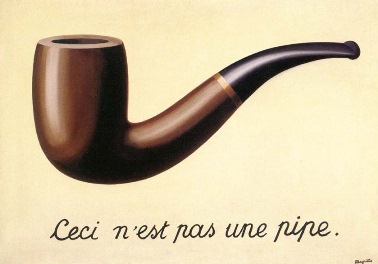
René Magritte, The Treachery of Images. Wikipedia. 1928-29. Oil on Canvas. en.wikipedia.org/wiki/The_Treachery_of_Images

The image above was introduced to me the first time I heard of postmodernism way back in my days as a freshman in high school. The caption translates into “This is not a pipe,” and the knee-jerk reaction is to disagree. The artist’s point, however, is that this is not in fact a pipe, it is merely the image of one.  All in all, in a world that has taught us to not accept anything and that more or less has taught us that our own interpretation is valid as long as we have the evidence and logic to back it up. So, in a world in which master narratives are meant to be thrown out, how can a new one be established?

1000 Ways to Die

There’s a lot of gross scenes in A Head Full of Ghosts. Marjorie oozes green slime out of her mouth onto her spaghetti, urinates and defecates on the floor, bleeds on the bed, and practically bites a man’s arm off. Any number of these gory scenes, or ones like it, could have been connected to the death of Merry’s family.

But poison? What an interesting choice. Especially potassium cyanide, a poison that in the book kills quickly and without much apparent gory side effects. According to the CDC, potassium cyanide is typically odorless, ships in easy tablets or pellets, and is rapidly fatal – so, at least in this part of the novel, the information is accurate.

Picture of potassium cyanide granules, perhaps similar looking as to what Merry mixed into the spaghetti sauce. Picture from BioPrepWatch

What is so surprising to me is the lack of gore involved. Merry’s family twitch and convulse for a brief time and then collapse dead to the ground – no oozing, bleeding, gushing, bursting – no nothing. Merry even keeps asking Marjorie when she is going to wake up after she has already fallen to the floor dead, perhaps because she still looks so normal she could just be sleeping.

After the gruesome deaths and moments in The Exorcist, including people being thrown out of high windows and splattering on the ground below with their necks turned 180 degrees, I expected a more dramatic ending for the three other members of the Barrett family. In that sense, the poison was an anticlimax for me, as I had been expecting from reading the book that the moments when the whole family was together, things often became disgusting, but not the case here. On the other hand, because I was not anticipating the poison, it was also quite a plot twist, ending that plot line much different than I thought it would.

Of all the ways that Marjorie, the mom, and the dad could have died, I wasn’t expecting poison to be one of them. Compared to a demon possessing you, poison seems almost laughable.


Post-Modern Horror: The Anxiety Never Ends

AGHHHHHHHHHHHH

We were warned that post-modern horror generally leaves loose ends and unresolved conflicts. We talked about these ambiguous elements in class and read about it in Isabel Pinedo’s Recreational Terror article. With all the time we spent discussing it, the readings, and everything we watched- I should have seen the ending to Tremblay’s A Head Full of Ghosts coming. I could not have found a better example of foreshadowing for what to expect from this novel, than the entire three weeks we have talked about post-modern horror. Honestly it’s embarrassing to admit that the ending left me as shocked and frustrated as it did.

I think the elements of ambiguity, vagueness, and lack of resolutions in post-modern horror are the most significant changes from the classic horror genre because of the effect that the ambiguity has on the audience. Post-modern horror has seemingly shifted away from the terrifying, monster-revealing moments, and turned its focus on creating an unwavering sense of anxiety for its audience. Like Pinedo says in her article,  horror films are like roller-coasters in that the “conviction that there is nothing to fear turns stress/arousal into a pleasurable experience” (Pinedo 25). The ultimate goal of horror is to stress out and create an anxious audience.

In classic horror films, there is generally a single moment/jump-scare that is the climax of the film (imagine Hitchcock’s 1960 film Psycho or the 1976 film Carrie, based off a Stephen King novel). Once this moment is over, however, the protagonist escapes/defeats the monster and lives to see another morning.  The John McCarty quote in Pinedo’s article references this as he said these were “the kinder, gentler days of horror” (Pinedo 25). While classic horror films create anxiety and then resolve it with a clear, and (generally) positive ending, post-modern horror uses jump-scare moments to provide temporary relief. After a jump-scare, the audience can take a breath and calm down, but the ending ultimately does not resolve itself and leaves the audience confused, angry, and frustrated.

A Head Full of Ghosts does a great job in creating a frustrating and ambiguous ending. Almost like an itch you cannot scratch, the reader is left at the end of the novel angry and shocked, demanding a clear ending (In some cases, the reader is so frustrated that he starts off his blog post with AGGHHHH). I think this frustration and anxiety defines the most significant aspect of post-modern horror because the stress remains unresolved long after you leave the movie theater/put down the book.


As a side-note Tremblay references the ending to the 1978 film, The Thing, while he was writing the ending to A Head Full of Ghosts in the notes for the last chapter as inspiration for its ambiguous ending. In the film, a shape-shifting monster fights a group of humans and imitates individuals to get closer to others. SPOILERS- in the last scene there is ambiguity on whether one of the last two surviving people are actually the monster in disguise. While there are theories that since you cannot see one of the men’s breath in the cold, he must be the monster, the ending is purposefully ambiguous and leaves the audience frustrated.


Works Cited

PINEDO, ISABEL. “RECREATIONAL TERROR: POSTMODERN ELEMENTS OF THE CONTEMPORARY HORROR FILM.” Journal of Film and Video, vol. 48, no. 1/2, 1996, pp. 17–31. www.jstor.org/stable/20688091.
The Thing. Dir. John Carpenter. Perf. Kurt Russell. Universal Pictures, 1982. Youtube- The Thing (1982) Excerpt. Movieclips, 27 May 2011. Web. 8 Feb. 2017. <www.youtube.com/watch?v=GA4Ozqt7338&gt;.
Tremblay, Paul. A Head Full of Ghosts: A Novel. New York, NY: William Morrow, an Imprint of HarperCollinsPublishers, 2015. Print.

The Ghost in the Machine


Both The Exorcist and the Black Mirror episode “Be Right Back” share a common theme in questioning the meaning and nature of the “self”. What does it mean to be a person? What defines that person? Their memories? The memories others have of them? Both? Their physical self?
I would argue it’s not the physical self, meaning the person incarnate, and I believe many would agree. Our physical selves are constantly changing, reforming, like the Ship of Theseus. So if not in the physical plane, where does the “self” exist? It’s fascinating to think that such a crucial part of being human exists entirely outside of any measurable and quantifiable plane. As many questions as science has answered, and will answer in the future, it is entirely realistic to consider that maybe the “self”, the “consciousness”, the “ghost in the machine” will forever remain outside the reaches of any scientific method, and as such, outside the reaches of “solid evidence”. Maybe that makes sense. There is no solid evidence for something that doesn’t exist in any state, for something that hovers outside the reaches of all physicals laws. Are we looking for something that doesn’t exist? Can we just trust our instinct, our gut feeling that we do truly exist on another plane?

In Black Mirror we are shown an example of how a simulation of the “self” ultimately falls short of the true self. This is the very blatant point the show tries to make, but I like to point out something that I find much more interesting.

Let me begin by splitting the “self” in three categories. The “outer self”, the “inner self”, and the “deep self”. The outer self is a combination of everyone’s memories of us, how we exist in other “selves”. The “inner self” is our experience of ourselves and our life, which not only define us, but how we are going to live every next moment of our life. The “deep self” is the purely instinctual or the suppressed self which on extremely rare occasion surfaces.

In Black Mirror Ash has some of his outer self, very little of his inner self, and a substitute to his deep self in the form of generic behavioral patterns. Even if he had all of these fully transferred from Ash, he still wouldn’t be Ash. Not because he wouldn’t be convincing, but because his code can be traced back to its origin. This is the most defining factor of the “self” which goes beyond the aforementioned three categories and is the most important. The human “self” cannot be traced back, the code cannot be broken down and followed to its roots. Memories can change, as well as ideas, but the essence of consciousness is in its unique nature.

In The Exorcist we get another example of someone losing their “self” in the form of possession. I find this example a lot less intriguing as the girl has no recollection of her possession and as such only further emphasizes how the physical “self” doesn’t exist. While she was possessed, she was not herself, and when she returns, she reverts to her “self”.