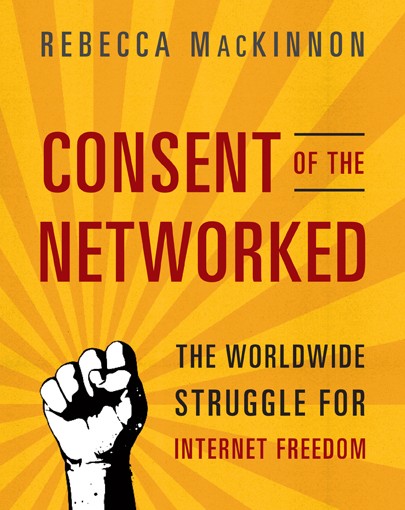
The Consent of the Networked

Politically, “consent of the governed” refers to the idea that a government’s power derives from the people that legitimize it. In practice, this means that a democratic system can only stand with the support of the people. In today’s technologically centered and ever-progressing society, “consent of the governed” must retain its motivation, but take on new interpretation in the context of data-mining and social media. In “How Your Data Are Being Deeply Mined,” Alice Marwick examines the consequences of modern data culture in terms of personal privacy and the impossibility of living a life “off the record,” so to speak. With the reality that data brokering is becoming more invasive and less transparent, Marwick ends her discussion by highlighting that, “Those of us concerned with privacy must continue to demand that checks and balances be applied to these private corporations.”

In her book, Consent of the Networked, Rebecca McKinnon emphasizes this idea. She argues that we, as consumers, must require the same regulations and rights in the digital context that we require in the physical context. This suggests that as society and technology evolve innovatively, so must our laws. This will be even more important as artificial intelligence progresses indefinitely. Matthew Gold, in Trending: The Promises and the Challenges of Big Social Data states that as technology progresses it will, “Combine the human ability to understand and interpret­ which computers can’t completely match yet-and the computer’s ability to analyze massive data sets using algorithms we create.” As computers progress to the point that they have the cognitive ability of humans, and data-mining increases exponentially, we have a responsibility to demand the same regulation of computers as we would of humans. Further, in order to maintain the consent of the networked,  governments must produce internet policies regarding data as innovative as the technology itself. Only then will it protect the peoples’ civil liberties in the digital world.

The Customer Service of Data Visualization

Both Klein and Kaufman wrestle with the idea of transforming archives into information that is quantifiable, visual and meaningful. This approach to interpreting the data available in their respective archives serves to illuminate the nuances of the information that otherwise goes missed.  For Klein, this was the significance of the relationship between Jefferson and James Hemings. She accomplishes this through a novel arc-graph depicting Jefferson’s communications with those closest to him and distantly connected to him. Kaufman, comparatively, illustrates the big topics, timeline and the players that made up Kissinger’s foreign policy through various force-directed diagrams and line and bar graphs. Both strategies, however, beg the question: How can these tools be of use to us if they are not “user friendly” or easily interpreted?

Upon first look, these visualizations have the potential to be detrimentally misinterpreted, even insofar as to negate their purpose. This is especially the case when the conclusions illustrated by the visualizations are not well conveyed or illustrated. In the case of Klein’s arc graph, one could see the person farthest connected to Jefferson, with the “widest” arc diameter, as the person with whom Jefferson most frequently corresponded regarding Hemings. Similarly, without understanding the meanings of the groupings, distances, lines and colors in Kaufman’s force-directed diagrams, the information provided by the visualization is rendered as meaningless as the overwhelming archive itself.

Even if these clarifications cannot be made apparent endogenously, they merit a key or an explanation outside of the visualization. While both Klein’s and Kaufman’s work serves to make large archives more user-friendly and meaningful, they have not gone far enough. Their insights are only as meaningful as they are accessible. We interacted with this idea in ‘The Library of Babel,” where information was existent albeit useless due to its disorganization and lack of availability. Data historians to come will have to discover new ways to not only visualize data but make the user experience as clear, aesthetic and evocative as possible.