It’s interesting you bring up the effects of the post-apocalypse on the internet. I think more than anything, I find fascinating the idea of communication using the internet. I know that the internet is in many ways like the hydra, in that it doesn’t have one centralized source which, if destroyed, would end the internet. It’s more like an intricate web of sources, or pillars, which hold the entire infrastructure up. Having said that, it would definitely keep running for at least a little bit after humanity would lose control over its technological infrastructure.
What I find interesting to think about is what exactly we would use it for? In my personal opinion, it’d be useless to try and preserve the data and information that exists online, in an effort to retain all the human knowledge we have garnered so far. Which is pretty huge, in that we kind of depend on the ability to store knowledge and information, and we stopped doing it in books as much as we used to, so most of our knowledge is digital in nature. I think the focus would fall on the communicative abilities of the internet. Being able to reach people and extend current information would seem to me to be the most important aspect of whether the internet existed or not, in a post-human world. However, it would still be only a matter of time where every aspect of the internet is lost. So I wonder then, of all technological blows we could suffer, would this one be the greatest? Technologies develop and evolve and come and go, the internet is much more fluid but also much more influential. Of all technologies, it seems we’ve become dependent on the internet most rapidly, letting it in our lives in a matter of two decades, as if it always belonged there. Which is interesting to think about, the development of the internet and its rapid growth seems almost like it was naturally meant to be.
Nether isn’t exactly the best example for what I’m going to write about, but it is a good example nevertheless (and a personal one, which is more important)!
Basically, Nether was marketed as a game with a lot of potential, and it certainly stood out from its counterpart online survival horror experiences. It stood out because of its incredibly stunning visuals and vertical level design, which is very unique in the genre. Most online survival horror games are very flat, in that they span over large amounts of land, and the buildings are usually never actually tall. I don’t know why it took so long for someone to make a survival horror game in a city, but it doesn’t matter. What’s more important is how this game has simulated the apocalypse in a way it couldn’t even anticipate.
What started off as a very successful marketing campaign, and many followers, is now a dead game, with about 8 empty servers still running. It’s a meta-apocalypse that no designer intentionally accounted for, but playing through it the last few days, has made me think how incredibly effective it actually is. So I used to play this game when I had some free time a few years back, when it was full of players, and full of player killing. It was a very action-packed experience, with many conflicts and many climactic moments in ever playthrough.
Playing it last night was a completely new experience, and I actually loved it. The server was entirely empty. Basically, I was the last person alive, other than a few merchants in the game. And the experience was so much more immersive, I felt so alone and vulnerable. I realized the importance of other people in a horror game like this. There was nobody to clear the safe zones! So all the safe zones were overrun constantly, and I had to just hide out from building to building, snacking on some things I’d find to eat and drinking the occasional bottle of water. Being that the safe zones were overrun, I could never reach the merchants to store items, so everything I did had so much more gravitas.
It’s interesting, and I don’t think it would work in any other scenario. It’s not a single player game, so when it becomes single player, the experience is incredibly unique. I don’t think if the game was designed to be single player, the effect would be the same. In fact, I’m certain it wouldn’t. It was the lack of design for this to be a single player game that made it so incredibly new and fresh.
With the modification for ARMA called DayZ and arguably the introduction of Minecraft to the gaming world, we witnessed a surge of post-apocalyptic themed video games. The surge in these video games is a direct result of the huge demand these games were producing. These games are widely successful and considered the most immersive video games across all genres (the ones that were finished and done properly). Most of the times, they are also very simplistic in nature. There are usually no actual goals other than surviving for as long as possible. The player has a bunch of variables (hunger, thirst, health, sometimes temperature, and rarely sanity meters) which have to be maintained for the video game character to survive, and that’s pretty much it. There are only backstories in these video games. The narrative being directly derived from the experience of the game itself. The visuals (with the exception of the referenced screenshot from Nether, which truly has stunning visuals) are usually sub par, focusing on quantity versus quality (worlds are usually huge).
What these games have going for them however is atmosphere and immersion. Atmosphere comes form sound design, which is mostly minimalist, having the player constantly aware of potential threatening sounds amidst the usual calm ambient. The immersion is rooted in the fact that people actually love the post-apocalyptic rulebook (or the lack of a rulebook (in that the rules are that there aren’t many rules, other than your survival)). Similarly to my comment on Philip’s post, I argue that it’s exactly that no rules approach that is so appealing about these games, and why people keep coming back to them. It’s a chance for escapism, except the character is a reflection of some anarchistic instinctual and primal version of yourself (or something like that (it’s basically a playground where you can get away with any crime)). It’s a little scary how badly we want games like these and how huge their following is then. If we think about it, it’s like, there’s a lot of pent up anarchistic energy in people and we’ve finally been given a place to exhaust it, and it’s crazy how high the demand is.
You know, the reason I say it’s scary is when you’re playing one of these games with a friend, and that friend befriends another person from the game world, and they spend hours working together, and then your friend shoots that other friend in the back and collects all the hours worth of collected loot – and you sit there wondering if this is going to happen to you as well. And you never see your friend the same way again, because now you KNOW they’re capable of backstabbing in virtual reality – it says something about them doesn’t it? Jokes aside, it’s a fascinating thing to watch people show a much darker and sinister version of themselves when granted the opportunity where the results aren’t actually real.
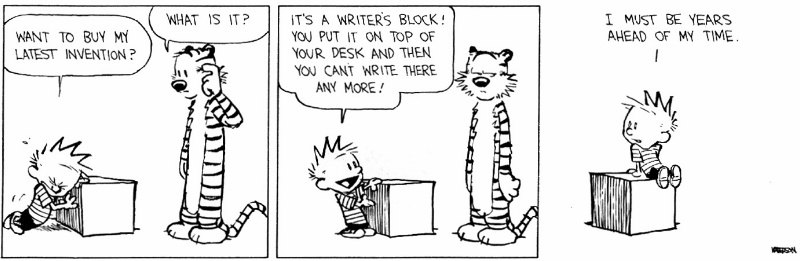
A part of my writing that I usually struggle with are my conclusions, especially my final sentence. While not always the clearest part of my written work, I find that these last sentences tend to convey the way I truly feel about the subject, even if I don’t realize it at the time. So for this reflective blog post, I thought I’d take a look at the concluding sentence for each of my eight previous blog posts to see how my views towards these different subjects have changed (or not) over time.
Accurate depiction of me using one of these when I have to write a conclusion. Photo courtesy of GoComics
Starting with my first blog, I wrote about the Exorcist Steps in DC, and seeing those steps in a different way now that I know the history behind them. This ending, of taking away and more learning and instructive message with me, was unique to this blog post only. My other concluding sentences, excluding #7, tended to be both pretty negative and pretty anti-technology.
What is clear to me, upon re-reading my posts, is that new technology, especially technology that differs from some classic forms, is something I’m usually initially hesitant about. In #3, I express how new interactive video games that are simulating death in their games seem a problematic way to portray death. In #4, I talk about how gravesites are “immersed in place and time” and should carry more weight than an online memorial site, which I don’t think has the same effect. And in #6 I mention how far the Tesla is away from being a true driving car, and the nervousness I have when using a Tesla.
I also tend to take a pretty grim view of the future of some technologies, as based on some of my other concluding sentences. In #2, I call poison “almost laughable”, compared to demonic posession, a sarcastic view of the final death in A Head Full of Ghosts. Through my #5 post, I reflect on how technology is changing us, expressing a negative view towards on technology’s impact on our society and moral standards, referring to the pictures at the Berlin Holocaust Memorial. And finally, in my recent #8 post, I end with the pessimistic view of quarantine, not that it is protecting the disease from spreading, but that “it’s a death sentence.”
My only bright spot is with blog #7, when I discuss how the Travelling Symphony is a rebellion against the death that they face all around them. Why this is my only bright spot throughout my 8 blogs, I’m not sure. But I can see that these blog posts have shown me that while I am an active and constant user of all sorts of technology, I’m hesitant to incorporate them into my everyday life until I know they work or until they become ingrained into our society. And with that, I’m concluding this conlusion of my conclusions.
Final Blog Sentences:
#8 = It’s a death sentence.
#7 = Even the Georgia Flu couldn’t take this away from them, and this way they are rebelling against the death and despair to be part of a production bigger than themselves.
#6 = As of now, while the car can do some driving of itself, it is still a long way from the true self-driving cars that would take you from point A to point B without you ever touching the steering wheel.
#5 = Regardless, it is unclear if technology simply the vehicle for sharing our actions with the wide world of the internet or if technology is truly changing the way we interact with the sacred and somber places in the world.
#4 = Immersed in place and time, the gravesite, I would argue, has a stronger emotional pull and generates a more powerful connection than a site lost in the endless pages of the internet.
#3 = I think that in these interactive video games where the point is to kill your way to the end, the gaming industry is making it pretty easy for gamers to pull the trigger.
#2 = Compared to a demon possessing you, poison seems almost laughable.
#1 = These places are firmly linked, a blending of physical and fake, and now a set of stairs that will always have two layers of memories for me, all because of my deep connection to Washington, DC.
Although we have talked about death in this digital age we are in now all semester, it is interesting to now think about post-digital age death. While it might not be a true visualization of future generations and how their deaths are remembered, it is interesting to see how death is portrayed and people’s lives are remembered (or not) in Station Eleven.
In flashbacks to when Kirsten is 15 and in her first year with the Symphony, we see a man that comes on too strong and is implied to have a want to assault her when she kills him. Two years later, Kirsten and the sixth guitar each kill a gunman in order to survive. For both lives she takes, Kirsten gets a little knife tattoo to remember them by.
On page 296, Kirsten takes a third life, the life of an archer, while August takes his first life ever. The advice we read going through Kirsten’s head after seems to be pretty telling of how killing and death is seen in this post apocalyptic world: it alters you but you will survive.
Survival is a main theme in the face of death in this post- digital age in Station Eleven. Are tattoos and altered lives of the surviving the only remembrance a life receives or can potentially receive in that type of age? In the prophets old town there were the graves and all of those markers but s that truly remembering those who died if no one who stumbles upon those markers in the future knows who they were?
We may say that there is so much oversharing and lives are wasted on the internet nowadays, but at least there is something to go back and see parts of their lives if someone dies in the digital age, unlike with Kirsten and her friends who merely have the tattoos and the memories of those who have died. Who’s version of death is better? I like to think the digital age gives us access to people’s lives and lets them leave a legacy and a digital fingerprint in a world where they otherwise wold be a forgotten grave marker on the outskirts of town.
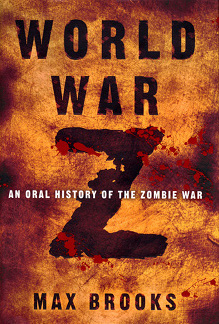
As I’ve been reading Station Eleven, I find that the book very much reminds me of one of my favorite “end of the world” novels, World War Z. If you haven’t read it, WWZ is presented as an “oral history of the zombie war”, and is set some years after the zombie apocalypse has both come and gone. The book is a collection of interviews with various figures from the zombie war, from Presidents to soldiers to astronauts to housewives turned warriors, as well as everything in between.
What sets both WWZ and Station Eleven apart from other apocalypse stories is their focus on the day-to-day and reality rather than any grand “saving the world” narratives. It’s angle I find fascinating, as it is often overlooked in these kinds of stories. Whenever we see a zombie movie, or read an infection/disease story, we never stop to think about anything beyond what we are shown. Yes it can be exciting to read about scientists scrambling to find some sort of cure, but how often do we stop and wonder about what happens to any astronauts stranded on the International Space Station? Or how governments and societies would undergo monumental shifts in policies? Or even how art and culture would survive and change as the years go on. There are real people hidden in the pages of every apocalypse story, and I think that often goes overlooked.
At its core, Station Eleven isn’t about saving the world or bringing things back to the way they were, there’s no “chosen one” or miracle cure. It’s just a small melancholy story, about a small melancholy group of people, doing the best they can with what they can to keep the dream of the human spirit alive. There’s something so romantically admirable about that. What other stories are out there that we have missed, that have been left out of the grand apocalypse narratives?
This blog over the course of the past semester has, in a way, served as a personal journal in which I’ve been able to detail my learning, how I began to make connections between relevant academic concepts, and how I integrated my learning into my real-world understanding of life around me. While I didn’t notice any trends in terms of how the nature of my blog posts changed throughout the semester, I did find a number of themes that ran throughout my writing.
One thing I touched on a few times was how we use technology to mediate our interactions with the world around us. “How else have we intentionally designed technology to mediate or fuel our fear?” I ask in my post regarding Merry’s use of her video camera to mitigate her fear in Head Full of Ghosts . This question was rather prescient, as it turns out I later address how we might use technology to fuel our fear of things in my post on virtual reality military technology in the Black Mirror episode: “Men Against Fire.”
My blog posts are peppered with my own personal reactions to various assignments, books, articles, and other media. I discussed how the Black Mirror episode “Be Right Back” “prompted me with a number of questions regarding how I myself might approach a situation in which I could interact with a reconstructed version of a dearly departed loved one.” I examined and questioned my personal reaction to the concept of the “Grief Police” when I asked “So why is grief something we (maybe just read: I) are (am) so judgmental about — especially when we have all experienced it?” In reflecting upon the reading and writing this response, I was able to critically examine my own judgements and biases that affect my non-academic life.
I also spend some time addressing the social ramifications of the technology with which we engage, referring to how things might go horribly wrong in the future if we aren’t careful about how we utilize technology. In “a world that in some ways is becoming more and more like a video game — things get scary.”
“As we continue to study the “death of technology,” I’m inclined to argue that technology never really dies, as it is simply a product of humankind.” I think it is absolutely key that we keep this in mind moving forward into unknown technological territory. Technology is only as dangerous or helpful as we, humans, make it, and it isn’t going away any time soon.
Main character in Men Against Fire confronts a “roach”; Funny enough, this is also a selfie of me — staring down the remainder of finals after completing this reflective blog post. Source: The MancUnion
In reading the last few chapters of Station Eleven, there was one quotation that particularly stuck with me. At the beginning of chapter 53, Emily St. John Mandel details Arthur Leander’s last day on Earth. She describes how Arthur, “made his late breakfast—scrambled eggs—and showered, dressed, combed his hair… all of the small details that comprise a morning, a life” (317).
I noticed a similarity between this quotation and a song from the famous Broadway musical Rent: “Seasons of Love.” In this song, the main characters contemplate how you measure a year in a person’s life.
“Seasons of Love” seeks to understand how to measure a year. It is not a big leap to go from a year to a life, as a life is the culmination of all the hours, mornings, days, and years in a person’s existence. Thinking on this quotation and the message in “Seasons of Love,” I began to wonder: how do we measure a person’s life after their death?
I believe that this is one of the fundamental questions at the heart of Station Eleven. How are we remembered after we are gone? I believe that the best exploration of this question is found through the book’s use of Arthur. Arthur is remembered by Kirsten after he is gone thanks to the legacy he left behind due to his fame. Tabloid pictures of Arthur, along with Dear V., along with a few shadowy memories, inform Kirsten’s view of Arthur. However, Clark also remembers Arthur and remembers the person he met when they were both young upstarts.
I am not sure what Mandel is trying to say with regards to how we are remembered. Is she saying that we are remembered by the legacy we leave behind or by the people in our lives that we have touched? Perhaps, Mandel is saying that we are remembered for “all of the small details that comprise” our lives. Regardless, I think that this is a question that deserves exploration when discussing Station Eleven.
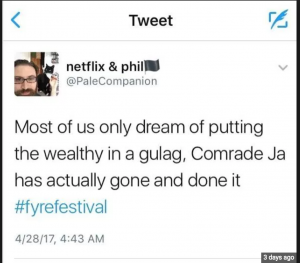
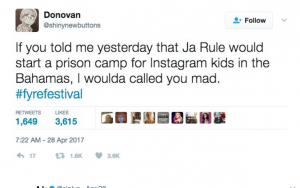
If you’ve been on the web this past week, you saw the panic of festival attendees unfold on Twitter while the rest of the web savored the moment to witness rich kids get punked by even richer kids in real time. Fyre marketed itself as a luxury get-away party, made complete by the presence of celebrities, models, and five star cuisine. Bored between musical sets? Hop on a jet ski and hunt for hidden treasure around the island — you may find cash, jewelry, or even cocaine from the eighties! (Somehow, a selling point in promotional materials was that the “private island” was “once owned by Pablo Escobar”).
Of course, the festival presented in the flashy videos and sexy social media posts was never going to be a reality. Co-founders Ja Rule and McFarland cobbled together a media Frankenstein/siren hybrid from fantasy and the transmission of digital bits. Social sirens — the models and celebrities paid to post about the event — lured the masses close enough to be entranced by the slick surfaces constructed out of other festival footage.
Video game scholar Raiford Guins detailed the lifecycle of failed 1980s Atari game E.T. The Extra Terrestrial. The game was panned by critics and returned en masse by consumers; Atari’s solution was to take all their copies of the game and unceremoniously dump them into a landfill. At this point, the game was cemented literally underground but also as a mythical representation within video game history. The physical death of the game cartridges was only the first step to immortalize the story of the game.
Just as Atari enthusiasts endeavored to uncover the game, I’m sure that Great Exuma island will begin to see its share of tourists searching for relics of dead Fyre Festival. The Festival died — in fact, it never really came alive outside of the digital promos — but the commentary and curiosity will live on. Enabled by the digital lens that shifted into hyper-focus on the event (cascades of tweets, incredulous Reddit threads, barrage of news articles), Fyre morphed from a festival into a totem where we can critically confront (and see, on uncomfortable display) celebrity obsession, conspicuous consumption, erosion of the social contract, and class consciousness among other abstract concepts. The fest may be dead, but Fyre-as-symbol lives on.
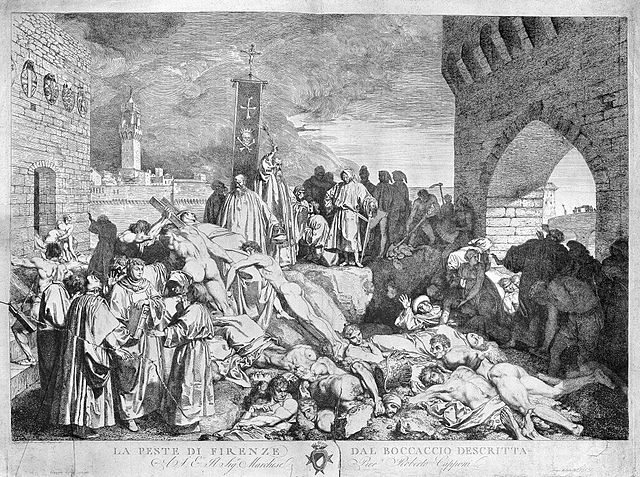
It can protect more people from getting sick, but if you are already quarantined, especially with an epidemic or a plague, quarantine can be a death sentence. An admittance to the fact that you are sick – or will be soon – and there is nothing that anyone can do to stop it, or maybe even nothing that they can do to save you.
The word quarantine is derived from two Italian words, quaranta giorni, translating to 40 days. This was the amount of time during the Black Plague that ships had to wait outside of Venice before landing if they came from an infected port. Whoever was still alive at the end of the 40 days could come ashore.
The plague of Florence in 1348. Photo courtesy of Ars Technica
Many quarantined areas in Station Eleven were not so fortunate. With no cure for the Georgia Flu, those areas designated as “quarantine” were themselves their own coffins, sealing the people inside off from the rest of the world. When the Air Gradia flight announced that it would not be docking because it was now quarantined, Clark knew that there was no hope for the people onboard, and reflected on the final moments of those passengers at other times throughout his sections of the novel.
What is most interesting to me is that Emily St. John Mandel decided to use a fake airline here for the quarantined plane, even though she uses real airlines in other parts of the books and Severn is a place in Michigan. Why would she give a fake airline the disease, sealing the passengers inside like a tomb, instead of an airline that exists in our world? Was it the fear of quarantine, the impending doom that it strikes within us in the book, the horror images that come to mind when Clark thinks about it – too much for a real airline? Or some other reason entirely, like pertaining more to Tyler’s growth and his obsession with reading to the planes?
Whatever the reasons, quarantine isn’t a promise of eventual recovery in Station Eleven. It’s a death sentence.


 Source