The main way I engaged with the blogging was to connect the reading to personal experience and sometimes other ideas relating to the subject matter in our class. I don’t often blog for other classes, so to me the exercise seemed more oriented towards personal experience or feeling, at least at first. My blog posts are often connect often connected to personal experience instead of abstract academic concepts—places I’d visited, things I’d read, etc. Though I maintain the first-person perspective an attitude throughout my posts, they have changed from more personal to professional, I’d say.
For example, in one of my first posts, I write: “The most disturbing element of Dead Set was certainly the gore, at least in my experience. I’m not a horror fan, and thus turn my head or close my eyes during the inevitably violent moments of my favorite TV shows or movies.” This is obviously a very firsthand and un-academic sentence, though I go on to talk about concepts and quotes having to do with the topic. However, by my last post, I did not mention personal reactions/feelings at all, but did relate the subject matter (Jackson’s “Broken World” thinking) to a book I had read.
In terms of concepts I revisit, the main two are haunting—haunted tourism, Edison’s spirit phone—despite that I haven’t considered this a topic in which I am particularly interested. The next topic is ethics of technology—Black Mirror, Slenderman, and dark/toxic tourism. I found myself circling around the topic of ethics with questions: Should we be doing this with technology? Should we be thinking about death this way? These questions, of course, apply to this class in general.
“There is a crack in everything. That’s how the light gets in.” Leonard Cohen, Anthem
Repair and destruction operate as the main themes of Station Eleven. From the destruction and reuse of old buildings to the figurative death and rebirth of the characters, repair and destruction offer a new look at Steven J. Jackson’s “Rethinking Repair.”
Jackson’s article mainly focuses on the destruction and reparation of material objects with an emphasis on the qualities of innovation, knowledge/power, and the ethics of care. This post will take those qualities and apply them to two characters, Miranda and Arthur, in order to grasp a deeper meaning behind them.
Death is not the same everyplace, everywhere, and for everyone. Everybody dies but not all in the same way. Some people die while they are still alive.
“She saw ghosts of herself everywhere here. A twenty-three-year-old Miranda with the wrong clothiers and her hair sticking up, washing her hands and peering anxiously at herself in the ladies’ room mirror; a twenty-seven-year-old recently divorced Miranda slouching across the lobby with her sunglasses in place, wishing she could disappear, in tears because she’d seen herself on a gossip website that morning and the headline was agonising: IS ARTHUR SECRETLY CALLING MIRANDA? (Answer: no.) (Mandel, 205)
Miranda was a living Spector. She hid away in her cartoons and Station Eleven with little regard to her life, her happiness, and her aspirations. Miranda had a rough beginning with the abusive and clingy Pablo, but her life became marginally better once she met Arthur. Her promising romance with Arthur, unfortunately, ended in the most bitter way possible. Miranda hit the lowest point in her life at the anniversary dinner party where Arthur and his mistress were openly flirting and blatantly ignoring her presence. Jeevan’s picture of Miranda in her sunglasses and dangling cigarette at four in the morning helped memorialise the worst moment in her entire life.
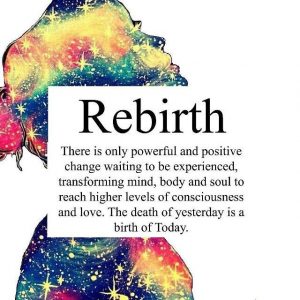
Although Miranda was dealt all of these hardships, she managed to find her way out of it. After the divorce, Miranda took her career even more seriously and devoted her life to her job, cartoons, and Station Eleven. She blossomed into a motivated and dedicated worker, had a dramatic makeover, and lived a busy life of travel, creativity, and success. She embraced the quality of innovation by finding new ways to approach her life and take care of herself. This sense of innovation allowed her to cultivate and entirely new and beneficial lifestyle. Before the Georgian Flu took her life, Miranda was able to become the person she was always meant to be. She had shed her previous life, come to terms with it, and was moving on to greater things. She underwent a rebirth forever leaving the old Miranda behind. Once Miranda began to take care of herself, she achieved wonderful things.
As Jackson points out, “To care for something (an animal, a child, a sick relative, or a technological system) is to bear and affirm a moral relation to it. . . Care brings the worlds of action and meaning back together, and reconnects the necessary work of maintenance with the forms of attachment that so often sustain it,” (Jackson 231).
When Miranda learned to value herself and take care of her needs, aspirations, and desires, she learned how to become a stronger person. Instead of hiding away in the shadows, she asserted her own identity and power and was willing to face any challenge that the world offered.
“It was disappointment, it seemed to her, that had settled over his face, and there was a strained quality about his eyes that she didn’t remember having seen before.” (Mandel, 209)
Arthur, on the other hand, never found the same piece of mind that Miranda did. Instead, Arthur’s light went out while he was still breathing. The young, vibrant, and eager young man had turned into a perpetual performer, a shell of his former self. Disappointment was rampant in his life and led to his multiple divorces, lack of friends, and other stressors in his life.
“Did this happen to all actors, this blurring of borders between performance and life? The man playing the part of the ageing actor sipped his tea, and in that moment, acting or not, it seemed to her that he was deeply unhappy.” (211)
This unhappiness stems from Arthur losing himself. The spirit that once led him to success had been crushed by the overwhelming life of fame. The death of his soul, of the young spirit that led Arthur to greatness, deterred Arthur from finding true happiness.
“Back then, back at the beginning. I was so struck by him. I don’t mean romantically, it was nothing like that. Sometimes you just meet someone. He was so kind, that’s what I remember most clearly. Kind to everyone he met. This humility about him.” (222)
By the end of Arthur’s life, he had lost the compassion, empathy, and genuine qualities that propelled him forward in the first place. Arthur either used up, neglected, or purposefully stomped out any remainder of this spirit and became miserable as a result. There was no more innovation, no sense of repair; there was merely a spiral into destruction.
Works Cited
Jackson, Steven J. “Welcome!” Steven J. Jackson, Cornell University. MIT, n.d. Web.
Mandel, Emily St. John. Station Eleven. Toronto: Harpercollins Canada, 2017. Print.
Looking back through my past blog posts there were two themes that I seemed to revisit time and time again. The first was privacy and the digital world. The second was what defines us as human.
I tended to look at the idea of privacy in relation to the digital world by inserting myself into situations we read about and attempting to see how I would feel. A Head Full of Ghosts first sparked my thoughts on this issue, and I tied those ideas to an article I had read about a TV show that broadcast a man’s death in the ER without his family’s consent or knowledge. That blog post can be found here. After I considered how I would feel in that situation, I came to the conclusion that this was a particularly cruel thing to do because of loved ones that might see it. I wrote that many of the materials we had looked at thus far in class, “provide examples of how technology has the potential to create digital ghosts, but also how these reminders of the dead can “haunt” living friends and relatives without their consent and in a far more vivid way than was possible prior to recording technology.” I revisited this idea most clearly when I created a digital will for myself and detailed the experience in another post, found here. Here, I came to the conclusion that I didn’t particularly care what happened to my digital possessions unless they would help friends and family grieve. In that case I thought they should have access to them. Finally, I revisited this theme with a blog post on the way the stories of people’s deaths are often used in campaigns without their consent. That post can be found here. Just like in my first post, I put myself into the shoes of the woman who I wrote about and found, “While undoubtedly these campaigns have the potential to make a positive difference in many lives, I can’t imagine I would particularly want details of my private struggles to be used without giving it the ok.”
Since I was little all over the place in these blog posts, I tried to sum up my final thoughts on privacy in the digital age. Personally, I wouldn’t want anything I hadn’t shared with the online world during my life to be shared after my death. Moreover, I was primarily concerned with how the sharing of these things would impact those I loved. While I didn’t realize I had focused on this issue so much in my blogs until after I finished writing it, I also looked at privacy in my final project in relation to how it is portrayed in Station Eleven. By the end of the semester I had settled more firmly on the idea that the extent to which the digital world invades our privacy is not great. I concluded, “Mandel’s treatment of remembering in Station Eleven at least forces us to question if the extent of information provided by the digital age can be just as much a burden as it is a gift in remembering the dead.”
The second issue that I addressed frequently in my blog posts was what makes us human. In my first blog post, found here, I commented that zombies seem to be particularly horrifying because superficially they maintain much of the appearance of their human counterparts. At that point, I had difficulty coming up with a concrete definition of when something stops being human (and in retrospect I never really came up with a detailed definition). I revisited this idea when I looked in depth at an episode Dead Set. That blog post can be found here. I wrote, “While I watched, I felt as though this set the characters up for a rather bleak outcome no matter what: either they died because of their humanity, or in fighting “the other,” they lost what made them better, or at least different, in the first place.” From this, it seems that in part, I define humanity by the ability to empathize. I reiterated this is my second project, where my podcast used an episode of Supernatural in parallel with a Dead Set episode to look further into this idea. In that project I extended my claims further to the idea that, “empathy for the monstrous is what makes us human, though…this is not the easiest path to follow.”
To provide a final conclusion or sorts to these thoughts, I attempted to synthesize what I have learned from the two themes that I addressed the most frequently in class. I’ll be the first to admit it was kind of a stretch. But anyway, here it is: if I choose to define humanity by our potential for empathy, then technology has the ability to increase our humanity via facilitating human connection and understanding (an example of this is in my third project, Pictorial Memorial) or it can threaten it in a number of ways such as the numbing flood of excess information or even the invasion of privacy as I detail in a number of my blogs.
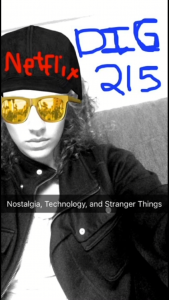
My snapchat project is the only one that didn’t get any love in this post, so here’s a cool selfie from my title page to finish out my digital studies career.
I’ve written previously about online public grief and how I think that it is an inappropriate method to mourn. I have since then run into a phenomena that doesn’t exactly change my views, but absolutely does give more credibility that to the opposing side.
Enter gatekeeping. The Urban Dictionary defines gatekeeping as “when someone takes it upon themselves to decide who does or does not have access or rights to a community or identity.” Upon reading this definition, I realized that I’ve been seeing this online for quite some time now, and very often at that. The idea resonates very strongly with the concept of snobby, ‘elitist’ preferences. Have you ever heard someone berate music tastes? How can you say you like abc music when you don’t even listen to xyz?!?
The premise is that unless one meets some arbitrary rules or thresholds, they are not “allowed” to identify with a particular group or collective. A similar statement may be made of ‘grief police’, who publicly condemn those who publicly express grief online. You’re not seriously mourning! True mourners stay off the internet and express grief alone! While I still hold true to the assertions that I made in my previous post, I do concede that there is a non-insignificant amount of people who engage in grief policing that fall into the ‘gatekeeping’ category. These are individuals that want maintain a sense of exclusivity and elitism for the right to mourn. They come up with absolutely arbitrary cutoff points-which oftentimes, and very conveniently so, happen to just barely include themselves.
When I made my previous post, I alluded to the fact that while public online grieving might be inappropriate, it does not necessarily imply that the strong reaction that it garners is appropriate. In the lieu of having discovered (or rather, having become aware of its consistent presence in social interactions) gatekeeping, I definitely agree that those who bully people online into hiding their public online grief are just as bad as those I mentioned are milking the opportunity of loss for attention.
The topic we discussed a lot throughout the semester was how robots are taking over in the future. To be honest I found this topic absurd until I found myself in the self-driving Uber in the middle of Pittsburgh. In the article Death by Robot by Robin Marantz Henig there is an example of a robot who is taking care of an elderly woman who just broke two ribs. The real concern about the robot started to happen when Sylvia (an elderly woman) asked him for a dose of painkillers. How should the robot handle that situation? A robots priority should be to help a human without hurting one, but what criteria is the robot supposed to use in deciding what the best option is for a human? When my teammate and I got in the Uber, there were two guys sitting in the front seat. The guy who was sitting behind the wheel turned out to be the guy who created the self-driving uber. He explained to us later on that there are only couple of them throughout the United States and that they were still being heavily tested. He acknowledged the pitfalls of a self-driving uber, but he strongly believed that in the range of five to ten years we won’t be able to see an uber with a driver in the car. While he had to drive through downtown himself, he let the car drive itself once we got on a highway. It was a pretty amazing experience to watch how the car was reacting to other cars. To be honest there was not a single moment where I did not feel safe in the car. As I stepped outside the uber I couldn’t stop thinking about it, I was amazed at how technology is beginning to dominate more and more facets of our lives. For the first time I was able to acknowledge that things that seemed so distant from reality are actually right around the corner. Robots and AI are definitely going to replace humans in a lot more complicated tasks, which leads to the logical assumption that a lot of jobs will be rendered useless for humans, and then one has to wonder, where does our economy go from there?
Michael Jackson topped an annual list of the top-earning dead celebrities for the fourth straight year. He gained more revenue than fellow musical icons Prince and David Bowie. Jackson, who died in 2009, raked in a bumper $825m in earnings for the 12 months ending 1 October, according to estimates from Forbes. That came mostly from the Jackson estate’s $750m sale of the late singer’s remaining stake in the Sony/ATV music publishing catalog to Sony Corporation.
In 2009, Sony paid $60 million for the rights to the Jackson film, This is It, which subsequently became the highest grossing concert film and documentary of all time. Later, Sony agreed to pay the Jackson estate $250 million for the rights to create 10 musicals over the next seven years. Similar to Michael Jackson, Marilyn Monroe raked in tons of profits after her death. The representatives in charge of her image decided to exploit it and gain monetary rewards by producing cheap knick knacks and derogatory products.
With the risk of sounding pretentious, why are people so infatuated with people who died of drug overdoses? This may be due to the fact that both Jackson and Monroe were cultural icons. Still, why are people so keen on idealising these two idols who led disastrous and notorious lifestyles? The fact that Monroe’s producers were pushing so much ridiculous merchandise out the door to reap a profit is despicable, but what about the people buying all of the crap pushed out of the corporate machine?
Marilyn Monroe is notoriously known for is her adulterous acts. She was married and divorced by the age of twenty . . . On top of this, she had many affairs with married men. The most well-known with John F. Kennedy. . . Her sleaziness isn’t something commonly talked about when girls start learning about Marilyn Monroe, but it definitely should be.
Marilyn Monroe stared in many movies, which is one of her claims to fame. . . Some would assume that someone who starred in such great movies of the time period must be a great actress. Wrong. In each of her roles, Monroe plays a ditzy blonde who wears tight revealing clothing, is very promiscuous and is only there to accompany the leading male role. . . Girls should have higher ambitions. . .
She wasn’t talented what-so-ever, which can be told by her petty acting jobs as dim-witted characters, but many movie agencies have claimed that Monroe sent naked pictures of herself in order to make herself look presentable for the roles she was auditioning for.
So, why do people keep on buying all of this merchandise? Has her image been tailored by her producers so much that we as a society idolise a completely different person?
On another note, the Telegraph article article immediately brought to mind Vincent van Gogh and Emily Dickinson. Although Monroe and Jackson reaped enormous success during their lifetime and afterwards, van Gogh and Dickinson died virtually penniless with zero recognition. It wasn’t until much later that their talent was recognised. It’s no wonder why Monroe and Jackson reaped more financial gain than van Gogh and Dickinson – van Gogh was a starving artist wandering the streets unable to sell a painting, and Dickinson was a recluse. The fame that ensued afterwards, however, is what draws these two pairs together.
Each of these people’s artistic contributions were recognised in the wake of their death, because the world realised that it had lost something special. These individuals contributed something unique to the world that can never be replicated or replaced. Jackson and Monroe most likely reaped even more benefits, because they died so unexpectedly. The tragedy of their untimely demise definitely ramped up sympathy among the masses; people who like to observe the chaos from afar, but who are careful not to get too close.
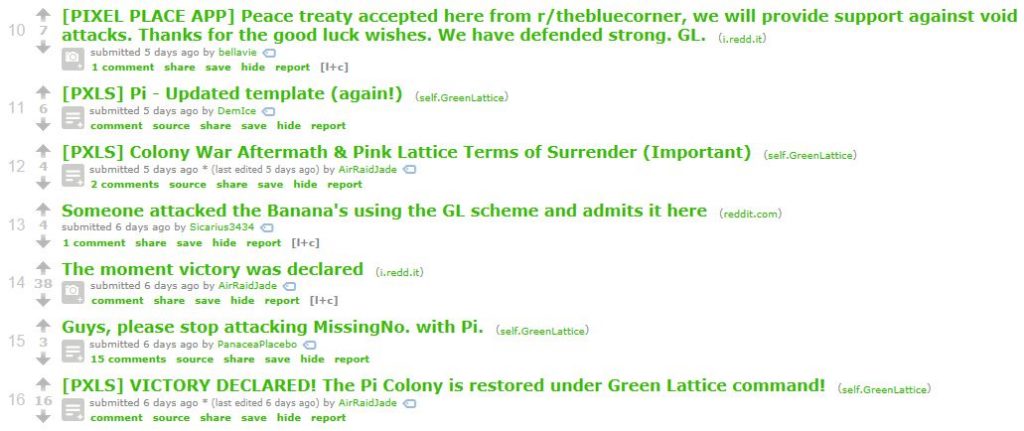
r/place is a place dedicated to pixels. On April Fools Day 2017, Reddit administrators created r/place, an interface where users could place one pixel on a massive canvas once every 5 minutes. At first, the canvas was dominated by primitive, random or algorithmic drawings. However, once internet warriors formed factions to coordinate group efforts to draw more complex creations, the results were absolutely extraordinary:
This video (90fps!!! 4K!!!) gets better literally every single watch. There are literally thousands of small, intricate, drawings that end up populating the final product. But what is more relevant to the subject of the course (and in my opinion, more interesting) is the journey upon which each region of the canvas embarks. As r/place became more and more popular, each pixel became valuable real estate, and drawings fought tooth and nail for survival, or sometimes what can only be described as… pure aggression.
There were so many French jokes here that I could make that I’d rather leave it up to your imagination.
So how does this relate to death in the digital age? Simply put, There were thousands of little deaths on the canvas throughout the 72 hours it was active. Often, larger, more coordinated groups were able to overwhelm smaller and less dedicated groups and claim larger territories for their pixel art. And what’s especially fascinating is that much of the dialogue both internal to these groups and between them are recorded in the various subreddits that popped up during r/place’s lifetime.
Other, less populated subreddits’ posts are dominated largely by confusion, panic, fear, and posts blaming other subreddits.
I found the reaction of various factions to losing their territory on the canvas to be eerily similar to how groups of people might react in the real world to impending doom. Often, when drawings were being vandalized or drawn over, there was a certain point where it was clear that the battle would lost (when around a third of the pixels were gone, more or less). It was during these times that the losing subreddit would behave in ways that reminded me of the stages of grief. In any case, r/place is an absolutely fascinating case study for internet group dynamics and how individuals can form vast social networks in very short time spans, and how these networks can behave as an individual.
To make this post more interesting than it is, I decided to put all of the text I wrote for this class (excluding projects) into an online word counting engine which excludes only common words, and otherwise returns the frequency of words used, and ranks them
very
29
people
28
think
24
self
23
person
19
game
18
just
17
world
16
many
15
story
15
foreign
15
gam
15
First, it’s obvious I talked about games a lot. Something went wrong with the code and it miscounted the amount of times I said game, but it’s in the thirties, and should probably be on the very top. It’s interesting, because I play games very selectively and I don’t really have a lot of time to play them, but the ones I do I enjoy analyzing and breaking down. I think they are very interesting because they are so new, but the craft of video games contains within it theories and understanding from all other fields: archit- (damn, I had to stop mid word to realize I’m writing about games again lol, anyways) -ecture, drawing, psychology, sculpture, music, communication, math, etc. You get it. They encompass everything and anything, and I think it’s beautiful, like a joined playground. Also, most of the games that I play are very related with death, and the way each one of them tackles it can be a post of its own.
I talk about the world and being foreign a lot as well. I remember that paper by Kocurek really stuck with me throughout this class. I felt it was so much deeper than just green blood in video games, and I could see a reflection of the paper’s point in so many other forms of media. I think it especially rang true with my experience here on earth, being that wherever I go, I’m considered foreign (I’m a third culture kid). And being foreign has its pros and cons which drastically shape the way you think about life, people, cultures, and conflicts, both global and local.
I also talk about stories a lot. I find narratives very intriguing, and especially how they tie into the world today, with social media, the internet, and level of globalization that never existed to this point. How our online digital narrative reflects who we are as a person (as explored by the episode of Black Mirror, Be Right Back), how well we truly know each other, and what our online secrets can tell us about ourselves. I remember watching a video by Slavoj Zizek, a modern day philosopher, who said that it’s exactly in the anonymous, fake profiles we might make as a joke on Facebook, that we reflect who we truly are. I would agree to some extent, but argue that we as people are much more multifaceted than what meets the eye, that our narratives can be both one thing and another. That our anonymous persona is just a thread in a larger narrative that encompasses what it means to be a person. That our digital self is just one dimension of our true selves.
I close then by saying, this statistic (word frequency) I drew on my own posts is also just one way of looking at the overarching narrative that I’ve told throughout this class. There are many ways to look at it, and I think personalities should treated as such, as multifaceted, with many perspectives, and no one ultimate perspective. I say this because it ties into the entire idea of who we are, how does technology change us, and if we uploaded all of this information about us, would we still be us. If we died in a time when technology allowed us to upload our brains into a computer, would we still be dead? My conclusion is that we would. Death in the digital age is no different than death in any time before. Death never changes, only life can do that.
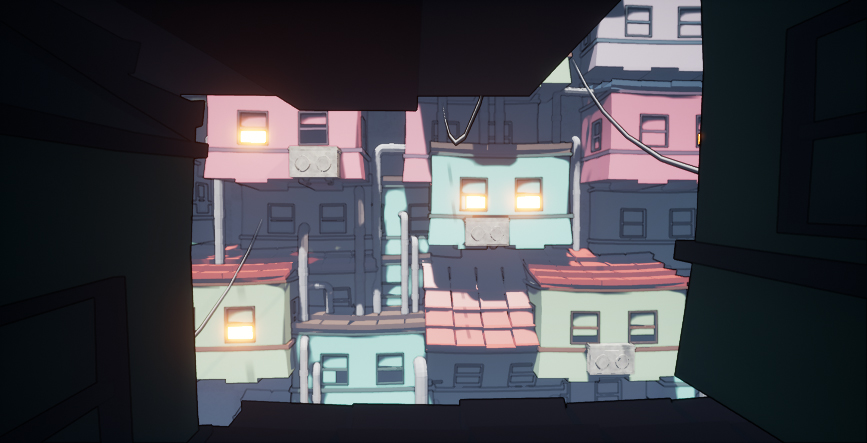
A screenshot from the video game I’m working on, which is heavily influenced by all of the digital studies classes I’ve taken, and I believe it deserves a place in what could be my final post in the digital studies field.
P.S. I used the word frequency as an interesting way of quoting myself, just to keep things interesting. The final sentence of the post is my grand takeaway from this class.
I was just reading through some of the posts and stumbled on Dusan’s post about power cuts in Serbia. I figured it’d be interesting to post one of my own experiences of the same situation in Montenegro.
So my family is sitting on that balcony, I’m inside the house (sorry, no pictures of the interior), watching some the very primitive TV we have available. I’m not really paying attention. In any case, it comes to be very late when suddenly everything just shuts off. Now, we’re not near the city, we’re in a village. A power cuts means complete darkness. It’s an interesting feeling being unwillingly exposed to the darkness, it feels very invasive actually. In any case, we all kind of conglomerate on the balcony to see what we’re going to do. My brother finds one of those wind-up lanterns, and before we know it, we notice wind-up lanterns and flashlights start going off on the balconies and porches of other nearby houses.
The first thing that follows is some form of communication between neighbors which usually never talk to one another when there is power. We wave our lantern, they wave there’s. There’s little background noise, soon we start shouting to one another across the field that is in the middle of all these houses (visible in the first picture). Before you know it, the entire neighborhood is throwing jokes from their own porches and balconies, usually serious people now making noises at each other and laughing. Inevitably, being that the power is out for so long, everyone conglomerates in the field in the middle, people bring food, and we sit around these windup lanterns talking about life, acting like a larger family. All conflicts are set aside, stories are being told, laughs are being shared. And then we hear distant yelling, and we know what it means. A nearby village has gotten power. I look over (again visible in the first picture, but not too well) the valley that’s beside our village, and spot a wave of lights turn on in different villages across the country. We start cheering as well, the lights go on in our village. We all separate, and tomorrow, everyone goes back to not talking and just minding their own business.
It really reminded me of some of the moments in Station Eleven, and I can’t get any of these images out of my head when we read the book. This post isn’t an argument against technology, but more of an interesting insight on a possible effect of a temporary lack of technology. I’m sure that if the power cuts lasted for much longer, that camaraderie would soon turn into chaos.
While growing up in Serbia, I witnessed some extreme events in the country. I am not talking about crime in the country or wars, I am talking about the world with power cuts. Just couple years after NATO bomb Serbia, the country was still trying to rebuild itself. During those tough times people all over the country would lose power and water for days. The same fate effected my family as well, for almost a week. After reading the book Station Eleven, from Emily St. John Mandel, I was able to recall so many of those memories. While she makes people think about life with no technology, I can vivid memories of it. There is not a better way to imagine life without technology than to take it away, and that is exactly what Mandel did to show her readers how reliable to technology we actually are nowadays. Back to my story, once the power cuts happened in the country my family and my cousins were all in one house. Phones did not work, lights were off, computers did not work…etc Bringing back these memories brought me to realization that at that time we lived like people in middle age did. Would it be weird if I tell you that one of my best childhood memories were made at that time? Even though we did not have all of the “unnecessary” things to be happy, my family and I had some of the best times together. My parents and my cousins were not able to go to work, they did not have a job (they were unemployed) and all of them were living in the moment with no stress. Every night my dad would make a fire and everybody would come together around the fire. We would be there for hours listening to funny stories and singing.




 Retrieved from: