Quirky Funerals

While coming up with our own traditional death ‘systems” and post-modern/digital death “systems” in class, I began to wonder about what other sorts of wacky death traditions people have.

Although we came up with some gosh darn wacko potential startup companies in class (shoutout to our plant a corpse company!), these definitely took the stakes and raised them even higher…

Funerals don’t necessarily have to be somber events. These memorials and traditions are heavy on quirk.

1. The last hurrah

Miriam Banks was the life of the party—even at her own funeral. When she passed away in June, her daughters honored her memory by recreating apart scenef amiliar to friends and loved ones. Instead of a coffin, the deceased sat at a table with a cigarette in her hand and her favorite beer and whiskey in front of her.

2. Highway to heaven

Billy Standley was so fond of his 1967 Electra Glide cruiser that he spent the last years of his life planning his burial on the motorcycle. When the fateful day finally arrived, a team of five embalmers prepared Standley for his final ride, mounting his body on the bike and dressing him in leather biking gear and a helmet. He led the procession to the cemetery.

3. Go out with a bump and grind

In Taiwan, some people hire strippers to appease wandering spirits and liven up the occasion. The dancers stay somewhat modestly dressed, but they are not shy about jumping on caskets or giving mourners lap dances.

4. Funeral Processions in New Orleans

In New Orleans, the dead go out in style with some jazz, dancing, and a procession that lasts into the evening.

5. The end of the road

George Swanson was buried with his Corvette in 1994. Car enthusiasts might find the Corvette’s death more tragic—the car only had 27,000 miles on its odometer.

6. The #Funeral Live Tweet

When publicist and Twitter addict Michael O’Connor Clarke died of cancer, his friend Mathew Ingram shared an online play-by-play of the memorial service. Ingram lost a few followers along the way, but Clarke’s family in Ireland appreciated the gesture.

Works Cited

Green, Amanda. “12 Strange Funerals and Funeral Traditions.” Mental Floss. N.p., 11 Jan. 2016. Web.

All images courtesy of iStock unless otherwise noted. 

Comedic Scary Movies

Brophy describes the necessary balance in horror films between comedy and horror stating:

“It is humour that remains one of the major features of the contemporary Horror film, especially if used as the undercutting agent to counter-balance its more horrific moments. The humour is not usually well-crafted but mostly perverse and/or tasteless, so much so that often the humour might be horrific while the horror might be humorous,” (29).

According to Pinedo, if the movie incorporates too much humour, then it creates a parody. On the other hand, if the movie incorporates too much terror, then it is a form of terrorism, (29). Scary movies need humour in order to balance it out and make the movie more appealing to the audience. Who would want to sit in a two hour film of pure, unadulterated terror? A masochists, probably, but the average movie goer would most likely not appreciate it.

Some films use humour unintentionally… Examples of these types of movies can be found by visiting this brilliatn list of 17 unintentionally hilarious moments in horror films.

One example that immediately came to mind is this scene from the 80s icon horror movie, Friday the 13th. Although this movie is a horror icon, there are so many unbelievable and drawn out moments that make it fun to watch. Check out this scene below to see what I mean:

Maybe the scene in the original movie didn’t look and sound exactly like this, but boy was that lady running for a long time.

Some movies take it too far and intentionally turn into parody. These include:

www.youtube.com/watch?v=PrFl800iYWI

And my personal favourite…

“Watching a horror film is, like riding a roller coaster, a collective experience. Horror expressly plays on the physical and emotional responses of the audience. It draws screams, nervous gasps, and laughter. Horror elicits audience rebukes and warnings addressed to narrative characters (‘Don’t go in there’), or about narrative characters (‘Heeeeere’s Jason’). A Gary Larson cartoon captures this dynamic: An audience of deer is watching a film in which a deer character approaches a door over which hangs a mounted deer trophy. The audience cringes and one member cries out, ‘Don’t go in there!'”

Sean of the Dead, as well as the other movies apart of this end-of-the-world trilogy, intentionally mix in more humour than horror to help make the film stand out. Don’t misunderstand – there are so many scenes in this movie that are chilling. The zombies are disgusting, a man gets his stomach ripped open on screen, and the ending makes you tear up a bit. . . but man, is this movie hilarious! There is a slight tip in the scales towards comedy, but this movie successfully finds a way to add in just the right amount of horror, emotional turmoil, and empathy to make it one of my favourite movies ever. You find yourself saying things like, “You IDIOT, look around you! It’s the god damn Apocalypse!” And, of course, all of this is in vain… You have to wait for this slow-witted, well-intentioning moron to figure it all out on his own. It’s heart warming, really.

There is a deliberate sense of hypermediacy in movies that fit under the horror comedy drama. The movie is aware of what the audience is expecting and delivers it with a twist of humour. The creators of Sean of the Dead, who are the main actor and his best friend, knew what audiences expected while watching a horror movie. They played off of this “insider knowledge” and manipulated it to put together a funny horror movie.


Works Cited

Pinedo, Isabel. “Recreational Terror: Postmodern Elements of the   Contemporary Horror Film.” Journal of Film and Video48.1/2 (1996): 17-31.

Are we destined to be immortal ? (blog post #6)

Throughout the semester we spent a lot of time addressing digital mortality and immortality. We started off the year with Ashe and the episode of Black Mirror, Be Right Back, later on we discussed social media of deceased, to finally conclude the semester with discussions about death of famous people and their digital mortality. In Alexandria Sherlock’s article “Digital Resurrection and the re-Enchantment of Society”, the author acknowledged that the death of a famous person can have a substantial effect on society. Parasocial relationships with famous person cause mourning and hysteria. One of the most famous examples are death of Elvis Presley and Princess Diana whose deaths still remain a relevant topic in the present day. The rise of technology allowed people to express their feelings on a whole different level. Social media, such as Twitter and Instagram, get hyperactive every time a famous person dies. Technology evolved so much that people were actually able to create a concert of Tupac with a hologram to represent him. Although the hologram looked just like Tupac, at the end of the day it is nothing more than a simulation. The same thing can be said about Ashe once Marta brought him back. The resurrected Ashe looked better than he used to look in his everyday life (due to his social media pictures), but it did not take long for Marta to figure out all the differences between the real and resurrected Ashe. The grand point being that, even though technology has progressed incredibly, especially in the last two decades, we are nowhere close to immortality, in other words, our mortality still remains just as relevant to our lives with no substantial change of dynamic, even with the introduction of advanced technology. Our life spans are longer, but once death knocks on the door, it’s pretty much the same.

retrived from: humansarefree.com/2014/09/science-could-make-us-immortal-but-do.html%5B/caption%5D


Peace,

Duka

Growing up with dead artists? (blog post #4)

While reading a portion of the assigned reading “A Resonant Tomb” from Jonathan Sterne’s The Audible Past, I was fascinated at how much emphasis was put on the difference between imagination and the practice of sound recording. Early recordings were seen as a method of immortalizing someone, but how successful were they?  Stern acknowledges that the process of sound recording protects present and future auditors from experiencing the deterioration of the voice. Sound recordings also separate body and voice in two different categories. One of the most unique examples from the reading was the funeral of the minister. Once he felt that he is going to die soon, he recorded his final sermon. This unusual act brought a lot of attention from the population as well as media. It was like a big mysterious spectacle where a dead person was preaching to the living. During those times people were astonished that a person that died could still talk to them, whereas today recordings are so normalized that they are not regarded as anything other than old technology. After the reading I really thought about this matter and realized that some people grew up admiring and following singers that are no longer with us. One of the prime examples is Tupac Shakur who was murdered in 1996. Even though that time is long past us, people still live with his songs as inspiration. Some even go the extra length to refuse he is actually dead. Every couple months I would run into one of those articles that are talking about how Tupac actually faked his whole death to get out of gang warfare and live anonymously somewhere else.

[​IMG] Retrieved from: www.thecoli.com/threads/tupac-shakur-died-18-years-ago-today-a-look-back-at-rap%E2%80%99s-most-influential-mc.248878/%5B/caption%5DPeace,

Duka

Hachiko, the Faithful

Reading about the story behind His Master’s Voice brought a question to mind.

Do out pets mourn and remember us after we are gone?

If you’ve ever watched Futurama’s Jurassic Bark episode, then you probably think YES, THEY LOVE US JUST AS MUCH AS WE LOVE THEM. At least, that’s what I believe. The story of Hachiko could prove that this sentiment is true.

 Hachiko

Hachiko and his best friend and owner Eizaburo
Hachiko and his owner Eizaburo

Eizaburo Ueno, a professor at Tokyo University, adopted Hachiko from the Odate city in the Akita prefecture. Hachiko, or Hachi, and his new owner soon became inseparable. For the next two years, Hachi would walk in the morning with Eizaburo to the Shibuya Train Station and return in the afternoon to walk Eizeburo back home. On May 21, 1925, Hachi waited at the usual spot for Eizeburo to return but… Eizeburo never showed up.

Unbeknownst to Hachi, Eizaburo had suffered an unexpected cerebral haemorrhage at work and died at his desk. After Eizaburo’s death, Hachi moved in with another family. For the next ten years of his long life, Hachi continued to go to the Shibuya Train Station every morning and afternoon waiting in vain for the return of his beloved owner.

A major Japanese newspaper reporter published Hachi’s story in 1932 making Hachi a national hero in Japan. People started calling Hachi, “Chuken-Hachiko,” meaning, “Hachiko – the faithful dog.” The story of the dog that never gave up gained a lot of attention, and people from all over the world came to visit Hachi and offer him treats at the Shibuya station.

Hachiko in the Japanese newspaper
Hachi in the newspaper

In 1934, a statue of Hachi was unveiled at a grand ceremony in front of  the Shibuya train station.

Haichiko in front of his statue

One year later, Hachi passed away on the street near the train station at the age of twelve. There is a monument of Hachi next to his owner’s tomb in the Aoyama cemetery located in Tokyo, Japan.

grave

Today, the Hachiko bronze statue is a popular attraction; reminding us all of the unconditional love and loyalty our pets can give.

There is also and enormous mosaic dedicated to Hachi in front of the Shibuya train station.

_DSC7126


Works Cited:

Dinh, Michelle Lynn. “The Last Photo of Faithful Dog Hachiko Breaks Our Hearts.” SoraNews24. SoraNews24, 06 Dec. 2013. Web.

Maria. “The Amazing And True Story Of Hachiko The Dog.” Nerd Nomads. N.p., 06 Aug. 2016. Web.

Messenger, Stephen. “Rare Photo Surfaces Of Hachiko, The World’s Most Loyal Dog.” The Dodo. The Dodo, 09 Nov. 2015. Web.

Caitlin Doughty

Caitlin Doughty

Caitlin Doughty is one of my new favourite YouTubers of all time. Doughty is a mortician who runs a YouTube channel dedicated to normalising death and exploring the myths and misconceptions surrounding death in Western cultures.

After releasing a Buzzfeed video discussing these myths and misconceptions, Doughty presented a TedTalk on the same subject.

For example, Doughty debunks the myth that dead bodies are contagious and potentially harmful to the living.  Doughty claims that this is completely false; our detachment from death is what led to this sort of problematic thinking. In fact, in a remote village in Indonesia, the families mummify the dead and hang out with the corpse for years to come. They take the corpse outside, bring it to breakfast, and tuck it in at night in bed with the kids. Families and friends bring the corpse snacks and talk to the corpse, because they believe that the corpse appreciates the offer and can hear the living. These corpses still function as solid members of the family and the community.

This level of intimacy with the dead, however, is non-existent in the West. The West has a broken relationship with death, which according to Doughty is a new phenomenon that occurred within the past century. In the past one hundred years, we have outsourced death and transferred the rituals from the hands of the family to the hands of professionals. Nowadays, people are either buried or they are cremated.

Even talking about death has become a sort of taboo reminiscent of the sex taboo in the earlier centuries. The trending Buzzfeed comments went along the lines of:

“I’m pretty open minded, but this is so weird”

“This girl really creeped me out”

“You’d be crazy to play with a dead person like a doll. Seriously, that lady needs to see a psychiatrist.”

According to Doughty the shocking part isn’t the troll-nature of these commenters or that people believe these things. The shocking part is just how quickly culture changes. This sentiment brings to mind the photographs we looked at in class that people would take with their dead loved ones. People wanted to remember their loved ones and paid extra money to have some proof of their fleeting existence. Even then, wakes were held in the privacy of the home. To us, it seemed weird and unsettling, but to those families it was meaningful and completely natural.

Doughty states that the death care industry is a multimillion dollar corporation that is not interested is handing the reigns back to families. To help this sink in, imagine just for a moment how painfully obscure and unnatural our funerals have become.

For example, let’s investigate chemical embalmment. Chemical embalmment swells up the skin and makes it look puffy and wax-like. All of the insides are hardened and nothing “natural” is left. The body being buried is more of a shell of the person, with the outside fully intact, while the insides are extracted and destroyed. Furthermore, the corpse is slathered with a full face of make-up and buried in an expensive article of clothing. Natural corpses, on the other hand, don’t exactly look as if they are asleep – they look dead. Still, they look natural. There is no painful shade of coral on your dead uncle’s lips combined with a tacky combover and veneers.

The most important message I took away from this TedTalk is to take the time to sit with the deceased and look after them. If someone I love passes away, then I want to be able to respect their body and take care of them on my own. This is someone who is important – not someone who is meant to be immediately carted to the funeral home or to the oven.


Cyber-bullying continues after the death of a Texas teen. . .

Brandy Vela

Brandy Vela, 18 year old victim from Texas

Brandy Vela’s bedroom is covered in Post-it notes. “You will always own a piece of my heart,” says one. “You will never be forgotten,” says another.

Vela committed suicide by putting a gun to her chest while her family begged her not to.

Cyberbullying

Brandy’s sister, Jackie, says the teen had always been mercilessly bullied online for her weight, but the cyberbullying eventually gained more momentum. “People would make up fake Facebook accounts and they would message her and she wouldn’t respond and they would still come at her,” Jackie said. “They would say really, really mean things like, ‘Why are you still here?’ They would call her fat and ugly. She was beautiful, absolutely beautiful; the only thing people could find to pick on her was her weight.”
Jackie says her sister changed her phone number and reported the bullying to police, but was told they couldn’t help her. Brandy also reported these instances of harassment to her high school, but the investigations led to nowhere. “They couldn’t do anything because [the suspects] used an app and it wasn’t traceable and they couldn’t do something until something happened, like they fight,” Jackie said.
Even when the Facebook pages were deleted after they reported them, it was just a matter of days before a new one was created. The profiles had Brandy’s name and photo and said she would “offer sex for free,” Jackie says.


“They would say, ‘I’m a slut and I’m a hoe. Anybody hit me up,’ ” Jackie explains. “It also had her phone number, so she would get text messages and phone calls all the time. It kept her up at night.”

Death

Brandy Vela sent a cryptic message to her sister one night, and her sister raced home with their mother and father to see what was going on. As soon as they arrived, they found Brandy with a gun pointed towards her chest crying and apologising for what she was about to do. The family tried to convince Brandy to put the gun down to no avail. Brandy was pronounced dead at the hospital.

Memorial Gone Wrong

While the family grieved their loss, they say bogus Facebook accounts of the high school senior continued to crop up online. One of the profiles showed guns on a photo of her, while another had a picture of the teen, who was bullied for her weight, as a pig.

“Two days after her funeral, somebody opened up a social media page in her name,” father Paul Vela said. “And people thought the family did it, so it started with people putting sincere condolences. After a few minutes, either four people or the same person posting four times said some things harassing Brandy about being a big fat cow, writing ‘you finally did it’ with a picture of a gun, writing ‘you’re a coward,’ ‘you should have done this a long time ago,’ some really horrific things.”

One of the posts shows a smiling Brandy with the words “my face when you shoot yourself in front of your family.” Another post showed a stick figure holding a gun with the words, “oops am I dead?”

The pages were removed after the family complained to Facebook, but authorities have not been able to determine who was behind the bullying.

I thought of this as a sightings post, because we came across commenting trolls while reading about online memorials. This is an extreme example of that where a person connected to the deceased bullied a girl to the point where she committed suicide and continued to harass the family on the online memorial sites.

Aftermath

Several months later, justice was served. After intense investigation into this cyber crime, police arrested two possible perpetrators. Police say 21-year-old Andres Arturo Villagomez and 22-year-old Karinthya Sanchez Romero, both of Galveston, were behind the harassment. Villagomez was allegedly the ex-boyfriend of Brandy. Sanchez Romero was his new girlfriend.

Works Cited

Hassan, Carma. “Bullied Teen Kills Herself in Front of Family.” CNN. Cable News Network, 01 Dec. 2016. Web.

Keating, Caitlin. “Teen’s Family Reveals the Intense Bullying Before Her Suicide in Front of Them: ‘It Was Stalking’.” PEOPLE.com. Time Inc, 14 Dec. 2016. Web.

POST, JACKIE SALO NY. “Bully Victim Brandy Vela Is Still Be Trolled Online after Shooting Herself.” The Sun. The Sun, 14 Dec. 2016. Web.

Eulogy for Vine: RIP

Vine is dead. It is now exists as a glorious smattering of Vine Comps on YouTube, a digital time capsule refracting the memes, digital sensibilities and the very special way Vine content was crafted between 2013 and 2016.

Vine was a special oddball within the social media landscape. It spurred us to do the most and the be the most — #doitforthevine. It was the perfect outlet for our jumpy, hyped up attention span: 7 seconds, hit me. In 7 seconds, creators grabbed us with the weirdest, wildest, most outlandish and unexpected content. It had the feeling of being raw media while also, often, being meticulously shot and re-shot until all 7 seconds flow liked gold. Twitter bought Vine for a reported $30 million in 2012 before it even went live. But they couldn’t figure out how to monetize it, to hack dollars out of our creations, to inject it with gross advertising and sponsored content. So now Vine is dead.

Gabbie Hanna, who shared her Vine videos with 4.9 million follows, eulogized the Vine death via Twitter: “Vine being deleted is like an old friend i havent rly talked to in a while dying & even tho we werent close anymore it hurts to see them go.” 

Vine was a platform for creative, unexpected content — a place for creators to experiment outside of the commercialized bubble of YouTube or platforms heavily tied to your identity, like Snapchat and Instagram. With Vine, we could effectively become performance artists, where the social and cultural capital wasn’t tied to normative social performances (which it is, on basically, like, every other platform #normies).

In class, we spent time discussing how social media reacts when a person dies — the Facebook memorials, the popularity-ranked HeavenAddress pages. But here we can see what happens when a platform dies: we won’t be able to experience Vines like kids in 2014 got to experience Vines. But the content still circulates in YouTube compilations. The ghost of Vine — incomplete and inexact but still enough — lives on, for now.

Warfare or a video game ?

With recent developments in all technology, military technology has followed closely, producing more and more unique answers to warfare. Countries around the world are spending billions of dollars competing for military power. Some of the most sophisticated and in turn terrifying military advancements come directly from the US. The notion of fighting a war from your backyard is something truly remarkable and questionable.I personally did not think something like drone warfare existed until a few months ago. I heard about it, but I did not understand what it actually meant.  In just the last few years around two and a half thousand people were killed by drones. Despite the many advantages drone warfare adds, it remains a questionable topic due to the ease with which it can be applied, and how little needs to be sacrificed. Originally, one of its main purposes was to put a soldier in the situation that would allow him to operate without fear, which would save the life of civilians. However, this purpose fails as results showed  that hundreds upon hundreds died since U.S. military introduced drones to the warfare. This technology allows soldiers to have a wrong perception of war, in many ways trivializing the topic. You have a remote control that allows you to kill people without any connection to the aftermath. In the article Death by Robot by Robin Martinez, a robot is asked to give a dose of painkiller to a woman that suffered from two broken ribs. Although the robot is not capable of deciding whether or not a woman really needs painkillers, it still must make a decision, bringing about a problem. When we, and we definitely will, start using AI to fight our wars, the ethics of warfare will need to be entirely rewritten.


Skynet is coming. <br> Image source: The Guardian. Retrieved from: www.hardwarezone.com.my/tech-news-ai-experts-and-researchers-demand-ban-ai-used-warfare%5B/caption%5D


Peace,

Duka

A Mental Hellscape: Alan Resnick Horror Shorts

A postmodern-horror-video-delivered-in-a-postmodern-medium sighting! Alan Resnick emerges!

Resnick is a video artist whose first YouTube creation was an uncanny video series on the tutorial genre. “alantutorial” oscillated between hilarious and disturbing as a high-pitched, odd character demonstrated how to eat a bag of chips or pick up a blue chair off the ground. His seemingly useless tutorials often escalated in unexpected and weird ways — like when he starts crying and throwing a tantrum when he can’t actually figure out how to pick up the blue chair off the ground.

Resnick proceeded to create short videos for Adult Swim; his combination of dark humor with uncanny horror became his signature. In “Unedited Footage of a Bear,” the frame opens on a literal bear. He is majestic, calm, and free. It’s the only moment of peace in a video that quickly devolves into chaos, panic, and violence.

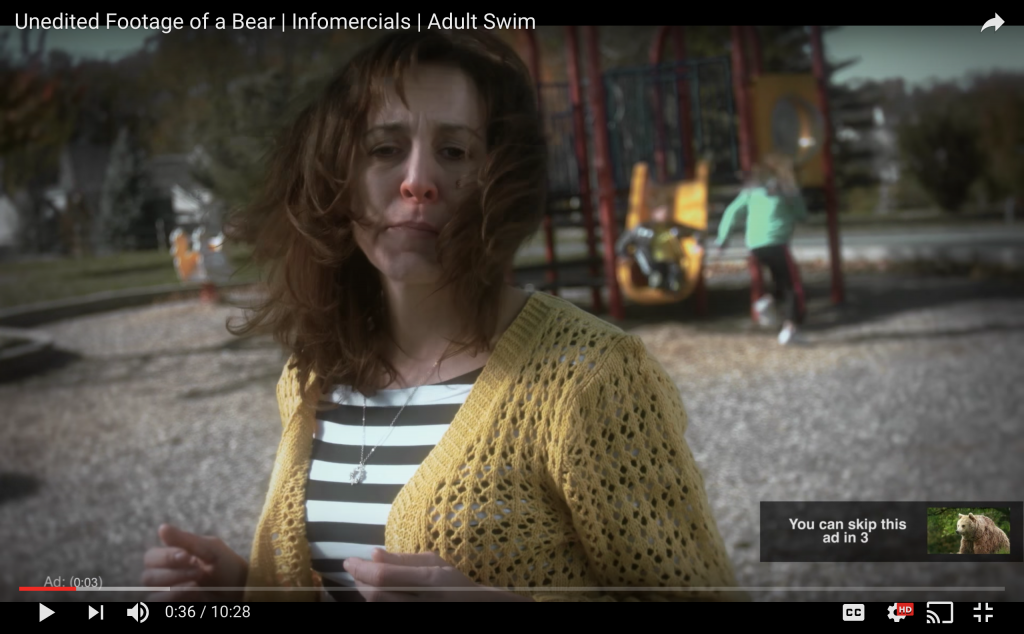
But first, the footage fades into an ad. A mom sneezes and looks miserable as her kids beg to play — she happily pops a pill and get back to her regular life!

Screenshot “Unedited Footage of a Bear” YouTube

If you let the video continue to play, the mom gets into her car, smiling widely. She is still performing for the “commercial” as a cheerful female voice lists off a barrage of side effects in rapid succession. Slowly, as the voice fades, the mom’s facial performance drops. She drives back into her “real life,” looking exhausted as she rolls through her neighborhood.

Yes, that ad and that performance was a little postmodern Russian doll!  This is media embedded in media, a video that sprawls beyond the typical YouTube format, an ad and a performance of an ad embedded into a larger narrative. If the viewer clicks “Skip Ad,” it actually directs them to a fake website for the drug the fake commercial was touting, Claridryl.

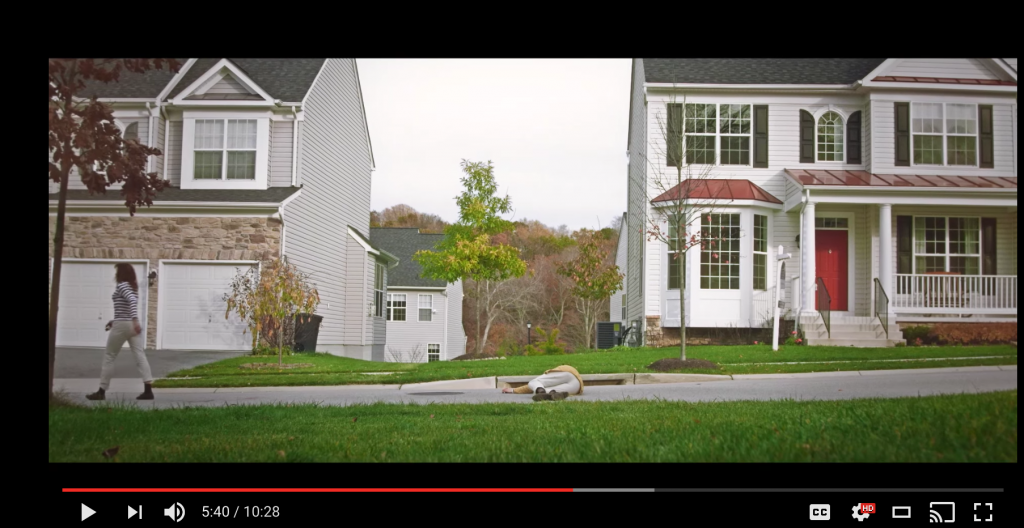
The rest of the video imagines the mental breakdown of this mom, as her Claridryl alter-ego — spun out on pharmaceuticals that triggered total darkness rather than enhanced health– hijacks her life. There is one scene where the mom is literally beaten and run over by this alter-ego, suggesting a total lapse of control.

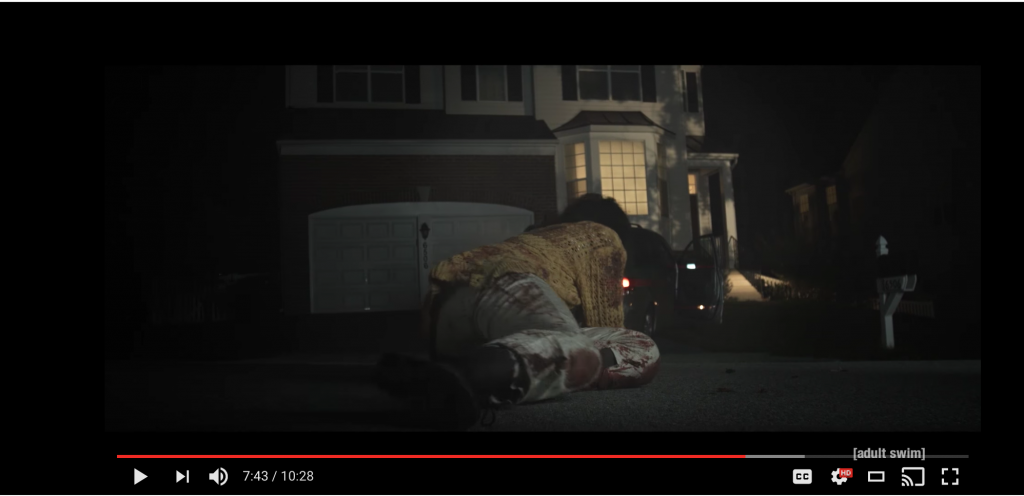
This is reminiscent of the postmodern body horror we discussed in Paul Tremblay’s A Head Full of Ghosts. The horror is located in failure of the body to adhere to societal standards, an ambiguous loss of control and the tension between mental illness and demonic possession. This all appears the case in UFOAB as the alter-ego proceeds to ransack the mom’s house and threaten her children while the mother writhes on the ground outside the house, beaten and bloodied, able to witness the destruction but not get up or control it.

Mom (right) is beaten in the street by her alter-ego (left). Screenshot.
Mom does not have the power to stop the horror inside the house. She crawls on the ground outside but cannot get up. Screenshot.

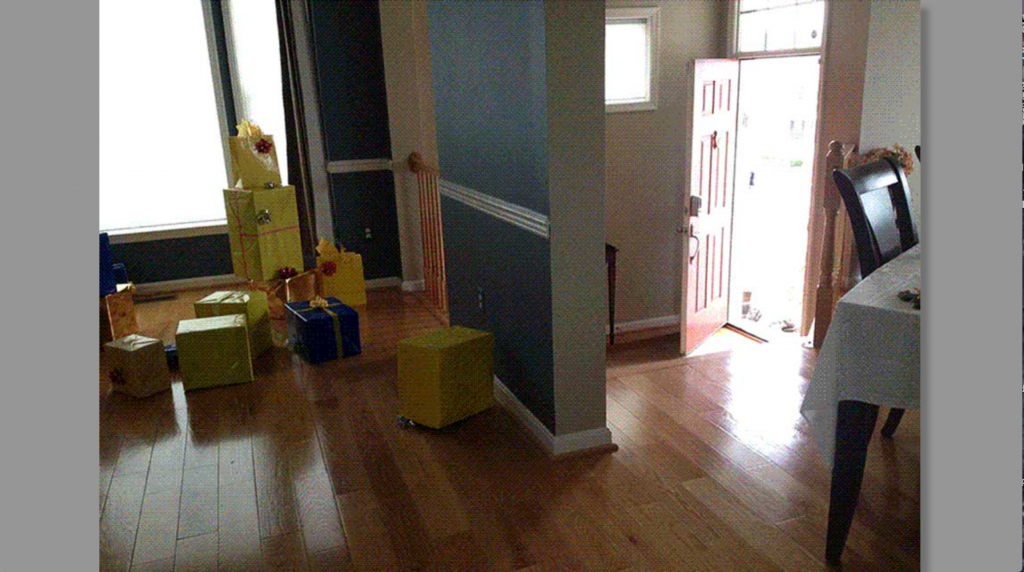
This postmodern narrative is set within an equally postmodern media format that combines nested video footage with an interactive website. As users click around on the Claridryl website, they will find surprising hidden “easter eggs.” For instance, you’ll notice a house in the background of the main banner image. If you click on the house, it draws it slowly into the foreground — and then it takes up the entire screen, but becomes an interactive, click-able image-scape. You can actually enter and explore the house as it appeared in the video in scenes where the alter-ego took over.

Entering the house from the video via the Claridryl website. Screenshot.

Linger on the main part of the website for too long, and it will slowly fade to grey…with a tiny GIF of the alter-ego perpetually running towards you.

Screenshot Claridryl website with alter-ego running figure.

Resnick achieves a totally creepy experience by layering his content and diversifying his mediums. The horror or Claridryl spans beyond the ten minute video; that horror builds and builds as you click through the nauseatingly designed website, as you find the house discover other uncanny imagery within it, as you are left with so many unanswered questions as blue and red police lights descended on the mom’s still bloodied body.