
One of the things I found most troubling with this week’s reading “Enter the Grief Police” was my own reaction. This article hit hard to home and forced me to confront and examine my own behavior and perceptions when it comes to experiencing and performing grief.
When I read this piece, I found myself siding with the “Grief Police” to one extent, but also vehemently reprimanding them on the other. When celebrities die (shout out to the year 2016) or someone in the local community passes away, many people have taken to showing their grief in a very public manner, through the use of social media platforms such as Facebook or Twitter. In so many of these cases, when I see the grief of my “friends” (are social media contacts really friends? That’s a whole different subject…), I cringe. Unless it’s a close friend or relative, I assume that their “grief” is superficial or all just for show — for attention. When a celebrity dies I think, “How on earth does this actually affect your life, dude? Get over it.” When someone posts concerning a community member that has passed, I’m likely to question what their actual real life relationship was with the person.
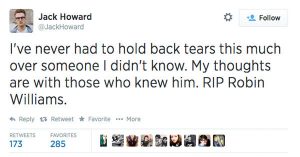
But this is all entirely unfair of me, too, because I do the same thing. I grieve in public, I ask for the support and kindness (read earlier: “attention”) of others recognizing my own pain, and I express my relationship to those who have passed along via public social media, somehow seemingly desperate to prove that I am affected by their passing.
So why is grief something we (maybe just read: I) are (am) so judgmental about — especially when we have all experienced it?