
It can protect more people from getting sick, but if you are already quarantined, especially with an epidemic or a plague, quarantine can be a death sentence. An admittance to the fact that you are sick – or will be soon – and there is nothing that anyone can do to stop it, or maybe even nothing that they can do to save you.
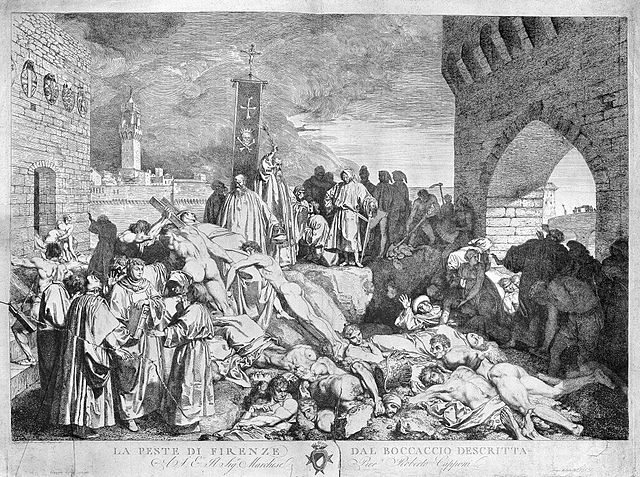
The word quarantine is derived from two Italian words, quaranta giorni, translating to 40 days. This was the amount of time during the Black Plague that ships had to wait outside of Venice before landing if they came from an infected port. Whoever was still alive at the end of the 40 days could come ashore.
Many quarantined areas in Station Eleven were not so fortunate. With no cure for the Georgia Flu, those areas designated as “quarantine” were themselves their own coffins, sealing the people inside off from the rest of the world. When the Air Gradia flight announced that it would not be docking because it was now quarantined, Clark knew that there was no hope for the people onboard, and reflected on the final moments of those passengers at other times throughout his sections of the novel.
What is most interesting to me is that Emily St. John Mandel decided to use a fake airline here for the quarantined plane, even though she uses real airlines in other parts of the books and Severn is a place in Michigan. Why would she give a fake airline the disease, sealing the passengers inside like a tomb, instead of an airline that exists in our world? Was it the fear of quarantine, the impending doom that it strikes within us in the book, the horror images that come to mind when Clark thinks about it – too much for a real airline? Or some other reason entirely, like pertaining more to Tyler’s growth and his obsession with reading to the planes?
Whatever the reasons, quarantine isn’t a promise of eventual recovery in Station Eleven. It’s a death sentence.
Given the string of bad press that United has received lately, I feel like if Emily St. John Mandel were to write Station Eleven today, that would be the obvious choice for an airline to quarantine its passengers.
Joking aside, I like that you turn quarantining on it’s head. Usually when I think of quarantining, I think of the sick person being locked away in order to prevent disease from spreading, but in your examples, you show that quarantining healthy people is also a way to keep them “safe.”
Besides the undermining of quarantine that you show Mandel delivers, especially with her use of planes, I think Mandel also subverts our ideas of an airport. While airports are definitely breeding grounds for disease and the spread of epidemic in our increasingly flattening world, they also are beacons of innovation and technology. I am inclined to think that the fact airports and planes become tombs, as you point out, highlights the destruction that a disease like this can bring, and that humans are a lot more susceptible to downfall despite the ego-stroking technology like planes provide us. I feel like the fact that airports are also symbols of travel also underline the feeling of a tomb and entrapment that you talk about with quarantines.
I also like that you seem to say that quarantines are by and large pointless. Like water, disease always finds a way in, and I feel like trying to escape from an epidemic is more of a “you can run but you can’t hide” situation. In most other apocalyptic narratives I’ve seen, those who survive often make it out because they are immune, not because of anything in particular they do. Whichever side of the coin you’re on though, I’ve never seen an apocalypse story in which some sort of humanity doesn’t make it through to the other side, so I think it’s interesting that no matter what kind of world we imagine after the peak of society we’re in now, we can’t imagine a world without the human at all.