A conclusion for all my conclusions

A part of my writing that I usually struggle with are my conclusions, especially my final sentence. While not always the clearest part of my written work, I find that these last sentences tend to convey the way I truly feel about the subject, even if I don’t realize it at the time. So for this reflective blog post, I thought I’d take a look at the concluding sentence for each of my eight previous blog posts to see how my views towards these different subjects have changed (or not) over time.

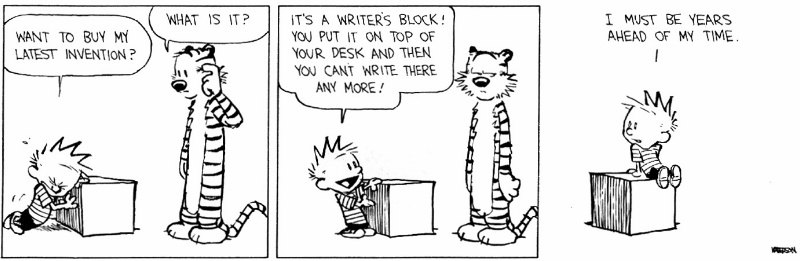
Accurate depiction of me using one of these when I have to write a conclusion. Photo courtesy of GoComics

Starting with my first blog, I wrote about the Exorcist Steps in DC, and seeing those steps in a different way now that I know the history behind them. This ending, of taking away and more learning and instructive message with me, was unique to this blog post only. My other concluding sentences, excluding #7, tended to be both pretty negative and pretty anti-technology.

What is clear to me, upon re-reading my posts, is that new technology, especially technology that differs from some classic forms, is something I’m usually initially hesitant about. In #3, I express how new interactive video games that are simulating death in their games seem a problematic way to portray death. In #4, I talk about how gravesites are “immersed in place and time” and should carry more weight than an online memorial site, which I don’t think has the same effect. And in #6 I mention how far the Tesla is away from being a true driving car, and the nervousness I have when using a Tesla.

I also tend to take a pretty grim view of the future of some technologies, as based on some of my other concluding sentences. In #2, I call poison “almost laughable”, compared to demonic posession, a sarcastic view of the final death in A Head Full of Ghosts. Through my #5 post, I reflect on how technology is changing us, expressing a negative view towards on technology’s impact on our society and moral standards, referring to the pictures at the Berlin Holocaust Memorial. And finally, in my recent #8 post, I end with the pessimistic view of quarantine, not that it is protecting the disease from spreading, but that “it’s a death sentence.”

My only bright spot is with blog #7, when I discuss how the Travelling Symphony is a rebellion against the death that they face all around them. Why this is my only bright spot throughout my 8 blogs, I’m not sure. But I can see that these blog posts have shown me that while I am an active and constant user of all sorts of technology, I’m hesitant to incorporate them into my everyday life until I know they work or until they become ingrained into our society. And with that, I’m concluding this conlusion of my conclusions.

Final Blog Sentences: 

#8 = It’s a death sentence.

#7 = Even the Georgia Flu couldn’t take this away from them, and this way they are rebelling against the death and despair to be part of a production bigger than themselves.

#6 = As of now, while the car can do some driving of itself, it is still a long way from the true self-driving cars that would take you from point A to point B without you ever touching the steering wheel.

#5 = Regardless, it is unclear if technology simply the vehicle for sharing our actions with the wide world of the internet or if technology is truly changing the way we interact with the sacred and somber places in the world.

#4 = Immersed in place and time, the gravesite, I would argue, has a stronger emotional pull and generates a more powerful connection than a site lost in the endless pages of the internet.

#3 = I think that in these interactive video games where the point is to kill your way to the end, the gaming industry is making it pretty easy for gamers to pull the trigger.

#2 = Compared to a demon possessing you, poison seems almost laughable.

#1 = These places are firmly linked, a blending of physical and fake, and now a set of stairs that will always have two layers of memories for me, all because of my deep connection to Washington, DC.

Quarantined.

It can protect more people from getting sick, but if you are already quarantined, especially with an epidemic or a plague, quarantine can be a death sentence. An admittance to the fact that you are sick – or will be soon – and there is nothing that anyone can do to stop it, or maybe even nothing that they can do to save you.

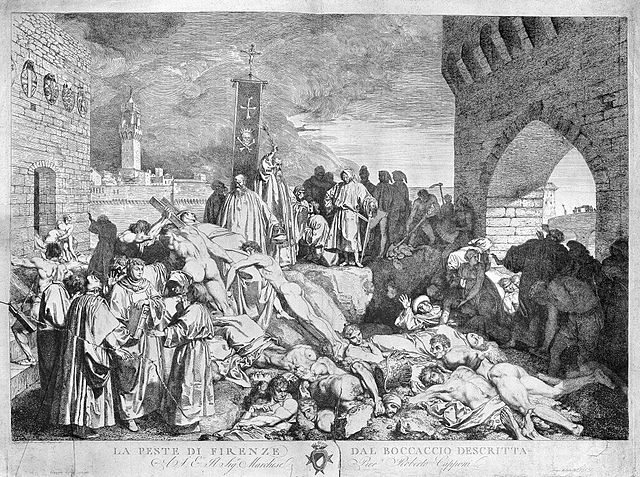
The word quarantine is derived from two Italian words, quaranta giorni, translating to 40 days. This was the amount of time during the Black Plague that ships had to wait outside of Venice before landing if they came from an infected port. Whoever was still alive at the end of the 40 days could come ashore.

The plague of Florence in 1348. Photo courtesy of Ars Technica

Many quarantined areas in Station Eleven were not so fortunate. With no cure for the Georgia Flu, those areas designated as “quarantine” were themselves their own coffins, sealing the people inside off from the rest of the world. When the Air Gradia flight announced that it would not be docking because it was now quarantined, Clark knew that there was no hope for the people onboard, and reflected on the final moments of those passengers at other times throughout his sections of the novel.

What is most interesting to me is that Emily St. John Mandel decided to use a fake airline here for the quarantined plane, even though she uses real airlines in other parts of the books and Severn is a place in Michigan. Why would she give a fake airline the disease, sealing the passengers inside like a tomb, instead of an airline that exists in our world? Was it the fear of quarantine, the impending doom that it strikes within us in the book, the horror images that come to mind when Clark thinks about it – too much for a real airline? Or some other reason entirely, like pertaining more to Tyler’s growth and his obsession with reading to the planes?

Whatever the reasons, quarantine isn’t a promise of eventual recovery in Station Eleven. It’s a death sentence.


Rebellion

“Because survival is insufficient”. It is the last line of chapter 11 in Station Eleven and a transforming sentence in my mind about the Travelling Symphony and their purpose in this post-apocalyptic world.

After reading that, our protagonists in this section of the book are not just passing through the days nor are they living passive lives in this new and difficult world. I see them now as people working to improve the lives of the people around them after the epidemic took everything they had away.

The Traveling Symphony doesn’t have much to work with to stand up for people, as even what we consider today as the most basic forms of technology, such as electricity and cars, are no longer available to the survivors. However, technology, as we have seen in other readings, does not have to be mechanical. The Symphony uses the tools they still have: their voices, bodies, costumes, instruments, and acting skills, to create productions of hope, joy, and power for the people watching. Their ability to from these productions is its own technology.

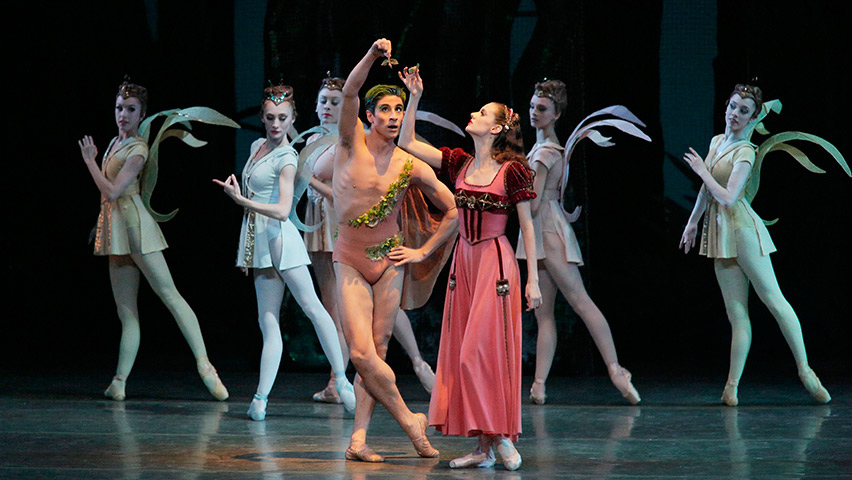
A performance of Midsummer’s Night Dream, also performed in Station Eleven. Photo courtesy of the New York City Ballet

“What was lost in the collapse: almost everything, almost everyone, but there is still such beauty” (57). With almost nothing left, the Symphony creates beauty, and with that, they can still positively impact others in this post-apocalyptic society. The Symphony shows that as long as people still have the ability to move their bodies and use their voices, no matter how terrible the apocalypse, disease, or tragedy, people will still come together to make something beautiful. Even the Georgia Flu couldn’t take this away from them, and this way they are rebelling against the death and despair to be part of a production bigger than themselves.

Tesla Magic

We’ve read articles on the dangers of the auto-driving Tesla features, the fears of depending on artificial intelligence, the future of technology in our everyday lives.

But however much some people may fear the advancement of technology, we will continue to be enamored with the progress of technology. Tesla’s technology isn’t perfect – far from the futuristic intentions of a self-driving car. Yet, Tesla is the hottest car on the market. On April 10th, The Washington Post reported that Tesla is the most valuable car company in America. Even when the car is ridiculously expensive and the company ends up losing money with profit versus the cost of producing the car, the shares of the company continue to rise.

The technology surrounding the Tesla is captivating for people. Much of that draw is due to the founder of the company, Elon Musk. A billionaire businessman and entrepreneur, Musk is responsible for some of the most innovative technological companies of the 21st century. In addition to Tesla, Musk also runs SpaceX, a new private space firm that may take rich people up into space for commercial reasons in the near future.

Photo of Elon Musk, courtesy of his Twitter page.

When celebrities are involved, the products that they stand by are sought after, even if all the bugs haven’t been worked out yet. We’ve seen in the news articles that the Tesla can kill you when the auto-pilot tool doesn’t work probably. Death by robot is not what the companies Musk runs are aiming for, but many of them are dangerous enough to potentially lead to that if anything goes wrong. In the “Death by Robot” article by The New York Times that we read for class, they talk about how cars have to know how to play the “game” of navigating the world of driving, which involves making decisions based on the environment around you. Tesla isn’t ready for this yet – the car can drive itself at one speed, but can’t make decisions that humans can to completely drive from one place to another.

But as long as Elon Musk continues to promote the virtues of the Tesla, and his influence continues to spread far beyond the sphere of business, his shares and public interest in his advanced cars will continue to climb. The Washington Post lists his worth at $14.5 billion, and his influence extends to the Trump administration, tech companies, and the general public. Tesla isn’t the self-driving car of the yet, but with the celebrity figure of Elon Musk backing it, regardless of the technology, people will keep buying it.

Riding in the Future

Two weeks ago, I went with one of my roommates, Catie, to have lunch with her grandparents. Usually, grandparents tend to be behind the times of technology, not really sure of any of the new items that are out there or how to use them. While her grandparents both have iPhones, there is no wifi or TV in their house near Lake Norman. What they do have, though, is a Model S Tesla.

They let Catie and I take the Tesla out for a drive after we had eaten, and the technology in that car amazes me. Everything is so touch and interactive based – the dashboard is a huge touchscreen, bigger than the screen on your laptop. You can do directions, find music, and even surf the internet on this screen. On the dashboard behind your steering wheel, there are more digital images: changing digital scales of your speed and gas level, as well as a little tiny Model S where you can see where you are in the lane, what is around you, and what to do next. Even as a millennial, I was out of touch in this car. Catie and I could barely figure out how to work most of its functions!

This is a semi-accurate representation of what Catie and I were doing when we put the Tesla on autopilot, where it drives itself, moving the steering wheel while on cruise control:

We thought the technology was incredible, but it was easy to see some of the shortcomings in the Model S as it is right now. You can set it to autopilot on the highway, but it won’t drive you everywhere, nor will it change speeds, so you can’t use it in traffic, with stop signs or stop lights, and it doesn’t follow your google map directions. While the tractor trailer may have been easily visible to us, I could see how the Tesla could mistake it during that fatal crash last year. The range of what the car can “see” is limited, and definitely, there are still kinks to be worked out. As of now, while the car can do some driving of itself, it is still a long way from the true self-driving cars that would take you from point A to point B without you ever touching the steering wheel.

Bob Ross: The Joy of Reading

Emma Johnson

Artist Statement

Bob Ross: The Joy of Reading Children’s Book

            I was only about five months old when Bob Ross died in July of 1995. I would never see him live on TV and he would never produce new shows that I could watch. Yet, there he was on PBS when I was growing up, speaking in his ever-soothing voice with his permed hair and gently smile. The name “Bob Ross” is now ubiquitous with landscape painting and public broadcasting. The official Bob Ross website at www.bobross.com claims that his show, Joy of Painting, is the most recognized and watched TV show on art in history (“About Us”). Through the magic of technology, his reach is more widespread today, 20 years after his death, than it ever was when he was alive. There is a Bob Ross YouTube channel, Twitter account, and two season’s worth of his episodes are on Netflix. Kids continue to grow up watching him as PBS continue to re-run his episodes and they see him on their social media accounts. In this way, no matter how many years have passed since Bob Ross died, he will continue to be the most well-known painter of the 21st century.

My children’s book, Bob Ross: The Joy of Reading, is designed to introduce kids to the wonderful presence of Bob Ross through a different medium than television. Using images from his shows, quotes from his episodes, and sound recordings, kids can grow up listening to Bob Ross and learn to read using his quotes. You can see his smile, hear his soothing voice, all in a kid-friendly format. All of the content is his own – I am merely the editor that worked to combine different senses together into one Bob Ross book. The true author still is Bob Ross.

The book was made using one particular episode in his Joy of Painting series, “Tranquil Dawn”. This episode combines many of the elements that are iconic in one of Bob Ross’s episodes: a peaceful nature scene, trees, and animals. Screenshots from moments throughout the episode were used to create the pages of the book, which were overlaid with recognizable and classic quotes from Bob Ross that can be applied to situations beyond this one episode. The strongest Bob Ross quotes were captured in sound and played through re-recordable sound modules placed in-between the pages to make it appear as if Bob Ross was speaking to the reader out from the pages of the book. In this way, the reader can follow along with the episode without having the watch it, but also take away larger lessons from Bob Ross beyond the scope of this episode, including ways to view nature, think about making mistakes, and creativity in art. The book is bound together with thick tape and covered by a dust jacket explaining the purpose behind this children’s book and a bit about Bob Ross’s paintings and show.

The use of audio tools in this children’s book are critical parts of maintaining the spirit and essence of Bob Ross over time. This way of preserving Bob Ross’s memory, by capturing his voice to be heard again and again from the pages of a book, was historically seen as a powerful way for the dead to be brought back to life. Jonathan Sterne discusses in his book, The Audible Past, about the power of recordings of dead people beyond their time, stating that “recording would enable transgenerational speech, where any “present” could address itself to almost an infinite range of possible futures (307-308). Bob Ross’s shows contain this omnipresent power – much of what he says can be saved and used again and again to apply to future generations, whether concerning painting or life itself. His phrases have become iconic, and when preserved in a digital audio form, they can live forever and continue coming from beyond the grave to leave their mark on others, even those that were not alive when he died. In addition, the stopping and starting of the audio, as well as occasional random playing and repeating of the audio, contribute to the haunted aspect of the book, where his voice appears to come straight out of the pages and haunts the book itself.

The visual aspects of the book primarily focus on Bob Ross’s image, as well as the images of the Tranquil Dawn painting he was creating in this episode. Blue painter’s tape is used liberally throughout the book, both as a binding to keep the pages of the book together but also to represent his profession as a painter and the important role that painting played his life and continues to play in the lives of the people who watch him and follow his work. In addition, the book jacket serves to collect the whole book together into one cohesive document. A title page is included, as well as a summary of the book on the inside flap, reviews of the book on the back cover, and an about the compiler section on the back flap. These sections all contribute to the overall aesthetic of the book, making it feel real and relatable to the reader.

There is no mention of death in my children’s book – it is not central to the idea and purpose of the book. His work transcends his own lifetime. I was not aware that he was indeed deceased until recently, within the last two years. I thought he had simply retired from working and making shows for PBS, choosing instead to spend his retirement painting in peace. Instead, I learned he died a premature death due to lymphoma at the early age of 52. His show ran for 11 years on PBS, meaning that is has been re-run on PBS for more twice as long as it originally aired for (Hajek). Much of his fame comes from his internet celebrity presence after his death, and his status now as a celebrity aids the proliferation of his shows and ideas around the internet. As Margaret Gibson puts it in her article on mourning in media culture, “some celebrity deaths do resonate in the lives of the individuals in ways that belie simple distinctions between real and fictional, myth and reality, public and private” (418). We choose to idolize our celebrities rather than forget about them, even after death, and that blurs the line between worlds. To those of us who love Bob Ross, we want to keep his spirit alive just as we remember him: in front of an easel, speaking to us about happy little trees, with permed hair that he hated. Talk of his death almost does not seem real, as we are entrenched in his TV show. “But he is right there, of course he isn’t dead”, we might think, representing the way that we can preserve someone at a moment in time forever.

This book preserves Bob Ross in the same moment, a time that we want future generations to remember him in as well. The information that many people actually know about Bob Ross beyond his paintings is limited, and the book is intentionally vague in keeping out personal details about his life. Through this book, Bob Ross is more than a person, he symbolizes an idea – representing the pleasure of nature, the peacefulness of art, the beauty in color. It would distract from the purpose of this book to also discuss his military career, his disease, and his life off camera. The simplicity about how the public remembers him is important in preserving his identity beyond the grave. Bob Ross has one major identity, no matter what he might think about it if he were still alive today. Painting is who he is, and who he will continue to be in the future.

This singular identity is also an important part of the marketing strategy of the children’s book. The landscape paintings, colorful and visually appealing, draw the kid’s attention, while the focus on Bob Ross and his art also attracts the parents. In this way, both the children and the parents are captivated by the book and eager to buy and learn from it. Parents are motived to use it because they want to pass a cultural icon from their generation to their kids, while the children may be intrigued by the colors, art, nature seasons, and animals pictured. Children’s books can often leave long lasting impacts on kids’ future passions, and in this way Bob Ross and his paintings can continue to be perpetuated in popular culture.

The Joy of Reading is haunted because Bob Ross seems to live in its pages, as if he never truly died at all, but was instead preserved in a different media than the one we traditionally call life. However, “haunted” typically carries the connotation of fear, danger, and revenge, which can be seen in many horror movies and novels. Bob Ross, on the other hand, is not presented in the book as someone who wishes to exact revenge on his audience or inspire fear for some sinister purpose. He is there doing what he always does, showing people how painting can cathartic, pleasing, and fun. In the case of this book, “haunting” is not associated with the horror media genre, but instead occurs as a way to continuing passing on his work to future generations.

Netflix and TV, in their own ways, are haunted with the presence of Bob Ross, but the children’s book is able to connect with people in a different way. In a similar idea as Edison’s spirit phone, which he hoped could enable you to directly contact your loved ones beyond the grace, the book makes it feel like Bob Ross is speaking with you directly, rather than addressing a wide TV audience (Zarrelli). This allows for a deeper and more impactful experience for the consumer of the book. In addition, the children’s book will be able to reach people that may not be affected by Bob Ross’s online media presence. In this more technologically driven world, where TV and social media are crowded with gory, dramatic, and visually stunning programs, Bob Ross’s painting programs do not stand out for their intensive program. It could be likely that kids today never watch Bob Ross on TV because there are simply thousands of more engaging shows they could be watching instead. A children’s book allows kids to interact with Bob Ross in a different way than they might otherwise, so Bob Ross can continue to pass his message and his passions on in different ways to more technologically-dependent kids. Then, when they are hooked on Bob Ross because of the book, they can find him on Netflix, YouTube, and the other online media sites that he has become so integrated in.

Works Cited

“About Us.”  Bob Ross Inc. N.p., n.d. Web. 1 Apr. 2017.

Gibson, Margaret. “Death and Mourning in Technologically Mediated Culture.” Health Sociology Review; Abingdon 16.5 (2007): 415–424. Print.

Hajek, Danny. “The Real Bob Ross: Meet The Meticulous Artist Behind Those Happy Trees.” NPR.org. N.p., n.d. Web. 1 Apr. 2017.

Sterne, Jonathan. “A Resonant Tomb.” The Audible Past. Durham: Duke University Press, 2003. Print.

Zarrelli, Natalie. “Dial-a-Ghost on Thomas Edison’s Least Successful Invention: The Spirit Phone.” Atlas Obscura. N.p., 00:00 400AD. Web. 1 Apr. 2017.

www.youtube.com/watch?v=x9DShZNUNa8&feature=youtu.be

 

Respecting the Dead

The name Emma Johnson doesn’t show it, but I have a Polish background. My grandfather on my mother’s side was Polish, a Polish Jew. Rudy Horenstein was born in a small town in Poland in 1923 and was just a teenager when the war started. Threatened with the invasion of Germany, my grandfather fled to Russia under a false identity, was imprisoned, forced into a labor camp, and was almost marched to his death in a bitter winter until he was liberated by U.S. forces.

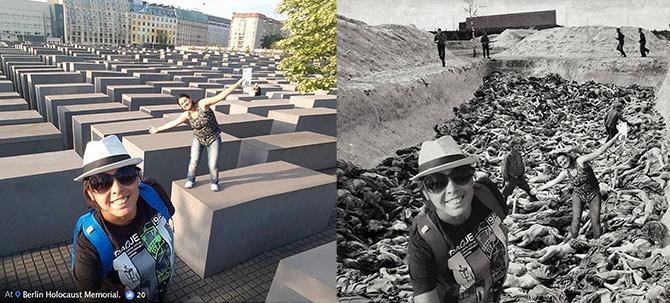
Needless to say, then, the Yolocaust project strikes an emotional cord in me. I’ve visited the Holocaust memorial in Berlin, and I’ve seen many of the same selfies and silly photos being taken there as the ones Shahak Shapira used on his website. The apparent thoughtlessness and insensitivity of these photos surprises me, as the gray blocks inspired in me a sense of dread and confusion instead of a background for artistic or fun photos.

An example of the photoshopping used in the Yolocaust project, reframing the selfies and funny shots at the Holocaust memorial around footage from concentration camps. Photo courtesy of EuroNews.

I think this speaks to the role of technology in shaping how we interact with a place. Are we less respectful of places now because of smartphones? Are we more concerned with how we can get more “likes” rather than the substance of the thing we are photographing? Without smartphones, would people not have done yoga on the blocks, or posed on them, or climbed on them? People might have continued those activities, but maybe that action would have been seen by only five other people rather than thousands of strangers on the internet.

I am biased in many ways concerning this story. I also don’t have a smartphone, and I’m a believer that smartphones prevent you from fully experiencing a place in the way that it was designed to be experienced. How can you recognize the uncertainty of walking over the uneven path, or fear the darkness from the towering stones above you when you are glued to your screen and its light is shining your way?

Of course, not everyone agrees with me. The anti-Semitic ones lashed back at Shapira with comments about being a “dumb Jew” and wishing he would die in a concentration camp. Others thought the original photos were just a funny joke. Regardless, it is unclear if technology simply the vehicle for sharing our actions with the wide world of the internet or if technology is truly changing the way we interact with the sacred and somber places in the world.

Standing the Test of Time

Deaths on the internet have a funny relationship with time. A Facebook page of someone who died is a snapshot of their life right before they died – their existing profile picture that captures their pre-death self, the posts from friends and family perhaps mixed with the deceased’s own status updates.  Year after year, if no one changes the content, this page will look the same. It will not look older with each passing year, nor will it be changed by the passing of the seasons. In some ways, an online memorial is a time capsule that preserves the moment of the death just as it was when it first happened, so visiting the site again could seem almost as if the person just died.

Something important is lost in preserving this person’s memory when time is put aside, however.   A gravestone weathers with each passing year, the edges erode, the letters fade. A gravestone shows a history, a context of a time and a place that a website is unable to transmit to the viewer. While the Brubaker et al. article argues that “Digital content can continue to persist without such decay, thereby expanding the reach of mourning and memorializing” (158), I believe that regardless for how long the site stays open, without the decay, the concept of time is warped.

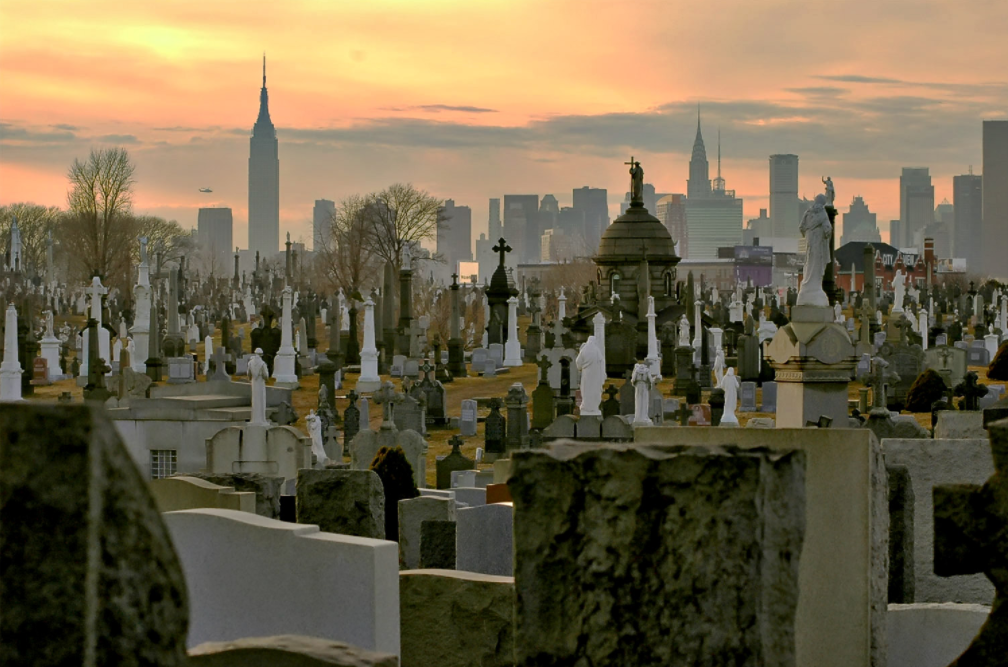
A cemetery of old and new gravestones in Queens, New York. Photo courtesy of Wikipedia

Additionally, the online memorial sites will never be able to replicate the sense of place that accompanies that passage of time in a physical location. At a cemetery, you walk by the other graves, feel the somber atmosphere, experience the passage of time in each season you go, leave tokens on the grave as memories, and feel the emotions more viscerally than through a computer screen. Immersed in place and time, the gravesite, I would argue, has a stronger emotional pull and generates a more powerful connection than a site lost in the endless pages of the internet.

Comparative Horror Analysis Project

Listen to my podcast below![googleapps domain=”drive” dir=”file/d/0B7Sk-h6zVixtel9Na0RNcmpmZXc/preview” query=”” width=”640″ height=”480″ /]

Here are the citations for my two outside references:

Carey, Katherine M. “The Aesthetics of Immediacy and Hypermediation: The Dumb shows in Webster’s the White Devil.” New Theatre Quarterly 23.89 (2007): 73-80. ProQuest. Web. 26 Feb. 2017

López, Ilse Marie Bussing. “Architecture, Technology and the Uncanny: Infiltrating Space in “The Veldt” and in “The Digital House Project”.” Revista de Lenguas Modernas.25 (2016): 102-11. ProQuest. Web. 26 Feb. 2017.


When It All Becomes Too Real

When I look at video games now, I remember how old I am in comparison to this technology. When I was a kid, I was navigating a pixilated Frogger across a congested roadway and completing secret missions in an animated James Bond game. I would sit with my brother on the couch facing the bulky old TV, holding PlayStation controllers with wires that often tangled. It was easy to see it was all fake.

Today, it seems that technology has graphics that match the real world and is taking them to the next level through more interactive means. Virtual reality technology has brought a new method of interacting with the horror, violence, or whatever theme is represented in the game.

This YouTube video is gameplay from a horror game using the virtual reality gaming technology called Oculus Rift, which makes a variety of very interactive virtual reality games that truly transport the user to the world of the game.

While this game relates to how more real and scary horror can become through a video game, this same type of virtual reality system can also be used to put yourself into war situations, holding a fake gun that is incorporated into the virtual reality experience.

Virtual reality gaming allows the user to fully immerse into the gameplay, turning you into the main character, violence and all. Photo can be found here

You are no longer playing as a character in the game – you are the character. This is your gun that you are shooting and killing people in the game with. Yet, even with the added reality effects, killing people still doesn’t seem to be a problem. That is what you are supposed to do, and even if the death might look real (with real blood color), it will never actually simulate the feeling of shooting someone and watching them die in front of you. The larger media industry would never allow that sort of reality.

So you have video game technology that is incredibly realistic in almost every sense, except that it is still easy to kill people. Players are still, as Kocurek argues in her article, dehumanizing the targets because their deaths do not carry the full emotional impact that killing a person must entail. Are video games making kids more violent? I think that in these interactive video games where the point is to kill your way to the end, the gaming industry is making it pretty easy for gamers to pull the trigger.