And the Terror Rained Down

I am an avid podcast consumer, and I was walking and listening to one particular podcast that struck me as postmodern horror happening in the real world way before its time.

The podcast I was listening to was Radiolab by NPR, the episode entitled “Fu-Go”. You can listen to it here.

The story is about the Japenese hoping to rain terror down on the United States as retribution for some air force attacks the US conducted after Pearl Harbor. The Japenese military was stretched so thin during WWII that they couldn’t commit troops to go and attack the U.S., so they put their minds to work, and came up with this:
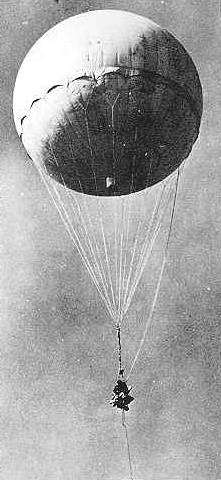
A historical image of the Fu-Go balloon bombs made by the Japenese. Photo found here.

A bomb, a very special bomb. The huge helium balloon is big enough to carry it in the Jet Stream, a tunnel of air that can take objects from Japan and carry them all the way over to the West Coast of the U.S. Attached are sandbags, which loosen when the balloon floats too low, allowing it to stay in the wind current. When all the sandbags were gone, it dropped bombs.

Here’s a map of how the balloons got to the U.S. and where they were found or seen in North America. Imagine the horror of the people felt seeing the balloons and watching them cause explosions. No one knew where they were coming from until scientists analyzed the sand inside the sandbags and the fabric used for the balloons.

Map of the path the balloons took across the Pacific from Japan to the US and where they were found or seen in North America. Courtesy of National Geographic.

While these bombs never created the true terror that the Japenese were hoping for, in its own way, they are a kind of technological monster that follows some of the disaster scenarios that Susan Sontag lays out in her essay. This thing, this strange balloon, arrives, but no is sure quite what it is or what it does. And it was not until the bombs start blowing up near big cities that the military took it seriously and started investigating where they came from. There is also a hero of some kind in this story: a sheriff that sees one of the balloons and wrangles it to stop it from flying away, which finally allows the military to find out what it is. And while there is no ultimate weapon needed to attack Japan, this real-life version of creating a disaster horror does follow some of the main points typically seen only in fiction.

Similarly, these bombs can fit into Cohen’s “Monster Culture” essay, in Thesis IV, which describes how history itself can become a monster, incorporating the events of real life into a kind of monster. As revenge for America’s destruction to their cities, Japan hoped to introduce their own technologically advanced, mysterious, deathly monster to the United States.

To learn more about the Fu-Go bombs, visit NPR History, the History Channel, and Project 1947.


1000 Ways to Die

There’s a lot of gross scenes in A Head Full of Ghosts. Marjorie oozes green slime out of her mouth onto her spaghetti, urinates and defecates on the floor, bleeds on the bed, and practically bites a man’s arm off. Any number of these gory scenes, or ones like it, could have been connected to the death of Merry’s family.

But poison? What an interesting choice. Especially potassium cyanide, a poison that in the book kills quickly and without much apparent gory side effects. According to the CDC, potassium cyanide is typically odorless, ships in easy tablets or pellets, and is rapidly fatal – so, at least in this part of the novel, the information is accurate.

Picture of potassium cyanide granules, perhaps similar looking as to what Merry mixed into the spaghetti sauce. Picture from BioPrepWatch

What is so surprising to me is the lack of gore involved. Merry’s family twitch and convulse for a brief time and then collapse dead to the ground – no oozing, bleeding, gushing, bursting – no nothing. Merry even keeps asking Marjorie when she is going to wake up after she has already fallen to the floor dead, perhaps because she still looks so normal she could just be sleeping.

After the gruesome deaths and moments in The Exorcist, including people being thrown out of high windows and splattering on the ground below with their necks turned 180 degrees, I expected a more dramatic ending for the three other members of the Barrett family. In that sense, the poison was an anticlimax for me, as I had been expecting from reading the book that the moments when the whole family was together, things often became disgusting, but not the case here. On the other hand, because I was not anticipating the poison, it was also quite a plot twist, ending that plot line much different than I thought it would.

Of all the ways that Marjorie, the mom, and the dad could have died, I wasn’t expecting poison to be one of them. Compared to a demon possessing you, poison seems almost laughable.


Mixing Horror and Reality: The Exorcist in DC

I was born and raised in Washington, DC, within the actual limits of the city (so not Virginia, not Maryland – I have a DC address and a DC phone number). The city itself is not very large, so when a movie or show is filmed in DC, I can usually tell at least what neighborhood the scene was shot in.

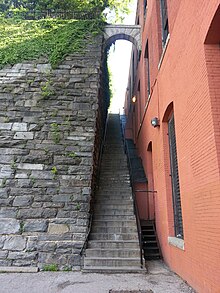
I had never seen The Exorcist before this viewing, but I was struck by the extensiveness of the filming in DC. The famous steep set of stairs that Father Damien falls down to his death near the end of the movie are stairs that I am very familiar with. I remember hiking up and down them with my friends to get from Georgetown down to the Potomac waterfront. I remember climbing them in the dark with my parents after watching the July 4th fireworks from Key Bridge, crossing the Potomac below Georgetown. I have memories of these steps rooted in my actual experiences.

The Exorcist steps in DC, from Wikipedia

Now, however, since I have seen The Exorcist, a new layer of memories and emotions has been added in my mind when I think of these steps, a layer that is no longer rooted in physical experience.

The setting of this movie in DC, a place so familiar and important to me, has served to influence my emotional response to the death of Father Damien more so maybe than for my classmates. If this movie was set anywhere else in the world, I would not have this same mixing of reality and horror in my mind as I do now. In the future, I’ll stand on that middle landing and think about both a dead man and a stunning fireworks show, even though only one of those events is real.

DC has taken extra lengths to integrate reality and horror in this place. In October of 2015, the Mayor of DC, Muriel Bowser, declared that these steps would be a DC Tourist Site. You can watch the video of her doing so in a news segment by ABC here. These places are firmly linked, a blending of physical and fake, and now a set of stairs that will always have two layers of memories for me, all because of my deep connection to Washington, DC.