The fervent desire to preserve the voice presented in this article among those in the sound reproduction community remained strong. The article addresses sound recording as “an extension of the art of oratory” and this remains incredibly true today. Much like how the article describes the emotional desire to preserve messages in vocal form, the desire of today is to capture a phonetic alphabet of one’s voice, one that could modulate itself in order to speak words in the matter with which the voices original owner spoke them. What the article presents as “preservation” is preservation of a speech, a sentence, a song. It is not preservation of the voice, or “chemical embalming” of a voice, that gives it way too much credit. The pronunciation of one sentence is a fraction of what constitutes a voice. Much like how the article gives the example of Crampton, a man who recorded his life story onto a phonograph before having his tongue removed for medical reasons, preserved his voice with the intention of reusing it, we have the chance to do the same thing with digital technology, but on a much more custom scale. Imagine being able to record the voice of a man going in for throat surgery, compiling a phonetic alphabet based around his speech patterns, and handing his voice back to him after the surgery. Imagine having a relative’s voice read an audiobook to you. That is preservation of the voice. The article seems to speak on this issue as if its cultural impact is over, but in fact what the article presents are just the first cultural hurtles the practice of archiving sound had to clear in order to take off.
While reading, “A Resonant Tomb,” from The Audible Past, I was particularly intrigued by the stories of ministers recording their own eulogies. I imagine that Sterne would make the argument that this sort of thing would have little impact today, as he explains that neither the content nor the person being eulogized was what was mesmerizing about these particular sermons, but rather it was the spectacle of the dead preaching to the living (304). At first I thought that today this wouldn’t really be much of a spectacle at all. The dead speak to us constantly, and we hear them without second thought. To be honest, before reading this article, I had never even considered the fact that it’s odd that we listen to long dead musicians without really contemplating the fact that we’ve separated their voices from a body that no longer exists. Then I realized, that to some extent, this was because they are celebrities, and we don’t have a real connection to them. There is something a little eerie about hearing the voices of my grandparents who have passed away on old home videos or on a saved voicemail, but nothing of the sort when I listen to the music of those who have died. It is almost as though once a voice becomes a song in the form of a product to be sold, it is no longer tied to the singer themself. In this way, the fears expressed by early celebrities in “A Resonant Tomb,” regarding if they should allow their voices to be recorded and heard for future generations (Sterne 297) don’t seem unfounded.
Yet, when reading about the minister’s prerecorded eulogies, I also couldn’t help but draw a connection between them and the death of David Bowie earlier this year. Bowie had been diagnosed with cancer a little less than two years before his death, and many fans consider his last album, which was released only a few days prior to his death, to have been a sort of self-recorded eulogy. He addresses death pretty specifically, opening a song from the album, “Lazarus,” with “Look up here, I’m in heaven.” An ill or dying artist creating a work contemplating his or her own demise is certainly not unique to Bowie, to the music industry, or even to this year. As my dad has always been a Leonard Cohen fan, I learned that his final album You Want It Darker, released just a few weeks before his death this year, was of a similar vein: a contemplation on life and the end of life. Interestingly enough, these albums and others like them, are some of the few I listen to in which I find I am not capable of separating the voice from the singer. In the article, “The Year of the Goodbye Album,” Lindsay Zoladz writes that Bowie’s album wasn’t just a contemplation of his life, but, “his way of art-directing his own death.” Celebrities and famous singers may lose control of their voices and works after they die, but Bowie, Cohen, and others like them have taken advantage of an opportunity many of us won’t have: they created the story of their own death and shared it, and did so in a way that will likely last far longer than that of the ministers mentioned in a, “A Resonant Tomb.”
“Lazarus,” a single from David Bowie’s last album.
Works Cited
Bowie, David. “Lazarus.” Columbia. 17 Dec. 2017.
Sterne, Jonathan. The Audible Past: Cultural Origins of Sound Reproduction. “The Resonant Tomb.” United States of America: Duke University Press, 2003. Pages 287- 311. Print.
Fueled by the compulsion to both look and not look, conflating fear and repulsion with curiosity and attraction, horror thrives as a narrative paradox. Often tightly circumscribed by its own generic structures, much of contemporary horror has clearly defined conventions that rely on formulaic constructions and tropes. The formula is in fact so inviolable that it has been made narratively explicit in films such as Wes Craven’s highly influential Scream (1996), a self-reflexive and intertextual postmodern masterpiece that grossed upwards of $100 million in the US alone.
Craven, along with a brilliantly written script by Kevin Williamson, breathed new life into the slasher film. They took all of the archetypical constructs of the slasher sub-genre and directly exposed them to the audiences while still staying within the confines of the genre. This was not new, parodies had done this in the past, but Scream managed to both keep a straight face and produce fear. Scream and other postmodern horror films that followed in its wake reinvigorated the flagging genre in the mid-1990s, due in large part to their extreme self-reflexivity, along with numerous intertextual references to earlier horror landmarks. The postmodern conceit is simple: Scream is a slasher movie in which the characters are well versed in the rules and conventions of slasher movies, to the self-referential point of characters talking at length about earlier slasher pics. It is a film in which the intertextuality, in effect, constitutes the text; and its media literacy and genre-bending are markers of the arrival of the postmodern era in horror film. Isabel Pinedo argues, “the postmodern horror film transgresses the rules of the classically oriented horror film, but it also retains features of the latter, which form the backdrop against which violations of the rules are intelligible as such” (“Recreational Terror”, 19). In its postmodern iteration, the horror film acknowledges its generic lineage before it subverts the formula thereof.
In Scream‘s opening scene, we watch as Casey (played by Drew Barrymore) has what originally seems to be a flirtatious phone conversation with a friendly stranger turn into a deadly game of horror trivia. The mysterious stranger asks Casey a series of questions about horror movies, such as who the killer in Friday the 13th was, with rather unfortunate punishments for Sydney and her boyfriend.
While this was a surprise for audiences in that many expected Barrymore to be one of the central characters, perhaps even the stereotypical “Final Girl“, this scene also set the stage for the rest of the film. The teens of the 90’s had grown up on slasher and horror flicks, knew the rules, the tropes, the characters. As such, horror movies had to evolve, had to change to suit the new experienced and cynical mood of the times. The characters in Scream know horror films and are constantly citing genre titles. The irony is that they are living in one.
Influenced by the widespread success of Scream, other postmodern horror films soon followed, films that both emphasized sameness by reveling in the established generic tropes while also crafting disjunctive, ironic narratives that acknowledged and played with those very same generic conventions. Films such as I Know What You Did Last Summer (1997), Urban Legend (2000), Final Destination (2000), the wildly successful The Blair Witch Project (1999), and reboots of both the Friday the 13thand Nightmare on Elm Street franchises all exhibit this postmodern tendency toward self-awareness, intertextuality, and hybridity. These films reflect the conception of postmodern anxiety as acute self-consciousness about the formal, constructed nature of the work. Just as postmodernism can be viewed as a crisis of systems of regulation, the postmodern horror film reflects anxieties about the horror genre. The commonplaces of generic tropes and conventions are concomitantly a source of both restrictive apprehension and creativity. The postmodern horror audience enjoys the reiteration of The Rules while simultaneously celebrating the subversion of them. Here occurs what Andrew Syder contextualizes as a postmodern “rhetorical deconstruction,” the move from strict sets of rules governing rhetorical creatures such as vampires, werewolves, and other classic horror monsters to a postmodern demystification of the “rhetorical nature of representations of the unknown” by tacit acknowledgement of the fictionality of the monster as narrative device (Syder 84-85). Essentially, the postmodern reframes traditional horror narrative, rupturing the unity exhibited in classic horror films and instead invites participation in the signification of the narrative rather than a distanced remove from it.
Following this new tradition of self-aware horror films, 2012’s The Cabin in the Woods, written by Joss Whedon and Drew Goddard, also tidily fits these definitions of the postmodern as multilayered, ironically detached, and simultaneously traditional and subversive. We begin with a couple of middle-management types going to work talking nonchalantly about their weekend plans. A sequence normal enough to the realm of drama or comedy, but unsettling in the slasher genre. We then turn to our group of college friends and our worries are laid to rest. They are going on a weekend trip. We know this story. At this point we understand there will be some inane banter that will hopefully allow us to care about the characters long enough to fear for them and in turn mourn their demise. We know they will fit in one of five stereotypes: “the fool,” “the jock,” “the scholar,” “the virgin,” and “the whore.” We know a moral compass will emerge from the group and during our final sequence we will switch our perspective respectfully from the killer/monster to the heroine “virgin” of the group. We also know the prophet of doom will attempt to save them, but through misguided fear and machismo our characters will remain stubborn to their plan. There will be sex, drug use, and incomprehensible reactions to dire situations.
The Cabin in the Woods is a perfect example of postmodern parody. Crucial to the idea of parody is a sense of historicity, a refiguring of the past rather than a denial or departure from it. Cabin not only exhibits this sense of historicity through its thick intertextuality but also by its appropriation and subversion of genre conventions and horror tropes. Cabin relies on these tropes as a way to establish a cultural continuity and as an appeal to a horror audience familiar with the trappings of the genre. Tropes themselves are a cultural signifier, and the rather shameless and flagrant use of tropes in The Cabin in the Woods is used as a stylistic method to investigate and deliberately call into question the fictional device of the trope.
LikeScream, Cabin in the Woods is tauntingly circular. The final 20 minutes of Scream, which borrow heavily, and with complete openness, from Halloween, have become iconic in their own right. One character is commenting on and narrating Halloween, which is playing on TV, warning Jamie Lee Curtis to turn around, while a masked killer is directly behind him. Someone even says, “I’ll be right back” after being warned to never, ever say, those exact words
The irony is gleefully obvious, which makes it all the more likeable. It doesn’t reek of pretentiousness. The curious contrast between Wes Craven’s satiric slasher and Cabin‘s bloody Rubik’s Cube is the acidic quality with which Whedon and Goddard etch their characters and plot twists. The movie is at times barely coherent, but it doesn’t matter because it moves at a furious pace and, unlike Craven’s film, has some anger behind its eyes. Whereas Craven wanted to dissect his own movie and took great pleasure in cutting clichés into bits, Whedon and Goddard are out for blood, taking swipes at Eli Roth and his torture porn cronies in particular.
Tropes act as a shorthand, an appeal to cultural memory, easily recognizable and familiar. Most horror films make repeated use of tropes as a tool of storytelling, but the tropic references in TheCabin in the Woods are practically legion. TVTropes.org, a wiki site dedicated to cataloguing tropes not only in television but also in film, videogames, and other media, maintains an extensive collection of user-inventoried tropic content. Based on the content there, Whedon and Goddard include, to name only a portion: The Abandoned Area, The Adjectival Man, The Creepy Basement, Death by Sex, an Ominous Music Box Tune, a Surprisingly Sudden Death, a Torture Cellar, the list goes on and on. These are all immediately recognizable conventions that border on horror film clichés, but the manner in which Goddard and Whedon utilize these tropes, however, is a complete subversion of the tropes themselves. As the film plays out, we learn the rural, abandoned cabin that belongs to a cousin of Curt (Chris Hemsworth) is in fact solely for the purpose of hosting these five sacrifices, and further, that Curt does not actually have a cousin who owns a cabin—the trope was employed as a believable fiction by the mysterious and shadowy organization who manipulates the environment. The Adjectival Man, a mysterious and peculiar figure in horror film who acts as a warning to the main characters (think the creepy hillbilly at the gas station, or the old woman in the small town) is seldom given an actual name, but is in this instance is explicitly named The Harbinger (Tim De Zarn) by the mechanics of the postmodern, self-reflexive sacrificial experience. More than that, he’s ridiculed by other characters for his over-the-top, almost biblical manner of speaking.
In postmodern fiction, narrative conventions like plotting, use of metaphor, and omniscient narrator are parodied so as to expose their role in the fabrication of meaning; so as to present the text as a fiction-making apparatus. Here, the movie is literally laughing at the absurdness of The Adjectival Man, using the trope even as it ironically comments on it. The generic device of the grotesque figure warning the protagonists away from their path is here parodied as a way to foreground the fictional construct of The Harbinger within Cabin’snarrative. All of the facets of traditional horror are there—the clichéd characters, the obviously menacing location, and the warnings that something bad is about to happen—and yet, Whedon throws these iconic concepts on their heads by acknowledging how completely ridiculous they are.
Likewise, the Creepy Basement is deliberately and absurdly creepy, in service to the sacrifice, complete with mechanical cellar door that flies open at a narratively opportune moment. The deliberateness of the creepy factor as well as the plethora of items that horror filmgoers will recognize as Summoning Artifacts both appeals to horror historicity while, in terms of the framing narrative, emphasizes the free will of the characters to make the choices that lead to them being sacrifices. Also a classic hazard of horror films, the danger of standing in front of a window exists in Cabin as well; the film toys with viewer expectation by having Marty (Fran Krantz) linger in front of the dark window, silent for a beat before Judah Buckner (Matt Drake) smashes through and pulls Marty out the bedroom window. Anyone versed in horror parlance knows that something is going to burst through the window, and the trope plays out, but the traditional outcome of that trope is subverted when we discover Marty was the victor in the skirmish, dismembering Judah with a trowel. Despite cognitive tampering, the Dumb Blonde in the film, Jules (Anna Hutchison), retains enough sense to be aware that it is a culturally-acknowledged bad idea to have sex in the woods (thereby echoing the audience’s knowledge of the generic motif), but the combination of a temperature-controlled environment, moonlight produced on cue, and aerosol pheromone mists lull her into the act, manipulating her into the perfect sacrificial Whore in order to fulfill the narrative requirements.
In fact, it is established early in the film that Jules has just dyed her hair blonde, and Dana (Kristen Connolly) indicates that Jules is pre-med, but the Chemistry Department’s Lin (Amy Acker) explains that they’ve slowed cognition through the hair dye, literally shoehorning Jules into the Dumb Blonde trope. Likewise, Dana is introduced as having just ended an affair with her professor, but ostensibly through more chemical interference, she assumes the role of the virginal girl, even confusing herself when she indicates such to Holden (Jesse Williams) while they are kissing. This both situates her as the sacrificial Virgin and positions her as the textbook Final Girl, the last girl standing in a slasher film, usually virginal, demure, and with a unisex name. Later, confronting the Director (Sigourney Weaver), Dana scoffs at being typecast as the Virgin, to which the director admits, “We work with what we have,” acknowledging that the pressing of each character into these stereotypes is frustrated at best. The Virgin, the Whore, the Fool, The Athlete, and the Scholar are all stereotypes, but the essential, specific nature of them is not “real” and for the means of the ritual, the characters in Cabin are shoehorned into the roles. This acts as a way of highlighting and criticizing the stereotypical characters so prevalent in the horror genre; as each character is forced into the stereotype in order to fit the demands of the sacrifice, Cabin calls into question the widespread use of these stock characters in other films in which there is no cognitive tampering to reduce characters to one-dimensional caricatures.
The use of other tropes reemphasizes the “fiction-making apparatus” so crucial to The Cabin in the Woods and its postmodern inversion of traditional horror films. When Dana drops the knife she used to stab Matthew Buckner with, we see Sitterson (Richard Jenkins) in the control room operating a joystick that sends an electrical shock to the knife, causing her to drop it, at last providing the audience with an explanation for this disturbing tendency in horror films for the protagonist to mindlessly discard her weapon—or, rather, making a self-reflexive comment upon the inane trope. The generic tendency of characters to discard their weapons is repeated, yet is reinterpreted by the offering of an explanation for the behavior. This tiny moment in Cabin illustrates exactly this postmodern tendency—the paradoxical reiteration and subsequent subversion of horror tropes.
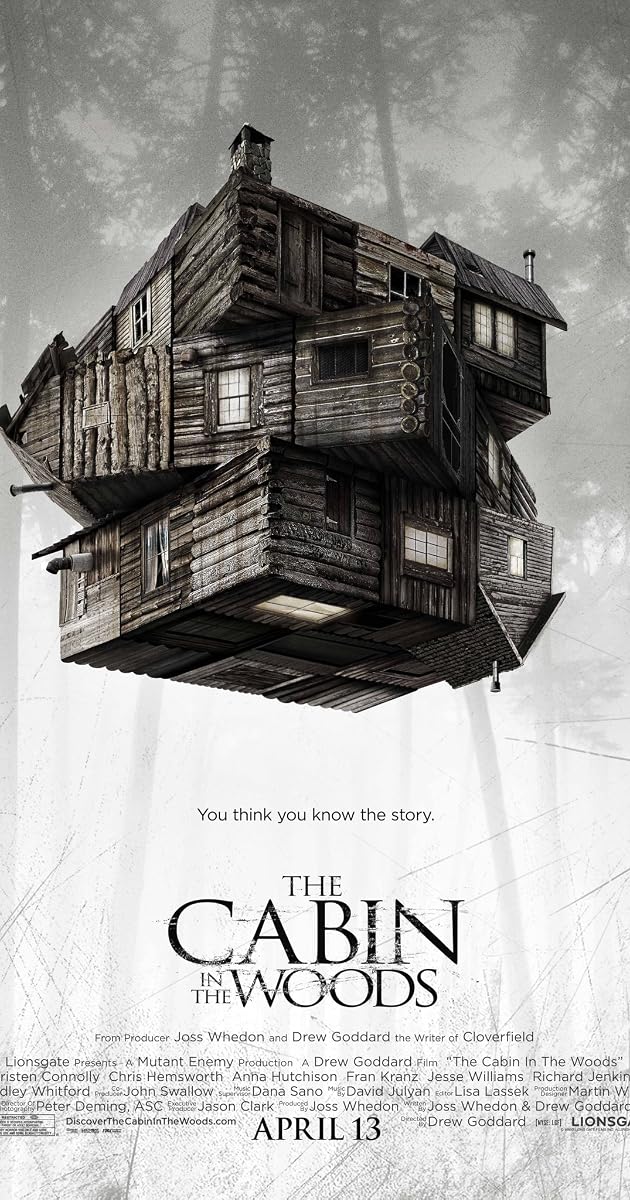
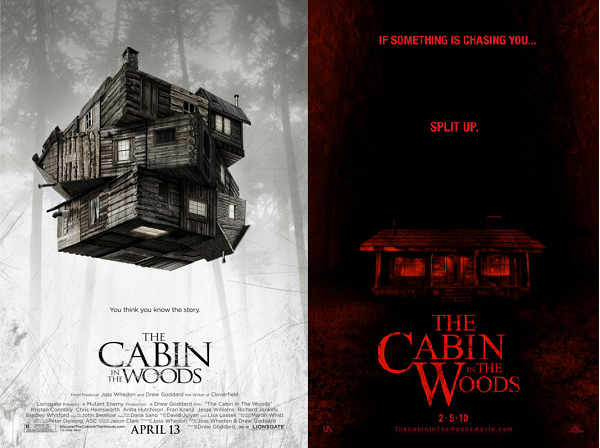
Similarly, the Ominous Music Box Tune that emanates from the jewelry box Holden plays with in the basement isn’t merely an object that justifies some diegetic, dissonant music in a minor key for atmospheric benefit—we later discover through musical refrain that the object would have summoned the unnerving Ballerina Dentata monster. In fact, it is not a singular Summoning Artifact in the basement, but rather an entire collection of them linked to different monsters and different means of death. These items mesmerize the five students, as arcane items in horror films do, and when it is revealed that this was a garden of forking paths with which to decide their fate, the audience’s previous experience of horror films informs the imaginative possibilities of what nightmare each object would have summoned. The objects are a literal catalogue of nightmares, and the trope of the inescapable allure of the Summoning Object is here placed in the basement because the film acknowledges that very inescapability of the allure of arcane items to characters in horror films. Further asserting itself as self-referentially postmodern, even the advertising campaign leading up to the film’s release acknowledged and subverted classic horror tropes, featuring movie posters that included phrases such as, ”You think you know the story” and “If something is chasing you… split up.”
This genre-specific pieces of advice are indeed employed in the film; while the cabin is being attacked by the Buckner family of zombies, Curt suggests they all stay together—until a controller flips a switch and releases some aerosolized drug that makes Curt pause, sway, and then decide the group should instead split up. It is the immediate familiarity with these classic horror tropes and the explicit acknowledgement of them within the story that pushes this ironic treatment into the realm of postmodern parody.
Perhaps most notably, however, is that whereas a film like Scream may contain, as Syder argues, an intertextuality that “in effect constitutes the text,” The Cabin in the Woods escapes such a reductive charge by using its own postmodern establishment of itself as self-referentially intertextual as a means to craft a framing narrative that uses its intertextuality in a creatively constructive way. The narrative creates a space in the interior story—that of the five protagonists on a nightmare vacation to a cabin—that participates in tropic generic convention, while the framing narration—that of Sitterson and Hadley and the ambiguous entity for which they become architects of the sacrifice—acts as a means of ironizing and criticizing overreliance on these conventions while simultaneously inscribing a larger cultural meaning onto these conventions as a means of appeasing the Old Ones. Implicit in such a narrative turn is an argument that, though overly familiar, horror tropes approach a mythic importance.
In a film like Scream, knowing the rules of the genre may possibly help a character survive the film; in Cabin, Whedon and Goddard have crafted a world in which those rules serve more than merely filmic generic tradition, and there is a very good reason why the characters should perhaps not survive. “The postmodern paradigm blurs the boundaries between good and evil, normal and abnormal, and the outcome of the struggle is ambiguous at best,” writes Pinedo, and in Cabin this coded ambivalence is prevalent—which outcome would be good (Pinedo 22)? Is the Director’s agenda evil, or good by definition of the wider common interest? Do we root for Dana and Marty, knowing it means our own (simulated) demise?
Postmodern parody is both deconstructively critical and constructively creative, and this is the force we see at work in these two films. By appropriating horror tropes and including a thick intertext, they have used the narrow formula as both a site of creative storytelling and a means of foregrounding the implications of these horror stereotypes. Where Scream is gleeful in its celebration of the ironclad rules of horror and the chaos that follows from those rules, Cabin is implicitly critical of the generic tendency to use rote characterizations in place of more complex, individualized characters of agency. By simultaneously inscribing and subverting generic conventions, these movies concurrently reemphasize the tropes while they subvert them, a simultaneity of conflicting juxtapositions that is so perfectly postmodern.
I’ll end with this, one of my favorite moments from Cabin, and one that perfectly sums up how postmodern films approach horror. In one of the films early comedic moments, the token stoner (“The Fool”) pulls out a telescopic bong that, when collapsed, looks like a coffee thermos. Later, he uses the thermos-bong as a weapon against a zombie. Maybe it’s a reference to the permeation of the Devil’s Lettuce and all things horror; after Halloween was labeled a morality play, its characters seemingly punished for acting immorally, smoking became a death sentence for horror characters. Instead, Whedon’s pothead uses his bong as a weapon against the enemy. Maybe it’s a sign of changes to come, a challenging of stale tropes and norms, a reawakening of a genre and a bored audience.
The Cabin in the Woods. Dir. Joss Whedon. Perf. Kristen Connolly and Chris Hemsworth. Lionsgate, 2012.
Pinedo, Isabel Christina. “Recreational Terror: Postmodern Elements of the Contemporary Horror Film.” Journal of Film and Video Vol.48 (Spring/Summer 1996): 17-31. JSTOR.
Scream. Dir. Wes Craven. Perf. Neve Cambell and Courtney Cox. Dimension Films, 1997.
Syder, Andrew. “Knowing the Rules: Postmodernism and the Horror Film.” Axes to Grind: Re-Imagining the Horrific in Visual Media and Culture. Ed. Harmony Wu. Spec. issue of Spectator 22:2 (Fall 2002): 78-88.
The BBC science-fiction series Black Mirror and the comedy podcast “My Favorite Murder” are very different in form, but both use their medium to confront the cultural anxiety surrounding their subjects. The final episode of Black Mirror’s first season, “The Entire History of You,” takes a proleptic look at how technology could affect human relationships and exacerbate negative human emotions like jealousy, while a particularly gruesome episode of “My Favorite Murder” uses the “I Survived” account of Mary Vincent to take a retrospective look at an actual account of human sadism. However, both Black Mirror and “My Favorite Murder” use their entertainment value and effectively utilize their mediums to fight against and quell the cultural anxiety surrounding their subjects.
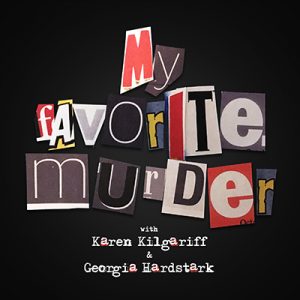
The subject of “My Favorite Murder” is, you guessed it, murder. Hosted by Karen Kilgariff, a comedy writer, and Georgia Hardstark, a host of multiple Cooking Channel shows and webseries, the podcast consists of the two true-crime obsessed women narrating an account of their favorite murder of the week to the other. Each episode may center around a theme – child-murderers or ‘90s murders or unsolved murders – but many episodes contain retellings of “I Survived” stories. Episode 18, or “Investigateighteen Discovery” is one such episode, telling the story of Mary Vincent, a 15 year-old hitchhiker who was raped, had her arms hacked off (literally), and was thrown off a cliff by Lawrence Singleton (You can find her episode of “I Survived” here).
The horrific details surrounding Mary Vincent’s mutilation and her miraculous survival story are encapsulating, and the monster figure of Lawrence Singleton is obvious. What’s less obvious is that “My Favorite Murder” is categorized as a comedy. Comedy and the macabre have a long history, and “My Favorite Murder” does not make jokes about the murders they explore, but the comedy stems from the hosts’ own self-awareness surrounding their unprofessionalism and strange-obsession with true-crime. The cover art plays on genre stereotypes, featuring wording in the style of a ransom-letter. The podcast features no non-diagetic sound, no interviews, no soundtrack, and for the most part remains uncensored. Instead, the show simply consists of the two women sharing conversation while sprawled on couches, gabbing about their days or botox injections or clarifying points from the last episode. In the 1hr and 7min of episode 18, they take over twenty minutes to get settled before going into the murders they’ve chosen to talk about for the week. Karen says early in the episode, “We’re trying to make sure our mics – we’re trying to make sure the sound quality is legit.” But in other episodes, they say call attention to their illegitimacy, saying things like, “We are not professionals” or “If this was a professional podcast…” They swear a lot, referring to murderers as motherfuckers or assholes, but remain serious and react appropriately with gasps or “oh my god”s when finding out the gory details of their counterpart’s story.
But Kilgariff and Hardstark’s “unprofessionalism” has garnered the podcast a large following. Kilgariff and Hardstark are upfront about their odd fascination with the macabre genre of murder, but their “unprofessionalism” has allowed them to openly discuss their own mental health issues. While reclining on couches talking about murder, they also discuss their therapy, anxiety, alcoholism, and drug abuse. As Andrea Marks writes in The Atlantic, the podcast has largely come to double as a mental-health support group. Marks says,
My Favorite Murder exposes listeners to two taboo subjects: murder, of course, and mental health. At the same time, it empowers listeners by offering practical advice for survival and self-care and by using comedy to deflate the scariness of these topics.
So while the podcast blurs the lines between comedy and horror, professional podcast and support group, taboo subjects are able to come to the forefront of discussion. Kilgariff and Hardstark’s conversational tone and openness – what they consider as unscripted and unprofessional in the podcast world – has led to much of the podcast’s success, helping it reach the number one spot in comedy podcasts and number 10 overall on iTunes. The podcast has a Facebook fanpage with over 100,000 followers, with people posting links to more murders to read about and also sharing mental health or murder-avoidance tips.
In email to Marks, Hardstark writes, “it’s a lot like exposure therapy, where you have to confront your fear to prove that it can’t actually hurt you.” A fellow fan describes listening to the podcast as a way to “exorcise that anxiety” about possibly being murdered. In research on exposure therapy, Stewart Elyse puts forth that “Anxiety is actively reduced by increasing the patient’s perceived level of self-efficacy. Higher self-efficacy should yield a decrease in threat perception, which consequently reduces anxiety” (304). Thus, by combining comedy and horror while subverting our expectations of a podcast, “My Favorite Murder” acts as a window to horrific moments in the past, exposing them and bringing them into the light as to ease our present day fears, making us realize the distance between our dark imaginations and actualities.
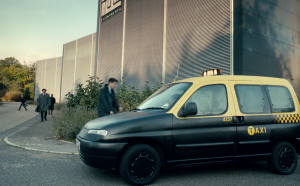
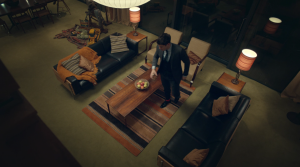
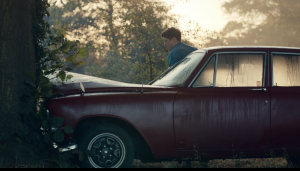
On the surface, the last episode of Black Mirror’s first season is very different than Kilgariff and Hardstark’s podcast. The show is meticulously crafted, and is by no means unprofessional, but by using its medium as its subject matter – screens and technology – Black Mirror brings a self-awareness to itself in a similar manner as “My Favorite Murder” in order to accomplish the same goal of easing the anxiety surrounding the shows topic. While “My Favorite Murder” talks about horrific scenes from the past in modern rhetoric in order to relieve listeners’ fear of murder, Black Mirror conjures up a “what-if” scenario using science-fiction to explore the hot-button topic of how technology is affecting our interpersonal relationships. In Season 1 Episode 4, “The Entire History of You,” everyone has access to a device that records everything they see, hear, and do. Black Mirror implies the “Willow Grain’s” ubiquity by showing airport security measures and making an oddity of a woman without one, but the world imagined within “The Entire History of You” remains remarkably contemporary. The “Willow Grain” technology clearly supersedes technology we have today, but the homes the characters live in and the food they eat and the clothes they wear and the cars they drive look no different than our own, despite the very different world this technology has created:
The taxi Liam hails at the beginning of the episodeHis very average, non-tech living roomThe car he drives
The implications surrounding the willow grain are disturbing, but the lack of futuristic elements outside of the willow grain put the audience at ease by highlighting that this world is a “what-if” scenario, not a prediction (although you can watch me argue here that snapchat has put us on a similar trajectory as the willow grain). The willow grain encapsulates what Freud calls the “uncanny,” or something that is at once both foreign and frightening and familiar. Freud argues that “an uncanny effect is often and easily produced by effacing the distinction between imagination and reality, such as when something that we have hitherto regarded as imaginary appears before us in reality” (15). This is more or less the premise of every Black Mirror episode, but memory, the focus of “The Entire History of You,” highlights another juxtaposition Freud touches on, something we have an intimate, emotional connection with but little scientific understanding of (13). This allows “The Entire History of You” to capitalize on our anxiety surrounding memory by twisting it just enough to be terrifying yet simultaneously believable.
Liam’s rejection of the willow grain at the end of the episode – either out of spite of his wife or as a realization that the technology has ruined his life – remind us that we do not bear the weight a lifetime’s worth of memories, but only the computer on our laps. The “uncanniness” of the willow grain simultaneously causes and eases our anxiety by showing a scary “what-if” situation, while highlighting the “if.” Like Liam is left facing himself in the mirror, grain-less, Black Mirror leaves us staring at ourselves through our screens at the end up the episode.
In “Recreational Terror,” Isabel Pinedo argues that “The postmodern horror genre constructs an unstable, open-ended universe in which categories collapse, violence constitutes everyday life, and the irrational prevails.” In “My Favorite Murder,” Karen Kilgariff and Georgia Hardstark simultaneously subvert the conventions of a podcast (professional sound editing, expert opinions, a story line or narrative arch) and the seriousness of murder, and the “monster” of a murderer comes to stand in as an embodiment of the anxiety and fear that their listeners have everyday. Black Mirror uses screens in order to depict what can go wrong when we rely on them too much. “My Favorite Murder” and Black Mirror both serve first and foremost to entertain us, but they also serve to capture their audience anxieties, then show them in their extremities in order to caution and also protect us against them. “My Favorite Murder” captures the general stranger-danger and fear of death we all have, and while the gruesome stories they share are real, they allow potential victims to live out their fear without the stakes being high. The nature of the podcast allows us to kick back our heels and recline along with them, and we feel more like we’re on a conference call than listening to a podcast. Black Mirror uses a fictionalized account of how technology could implode our interpersonal relationships and communication, capturing the growing anxiety over how far our relationship with technology should go, and by using technology to deliver this message, it makes us all the more wary.
Pinedo concludes by saying horror “is a welcome release from the fiction that life is ordered and safe. Horror affords us the opportunity to express our fear of living in a minefield or, perhaps more accurately, the opportunity, to dance through it” (29). Ultimately, both “My Favorite Murder” and Black Mirror afford their audience the opportunity to flirt with our worst nightmares while remaining safely behind our screens or earphones.
Hardstark, Georgia; Kilgariff, Karen. Audio blog post. “Investigateighteen Discovery.” Feral Audio, May 27, 2016.
Black Mirror – The Entire History of You. Dir. Brian Welsh. Perf. Toby Kebbell. Black Mirror. BBC, 18 Dec. 2011. Web. 1 Mar. 2017.
Marks, Andrea. “How a True-Crime Podcast Became a Mental-Health Support Group.” The Atlantic, Feb. 21, 2017. Web.
Pinedo, Isabel. “Recreational Terror: Postmodern Elements of the Contemporary Horror Film.” Journal of Film and Video, vol 48 no 1/2, 1996, pp. 17-31.
Stewart, Elyse, et al. “Exposure Therapy Practices and Mechanism Endorsement: A Survey of Specialty Clinicians.” Professional Psychology: Research and Practice, vol. 47, no. 4, Aug. 2016, pp. 303-311. EBSCOhost, doi:10.1037/pro0000094.
The cinematic survival-horror game Until Dawn and the zombie-apocalypse short story Zombicorns may both fall under the “horror” umbrella but the jump scares in the video game provide a much greater shock to the system than the philosophic, rambling musings of the narrator in the short story. As late postmodern horror, both exploit the subtle terror themes hidden in our daily lives. In her article “Recreational Terror: Postmodern Elements of the Contemporary Horror Film”, Pinedo writes that “horror exposes the terror implicit in everyday life: the pain of loss, the enigma of death, the unpredictability of events, the inadequacy of intentions” (26). In drastically different methods, both Zombicorns and Until Dawn amplify these commonplace terrors: the pain of the loss of a sister or close friend, the enigma of death and whether the undead are no longer human, the unpredictability of characters and effects of decisions, and the insufficiency of intentions when no action or unintended consequences follow. By analyzing how Zombicorns and Until Dawn incorporate these implicit everyday terrors, we discover these media ultimately continue the discourse on what makes a monster and how our actions impact our fate.
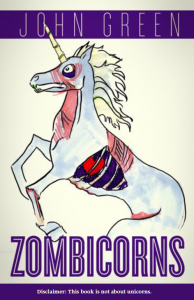
While the title Zombicorns may lead the reader to anticipate that the short story about zombie unicorns, author John Green quickly dismisses that idea with a disclaimer[1]: “This book is not about unicorns.” The “corn” part comes from how the zombies are created, which is from mutated corn. The narrator Mia explains that “the z’d” (the zombies) aren’t technically zombies; a person’s transformation is a result of contracting a virus called AMRV from the consumption of a variety of corn called Devotion131Y (D131Y). When a person becomes infected, they gradually become obsessed with D131Y to the point of devotional worship.
As Mia refers to them, the “z’ed up” are like zombies in that z’s will eat your brains but they will also “eat anything else, except for Devotion131Y… once you get infected, you don’t want to eat it, because you’re too busy loving it” (Green 13). The z’s spend their time planting and caring for the corn. Mia acknowledges various theories about the motivations of the z’ed up but she believes that the z’ed are an extension of the corn: they attack anyone who threatens the corn (drives over it, walks through a cornfield, etc.). The z’ed stay alive by briefly taking breaks in their agricultural activities to eat; consuming anything from piñatas[2] to humans but never the corn. Forcing humans to eat the contaminated corn is also a worthwhile activity for the z’ed, further ensuring the survival of the corn by creating more corn caretakers. Because of all of the planting, the z’ed are hunched over and grimy and have yellow-ringed pupils as a side effect of the virus.
In Mia’s “re/accounting of human life post-virus” – the context of the short story – she is only remaining member of her immediate family who hasn’t been z’ed up. The only beings in her life are her dog Mr. President, her z’ed-up little sister Holly who she cares for from a distance, and her compatriot Caroline who no longer views z’s as humans (Green 72). Caroline and Mia’s contrasting attitudes towards z’s and the apocalypse help fuel the tension in the story and demonstrate the implicit terrors in everyday life.
The “enigma of death” is the most divisive terror between the friends. Caroline explains, “it’s very easy to look at them and know they don’t have souls, that the virus stole their souls, and that you aren’t killing them, because their themness has already been killed. You’re killing the virus, which is a frakking privilege as far as I’m concerned” (Green 37). This impersonal attitude toward murdering fathers and sisters, especially children, is difficult for Mia to accept. She counters Caroline: “‘Maybe they don’t have souls,’ I said, thinking of Holly’s empty eyes ringed in yellow. ‘But they used to be people’” (Green 48). Pinedo’s remaining three aspects of “terror in the everyday” (the pain of loss, the unpredictability of events, the inadequacy of intentions) compile in the climax of the short story when the z’ed Holly shuffles to get Mia’s daily food ration (via sombrero piñata) and Caroline shoots her:
I could still see my little sister. It was the best part of every day.
And then the gunfire rained down on Holly as she knelt there eating, her body spasming as the bullets filled her up, animating her ever so briefly until the gunfire stopped and she did too, her body hideously still, cuddling the sombrero, bleeding out onto the candy I’d brought her.
(Green 70)
The immense anguish of the loss of her sister and the unpredictable betrayal by Caroline, leave Mia reeling. Her shock is furthered by insufficiency of Caroline’s intentions; Caroline defends her actions by saying, “‘She wasn’t a person anymore, Mia. This game needs teams. I can’t go north alone, and there’s no one else to go with, but we need to go… I did it for you, you know. I did it because you couldn’t, and I hope you’d do the same for me’” (Green 70). With this, Mia reacts: “I raised the pistol from my hip and shot Caroline once in the face. The chair fell backwards with her in it and I stepped forward. She started to say something or at least her mouth was moving, and I shot her twice more in the head to make it quick” (Green 70). In this instant the real monster is no longer the z’s but could be Caroline, whose hardened personality was a result of the z’ed “stealing” her normal life, or for Mia, for impulsively shooting Caroline. Caroline emotionally hurt Mia and so Mia implicitly decides not to join Caroline on their northern journey and shoots her, emotionally and physically hurting her. Mia is agonized about the death of her sister and so shooting Caroline provides brief justice but her “regret was immediate and permanent and useless” (Green 70). Both of the teenagers’ unpredictable actions caused permanent hurt and changed their fate changed by the other.
Although Pinedo’s “terror elements of the everyday” were shown emotional and philosophical lens in Zombicorns, the same elements manifest themselves in a much scarier and intense way in Until Dawn. The plot of the game is reminiscent of a ‘90s teen horror flick: a group of friends is reunited for a holiday at a remote ski lodge with a murderous psychopath lurking around. Adding to the tension is that this spot is where two of the teens, twins Beth and Hannah, died from falling off a cliff in a snowstorm after a prank turned sour. We eventually learn that Beth died fairly quickly from her injuries and the cold and so Hannah resorted to cannibalism, eating her sister to remain alive. This tragedy looms over the heads of the remaining eight friends and drives some of their motivations, such as their older brother Josh.
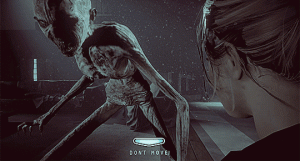
A wendigo from Until Dawn. Wendigoes can’t detect movement so during a “Don’t Move” event, the player has to hold the controller completely still.
In the game the player is rotated through playing as each of the eight characters. Periodically, the player is given the power to make significant choices for the character that impact the outcome of the game. Called “Butterfly Effects”, these decisions range from as trivial as taking a “safe” route versus a “fast” route to life-or-death decisions like jumping from a platform to safety versus saving a friend who is dangling off the platform (Seppala). The game explains this philosophy at the start: “A tiny butterfly flapping its wings today may lead to a devastating hurricane weeks from now” (TetraNinja). The decisions the player makes throughout the game impact situations later in the game, as well as the deaths of the other characters. Supermassive Games, the developer of Until Dawn, proclaims that with all of the choices and scenarios, there are “hundreds of endings”. While there aren’t literally hundreds, the numerous endings make replaying the game a puzzle, trying to figure out which decisions result in a character’s deaths (spoiler: there is a way for all 8 characters survive – and likewise an ending in which all characters die (Thielenhaus). Of course there are numerous variations between these extremes).
The generic terror of the psychopath and the emotional connection to wendigoes captures all the aspects of Pinedo’s everyday terrors but in a gorier and “jumpier” way than Zombicorns. The pain of losing Hannah and Beth haunts the group, especially their brother Josh, who eventually goes insane. The wendigoes and lurking killer create many jump scares, emphasizing the unpredictability of the characters as both beings have human-like intellect and plan traps for the teens. Unique to Until Dawn is how the Butterfly Effect plays with the insufficiency of intentions and the seemingly random effects of decisions. In order to obtain a specific outcome, several play-throughs of the game are required in order to properly align the effects. Instinct will help initially guide the player but a moral compass also helps. In “Death Games and Survival Horror Video Games: On the Limits of Pure Torture Show Entertainments”, Patrunjel acknowledges the centrality of morality within horror: “in horror fiction the moral law and the concept of nature itself as rational order are deeply chained one to another representing the same reality the hero stands for” (42). Just as decisions for the good of the group are rewarded, acts that upset nature like cannibalism (turning into a wendigo) or shooting a wolf (instead of befriending it) have negative effects for the character.
Finally, Until Dawn also emphasizes the undead versus dead enigma like Zombicorns. The hideous depiction of the wendigo and the cannibalism emphasize them as the Other but the Hannah-turned wendigo shows there is still human aspects to them. When given the chance, she doesn’t kill Mike, who she had a crush on while alive. In one of the sequences, if Josh recognizes her via her tattoo and calls out to her, she leaves him alone. As Mia recognizes in Zombicorns, the undead were once human too and their human memories remain with them in Until Dawn. Although both pieces affect the audience in drastically different ways, the themes of terror in the everyday recur and have a haunting impact.
[1] John Green also disclaims the quality of the story in the preface: “Dearest Reader, This is a bad zombie apocalypse novella. It was written in a hurry. It is riddled with inconsistencies. And it never quite arrives at whatever point it sought to make.”
[2] Yes, pinatas. Mia visits her z’ed up little sister Holly each morning and delivers her a piñata stuffed with actual food like protein bars and mini-boxes of cereal.
Works Cited
Green, John. Zombicorns. (n.p), 2011.
Patrunjel, Flaviu. “Death Games and Survival Horror Video Games: On the Limits of Pure Torture Show Entertainments.” Scientific Journal of Humanistic Studies, vol. 4, no. 7, Oct. 2012, pp. 38-45.
Pinedo, Isabel. “RECREATIONAL TERROR: POSTMODERN ELEMENTS OF THE CONTEMPORARY HORROR FILM.” Journal of Film and Video, vol. 48, no. 1/2, 1996, pp. 17–31., www.jstor.org/stable/20688091.
Seppala, Timothy J. “The Real Horror of ‘Until Dawn’ Is That Sony Sent It to Die.” Engadget. Engadget, 14 July 2016. Web. 27 Feb. 2017.
TetraNinja. “Until Dawn Walkthrough Part 1 – First 2 Hours! (PS4 Let’s Play Gameplay Commentary).” Online video clip. YouTube. YouTube, 24 Aug. 2015 Web. 28 Feb 2017.
Thielenhaus, Kevin. “Save (Or Kill) Everyone in “Until Dawn” With These Choices.” The Escapist. Defy Media, LLC, 25 Aug. 2015. Web. 28 Feb. 2017.
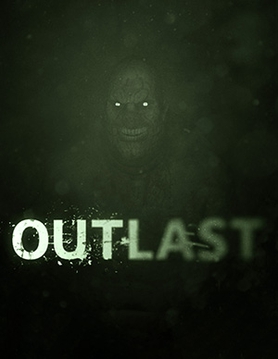
The Blair Witch Project (1999) Box Office Artwork via WikipediaOutlast (2013) Promotional Art via Wikipedia
A forest, an asylum. A film crew, a reporter. A witch (maybe), mental patients (and worse).
On the surface, The Blair Witch Project (1999 horror film) and Outlast (2013 horror game) seem to share little more than the same overarching genre. Looking at simply a narrative level, the common ground does not improve greatly. The Blair Witch Project comes from independent directors Daniel Myrick and Eduardo Sánchez, presented as found-footage shot by film student Heather and her crew members (Joshua and Mike) for a documentary about the titular Blair Witch. Meanwhile, Outlast, by independent studio Red Barrel Inc., follows investigative reporter Miles Upshur as he documents his attempts to verify a tip about inhumane practices at the private Mount Massive Asylum for the Criminally Insane. Perhaps one of the few aspects they do share is a certain critical subgenre fatigue that clashes with their mostly positive reviews. Found-footage seems to be collapsing under collective weight of all the Paranormal Activity movies and Blair Witch remakes, while first-person games have to suffer the baggage of every iterative first-person action-shooter.
Paranormal Activity 4 (2012) Box Office Art via Rotten Tomatoes
Where these two works explicitly do intersect is in their similar use of technology, specifically that of the camera. The Blair Witch Project and Outlast both rely on footage from diegetic cameras operated by the main character(s) and shot mostly in real-time, making both of them works of first-person “vérité horror” as coined Barry Keith Grant in his essay“Digital Anxiety and the New Vérité Horror and SF Film” (Grant 153). This common visual and narrative framing found its popular start with The Blair Witch Project in 1999 and has since then been adapted and tweaked by interactive media to a crystallized form represented by Outlast in 2013. Together these two works form a dialogue that offers a chronological record of its evolution and informs the vérité horror mode as a whole.
Though it certainly was not the first instance of vérité horror in film (many would argue that the title goes to Ruggero Deodato’s Cannibal Holocaust in 1980), The Blair Witch Project was certainly the film that popularized both the subgenre and its subcategory, found-footage. As such, The Blair Witch Project exemplifies much of the characteristics identified by Grant as vérité horror. The entirety of the film is shot on the two diegetic cameras that the documentary film crew carries with them into the woods in Burkittsville, Maryland. Additionally, whether conscious or not, the actors channeled cinema vérité’s respect for “real-time” in their depiction of real-life duration of events. And, even more effectively, these amateur filmmakers (both the directors and the actors) convincingly represented “real-space,” prompting viewers to “anxiously search the periphery of the screen for…something that simply [was] not there” in the words of Scott Dixon McDowell (qtd. in Grant, 165). In keeping with its style of shooting that would come to be known as “shaky cam,” The Blair Witch Project presents flawed, impartial, or even obscured glimpses of the film’s horrors purposefully in a skillful ploy to up the suspense of the film as audiences wait for a big reveal that never comes. Instead, audiences find themselves stuck, eating up the amateur aesthetic of “real” fear while simultaneously wishing it would break its own rules.
The real-life directors of the film took vérité horror a step further, having their actors film their trip, improvise their lines, and actually camp alone in the woods for long stretches of time–“method filmmaking” in the words of Myrick (qtd. in Heller-Nicholas, 97). This “method filmmaking” functions much like cinema vérité, dissolving the boundaries between “the artificial” and “the real” so that the audience has trouble telling the two apart. The Blair Witch Project certainly succeeded in walking that line, as a large part of its popularity surrounded whether or not it was “real.” Accompanied by a strong (mostly Internet) marketing campaign, seemingly encouraged the controversy of its veracity. No matter the audience opinion, these calculated advertising pushes kept the film at the forefront of conversation for a sizable amount of time.
These extratextual reminders of the controversy and the medium itself serve to evoke in viewers a further elevated sense of reality, striving for an effect labeled “hypermediacy” by Jay David Bolter and Richard Grusin–a sort of hyper-self-awareness in regards to media and technology possessed by certain works. The Blair Witch Project touts hypermediacy even within the text itself, its characters almost revelling in their acknowledgements of the camera, juggling of filming, mocking of the documentary process, and even direct address of the (intended) audience of the film.Together with its marketing, these elements work in conjunction to create a hypermediacy that further elevates the vérité horror of The Blair Witch Project.
Further adding to the hypermediacy resulting from the online marketing and authenticity debate, film critic Alexandra Heller-Nicholas argues that the creators of The Blair Witch Project engineered an “alternative reality game” (ARG)–an interactive narrative using transmedia storytelling that often acts as promotional material–that made viewers “actively partake” in part of the production of The Blair Witch Project’s vérité horror. This added enticement to involve the viewer comes on top of the first-person perspective that the film employs, and is further amplified by the inherent “interactivity” that Grant argues is significant to the vérité horror subgenre. He argues that when the diegetic “camera operator interacts with profilmic event” (the event happening in front of the camera), the film encourages the viewer to abandon their abstract detachment from the film and subconsciously identify with the camera and camera operator. With this its additions to vérité horror’s built-in interactivity, The Blair Witch Project sets a remarkably high standard for audience involvement.
In discussing interactivity in horror, the mind might naturally jump to horror video games. Grant spends a considerable amount of time comparing cinematic vérité horror to horror video games, especially survival horror games. Grant provides a strong definition for survival horror, which he defines as a subgenre where “the player fights monsters” with limited means of resistance, “often in enclosed, maze-like spaces while searching for hidden items that will allow movement to new areas…or provide various means for staying alive” (Grant, 163). He traces this term back to the 1996 release of the first Resident Evil, a fixed-camera zombie game that depended on its confusing spatial design, challenging puzzles, and (most importantly), its extreme scarcity of ammo and resources. In the almost two decades since then, survival horror has bled into the first-person market–the result of which has recently pushed the subgenre to an extreme. After the critical and financial success of 2010’s Amnesia: The Dark Descent, first-person survival horror games have embraced an almost complete powerlessness in contrast not only to the recent glut of action-oriented first-person games (think shooters like Call of Duty and Halo), but also to even Resident Evil’s limited combat. Outlast follows in this vein, emphasizing from the very beginning that you, the player character, cannot fight, rather you can only run and hide, and you have no weapons or tools except for a night vision-enabled camcorder with which to “record” the events of your investigation.
Outlast’s camera interface (plus incredibly big scissors!) via Giphy
With this mechanic, Outlast creates an unusual relationship with the player and the character, as you interact with the game world in an unusually passive manner for a first-person game, yet you actively spectate these interactions by recording with the diegetic camera. Despite this paradox of control, Outlast still essentially takes the immersive nature of vérité horror to another level.
Perron highlights a distinction between emotional reactions to horror mythology and conventions. Among other types of responses, he distinguishes between “fiction emotions” and “gameplay emotions,” which he defines as “emotions rooted in the fictional world” and “emotions that arise from the gamer’s actions in the game-world,” respectively. Whereas films, invoke fiction emotions, video games elicit both fiction and gameplay emotions, giving you the player an emotional reason to immerse yourself fully into the game. Outlast provides a unique combination of these emotional enticements, placing more emphasis on the fiction emotional stimuli while still supplying the gameplay emotional stimuli that its interactivity guarantees.
In addition to the added emotional investment, the game also includes diegetic, non-diegetic, and extradiegetic features to heighten the realism of your immersion. The sound plays a crucial role in the immersiveness of the game, with diegetic elements like heaving breath, dripping blood, beeping ripping body parts to draw you into Outlast’s vérité horror experience and nondiegetic sound effects to amplify the effectiveness of the horror without removing you from the experience. One of the more effective immersive details comes in the form of the extradiegetic vibrating controller feedback that adds to the emotional responses of the experience.
By far the most immersive factor in Outlast is its treatment of the diegetic camera. The experience of using this camera acts contrary to most other first-person implementations of the mechanic. Unlike many other video games, Outlast attempts to make using its diegetic technology as transparent as possible, channeling the “immediacy” of media and technology as coined by Bolter and Grusin and contrasting The Blair Witch Project’s hypermediacy. Outlast’s immediacy acts as a boon to the player, since it increases the immersiveness despite the fact that the game positively reinforces the camera’s use with both story and gameplay. Yet, for better or worse, that immediacy means that many of the actual limitations of night-vision camcorders are applied to the diegetic camera, ranging from light blindness to battery-life issues that turn the game into a terrifying battery scavenger hunt.
While in other more action-oriented games, the immersion from this first-person gameplay might be “replaced by the sense of agency” in the words of Film Studies professor Bernard Perron, Outlast instead partially invokes the passivity of the filmic experience. But unlike cinematic vérité horror, Outlast’s video game vérité horror places you in control of the camera operator, rather than only allowing you to identify with him or her. As such, it strikes a unique compromise between the distance between audience and experience, allowing the player control over the focus of events (except in scripted cutscenes), but discouraging some of the mitigating mechanisms that are effective with films (closing your eyes or covering your face, for example). Consequently, Outlast’s vérité horror experience becomes infinitely more graphic than The Blair Witch Project’s earlier cinematic version–embracing its identity as postmodern horror by displaying all the camcorder-captured mutilation, decapitation, and evisceration it can.
Though both The Blair Witch Project and Outlast exemplify first-person vérité horror, they act as bookends of a still-changing subgenre. The Blair Witch Project may have created the current popularity (and fatigue) that surrounds the found-footage and vérité horror in general. However, Outlast currently stands as distillation of the spirit of vérité horror, making the player actually step into the role of the camera operator rather merely identify with the camera in spite of the uncanny (or just plain unrealistic) nature of video game graphics. Yet as graphics and computing technology improve alongside that of virtual reality, we find vérité horror has strayed beyond both both The Blair Witch Project and Outlast to take on different, even more immersive form.
Works Cited:
Bolter, Jay David, and Richard Grusin. Remediation: Understanding New Media. Revised ed. edition. The MIT Press, 2000. Amazon. Web. 26 Feb. 2017.
Grant, Barry Keith. “Digital Anxiety and the New Verité Horror and Sf Film.” Science Fiction Film and Television 6.2 (2013): 153–175. Print.
Heller-Nicholas, Alexandra. Found Footage Horror Films : Fear and the Appearance of Reality. Jefferson NC, US: McFarland, 2014. ProQuest ebrary. Web. 1 March 2017.
Perron, Bernard. “Sign of a Threat: The Effects of Warning Systems in Survival Horror Games.” ResearchGate . Web. 26 Feb. 2017.
Here is the LINK I was finally able to figure out! (The add media link wasn’t working for this audio file, it kept calling the file invalid and unable to upload, so this was my loophole around that invalid message!)
Pinedo, Isabel Cristina. “Postmodern Elements of the Contemporary Horror Film.” The Horror Film. N.p.: Rutgers U Press, 2004. N. pag. Web. <books.google.com/books?hl=en&lr=&id=S6jKVfuQG3wC&oi=fnd&pg=PA85&dq=postmodern horror&ots=rKqzTqd3xy&sig=fOXUvaM1zPTefyhsigJMmnj1dD4#v=onepage&q=postmodern%20horror&f=false>.
In Kyle Bishop’s introduction to The American Zombie Gothic, he discusses the twenty-first century revival of societal interest in zombies, a phenomenon he refers to as the “Zombie Renaissance.” He explains how the zombie film genre can be viewed as an expression of an era’s cultural anxieties, describing how more recent zombie movies have “reacted to social and political unrest, graphically representing the inescapable realities of an untimely death (via infection, infestation, or violence) while presenting a grim view of the modern apocalypse in which society’s supportive infrastructure irrevocably breaks down” (Bishop, 11). The 2007 film, I Am Legend, based on the novel of the same name, distinctly demonstrates this post-apocalyptic trope. The film’s narrative follows Robert Neville, played by Will Smith, the last surviving human in New York City after a virus has nearly wiped out the world’s human population, turning people into zombie-like mutants.
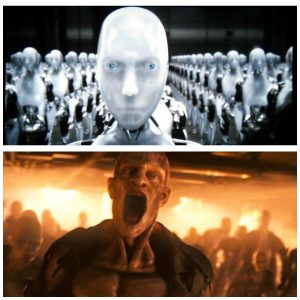
Meanwhile, I, Robot, a 2004 film also starring Will Smith, takes place in a dystopian future in which humanoid robots with artificial intelligence pose a threat to human civilization. At first glance, robots and zombies may seem to have very little in common, besides the fact that they are both non-human. However, this concept of non-humanness is precisely the way in which these two narratives parallel one another. Both the zombies and the robots in the two films are uncanny in their resemblance to humans, but are also different enough from humans to be monstrous. Laura Spinney, journalist for the New Scientist investigates the concept of the uncanny in relation to the non-human in her article, “Exploring the Uncanny Valley.” She writes, “You might have heard of the uncanny valley: the notion that the more human-like a non-human character becomes, the more we like it – until suddenly, we don’t. As some point where it is almost, but not quite, human, we become unsettled, even revolted. The uncanny valley has been used to explain our adverse reactions to all sorts of almost-humans from zombies, androids and corpses to the creepy clowns recently terrorizing North America” (Spinney, 1). We see this idea demonstrated in the upgrade from old robots to new robots in I, Robot. Although the old robots have somewhat human faces, consisting of bolts for eyes and a slit for a mouth, they remain very machine-like in appearance. The new robots, on the other hand, have distinct facial features that move when they speak and the ability to display emotive facial expressions. The film’s main robot, Sonny, can even express human emotions such as sadness and anger, which cause the human characters and audience to experience empathy towards him – a quality that the old robots do not evoke. However, some human characters, particularly the protagonist Del Spooner, have disdain for these robots and are skeptical of the future of robotic technological development.
Sonny, a new robot (left) standing next to an old robot (right).
In Despina Kakoudaki’s book, Anatomy of a Robot, she discusses the significance of humanoid robots in popular culture in the chapter, “The Existential Cyborg.” She explains how the genre of science fiction focused on artificial intelligence investigates ideas of otherness and identity – of not just the robots but of humans as well. Kakoudaki explores “the ways in which stories of artificial people take on an existential tone in the course of the twentieth and twenty-first centuries, using the vocabulary of artificiality in order to investigate questions of being and experience. As a versatile and adaptable cultural construct, the discourse of the artificial person offers a narrative framework for expressing threats to the self, but it can also sustain new understandings of how humanity might be defined” (Kakoudaki, 174). In I, Robot, Sonny is a prime example of an existential robot. Not only can he exhibit human emotions, as previously noted, but he also expresses a strong desire to understand. For instance, in the interrogation scene below, he asks Spooner: “What am I?” – an existential question that a human being might ponder. Sonny’s curiosity regarding his identity and purpose demonstrate how the new robots transcend the old robots with their ability to have philosophical, human-like thoughts. He also proves himself very perceptive when he asks Spooner what the action of winking signifies, expressing a desire to understand humans and the world around him. He even claims to have dreams and be capable of love – qualities that are often thought of as intrinsically human.
However, perhaps what is most uncanny about these new humanoid robots is that they threaten to transcend humanity as well by going above and beyond what average humans are capable of. We see this tension demonstrated in the scene above, when Spooner asks Sonny, “Can a robot write a symphony? Can a robot turn a canvas into a masterpiece?”, to which Sonny replies, “Can you?” While Spooner may not possess the talent to accomplish such artistic feats, as artificial intelligence becomes more advanced, the creative capacity of robots may very well exceed that of most humans. Referring back to “The Existential Cyborg,” Kakoudaki writes, “The stereotypical focus on coldness, rigid logic, and lack of emotion for the depictions of robots, androids, or various aliens, however human-like they may otherwise be, thus offers a rather eloquent, if implicit, conceptualization of this problem: it both absorbs the modern emphasis on rationality and dispels it, reinstituting elements of vitality and irrationality as defining features of the human” (Kakoudaki, 182). Essentially, I, Robot questions what makes humans uniquely human. If society elevates reason and rationality as intrinsic human characteristics, the new robots prove their rationality to be superior. For instance, the new robots manage to find a loophole in The Three Laws of Robotics, which are as follows:
LAW I: A robot may not injure a human being or, through inaction, allow a human being to come to harm.
LAW II: A robot must obey orders given it by human beings except where such orders would conflict with the first law.
LAW III: A robot must protect its own existence as long as such protection does not conflict with the first or second law.
When the new robots attempt to usurp the humans in their revolution, their leader, VIKI, an artificial intelligence supercomputer justifies the robots’ actions by explaining, “You charge us with your safekeeping, yet despite our bests efforts, your countries wage wars. You toxify your earth and pursue ever more imaginative means of self-destruction. You cannot be trusted with your own survival.” It is interesting to note that the film presents Three Laws of Robotics as concrete and fool-proof, almost paralleling scientific laws, such as the laws of physics. Yet, the robots end up outsmarting humans by effectively using these trusted laws against them. Furthermore, the robots not only threaten human civilization with their superior capabilities, but they also threaten human existence itself in that they are virtually immortal. If continually repaired and maintained, artificial intelligence could technically live forever, whereas humanity is bound to mortality.
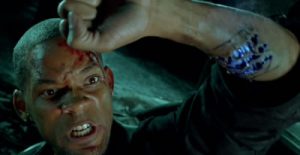
Ultimately, the robots in I, Robot blur the distinctions and boundaries between the human and the non-human. A particularly uncanny moment occurs when the film reveals Spooner’s prosthetic robot arm underneath his human skin, symbolizing a quite literal blurring between robot and human. In the scene below, the narrator, or the inventor of the robots, expresses these undefined boundaries. He asks, “When does a perceptual schematic become consciousness? . . . When does a personality simulation become the bitter mote of a soul?”
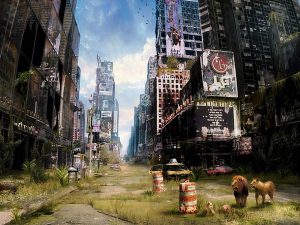
Switching modes from a robot revolution to a zombie apocalypse, we see a very different extreme of the non-human in I Am Legend. To begin with, while I, Robot is set in a technologically-advanced, futuristic society, I Am Legend takes place in a post-apocalypse society in which human civilization has been completely destroyed. They are both set in large cities, Chicago and New York, respectively, but stand in stark contrast with one another – the large city demonstrates the bustle of “life” for I, Robot, while depicting absolute desolation in I Am Legend. In one of the very first scenes, the protagonist Robert Neville is shown hunting deer for meat, competing with a lioness for resources, demonstrating the collapse of civilization as we know it and a retreat to prehistoric times.
Wild lions in post-apocalyptic New York City.
The presence of technology in the film is also interesting in that it further signifies this regression from modern human civilization – for example, with the world being desolate, technology is no longer updated, so Neville watches reruns of the news every morning, perhaps simply to make himself feel less alone and hopeless. Yet, some hope remains, as he broadcasts himself on the radio every day to reach out to other potentially remaining humans.
Robert Neville using technology to reach out to other humans still alive.
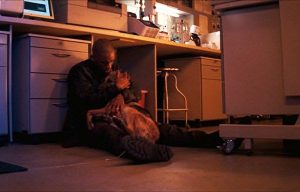
In the chapter, “The Rise of the New Paradigm,” from The American Zombie Gothic, Kyle Bishop discusses how modern zombies distinguish themselves from those found in earlier films. He claims that they differ “in four key respects: 1) they have no connection to voodoo magic, 2) they far outnumber the human protagonists, 3) they eat human flesh, and 4) their condition is contagious” (Bishop, 94). Because humans cannot blame the presence of the zombies on some supernatural force, they have no one to blame but themselves. At one point in the film, Neville says, “God didn’t do this; we did.” Much like the narrative in I, Robot, humans in I Am Legend bring themselves to their own demise by creating their own monsters. In the film, what originally began as a well-intentioned cure for cancer turned out to be a catastrophic virus killing most of its victims, while turning some into monstrous predators – only 1% of humans possessed immunity to the virus, including Neville. Bishop also writes, “because these creatures infect and transform their prey into monsters such as themselves, once-trusted friends and loved ones prove the greatest threat to the few surviving protagonists, and that threat is often not apparent until it’s too late” (Bishop, 95). Once again, the uncanny comes into play, as humans see themselves in these monsters. They not only resemble humans, as do robots, but they were actually once human. However, the film’s emphasis on Neville’s dog and sole companion, Sam, offers an interesting perspective of humanity. Not only does the virus affect humans, but it also affects certain animals that coexist with humans, like domesticated dogs, but not wild animals. Perhaps this suggests that there is something humane within animals that live amongst people, such as dogs. In fact, one of the most heartbreaking scenes in the film occurs when Sam is bit by a zombie wolf and Neville is forced to put him to sleep before he transitions into a predator, leaving Neville completely alone.
Neville and Sam hiding from the zombies together.Neville holds Sam as the effects of the virus begin to kick in.
Referring back to Neville’s quote, “God didn’t do this; we did,” he also says to Anna, another survivor he meets towards the end of the narrative, “Every single person person that you or I has ever known is DEAD. There is no God.” The rejection of God may prompt the question of whether the soul exists. As noted earlier, I, Robot ponders upon the idea of what a soul consists of. However, if souls do not exist, then what makes humans distinctly human? If we assume that reason is an intrinsically human characteristic, the zombies in I Am Legend are sub-human in that they seem to lack reason, instead being portrayed as mindless predators who act only instinctively – a stark contrast from the highly rational robots in I, Robot. In the scene below, Neville makes futile attempts to reason with the zombies, telling them, “I can save you. You are sick and I can help you,” but the zombies fail to understand him. Finally, an essential part of the narrative is that Neville takes a rational approach to find a solution, turning to science to find a cure for the virus. The film presents him as humanity’s last hope, and science as the salvation. While in both movies, science and technology create the monsters that turn against humanity, in I Am Legend, it also ultimately saves humanity.
In 1959, CBS aired the pilot for a science-fiction, fantasy, psychological-supernatural horror show that would go on for five seasons and won two Emmy Awards in Drama and a Golden Globe. Today, more than fifty years after its initial release, the show is often ranked as one of the best shows of all time. Do you know which TV series I am describing? Most likely not without some help, so here is the introduction. “There is a fifth dimension beyond that which is known to man. It is a dimension as vast as space and as timeless as infinity. It is the middle ground between light and shadow, between science and superstition, and it lies between the pit of man’s fears and the summit of his knowledge. This is the dimension of imagination. It is an area which we call the Twilight Zone.”
Rod Sterling’s The Twilight Zone remains syndicated by CBS and lives on through reruns and on streaming sources like Netflix and Amazon Prime. The Twilight Zone undoubtedly fulfills an early example of post-modern horror, as the show depicts characters facing futuristic, paranormal, supernatural, or disturbing events and moral difficulties. The surprising twists and moral lessons that made the show famous defined an innovative new genre for television. Although there have been attempts to revive or reboot the show, they could not capture the same quality that made the original so successful. The Twilight Zone falls into that category of things that you only really understand until you experience it first-hand; something that cannot be described adequately to someone else without showing them.
Until recently, it was hard to find another example that fit neatly into The Twilight Zone’s unique genre and created a similar sense of psychological tension. One of the shows that has come close is Netflix’s Black Mirror, which we have discussed in class. Undoubtedly, many fans of the show use language like modern-day-Twilight Zone, or describe it as a technologically skewed version of The Twilight Zone, because the show is similarly difficult to describe without first-hand experience. We can see this description through blogs and news articles- here, here, here, and here (among countless other examples).
(As a side note, I think that any television show or horror work that Stephen King tweets about should automatically be qualified as a post-modern horror success- as seen in his tweet below)
Loved BLACK MIRROR. Terrifying, funny, intelligent. It's like THE TWILIGHT ZONE, only rated R.
While there are many authors devoted to describing the particular brand of psychological horror shown in both Black Mirror and The Twilight Zone, as well as many shows trying to recreate their success, I want to focus on the aspects that differ between the shows. In trying to compare the two shows, I chose two episodes from Black Mirror and The Twilight Zone that focus on a similar theme, mainly class structures in society and the desire to “fit in” with others. I am going to describe the episode from The Twilight Zone first, move on to the episode from Black Mirror, and then look at how they interact.
Eye of the Beholder
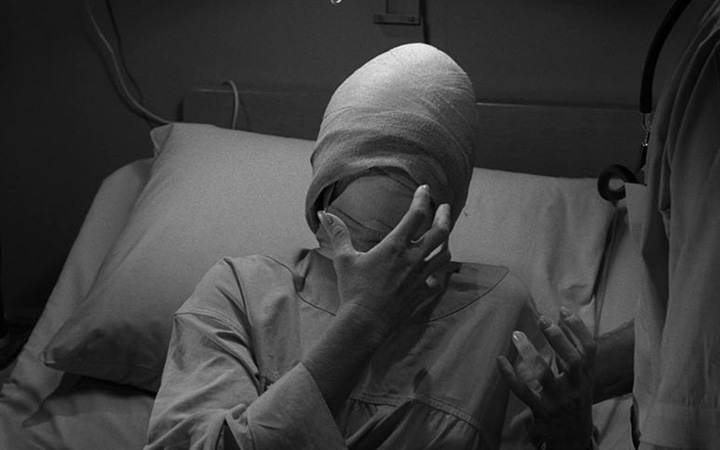
Season two, episode six of The Twilight Zone focuses on a woman named Janet Tyler. We spend the first twenty minutes without seeing Janet’s face; it is covered in bandages. She lies in a hospital bed. As she starts talking to a nurse in the room the camera focuses on her covered face, and then moves to follow Janet’s hands as she talks. Janet begs the nurse to ask the surgeon to take of the bandages because she wants to see if the operation was successful. She cannot wait any longer, since this is her 11th time undergoing procedures on her face. Janet lives in an alternate reality, at an unknown time, where being ugly is outlawed and procedures are performed to make citizens pretty.
As you can understand after 11 surgeries, Janet must be restrained at times to let her face heal because she cannot wait any longer. If the operation turned out to be unsuccessful, she will be sent to live in exile with other undesirable persons.
Throughout the episode, before the bandages are taken off, Janet talks to anyone who will listen about how much she wants to be normal. She just wants to fit into society. She is not upset about the forced participation and mandatory procedures because she wishes to walk in the street without scaring anyone. Ostracized for her looks her entire life, Janet offers to wear a mask and stay indoors all the time, just so that she can live a normal life if the surgery is unsuccessful.
She befriends her surgeon and shares with him that her earliest memory is looking at a little boy and making him cry because of her ugliness. The surgeon comforts her and identifies with her. He knows that the chances of the surgery were slim and that she is likely as ugly as before.
Stepping back for a moment here, the film techniques, camera movement, jump cuts, and use of shadow to hide the faces of everyone except Janet is exceptional. By interacting with a protagonist whose face is covered, and making clever use of the black and white medium of television at the time, The Twilight Zone forces the audience to interact with an entirely faceless cast. For the first twenty minutes of the episode, we do not see anyone’s face. This seems normal at first, that maybe a reveal will come in the next shot, but as the episode progresses we begin to question the importance of personal appearance. At one point, Janet’s surgeon asks himself whether beauty is only skin-deep, and what it truly means to be beautiful.
The climax of the episode comes as the surgeon removes the bandages from Janet’s face. Slowly and methodically, this scene lasts for almost five minutes, until the final bandage is taken off and we see the results of Janet’s procedure. She is strikingly beautiful, and touches her nose and skin in excitement. She suddenly screams, however, and runs away when she gets to her lips and nose. As the surgeon turns on the lights, the twist of the episode is revealed. Beauty in this world does not match up to the audiences’ standard of beauty; what might be considered ugly for us is the definition of beauty for Janet and her society. Since uniformity and beauty are required of every citizen, she is destined to live in exile. She cannot undergo anymore procedures.
This episode reminds the viewer of Nazi Germany, where uniformity and conformity were praised. Where being different meant being dirty or inhuman. The leader shown on the television screens in the episode shouts how glorious conformity will unite the nation and praises the benefits of uniformity. As its title implies, Eye of the Beholder plays off the adage that beauty is subjective and only serves to create class and social tensions. The episode warns of what might happen if society becomes too focused on standards of beauty and the subjectivity of ranking others based on personal traits. It ends vaguely, as most post-modern horror works do, with Janet walking towards her new life in exile.
Nosedive
Black Mirror’s first episode in season three, Nosedive, has similar themes of segregation, class tensions, uniformity, and societal values. It follows a young woman named Lacie who lives in a futuristic world where you can rate others’ popularity on your phone. Your rating determines many different aspects of your life, including where you can live, who you can socialize with, what businesses you can shop at, and what discounts you can get. Lacie wants to move into a luxurious apartment, and can either pay a massive rent or raise her rating to obtain a discounted rent. She chooses to go to a rating improvement agency and gets life and networking coaching, attempts to socialize with higher rated people, and is eventually invited to speak at a wedding with people with top ratings.
We see as the episode progresses how such a future might be possible in real life, outside of the television show. The episode alludes to the ranking system that companies like Uber, Yelp, and even Netflix use in our daily lives. It depicts a society where every move is scrutinized, every word is parsed, and every hair must stay perfectly in place. Social values become integrated and forced upon everyone.
While the ending for Lacie is both tragic and liberating, because she frees herself from the vicious cycle of the rating system by destroying her score, the episode shines a light on the inherent class system that comes with society and the pressure we feel to fit in or be popular.
I looked further at research in social anxiety, the othering theory (that we instinctively find differences between groups of people), and the psychology of presenting your best self to society. In Mark Leary and Robin Kowalski’s 1995 book, Social Anxiety, the authors discuss how self-presentation behavior, along with impression management, influence interpersonal behavior as a basic necessity for social life (Leary and Kowalski 16). They write that there is nothing inherently manipulative in influencing other people, social influence is just an essential and valuable aspect of our daily lives. Particularly interesting to this episode of Black Mirror, Leary and Kowalski write that as long as people believe they are projecting the right kinds of impressions, they will be more relaxed and confident (Leary and Kowalski 19). Alternatively, when you think you are giving off the wrong kinds of impressions, then you are more flustered and anxious. They present a self-presentational theory of social anxiety, that social anxiety is a function of two factors: “the motivation to make a desired impression and the subjective probability of doing so” (Leary and Kowalski 19).
What does all of this mean for Lacie, though? As the episode starts out, Lacie has a good rating. She feels confident in herself and her public image, so is also confident in how she presents herself to the world. It is only when she feels an increased pressure to improve her popularity that she begins to doubt her ability to influence others. As her anxiety and frustration begin snowballing her rating lower, she creates this negative feedback loop that can only end in two options: becoming a social outcast and be miserable trying to climb back up the ranks, or choose to disregard the rating system and rid herself of the social anxiety it causes her.
Lacie doesn’t care about what others think of her, setting her free from the vicious cycle. (Tumblr)
Social Anxiety, Fitting in, and 50 Years of Psychological Horror
I guess it is both comforting and upsetting that social anxiety and the pressure to fit in was as prevalent in the 1960’s as it is today. Both Black Mirror and The Twilight Zone offer different takes on similar issues. While Black Mirror offered a futuristic, technology-based approach to the dystopian world depicted in Nosedive, The Twilight Zone presented the issues of segregation, popularity and beauty, and social anxiety in Eye of the Beholder with a science fiction and monstrous lens. Both Janet and Lacie face social pressures to conform and gain popularity among their peers.
Both these episodes might not be considered horror in its traditional definition, but engage in a type of post-modern horror called digital anxiety. Barry Grant discuss digital anxiety in his article “Digital Anxiety and the New Verité Horror and SF Films.” Grant describes digital anxiety as a stylistic approach that depicts the “monstrous in the mundane spaces we see every day in social networking, which also captures and disseminates globally daily atrocities beside which monster movies pale” (Grant 153). In both episodes, the anxiety is created when our normal perceptions about society or the world are flipped and perverted. While we may wish to be more beautiful or popular, these episodes show what society would be like if these social pressures ruled every aspect of our lives.
The larger message though, when both of these episodes are looked at together, is not simply that we need to worry less about our physical appearance or how popular we are (though that would definitely help many of us), but rather that humanity inherently creates these social classes and pressure. What is truly horrifying is that we can imagine both of these alternate realties coming true. While we might laugh at the pig-features of Janet’s world and scoff at the technological aspects of the rating system, these episodes make one realize that humanity is not above these behaviors. This subverts our comfort in our own lives, because while these episodes are just fiction, they shine a light on human nature that creates this underlying anxiety. Knowing that something depicted in these shows could happen in real life breaks down the comfort barrier between the viewer and the fictitious world.
Looking back, the similarities between Black Mirror and The Twilight Zone are striking. It is understandable now why so many viewers can only really describe one show with the other. They form a unique blend of drama, science fiction, fantasy, supernatural, and psychological horror, that creates and fits into a distinct genre.
Works Cited
Black Mirror – Nosedive. Dir. Jon Wright and Charlie Brooker. Perf. Bryce Dallas Howard. Black Mirror. Netflix, 21 Oct. 2016. Web. 1 Mar. 2017.
Grant, Barry. “Digital Anxiety and the New Verite Horror and Sf Film.” Science Fiction Film & Television 6.2 (2013): 153-75. Web. 1 Mar. 2017.
The Twilight Zone – Eye of the Beholder. Dir. Robert Enrico. By Robert Enrico and Rod Serling. Perf. Roger Jacquet and Anne Cornaly. CBS-TV, 1964. Netflix- S2E6.

 Here, for fun, are the noise profiles of the phonetic alphabet. This is the cutting edge of sound preservation. Picture from:s-media-cache-ak0.pinimg.com/736x/d1/fa/c8/d1fac8222ca88592bce8aa4e62df4a59.jpg%5B/caption%5D