Canavan, Gerry. “”We are the Walking Dead”: Race, Time, and Survival in Zombie Narrative.” Extrapolation, vol 51 no. 3, 2010, pp. 431-453.
“Halt & Catch Fire.” Supernatural, season 10, episode 13, The CW, 10 Feb. 2015.
Mezei, Sarolta. “Spectral Media Technology and the Vicious Brothers’ Grave Encounters.” HJEAS : Hungarian Journal of English and American Studies, vol 22 no. 1, pp. 167-180.
Pinedo, Isabel. “Recreational Terror: Postmodern Elements of the Contemporary Horror Film.” Journal of Film and Video, vol 48 no 1/2, 1996, pp. 17-31.
“Running.” Dead Set, season 1, episode 4, Zeppotron, 30 Oct. 2008.
Shut Up and Dance is the third episode of the third season of the show Black Mirror. On the surface, it explores themes such as cybercrime, privacy, internet anonymity, and vigilante justice. No Country for Old Men is an American movie released in 2007 directed by the Coen brothers as a cinematic adaptation of the Cormac McCarthy novel of the same name. While both works are stunning examples of post-modern horror and share striking similarities, they have quite the different approach to what will be addressed as ‘generating fear’—that is, the two works provide opposite, but equally effective reasons for the viewer to feel fear. This short study will first provide a brief plot summary of both works, examine the tone and pacing, and finally discuss how this affects the generation of fear for each. I will argue that while Shut Up and Dance generates fear by depriving the viewer of contextual knowledge, No Country for Old Men achieves the same end by providing it. Finally, I will argue that these two methods each demonstrate how effective the other is as a representation of two extremes of a spectrum, and the resulting implications of these conclusions on storytelling.
Shut Up and Dance tells the story of a Kenny, a young adult whose laptop is hacked to record a video of him while masturbating. Using this video as leverage, the hackers responsible for this send Kenny instructions to obey their will via text. Throughout the course of the day, he meets people who are not the hacker but also apparent fellow victims, presumably with some similar stake in performing to the satisfaction of the hackers. Kenny eventually runs into Hector, who fears divorce and losing custody of his children due to an extramarital affair. The text messages instruct the two of them to rob a bank using a gun that another victim delivered to them. Kenny successfully holds up the store, and the two later receive instructions to go separate ways. In a dramatic scene where the hackers order Kenny and yet another victim to fight to the death, it is revealed that both had been in possession of child pornography. Kenny first attempts suicide and then later is seen bloodied, presumably having murdered the other man. Despite all of the victims’ strict adherence to the hacker’s instructions, every single hacking victim suffers from an information dump, and each are apprehended appropriately for their wrongdoings. The classic traits of postmodern horror are present: fear, violence, and a transgression of violence (Pinedo, 1996).
The last thing that every single victim receives from the hacker. The trollface is synonymous with an aloof, detached, and destructive sense of black humor.
No Country for Old Men (2007) is quite different in tone. When the Texan protagonist Llewelyn Moss finds a briefcase of money from a drug deal gone bad, he becomes wanted by the Mexican drug cartel. A hitman named Anton Chigurh threatens to kill his wife Carla Jean if Moss does not comply and surrender the money. Llewelyn then orders a reluctant Carla to go into hiding as he flees with the briefcase. After several close encounters between Moss and Chigurh resulting in both being injured, Carla seeks protection from the local sheriff, Bell. Unfortunately, this conversation unknowingly reveals Moss’s location to the Mexican cartel, and he is later found dead, killed off-screen. Chigurh later finds Carla at her home, and the film strongly implies that he kills her. Sheriff Bell plans to retire as he feels overwhelmed with the increasing violence of the neighborhood, noting that Terrell Country is “no country for old men.”
While Shut Up and Dance might also be described as a ‘thriller’, this is certainly not the case of No Country for Old Men. While there are shootouts and action (actually even more so than Shut Up), No Country takes on an excruciatingly slow, intensely unnerving tone and pace. The horror is exacerbated not by gore or violence, but the threat of violence. Take, for example, a scene in which Moss and Chigurh confront each other:
A scene involving two very resourceful characters. Moss is a Vietnam veteran and knows his way around a gun. However, he is clearly outmatched, and watching Chigurh’s mind work is arguably more terrifying than the actual firefight itself. This will be touched on later as well!
There is no soundtrack to warn of an impending clash. The viewer hears exclusively diegetic sounds throughout the film, and the effects are apparent in this scene. What would Moss hear as he prepared for Chigurh’s assault? Nothing. So the viewer gets nothing as well, and is forced to endure the agonizing wait. When the wait ends, the release is not nearly as exhilarating or cathartic as one would hope. Some stray shots are fired, but both parties escape. And this is what at its core makes No Country such a novel post-modern horror film—the horror is generated entirely by the viewer’s wish for a traditional confrontation which never occurs. The predator/prey interactions never result in a conclusive finish, and each iteration piles increasing amounts of fear of the next one. Of course, when Moss when is killed by the Mexican cartel, it is an infuriatingly unceremonious, off-screen death. There is no closure, only continued fear and terror of Anton Chigurh. These classic postmodern traits indicate that two wildly different forms can accomplish the same effects through different methods.
Shut Up and Dance chooses to keep the viewer in the dark about a sinister secret that the protagonist guards, choosing to reveal this at the last minute as a plot twist. However, before this dramatic moment the viewer is forced to endure the humiliating power that the hackers hold over Kenny. Part of what makes the hackers so scary to both Kenny and the viewer is that so little is revealed about them. The only interaction that is witnessed throughout the course of the episode are text messages, and the remnants of the instructions received by other victims.
Because so little is known about the hacker, its nature becomes ambiguous. It is unclear what exactly the hacker is capable of doing. The writers of Shut Up and Dance play this angle appropriately by making the first of the text-message instructions relatively innocuous, and slowly ramping up the danger involved. Throughout the course of the day, Kenny delivers a cake, goes for a joyride, and robs a bank at gunpoint, and murders a man with his bare hands. The reason the viewer feels fear is because the intentions of the hacker are only revealed incrementally via the instructions, which undergo a drastic transformation throughout the episode. When the big plot twist is revealed (Kenny’s computer is filled with child pornography!), the viewer is left in even more confusion. The entirety of the episode draws on post-modern horror effects by inducing fear of the unknown without ever explaining these unknowns.
This leads to the fundamental differences in the approach to post-modern horror taken by No Country and Shut Up. Shut Up chooses to keep the viewer in the same boat as Kenny. The hacker then comes to represent a fear and a complete loss of rationality because so little is known about them. When Kenny first discovers that his computer has been compromised, he becomes absolutely hysterical, crying and screaming at his phone. This irrational behavior partially stems from the fact that he has no idea who to even blame—his overlord is merely a nameless figure with a seemingly infinite presence. Of course, the final twist is that Kenny was guilty of some heinous crimes, and that he knew that he was from beginning. However, this does not detract from the powerful sympathy the viewer feels towards Kenny. In this way, Shut Up and Dance fulfills its own post-modern criteria–the viewer had been rooting for a pedophile the entire time! This gross perversion of the narrator-viewer relationship serves to deprive the viewer of neither the victory nor defeat of a traditional ending.
On the other hand, No Country opts to give the viewer full knowledge of the situation that Llewelyn finds himself in. From the first scene, the film demonstrates the full extent to which Chigurh will go to achieve what he will do. In stark contrast to generating fear by creating a mysterious antagonist, the film chooses to generate fear by exposing the viewer to the terrifying, unstoppable force that relentlessly pursues the protagonist. Instead of wondering what Chigurh is capable of, the viewer feels fear for the Moss’s rapidly declining odds against the murderous sociopath. Twice in the film he allows victims to wager their life on a coin toss, and he plays God in that moment for whoever calls heads or tails. This unfeeling, unsympathetic, and merciless God who simply offers the chance because it amuses him embodies what the viewers learn to fear (Cagle, 2014).
Anton Chigurh, one of cinema’s most iconic antagonists, is a perfect medium through which No Country achieves this effect. The film goes out of its way to demonstrate Chigurh’s thought process. In one scene, he prepares for a gunfight against Mexican cartels that he knows to be sheltered in a small motel:
Chigurh’s silence and brutal efficiency is honestly chilling. But what is really unsettling is how deliberately he practices the motions needed to secure a job well done, showing that he is a rational human that is capable of premeditated actions.
In order to ensure that he has the upper hand, Chigurh rents out a room in the motel as well. He studies the room layout and checks walls for potential penetrating shot opportunities. Then he practices the motions of abruptly throwing the door open and flipping the switch. This practice results in three dead cartel members, and an unscathed hitman. This scene is so scary not because of the action (which is scant) but the fact that Chigurh smart (Cagle, 2014). This is one of the best examples of the film that stand out to demonstrate the value in giving the viewers everything.
As the film continues to characterize Moss and reveal his backstory, no further information is given on Chigurh. But the knowledge of the inevitable results in a continued, indirect dehumanization of Chigurh (Bayless and Redmon, 2013). While Bayless and Redmon primarily discuss differences between the film and the original McCarthy novel, they raise many interesting points. For example, they remind the viewer that the Coen brothers take very deliberate steps towards humanizing Chigurh to some extent. The scene in which the now iconic captive bolt pistol is explained, they argue, serves to “push the audience to align Chigurh with humans rather than animals. He is clearly the one holding the air-gun and not the one on which it is being used. This reminder forces audiences to acknowledge Chigurh’s humanity and the specifically human agency behind the horrific actions this character performs” (Bayless and Redmin, 2013). Again, this reinforces the argument that full disclosure in No Country is effective in inducing horror in an indirect way. In this case, the viewer is left horrified by the possibility of a human being’s capacity to kill mercilessly, or to see others as animals. Without the scene in which the weapon is explained, Chigurh becomes an embodiment, rather than somebody that you might simply spot in a crowd. The possibility of an actual living Chigurh out in the real world is legitimately frightening.
A similar, representative moment in Shut Up is when the cake that Kenny received from another victim is revealed to contain a handgun. This is the first indication that the hacker has very, very sinister intentions, and both Kenny, Hector, and the viewer immediately have the same reaction—how many victims are there? For each victim to have completed a small role, how many unknowing hands did this handgun pass through? How many more will touch? The possibilities are endless, highlighting the strength of this style of horror.
Upon seeing the handgun, the viewer is instantly compelled to think about its recent history. How many iterations of the same hack and instruct protocol were conducted to get this gun in a car with two people in front of bank? Maybe countless.
The effectiveness of both of No Country for Old Men and Shut Up and Dance suggests that these two approaches to generating fear are both viable methods. Juxtaposing these two works together tells us that in order to scare an audience, there are no half measures: give full disclosure of a genuinely horrific phenomenon, or give away nothing and let the imagination run wild.
These assertions have multiple implications for the art of storytelling. The storyteller, whether it is an author, director, or an actor, must make a deliberate decision as to how much context the audience will receive. Both examples given above suggests that the either end of the spectrum may prove sufficient. But each method of storytelling requires a different set of narrative criteria. In providing little to no context such as in Shut Up and Dance, the underlying sinister nature of the source of fear must be incrementally exposed, so as to build continuous tension and fear throughout the entirety of the story, and prevent shock value from wearing off early into the story. On the other hand, choosing to present the audience with full disclosure of impending doom requires characterization alongside this overwhelming force to refresh the fear that the viewer feels for the characters. In addition, the nature of this force must be absolutely horrifying such that it is clear that the victim is outmatched. This foundation provides the basis for the generation of sufficient fear as the inevitable loss draws nearer towards the end of the story. T
he final, and perhaps the most important supporting criteria, is that there must be no cathartic solution. I think that this is what distinguishes a ‘thriller’ type film from a postmodern horror one, and Cagle (2014) would agree. A central aspect of postmodernism is the lack of conclusive ending, and No Country is a flawless example of such. While the ending gives the slightest hint of change regarding Chigurh’s character, the rest of the film is frustrating in that not much is resolved. His argument that No Country “refuses to develop toward a proper resolution between opposing forces” (Cagle, 2014) is indicative of the continued rise in tension I described earlier, with no final crescendo, leaving the viewer in the uncomfortable, on-edge mood.
Shut Up and Dance and No Country for Old Men achieve the same postmodern horror effect on their viewers, but through different methods respectively. While both are effective, each requires a unique set of skills to tell a good story. Both of the works examined above do this almost flawlessly, and the result is a masterful depiction of postmodern horror.
Bibliography
Isabel Pinedo. “Recreational terror: postmodern elements of the contemporary horror film.” Journal of film and video, Vol 48, No. 1/2, 1996, 17-31.
Jeremey Cagle. “”I hope it has a good endin’ “: rewriting postmodern play in Cormac McCarthy’s No Country for Old Men.” The Cormac McCarthy journal, Vol 12, 2014, 1-19.
Ryan S. Bayless and Allen H. Redmon. “”Just call it”: identifying competing narratives in the Coens’ ‘No Country for Old Men.'” Literature/Film quarterly, Vol 41, No. 1, 2013, 6-18.
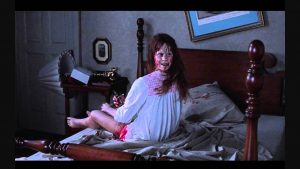
A common trope in the genre of horror is that the monster or the object of possession and perversion is often female. For example, the 1973 post-modern horror film, The Exorcist, centers a prepubescent young girl being possessed by a demon. The audience witnesses her turn from innocent and loving, to tortured and pained, to evil and destructive. An additional and more recent example of an overcome female is in a recent horror podcast series The Bright Sessions. This fictional series consists of episodes that are a therapist’s secret recordings of her “strange and unusual” patient sessions. The patient of the first episode is a 25-year-old woman who gradually reveals during her first session that she can time travel. These two works both portray a girl or woman as a crazed and these characters embody a cultural imaginary of people no longer being bound by what is normal or human. It is through comparing these two works that I argue that The Exorcist and episode one of The Bright Sessions tap into a deeper cultural anxiety—that if an individual were granted with capabilities that exceeded human limits, then he or she would live a life of pain, destruction, and loneliness.
A frame of possessed Regan in The Exorcist. Source: Blum House.
The Exorcist
The film The Exorcist was an extremely popular horror film during its time. It led to major box office success followed by multiple imitation films throughout the decades (The Devil Within Her, Abby, Cathy’s Curse, Lisa and The Devil, To the Devil—A Daughter, Audrey Rose, and The Sexorcist). Creed graphically summarizes in her psychoanalysis of The Exorcist the horrid actions of the main character. “Regan, the young female protagonist… is a truly monstrous figure. She spews green bile, utters foul obscenities, tries to fuck her mother, causes inanimate objects to fly, rotates her head full circle on her neck, knocks men to the floor with one punch, tries to castrate a priest, murders two men, and in her spare time masturbates with a crucifix” (Creed 31). One common trope in horror films and a central one to this plot is the perversion of what is good an innocent. The film initially introduces the audience to a prepubescent “pure” girl who has a loving relationship with her mother. However, as the demonic possession progresses both Regan’s purity and warm maternal relationship dilapidate. She begins to levitate, make furniture fly across the room, and her skin corrodes and mutates to look undead. Possessed Regan looks and has obtained abilities that are beyond human. To extend what Creed argues, the possession not only contorts Regan to be socially improper, sexually impure, and unstoppably violent, but this perversion also excuses her actions and is “perversely appealing” (31). Particularly within post-modern thought, society questions and blurs the lines of authority, religion, and truth. When Regan becomes possessed, she simultaneously challenges religion, parental control, and sexual repression. The obeying of authority and the policing of sexuality are two major social norms on which the demon pushes back. In this vein, the film serves as an outlet through which the audience can liberated from societal repressions. It is important to note, however, that this liberation comes at the cost of the well-being Regan and she harms those that love and want to help her along the way.
Thumbnail of The Bright Sessions podcast. Source: SoundCloud.
The Bright Sessions
The Bright Sessions, is a relatively new podcast (episode 1 was released in 2015) which has received popularity and high acclaim within the horror podcast genre. To summarize the premise of the series, the therapist Dr. Bright has placed an ad in the paper offering “therapy for the strange and unusual.” Dr. Bright secretly records her sessions for research and each episode in the series is the recording of one patient’s session. As a disclaimer, I will be analyzing and comparing The Exorcist to only the first episode of this podcast series for this is a scope I can appropriately and responsibly cover. Episode 1 walks its listeners through the first session of a patient named Samantha Barnes (or Sam). Sam came to see Dr. Bright after seeing the ad in the paper and Sam discloses that she came with the understanding that she sees herself as “strange and unusual.” Throughout the episode, the listener learns that Sam can time travel. The unexpected part of the session is not her superhuman ability though. The surprise is that she does not reveal her secret with fascination or wonder, but more accurately, Sam—similar to how one would confess to a Catholic priest—confesses her time-traveling ability to Dr. Bright with guilt and pain. Sam up until this point has pent up her frustration and paranoia of her secret ability over which she has no control. The mere act of time traveling is out of Sam’s control and it brings her much bodily pain. Throughout Sam’s session she vents about how time traveling “sucks” and how she was “scared” when it first happened to her. She describes her experience time traveling in the following lines:
Sam: They can never see me, I’m just there. It’s like being stuck inside someone’s memory or something. I can move around but I can’t talk. I’m basically a ghost. Or a reverse ghost. Not dead or visible. Or not even born yet, I guess. Ugh, I don’t know.
Dr. Bright: That… that must be difficult.
Sam: It’s horrible.
In Sam’s line “it’s horrible,” listeners can hear the pain in Sam’s voice. This moment in the podcasts merits more analysis into the podcast as a medium and how it effectively contributes to the empathy listeners feel. Understanding podcasts as a medium is particularly important to understanding how listeners feel Sam’s pain. Merely looking at these few transcribed lines and reading Sam’s pain and frustration on a page is one thing, but podcasts offer more intimacy and relatability than other digital media. Podcasts are absorbed only through hearing. Various scholars analyze the intimacy of radio and podcasts: Crisell notes that much like radio channels, podcasts are a “blind medium” through which listeners “cannot see its messages, they consist only of noise and silence” and they must imagine the scenery in their own minds (15); “voice is an intimate key to audiences’ hearts…” and “podcasts with headphones further emphasizes the individual’s experience of listening to a conversation with a friend” (Lindgren 27). Throughout this episode, listeners do not just passively listen to Sam’s story, but in a way, listeners recreate it in their imaginations and empathize with it. Sam’s deep exhale after confessing her strange and unusual ability, or the tightness in her throat when she talks about her bodily pain, or the acceleration in her speech as she laments her loneliness and frustrations—all of these extra-textual components cue listeners to internalize and feel Sam’s resentment and despair instead of merely read it on a page or see it on a television screen. Though Sam has a super capability that, in most fictional worlds, would seem “cool” and heroic, listeners realize that Sam’s reality could not be more opposite. Sam has been living in hiding with no family or friends and her secret is more of a curse than it is a blessing. The ability has brought Sam physical pain, emotional turmoil, and deprived human connections.
The Bigger Picture
Now what do these two works, published on completely different digital mediums, have to do with each other? As I have laid out, there are many thematic similarities between the two: the possession of a young girl/woman, the confessing and seeking of help from a higher authority (whether that be a pastor or a professional therapist), and uncontrollable extraterrestrial capabilities being assaulted onto a human being. However, these texts relate in a way that is a microcosm of a deeper cultural anxiety. Humankind evolves and adapts to survive and progress in a world where its existence—no matter the advancement of technology—will ultimately come to an end. Regan’s being possessed by a demon and Sam’s having the uncontrollable ability to time travel tap into the human fantasy of obtaining unimaginable and unlimited abilities. The heartbreak of these two works lie in man’s wish to be infinite. Regan and Sam embody the tragic, and arguably more realistic, repercussions of coming across a remedy to finite and insignificant existence. These two character show its audiences that obtaining these abilities would hurt them and hurt their loved ones rather than offer an abundant and beautiful life. Ultimately both Regan and Sam lead a life of heartbreak and loneliness.
In The Exorcist, Regan originally symbolizes innocence, love, and youth and then becomes the very opposite of what the audience treasures: destructive, perverse, and squeamishly abject. The Bright Sessions observes a girl who experiences immense pain from a supernatural ability for which she never asked. These two works speak to the collective horror story of what it could potentially be like for man to obtain a remedy to the universal fear of death and insignificance. Instead of superhuman power offering a life of catharsis and relief, it would only bring about pain, loneliness, and destruction.
Works Cited
Creed, Barbara. The monstrous-feminine: Film, feminism, psychoanalysis. Psychology Press, 1993.
In the portion of assigned reading from Jonathan Sterne’s The Audible Past, I was particularly fascinated by his analysis of the process of embalming and its influence on sound recording. Just as embalming alters the corpse to prevent physical decay that would render the body unpresentable for viewing, the process of sound recording protects present and future auditors from experiencing the decay of the voice. The phonograph altered recorded voices in ways that transformed the internal consciousness behind the speaker’s words to perform external and cultural functions. Similarly, various alterations and the removal of internal organs from the dead body during the embalming process was performed for solely external purposes. In his book Hearing History, Mark Michael Smith writes,“While competing methods were concerned with interiority, with preserving the body in its original form, chemical embalming was concerned only with exteriority, with the appearance of the body and its potential to perform its social function” (Smith 301). He also emphasizes the idea that the recording studio is analogous to the embalming process, since the voice is transformed in ways that beautify it, just as the body of a corpse is enhanced to make it appealing to the eye.
The connections between sound recording and the embalming process pose specific threats to the culture society that has established in terms of the nature of preservation. This led me to think about my favorite song, “Here, There and Everywhere” by the Beatles, and my favorite book, “Jane Eyre” by Charlotte Brontë. John Lennon of the Beatles certainly did not live long enough to witness the longevity of this beautiful love song and Charlotte Brontë was not able to see how, through the power of her pen, she revolutionized contemporary literature. Yet both of these magnificent works live on in their author’s absence. As a matter of fact, many of the most famous works of music and literature today gained their high level of regard after the death of the artist or writer. After thinking about this in more detail, I began to question: how much of the embalming process has infiltrated into the media we encounter today? I believe that the answer to this question is A LOT.
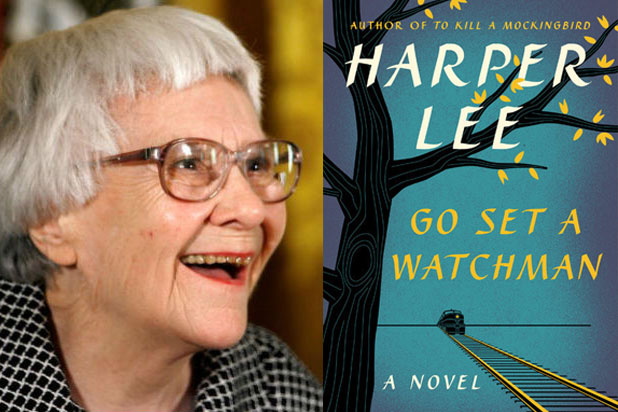
To illustrate this point, I’d like to examine the controversy associated with the publication of Harper Lee’s Go Set a Watchman, which occurred during the summer of 2015. After writing and publishing her beloved novel, To Kill a Mockingbird, in 1960, Lee insisted that she would never again publish another book. After Lee’s sister passed away, her new legal guardian, Tonja Carter, claimed she “discovered” a manuscript to what later became the published book, Go Set a Watchman, and brought it to the attention of various publishing companies. It was very clear that Lee never intended to publish this novel and had marginal input in the book that would bear her name. In one of her last public interviews that was conducted in 1964, Lee said, “I think the thing that I most deplore about American writing … is a lack of craftsmanship. It comes right down to this — the lack of absolute love for language, the lack of sitting down and working a good idea into a gem of an idea.” Instead of taking these words to heart, the publishing company completely ignored the legacy Lee wished to leave on the public and went ahead and published the novel. If Lee really wanted this piece of literature to have been published she would have advocated for it during her earlier years. Although the book sold rapidly once it was released, I decided to not purchase it as a protest to preserve my adoration and respect for Harper Lee’s voice, which had been so blatantly disregarded.
Harper Lee and her book, Go Set a Watchman. Find source here.
This issue relates to the process of embalming because Lee’s interior motives were warped and transformed into the publication of something that she never intended for the external world to see. The book became far less about what it contained on the inside and far more about its external implications regarding the prestige of being Lee’s second book. In this case, in an effort to protect certain pieces of Lee’s work from “decaying,” the publishing companies took advantage of her and published something that should have never been released. This connects to what Jonathan Sterne mentioned about “a disregard for the preservation of the voice in its original form” and how we alter the voice in forms that “perform a social function” (Sterne 297). If we step back and take a look at the media we are presented with, it is important to question if the content aligns with the initial intention behind it or if it was obstructed for a social or cultural purpose. As a result, I foresee changes in how we define “preservation,” especially within our rapidly evolving digital climate.
Works Cited:
Smith, Mark Michael. Hearing History: A Reader. United States of America: University of Georgia Press, 2004. Print.
Sterne, Jonathan. The Audible Past: Cultural Origins of Sound Reproduction. “The Resonant Tomb.” United States of America: Duke University Press, 2003. Pages 287- 311. Print.
(Don’t mind my Facebook profile picture – I linked my accounts)
Works Cited:
Biancorosso, Giorgio. “The Shark in the Music.” Music Analysis 29.1-3 (2010): 306-33. Web.
Galloway, Alexander R. “Origins of the First-Person Shooter.” Gaming: Essays on Algorithmic Culture. Minneapolis, MN: U of Minnesota Press, 2006. 39-69. Print.
Kirkland, Ewan. “Resident Evil’s Typewriter Survival Horror and Its Remediations.” Games and Culture 4.2 (2008): 115-26. Web.
Myrick, Daniel, et al. The Blair Witch Project. Special edition. ; fullscreen version. Santa Monica, CA: ArtiEntertainment, 1999.
Slender: The Eight Pages. v 0.9.7. Parsec Productions. 2017. Video Game.
Horror movies elicit certain types of moods, feelings, and reactions. Most often they deal with fear, insecurity, or the urge to bury your face into a pillow in order to avoid the gore that will inevitably ensue. While these are reactions are standard in horror, the method in which they are achieved differ greatly. Slenderman: Winter Edition ,the videogame, allows the player to navigate through a dark atmosphere in order to escape death. Hush, the movie, deals with a deaf woman having to fend for her life from a mysterious serial killer. Both of these media forms create horror in their respective ways, but once we analyze them together we see that sight is the most efficient manner of sending this message through media.
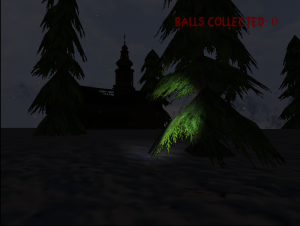
The version of Slenderman that we are looking at places us in the middle of what seems to be a deserted farm. Initially you see shapes in the distance that resembles houses and an abandoned car in front of you. As you progress through the open field laid before you the surroundings areas become more clear as you near them, but the areas that you are leaving become cloudy. It soon becomes apparent that there is no clear sense of visual clarity in this snow filled map. The player gets lost in a myriad of trees on the outskirts of the map, while the buildings that can be entered have no internal lighting.
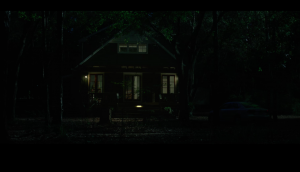
The first sight you are met with in the Slenderman game.
There were often times where I would find myself entering a new area only to find out that I had already previously been there. The sense of being lost and alone is major reason that the game elicits fear. Where do you go? Where do you turn to when you have no idea where you are? Who can help you? Eventually, after picking up an item, you begin being chased by the no faced monster called Slenderman. Not only can we not see our surroundings clearly, but we are quickly being chased after. The visual distortion that the player is subjected to is one half of what contributes to the horror in the game. The second half is the sound.
The soundtrack to Slenderman is rather eerie and ominous. At first, it seems like the game opts for a white music background. This quickly changes into the sound of a car motor running at a slow pace and then again pots and pans clanging together. The tempo of the music speeds up when the Slenderman is nearby, ultimately resulting in a strange fast beating noise. The combination of the dark atmosphere and the eerie sounds elicits the feelings of nervousness that we have previously discussed.
In Hush we are placed again into a forest of some sort, experiencing the world through a third person perspective. Maddie, the main character, is a deaf writer who happens to fall victim to a serial killer. At the beginning of the movie we see a seemingly happy sunny day in the woods. The atmosphere slowly develops into a darker, more somber mood, and it remains so until the film’s finale. From the beginning we can see that technology plays an important part in this movie, as iPhones, Macbooks, and Facetime are all clearly shown on the page. The main character does not notice that a masked serial killer has entered her house because she is deaf, but technology alerts her to this fact. The serial killer takes Maddie’s phone and sends her pictures of herself typing. This is the first sign of technology leading to the conflict at hand.
The clear view of the day before the storm in Hush.
The setting for the remainder of the movie.
As the story develops we see the lack of technology as a handicap for Maddie, who is desperately trying to survive. The serial killer has taken her phone, turned off her electricity which disables her Wi-Fi, and slashed the wheels on her car. Once again we are met with the feeling of being lost, but this time it is different. The main character is not being chased. She is trapped with nowhere to go. The serial killer at one point says “I can come in at any time I want. And I can get you at any time I want. But I’m not going to. Not until its time. When you wish you were dead, that’s when ill come inside.” A majority of the horror that occurs are related to the mind games that Maddie is forced to go through. She tries to escape the house multiple times only to get scared back in by the killer. The rest of the movie relies on quick camera changes, dramatic music, and Maddie’s mental deterioration for its fear inducing effects.
The first difference that comes to mind is the lack of technology in Slenderman: Winter Edition and the presence of it in Hush. In Slenderman the player can walk around with a flashlight and nothing else. In Hush the technology is in the hands of the killer, yet the main character has no access to it. I find it interesting that both of these media forms were able to utilize the lack of/access to technology in a fear-developing way. A flashlight may not be new age technology, but it is the only technology present in the Slenderman game.
The flashlight is the only technology you have in the game.
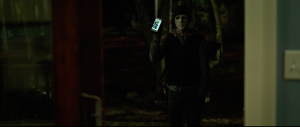
One of the many technology items found in the movie. This is the catalyst for the remainder of the film.
A further difference point, while speaking on the differences between the character the villain, is the presence of bloody female flesh in Hush and the lack of it in Slenderman. Barbara Creed in The Monstrous Feminine describes the female body as being exposed as “flesh” in different manners including blood (Creed 38). Maddie is repeatedly harmed and made to bleed, yet we see none of this in the videogame. We are not aware of the character’s gender and we see no carnage. We can also look towards Barry Keith Grant’s The Dread of Difference: Gender and the Horror Film in which he discusses the continual gender divide seen in movies of said genre. He specifically states “probably the most common image in horror movies, whatever the subgenre…is what Harvey Roy Greenberg, writing on King Kong(1993) calls the beast in the boudoir. Most often in such scenes, the monster is coded as male, the victim, female” (Grant 5). We again see this distinction made in Hush where the female victim, Maddie, is being attacked by the male monster, the serial killer. Slenderman has no such distinction.
The bloody female trope commonly found in Horror movies on display in Hush.
I believe that the control that one has in these horror adventures is the most underappreciated aspect in media, and my comparison of Slenderman and Hush confirmed it. In the game we are free to roam around and explore the area until reaching the outer limits. In a movie we do not have that accessibility. We are stuck in the progression of time and place that the director has laid out for us. We have no voice. This lack of control ultimately leads to a deeper and more intense horror experience. We, as the viewer, would like guide the main character to safety but are stuck waiting on what happens next. I had not realized that a sense of control heightened the fear factor of horror media until I experienced both Slenderman and Hush. Incidentally I watched the movie right after playing the game and found myself wanting to use an imaginary control to help Maddie escape the serial killer.
The most important takeaway from the comparison of these two works of horror is not evident until one has thought in depth about the experiences of those being portrayed. I put myself into the shoes of the someone who was playing Slenderman, and the character inside the game. I watched the movie from the usual bystander perspective, and then attempted to put myself into Maddie’s shoes. These experiences ultimately revealed to me that sight is the most influential and efficient form of creating fear in the postmodern horror genre. These observations originally stemmed from Maddie’s deafness and her reactions to the serial killer. If one watches the movie with the volume and subtitles off, as I did, the horror effects are still present without sound. If one closes their eyes and merely listens to the movie, the fear experienced is not as intense. Playing through the videogame with a blindfold on still elicited fear due to the eerie noises, but not as much as playing it with no sounds.
The above video game is called Sightless. This is more or less the experience that one gets when playing Slenderman with a blindfold.
The Netflix link to Hush can be found here. For the same viewing experience turn the subtitles off and the volume down.
This observation is important for two reasons. The first being that our society is one that has tried to accommodate people of all disabilities and handicapped status. We must ask ourselves, is there any way to make the future postmodern horror more inclusive to those that cannot see? Our technology is rapidly advancing and this might soon become a reality. The second reason deals with the future of the genre as a whole. If sight/perspective is the influential factor influencing fear in the horror works, why not focus on refining this technique? I believe that this could lead to a post postmodern horror that incorporates visual stimuli to new heights and pushes the boundary of the saying “a picture is worth a thousand words.”
This new era would continue challenging Walter Benjamin’s beliefs as the current postmodern horror is doing. In his book Illuminations, Benjamin states “experience which is passed on from mouth to mouth is the source from which all storytellers have drawn” (Benjamin 84). This is no longer the case. In our current society experience is more commonly that which we see and not that which we share by word of mouth. There is a reason why movies are consistently being displayed in three dimensional form, and why virtual reality headsets are in high demand. The experience is dictated by sight, and sight the future of storytelling. If this aspect was not as important then new High Definition televisions would not be so heavily marketed, and the old standard TVs would still be in circulation. I would encourage those that disagree to try the experience that was described when comparing Slenderman and Hush.
Overall, Hush and Slenderman were both able to create fear in their own respective ways. Whether it was the presence of the bloody female trope or eerie noises that were indiscernible, both media forms fit the postmodern horror genre. When compared, we see the role the visual stimulation plays in fear, and how its simple removal drastically affects the media’s impact on the viewer/player. This comparison also highlights the role that viewer/player control has on the mood created by the media. These observations would not have been achieved had the two differing media forms not been compared. Those who wish to dabble in this genre in the future would be wise to focus on these two aspects.
Sources:
Benjamin, Walter. Illuminations. Place of Publication Not Identified: Bodley Head, 2015. Print.
Cohen, Jeffrey Jerome. “Monster Culture (Seven Theses).” Monster Theory : Reading Culture. Minneapolis: University of Minnesota Press, 1996. Web.
Iles, Timothy. The Crisis of Identity in Contemporary Japanese Film : Personal, Cultural, National. Leiden: Brill, 2008. Web. Brill’s Japanese studies library, v. 30; Brill’s Japanese studies library, v. 30.
Pinedo, Isabel. “Recreational Terror: Postmodern Elements of the Contemporary Horror Film.” Journal of Film and Video 48.1/2 (1996): 17-31. Print.
Skloot, Rebecca. The Immortal Life of Henrietta Lacks. New York: Crown, 2010. Print.
Wada-Marciano, Mitsuyo. Japanese Cinema in the Digital Age. N.p.: U of Hawaii, 2012. Project Muse. Web.
I would like to examine two postmodern horror narratives that engage with young women struggling with mental illness—specifically, schizophrenia—and how their status as both female and schizophrenic is depicted through their respective narratives. Furthermore, I want to consider how their digital agency—and how that digital agency is figured—compounds and contradicts the narrative’s status as a horror narrative. That is to say, what are these horror narratives saying about preteen girls with schizophrenia? How does digital media facilitate violence in the narrative? The two horror narratives I will look at are HBO’s documentary Beware the Slenderman, and Paul Tremblay’s novel A Head Full of Ghosts.
HBO’s trailer for Beware the Slenderman.
Beware the Slenderman
In June of 2014, two twelve-year-old girls stabbed their classmate and friend 19 times, leaving her for dead in the woods. The victim, named Payton (but confusingly nicknamed Bella by her friends), survives after being discovered by a cyclist. Regardless, Morgan and Anissa, the two girls who stabbed her, were charged as adults with attempted homicide.[1] Their motivation for the stabbing? A popular internet-generated horror meme called Slenderman. Earlier this year, HBO released a documentary about this story, called Beware the Slenderman.
Andrew Peck, a folklore scholar who is the go-to expert on Slenderman, had already published his studies on Slenderman, sometimes stylized as Slender Man, by the time of the murders. According to Peck, Slenderman is “A faceless, tall, eerily long-limbed humanoid clad in a black suit [that] emerged in an online forum as a pair of photoshops and a half-dozen lines of text.”[2] It originated on June 8, 2009 when SomethingAwful.com forum member “Gerogerigegege” created a discussion thread called “create Paranormal images,” inviting other users to create and share mundane images that had been manipulated to appear paranormal. Users began writing stories to accompany these images and suggested that the images were real by linking them to personal experience.[3] According to Peck, “Locating authenticity in ‘reality’ reflects one of the earliest shared expectations that emerged around Slender Man legend performances.”[4] In other words, the best Slenderman narratives were those that took place in our world, but held on to the sense of ill-intentioned mystery.
A digital version of a presentation Andrew Peck gave on Tall, Dark, and Loathsome.
According to legend scholar Bill Ellis, “Legend performances typically place events in the group’s [the “Something Awful” forum where Slenderman was conceived] conception of the real world while also challenging the boundaries of that world.”[5] When it comes to the case of Morgan Geyser, these boundaries were challenged to begin with: Morgan was beginning to show the signs of schizophrenia at the time of the murders. None of the subsequent news coverage, nor the first hour and twenty minutes of HBO’s documentary on the matter, bridge the topic of Morgan’s mental illness. The narrative structure of Beware the Slenderman is problematic because our discovery of Morgan’s schizophrenia operates as the narrative sucker-punch, co-opted into the twist at the end of the documentary as opposed to a sustainable explanation for her behavior throughout the film. Indeed, in one courtroom clip, the psychiatrist on the stand explains that “Believing that Slenderman is real is a delusion [symptomatic of childhood schizophrenia.]” He goes on to say, “What’s unique about Morgan’s case is that a severe course is so predictable.”[6] Morgan’s father also has a severe kind of schizophrenia, and even still her parents had neglected to keep an eye out for problematic behavior, or even to inform Morgan that her father also had schizophrenia. This information was unloaded upon Morgan at the hospital after the stabbing.[7] The majority of the narrative, however, would have you believe there is no such scientific explanation for Morgan’s actions.
The draw of Beware the Slenderman has its basis in Creed’s theory that “Possession becomes the excuse for legitimizing a display of aberrant feminine behavior which is depicted as depraved, monstrous, abject—and perversely appealing.”[8] Though Anissa and Morgan were not “possessed,” as it were, they were motivated by a demonic, mysterious figure all the same—or so the narrative of Beware the Slenderman would have you believe, seeing as the narrative of mental illness is largely absent. Creed writes that “Central to [possession films] was a strong sense of the vulnerability of the body and its susceptibility to possession.”[9] HBO’s official description of the documentary plays into this idea of vulnerability:
It was a local story that horrified the nation: two 12-year-old girls lured a friend into the Waukesha woods, where they proceeded to stab her 19 times in an effort to appease a faceless mythical entity known online as ‘Slenderman.’ This sobering documentary delves deep into the story and examines how an Internet urban myth could take root in impressionable young minds.[10]
Their “impressionable young minds,” (female minds) are the nexus of this vulnerability, the place where the seed of Slenderman could grow until it became too much to bear. These 12-year-old girls in the suburban Midwest commit unthinkable evil, inspired by digitally mediated horror narratives, and represent the intersection of “the major boundaries […] between innocence and corruption, purity and impurity.”[11] Ostensibly, this evil is a product of the internet.
Throughout the documentary, the internet and its digital mediations, specifically iPads, are demonized, especially by Anissa’s father. Morgan is depicted as the mastermind, and Anissa the friendless sidekick, willing to do anything. Indeed, much of the film is spent describing Anissa’s lonely, outcast status and how relieved her parents were when she found Morgan as a friend. He blames the iPad for his daughter’s “corruption,” as it were. Anissa’s independence in the digital world facilitates her penchant for violence—Anissa’s disturbing YouTube history is revealed in Beware the Slenderman, and the montage is among the most harrowing moments of the film.[12] As Peck explains it:
Of all the details of this gruesome story, the involvement of the Slender man resonated most in subsequent news coverage. The relative obscurity of the character and its de-contextualized association with the stabbing served to kindle a classic moral panic narrative. Headlines and sound bites focused on the dangers of unsupervised tween media use and the corrupting allure of the dark corners of the internet.[13]
A former FBI investigator, who happens to be female, described the case of the Slenderman stabbings as “very unusual — not just because is involves young females, but the brutality of it.”[14] Think of Creed and the monstrous woman—indeed, girl—and how “Horror emerges from the fact that woman has broken with her proper feminine roll—she has ‘made a spectacle of herself.’”[15]
To what extent can the internet be blamed for Morgan and Anissa’s actions? A recent study conducted by John A. Oyewole found that “at an average of 53.0% for males, and 53.3% for females across all ages, at least half of audiences who get exposed to violent media contents will develop a tendency to imitate such media contents.”[16] In fact, Oyewole mentions the Slenderman stabbing by name as an example of this statistic.[17] This statistic fits into the documentary’s message, which I believe prioritizes the demonization of the internet over a narrative of mental illness awareness.
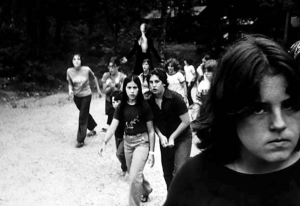
From the original “Something Awful” forum. “‘We didn’t want to go, we didn’t want to kill them, but its persistent silence and outstretched arms horri ed and comforted us at the same time . . .’ 1983, photographer unknown, presumed dead.” Posted by Victor Surge, June 10, 2009.
A Head Full of Ghosts
Paul Tremblay’s A Head Full of Ghosts approaches the issue of schizophrenia in a less opaque way than it is presented to us in Beware the Slenderman. Indeed, the back jacket of the book intones, “The lives of the Barretts, a normal suburban New England family, are torn apart when fourteen-year-old Marjorie begins to display signs of acute schizophrenia. To her parents’ despair, the doctors are unable to stop Marjorie’s bizarre outbursts and subsequent descent into madness.”[18] Marjorie’s “descent into madness,” then, is at the forefront of Tremblay’s presentation of the narrative. The ambiguity of Marjorie’s schizophrenia relies on its “off-screen” (literally) nature—the drama having to do with her diagnosis and institutionalization does not take place in the house, nor does it operate as a plot factor in the reality TV show being filmed.
There are many moments when technology both mediates and facilitates the performance of Marjorie’s possession, which she claims is for the benefit of her father, who is really the sick one.[19] If you read the novel with the assumption that Marjorie is not actually possessed (which is certainly a possibility), Marjorie’s digital agency is crucial to her performance of possession: she gleans the knowledge she needs to fool the clergymen and viewers of the TV show from the internet. During the exorcism, the following exchange takes place:
Marjorie: I’m looking shit up on the Internet, looking up the same stuff over and over, and I memorize it because I’m wicked smart, because I have to fill my head with something other than the ghosts.
Father Wanderly: I suggest that you no longer allow her access to the laptop until after the rite has been performed successfully.[20]
This exchange demonstrates two things: one, that Wanderly’s belief in her demonic possession is too deep to accept this rational answer to her struggle with the “ghosts” (her schizophrenic delusions, perhaps); and his unwillingness to acknowledge Marjorie—the “you” here is her parents. Afterwards, when the adults are discussing Marjorie’s knowledge, one of the producers defends the internet standpoint: “She could’ve made the connection on her own. Or maybe she Googled my T-shirt, found Lovecraft and Yidhara on Wikipedia. Not a huge leap, there, I don’t think—“[21] Merry, writing as her blog persona, compounds the idea that the internet is the logical source of her knowledge, explaining that “John Barrett duly informs us that Marjorie claims she never heard of the Internet or the library [sic] doesn’t know where she heard the stories or the song […] but swears she hadn’t learned of them or heard them from outside sources.”[22] Her sarcastic strikethrough reads clearly: digital agency in the form of internet access facilitates Marjorie’s convincing performance of possession, as the adults around her refuse to believe she could pull such a thing off—consider this frenzied exchange after her performance:
“—even if she had looked it up on the computer—“
“—no way she could’ve memorized it all—“
“—a girl like her can’t speak as eloquently as she did—“
“—a girl wouldn’t ask the questions she asked—“[23]
Merry’s persona explains this phenomena well: “…Marjorie’s knowledge of the rite is again [sic] presented to us as proof positive of her possession. This is one of the most misogynistic aspects of the show: not only is it impossible for a silly girl [sic] to know what the patriarchy knows[…]we’re supposed to actively fear that she has acquired that knowledge.”[24]
Paul Tremblay is aware of the figuration of mental illness is his novel. Goodreads user Shiv Eloise asked of Treblay, “Where you at all considering what harm you might cause by linking schizophrenia and possession?” Tremblay responded curtly:
Harm? No. If anything, I wanted some readers to realize that religious figures have used and conflated the symptoms of various mental illnesses as (bogus) signs of possession for hundreds of years. On the other side of it, I certainly wasn’t intending to vilify people who suffer from schizophrenia. That’s not in the book either.[25]
The thread discussion continues regarding the debate between the merits of each side: religious “fanatics” mis-assigning possession to mental illness, and the potentially negative figuration of schizophrenia as the product of the devil’s spirit. Tremblay’s dismissive line, “That’s not in the book either,” makes me wonder to what extent Tremblay had considered the reception of his book—and if, as an author, he should even be asked to consider that. Regardless, the link between schizophrenia and possession in the book is obviously very strong—it drives its entire sense of ambiguous malaise. Furthermore, Marjorie’s digital agency mitigates her isolation even as it also operates as a mechanism for her to convince the adults she is really possessed: “Marjorie kept texting, fingers crawling over the phone’s keyboard screen while she talked at the same time.”[26] Marjorie navigates her schizophrenia by manipulating digital media to her advantage; it enables her to trick the bumbling adults around her that she is truly possessed.
Synthesis
We can pinpoint digital agency as the catalyst in each of these schizophrenia horror narratives. In Beware the Slenderman, Anissa and Morgan are motivated by the internet-made Slenderman, whose ambiguous digital presence is a perfect storm when combined with Morgan’s childhood schizophrenia. Indeed, Anissa’s father would rather blame technology than his daughter’s own troubles, and Morgan’s parents did not pay enough attention to their daughter’s slow disappearance into a virtual obsession with Slenderman. In A Head Full of Ghosts, internet access enables Marjorie to perform her possession in the face of her schizophrenia. On the structural level of each of these narratives, schizophrenia is figured problematically. Beware the Slenderman saves the reveal of Morgan’s mental illness for the end of the film, problematically placing her condition and her parents’ treatment of it as a plot twist. When it comes A Head Full of Ghosts, the author is ultimately unconcerned with thoroughly explaining the link he provides between mental illness and possession. We should think further about how the representation of schizophrenia, especially in young women, motivates and operates postmodern horror narratives, and what both the construction and reception of these narratives says about mental illness in the digital age.
[15] Creed, “Woman as Possessed Monster: The Exorcist,” 42.
[16] John Ayodele Oyewole, “Gory Attractions in the Threshold of the Contemporary Media: The Level of Influence on Young People,” in International Journal of Arts & Sciences 9.3 (2016): 334.
[17] Oyewole “Gory Attractions in the Threshold of the Contemporary Media: The Level of Influence on Young People,” 334.
[18] Paul Tremblay, A Head Full of Ghosts (New York: HarperCollins, 2013).