
Horror movies elicit certain types of moods, feelings, and reactions. Most often they deal with fear, insecurity, or the urge to bury your face into a pillow in order to avoid the gore that will inevitably ensue. While these are reactions are standard in horror, the method in which they are achieved differ greatly. Slenderman: Winter Edition ,the videogame, allows the player to navigate through a dark atmosphere in order to escape death. Hush, the movie, deals with a deaf woman having to fend for her life from a mysterious serial killer. Both of these media forms create horror in their respective ways, but once we analyze them together we see that sight is the most efficient manner of sending this message through media.
The version of Slenderman that we are looking at places us in the middle of what seems to be a deserted farm. Initially you see shapes in the distance that resembles houses and an abandoned car in front of you. As you progress through the open field laid before you the surroundings areas become more clear as you near them, but the areas that you are leaving become cloudy. It soon becomes apparent that there is no clear sense of visual clarity in this snow filled map. The player gets lost in a myriad of trees on the outskirts of the map, while the buildings that can be entered have no internal lighting.

There were often times where I would find myself entering a new area only to find out that I had already previously been there. The sense of being lost and alone is major reason that the game elicits fear. Where do you go? Where do you turn to when you have no idea where you are? Who can help you? Eventually, after picking up an item, you begin being chased by the no faced monster called Slenderman. Not only can we not see our surroundings clearly, but we are quickly being chased after. The visual distortion that the player is subjected to is one half of what contributes to the horror in the game. The second half is the sound.
The soundtrack to Slenderman is rather eerie and ominous. At first, it seems like the game opts for a white music background. This quickly changes into the sound of a car motor running at a slow pace and then again pots and pans clanging together. The tempo of the music speeds up when the Slenderman is nearby, ultimately resulting in a strange fast beating noise. The combination of the dark atmosphere and the eerie sounds elicits the feelings of nervousness that we have previously discussed.
In Hush we are placed again into a forest of some sort, experiencing the world through a third person perspective. Maddie, the main character, is a deaf writer who happens to fall victim to a serial killer. At the beginning of the movie we see a seemingly happy sunny day in the woods. The atmosphere slowly develops into a darker, more somber mood, and it remains so until the film’s finale. From the beginning we can see that technology plays an important part in this movie, as iPhones, Macbooks, and Facetime are all clearly shown on the page. The main character does not notice that a masked serial killer has entered her house because she is deaf, but technology alerts her to this fact. The serial killer takes Maddie’s phone and sends her pictures of herself typing. This is the first sign of technology leading to the conflict at hand.
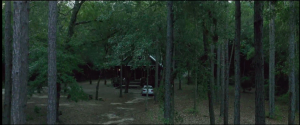
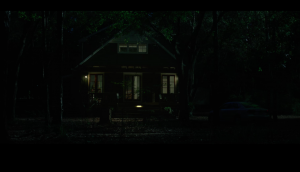
As the story develops we see the lack of technology as a handicap for Maddie, who is desperately trying to survive. The serial killer has taken her phone, turned off her electricity which disables her Wi-Fi, and slashed the wheels on her car. Once again we are met with the feeling of being lost, but this time it is different. The main character is not being chased. She is trapped with nowhere to go. The serial killer at one point says “I can come in at any time I want. And I can get you at any time I want. But I’m not going to. Not until its time. When you wish you were dead, that’s when ill come inside.” A majority of the horror that occurs are related to the mind games that Maddie is forced to go through. She tries to escape the house multiple times only to get scared back in by the killer. The rest of the movie relies on quick camera changes, dramatic music, and Maddie’s mental deterioration for its fear inducing effects.
The first difference that comes to mind is the lack of technology in Slenderman: Winter Edition and the presence of it in Hush. In Slenderman the player can walk around with a flashlight and nothing else. In Hush the technology is in the hands of the killer, yet the main character has no access to it. I find it interesting that both of these media forms were able to utilize the lack of/access to technology in a fear-developing way. A flashlight may not be new age technology, but it is the only technology present in the Slenderman game.

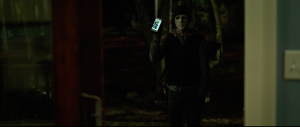
A further difference point, while speaking on the differences between the character the villain, is the presence of bloody female flesh in Hush and the lack of it in Slenderman. Barbara Creed in The Monstrous Feminine describes the female body as being exposed as “flesh” in different manners including blood (Creed 38). Maddie is repeatedly harmed and made to bleed, yet we see none of this in the videogame. We are not aware of the character’s gender and we see no carnage. We can also look towards Barry Keith Grant’s The Dread of Difference: Gender and the Horror Film in which he discusses the continual gender divide seen in movies of said genre. He specifically states “probably the most common image in horror movies, whatever the subgenre…is what Harvey Roy Greenberg, writing on King Kong(1993) calls the beast in the boudoir. Most often in such scenes, the monster is coded as male, the victim, female” (Grant 5). We again see this distinction made in Hush where the female victim, Maddie, is being attacked by the male monster, the serial killer. Slenderman has no such distinction.

I believe that the control that one has in these horror adventures is the most underappreciated aspect in media, and my comparison of Slenderman and Hush confirmed it. In the game we are free to roam around and explore the area until reaching the outer limits. In a movie we do not have that accessibility. We are stuck in the progression of time and place that the director has laid out for us. We have no voice. This lack of control ultimately leads to a deeper and more intense horror experience. We, as the viewer, would like guide the main character to safety but are stuck waiting on what happens next. I had not realized that a sense of control heightened the fear factor of horror media until I experienced both Slenderman and Hush. Incidentally I watched the movie right after playing the game and found myself wanting to use an imaginary control to help Maddie escape the serial killer.
The most important takeaway from the comparison of these two works of horror is not evident until one has thought in depth about the experiences of those being portrayed. I put myself into the shoes of the someone who was playing Slenderman, and the character inside the game. I watched the movie from the usual bystander perspective, and then attempted to put myself into Maddie’s shoes. These experiences ultimately revealed to me that sight is the most influential and efficient form of creating fear in the postmodern horror genre. These observations originally stemmed from Maddie’s deafness and her reactions to the serial killer. If one watches the movie with the volume and subtitles off, as I did, the horror effects are still present without sound. If one closes their eyes and merely listens to the movie, the fear experienced is not as intense. Playing through the videogame with a blindfold on still elicited fear due to the eerie noises, but not as much as playing it with no sounds.
- The above video game is called Sightless. This is more or less the experience that one gets when playing Slenderman with a blindfold.
- The Netflix link to Hush can be found here. For the same viewing experience turn the subtitles off and the volume down.
This observation is important for two reasons. The first being that our society is one that has tried to accommodate people of all disabilities and handicapped status. We must ask ourselves, is there any way to make the future postmodern horror more inclusive to those that cannot see? Our technology is rapidly advancing and this might soon become a reality. The second reason deals with the future of the genre as a whole. If sight/perspective is the influential factor influencing fear in the horror works, why not focus on refining this technique? I believe that this could lead to a post postmodern horror that incorporates visual stimuli to new heights and pushes the boundary of the saying “a picture is worth a thousand words.”
This new era would continue challenging Walter Benjamin’s beliefs as the current postmodern horror is doing. In his book Illuminations, Benjamin states “experience which is passed on from mouth to mouth is the source from which all storytellers have drawn” (Benjamin 84). This is no longer the case. In our current society experience is more commonly that which we see and not that which we share by word of mouth. There is a reason why movies are consistently being displayed in three dimensional form, and why virtual reality headsets are in high demand. The experience is dictated by sight, and sight the future of storytelling. If this aspect was not as important then new High Definition televisions would not be so heavily marketed, and the old standard TVs would still be in circulation. I would encourage those that disagree to try the experience that was described when comparing Slenderman and Hush.
Overall, Hush and Slenderman were both able to create fear in their own respective ways. Whether it was the presence of the bloody female trope or eerie noises that were indiscernible, both media forms fit the postmodern horror genre. When compared, we see the role the visual stimulation plays in fear, and how its simple removal drastically affects the media’s impact on the viewer/player. This comparison also highlights the role that viewer/player control has on the mood created by the media. These observations would not have been achieved had the two differing media forms not been compared. Those who wish to dabble in this genre in the future would be wise to focus on these two aspects.
Sources:
Benjamin, Walter. Illuminations. Place of Publication Not Identified: Bodley Head, 2015. Print.
Creed, Barbara. The Monstrous-feminine: Film, Feminism, Psychoanalysis. London: Routledge, 2015. Print.
Grant, Keith B. The Dread of Difference: Gender and the Horror Film. Austin: U of Texas, 1996. Print.