My Best Friend’s Voice

His Master’s Voice

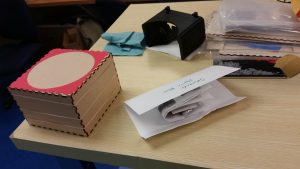
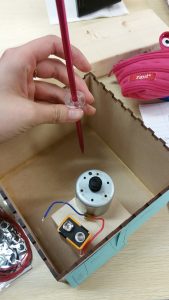
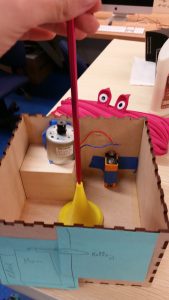
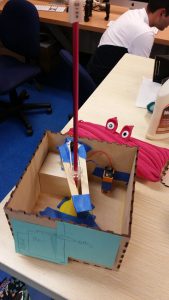
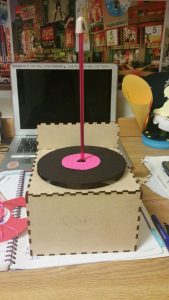
My project was inspired by James Francis Barraud’s His Master’s Voice. The design of my box is meant to mimic his painting. I accomplished this by creating a spinning record player, which is reminiscent of the gramophone in the painting. The twist is that instead of the pet listening to his master’s voice, the master can hear a sound that is associated to his or her pet. For example, this can be the sound of a dog barking, a cat meowing, or a hamster wheel spinning. As Jonathan Sterne points out in The Audible Past, “The sound of the voice, and not necessarily what’s being said, is what matters” (Sterne 303).  Likewise, the sound of the pet, whether it’s the actual voice of a pet or the sounds accompanied with the pet, is what triggers the nostalgic effect of the piece. Nostalgia is the most important factor of my product, because nostalgia can alleviate the grief one feels when losing a loved one. The nostalgia in the product will allow the owner to recreate a fond memory of his or her pet. Studies show that it is possible to help a person through the grieving process by encouraging him or her to reminisce (Tully). With this product, the owner can listen to and see a memory of his or her beloved pet at any time.

The most important factor of my project is the nostalgia factor. “It is not uncommon, especially after the death of a pet, for an owner to sense that he hears or sees his pet in familiar places,”(Tully). This contraption allows the owner to see and hear the pet in a familiar place; the home. This product provides the owner with a private way to grieve for his or her deceased pet. In order for the animation to work, one must manually turn on the contraption, turn off the overhead lights, and position a strobe light against the middle of the object. This setting makes the experience feel more intimate, private, and controlled.

The intention behind this contraption is to give a positive reminder of the vitality of life the pet once possessed, as well as allowing the owner to stay connected with the pet during the grieving process. I highly encourage those who purchase this product to send in a video of their beloved pet, because that video can be turned into a reel and become animated. Having an animated representation of a special moment with one’s beloved pet is endearing and allows the owner to reminisce in a positive way.

The idea of reminiscing a deceased loved one is a topic that we have thoroughly explored in class. We have seen it in the creation of Facebook memorials, on entire websites dedicated to deceased loved ones, and in the Victorian pictures of people with dead family members. Additionally, the commodification of grief has been a highly discussed topic in class. The commodification of grief can be seen in the perfumes made from loved ones, the option to turn the dead into compost, and even in our traditional funeral services. The price of a traditional funeral with flowers, a full service, embalmment, and a practical coffin can easily reach into the thousands. Overall these commodities are monetarily out of reach to middle and working class people. My project, on the other hand, is intended for people from all economic backgrounds. In fact, it’s pretty reasonably priced! It would only cost the buyer $10, which is reasonable considering how much time and effort goes into crafting each individual product. Buyers must complete this form when purchasing one of the boxes:

Please send in the following while purchasing “My Best Friend’s Voice”

  1. Please send in a video complete with sound depicting a special moment with your beloved pet. 
  2. Enjoy!

 As many animal lovers know, losing a pet is devastating. Sometimes, it’s just as difficult to lose a pet as it is to lose a family member. In fact, in North America some studies have found that between 85 and 99% percent of people, “define their dogs as being like a close friend of family member,” (Kogan 2). “While the length and intensity of the mourning period may differ, the grief process is essentially the same whether one mourns the loss of a person or a pet,” (Tully). The grieving process is not linear, and many people experience going back and forth between stages (Tully). Whether the death of the pet was sudden or anticipated, acknowledging the full reality of the loss may take weeks or months. One may come home still expecting his or her pet to run to the door. That person may reach down to stroke the pet only to find that the pet is no longer there. Getting used to the idea that one’s pet is gone takes time. It is normal to move back and forth between protesting and embracing the reality of the death (Wolfelt). My product will help a grieving person during this process, because that person can relive a happy memory when needed.

Let’s face it, we are mommies and daddies to our pets. We feed them, train them, and care for them. Parents are supposed to keep their children safe. We feel responsible for their well-being. It is natural to feel guilt and even a sense of failure when our pet dies, even if he was old. Animals’ life spans are so short in comparison to our own that in some way we feel short-changed. So, what emotion does Bobby feel most of all? “Lonely,” was her simple, poignant response. There’s that word again. Even with eleven other dogs, Bobby is lonely. No other dog or person can fill that spot in her heart where Bett belongs. This is true grief, (Heath).

The physical and audible presence of the pet can be extremely comforting for a grieving owner. Sadness, anger, guilt, relief, helplessness, loneliness and many more are all emotions that are associated with the grieving process, (Tuzeo). Loneliness seems to stand out the most. Ideally, loneliness can be relieved by this product. For example, the audible barking of a dog accompanied by the image of the dog sniffing flower and running through a green field can potentially be powerful for someone who misses that dog.

I based this project off of my own pet, Tinkerbell. Tinkerbell is a fourteen-years-old, fat, lazy, cranky chihuahua (?) who has been my best friend since Elementary School. The year before we got Tinkerbell, our dog, TooToo, attacked a neighbour and had to be put down. We were searching for a new dog and visiting countless shelters until my Mom came across a newspaper ad about a woman selling puppies. My brother and I convinced our mom to take us to the parking lot and see the puppies. Tinkerbell  was the last of the litter as well as the runt of the litter. She was so small that she could fit into the palm of my hand. She grew up to be one hell of a dog. She was notorious for picking on larger dogs and baring her tiny teeth, so we nicknamed her, “Chupacabra.” Now, she’s at that age where she’s having trouble getting up in the morning and needs help going to the bathroom. She still has tons of spunk and sass, but my parents are preparing for the inevitable. Although I’ve been worried that she was going to die since she was five – my best friend pointed out that dogs live for ten years so Tinkerbell was already halfway to death’s door, and I jumped on board and we would both cry over her even though she was completely fine – she continues to be extremely stubborn. I modelled this project with Tinky in mind, but it was almost too hard to put the image of Tink on the contraption since she is still alive. Sure, she’s old, but I don’t want to think about that yet. Instead, I decided to use a video of my other dog, Nabi.


The Building Process!

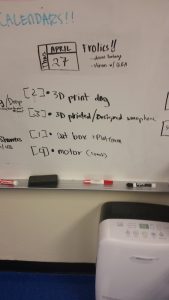
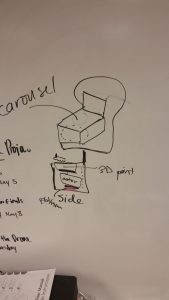
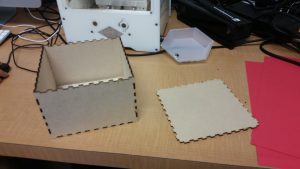
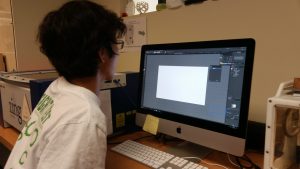
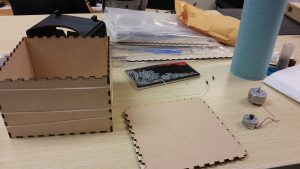
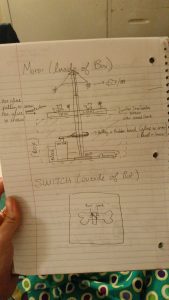
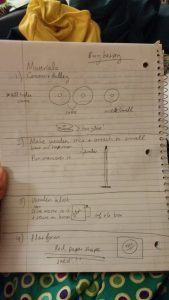
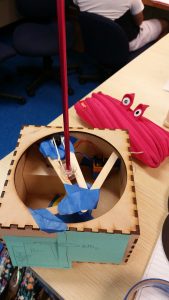
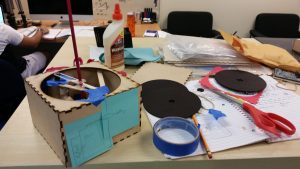
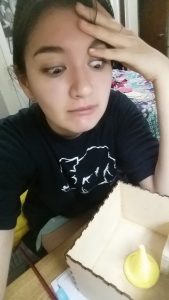
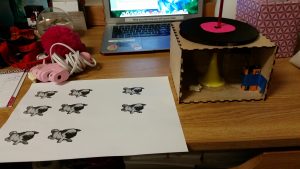
Step One: Designing the Box. This took way longer than I will ever be willing to admit. 
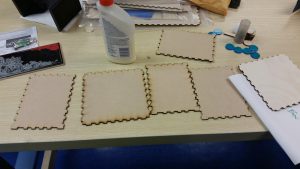
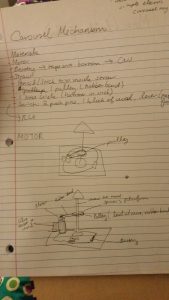
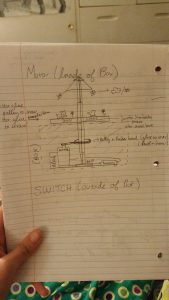
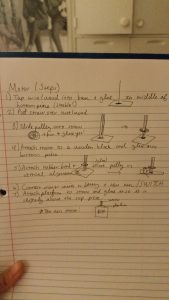
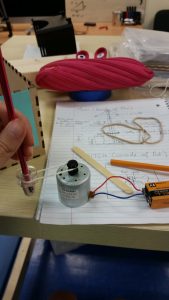
The next step was to figure out how to make the motor… Surprisingly, this was the easy part!
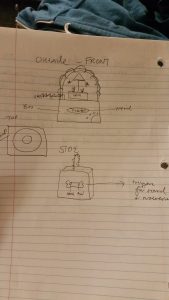
Now, how do I fit it all inside?
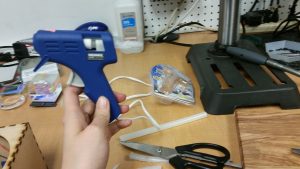
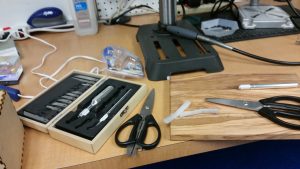
DIY glue stick #never getting that hour of my life back again #RIP Maker Space person’s finger #xacto knife

I had to help an RLO staff member prank her co-workers in order to borrow this glue gun. #Clippy lives on
Me realising that I have to tear the box apart in order to wire everything inside.

Finally, it all fits!! Eureka!
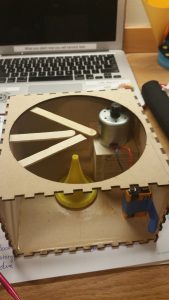
Annnnnnnnnnnd it breaks….
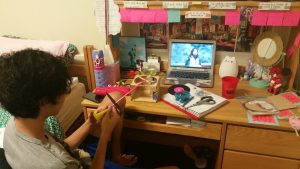
As soon as I tried to show my boyfriend, it broke. Maybe it’s because I spent an hour turning it on and off, which wore down and broke the string – but who actually knows what happened.

Time to find a new way to hook the motor to the spool inside of my box… I needed the perfect fit, so I improvised with the band inside of a rubber glove. These were semi-effective. Thankfully, I ended up finding the perfect sized rubber band in a random box underneath my bed.
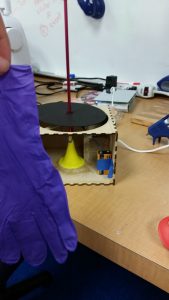
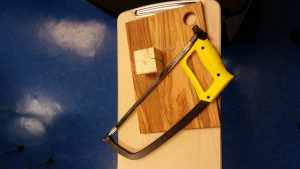
Also this happened, which didn’t really help. I wanted to glue the motor vertically against this block and glue it to the box, but it was too big to fit inside of the box. I needed to saw it down… and gave up after twenty minutes of mindless sawing. Ain’t nobody got time for that! I used the last of my hot glue to put the motor in place instead.
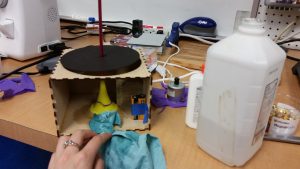
Not only did the string break, the actual contraption came apart and I had to re-glue it all together. I settled the base in place, but once it dried I realised that it was glued WAY off center… So I had to wash off the hot glue and reset the entire piece. It all worked out in the end, but I was not a happy camper at this moment in time haha. 
For the figurines, I worked on both 3D printing dogs and making my own dogs from clay, but the dogs kept flying off so I needed a new option…
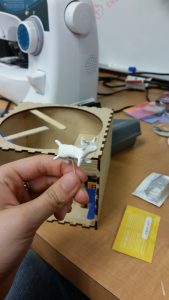
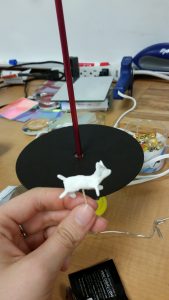
  

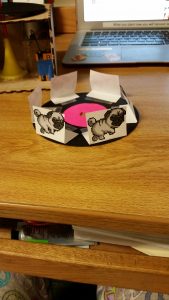
As a result, I made a paper zoetrope of my pet. I used pugs as a demo, because Tinky is so fat that people mistake her for a pug!

Below are a few videos of the design process:

youtu.be/Br0f7_32ZlE

Unfortunately, the sound did not transfer over. There is supposed to be barking associated with the music box!  I will upload a new video!

EDIT: STAY TUNED FOR NEW PICTURES! I am going to add paint and a lever and demonstrate what the animation looks like with a strobe light. 


Works Cited

Blazina, Chris, and Lori R. Kogan. Men and Their Dogs : A New Understanding of Man’s Best Friend.Cham: Springer, 2016.

Heath, Judy. No Time for Tears : Coping with Grief in a Busy World (2). Chicago, US: Chicago Review Press, 2015. Chicago Review Press.

Sterne, Jonathan. “The Audible Past.” Duke University Press. Durham and London, 2003.

Tully, Jane. “Dealing with Death: Good-Bye, Old Friend.” The American Journal of Nursing, vol. 99, no. 8, 1999, pp. 24DDDD–24FFFF., www.jstor.org/stable/3472180.

Tuzeo-Jarolmen, JoAnn. When a Family Pet Dies : A Guide to Dealing with Children’s Loss. London, GB: Jessica Kingsley Publishers, 2006. ProQuest ebrary. Copyright © 2006. Jessica Kingsley Publishers.

Wolfelt, Alan D.. When Your Pet Dies : A Guide to Mourning, Remembering and Healing. Fort Collins, US: Companion Press, 2004. ProQuest ebrary. Copyright © 2004.
Chatbot.exe

Chatbot.exe

For my Haunted Media Project I used a simple text adventure game engine called Quest, to emulate a sort of chatbot experience. I thought that creating a text adventure would be a unique way to fulfill the requirements for this project, while enjoying the process itself. Below, in my artist statement I will further explain the goal of my project and all of the necessary steps it took me to created the final version.


Artist’s Statement  

First I will start with explaining the main points of my game, and the steps it took to create what I did. I will also address my line of thinking during each of the steps and features included in the project. The goal of my text adventure was mystery – I wanted the audience and player to be immersed in the conversation, which was very limited in nature due to me not creating more options for the player. The idea was to leave players speechless with the shocking nature of the content, while slowly introducing them to the “plot” of the experience. In order to immerse the players, I had to find a way to engage with the player for the very start, a way to absorb the attention of the player. I decided to use some dark ambient music to create an atmosphere of dread and mystery. The music starts at the very beginning of the text adventure, and persists during the entire game. The name of the character used in the text adventure was Walter Sullivan, a character from the video game Silent Hill 4: The Room (2004) published by Konami. At first, I didn’t mean the characters to have parallels beyond the interesting name, but later I decided to include plot points from Sullivan’s life in order to give the player something more to think about if they were compelled to google the name out of curiosity. As a result, some points in the chat are inspired by events from Walter’s life in the video game Silent Hill, while others I created myself to pace the experience in a way that would be shocking to the audience, due to its starkly contrasting calm beginning, and a very dark and disturbing ending.Another method of building anticipation and helping the shocking nature of my text adventure was using the typewriter and decryption text effects, where text is revealed subtly or slowly, in an effort to build suspense. I hoped I would build anticipation in players, and a want to click further and see where the story would go. The effects, coupled with the persistent soundtrack should have left a strong impact on the player. As mentioned earlier, the start of the game is very introductory in nature, in that it is slow and deceivingly benign. This makes it hard for players to assume where this game was going, so when the action starts to unfold, the viewers find themselves in shock with every new message which bring the maximum entertainment value to the experience. Although, the game itself is pretty dark and dreary, viewers who enjoy a trill or anything horror related can find themselves an interesting experience in my short and crude text adventure.  


Upon reading the guideline of the project I looked back at everything we had done in class so far. The most immediate reaction to the guidelines of the project was thinking of the episode of Black Mirror, “Be Right Back” which we watched at the beginning of the semester. The idea stuck with me and the entire episode was very impactful. I decided I wanted to make something similar, but different enough for the parallel to exist, but the unique nature of my project and plot to remain. In the “Be Right Back” a guy name Ashe dies in a car accident after which his fiance, Marta, is desperately trying to bring him back somehow. Once she found a program that allowed her to chat with artificial Ashe, she kind of lost her mind. The program collected data from a death person in order to create responses in the chat. After a while the program offered a series of upgrades which allowed her to bring artificial Ashe in existence. While my idea intersects with the chatting aspect of the Black Mirror episode, there are some major differences.The conversations between Ashe and Martha, and the player and Walter Sullivan are starkly different. Mine being much more overtly disturbing and shocking. While in the “Be Right Back” audience can witness texting between Marta and artificial Ashe that is like regular life texting and without the awkwardness, in my text adventure the tone is always cryptic and weird. From the very start, the audience is hinted on a weird plot – just how weird it is though, one has to find out by going through the whole experience.


Throughout the process of creating my project I looked into things that would be most wanted by the people if my project can come to existence. Since the origins of humankind, people grief their loved ones when they pass away. Often the death of the closely related person can cause people to lose their mind. Most people who lose their loved ones would do anything to bring them back. In the article Natalie Zarrelli’s “Dial-a Ghost on Thomas Edison’s Least Successful Invention: The Spirit Phone.” I was able to recognize that people were trying to find a way to connect with death people.  In 1933, Thomas Edison and many other scientist gathered in the secret laboratory to conduct an invention called “spirit phone”. The spirit phone was suppose to connect with smallest particles that are floating in atmosphere (which would also give the proof of the afterlife) in order to connect live with death. Unfortunately, after many hours spent on this project Thomas Edison and other scientist realize that they were not able to get the results they were expecting. Edison’s idea was another stepping stone in creating my project as I used his idea in today’s world. With the improvement of technology we are closer than ever in connecting life with death. Not that long ago people had to write letters back and forth in order to stay connected despite the long distance. It would take weeks before one would receive a letter. However, nowadays we are not only able to speak to a person that is on a different part of the planet from us, but we are able to see them too.


In the article, Cyberspace When You’re Dead by Rob Walker, there was a line that really stuck with me. “‘So I’m still having this conversation’ with his friend Tonnies, he told me, ‘even though he’s been dead for more than a year.’” When I read this I felt really odd about the entire idea. I knew that my project could be related completely to this idea, and I knew I had found something worth exploring. I wanted to recreate the feeling I felt when I read that line, in whichever way I could. I expanded on it however by including the hints of an afterlife. The player isn’t offered much of a description, as Walter himself struggles to describe what exactly is going on, and how much he can be trusted is questionable as well. Regardless, the afterlife is a very interesting topic to me, so it felt natural to connect a line between all these points and create a text adventure for people to play and feel a certain way.


I also read a paper called, Death and the Internet: The implications of the digital afterlife by Nicola Wright. In it, the author addresses the cultural implications of death given the introduction of the digital age and all of its features. Despite the topic of the article being very similar to what we do in class, for some reason after reading it I thought of an idea – what if the digital afterlife was actually a place, and we just can’t communicate with it, until now.


I created a chatbot experience in which I tackle issues from our class, while introducing things that I have always thought of throughout my life. Ideas which I have questions about tend to leave a strong impact on the work I do, so I thoroughly enjoyed having the opportunity to create something which could encompass these different ideas and things that I find enjoyable to think about and explore. I believe the text adventure, if anything, is an interesting experience, and to some extent conveys what I attempted to convey, despite my lack of knowledge in coding and creating such things.


Work Cited

Zarrelli, Natalie. “Dial-a-Ghost on Thomas Edison’s Least Successful Invention: The Spirit Phone.” Atlas Obscura. Atlas Obscura, 18 Oct. 2016. Web. 21 Apr. 2017.

Walker, Rob. “Cyberspace When You’re Dead.” The New York Times. The New York Times, 08 Jan. 2011. Web. 21 Apr. 2017.

Wright, Nicola. “Death and the Internet: The Implications of the Digital Afterlife.” First Monday. N.p., June-July 2014. Web. 22 Apr. 2017.

Rest in Pieces: Incorporating the Soul into Modern-Day Remembrance Photography

The final product

In looking at the objectives of our course, our class focused on how representations of death in the 21st century interact with pop culture and applied historical and theoretical concepts to this morbid intersection. Our haunted media object is a physical representation of this intersection, as a way to evoke the themes we have discussed this semester in an artistic, physical presentation. The two ways we approached this intersection were through (a) ghost-centric examples of technology that perpetrated to allow the user to speak with friends, family, or other entities after their death, or (b) grief-centric facets that helped individuals and families move through the grieving process more quickly, or with less pain.

For this project, I was influenced by our discussion in class on the phenomenon of interacting with a loved one after they pass away. While current generations take this for granted in the modern age, the idea of hearing a loved one’s voice was unimaginable before the invention of recording and transcribing sound onto phonograph records; As was the idea of seeing a loved one’s face after they died before the invention of photography. Along with the reading in The Audible Past by Jonathan Sterne, in which he discusses how strange it was for society to listen to the words of those who had died, we also discussed how the invention of photography changed the way families grieved their loved ones by allowing them a perfect visual reminder for the first time. We see this in what are commonly called ‘Victorian Death Photos,’ where families in Victorian London posed the dead in family photographs, in coffins, or in their cribs, and made it look like the dead were still alive.


Those dead in Victorian Death Photos are shown more sharply because they did not move in long-exposure shots. Sourced from BBC.


Once photography became affordable, portable, and more socially acceptable, Victorian-era families began permanently preserving their loved one’s likeness. Since photography was still relatively expensive and the practice was not yet widespread, these families often did not hire a photographer until their loved one had died- making it necessary to stage the photo and prop up their loved ones. As an article in BBC confirms, death portraiture became increasingly popular as people realized it offered the last chance to have a remembrance of their measles-riddled children. These death-reminders, or memento mori, were considered acceptable at the time but our class was relatively shocked by these remembrances.

I did more research into death photography, often called remembrance photography, and found that many families still choose to commission photographs of their loved ones who pass away. Molly McElroy, in an article posted by the University of Washington, found a surprising practice of remembrance photography and preemptive photography for children facing life-threatening illness. One of these nonprofit groups, called Soulumination, focuses on helping families with children under 18 who are in the hospital for major illness. The other nonprofit, called Now I Lay Me Down to Sleep, is a nationwide network of photographers who provide free remembrance photographs often for newborn children who pass away shortly after birth. The service believes that the photos provide parents with lasting memories of their children who lived so briefly that “little else exists to remember them by.” They also say that the professional photos are easier to look at than the photos the families took themselves. It becomes easier to breach the subject of death if one has a photo to talk about and explain, like a “gateway to bringing up memories of the deceased.”

Surprisingly, this practice was born with the invention of photography and lives on today. I wanted to know why remembrance photography was (somewhat) popular and what it might look like in today’s digital, video-centric world. This led to a discussion of grief, and the function of grief in society. Authors Claire White and Daniel Fessler discuss in their article, “Evolutionizing Grief,” how photographs of the deceased impacts the bereaved and influences their grieving process. For them, they believe that grief is a process that has two functions. First, to encourage two (living) people who have separated to reunite. Second, if one of the partners dies, to “facilitate the reconceptualization of the other as no longer a living, viable relationship partner, opening the door to investment in new relationships.” They found that neurobiological systems, like our facial recognition systems are activated by photographs and videos. This means that viewing a photograph of a loved one who has passed away creates a response in your brain as if the person were physically with you. White and Fessler argue that this will “enhance the conflict between the old representation of the loved one and the new one to which the bereaved is transitioning.” This is understandable, that while photographs may make us more uncomfortable and delay the grieving process because of our neurological responses to seeing our loved one’s face, our state of grief forces us to reconnect with them in any way possible.

Moving away from the biological research- our discussion of grief, of remembrance and Victorian-era death photography, and of the phenomenon of interacting with someone after they have died, motivated me to try and capture a digital interpretation of death photography.

With the gracious help of my friends, I posed a photo which showed three friends centered around a chair and another friend pretended to be dead and was propped up on the chair. The ‘living’ friends were encouraged to move freely- fix their hair, scratch an itch, etc.- while I asked the ‘dead’ friend to resemble a corpse propped up like in a Victorian-era photo. I then took this video and created a .gif file that would allow the video to loop when displayed, which created the illusion that my friends were continuously moving, and ‘alive’ in a way, within the video.

imgur.com/CnFJnJl

(Above .gif file was created by the author)

In many Latin-American countries and in some other societies, there is a myth that when you are photographed, a piece of your soul is trapped within that photo. With this video and .gif, I wanted to capture this idea that my friends were alive within the frame and that their souls existed within it.

When first creating this .gif, I realized that videos are not generally used to grieve a loved one, because videos are generally candid and unposed. Videos are also difficult to casually display in the home because of the limits of technology, so it is more common to grieve a loved one through a photo taken while they are still alive. By creating a video of my friends in a pose normally reserved for a photograph, and their small movements within the video, I feel it adds an uncanny element to the project.

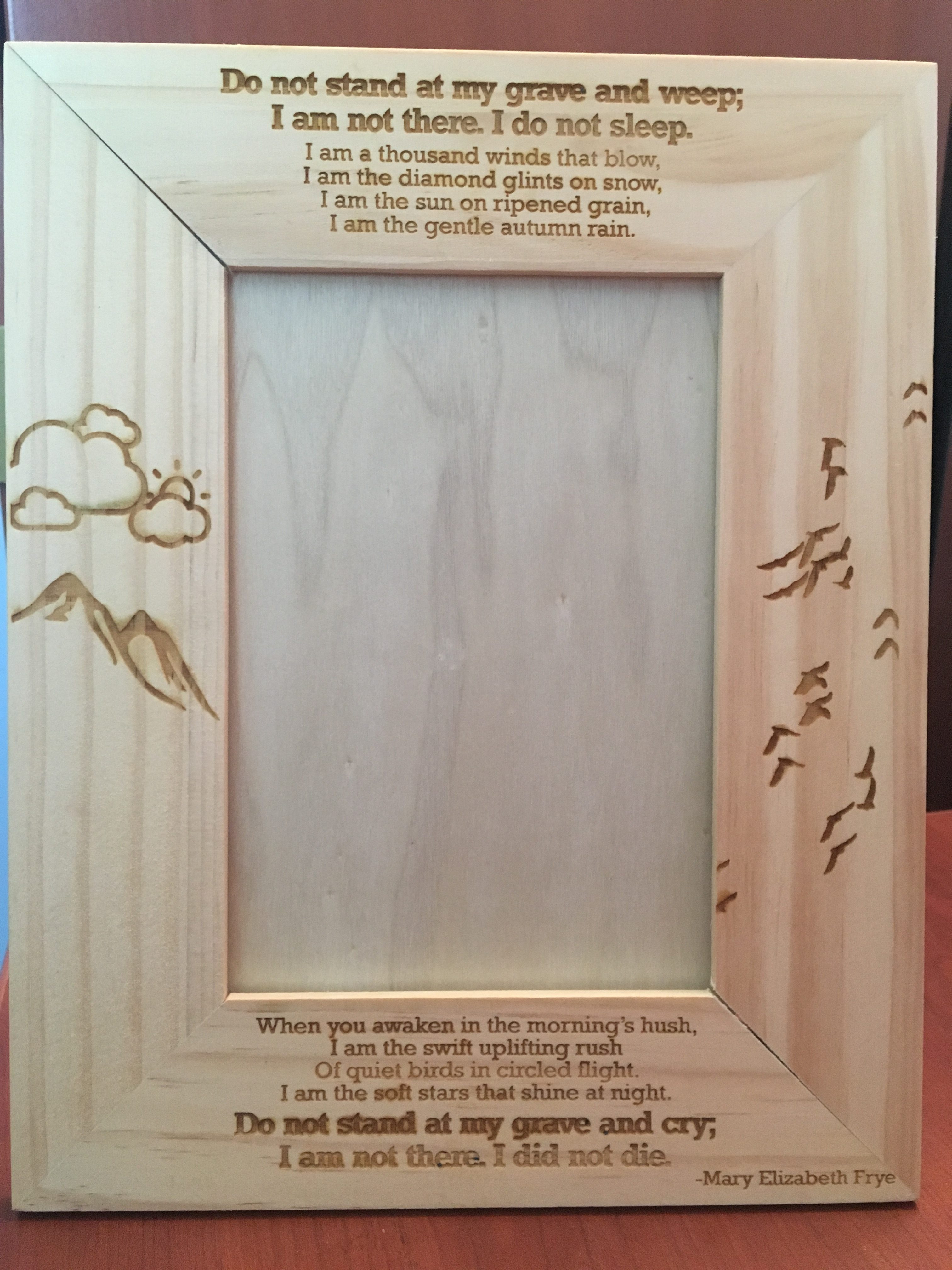
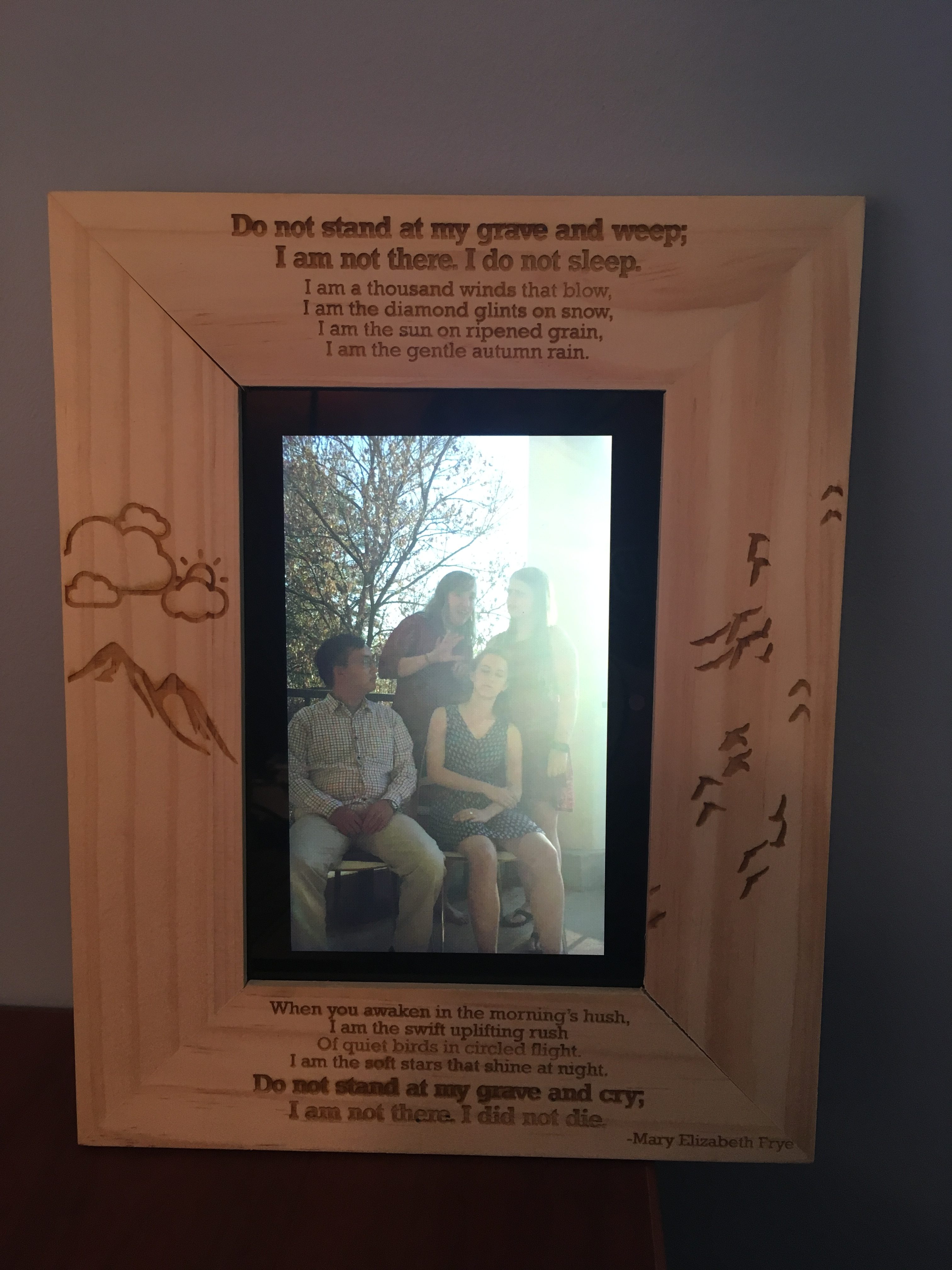
I then wanted to carry this illusion in the physical representation by placing the video in a photo frame. I used a tablet to display the video and found a frame that fit well around the tablet. As a result, the final product initially seems like a standard photo in a frame, until you notice that the people within the photo are moving. To make the frame more exciting, and to reinforce the idea that the project carried small pieces of my friends’ souls, I engraved the frame with Mary Elizabeth Frye’s famous poem “Do Not Stand at my Grave and Weep.” I have included it below: (Sourced from poemhunter.com)

Do not stand at my grave and weep;
I am not there. I do not sleep.
I am a thousand winds that blow.
I am the diamond glints on snow.
I am the sunlight on ripened grain.
I am the gentle autumn rain.
When you awaken in the morning’s hush
I am the swift uplifting rush
Of quiet birds in circled flight.
I am the soft stars that shine at night.
Do not stand at my grave and cry;
I am not there. I did not die.

By including this famous bereavement poem, I wanted to pretend that my haunted media project carried a piece of the deceased’s souls; that it is useless to cry at their graves because they are just as present, if not more present, in the photo frame. The poem suggests that the deceased does not want people to miss out on life because of their mourning; that they will be with their loved ones always. While the poem adds a religious element to the project, I think it furthers the idea that the subjects of the video are spiritually within the video and frame.

Custom engraved photo frame to hold the kindle fire

I believe I combined the grief-centric and ghost-centric objectives in my project because the photo frame is both a tool for grieving as well as a ‘haunted’ vessel for the deceased’s souls. I wanted to create something that would put a modern spin on Victorian-era remembrance photos and show the intersection of popular culture and technology with a photography practice that has been around for generations. Grieving has been a natural part of human existence, and only recently in our history have we been able to interact with people after they die. After looking at the different biological factors that impact grieving, I see that there is a natural conflict between trying to move on after death and trying to hold onto a loved one through photos and other remembrances. While we may think that some practices in today’s death-avoidance society are morbid or uncomfortable, practices like infant photography after death helps families validate their child’s short life and provide small comforts as they move through the stages of grief.

Works Cited:

Bell, Bethan. “Taken from life: The unsettling art of death photography.” BBC News. BBC, 05 June 2016. Web. 06 Apr. 2017.
Frye, Mary Elizabeth. “Do Not Stand At My Grave And Weep.” PoemHunter.com. N.p., 31 Dec. 2002. Web. 06 Apr. 2017.
Konigsberg, Ruth Davis. “New Ways to Think About Grief.” Time. Time Inc., 29 Jan. 2011. Web. 06 Apr. 2017.
McElroy, Molly. “Grieving parents find solace in remembrance photography – with photo gallery.” UW Today. University of Washington, n.d. Web. 06 Apr. 2017. <www.washington.edu/news/2013/03/19/grieving-parents-find-solace-in-remembrance-photography-with-photo-gallery/&gt;.
White, Claire, and Daniel M. T. Fessler. “Evolutionizing Grief: Viewing Photographs of the Deceased Predicts the Misattribution of Ambiguous Stimuli by the Bereaved.” Evolutionary Psychology 11.5 (2013): 147470491301100. Web.

Artist Statement – Tower of Babel Space Memorial


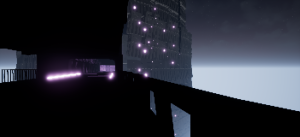
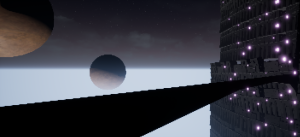
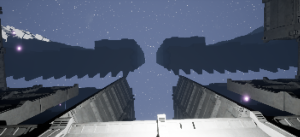
I personally find the most fulfillment in creating things that don’t already exist. Bringing imagination into some form of reality (in this case virtual) through which the realm and idea can be shared is something I strive for. Having said that, what better way to share an idea than through a video game. I find the power of strong visuals in combination with audio to be very powerful in immersing an audience. For this project, I wanted to create an alternate scenario, versus something grounded in our current reality (I figured there would be a lot of the former as project decisions, and little of the prior). I decided to use the unreal engine (which is known for its powerful graphics capabilities) and give it a retro twist, both in sound and visuals. The decision came about after re-reading Kirkland’s Resident Evil’s Typewriter Survival Horror and Its Remediations. For my haunted media project to feel more like a relic or bridge to the past, it made sense to make use of a technological aesthetic that is from the past as well. The pixelated graphics and 8-bit music tap into the origins of digital technology and given the background story of the Space Memorial, it would make sense why our robot successors have a more meaningful connection to the advent of digital technology. (Their own creation was most greatly influenced by the digital age – apparently) The space memorial itself is haunted by ghosts which will harm the player in their endeavor to explore the space memorial. The whole point of a haunting is that it instills some kind of emotional effect on the one who experiences it. Usually fear. So I tried, in the limited time to actually build and code the experience, to create some semblance of fear in the player.

There is a whole art to creating emotions in players and an audience in general, and it usually requires a little more composition on the part of the creator to be effective (due to time constraints, there almost were no ghosts). Coding AI for a horror video game is challenging in that the AI must, in its idle state, be roaming the world, so that the player can never be certain about what lurks around the corner. This is in line with the whole goal of creating a haunting, a haunting isn’t cool (cool? attractive?) unless it’s uncertain.

My inspiration for the ghosts comes from a video game I played when I was young (unfortunately, never learned the name of the game, I played it on my cousin’s console). The sounds, poses and general feel of the ghosts was something that really stuck with me growing up. I had a few chances to play the game when I was younger, and it was devastating. I literally couldn’t even play it. I’d start, and I’d hear that terrible moan that the ghosts would make, and I’d drop the controller (I was young, okay?). Fast forward, I’m older now, and still scarred (and scared, no pun intended). The point is, I learned something, and I wanted to use that to my advantage in this project. From the get-go I knew what I wanted the haunting to be. It was just the execution that became the difficulty. Needless to say, after a lot of work, I had created something that is just slightly what I imagined, but it was something.

Of course, creating ghosts means there need to be hiding spots, safe zones for the player to fully relax. I used the whole concept from Amnesia: The Dark Descent, hiding in closets and cabinets does one thing specifically to further the feeling of being in danger. Hiding in closets means that whoever you’re hiding from reigns over the rest of the domain, and your “safe space” is actually a secondary space in the grand scheme of things. It’s a powerful way to say that, you are second to some other creature, you don’t belong here, and you should stay in the closet. All of this sounds exciting and potent in theory, but of course, again, given the time limit, it was difficult to really execute the idea to its full extent. I wish that the player has to mostly traverse through vents, closets, and side routes (inside walls and whatnot) – so that the player never feels like they belong to the world. The idea is there nevertheless.

Moving on. You have a lantern, which gives you some control over your surroundings. You can light dark areas, and see details that are otherwise not visible in the old space memorial. The lantern attracts ghosts however (not actually, because I didn’t have time to code that), but the effect is that your actions in the game can directly endanger you, even those actions which seem to be helpful, can at times be your greatest source of danger. (AGAIN, this all is how it should work in theory, and as much as I actually implemented a lot of these feature, it takes much more than pure intent to actually execute these ideas effectively ala Amnesia).

The setting is an homage to the works of Mobeius, Sergio Toppi, and Tsutomu Nihei. All three are very inspirational artists (first), graphic novelists and comic artists. The world is meant to be monotonous in that it uses a very repetitive pattern, but spectacular in scale and vision. The idea behind it that it is created by robots, and computers tend to specialize in certain aspects and lack in others. For instance, a calculator can calculate at incredible speeds, but cannot learn a language. Back to the project, the setting is in many ways extremely ambitious (an enormous space memorial with huge hallways, bridges, and constructions), made in a very repetitive way with little consideration for beauty and pattern-breaking.

Another important point of inspiration came from Kocurek’s article Who hearkens to the monster’s scream? Death, violence and the veil of the monstrous in video games. I figured, when we talk about a haunting, the “antagonist” is a person from the past. Usually due to some unresolved issue from their life, they remain in our realm to send messages, warn people, harm people, scare people, but in some way communicate. For my project, I wanted to further this idea. The ghosts that roam around are nothing more than dangerous apparitions with no backstory or personality. They are stripped of their own  story and purpose, and instead are just one of (presumably) many others stranded in our world, with nothing to do other than hiss and roam around. When we think of othering in the form that Kocurek speaks about, we usually think about things unrelated to “us”. What I mean by that is that we other things we find foreign. I thought it’d be interesting if this was a robot world in which we, humanity, is the “other”. 

I attempted to create an experience of a haunted space memorial created by robots in commemoration to their, now gone, creators. The memorial is haunted by the ghosts of our past. But more so than the literal haunting in the project, I was aiming at the meta-haunting which is our species haunting another species. We’ve always been on the end of the chain, looking back at “common ancestors” and histories we didn’t belong to. It’s entirely possible that one day, we become someone’s common ancestor, that one day, humanity will be a collection of data and information, or a digital footprint for other intelligent species to decode and learn from. It is an interesting notion, to think that maybe one day, none of us will exist any more, in the capacity that we witness each other. The notion that we move from the spotlight, into a display (like in a museum) of intelligent life, and none of it will matter to us, because the last of us will be gone. It is a somewhat tragic notion, but interesting nevertheless.

In conclusion, I had a strong vision which I wanted to bring to the digital realm in all its glory. Of course, I would not say that I was successful in fully (arguably even partly sometimes) translating the theories and effects I wanted to. However, the concept is there, and the intent as well. With such a time constraint, it is the closest my vision would become a reality. Technical difficulties are many when creating any project, but this project was deceivingly costly on the processing end of things. Correcting errors and moving through technical obstacles was the greatest issue I had, and it is the reason many features either didn’t work the way they were intended, or didn’t end up in the final version. The experience, despite its horror theme, is supposed to be meditative, with moments of tranquility in which players can just immerse themselves in this world, take a moment, and consider a world without humans, but with humanity. What I mean by that is, humanity seems like it can live on even without us, and it can be the greatest gift we impart on our successors, or our excavators (in the case that we don’t have a successor, but an intelligent species that is able to observe us or find us and our physical and digital remains).


Impakt

My daydreams about this project were grounded in reality: I wanted to discover what information I could glean from the tweets by using skills from my computer science courses. Eager to flex my coding muscles, I jumped into the project. But I started running into roadblocks: I couldn’t get as many tweets as I wanted, I struggled with remembering the syntax of JavaScript, the data wasn’t as easy to work with as I had hoped. With the clock ticking, I mentally reset and reminded myself that this project is intentionally not grounded in reality. We’re supposed to take an almost-plausible idea, one that nearly fits into our reality, but add an element of the uncanny to it, something that makes us examine the object and shudder with relief that the world isn’t that screwed up. Keeping this in mind, I adjusted my mindset and developed Impakt, a macro-social media site that distills down a celebrity’s death to handful of figures to deliver one final reading of the social climate surrounding him or her.

The Impakt of Social Media Grief Competition 

Impakt analyzes the millions of para-social relationships that Twitter users have with a given celebrity. This data analysis gives a large-scale representation of the impact a celebrity had on society around their demise. The obvious goals of Impakt as a “brand” are to make the user aware of the impact of a death of a celebrity, to highlight the para-social relationship between the fans and the public figure, and to trivialize death by making it another social media gimmick. As an art piece, its “goal” is to push social-media grief into the realm of the uncanny by further distancing users from the actual death of the celebrity and turning generating attention into a competition, valuing the quantity of social media attention over the quality. The cultural attention shifts even farther from death to trivial “here-and-now” things, like the Internet and the media. Sherlock suggests that these media “facilitate a new type of ritualized, collective mourning that potentially serves to distract mourners from the physical reality of death” (169). The deluge of images and messages in mourning and memorializing tweets provides a distraction for the Twitter user from being reminded of his or her own impending end. As Sherlock states, “to control the corpse is to control death, disorder, and chaos”, and so “a culture that promotes the notion of a symbolic immortality” would aid in distracting us from our own mortality (169). If we create a culture that minimize the finality of death by continuing to celebrate a celebrity after their demise, we cultivate the belief that we will also be celebrated and respected after our death, capturing a sort of immortality. Impakt attempts to enhance this mindset and take it to an extreme. By making popularity and impact a social competition, people are even more concerned about their image after death, and may choose to include in their will the hiring of tweeters or bots to preserve their social relevancy after death.

Postmortem Digital Identity

Yet, what role should be assigned one’s digital identity after death? What are the moral and cultural guidelines that the bereaved should be expected to follow? Brubaker, Hayes, and Dourish touch on these questions in their examination of online memorials and the digital identity postmortem on Facebook. Facebook’s protocol when handling the passing of a user consists of “memorializing” a user’s page, which partially freezes the page so no new friends can be added and no personal information can be modified. Brubaker et al. argue this protocol “prioritizes the needs of a now-dead individual over the grieving community that remains” (161). The grieving community can post memories and content on the deceased’s wall, adding detail to the postmortem identity and creating a divergence between the pre- and postmortem identities of the deceased. Since the owner of the page no longer can filter the content allowed on their wall, survivors may take offense to posts or images added to the page by commentators (Brubaker et al. 161). Even the deceased might not have approved of some of the content.

The Do’s and Don’ts

How much control should you have over your postmortem social identity? What should the moral standards be for grievers and commenters? Odom et al. suggest paying attention to the “delicate social arrangements” surrounding managing these digital representations and not simply allowing a profile to exist with restrictions. Impakt places no such restrictions on the information displayed on the site: any publicity is good publicity. The philosophy of Impakt encourages tweets of any kind about the celebrity, with a weighting system that centers more on the sincerity of a tweet rather than the sentiment. Negative tweets (“Insults”) impact the algorithm just as much as positive tweets (“Compliments”) (see section “The Tunes of Tweets”). This reflects Walter’s idea of postmodern death, by which private feelings of the dying and bereaved are publicly proclaimed as a form of individual expression. Regardless of the motivation or sentiment behind a tweet, any form of grief in a public place does not ensure the same level respect that one receives by grieving in private. An individual has the right to express themselves as they wish in public, accounting for the repercussions of posting anything on a public platform.

 The Tunes of Tweets

The tweets posted in relation to a public figure’s death run the gamut from insults to tweets of concern to impartial headlines. The categories used for Impakt’s Popularity Breakdown were inspired by Cutrona and Suhr’s (1992) five types of social support as described by in an analysis by Lee and Goh on Twitter’s response to Michael Jackson’s death. This scheme has been applied to studies involving online social support and so Lee and Goh adapted this scheme for the death of a public figure. I expanded Cutrona and Suhr’s five types of social support to seven tweet categories (names of the original types are denoted in brackets):

  1. Info [informational support]
  2. Emotions [emotional support]
  3. Compliments [esteem support]
  4. Connects [network support]
  5. Rumors
  6. Insults
  7. Other

The categories are explained on the Impakt FAQ page. The tweets regarding Michael Jackson were primarily info (46%), with emotions being the second greatest proportion of the tweets (23%). Through during their study of Michael Jackson’s death, Lee and Goh discovered “categories not normally associated with grieving, such as spreading of rumors, expressions of hatred, and spam, also occupied a large proportion of tweets” – nearly 30% (rumors, insults, and other). The authors suggested that these contributors took advantage of the high Twitter traffic “for a variety of purposes such as spreading rumors, spamming, marketing, and advertising” (473). I emulated these results in the Popularity Breakdown section of Impakt. For most the tweets, they “seemed more like personal and social expressions of emotions and thoughts” with no response necessary from other users, like a condolence book (Lee and Goh 473).

The Nature of the Bird

Twitter’s public, event-driven nature, and 140-character restriction requires tweets to be deliberate, timely, and pithy. These characteristics make it a perfect metric for examining the effects of major events, providing “insight into traumatic events and experiences and elucidate how youth view the world, self, and others from the perspective of youth tweeting about social events and experiences they deem significant and important in their lives. (Patton et al. 229) Even more ideal when dealing with public figures is how commonplace tweeting has become for them to use to interact with their fans. While a celebrity is alive, their Twitter page is a critical part of maintaining para-social relationships and thus is an intuitive medium to turn to when expressing sentiment toward the celebrity. Although Twitter, Facebook, and other social media sites are typically centers for lighter content, people engaging with content on these sites “often alter and modify the original intent of software to fulfill a need or desire” (Patton et al. 229). Patton explains that the Internet can ease that need to commune with other mourners and “strengthen group bonds by allowing users to share experiences of mourning… and memorialize the deceased with the use of text, photographs, music…” (Patton et al. 228). The online community also has the side effect of popularizing someone’s death, drawing more publicity than a news story or obituary would have generated. Patton et al. examined a case study of a young woman in a gang who was killed and noted “the public may never have known about Gakirah’s story without the communication capabilities of social media. In the pre-Twitter era, she might have been a name in a back-page newspaper story” (238). This attention may have positive repercussions (e.g. another source of outlet and support for mourners) or attract negative commenters (e.g. RIP trolls or advertisers). For better or worse, Twitter is public. If you wish to keep your mourning private, don’t post on Twitter. Alternatively, online memorializing can provide support and community for geographically-restricted groups so sharing online may help you find a connection and ease the grieving process.

The takeaway

Currently, grieving on social media is still weird, but so is mourning someone you never met. As we’ve seen, the peculiarities of Twitter lend itself oddly well to mourning celebrities and other para-social relationships. Yet the idea and culture surrounding mourning on social media haven’t quite settled into acceptable norms. I challenged the idea of what could be deemed appropriate via Impakt, essentially making celebrity deaths into a quantifiable popularity contest. Since social media is more of a superficial grief setting, mourners generally do not post deep, emotional posts, especially on character-restricted Twitter. With that mindset, it’s perfectly eerie to consider what happens when valuing trivial social media stats takes priority over grieving the loss of someone.

Note: While the finished product didn’t include access to live data, I hope I communicated the general idea of the site. The rankings were an amalgam taken from various tabloid articles. As mentioned, the percentages used were based on Lee and Goh’s results. The most favorited/retweeted tweet, the top 5 words and hashtags, and the frequency graph were generated from actual tweets surrounding Chuck Berry’s death (specifically the last 10,000 tweets returned from the query “chuck berry” taken during the 18 March – 19 March 2017 window).


Works Cited

Brubaker, Jed R., et al. “Beyond the Grave: Facebook as a Site for the Expansion of Death and Mourning.” Information Society, vol. 29, no. 3, May/June 2013, pp.152-163. EBSCOhost, doi:10.1080/01972243.2013.777300.

Lee, Chei Sian and Dion Hoe-Lian Goh. “Gone Too Soon: Did Twitter Grieve for Michael Jackson?.” Online Information Review, vol. 37, no. 3, May 2013, pp. 462-478. EBSCOhost, doi:10.1108/OIR-05-2012-0082.

Patton, Desmond U., et al. “I Know God’s Got a Day 4 Me.” Social Science Computer Review, vol. 35, no. 2, Apr. 2017, pp. 226-243. EBSCOhost, doi:10.1177/0894439315613319.

Sherlock, Alexandra. “Larger Than LIfe: Digital Resurrection and the Re-Enchantment of Society.” The Information Society, vol 29, no. 3, May/June 2013, pp. 164-176. EBSCOhost, doi:10.1080/01972243.2013.777302.

Reconnected or Reborn?

*In my project, Reconnect, there includes a website (listed below), a complete text message thread (attached), and pictures of “the little black book” of information on victims and clients. Links are all listed below*

Reconnect site

Text Convo

Exploited Information

Client Log

Artist’s Statement

Reconnect

Annabelle and Abigail Morgan were identical twins born on September 3rd, 2000. They lived with their parents in Denton, Texas. To each other, they were Annie-bee and Abbie-bug; nicknames that had stuck from when they were little girls. Both girls were avid social media posters and texted each other non-stop, they were the other’s best friend. When they turned 13, Abbie started to feel slightly off but wasn’t really sure what was wrong. It took her sister finally dragging her in front of their parents almost a month later for Abbie to realize how sick she was actually feeling. At the doctor the next morning, their pediatrician couldn’t figure out what was wrong and sent her on to a specialist to get blood work done. He figured that since she was showing symptoms like fatigue, easy bruising, and shortness of breath, she could possibly have low iron levels. The results of that test were devastating. The doctors sat Abigail and her parents down and explained to them about how in healthy 13 year olds, white blood cell counts should be somewhere between 5,000 to 10,000. Abbie’s white blood cell count was off the chart high. The doctors told her anemic symptoms were what caused her to feel faint and show symptoms of anemia, but the main problem lay in her inability to fight off infections because of the rapid overproduction of her white blood cells. Abbie had acute leukemia.

Annie was next to Abbie’s side for the next three years monitoring blood cell counts, trying to ward off infections, and keeping her spirits high in the tough moments. Abbie started with a few rounds of chemotherapy, but at 15, her leukemia took a turn for the worse and she began radiation therapy and was even put on a stem-cell transplant list. On November 12th, 2016, Abigail lost her fight against leukemia.

Annie was devastated, she had lost her sister and best friend and didn’t know how she’d be able to go through a day, a week, let alone a year without speaking to Abbie at least one more time. Annie was constantly on her phone looking at old pictures and scrolling through their old text conversations. Although they knew her sister was sick and getting worse, accepting that she was gone now was hard for Annie. Her parents’ full attention was now on Annie 100% and she found it suffocating to try and heal while under such scrutiny. Her escape was online. While surfing on the internet day, another user in a random online forum about grief sent her a link to a very interesting site called Reconnect. It prompted her to enter her full name, cell phone number, and email, along with the person she was grieving’s full name and death day. Annie was hesitant about it but the site promised she would be able to text her lost loved one again and reconnect. When she went through with it, she shakily texted the number that the site emailed her, hoping beyond hope that her beloved sister would indeed be the spirit behind the texts.

For the next two weeks, Annie was slowly more and more convinced that Abbie was the one she was texting. As the site said it would, those texts did indeed help Annie come to terms with her sister’s death, but it also disguised a terrible scheme of identity theft. Unbeknownst to Annie, the “Abbie” she was texting a culmination of a bot that had taken all of her online social media activity and turned it into a book of information, including phrases she was prone to say and pictures, and a real human on the other end of the line that was slowly gathering the childhood best friend names, first pet names, and other such security type questions. The Reconnect site was a rouse to get grieving people that were desperate enough to believe they were talking to their loved ones again and manipulate them into handing over countless sensitive facts about themselves and their loved one, allowing the makers of the site to steal the identity of the passed loved one. The turnaround was amazing on how fast there was always a buyer on the dark web ready and in need of a legit ID that could be used for social security number purposes, voter ID purposes, and a number of other things that The Makers didn’t really care to concern themselves with as long as the money was wired to them. In the end, this reconnection of a lost sister turned into her rebirth as a new identity.

Behind the Piece

The idea behind this Haunted Media project is a combination of four themes presented in Cohen’s Monster Thesis, Zarelli’s Dial-a-Ghost, Walker’s Cyberspace When You’re Dead, and Bonazzo’s Do You Need to Control Your Online Identity After Your Death. Everyone grieves in different ways, however it is more and more common in this digital age for grief to be shared online. Since telephones were invented, this idea that technology could reach beyond that of our physical realm, has been present. In October 1933, the first such idea was born that the human personality doesn’t totally die and that there are small pieces living around, just waiting to be found and spoken to (Zarelli). While this might have been an idea for the telephone in the early days of technological advances, in our day and age we are so much further advanced that it is not a stretch to think that we may now have found a way to bride that link between the living and dead through technology. According to Statista, 98% of millennials own a cell phone, 96% text, and 93% use social networking and the internet in 2014. Taking this information, it is obvious that two young millennials such as Annie and Abbie are deeply entrenched in this age where technology is a main aspect of their lives and time. It’s not too far-fetched to believe that in her young grief, Annie fell for a rouse to reconnect with her sister one last time through the use of something as normal as her cell phone.

In Bonazzo’s piece about your online identity, he outlines how an online account is a digital asset in terms of information that can be stored from your usage of that account. In most states it is illegal to access someone else’s personal accounts, but what about those who do not care about it being legal? Differing accounts have ways of knowing when a loved one as passed on, such as Facebook moving the page to an inactive account and gives your ‘legacy’ managing duties of your page. This doesn’t delete any content online, merely holds captive for anyone to find. This got me thinking how this information could be used maliciously in Reconnect.

According to Cohen, a monster in the horror genre encapsulates seven basic thesis. Of these seven, about five are used to outline the ideals behind my ‘monster’ in the piece Reconnect. (To be clear, the monster is the person on the other end of the text conversation and the one selling the dead identities to buyers on the dark net). The five that are used to form this monster from Cohen’s monster theory are: The Monster’s Body is a Cultural Body, The Monster Always Escapes, The Monster Dwells at the Gates of Difference, The Monster Polices the Borders of the Possible, and Fear of the Monster is really a Kind of Desire. Reconnect’s monster form is one of an online participant in chat rooms and a speaker for the dead using their social media history. By using such a culturally relevant method of communicating is the first step to the digital age’s monster. Having an online platform as the means to communicate in the first place means that the monster can leave no trace if their technology usage is savvy enough and con therefore get away with no trace. Next, our online monster persona allows the victim to believe there is a connection to the outside world, seeing the monster as an Other being. This encapsulates the last three thesis in that our monster is a sign of the impossible happening (a loved one speaking from the dead), but yet it is just probable enough to warrant longing and desire for the phenomena to be real. Thus, the Reconnect monster was born to lure unsuspecting grieving family members or friends to talk to him in order to remake the dead person’s identity. In essence, this reconnection of loved ones leads to the rebirth of an identity for numerous purposes such as identity theft, illegal immigration, voting fraud, or organized crime.

This monster is only even possible because of what Abbie left behind; her sister and her online profile. Rob Walker cites your online profile and what you post as reflections of who you are and who you wish to be. This idea led to Reconnect’s monster to have its own bot that boiled down Abbie’s (and other previous victim’s) online profile into enough phrases and nicknames and such that the grieving victim was tricked into thinking there was still a bit of their passed loved one’s personality still texting them.

Ultimately, this haunted media project runs full circle when a death in real life can be remade through the internet and texting, enough so that a newly formed identity using Abigail Morgan and other passed names are still floating around and being used after her death. This use is a form of haunting in the digital age.


Word Count: 1595

References

Bonazzo, John. “Do You Need to Control Your Online Identity After Your Death?” Observer. N.p., 23 Feb. 2016. Web.

Cohen, Jeffrey Jerome. “Monster Culture (Seven Thesis).” page. Web. Found at: courses.digitaldavidson.net/dig215/documents/monster-theory-seven-theses.pdf

“Dial-a-Ghost on Thomas Edison’s Least Successful Invention: the Spirit Phone.” Atlas Obscura. N.p., 20 Oct. 2016. Web.

“Media use among Millennials 2014 | Statistic.” Statista. N.p., n.d. Web.

Pictorial Memorial: Time and Grief in the Digital World


Pictorial Memorial: Time and Grief in the Digital World

pictorialmemorial.wordpress.com

For many people, especially millennials, a large part of our lives is documented only on social media sites. Digital photographs serve as the core of many social media sites like Instagram and Facebook, where images document every aspect of our day-to-day life from college parties and vacations to graduation and family birthdays. While some sites are working on ways to address what happens to these accounts and images when we die, such as the ability to memorialize accounts on Facebook, many questions remains about exactly what role these photographs might play in the grieving process when a person passes away. My project, Pictorial Memorial, explores the issue of how the digital world has changed the grieving process and its relationship to time. Time and grief are addressed in two distinct ways within my project. First, the website Pictorial Memorial offers products created from social media photographs of the deceased and offers an example of how our desire to preserve our memories of the deceased might be commercialized in the future. Second, the way in which the timeline of the grieving process might be altered by the digital world is explored through the made up narrative of one of the deceased registered to the Pictorial Memorial website.

Both of these aspects of the project center around photography because of the important role that images of deceased loved ones play in the grieving process. Photographs serve to keep loved ones who have passed away alive in a certain sense by capturing something of that person, if only in a particular moment in time. By preserving memories, photography, “enables the past to be recalled and reinterpreted” (Riches and Dawson 122). When families grieve, photography helps, “transform obsession with the single event of the death into a broader acknowledgement of the meaning of his or her life” (Riches and Dawson 124). Moreover, the ease and affordability of taking digital photographs with phones means that we visually document our lives to an extent that we never have before. Thus, when people die, many now leave behind a collection of images that may allow grievers to feel as though they have a more complete representation of a dead loved one than ever before.

The website I created, Pictorial Memorial, capitalizes on our desire to hold on to memories of deceased loved ones. Pictorial Memorial is a mock-up of a website where after a loved one dies you can set up an account and friends and family can import photographs from various social media sites. While the website masquerades as a memorial website to collect photos of a loved one in a single place and to create a community of mourning, it also attempts to exploit grieving loved ones. This is done through offering the services of a team of artists to create a variety of what I intended to be relatively cringe worthy memorabilia of their loved ones. While the idea of exploiting grief for profit in such a way was meant to be slightly uncomfortable, such a campaign did not feel unrealistic to me. For many, the digital world feels impermanent and intangible in contrast with physical photographs or other physical keepsakes. In the article, “Family memories in the home: contrasting physical and digital mementos,” Daniela Petrelli and Steve Whittaker asked 16 individuals to give interviewers a tour of their home and discuss family mementos. The authors found that interviewees placed low perceived importance on digital artifacts (Petrelli and Whittaker 160). Moreover, the authors suggest that this is in part due to, “perceived fragility of the digital,” in contrast with, “a generic sense of physical objects as destined to last and in no real need of maintenance” (Petrelli and Whittaker 164). When a loved one passes away, we cling to whatever is left that reminds us of them. Pictorial Memorial is perhaps a little bit conniving in the extent to which it commercializes this desire but nonetheless offers those with grief a reminder of their loved one that feels more permanent than digital archives.

The other aspect of Pictorial Memorial that explores how the digital age has impacted the grieving process is through the saga of an invented person, Fred December. There were several important background details to Mr. December’s story that play a role in setting up the transgression of temporal grieving norms. Mr. December died relatively young and left behind a young son, James, with a wife, LouAnne, who he had met in New Zealand and had moved to the United States with him. After his death, Mr. December’s wife moved back to her home in New Zealand and took her son with her, thus separating the kid from those who knew his father well. Of the grievers who post on the memorial site, the one who appears to be most haunted by Fred’s death is the man who was with him when he died, Drew. This is demonstrated by Drew posting long after the other posters had stopped. Notably, Mr. December’s now grown son responds to Drew’s last post, offering an opportunity for the boy to learn about his dad and grieve for him with someone who still feels a similar sense of loss.

Here, Pictorial Memorial demonstrates how the digital world allows us to transverse geographical and temporal boundaries in ways not previously possible. In describing the temporal expansion of death in “Beyond the Grave: Facebook as a Site for the Expansion of Death and Mourning,” Brubaker et al. write that users of social media, “continue to engage with postmortem profiles, sharing memories, and speaking to the dead (160),” far more commonly than before grief entered the digital sphere. In my example, Drew and many other mourners continue to speak to Fred for years after his untimely death. Brubaker et al. also mention how grief has been expanded in the digital world through removing geographical barriers (160) and how online grieving has expanded the social circles of grieving. Brubaker et al. write, “friends from multiple social contexts-work, home, past, and present-are collapsed together.” I demonstrated this in part by having friends from many aspects of Fred’s life share photos and even in small details such as some friends referring to the deceased as Freddy instead of Fred showing how people from different times in our lives know different versions of us. Moreover, the connection between Drew and James in the last post demonstrates an intergenerational and international connection between two mourners that likely would not be possible without the digital world.

I also intended to use the posts about Drew to demonstrate how grief in the digital world has allowed for the period of grief to be extended past when it might in more traditional memorials. Graham et al. compared the roles of digital memorials and gravesites in Australia and found that online memorials allow for grief to be stretched out (50). Graham et al. write, “posts were often very personal and written years after the deceased’s death. There is little sense that the emotions associated with these posts run through stages or reach some kind of conclusion” (51). Through the character of Drew, and even James, I attempted to convey the extent to which the grieving process may be drawn out.

This temporal expansion of grief makes some uncomfortable. Brubaker et al. found that several interviewees though that the manner in which death and grief had the potential to pop up in their lives every day was at times distressing (157). I attempted to incorporate some of this confusion about the appropriate timeline of grief into the memorial of Mr. December primarily through posts by Mr. December’s wife LouAnne. Her posts slow over time, and end as she remarries. In her final post she expresses some discomfort at continuing to share romantic photos as she moves on to a new marriage. While no doubt there will always be a place for private grief of lost loved ones, the former Mrs. December recognizes that Pictorial Memorial is a space where displays of grief our captured and shared with others and thus may not be as acceptable after a certain extent of time. Additionally, I used automated posts from the Pictorial Memorial team alerting Drew that the account was no longer open and products no longer available to purchase to point to the way in which personal grieving processes may extend past what others find to be acceptable.

I also found the idea of Pictorial Memorial to be an excellent platform to illustrate how the digital sphere has impacted grief over time because of the way in which it provides a visual of someone essentially being forgotten. This is demonstrated through the influx of posts immediately after Mr. December’s death, and how this slows over time with eventually just one or two folks posting. While obviously the lessening of public grief occurs outside of the digital sphere as well, the manner in which the place for grief is publically visible and confined to one spot makes it more evident online. In “Grieving in the Internet Age,” Falconer et al. consider how online developments have changed the grieving process from a psychological perspective. They go as far as to suggest that, “those in mourning could become upset if they feel friends are no longer visiting a loved one’s site” (84). This leads to what is described as mourners close to the deceased having to live through a perceived second death, as they watch activity and interactions with a dead loved one online fade out (84). I attempted to portray this to some extent with Drew’s commentary on being the last one left posting, and visually through the variety of names on the early posts, slowing to just ones by Drew at the end of the project.

While Fred December is merely a made up character, the death of people whose lives have been documented extensively through social media is commonplace. The intangibility of the digital world then makes grieving those deaths particularly difficult as it feels as though we lose both their physical persona and their digital one. I addressed the desire for more permanent mementos of loved ones through the creation of Pictorial Memorial. While I am skeptical of how much these mementos may really aid the grieving process, the opportunities that Pictorial Memorial provides in allowing loved ones to share in the grieving process in ways they otherwise wouldn’t is something I believe to be a very real benefit of online memorials. While perhaps a little cheesy, ending my project with the start of communication between Drew and James represents what I feel to be one of the best ways in which the digital world has changed not just the grieving process but our lives in general: it allows us to make connections with people that we share some part of ourselves with across barriers that are far harder to breach in the physical world than online.

All images used in this project are public domain photos.

Works Cited

Brubaker, Jed R., Gillian R. Hayes, and Paul Dourish. “Beyond the Grave: Facebook as a Site for the Expansion of Death and Mourning.” The Information Society, vol. 29, 2013, pp. 152-163.

Falconer, Kimberly, Mieke Sachsenweger, Kerry Gibson, and Helen Norman. “Grieving in the Internet Age.” New Zealand Journal of Psychology, vol. 40, no. 3, 2011, pp. 79-88.

Graham, Connor, Michael Arnold, Tamara Kohn, and Martin R. Gibbs. (2015) “Gravesites and Websites: A Comparison of Memorialization.” Visual Studies, vol. 30, no. 1, 2015, pp. 37-53.

Petrelli, Daniela, and Steve Whittaker. “Family Memories in the Home: Contrasting Physical and Digital Mementos.” Personal and Ubiquitous Computing, vol. 14, no. 2, 2010), pp. 153-169.

Riches, Gordon, and Pamela Dawson. “Lost Children, Living Memories: The Role of Photographs in Processes of Grief and Adjustment Among Bereaved Parents.” Death Studies, vol. 22, no. 2, 1998, pp. 121-140.

Undead celebrities: Para-social celebrity relationships and the inauthenticity of digital images

sarahfunderburg.com/undeadcelebs

password: bobross

Artist Statement

“When the original ceases to exist, yet can be seen to live on in the media, the possibility of an extended immortality can be implicitly evoked. The fact that all this happens within the realm of entertainment and popular culture, where, for many, the exercise of a willing suspension of disbelief has become almost second nature, makes the entire proposal even more persuasive.” Alexandra Sherlock, 173

“Always the photograph astonishes me, with an astonishment which endures and renews itself, inexhaustibly. Perhaps this astonishment, this persistence reaches down into the religious substance out of which I am moulded; nothing for it: Photography has something to do with resurrection. (Barthes 2000 [1980], 82). [sic]” Roland Barthes, quoted in Sherlock, 174.

——–

I wanted to consider the idea of the celebrity in a captured image and its meaning in our digital era. The photograph was long considered an object of truth, far removed from art and reinterpretation, but with the advent of digital photography, the manipulation of photos has become ubiquitous, and practically synonymous with photos of celebrities. Whenever we, as a culture, see a photograph of a famous person, whether it be in a magazine or on the red carpet, we often assume that it has been “doctored”; that is to say, altered in a manner favorable to the celebrity.

Photographs have an aura of permanence—of a temporary moment permanently transcribed with the camera’s technology. When considering this, I found that the concept of the image reminded me of the way Sterne described early audio-recording technology in Resonant Tomb. Of course, the first rudimentary audio recordings and these high-definition photographs appear to have little in common—certainly not in terms of medium or quality. These altered photos are intended to strike the middle ground between ephemerality and permanence, just as the first audio recordings did (Sterne). Sherlock writes, “Photography marked a new era in the reproduction of self: Each time we are photographed we reproduce (Giles 2000, 51), and each reproduction lives on into the future as a record of our existence” (166). These reproductions are what I consider.

Consider this quote: “Barthes believed that all photographs (and potentially all forms of visual representation) contain a paradox between life and death—the moment is dead but the photograph is alive and present, and this paradox is the punctum that pricks our attention” (Sherlock 170). As Sherlock defines it, Barthes’ punctum “Is what punctuates a photograph: something that jumps out and grabs your attention, for whatever reason. It is usually something that the viewer does not fully understand and sparks the viewer’s curiosity” (170). Barthes names five possible punctums: the two I want to engage with in this project are “contortions of technique or trickery,” and “the ‘lucky find’” (Sherlock 170).

The trickery is my post-production digital manipulation of photos of award ceremonies and music festivals, altered to include dead celebrities, and on two occasions, celebrities who were killed on Twitter (more on that later). This is not quite necromancy as Sherlock has it (the celebrities aren’t talking back), but more of a reanimation or reinvigoration of the dead celebrity. The “lucky find” is also at work, being that hopefully the “Photoshopping” is effective enough to incur some searching on the part of the viewer for the uncanny subject: What haunts this image?

As Sherlock phrases it, “To suggest that we are fooled by these living images of the dead would be misleading—rationally we know that the subject is deceased. However, the cultural avoidance of death can provoke an ever-greater fascination and curiosity, a curiosity quenched by the further consumption of death-related popular culture (Durkin 2003). Images of those that have since died have a special effect and can evoke spine tingling feelings of creepiness.” (169-170) In this case, you all are hyperaware of these celebrities’ deaths given the nature of this context, which is why I included the Twitter deaths of still-living celebrities.

This project is also about the para-social relationships “the public” has with fame. As Sherlock explains, “Horton and Wohl coined the term para-social to explain the bond—facilitated by the media—that many viewers felt with particular television personalities and presenters” (168). Meyrowitz complicates this phenomena further, stating: “Even an awareness of the para-social mechanism is not enough to permit escape from its ‘magic’” (128). These photographs blur the boundaries between reality and fiction, honor and disrespect, and preservation versus peace. When do we let a celebrity rest? Think of Marilyn Monroe’s twitter—she is long gone, yet we still insist on conversation. To borrow a phrase from Sterne, these photos deal with “Death as a receding limit” (199). Imagine them as being captured at a fictional award ceremony that happened yesterday.

As mentioned earlier, Britney Spears and David Guetta had “Twitter deaths.” This is to say, these people are still among the living, but Twitter, at one point or another, insisted otherwise. Both Guetta and Spears’ names became trending topics alongside the hashtags #RIPDavidGuetta and #RIPBritney, in 2011 and 2016, respectively.

Britney Spears’ Twitter death included headlines the likes of “Everyone Thought Britney Spears Was Dead Because Of A Savage Twitter Hack” (Elite Daily), “PSA: Britney Spears Is Still Very Much Alive: The Sony Music account’s tweets reporting her death are false” (Elle), and “Sony Music apologizes for Britney Spears RIP tweets” (Fox News). Fox News explains Spears’ Twitter death with a strange tone: “Sony is well aware of the damage a hacked account can cause, especially when it impacts an entire service such as the PlayStation Network. The latest Sony hack is on a much smaller scale, though, with the only real consequence being lots of upset Britney Spears fans.” Indeed, Spears’ Twitter murder is of little consequence to them.

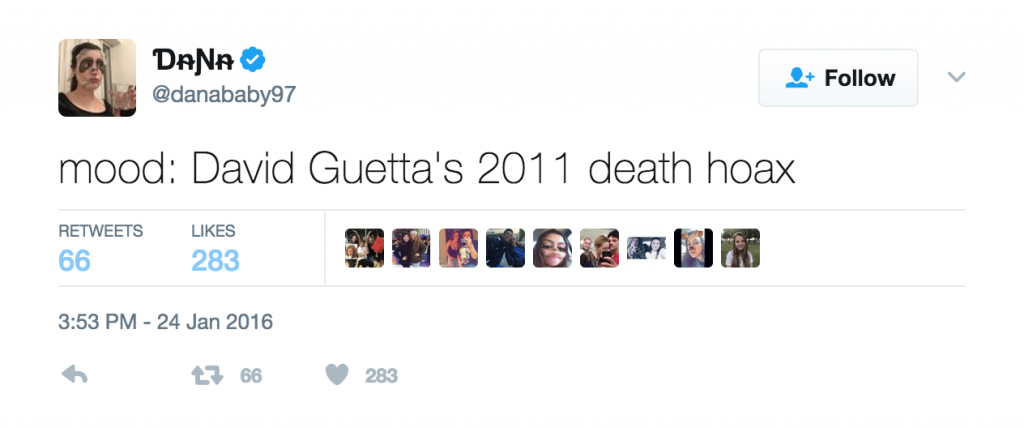
David Guetta’s Twitter death is treated with more levity and much less general coverage on the internet. His Twitter death is a kind of internet in-joke, more useable in memes than headlines, perhaps due to the fact that it occurred five years earlier than Spears’. As Twitter user @danababy97 has it:

@danababy97’s tweet: “mood: David Guetta’s 2011 death hoax”

Meyrowitz discusses this strange kind of murder even though it’s unlikely he anticipated something like Twitter culture, having written No Sense of Place in 1985. He wrote:

The para-social relationship has also led to a new form of murder and a new type of murder motive […] The para-social murder. In both love and hate, normal and bizarre, the para-social relationship is a new form of interaction. It has some of the traditional characteristics of both live encounters and communication through books, but it is, in fact, neither” (121)

I would argue that these Twitter murders rely on para-social interactions, further complicated by the user reciprocity (retweets, etc.) that Twitter encourages. These celebrities, digitally murdered on Twitter, live on in the way that “matters.” However, as Sherlock phrases it, “To what extent can digital representations substitute for those they refer to, and how could the death of the “original” affect public perceptions of the representations that continue to be perpetuated in popular culture? Ultimately, what effects might these digital ghosts or even reincarnations have on popular perceptions of death and mortality?” (165)

Meyrowitz sums up what I hoped this project would access pretty well:

Ironically, but appropriately, the media provide the most ritualized channels of mourning. Radio and television present specials and retrospectives. And many people use the telephone to contact real friends who shared the intimacy with the para-social friend. But the final irony is that, in some ways, the para-social performer does not die. For the only means through which most people came to know him or her—records, films, and videotape—are still available. The relationship is frozen, rather than destroyed. In part, it is the potential and hope for increased intimacy that dies, and the never to be face-to-face consummation of the relationship that is mourned. (120)

With these manipulated images, I wanted to “unfreeze” and refigure the relationships, casting doubt in some cases on the living status of these celebrities. Imagine what Meyrowtiz would do with the knowledge of the expanse of internet-mourning today—the Twitter funerals, Oscar and Grammy in memoriam slideshows, the endless barrage of grief-stricken updates on Facebook and Instagram. Sherlock follows this thought: “Paradoxically, while death has become less visible, mourning, particularly in response to the death of a public figure, has become more visible. The Internet and the media facilitate a new type of ritualized, collective mourning that potentially serves to distract mourners from the physical reality of death” (169).

The nature of the “reality” I have created here depends on this idea about the reproduction of images given in Sherlock: “The representation is even more real if you have never met the original—it is the original” (168). Without further evidence, how do we know for certain that what we’re seeing isn’t true? The people who engineered the Tupac hologram knew this was a powerful question to ask of celebrity.

CONCLUSION:

I found several aspects of completing this project thought-provoking beyond the comparison/analysis of the photos I manipulated and the sources I included. One of those thoughts has to do with the format of this project, being an accessible/public page on my website. What does it mean for someone to look at this page not knowing the context? Would they imagine these celebrities/people as living again? Sherlock also accesses this thought: “To what extent can digital representations substitute for those they refer to, and how could the death of the ‘original’ affect public perceptions of the representations that continue to be perpetuated in popular culture? Ultimately, what effects might these digital ghosts or even reincarnations have on popular perceptions of death and mortality?” (165) The lack of clarity was unsettling enough for me to install a password. Furthermore, Is this illegal? Sure, the images are licensed for public use, but who owns the rights to these celebrities’ “personality rights”? (In reference to the article we read, “These are the most influential dead people on Twitter”). Would they have been O.K. with being visually included at these events?

The next thing I found myself concerned with was that I was performing a sort of celebrity audit; In making the images, I would ask: Would this famous dead person have been famous enough to be in this situation? This idea was particularly central to Alan Rickman sitting behind Ryan Gosling, the Smith family, and more (Image 8), and Paul Walker in the Ellen selfie instead of Bradley Cooper (Image 4). Furthermore, this audit reaches another level in terms of the celebrities I chose to include in the project at all; the ones I have included already passed some sort of fame test. I found myself wanting to continue in the vein of these arbitrary inter/intra-celebrity classifications. As uncomfortable as this made me, it occurred to me that this kind of categorization is someone’s job. Think of the “rest in peace” segment at the Oscars and Grammy’s every year: What is the criteria for making the cut?

Sherlock mentions this idea: “In his article on fame, Halberstam describes it as a measure of having lived a ‘worthwhile, or at least noteworthy, life’ (1984, 96), making a mark on the world and gaining assurance that one’s existence has been noticed” (167). That seems like a vague set of criteria to me.

The last element of the project I found unsettling was the effect the formatting of my webpage had of creating a sort of dead celebrity “Where’s Waldo,” a virtual necromancy game. Ultimately, what does it mean to visually bring these people back to life in this way? As one of our questions in class asked, what does a social life look like for the dead? Hopefully, these images do something to answer that question in the context of celebrity—though I may have more questions than answers.

Word count: 1,990

Works Cited document

PDF of Artist Statement

An indirect look at grief: using Wikipedia articles as a medium for describing reactions to catastrophic events.

Upon reading about the US government Department of Energy’s preparations for burying nuclear waste, I became fascinated with the idea of creating a message that outlives entire languages, cultures, and civilizations. Although we currently live in the digital age, there is the looming possibility that what the world may look like 100, 1000, or 10,000 years may not be entirely progress, but regression. When one attempts to create a coherent message designed to survive as long as cave paintings are old now, it is interesting to think about how perspectives might be different due to the long-lasting presence that digital media has had. In a world where the internet is not really novel, is grief examined differently? Are tragic events viewed differently?

I decided to examine what a future civilization’s discovery of a nuclear waste disposal site might resemble. Because there are so many details that can go wrong, I thought it would be apt to assume the worst and have this future civilization undergo a catastrophic event in which thousands are accidentally exposed to dangerous radiation. How did these people cope with the loss of hundreds? Our brief examination of how people express grief online in social media was highly relevant. As digital media becomes more and more prevalent, it becomes the norm in everyday life. While some, myself included, might consider tweeting at a funeral distasteful, there’s no reason to think that this will not be the norm 100 years from now. I thought that my example created a great thought experiment in which a futuristic, globally connected world with technology that far surpasses humankind’s current capacities, handles a highly publicized catastrophic event.

In order to capture and depict the digital grieving in this future world, I decided to take in indirect approach. While I considered creating a mock memorial page dedicated to the victims of the incident, or creating a model replica of a physical memorial erected in memory of the incident, I created an ‘objective’ depiction of this hypothetical tragedy through a particular medium: a Wikipedia article. Of course, while Wikipedia’s existence (and really the existence of culture as we know it today) into the next millennia or two is up for debate, I used simply because it is a familiar way in which the everyday digital consumer searches for and receives information about their world. I also decided on this medium specifically because of its unique, collective method of recording and recounting history, which has historically been a very individualistic craft (Rosenzweig 117). Rosenzweig argues that the supposed objectivity of Wikipedia articles is misunderstood—the true meaning of a ‘neutral point of view’ as described by Wikipedia denotes the description of both sides of an argument rather than a presentation of an argument itself (122, 123). While this sounds sound in theory, I’ve personally found that it is much harder in practice, and some Wikipedia articles in my anecdotal experience seem to reflect this as well. Nevertheless, I thought that the potential for this dread bias to enter into what is a supposedly objective medium provided an interesting way to describe a tragic event in the digital age.

In actually creating these mock Wikipedia pages, I was heavily inspired by similar, real Wikipedia articles which describe events of mass death, such as the article detailing the events of the 2001 September 11th attacks in New York City, as well as the article describing the resulting memorial. While Wikipedia, as well as other informative sources, use objectivity and fact checking as a critical feature of their articles (Rosenzweig 123), one can’t help but gain a feeling of dread, loss, and tragedy when reading about these catastrophic events. The way they callously detail the number of victims, the perpetrators, the date, and afternoon is chillingly terse. Even more unsettling is if other related articles (or the article itself) contains a section detailing how this loss of life was memorialized. This is particularly fascinating because it is an ‘objective’ description of something that is inherently emotion (grief, sadness, and memorialization). I thought this was an incredibly fascinating way of examining how the grief surrounding this event is expressed.

Wikipedia articles can be strangely poignant when addressing mass casualty events, paradoxically because of their objective tone–the journalistic report of human death sounds as if it attempts to lessen its emotional impact, which of course seems to often produce the opposite effect on concerned readers.

The final product consists of two brief mock Wikipedia articles, one detailing the events that lead to the catastrophic opening of the vault containing radioactive material and its aftermath, and another detailing the construction of a memorial dedicated to the incident and its digital features. In particular a key feature that I gave to this monument was a blurring of the line separating the digital and the analog. While the memorial itself has physical form (it is a replica of the warning message that went unheeded on the waste disposal site), it also has digital capability. Today, when some tweets or posts to Facebook or Reddit, the most compelling thoughts are the ones that tend to be most visible: the system rewards the submissions that garners the most attention from other users (retweets, likes, and upvotes). This memorial takes the public’s digital submissions and displays in on the statue itself, so that the submissions incurring the most positive response are shown on the outskirts of the memorial (more accessible to those looking within from outside), those incurring the most negative response would be displayed in the center (requires someone to actively seek out these submissions), while those that don’t raise any sort of response are not displayed at all. How would an ‘objective’, journalistic record of history such as Wikipedia describe this monument in an age when digital media is the norm? This is the essence of my haunted media project.

Current records of online grief are controversial, to say the least. Garber  suggests that internet grieving is something that will grow on society to one day become a hardened social ritual, and that ‘grief policing’ assumes the worst of people rather than the best (Garber, accessed 2016). In the case of the 3/30 Memorial, would there be angry backlashers ‘policing’ what they perceive to be rather crude or immature inappropriate submissions that make it to the forefront on the monument’s display? I think so. One of the primary arguments that internet grieving is a natural thing is that it is merely a digital representation of what happens locally—the only difference is that these thoughts and actions are now visible to anyone with a smart phone (Garber). Phillips examines the phenomena of RIP trolling, and concludes that the activity may be attributed partly to an ‘amplification process’ in which each tragic event recorded online contributes to an ever escalating ‘troll’ response. Those emotionally unaffected by the event (the overwhelming majority of people online in a global network on any given moment) contribute crass remarks because they have the emotional distance to do so (Phillips, accessed 2015).

While Garber suggests that the internet provides a large, digitally connected forum in which ‘community grieving’ is possible. I must disagree and bring up the crucial point (also a primary point made by Phillips) that it provides just as large of a forum for grief policing. In considering Phillips’s thoughts, it seems then that internet RIP trolling is something that is unique to globalized, digital media. It is an inherent characteristic of a global communication network. In this sense, I do think that the 3/30 Memorial would display quite the amount of ‘trollish’ submissions—as any public, digital media forum would, whether in our time, or the future.

The emergence of digital media and globalized information networks truly are the agent of permanent social change. While I argue that basic human nature remains the same (hence the apparent immortality of RIP trolling and the derision of tragic events), there are aspects that are changed due to digital media, and the mock Wikipedia articles serve to demonstrate this change. Biddle demonstrates that suicide rates, methods, and success rates have undergone significant changes since the dawn of the internet (800-801). Biddle shows that while many people whose suicide have been attributed to internet exposure (such as online forums discussing suicide methods), there is indeed a subset of those who commit suicide who had a significant chance of avoiding suicide had the digital media available to them had not existed. Those who might have only considered suicide temporarily are exposed to chat room in which ‘peers’ pressure, and even drive, others to commit suicide (801-802).

I thought that this phenomena, and doubtlessly countless others which have risen as a result of the dawn of the digital age, could partially be attributed to Phillips’s amplification process. However, Biddle’s research also holds strong weight in Garber’s argument that online communication provides an outlet for permanent social change in which previously unquestioned social norms are often challenged relatively quickly and aggressively. I thought that this would be reflected in the 3/30 Memorial as well. There must be some messages and thoughts uploaded to the memorial that would have never have been even conceived of had it not been for the possibility that these thoughts and inklings could be displayed publicly. In this way, the mock Wikipedia page describing the 3/30 Memorial also demonstrates how digital media permanently warps social spheres and changes the very meaning of what one might consider ‘inappropriate’ in the digital age. While trolls have always existed, whether digital or not, it seems that the 3/30 Memorial in this project also serves to represent a shift in thinking regarding death and grief.


References

Garber, Megan. “David Bowie and the Rise of the Grief Police – The Atlantic.” N.p., n.d. Web. 6 Apr. 2017.
Phillips, Whitney. “LOLing at Tragedy: Facebook Trolls, Memorial Pages and Resistance to Grief Online.” First Monday 16.12 (2011): n. pag. firstmonday.org. Web. 6 Apr. 2017.

Rosenzweig, Roy. “Can History Be Open Source? Wikipedia and the Future of the Past.” The Journal of American History, vol. 93, no. 1, 2006, pp. 117–146., www.jstor.org/stable/4486062.

“WIPP Exhibit: Message to 12,000 A.D.” N.p., n.d. Web. 6 Apr. 2017.
Biddle, Lucy, et al. “Suicide and the Internet.” BMJ: British Medical Journal, vol. 336, no. 7648, 2008, pp. 800–802., www.jstor.org/stable/20509459.

True Funeral or True Bullsh*t?

screenshot of TrueFuneral’s homepage

In the midst of stressful job applications, one of my apartment-mates told me about an interesting startup that she had applied for called TrueFuneral.  Basically, their whole mission is to provide “online platform that empowers families with accurate and actionable funeral service pricing information” (quoted from their LinkedIn page). A couple things about this startup company strikes me as interesting with respect to our class discussion and readings. I checked out their TrueFuneral’s website, which was very straight-forward, clean, and simplistic in design. The first image that is spread across the home page is a young man and an old grandfather seeming to be in mid-laughter during a conversation. The words spread over their faces in large font size but non-aggressive font are “Losing a loved one is overwhelming. Planning the funeral shouldn’t be.” I immediately notice how this website and this company make the topic of death as “happy” and life-like as possible. No one is mourning, natural-like lighting is used for the photograph, people are laughing and living, there isn’t a funeral, coffin, ern, or any implication of a recent death in sight.


If you click the “About Us” link, more general information about the company shows up with similar photos. Mainly young people or families apparently dealing with a recent loss of their loved one. The only picture that displays old people is a zoomed in photo of a couple holding hands, but the frame of the image contains only their hands that are holding. Knowing that TrueFuneral is a company trying is profiting off of individuals and families grieving the loss of a loved one, whether there is mal-intent or not, this makes me feel a little conflicted. This company seems to do a good job of showing the best prices and options available for funeral services (or at least their website is doing a good job of convincing me of this). However, the fact that this company seems fixated on making its branding as far from death as possible makes me think about who is behind the scenes saying something along the lines of “Hmm… If we use this picture, will it attract more people to use our services over others and subsequently bring in more money for us?” This website made me think about the Australian memorial page that we looked at in class, and how the memorial pages that got the most “likes” were of those who were the least likely to have been associated with death (a natural one at least). I think it is also important to mention that my apartment-mate said that the company is going through a name change! Instead of TrueFuneral, the company will soon be called TrueSolace! So even the name of the company shifted its attention from the dead to the mourning. I guess it makes sense, this company can’t profit off of the dead!

screenshot from the “About Us” page on TrueFuneral

Though in class we discussed and read in class on whether there is a place for us to police grieving, I think in this case my policing of this company is different from that of our class’ criticisms on the Australian memorial page. The pages on the Australian website were made by those who were mourning. The TrueFuneral website, however, is made by a company trying to target those who are grieving.