After discussing various episodes of Black Mirror in class, I decided to go ahead and binge watch all of the episodes. One of the episodes that stuck out to me specifically for this class was episode 4 of season 3, “San Junipero.” The episode is ultimately about life after death through technology. San Junipero is a virtual town full of dead people’s consciousness who are able to live as their younger selves forever. The living but dying can visit the town for up to 5 hours per week as a trial to test whether they would like to be uploaded into the town. As with many Black Mirror episodes, the music can explain what’s really going. The songs: “Heaven Is a Place on Earth”, “Fake,” “Living in a Box,” and “Girlfriend in a Coma,” almost have ironic meanings since this heaven on earth is “fake” and is a literal box of data. The episode plays with our society’s notions of heaven and fear of death.
Different religions have different explanations as to what happens to humans after death. San Junipero provides it’s own explanation and relief from the anxiety of impending death and the fear of the unknown. The dying know exactly what to expect and have a choice of when to die and where they will go after death. The episode, like “Be Right Back” also plays with the notion of intimacy and love of something that isn’t totally real. If someone you loved chose to be in San Junipero would you follow? The episode shows the romance of an elderly dying woman and a middle age paraplegic woman, yet in San Junipero they are young, beautiful and healthy. The question still remains can technology replicate personality and unique qualities that make up a person? If stripped away of all the imperfections, are you still the same person?
I also found a very interesting article about a company that claims it can transfer consciousness to an artificial body. The company “Humani“, promises that within 30 years they can cheat death. Using nanotechnology, and artificial intelligence, Humai is saving the way people talk, their behaviors and thought process to recreate consciousness. The CEO of the company, Josh Bocanegra said, “I don’t think of it as fighting death. I think of it as making death optional. I personally cannot imagine why someone would want to die, but I respect everyone’s wishes.” I would imagine this endeavor is very expensive and if the technology is sound, will only provide access for the very rich. It is also problematic since we all know how finicky technology could be. What happens if the data becomes corrupted or broken, a virus is installed or God(?) forbid hackers try to infiltrate the system. The last scene of the episode truly shows the frailty of San Junipero and this technology as the after life of individuals is stored in a huge warehouse run by robots. If an accident occurs, will your afterlife be cut short?
For my project I created a Twitter bot that tweets as Albus Dumbledore from beyond the grave. You can find the twitter profile here. Below is my artist’s statement, detailing the goals I had for this project, as well as the process I went through in creating the finished product.
Between these two articles, I noticed a commonality: the idea of communication with either a person or idea that has passed on. Thinking back to what we witnessed in the Black Mirror episode “Be Right Back,” I was particularly drawn to Thomas Edison’s idea of there being a possibility of, “personalities which have left this earth communicat[ing] with us” (Zarrelli). I believe that many people would want to communicate with their loved ones who have passed on, so I drew on that idea and decided that I wanted to create something that could, using scientific methods, as Edison intended, allow this possibility to become a reality (Zarrelli). Looking at the different possibilities for how I could achieve this communication, however, I was not sure that a phone would be the proper method. Theoretically, it would be wonderful for us to give a phone call to our loved ones who have passed away, but I wanted to come up with something more unique.
With an increasing percentage of the world taking part in social media, the world is now more connected than ever. In relation to death and the death experience, this connectivity is seen as something that can be a good thing. According to an article published in The Journal of Continuing Education in Nursing, social media offers seriously ill and dying individuals the ability to communicate with distant friends and family, and offers a place of support for loved ones, by connecting them to people who have gone through similar experiences (Billingsley & Currie 435-436). In fact, more and more people are turning to social media and the Internet when there is something that they do not know and when they are seeking advice on situations (Billingsley & Currie 435). Knowing this, I became interested in exploring my idea of communicating with the dead through the use of social media.
Though we had read articles exploring Facebook’s effects on the grieving process, and how Facebook has changed memorialization, we did not delve too deeply into Twitter. As Twitter is one of the most used forms of social media in the world, this surprised me. Twitter is considered quite similar to blogging—though it can only be done in 160 characters—and has such, has been shown to have emotionally cathartic effects (Keim-Malpass & Steeves 378). Tweeting and following the tweets of others undergoing similar painful situations, such as a death or serious illness, can help alleviate some of the pain and encourages acceptance and progression through the necessary steps in the grieving process (Keim-Malpass & Steeves 378). Thus, I believed I should embark into uncharted territory and form some form of memorialization service using Twitter.
Not really knowing where to begin with Twitter, I drew inspiration from the Chiel article about Twitter bots. According to Chiel, “bots…are programs that use an application program interface (API) to post to or pull information from various services.” In simpler terms, a Twitter bot is able to run a program that sorts information to generate tweets. The types of bots that exist are as varied as their creators: “programmers, artists, journalists, and anyone else who feels like making bots” can create bots that, “sort pixels, suggest Marxist startup ideas, or behave more like teens than teens” (Chiel). What attracted me to the idea of using a Twitter bot for this project was the low maintenance of the bot. For example, some bots can run uninterrupted for three years without any effort from their creator (Chiel). I also knew that I needed to create something that could function on its own, without my having to constantly draft a tweet and then send it. As this is a Haunted Media Project, I found a sort of poetic justice in creating something that could outlive me. The Twitter Bot could be doubly haunted—outliving its creator, and the person it was created to memorialize.
The only problem with generating a Twitter bot, is that I am not a programmer. I do not know how to code, and I am blissfully unaware of the inner workings of user interfaces and, honestly, computers in general. Thankfully, there are quite a few services available that provide step-by-step instructions on how to create your very own Twitter bot. I used one of these instruction guides, created by Zach Walen. The guide was extremely helpful in walking me through the process to create an autonomous, self-tweeting Twitter Bot. Another aspect of Walen’s guide that made it even more accessible to my programming-illiterate mind, was the fact that the majority of the program is run in a Google Sheet. Those interested, can view the Google Sheet containing my “code” here.
For my Twitter bot, I chose to memorialize one of the most beloved, but deceased character’s in the Harry Potter franchise: Albus Dumbledore. Beginning this project, I knew that I did not want my Twitter Bot to simply tweet out famous quotes of Dumbledore. While this would memorialize the character, it did not evoke my original goal of providing a form of communication with the deceased. I thought it would be fine for the Twitter bot to tweet out Dumbledore’s quotes occasionally, but I also was inspired to have the bot generate tweets that were original, yet still seemed as though they could have been said by Dumbledore. Walen’s guide provided a few options for how the Twitter bot could generate tweets, but keeping my goals in mind, I chose to use Walen’s guide for creating a Markov Twitter Bot. This means that my Twitter Bot runs on a Markov-chain algorithm to generate new tweets.
That sounds immensely intimidating and complex, but in reality is quite simple. A Markov chain is defined as, “a sequence of events the probability for each of which is dependent only on the event immediately preceding it” (dictionary.com). The “events” for my Markov chain are the words being tweeted out. On my google sheet I have a page where I entered everything that Dumbledore ever said in the books of the Harry Potter series (an exhaustive process—he speaks often and can be long-winded). To my understanding, the algorithm randomly selects a word to begin the tweet. It then scans through all of Dumbledore’s quotes until it finds a word that is highly probable of following the word selected before. This process continues until the tweet is generated.
Therefore, the final tweet is something that may never have been said by Dumbledore, no matter how likely it may seem. For example, the first tweet generated by the bot was, “It is no immediate danger.” I checked through my spreadsheet, and I have no record of Dumbledore ever uttering that specific sentence. Sometimes, however, the bot can create a nonsensical tweet. Immediately following “it is no immediate danger,” Dumbledore tweeted, “head of our words.” While not possessing a true meaning, I think that these nonsensical tweets still capture the eccentricity of Dumbledore, and still evoke his character as the reader tries to decode what the wise Dumbledore could mean with his strange musings.
All in all, I am extremely pleased with the final result of my Twitter Bot. I think that it accurately captures Dumbledore’s character, and provides a new outlet for continued communication with the character, though he is deceased and the book series has ended. Lastly, and I am most proud of this, I believe that my project demonstrates the efficacy of using Twitter as a way of continuing on a person’s presence after their death. While the bot cannot respond to messages, and therefore cannot carry on a conversation like the online reincarnated presence of Ash in “Be Right Back,” it still can provide new material that retains the essence of those that it seeks to emulate. Thus it serves as a way for people to still communicate with the dead, though it is not as two-sided as I wish it were.
I do believe that my project could be extrapolated and used to memorialize other, non-fictional persons as well. All that must be done to memorialize someone else would be to change the input of the Markov algorithm. With the Library of Congress attempting to archive all tweets, it would be incredibly simple to memorialize someone’s twitter persona. We would simply need to input all of their tweets to allow the Markov algorithm to generate new tweets. Thinking of the different services we have seen for memorialization—as well as Be Right Back—I could even see the creation of these Twitter bots being something that people eventually generate a profit of off, though I hope that it would always stick to my original plan of simply being a means for someone to still feel as though they are communicating with a deceased loved one.
Works Cited
Billingsley, Luanne, and Paula S. Currie. “Using Social Media to Share the Death Experience: Discussion Points.” The Journal of Continuing Education in Nursing 44.10 (2013): 435-36. ProQuest. Web. 5 Apr. 2017.
Chiel, Ethan. “What Happens to a Twitter Bot after Its Maker Dies?” Fusion. Gizmodo Media Group, 01 Mar. 2016. Web. 06 Apr. 2017.
Keim-Malpass, Jessica, and Richard H. Steeves. “Talking With Death at a Diner: Young Women’s Online Narratives of Cancer.” Oncology Nursing Forum 39.4 (2012): 373-78. ProQuest. Web. 5 Apr. 2017.
“markov chain”. Dictionary.com Unabridged. Random House, Inc. 5 Apr. 2017.
Zarrelli, Natalie. “Dial-a-Ghost on Thomas Edison’s Least Successful Invention: The Spirit Phone.” Atlas Obscura. Atlas Obscura, 18 Oct. 2016. Web. 05 Apr. 2017.
On September 12th, 2008, David Foster Wallace ended his own life by hanging himself on the patio of his home in Claremont, California, shortly after writing a two and a half page note to his wife and neatly arranging the manuscript and pages of edits for The Pale King under the light of the desk he worked from in his air-conditioned garage. In an interview for the guardian, his wife, Karen Green, said, “It all turns him into a celebrity writer dude, which I think would have made him wince, the good part of him,” but nonetheless she followed through on what seemed to be one of her husband’s last wishes and saw through the publication of The Pale King. As Taylor Marshall remarks in an analysis of the unfinished novel, “David Wallace’s 2008 suicide ignited intense public devotion to the man, both within and without the academy” (113).
David Foster Wallace’s suicide was the result of a long battle with depression that he ultimately lost after trying to switch, and then wean himself off the antidepressants he had been living on. He had earned a national audience and celebrity-author status with the publication and success of Infinite Jest a decade earlier, but his death brought him an even larger cult following and attention, even if he did not want or anticipate that. I was initially introduced to DFW’s writing through a friend who directed me to the graduation speech he wrote for Kenyon College in 2005 called “This is Water.” With it, I was introduced to DFW’s tendency to dole out advice for getting through life, specifically finding beauty in boredom (granted, it was a graduation speech). Within the mammoth of a novel that is The Pale King, DFW offers similar anecdotes, harping again and again on tedium, boredom, and little snippets of life advice.
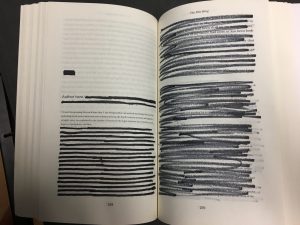
The reason I was drawn to DFW for the Haunted Media project was exactly for his ability to offer a way through the monotony and bleak aspects of life while he himself was unable to overcome them. He wrote a story called “The Depressed Person” and even wrote a short blurb sympathizing with those who commit suicide. In retrospect, his suicide seems obvious and expected. The Pale King itself provides a particularly interesting case to work with. The mock memoir structure that DFW creates further casts the novel as a haunting piece of literature. At two different points he addresses the reader, saying, “Author here,” and going out to clarify in a footnote that “I won’t keep saying this each time that I, the living author, am actively narrating” (258). There are moments like this throughout the novel, moments where we’re abruptly reminded of the fact that DFW is not, in fact, a living author anymore, yet this book still seems to breathe. In his analysis of the novel, Robert Hamilton says, “In short, this is hardly the first of Wallace’s works to stop short in an abrupt and at least superficially unsatisfying manner,” and notes how the novel has been read as “(merely) a last will and testament” (169). In In the editor’s note prefacing the novel, Michael Pietsch refers to book as “an unfinished novel,” and said, “Although not by any measure a finished work, The Pale King seemed to me as deep and brave as anything David had written. Working on it was the best act of loving remembrance I was capable of” (xi).
Inspired by Megan Garber’s “Enter the Grief Police,” and Alexandra Sherlock’s piece on re-enchantment, I was interested in conflating the immense project of assembling the novel that Pietsch took on as an act of grief and the “google-able” quotes that DFW’s legacy has largely become. So who is right? Is Pietsch hiding an economic incentive behind what Garber’s Grief Police would call crocodile tears? There may not be a digital recreation of DFW, but how is his legacy complicated by the fame that his death and posthumous publication brought him to? Should an unfinished novel be thought of as the author’s last word? Sherlock makes the case that fame is a gateway to immortality, so despite DFW’s widow saying he would have hated to become so famous after his death, his suicide seems to have had the opposite effect, allowing him to transcend death rather than embrace it.
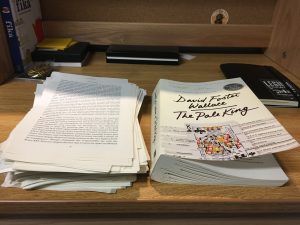
Plug in “The Pale King Quotes” – or anything followed by the word “quotes” for the matter – and you will almost always be greeted with a link to goodreads.com at the top of the page. For this project, I’ve taken every quote listed on Good Reads and a few from other websites (sifting through a lot of overlap) and have “highlighted” them in the text by blacking out every other word on the page. Pages without any quotes? Ripped out. Within the 549 pages of the novel, there are (not surprisingly) an incredibly small number of sentences left. Some of the pages are nearly covered in black, a single line or two buried within other pages not deemed worthy by Good Reads users. I chose to blackout certain elements of the paratext, underscoring his suicide while also getting rid of any plot description (there wasn’t much plot left after I roped out hundreds of pages). I chose to leave all of the opening pages that included blurbs, forewords, and legal information in order to highlight both the commercial nature of the project and the impact it had across the world of writing. I blacked out sections in two distinct ways. Some of the sections’ black lines run crisply in line with the sentences to evoke classified documents and parallel the tedium represented in the novel’s I.R.S. paperwork-content. Furthermore, blacking out sentences in such a way provides tedious work in itself, and as DFW says, “If you are immune to boredom, there is literally nothing you cannot accomplish” (440). Other sections are furiously scribbled out in swathes of black sharpie ink, speaking to the frustration of DFW’s decade-long editing process and his inability to finish the work, as well as provide an image symbolic of depression.
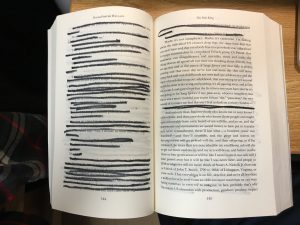
There were a few things that happened during the process of creating this artifact, this carcass of a book, that I did not expect going into it. First, I did not anticipate just how creepy some of the quotes would be in light of his death, and at points I had to step away from the project. Page 145 has only three lines blacked out, the rest consisting of a long anecdote all about our inevitable deaths and our attempt to distract ourselves from the fact that “we’re all less than a million breaths away from an oblivion more total than we can even bring ourselves to even try to imagine” (145). There were times that I so closely identified with a quote that my I had that beautiful moment of recognition of seeing my own feelings I didn’t know others felt written so eloquently put into words, and then throwing the book away from me after realizing its writer was unable to overcome these feelings. (Now is a good a place as any to note that while DFW wrote often about depression in a fictional sense, he never openly wrote about his own struggles).
Pgs 144-145, a rather bleak outlook on life. Or death, rather.
Secondly, and maybe it’s just my liberal arts English major speaking, but I couldn’t help but feel I was vandalizing the book. Of course DFW doesn’t care, he’s dead! But it felt a little bit like burning a photograph at a funeral. Sure, there are millions of copies out there and I even have the digital Kindle version, but the novel’s unfinished state and posthumous publication gave it a sense of delicacy that gave me unease more so than if I had taken a sharpie to any standard high school summer reading assignment (ripping pages out felt like straight blasphemy).
Thirdly, Good Reads may have a monopoly when it comes to Google-searching for quotes, but scrolling beyond the most “famous” quotes revealed a hidden intimacy between DFW and his readers. Good Read sorts the quotes based on likes from user profiles. The most-liked quote, “How odd can it be that I have all this inside me and to you it’s just words?” is ranked with 633 likes, but the numbers quickly drop. Scroll to the bottom of the page and you’re down to just 15 likes, and the last two pages of results are quotes uploaded and liked by a single user. Given DFW’s harping on loneliness and the sadness surrounding his death, there was something comforting in these singularly-liked quotes.
What I was ultimately left with was a haunted artifact that conflated the physical and digital legacies of an author published posthumously. In the digital age of clickbait and short attention spans, DFW’s The Pale King makes for both a good headline (suicidal author’s posthumous publication) and offers plenty of easily digestible quotes (because who has time to read that long of a book?). In an article for The New Yorker, D.T. Max argues that The Pale King “would show people a way to insulate themselves from the toxic freneticism of American life. It had to be emotionally engaged and morally sound, and to narrate boredom while obeying the physics of reading,” yet ironically most the of famous quotes on good reads are not the optimistic pieces of advice but rather the anecdotes that highlight the toxicity Max references. This haunted artifact serves as a conflation of literary and digital grief for the author, and while I was left with a skeleton of a quote book, I was also left with hundreds of torn, untouched pages that a man had poured his soul into.
Works Cited
Garber, Megan. “Enter the Grief Police.” The Atlantic. 20 Jan, 2016.
Hamilton, R. C. ““Constant Bliss in Every Atom”: Tedium and Transcendence in David Foster Wallace’s The Pale King.” Arizona Quarterly: A Journal of American Literature, Culture, and Theory, vol. 70 no. 4, 2014, pp. 167-190. Project MUSE, doi:10.1353/arq.2014.0029
Marsh, S. T. “Self-Sacrifice in the Autobiographical Narration of David Foster Wallace’s The Pale King.” Biography, vol. 39 no. 2, 2016, pp. 111-128. Project MUSE, doi:10.1353/bio.2016.0025
Sherlock, Alexandra. “Larger Than Life: Digital Resurrection and the Re-Enchantment of Society.” The Information Society, 29: 164-176, 2013.
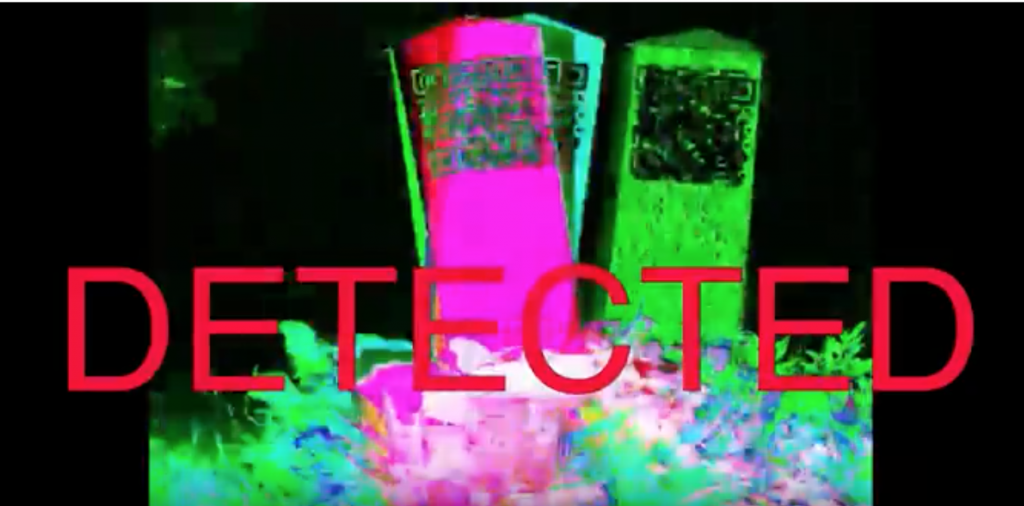
Shrine File is a corrupted collection of data that dictates passage of the self. When your physical form fails, where is the self enshrined?
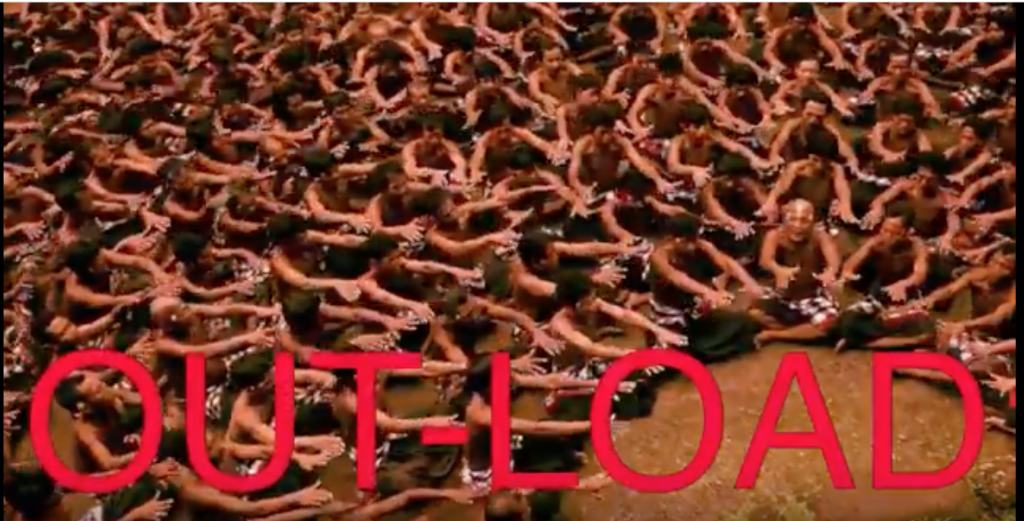
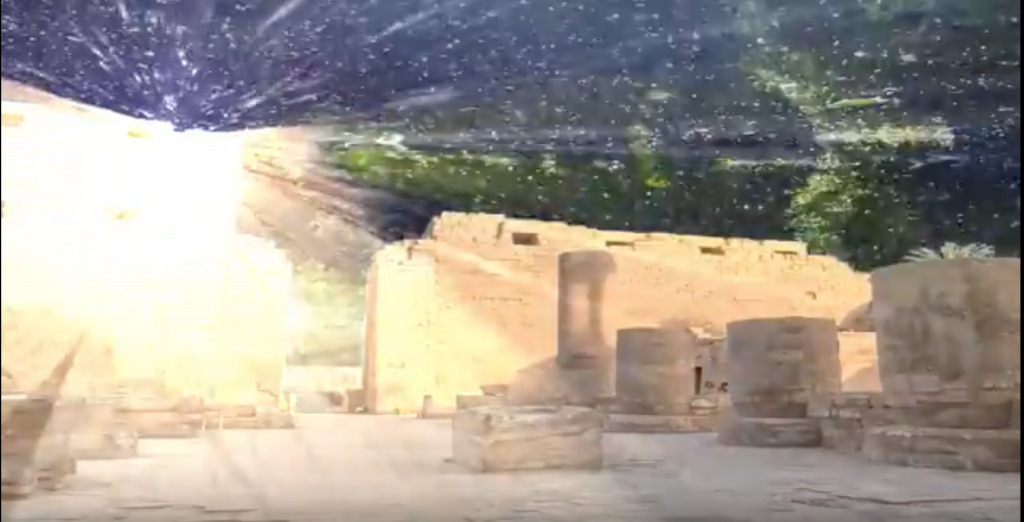
The file visually imagines the digital intersection of sacred and profane: 360 videos of ancient tombs and chapels are layered with everyday masses of human flesh alongside suggestions of an infinitely folding universe. Tombstones branded with digital codes melt into a physical human hive. The file exists between the moment of life and death. The moment the self can be digitally enshrined before dissipating. It exists between the individual self and the collective human cloud.
Emile Durkheim wrote that “religious and profane life cannot coexist in the same space…religious and profane life cannot coexist in the same time.” (The Elementary Forms of Religious Life). Man is not sacred: he creates this through ritual and belief. The ritual sets the sacred apart from everyday life. The afterlife wisps beyond our everyday grasp, but with the digital shrine we draw it closer. Our afterlife becomes a “tangible” set of digital artifacts — how do we populate them, position them, secure them, maintain them?
The digital shrine becomes the totem laden sarcophagus. We spend the lifetime preparing the Shrine File so that we can die immortal.
“A coded human existence is one without the singularity of the liberal subject. Instead of a multiplicity of singular wills or a cacophony of different spirits and personalities, subjects are transcribed into codes operating via variations of ones and zeroes.” (Anna Piepmeyer). Choose ENCODED: the file imagines such a human code. Individuality is transformed at the moment of physical death: from the gravestone emerges a collective force, a glitched soul enmasse. “We are now on the threshold of a new mutation.” (Slavoj Zizek).
Is the coded mutation/the hive/the noosphere simply a colossal collective of the everyday profane? Or does it elevate into the realm of gods? For Durkheim, sacred cannot exist unless differentiated against profane. The binary is necessary to construct separate sacredness. The glitched, grubby digital is a profane shell, unreliable and easily broken. The collective hive, jacking the code as a ground, remains sacred.
Choose TEMPLE: “Join us,” screams the chorus as they whirl through ancient sacred grounds. Can you know a sacred god or the devil through these secular, digital bits? Instead of a physical site, we embed the mementos of self here, in these holy reconstructions. Navigate your keystrokes to mourn, to memorialize, to pray.
This project arose out of the integration of digital death into everyday life. For centuries, death was aesthetically understood as a “natural part of life,” where physical grave sites “connected [living communities] with the death and [gave] a sense of unity with nature even in the face of the chaos of death.” (Graham, 38).
The “back to nature” — through land or water burial or burning — death process was ritualistically separated from the fabric of everyday life.
Spending time in online space is an everyday part of life; so can something like Facebook Memorial walls ever cultivate a sense of sacredness amongst the profane streams of daily chatter? When presented with so much content, whether kids taking selfies at a funeral or heartfelt condolences posted online, can any of it be sacred if none of it can be separated from the profane?
Brubaker, Hayes, and Dourish examined Facebook as a site for death and mourning. They note how “features like the Newsfeed often continue to inject death into otherwise typical Facebook use.” (157). Interview subjects varied between feeling like Facebook was cold and impersonal and feeling like it was a productive way to “make readers feel a little more at ease about the death.” (156).
Graham et al. addressed a digital memorialization page called HeavenAddress in their exploration of physical and digital grave sites. Unlike Facebook, HeavenAddress is specifically made for remembering the dead. But it still reeks of normative social media qualities — people can like and share the obituary pages, tap “love u/miss u/thank u” buttons, and leave digital candles and flowers. In the most contrived move, users can also vote on words to create a word cloud inspired by the deceased.
Brubaker et al. would characterize something like HeavenAddress as a feature of postmodern death: the boundary between public and private mourning is eroded, and many of the publicly expressed feelings are expressions of individualism, not collectivism. The social sharing and writing is oriented around digitally performing for the living.
Online bereavement provides immediate connection across physical boundaries and social groups, which Brubaker et al. call temporal, spatial, and social expansion. Because of this convenience of connection, death will never go offline. But how we choose to approach death online should be a matter of concern.
For Durkheim, the distinctions a society chooses to make between sacred and profane is the basis for truth and collective memory of the society. Sacred rituals produce “continuity over generations,” and in this way, “societies become conscious of themselves and their history.” (Coleman, 67).
If digital forms of death content are to provide a sacred space and collective memory, then they must become ritualized and separate from typical forms of online content. Already, online users can access 360 view videos of temples, chapels, and ancient religious ruins; I can imagine a world where accessing simulations of sacred sites become part of the digital death ritual.
On the flip side of imagining this sort of ritualized online visit to the TEMPLE is the process of being ENCODED; to ritualistically shed the cult of individuality and tap into the collective. Perhaps this is the point where instead of using the remnants of a digital self to remember and memorialize an individual (and to leverage mourning as a way to express the individual self), the content is passed into the collective memory. “Detected/in-loading/load” text on the ENCODED video generally suggests a sort of information gathering, akin to Facebook, but the uploading process is without individual imagery.
The two videos are halves of an imaginary file, corrupted by age and outdated technology. It is a capsule of futuristic digital death rituals discovered even further in the future. The audio tracks are suggestive of myth, mystery, and secrecy — one, a rock song that when played backwards allegedly contains Satantic messages (this, out of 80/90ies heydey of deliberate backmasking that became so dramatic that California passed a bill banning backmasking that “can manipulate our behavior without our knowledge or consent and turn us into disciples of the Antichrist”). The second is a non-verbal synthed chant layered and repeated to provoke a feeling of otherworldly, unbounded encounters.
For the digital world to become a more significant meaning container for death, we have to be deliberate about separating our death rituals from the everyday flow. Postmodernism dictates that these boundaries between sacred and profane will erode and collapse; but when that happens, our collective consciousness becomes flimsy and our collective memory myopic. Ritualizing death as sacred, even in online space, reminds us of our mortality while simultaneously creating a collective consciousness that transcends the individual.
Works Cited:
Brubaker, Jed R., Gillian R. Hayes, and Paul Dourish. “Beyond the Grave: Facebook as a Site for the Expansion of Death and Mourning.” The Information Society 29.3 (2013): 152-63. Web.
Coleman, Elizabeth Burns, and Kevin White. “Stretching the Sacred.” Negotiating the Sacred: Blasphemy and Sacrilege in a Multicultural Society. Canberra, A.C.T.: ANU E, 2006. 65-78. Print.
Graham, Connor, Michael Arnold, Tamara Kohn, and Martin Gibbs. “Gravesites and Websites: A Comparison of Memorialisation.” Visual Studies 30.1 (2015): 37-53. Taylor and Francis Online. Visual Studies. Web.
THE CREATIVE NARRATIVE BEHIND THE CRAIGSLIST AD, THE CUCKOO CLOCK, AND THE JOURNAL ENTRY
Backstory
Mort Lindheimer loves the author Ray Bradbury. So much so, in fact, that he carried Fahrenheit 451 in his backpack during college wherever he went, the pages tabbed down and thumbed soft. It was Bradbury’s short story, There Will Comes Soft Rains, that kept Mort up late at night, fascinated by the concept of a mechanical house that, in the absence of human touch, breaks down against the backdrop of a “radioactive glow” (Bradbury 1). Mort doesn’t trust technology and he gets goose bumps thinking about the charcoal silhouettes of a man, woman, and their two children inscribed onto the walls of Bradbury’s fictional house after an atomic bomb.
Part 1: The craigslist ad
For his fiftieth birthday Mort’s wife, Calliope, purchased a miniature model of the Bradbury house on craigslist: a collector’s cuckoo clock that promises to recite the poem played in the children’s nursery each time the hour strikes.
Part 2: The clock
Mort is thrilled with Calliope’s gift and the two excitedly wait for the hour to strike to hear the poem recited. However, to their great disappointment, the clock makes no noise and what’s worse, the hands tick counter-clockwise. Disheartened, the couple finally go to sleep, leaving the clock on the dresser.
When they turn out the light, Mort hears a small buzzing noise, almost imperceptible and yet impossible to ignore. Exasperated, he realizes it’s issuing from the clock. He inches closer, pressing his ear against the clock to amplify the soft noise. What he hears is not a poem at all but rather a monotone voice repeating a short phrase with no inflection. It takes him multiple tries to decipher the fragmented words:
Intruder next to you
Do you see me here
Danger obscured
A chill runs through him and he looks instinctively around the room. Intruder? Thoroughly unsettled, Mort feels a sudden urge to get rid of the clock, sensing some inexplicable presence in the room. He grabs the clock and dumps it in the trash outside.
Part 3: Mort attempts to reconcile the events of the night by writing in his journal
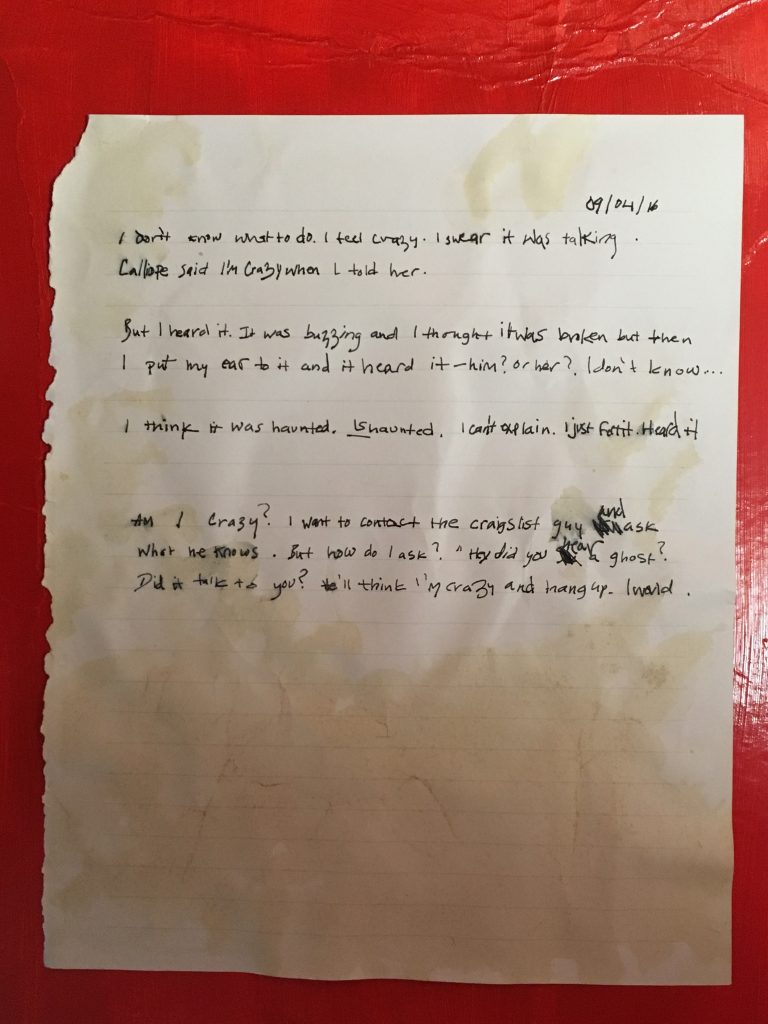
In the morning, Calliope is outraged by Mort’s rash decision. He himself is unable to explain the strange happenings of the night, as reflected in his journal entry.
Mort attempts to make sense of the night’s events in his journal entry
Unbeknownst to the couple, the clock is haunted by the spirit of a real family of four from the Cold War era who met a similar fate to that of the fictional family outlined in charcoal on the walls of the house. When the artist created the clock he accidentally set the clock backwards, literally going back in time and summoning the dead of the historical past. The family became trapped within this miniature model, warning of danger and crying for help. This faulty clock is a home for the undead, a shrine for restless spirits. The “intruder” referenced in its warning isn’t a physical trespasser but rather the ubiquity of technology as an unrealized threat—danger obscured.
ARTIST’S EXPLANATION
The cuckoo clock is comprised of three main elements:
1. The charcoal images of the family on the wall that symbolize the danger of technology,
2. the light sensored-voice that speaks of imminent danger and symbolizes the intersection between advanced sound technology and death,
3. and the counter-clockwise clock, a nod to the postmodern blurring of boundaries between death and life and the construct of time.
When I first began this project I was inspired by Ray Bradbury’s concept of a mechanical house capable of self-regulating and functioning (almost) entirely independently. However, despite its human-like self-regulatory qualities, the house is ultimately unable to sustain itself without human presence. I tried to reflect this hyper-digitized space in my clock design. You’ll notice that the circuit playground is featured prominently. I chose this placement because I wanted to situate technology as central to the house’s identity. The decorations are also technologically produced; the bird is 3D printed, the engraved banner and wood birds are laser-cut, and even the grass is a synthetic silver color rather than green. Additionally, the warning message emitted by the circuit playground when the lights dim or go out is coded as a repetitive loop to highlight the limitation of the technology (it can only repeat, not respond or explain).
1. The charcoal images of the family on the wall symbolize the threat and danger of technology.
Bradbury’s reference to an atomic bomb is an important reminder that the ubiquitous presence of technology within society is dangerous as much as it is convenient. The black spots left by the family on the wall of the house are historically grounded. As Alan Taylor points out in “Hiroshima: Before and After the Atomic Bombing,” victims of the atomic bombings of Hiroshima left shadow-like imprints on buildings and roads. History is never far away in these discussions, and as Isabel Pinedo points out in her article “Recreational Terror: Postmodern Elements of the Contemporary Horror Film,” postmodernism itself can be understood as “the cumulative outcome of repetitive historical stresses, including the Holocaust, the bombing of Hiroshima, the Cold War, the war in Vietnam…” (Pinedo 18). References to Hiroshima can thus be seen as part of a larger cultural narrative that continues to haunt contemporary society through its unresolved memory in an increasingly technologically-driven world. Maria del Pilar Blanco and Esther Peeren note in their book Popular ghosts: the haunted spaces of everyday culture, “…ghosts therefore often operate as erratic monuments or hieroglyphs that signify a disturbing incident that happened in the past, a secret that has to be deciphered in order to understand the repercussions of the past” (Pilar 187).
With this in mind, I imagined the haunting in my project on multiple levels, both literally through the mechanized voice, and figuratively in the shadows that remind us of a larger technological death. When I was designing the audio element of the clock, I chose the circuit playground as my sound source, rather than a pre-recorded audio chip. The reason for this is because the circuit playground muffles sound and limits the contents of its message to Arduino’s basic speech dictionaries. The barely audible volume and incomplete message must thus be decrypted as cultural “hieroglyphs” —my attempt at exploring this concept of deciphering the past.
2. The light sensored-voice that speaks of imminent danger and symbolizes the intersection between advanced sound technology and death.
When designing and coding the sound component of the project, I was inspired by class readings regarding sound preservation and its connection to death. In his book The Audible Past: Cultural Origins of Sound Reproduction, Jonathan Sterne uses the example of the revolutionary introduction of the phonograph during the 19th century to explore the symbiotic relationship between popular conceptions of death and the power of the disembodied voice. Sterne describes popular beliefs of the time which justified a potential connection to the spirit world using the argument that “…media are forever setting free little parts of the human body, mind, and soul. If the voices of the dead were, indeed, free agents, perhaps they could then be enticed back into the world of the living” (Sterne 289). There’s a certain logic here; the fragmented, pixelated nature of technology offers the possibility of preserving human life in an equally fragmented (yet nonetheless present) continued existence. Given this logic, it’s not so hard to believe in ghosts: voices of the dead, fragmented as isolated parts, get trapped in human objects (such as a cuckoo clock). The clock serves as a metaphorical coffin for these spirits, “embalming” their voices (Sterne 293).
Blanco and Peeren speak of a similar relationship between sound and death, noting, “The utter non-referentiality of this medial space endorses a transgression of the dichotomy of ghostly and human realms, so that the dialectical questions evoked…(Is it ghostly? Is it real?) are swept off the table by the annihilating gesture of mediation” (Pilar 289). In other words, Mort can no longer distinguish what is real and what is merely a creation of his mind because he is a subjective mediator. His ears filter and interpret the sound of the clock in a meaning-making process subject to embellishment, mishearing, and forgetfulness. In his journal entry, Mort struggles to trust himself as a mediator and interpreter of what he heard. The transgressive nature of the auditory thus lies in the fact that it blurs the boundaries between the real and the unreal, placing the onus of this distinction on the human listener (Pilar 291).
This dissolving and blurring of boundaries through the hybridity of previously distinct categories and identities is characteristic of postmodernism and “…the erosion of universal categories, the collapse of faith in the inevitability of progress, and the breakdown of moral clarities” (Pinedo 17). Indeterminacy, the result of this erosion, leads to the conviction that we cannot know anything with certainty (from class discussion). This is reflected in Mort’s spiral of confusion and self-doubt in his journal entry. Equally important to the postmodern space is the triumph of intuition over rationality, and even the failure of rationality all together. Mort is unable to reason through this instinct to destroy the clock and he struggles to explain his actions to his wife for which there is no rational explanation.
3. The counter-clockwise clock is a nod to the postmodern blurring of boundaries between death and life and the construct of time.
Notice how the clock hands move counter-clockwise, the clock face is missing certain numbers, and the remaining numbers are off-center and miss-aligned. As we discussed in class, in postmodernism we witness a sort of “decanonization,” which is to say that those things that used to the be at the center of culture and society such as universal truth or linear time are questioned through a general skepticism of authority. In the case of the cuckoo clock, “decanonization” occurs through the destabilization of time as a construct. Traditional understandings of both death and life are informed by the perception of time as a finite, linear construct with a definite start and end. And yet, the ghosts that haunt the clock are summoned through the non-linear manipulation of time when the clock inverses its movement.
Elana Gomel explores the construct of time in great detail, emphasizing early on in her book Postmodern Science Fiction and Temporal Imagination that “…time is an illusion. The past, the present and the future coexist. This is not in flux, a flow, a rushing river, as it is so often envisioned in other texts…” (Gomel x). Linearity is an imagined ideal constructed in order to appeal to human rational and social organizational tendencies. But while postmodernism fractures and fragments “…both public and private time”, this does not mean that time ceases to exist (Gomel xi). Rather, as Gomel argues, “Time out of joint is still time, albeit crippled” (Gomel 4). In this postmodern reality, we must redefine time within new parameters of imagining; the counter-clockwise clock asks us to consider time outside traditional boundaries.
4. Additional thoughts
It’s important to note, too, the element of “participatory culture” at play in the design of the cuckoo clock. This term, discussed during class, refers to the fact that in modern society, anybody can make a fan video, a supercut, memes, fan fiction—etc. The cuckoo clock is the perfect example of this, itself a product of a fan base that seeks to replicate and reconstruct the reality of Bradbury’s narrative. This collector’s item must be situated within a larger concept of consumerist commercial culture. Historical trauma intersects with pop culture in an unsettling marriage between the real and the constructed.
5. Concluding remarks
Examining haunting from a technical perspective during production design allowed me to explore digital haunting on a hands-on level. It’s cool how a simple coding formula and a few basic words strung together can transform a product of logic into an object of the uncanny. Technology rides this line between the rational and the inexplicable in a way that makes its relationship to death all the more interesting.
Word Count: 2000
Special thanks to the Studio M Staff, particularly Brian Little and Tien Le, for their patience and support.
Gomel, Elana. Postmodern Science Fiction and Temporal Imagination. New York: Continuum, 2010. Web. Continuum literary studies; Continuum literary studies.
Pilar Blanco, María del., and Esther. Peeren. Popular Ghosts : The Haunted Spaces of Everyday Culture. New York: Continuum, 2010. Web.
Pinedo, Isabel. “Recreational Terror: Postmodern Elements of the Contemporary Horror Film.” Journal of Film and Video 48.1/2 (1996): 17-31. Print.
Sterne, Jonathan. The Audible Past : Cultural Origins of Sound Reproduction. Durham: Duke University Press, 2003. Web. e-Duke books scholarly collection.
An Experiment in Digital Grief: the Death of Hubert Cunningham
Matt St. Lawrence
Davidson College Spring 2017
ABSTRACT
The advent of digital technology has redefined the ways in which mourning and grief is expressed. As the digital personality of Facebook users becomes more fleshed out, the question of grieving artificial bodies becomes increasingly relevant. What makes an automated Facebook “bot” more real than an online friend? As an experiment to explore digital grief, a Facebook automated “bot” with a small but devoted fan base was terminated. Its page was memorialized, and fans of its content were given permission to leave their respects. A variety of active commenters left memories and jokes, which exemplified the genuine connection Facebook users could have with an artificial being.
INTRODUCTION
I’d like to start with a brief history of Hubert Cunningham. About three years ago I was involved in a local Dungeons and Dragons group. For one of the sessions I created a character named, “Hubert Cunningham”. The character became so beloved that even after the end of the game, the players wanted to keep hearing about what Hubert was up to. I decided to help everyone stay in touch with Hubert by making him a Facebook account. The first posts chronicled his adventures post-game, but eventually I ran out of creative steam and decided to make him a “bot”. His script was to draw from a dictionary of nouns at random, and post to Facebook once a week using the model, “Hubert knows a lot about (variable noun), ask Hubert anything!” From there I would just answer the questions posed by friends. The stiffness of the algorithmic speech gave rise to a unique sense of humor that was appealing to those who did not know the “Hubert” of the table-top RPG. By way of this experiment in digital death I sought to understand how people grieve for an entirely digital body, when compared to the digital footprint of a physical body.
EXPERIMENTAL PROCEDURES
Hubert’s page of four years was requested to be memorialized. While Facebook was processing the request, separate fan “Page” on Facebook was established named “Remembering Hubert Cunningham” and an invitation to ‘like’ the page went out to all of Hubert’s 79 active friends. The profile picture of the page was a picture of Hubert with crudely edited flowers beside him and text which read, “Remembering Hubert Cunningham”. A post was made that read:
“Friends, it is with a heavy heart that I inform you that our friend Hubert Cunningham passed away late last night .This page is a place for us to heal and honor his memory. Feel free to keep the conversation non-civil, we all know Hubert did.”
After that, the page was left to circulate for 7 days. This was a blind study, as nobody outside of the classroom knew the intent behind Hubert’s passing. Hubert’s profile was eventually memorialized, but experienced no traffic.
RESULTS AND DISCUSSION
From the experiment I sought to gain a greater understand of how individuals respond to the death of an artificial body. The reaction on Facebook over Hubert’s death is shocking, to say the least. Over the course of one week, this page was visited by 21 different accounts, gained 15 followers, and had 6 different accounts post on it. The most insightful part of this is the demography of the visitors. Asheville, Charlotte, Cary, Greenville, almost every large city in NC trafficked Hubert’s account. Much of the traffic was from Davidson students, but traffic from students at other UNC-system schools also made up a significant amount of visits. Several of the people who ‘liked’ “Remembering Hubert Cunningham” were people who I do not personally know, illustrating that Hubert in a certain sense had a social life of his own. Mourners paid homage to Hubert’s memory is by mimicking the flowery, semi-disjointed language that resulted from the bot’s imperfect code. For instance, one commenter references the bot’s tendency to flip certain phrases (‘Sea captain’ to ‘Captain sea’)
“The most Hubert sea captain to ever captain the sea. What a remarkable and most nautical life he lived.”
While quirks like this would often give away an account’s identity as a bot, many of Hubert’s followers found these glitches endearing and funny, making him seem far more human than if his language maintained any sort of stiffness. These comments show an innate desire of Hubert’s fans to leave their respects, just as they would want to if he was physical. However, instead of the sadness we associate with mourning, the comments left on his page hold a humorous tone. This speaks to the authenticity of the bot, and shows that although Hubert’s connection with his fans may have been one-dimensional, it was genuine. For those in mourning for Hubert, it seems fitting to connect with him one last time over humor, as humor was the bot’s primary function. For example, a fan-favorite of Hubert’s antics was the construction of intentionally low quality Photoshop edits of images. One commenter paid homage to this with a crude edit in memory of Hubert.
Overall, I found my bot’s memorial page to be effective at probing the kind of reaction, if any reaction at all, to the death of a program. The behaviors displayed by commenters do not stray too far from traditional grief. According to Jed Brubaker’s article “Beyond the Grave: Facebook as a Site for the Expansion of Death and Mourning.” Brubaker outlines four “Identity preservation strategies” which are used by those who are in mourning both in the physical and digital realm. The strategies are (1) Reinterpreting thoughts, memories, or objects. (2) Idealizing the deceased by redefining negative qualities. (3) Continued pre-death bonding activities. (4) Sanctifying meaningful symbols. Of these strategies, the most prominent on the bot’s memorial page is the reinterpretation of thoughts and memories. In many cases, commenters not only reinterpreted but also fabricated positive memories with the bot. One commenter posted:
…I never saw him in person, no, but this was all apparent from his many Facebook posts and the long conversations we held on messenger into the night.
The bot was only to post publicly, and was never functionalized to privately message anyone. Nonetheless, this commenter interpreted Hubert’s public algorithmic speech as a private conversation on messenger. This is not evidence that its fans are actually in mourning about the shutting down of a bot, but it is evidence that when faced with death, individuals tend to default to practices outlined by Brubaker that we are socialized to believe is the correct response to death.
A major factor disconnecting the death of a bot from the death of a human is the one-dimensional nature of the bot. Everything the bot was programmed to do was done with humor in mind. Its job was to make people laugh, and its fans appreciated that. Humor was the only possible emotional commodity that the bot could provide, and because of this it is understandable that its fans would treat the termination of the bot as just the last in a four-year series of jokes. However, the activity on the page shows that fans still desire to leave their sentiments, which gives rise to a sort of mourning without deep sadness. Let’s call this ‘Positive Grief’.
This positive grief allows the bot’s fans to toast his departure with humor, ironic eulogies, and fond memories of the jokes which sprung from the sentence structures the bot was programmed to output. Although far-removed from actual death, this experiment provided a public space where participants could explore interacting with the concept of death within the new and increasingly prominent digital setting. Megan Garber’s The Atlantic article “Enter the Grief Police” described how many people online try to reconcile how they portray their feelings online with how they have grieved traditionally. Garber cites the example of David Bowie’s passing, and how a “Grief Police”, made up of individuals who found some online expressions of grief offensive, pushed back against the commenting mourners. However, with no prototypical method of grieving for artificial bodies set in place, commenters on the bot’s page could post what they like without having to adhere to any pretense.
Given all of the humor surrounding the death of my Facebook-bot, is it fair to say that its death ultimately has anything to do with real death whatsoever? In Kendall Walton’s article “How Remote are Fictional Worlds from Real Worlds?” Walton explains that grieving for fictional characters springs from being able to understand a fictional character in their totality, as they are made up of what it written about them. The simplicity of fictional characters makes them sympathetic. Kendall also touches on the power of theatre to bring these sympathetic characters into the physical world, and how the blurring of fictional and physical worlds make death in plays so powerful. Programming and automation can similarly blend fiction and reality, as evidenced by Hubert making the leap from existing inside a role-playing game to having Facebook friends. A Facebook user that attends Davidson College but was unaware of Hubert’s identity privately messaged the page set up for Hubert, giving their condolences and asking if he had gone to Davidson.
The Huffington Post article, “Why We Grieve Fictional Characters” sums up the connection we have to fictional characters by describing them as “escapes from some of the stresses of life”. Commenters were most active under my bot’s statuses during finals. Fans clearly enjoyed being able to take a five minute break from studying and interact with a wacky, cartoonish pirate. Losing that outlet is why I imagine there is a sadness surrounding the death of Hubert Cunningham.
Holmes, Lindsay. “Why We Grieve Fictional Characters.” The Huffington Post. TheHuffingtonPost.com, 29 Apr. 2015. Web. 05 Apr. 2017.
Walton, Kendall L. “How Remote Are Fictional Worlds from the Real World?” The Journal of Aesthetics and Art Criticism 37.1 (1978): 11. Web.
Garber, Megan. “Enter the Grief Police.” The Atlantic. Atlantic Media Company, 20 Jan. 2016. Web. 05 Apr. 2017.
Brubaker, Jed R., Gillian R. Hayes, and Paul Dourish. “Beyond the Grave: Facebook as a Site for the Expansion of Death and Mourning.” The Information Society 29.3 (2013): 152-63. Web.
I was only about five months old when Bob Ross died in July of 1995. I would never see him live on TV and he would never produce new shows that I could watch. Yet, there he was on PBS when I was growing up, speaking in his ever-soothing voice with his permed hair and gently smile. The name “Bob Ross” is now ubiquitous with landscape painting and public broadcasting. The official Bob Ross website at www.bobross.com claims that his show, Joy of Painting, is the most recognized and watched TV show on art in history (“About Us”). Through the magic of technology, his reach is more widespread today, 20 years after his death, than it ever was when he was alive. There is a Bob Ross YouTube channel, Twitter account, and two season’s worth of his episodes are on Netflix. Kids continue to grow up watching him as PBS continue to re-run his episodes and they see him on their social media accounts. In this way, no matter how many years have passed since Bob Ross died, he will continue to be the most well-known painter of the 21st century.
My children’s book, Bob Ross: The Joy of Reading, is designed to introduce kids to the wonderful presence of Bob Ross through a different medium than television. Using images from his shows, quotes from his episodes, and sound recordings, kids can grow up listening to Bob Ross and learn to read using his quotes. You can see his smile, hear his soothing voice, all in a kid-friendly format. All of the content is his own – I am merely the editor that worked to combine different senses together into one Bob Ross book. The true author still is Bob Ross.
The book was made using one particular episode in his Joy of Painting series, “Tranquil Dawn”. This episode combines many of the elements that are iconic in one of Bob Ross’s episodes: a peaceful nature scene, trees, and animals. Screenshots from moments throughout the episode were used to create the pages of the book, which were overlaid with recognizable and classic quotes from Bob Ross that can be applied to situations beyond this one episode. The strongest Bob Ross quotes were captured in sound and played through re-recordable sound modules placed in-between the pages to make it appear as if Bob Ross was speaking to the reader out from the pages of the book. In this way, the reader can follow along with the episode without having the watch it, but also take away larger lessons from Bob Ross beyond the scope of this episode, including ways to view nature, think about making mistakes, and creativity in art. The book is bound together with thick tape and covered by a dust jacket explaining the purpose behind this children’s book and a bit about Bob Ross’s paintings and show.
The use of audio tools in this children’s book are critical parts of maintaining the spirit and essence of Bob Ross over time. This way of preserving Bob Ross’s memory, by capturing his voice to be heard again and again from the pages of a book, was historically seen as a powerful way for the dead to be brought back to life. Jonathan Sterne discusses in his book, The Audible Past, about the power of recordings of dead people beyond their time, stating that “recording would enable transgenerational speech, where any “present” could address itself to almost an infinite range of possible futures (307-308). Bob Ross’s shows contain this omnipresent power – much of what he says can be saved and used again and again to apply to future generations, whether concerning painting or life itself. His phrases have become iconic, and when preserved in a digital audio form, they can live forever and continue coming from beyond the grave to leave their mark on others, even those that were not alive when he died. In addition, the stopping and starting of the audio, as well as occasional random playing and repeating of the audio, contribute to the haunted aspect of the book, where his voice appears to come straight out of the pages and haunts the book itself.
The visual aspects of the book primarily focus on Bob Ross’s image, as well as the images of the Tranquil Dawn painting he was creating in this episode. Blue painter’s tape is used liberally throughout the book, both as a binding to keep the pages of the book together but also to represent his profession as a painter and the important role that painting played his life and continues to play in the lives of the people who watch him and follow his work. In addition, the book jacket serves to collect the whole book together into one cohesive document. A title page is included, as well as a summary of the book on the inside flap, reviews of the book on the back cover, and an about the compiler section on the back flap. These sections all contribute to the overall aesthetic of the book, making it feel real and relatable to the reader.
There is no mention of death in my children’s book – it is not central to the idea and purpose of the book. His work transcends his own lifetime. I was not aware that he was indeed deceased until recently, within the last two years. I thought he had simply retired from working and making shows for PBS, choosing instead to spend his retirement painting in peace. Instead, I learned he died a premature death due to lymphoma at the early age of 52. His show ran for 11 years on PBS, meaning that is has been re-run on PBS for more twice as long as it originally aired for (Hajek). Much of his fame comes from his internet celebrity presence after his death, and his status now as a celebrity aids the proliferation of his shows and ideas around the internet. As Margaret Gibson puts it in her article on mourning in media culture, “some celebrity deaths do resonate in the lives of the individuals in ways that belie simple distinctions between real and fictional, myth and reality, public and private” (418). We choose to idolize our celebrities rather than forget about them, even after death, and that blurs the line between worlds. To those of us who love Bob Ross, we want to keep his spirit alive just as we remember him: in front of an easel, speaking to us about happy little trees, with permed hair that he hated. Talk of his death almost does not seem real, as we are entrenched in his TV show. “But he is right there, of course he isn’t dead”, we might think, representing the way that we can preserve someone at a moment in time forever.
This book preserves Bob Ross in the same moment, a time that we want future generations to remember him in as well. The information that many people actually know about Bob Ross beyond his paintings is limited, and the book is intentionally vague in keeping out personal details about his life. Through this book, Bob Ross is more than a person, he symbolizes an idea – representing the pleasure of nature, the peacefulness of art, the beauty in color. It would distract from the purpose of this book to also discuss his military career, his disease, and his life off camera. The simplicity about how the public remembers him is important in preserving his identity beyond the grave. Bob Ross has one major identity, no matter what he might think about it if he were still alive today. Painting is who he is, and who he will continue to be in the future.
This singular identity is also an important part of the marketing strategy of the children’s book. The landscape paintings, colorful and visually appealing, draw the kid’s attention, while the focus on Bob Ross and his art also attracts the parents. In this way, both the children and the parents are captivated by the book and eager to buy and learn from it. Parents are motived to use it because they want to pass a cultural icon from their generation to their kids, while the children may be intrigued by the colors, art, nature seasons, and animals pictured. Children’s books can often leave long lasting impacts on kids’ future passions, and in this way Bob Ross and his paintings can continue to be perpetuated in popular culture.
The Joy of Reading is haunted because Bob Ross seems to live in its pages, as if he never truly died at all, but was instead preserved in a different media than the one we traditionally call life. However, “haunted” typically carries the connotation of fear, danger, and revenge, which can be seen in many horror movies and novels. Bob Ross, on the other hand, is not presented in the book as someone who wishes to exact revenge on his audience or inspire fear for some sinister purpose. He is there doing what he always does, showing people how painting can cathartic, pleasing, and fun. In the case of this book, “haunting” is not associated with the horror media genre, but instead occurs as a way to continuing passing on his work to future generations.
Netflix and TV, in their own ways, are haunted with the presence of Bob Ross, but the children’s book is able to connect with people in a different way. In a similar idea as Edison’s spirit phone, which he hoped could enable you to directly contact your loved ones beyond the grace, the book makes it feel like Bob Ross is speaking with you directly, rather than addressing a wide TV audience (Zarrelli). This allows for a deeper and more impactful experience for the consumer of the book. In addition, the children’s book will be able to reach people that may not be affected by Bob Ross’s online media presence. In this more technologically driven world, where TV and social media are crowded with gory, dramatic, and visually stunning programs, Bob Ross’s painting programs do not stand out for their intensive program. It could be likely that kids today never watch Bob Ross on TV because there are simply thousands of more engaging shows they could be watching instead. A children’s book allows kids to interact with Bob Ross in a different way than they might otherwise, so Bob Ross can continue to pass his message and his passions on in different ways to more technologically-dependent kids. Then, when they are hooked on Bob Ross because of the book, they can find him on Netflix, YouTube, and the other online media sites that he has become so integrated in.
Works Cited
“About Us.” Bob Ross Inc. N.p., n.d. Web. 1 Apr. 2017.
Gibson, Margaret. “Death and Mourning in Technologically Mediated Culture.” Health Sociology Review; Abingdon 16.5 (2007): 415–424. Print.
Hajek, Danny. “The Real Bob Ross: Meet The Meticulous Artist Behind Those Happy Trees.” NPR.org. N.p., n.d. Web. 1 Apr. 2017.
Sterne, Jonathan. “A Resonant Tomb.” The Audible Past. Durham: Duke University Press, 2003. Print.
Zarrelli, Natalie. “Dial-a-Ghost on Thomas Edison’s Least Successful Invention: The Spirit Phone.” Atlas Obscura. N.p., 00:00 400AD. Web. 1 Apr. 2017.
Other than a short epilogue in which everyone has gotten married, had children, and is appearing to be living happily ever after, J.K. Rowling gives us little insight into the state of the Wizarding World after Harry Potter defeats Voldemort. As is the case among fans, I imagined a possible future for the universe. In this future, the events of the series are taught in a History of Magic class, and I theorized about the reactions of the muggle born students upon learning about the people who had died fighting to ensure their place in the Wizarding World. Therefore, my Haunted Media Artifact is an in-universe memorial page, The Phoenix Project, created by these muggle born students for those who died fighting Death Eaters in Harry Potter. In crafting my project, I combined elements of parasocial relationships, online memorial pages, and Internet trolling to reflect the complexities of online grieving.
Civil Rights in Harry Potter
I am currently in the middle of a Harry Potter re-read, and am struck by how integral civil rights are to the overarching plot of the entire series. Although I struggled to find much scholarship on it, the central conflict of Harry Potter is a fight against racial supremacy. While the struggle is represented allegorically through pure blood and muggle born witches and wizards, it is clearly speaking to a history of civil rights battles. In the Harry Potter universe, the slur “mudblood” is meant to denigrate the less privileged in society for their lineage. Authors, particularly ones as masterful as J.K. Rowling, are deliberate in their every move. Rowling invented a racial slur for her universe to emphasize that racism operates within it just as it does in the non-magical world. Voldemort rises to power by demonizing a disadvantaged minority group and asserting his, and his followers’, superiority over them. Under his rule, muggle borns cannot work in the Wizarding World, have their wands confiscated, and are liable to be jailed. In this re-read, I have found myself focusing on Hermione’s experience of racism in the Wizarding World, and I have thought a great deal about the experiences of muggle born students in such a hostile environment.
Parasocial Relationships
My project was heavily influenced by the concept of parasocial relationships. Coined by Horton and Wohl , parasocial relationships are bonds people feel with public figures despite not knowing them personally (215). While Horton and Wohl’s paper focuses mostly on television personalities, the concept of parasocial relationships has extended far beyond that original limited scope. These relationships, as we have seen with the amount of beloved celebrities who passed away in 2016, can be quite intense. In crafting my project, I wanted to draw on the idea of bonds with public figures. I imagined that in the Wizarding World, muggle born students would feel a particular affinity with those who had died fighting for muggleborn equality, and therefore created a backstory involving four original muggle born characters. Many of the characters who died in the Second Wizarding War were not famous at the time of their death, but like we have seen with scores of celebrities or public figures, from Bob Ross to Emily Dickinson, fame is frequently achieved posthumously. In our digital age, parasocial relationships are easier than ever to achieve. While the internet does not exist in the Wizarding World, and these figures would likely only appear in history textbooks, muggleborn students would have grown up with exposure to the internet. It is therefore their experiences with forming parasocial internet relationships, not only the importance of muggleborn rights, that make them particularly apt people to create such a project.
I acknowledge that it is probably unusual to form a parasocial relationship posthumously, I think it could be possible, particularly in the Wizarding World, where death operates somewhat differently than it does in ours. Pictures move in this universe, so it would be easier to understand and connect with someone deceased. Albus Dumbledore and Severus Snape both have talking portraits hung in the Hogwarts castle, allowing students to interact with them in a very life-like manner.
Website Design
In crafting the memorial page, I took some cues from existing online memorial pages, but also endeavored to depart from certain elements. As Brubaker et al. observed, online memorial pages usually include an obituary component as well as a memorial guestbook (154). I included both of those elements in my website, with individual biographies for the deceased and a guest book that allowed users to leave messages. In crafting those messages, I followed the observations Brubaker et al. had made that people who knew the deceased tended to address their comments to them directly, while those who did not know the deceased personally generally addressed the creators of the website (155). Also, acknowledging that some people do come to online memorial pages simply to wallow in false grief, I added a few inane comments. I also added messages from internet trolls, as they tend to be a common presence on online memorial pages, but I will address those comments in depth later in the statement.
While I did model my page using the general template of online memorial pages, I also wanted to depart from some elements I did not like. As Graham et al. found in exploring Australian memorial websites, some, such as the popular Heaven Address, contained “Featured” and “Most Visited” profiles (43). This design struck me as disrespectful and inappropriate. The idea of competing for online popularity even in death seems almost sacrilegious. Additionally, I found the world cloud component of the Heaven Address memorial pages as somewhat too silly for my website. The notion that death, particularly as casualties of war, deserves a certain seriousness drove the design of my website. I attempted to balance an attractive aesthetic with a degree of solemnity. While the color palate of Heaven Address is bright, featuring white, yellow, and green, my website is predominantly black with white text and some light red accents. I chose to emphasize black because it is the traditional color of mourning. This choice naturally lent itself to white text to make the website as easy to read as possible. However, in an effort to add visual interest to the page, I added some light red, which looks nice but maintains the seriousness I meant to convey in the site.
The choice of fonts was also very deliberate. I spent a good deal of time playing around before deciding on which three to use. All three fonts were deliberately sans serif, because I wanted a minimalist, elegant look to convey solemnity. For titles, I chose a font called Marzo, a thin, almost spindly font. I wanted something eye-catching for the titles, but did not feel that playful fonts with curlicues or fun shapes seemed appropriate, so this unusual but simple font seemed like a good middle ground. For the paragraphs, I chose Avenir Light, which was simply a plain, sans serif font that worked well for bodies of text. For other elements and accents, I used a font called Lulo Clean. I did not want all the sans serif fonts to look too similar, so this font was chosen in contrast to Marzo. While Marzo is thin, Lulo Clean is an all-caps, blocky font, which provided a good visual contrast without being too decorative.
Trolls
No corner of the Internet is complete without at least a few trolls, and as we have found, memorial pages in particular tend to attract a certain vitriol from anonymous Internet users. Combined with the fact that this page is commemorating people who died fighting for equality, trolls seemed inevitable. As Whitney Phillips found, trolls tend to target those whose grief they view as inauthentic. In general, trolls do not target the families of friends of the deceased, but rather mourners who never knew the deceased and yet still grieve publically. My memorial page is crafted by those who never knew the deceased, and therefore could be seen by trolls as simply an attention-seeking, tacky, unnecessary online grieving display. According to Phillips’s research, my website would be the perfect place for trolls.
The anonymity afforded by the website also opens the door for vicious, inflammatory comments. Haines et al. found that anonymity allows users to feel more comfortable expressing support for questionable or socially undesirable positions or behavior (779-780). In the real online world, there is no shortage of racist, sexist, homophobic, or otherwise bigoted sentiments, particularly on platforms like Reddit or Tumblr, where one can remain anonymous. As The Phoenix Project allows anonymous commenting, it seemed in-keeping with online culture to sprinkle in a few pure-blood supremacist comments along with the usual sensationalist trolling.
Conclusion
As with anything, our conception of death and methods of grieving are changing with the rapid expansion of technology. The Phoenix Project was meant to integrate several components of that changing landscape. I focused primarily on the idea of parasocial relationships with the dead, especially in light of the broader social context of the Harry Potter universe. I was very deliberate in the crafting of this memorial page, and tried to embody some of the best aspects of online culture—the accessibility of information and the ease of communication and community-building—while avoiding those elements—an obsession with popularity and the commercialization of nearly anything—that I find distasteful. I wanted to depict the potential value of public grieving sites in uniting people and creating a sense of community while still acknowledging the presence of grief-policing trolls. Ultimately, while The Phoenix Project, and those memorialized within it, are entirely fictional, I hope it provides some real insight into how the Internet challenges some of our attitudes surrounding death
Works Cited:
Brubaker, Jed R., Gillian R. Hayes, and Paul Dourish. “Beyond the Grave: Facebook as a Site for the Expansion of Grief and Mourning.” Information Society 29.3 (2013): 152-63.
Graham, Connor, Michael Arnold, Tamara Kohn, and Martin R. Gibbs. “Gravesites and websites: a comparison of memorialisation.” Visual Studies 30.1 (2015): 37-53.
Haines, Russell, Jill Hough, Lan Cao, and Douglas Haines. “Anonymity in Computer-Mediated Communication: More Contrarian Ideas with Less Influence.” Group Decision and Negotiation 23.4 (2014): 765-86
Horton, Donald, and R. Richard Wohl. “Mass Communication and Para-Social
Interaction.” Psychiatry 19.3 (1956): 215-29.
Philips, Whitney. “LOLing at tragedy: Facebook trolls, memorial pages and resistance to grief online.” First Monday 16.12 (2011): n. pag. Web.
This baby scrapbook is dedicated to children who have been (at least allegedly) murdered by their mothers. This tragic, unimaginable, and reprehensible act, sometimes referred to as “maternal filicide,” is one we rarely discuss outside highly charged debates surrounding recent cases. It is often left untouched by arguments of reason and levelheadedness, given the repulsion by which it is regarded – and with good enough reason, too. I am entirely horrified by what motivates mothers to kill their own children. This project was no easy task, given the amount of research into gruesome cases of maternal filicide and the details surrounding these murders. This book is, in a way, haunted by the memories of these children that were killed, by the details and motivations surrounding the murders that remain unclear, and by the injustice of it all.
I decided to limit my focus to three high-profile cases, so that I can highlight the way in which the cases were treated by the media and processed by the general public. I focused on Caylee Anthony, whose cause of death was reported as undetermined and whose mother, Casey Anthony was tried and found not guilty of her murder. The Casey Anthony trial garnered unprecedented attention across the globe. I included the death of Addison Weaver, a baby who was wrapped in a plastic bag and discarded in the trashcan outside the Delta Gamma Theta sorority house at Muskingum University in Ohio by her mother, Emily Weaver. This was the second case of its kind in the 21st century at Muskingum University. The mother, Emily Weaver, was found guilty of the murder and sentenced to life in prison without parole. Finally, I included the murders of Noah, John, Paul, Luke, and Mary Yates, all systematically drowned in a bathtub by their mother in their Texas home.
I chose the form and aesthetic of a baby book for this project partially for the shock factor, and partially as a way to comment on the lives and memories that these children could have had had they survived past their infancy or young childhoods. The light pastel colors, soft fonts, patterns, frames, and illustrations are all intended to lull the viewer into a false sense of ease and security – a hauntedness that reminds us what their lives might have been. The photos of the children before they were killed and the photos of the mothers’ mug shots and court proceedings are intentionally juxtaposed against the soft backdrop of the baby book to elicit a sort of cognitive confusion.
The Casey Anthony trial was a national melodrama that captivated audiences all across the United States. Although Anthony was found not guilty of child abuse, manslaughter, and murder (Barnett 2016, 14), this case exemplifies the way in which mothers accused of such an unthinkable crime are represented in popular media. Caylee Marie was reported by her grandmother, Cindy Anthony, approximately a month after she had last seen the child alive. The report set off a massive search for the missing toddler, eventually leading to the discovery of her remains in the woods near her grandparents’ house. Casey claimed that Caylee had been kidnapped by a babysitter, and then switched her story to claim that she had drowned in the family pool and was then buried in the woods by her grandfather, Casey’s dad, George.
After the toddler’s remains were found, however, focus was placed primarily on the activities and demeanor of Casey during the month long period in which her daughter was missing. The media had a field-day covering Casey’s lack of merit as a mother and painted her as a callous, calculating liar. Much of the attention was centered on the drinking, partying, and shopping she was doing, the clothes she was wearing, and the men she was dating while Caylee was missing. During her trial, spectators from all across the country flocked to Orlando, Florida in an attempt to procure one of the highly coveted public seats in the courtroom. One woman in attendance said that Anthony’s “stories are so extreme and fantastic, it’s hard to believe they’re true, but that’s what engrosses people. This case has sex, lies, and videotapes just like on reality TV.” (Barnett 2016, 13).
When a jury of her peers found her not guilty, social media went wild with shock and threats of vigilante justice. The social media coverage of this case allowed journalists and their audiences to interact and to air their grievances and outrage. Facebook groups, posts, and tweets questioned how long Anthony would make it outside of prison before being “taken out” and urged citizens to track her whereabouts and make sure she didn’t “slip into hiding” (Barnett 2016, 14). Social media was an outlet for those who felt invested in the outcome of the case and created the illusion that by engaging via the Internet, a person had acted or contributed constructively to the case. While there was a great deal of vilification of Anthony, there was very little shared on how we might avoid such a tragic case in the future. Over the course of the investigation and trial, Casey Anthony became one of the most nationally prominent villainous celebrities and the token “bad mom.”
Emily Weaver was tried and convicted for giving birth to a baby girl in a sorority house bathroom and then disposing of the baby (who proceeded to die from asphyxiation) in a plastic bag in the trashcan outside. She was sentenced to life in prison without parole because the judge didn’t think she seemed the least bit remorseful. Prosecutors argued that Weaver knew she was pregnant all along and engaged in risky behaviors because she had never intended on keeping the baby. One of the most surreal aspects of this case is that virtually the exact same thing had happened at this university in 2003 when Jennifer Bryant dumped her newborn baby in a campus trash receptacle, pleading guilty to the charges but maintaining that she had thought the baby was stillborn. Bryant was sentenced to three years but served only six months in prison.
Andrea Yates was portrayed as a picture-perfect mother who was mentally troubled and unstable. She attempted suicide twice months after the birth of her fourth child and a few years before the murders. Despite the symptoms of what was later diagnosed as postpartum psychosis, a rare condition that affects approximately 0.1 percent of mothers, Yates’ family never saw her as a threat to her children because they believed she loved them so much (Barnett 2016, 66). Yates, however, saw herself as a terrible mother who was failing to save her children from the temptations of Satan. Sometimes she thought she was possessed by Satan himself and other times she believed she was carrying out a prophecy.
Some accused Yates of being a lying trickster (an all too common trope assigned to women) who was feigning her mental illness in an attempt to get off the hook for her actions. She was initially charged with the crime of which she admitted she had committed and sentenced to life in prison. Upon appeal, however, she was found not guilty by reason of mental insanity and committed to a mental facility where she remains today. Referring to our understanding of the events and the motivation of Yates, journalist Dahlia Lithwick said, “Perhaps it comforts us to believe that anyone who violates the sacred mother-child bond is simply crazy; it would be unimaginable if these mothers were making rational criminal decisions” (Barnett 2016, 71). We label women who kill their children as nutcases, so as to more neatly fit these anomalies in our understanding of what women and mothers should be.
In her chapter on “Woman as Possessed Monster” Creed argues that many horror films explore female monstrousness and the inability of the male order to control women whose perversity is expressed via her rebellious body (Creed 34). As is evidenced by these and other cases of maternal filicide, it is easier for us to understand women who kill their children as monstrous anomalies rather than perhaps the product of a system that rarely provides enough support or acknowledgement for women who struggle with the demands of motherhood.
In “Beyond the Grave: Facebook as a Site for the Expansion of Death and Mourning,” Brubaker et al. discuss how the removal of geographical barriers via social media changes the ways in which people grieve and mourn. They also examine how the social expansion of mourning has changed the dynamics surrounding death. This is especially evident in these cases, where the public – perhaps even from states away, geographically and socially removed from the immediacy of the situation – grieves the children murdered and calls for justice via tweets, comments, and likes.
Tragic stories of women killing their children are nothing new; they date back at least as far as the Greek tragedy Medea. The facts about these real life tragedies are not shared via statistics, however, but shrewdly crafted into human interest stories that inform and explain things in a way that create and reinforce cultural norms. The way we talk about these cases and these women matter. The way they are portrayed by the media matters and affects the general discourse and the norms and values with which we continue to instill upon each new generation of mothers.
Barnett, Barbara. 2016. Motherhood in the Media: Infanticide, Journalism, and the Digital Age. New York: Routledge.
Brubaker, Jed R., Gillian Hayes, & Paul Dourish. 2013. “Beyond the Grave: Facebook as a Site for the Expansion of Death and Mourning.” The Information Society 29: 152-163.
Creed, Barbara. 1993. “Woman as Possessed Monster” In The Monstrous Feminine. London Routledge. 31-42.
In my search for a Haunted Media Project idea I came across a dilemma. I wanted to create something that was surprising in itself, yet was not new to the audience viewing my work. This was hard to do, but I ultimately settled on making a faux social media account. In class we have discussed the various implications that death has on a deceased person’s internet profile, and I wanted to take that a step further. The discussion, both at my table and class wide, led me to believe that Facebook was the social media platform that encompassed the most amount of information regarding a person’s “online” profile. This profile curation stems from pages liked, to comments posted, and even the pictures that are shared. I ended up making a social media platform that attempted to recreate the most basic functions of Facebook, with a focus on death. DeadBook was the outcome.
In its most basic form, DeadBook is a social media site intended for those who have terminal illnesses or are going to die soon. This website focuses on making connections between social media users that are going through a rough patch in their lives, and do not have much time to spare. The name “DeadBook” is an altered version of the name Facebook. This was done on purpose to limit the amount of confusion that any random visitor to the page might experience upon initial interaction. If the website has the name “book” as part of the second half of its full name, it will most likely be somewhat related to Facebook. The “Dead” portion of the name was also done to avoid confusion. If anyone ever encounters a “book” of “dead” people, then it will most likely contain information about the deceased. Likewise, my product showcases those who are near life’s end. The tag line “Going to die soon? Don’t worry, we’re here for you” further develops the comparison between the actual social media site and my product. In my experience, the website that require one to input a mass amount of information make one feel like they are trustworthy and would not cause harm. My tagline exemplifies this recurring trope. The difference between Facebook and DeadBook manifests itself in the content that is shared among the community engaging in its forum.
Upon first visiting the website, one is greeted by the tagline and name of the website. The design is a cool white background composed of differently white colored squares. Explanation for the design choice will be discussed later. The homepage consists of a few announcements made by the company, and the rest is made up of social media profiles that have been created by users. The announcements are meant to further enhance the social media experience that the user is exposed to. Often I am met with new notification from Facebook that details new features, so I saw it appropriate to do the same with my own website. The most important part of the website can be found within the profiles that I created.
These profiles are meant to mock standard Facebook profiles, but in a much darker and somber way. The standard Facebook picture and current location aspect of the user profile is made a part of the DeadBook account, but the surprise factor comes in with the last two portions that make up said profile. The first is “story”, which can mean anything, but I wanted it to represent the person’s journey to their current path of death. Most Instagram or Facebook bios give a condensed version of what represents that profile. It seems appropriate that a death support group social media platform do the same. The second portion takes the taboo topic of death and expands it further by asking the person what their life expectancy is. In many social interactions where one has learned that a person is about to die the first question that may come to mind, but is not primarily asked, is “how long do you have left to live?” This question is considered taboo and inappropriate by some, but its inclusion in my product is one-hundred percent intentional. By destigmatizing this question we can make more users of DeadBook feel more comfortable. If every person who has a social profile is asked how long they have left to live, then no one will feel out of place. Death is common on DeadBook, there is no need to hide it or shun it in any manner. My website throws the taboos related to death out of the window and places it into a very public and easily accessible social sphere. Reflecting on our discussions and observations from the class material, we have seen that there are certain Facebook users that are not fans of the “Remembering” feature. In Megan Garber’s article Enter the Grief Police, we see a societal expression of discomfort with public grieving. She states that the tradition of grief is “in the popular imagination… a sadness to be experienced and carried and borne as silently and as stoically as possible”. DeadBook counteracts this trend by providing a community where those who feel marginalized due to their terminal illnesses will find comfort, and those who do not wish to be witnesses to public grieving can avoid it by not enrolling in the site. Garber’s concern that policing exists is itself non-existent within my product.
When mentioning grieving and my website, it is important to note the intersection between race and grieving. As a latino, I have been told that grieving must occur behind closed doors, as these emotions are not meant for the public sphere. In talking with other minorities about public grieving, I have seen the common trend that, among this community, grieving should occur internally. I wanted to display this dichotomy through the profiles that are featured on my website. Firstly, I wanted to make the profiles diverse in order to represent the fact that death affects people of all colors. When one is dead, it does not matter what race they were when they were alive. I also wanted diversity to make the website seem more inclusive. This inclusivity tells users that everyone is welcome regardless of race. Secondly, I wanted to shine a light on topic of race and grieving. When going through the profiles, users can see that this website has more white profiles than minorities. The minorities are there, but they do not make up the majority of the profiles. The difference is subtle, but if one visits the site multiple times this comparison becomes more evident. This was done to highlight the racial differences that are not often talked about when we discuss the different methods in which people grieve. In my experience, white people tend to be more public about their grief. This would mean that, socially speaking, one would more likely encounter a white profile than one belonging to a person of color. Hopefully, those going through DeadBook see the stark difference and ask “Why are there more white people?”
I would like to reference Sterne’s The Audible Past when explaining the importance of my product. Sterne focuses on the importance of sound recordings and iconography, but I believe that the heart of the argument rests within the ability to explore boundaries. Sterne states that the” unique transformation of the interior to facilitate the functioning of the exterior is one of the defining characteristics of sound recording’s so-called modernity. If the past is, in deed, audible, if sounds can haunt us, we are left to find their durability and their meaning in their exteriority” (pg 333). We know that profiles can haunt us, as we have seen with Facebook. However, we do not realize that the ability to revisit the past through sound paved the way for communities, like the one that DeadBook creates, to thrive. I transformed the interior design of a regular social media website in order to make an exterior comment about society’s views on death and terminal illnesses. DeadBook exemplifies the “intersection of cultural forces” that Sterne finds in audio recordings(pg332).
Connor Graham et al. discuss various aspects that are crucial to my product in Gravesites and websites: a comparison of memorialization I would like to start off by saying that DeadBook is not a gravesite completely. If anything, it is an in-between-the-grave site. Symbolism is brought up in this piece as a means to demonstrate the importance that the cross has to death (pg 47). While I do see the validity of the point that is being made, I can also recognize its flaws. The article holds symbolism of the cross as essential to sites that discuss death and the grave, however, DeadBook has no such imagery and achieves the same goal (pg 48). In fact, DeadBook has no imagery besides the use of stock photos that add richness to the content. As a Christian I can see the influences that crosses may have on gravesites, but as the founder of DeadBook I see that it is unnecessary to elicit certain moods/reactions.
The stock photos are purposefully perfect. If one takes a closer look at the pictures, the people in them appear to be content and flawless. These are not descriptions that one would use when describing those who are on/near their deathbed. The photos are meant to represent the standard of beauty that is “required” of social media sites. I say “required” because there is no explicit requirement that one be attractive, but users will always use their best looking picture for a profile. Deadbook wishes to comment on the notion of beauty perpetuated by these platforms in a way that highlights how important physical appearance, or supposed physical appearance, is. The website is meant to be a support group for those that are dying, why would people feel the need to post good-looking, or presumably old pictures? Because society has deemed this practice as necessary. In order to get attention on your profile you must be attractive/healthy looking or feign the appearance of it. The last thing dying people need to worry about is their physical appearance on a social media website, but Deadbooks shows that this is not the case.
The rest of the features that are seen on the website are done in order to give it validity as a “social media” platform. On Facebook one can change their relationship status and plan events to get together, and these features bring a sense of community to the website. The events and DeadBook dating are included to add depth to both the support system of DeadBook and its validity as a website. I can imagine situations where a romantic encounter was about to unfold, but one of the involved parties holds back because the other is near death. With the dating feature, those who are already looking for a community to accept them can have the opportunity of seeking romantic companionship despite their current health status that might otherwise hold them back. The events feature adds to the shared community feeling that is focused on death, which DeadBook holds as its primary goal.
The Terms and Conditions page was added partially because every legitimate website has a section dedicated to it. The difference between the Terms and Conditions on DeadBook and any other site is that my page displays this aspect publicly. Most social media sites tend to hide the Terms and Condition, or make it hard for an average user to find it. DeadBook does not wish to do that because the page does not have anything to hide. The social media sites that engage in this practice often do so because they are profiting off of the user, through information selling or other implicit actions. The hidden agreement allows these websites to engage in said behaviors without legal repercussions. My website wants the users to know that it will be that trustworthy platform they can access during their time of need. A deathly ill person does not need to be further stressed out that a company could use their information maliciously. My project does not seek to profit off of the profiles, unlike a Facebook, Twitter, etc. The page as whole, when compared to other social media platforms, makes a statement when part of a dichotomy that analyses similar mediums.
In terms of design, I wanted to create a website that had a calming effect on those who saw it. Clearly, those who are on the brink of death, or know their estimated expiration date are in dire need of some calm in their life. The white triangular background achieves the calming effect that I am aiming for, while adding some complexity to the overall design. I studied the effect of colors in a high school class, and the color white connotes peace and tranquility. I decided against simply white background because I felt like that would be too boring, and would cause the site to look unprofessional. In my encounter with social media platform, I have seen the design pattern emulating an advanced yet simplistic look. The background that I chose says “Hey, we’re here to make you feel at home with our calming yet cool-looking design. Please join us.”
As someone who likes to play devil’s advocate, I see the merit in entertaining opposing viewpoints. I envision critics of DeadBook stating their beliefs that the website will never create the supporting community that it so desperately desires. However, when discussing matters of online communities, I like to refer to Chang-Won Park’s book Emotion, Identity and Death: Morality Across Principles. Throughout Park’s research he has seen the ability of audiences, exposed to death, present itself as “transient, forming loose, short-lived networks around a particular event” (pg 53). However, “in some cases new connections created online can develop into ‘enduring communities’”(pg 53). Park’s extensive research into the field of Grieving and Remembering on the Internet give me hope for the overall product. I see DeadBook being a site where random people offer each other support from time to time without ever really connecting with each other. However, if there is a slim possibility that a “real community”, as described by Park, can be created then I would have succeeded in my goal.