Not the future we need but the one we deserve

I imagine that my grandkids will laugh at the idea that I wasted an hour and a half of my day in the car actively driving myself back and forth to high school everyday. And with automakers aiming to release fully autonomous cars by 2018, maybe grandkids is even thinking too far in the future. Driving is the most dangerous thing we do on a daily basis – a fact we very often forget, but we are far away from cars doing all of the work for us.

Jack Stewart’s article detailing the legal conundrum following the death of Tesla-driver Joshua Brown led me to another Wired article, which outlined three different levels of autonomous driving. While level three is a completely autonomous system that removes the driver from the equation completely, Tesla’s Autopilot system falls into level 2, somewhere in between complete autonomy and the need for driver intervention. These levels reminded me of a different article I read a while back detailing the new system Mercedes is rolling out, one that The Verge claims will give Tesla a run for its money and that seems to be more self aware of its position in level two autonomy.

Ignore the system too long, and the car will bring itself to a stop. Courtesy of The Verge.

The name of Tesla’s system itself implies a higher level of autonomy, but Mercedes’s system is intentionally imperfect in order to demand more of the driver’s attention. Sure, the name Drive Pilot isn’t much better, but Mercedes seems to understand that we are not at a place of full autonomy yet. The car requests feedback via a touch of the steering wheel every ten seconds, slowing the vehicle to a stop if the warnings go ignored. Turning on the turn signal slows the vehicle to an appropriate turning speed. The car resists staying perfectly in the middle of the lane, partly avoiding bumps and partly in order not to put the driver too at ease. The system demands a relationship between the car and driver. Tesla’s system may be a bit more futuristic with an eye towards a driver-less highway system, but that’s a future a world full of shitty drivers is not ready for.

Do We Really Want Ethical Robots?

While reading Robin Marantz Henig’s “Death by Robot,” I was reminded of a recent successful movie: Avengers: Age of Ultron. In the article, Henig discusses how we are currently striving to construct autonomous robots capable of making ethical decisions. This reminded me of a common trope used in science fiction films: the uprising of the robots.

Whenever humans construct artificially intelligent robots, the majority of the time, these robots begin to question why they are taking orders from their creators. As Henig mentions in the article, humans cannot process information as quickly as a computer can. Humans are also blinded by the emotions that robots cannot possess. In the robots’ minds, this makes the humans weaker. This is especially true for the character of Ultron in Avengers: Age of Ultron. In the video below, you can hear some of his best quotes, where he harps on humanity’s weaknesses.

Ultron was created as a peacekeeping force. However, similar to the ethical dilemmas presented in “Death by Robot,” Ultron is faced with his own dilemma: his creators cause some of the most damage, death, and destruction in the world. Thus, Ultron decides that the only way to create peace on the world would be to eradicate humanity entirely.

This story seems quite familiar to me—man creates machine, machine attempts to usurp man, man destroys machine. Whenever a robot seems capable of making ethical decisions, it realizes that humans are some of the least ethical creatures on the Earth, and that the Earth could do a lot better without us. Through media such as Avengers: Age of Ultron and I, Robot, humanity is taught to fear the day when robots and computers are able to make the same ethical decisions as humans. They can do so faster, and in some cases, better than humanity ever could. This begs the question though: do we really want robots to realize how much more capable they are?

Riding in the Future

Two weeks ago, I went with one of my roommates, Catie, to have lunch with her grandparents. Usually, grandparents tend to be behind the times of technology, not really sure of any of the new items that are out there or how to use them. While her grandparents both have iPhones, there is no wifi or TV in their house near Lake Norman. What they do have, though, is a Model S Tesla.

They let Catie and I take the Tesla out for a drive after we had eaten, and the technology in that car amazes me. Everything is so touch and interactive based – the dashboard is a huge touchscreen, bigger than the screen on your laptop. You can do directions, find music, and even surf the internet on this screen. On the dashboard behind your steering wheel, there are more digital images: changing digital scales of your speed and gas level, as well as a little tiny Model S where you can see where you are in the lane, what is around you, and what to do next. Even as a millennial, I was out of touch in this car. Catie and I could barely figure out how to work most of its functions!

This is a semi-accurate representation of what Catie and I were doing when we put the Tesla on autopilot, where it drives itself, moving the steering wheel while on cruise control:

We thought the technology was incredible, but it was easy to see some of the shortcomings in the Model S as it is right now. You can set it to autopilot on the highway, but it won’t drive you everywhere, nor will it change speeds, so you can’t use it in traffic, with stop signs or stop lights, and it doesn’t follow your google map directions. While the tractor trailer may have been easily visible to us, I could see how the Tesla could mistake it during that fatal crash last year. The range of what the car can “see” is limited, and definitely, there are still kinks to be worked out. As of now, while the car can do some driving of itself, it is still a long way from the true self-driving cars that would take you from point A to point B without you ever touching the steering wheel.

Haunted Google Drive

Context:

For my haunted media project, I chose to create a Google Drive that belongs to a Davidson College senior named Daniel Watson, also known as Dan, also known by many nicknames: Dan, Lit Dan, Dan the Man, and Danny. Daniel has a pretty flawless reputation on campus: He is an active member of a controversy-free fraternity on campus, serves on the Student Government Association, consistently does well in all of his classes, has nothing but positive things to say about everyone, comes from a wealthy family, has a high-paying banking job lined up after graduation, is popular and has a high traffic Instagram to prove it. The username/email to the account is “littyAFdan@gmail.com” and the password is “Watson2017”. For the sake of this story, Daniel’s brother knows his password and is easily able to have access to this account.


The Death of Dan the Man:

One day, on April 6th, President Quillen sends out a school-wide email to the student body informing everyone that Daniel Watson has been in a fatal car collision and was pronounced dead at noon that day, but it is inconclusive as to whether foul play was involved. The death of this charismatic and well-known student brings public outcry within the campus. Soon after the family is informed of Dan’s death, Charles (Dan’s brother) goes through Dan’s internet history to try to find out if there are any leads he can find on his own. Charles, informs the family that Dan’s internet history is very normal. Dan had checked a couple emails, watched some Netflix, was on his Google Drive throughout the day, and scrolled through his Instagram feed a handful of times. Nothing was out of the ordinary. Dan’s Google Drive consisted of a couple of class papers, a resume, class schedule, to-do list, and so on. It was not until a couple days later that Charles realized that a couple things were off in Dan’s Google Drive. There were a couple files that were illegible with gibberish like the following file “To-Do List”:

This is a screenshot of the “To-Do List” file on Dan’s Google Drive.

Charles realized that this file is encrypted. Luckily Dan left behind a hint on the document for the password to decrypt this file: “a man’s best friend.” Naturally, this hint makes Charles think of their childhood pet dog Maximus (you as the third party can know this by looking through Dan’s Instagram posts which are also conveniently on Dan’s Google Drive in the form of screenshots on a Google Slides file). If you click the “Protect File” tab at the top of this file and click “Decrypt,” type in the password “Maximus” and the gibberish will change into the following:

Screenshot

Looking at this decrypted to-do list, Charles is confused as to what Dan was delivering and who Mark is. Dan’s to-do list, its encryption, his paying someone for “supplies,” and his asking about an potential expansion all imply that there is secretive and illegal activity. Charles makes note that the tasks stopped being checked off starting from “ask Mark about expanding.” Charles is inclined to believe that Dan’s asking about “expanding” led to some trouble with Mark. Daniel’s death was not an accident by any means, rather it was a contracted killing.

Charles is thoroughly freaked out and begins to look through all of his brother’s files on his Google Drive in the hopes to find out what is behind Dan’s illegal activities and sudden death. Charles sees Dan’s schedule for the week. It is filled out with his classes for the day but there are mysterious 30-minute chunks of time that are blocked off in red with no description. By referencing the to-do list, Charles sees that the number of deliveries on the to-do list match the number of red boxes for every day. Dan was pronounced dead at noon, but according to this schedule there was a red box at 11:30. Maybe this was Dan’s meeting with Mark and Mark felt threatened by Dan’s savvy entrepreneur mind. Maybe Mark took care of it. The puzzle pieces were starting to fit.

There was one last document that Charles did not open which was titled “Look Here.” When he opened the document it was encrypted, too:

Screenshot

The hint this time was “best place on Earth.” Charles took a little longer to find this out, he tried “home” or his home city “NYC” or even “Davidson College,” but then he recalled all the times Dan talked so fondly of the family beach house in Hawaii, and surely “Honolulu” works to decrypt this final document. (In Dan’s Instagram, there is a post that has Honolulu as a geotag).

Screenshot

Charles must now decide whether to delete Dan’s Google Drive or to submit this information to the police with the hopes to investigate and prosecute Dan’s murderer to receive justice for his brother’s death.


Theoretical Analysis:

In making this haunted Google Drive, I raise a couple of questions regarding death in the digital age. First, should Charles comply to Dan’s last requests? Second, to what extent does the information on this drive belong to the purview of the public versus the private?

The letter encrypted in “Look Here” is, in an essence, Dan’s digital will. Though it is by no means a typical digital will, it is his one last request upon his death. Ending this story without resolution was an intentional decision because it leaves it up my audience to put themselves in Charles’ shoes and think about what they would have decided on amid unclear moral lines. This cliff hanger also makes it uncertain as to what will follow: closure for the Watson family, or the beginning of a complicated pain. In one of our class readings it explicates that “one of the defining features of postmodernism is the blurring of boundaries” (Pinedo 17). Gitlin, a postmodern and political science scholar, expands this definition by describing the postmodern era as a time where moral clarities are blurred (353). For Charles, the information on this drive leads to much confusion, inner turmoil, and a blurring of what is right and wrong. If Charles fulfills Dan’s wishes, he must come to terms with not fully knowing the story behind his brother’s murder. If he turns in this information into the police to for further investigation, then not only would Dan’s death become a scandal but his life’s flawless image and family’s great reputation would become tainted too.

This project taps into another debate brought up in one our class readings, in which we discussed the case of Mario Costeja Gonzalez and how he was protected by the “right to be forgotten” (Senemar). The article explains how “the data that ‘represents’ you on the internet, for the most part, does not belong to you. In fact, it often isn’t even created by you — it’s generated passively, an idle consequence of your living in a world in which all ‘things’ can be connected by the internet. So who really owns ‘your’ data?” (Senemar). Even if Charles decided to share the context of this Google Drive with the police, we must ask if this is fair and to whom. Does he still not have the right to be forgotten even though he is dead? The Watson family may feel that they have the right to know what happened to Daniel. However, if these rights are at odds with one another, which party deserves to be appeased?


Artist Struggles

I had a lot of fun creating this project, but it did not come without extra research and experimenting to figure how to make certain components of the Google Drive work or look aesthetically pleasing/appropriate for the storyline. For this project, I originally started with the idea of a simply email account that show email exchanges between Daniel and his close friends while he was still living. Once I made the account however, I realized that a Google Drive could encompass more platforms of sharing digital information (such as a using a slideshow for social media screenshots, class schedule, documents, unique passwords, etc.). When I questioned how to make it more haunted I thought about making the drive like an escape the room type of game, where one has to use the information they have access to to use as clues or codes to get to the next stage.  I Googled how to password protect individual Google files and the only encrypt-able type of file on Google Drive was a Google sheet. I got the template and instructions from here. For this template to work I had to keep certain text in certain boxes, however this text was not relevant to the storyline, so I worked around this by making the text color the same as the cell’s background color to make it essentially invisible.

Regarding the Instagram screenshots, I got the template from here which allowed me to customize a profile picture, the number of likes, the geotags, and the captions. I wanted these images to look as real as possible so I made sure to make the handles and hashtags in the same blue font that Instagram uses for these specific linked words.

There are a couple of files that were not relevant to Dan’s death but were added for the aesthetic of being a college student. These files are not my own work. I copy and pasted from Wikipedia and resume samples online which are linked here: ENG 350, ECO 101, Resume.


Works Cited

Gitlin, Todd. “Postmodernism: Roots and Politics.” Cultural Politics in Contemporary America. Ed. Ian Angus and Sut Jhally. New York: Routledge, 1989. 347-60.

Pinedo, Isabel Cristina. Recreational Terror: Women and the Pleasures of Horror Film Viewing. Albany, N.Y.: State University of New York Press, 1997.

Senemar, Alex. “What Happens To Your Data When You Die?.” A Medium Corporation. 27 Jul. 2015. Web.

Death is Cheap

As far as literary and cultural studies go, comics are often overlooked.  They’re seen as too childish, too commercial, too commonplace to have any sort of relevance to grand cultural narratives. Now, in recent years that has started to change, but the fact remains that when people think about the “artistic” and the “intellectual,” comics often get the short end of the stick. However, I believe that to omit comics from these sorts of studies is to neglect a subject full of points to make and questions to ask. Comics, and the place they hold in our culture, are unique. They straddle the line between high art and low art, form and content, picture and text. They cross boundaries and borders, bringing people together in support of a diverse cast of heroes and villains. As opposed to a book or a movie, where the plot is self-contained from the very beginning, comics give readers ongoing storylines that continue week to week and month to month. However, what happens when those storylines are broken? What happens when death, the great disruptor, interrupts the stories and fictional lives that millions of people hold so dear?

For my project, I wanted to look at death in comics, specifically how fans react to it. It’s no secret that dying in a comic isn’t exactly the most lasting of things, with about the same level of severity as a slight fever, with a quicker recovery time to boot. Still, when a fictional character dies, that tends to mean something to people, no matter the medium. However, in a place where characters are killed and resurrected with alarming regularity, does death begin to lose its impact? How do people grieve or mourn when they expect to be seeing the deceased in next month’s issue? What does a para-social relationship look like when it goes both ways? Where does the willing suspension of disbelief enter into all this? These are all questions I was seeking to both pose and answer with my project, Death is Cheap, an online compilation of the lives, deaths, and resurrection of comic book heroes.

The title of my project comes from the tvtropes page on this very subject, and I felt it fit. I wanted to create something that compared the grieving of both the fictional comic world and our own reality. To that end, I chose multiple heroes from both DC and Marvel, whose deaths (and resurrections) I felt were unique and meaningful enough to have significant impact in both their world and ours. I wrote in-universe tributes and memorials about each hero, immediately following those with comments and thoughts taken from different comic-related message boards, internet forums, and blogs. There is a definite tonal shift, a change from open grieving to a sort of cynical analysis. To be clear, it’s not that people didn’t miss or mourn for the fallen heroes, but rather that they were genre-aware, secure in the knowledge that their idols would eventually return, whether in a few months to a few years.

One subject I wanted to explore with my project was that of online memorials, of how grieving and mourning sites on the web differ from those in real life. Now, obviously it’s probably a little different when the mourning subject in question is in fact fictional, but there are still many themes that carry over. The article “Gravesites and Websites: a Comparison of Memorialization,” by Connor Graham, Michael Arnold, Tamara Kohn, and Martin Gibbs, talks about how “each and every gravesite has, on one hand, a static, enduring component and, on the other, a dynamic, changing on” ( Graham 49). There is the unchanging tombstone, and the flowers that cycle week to week. However, for “memorials” of dead comic book characters, this dichotomy is altered. While the posts and tributes are indeed constantly changing, with fans constantly weighing in with their opinions and feelings about the character, the “static, enduring” part is, in fact, the comic itself.  Even though the character is “dead”, the comic continues to be printed, continues to serve as a lasting memorial to their legacy and impact. The digital forums serve as places where fans can gather to discuss the comics, acting as a sort of permanent wake for the dead character.

When it comes to online memorials specifically, there is a definite ongoing sense of “continuing relationships with the dead…a sense that the dead are receiving messages” (Graham 50). Memorial and tribute sites are, by their very digital nature, constantly changing and updating, always revising and renewing themselves. However, the key difference in regards to comic books is that the dead are, in fact, receiving messages. Comic writers and artists are known to habit different popular forums, trying to see what is and isn’t working for their fans. If a character is killed off and there is a massive outcry, that character can be brought back. The dead, for these memorials, are very much “active listeners”, as Graham puts it. To reflect that, I created a space on my site where users could submit characters they felt particularly strongly about, or whose death (and resurrection) they felt had an especially large cultural impact. Digital memorials are not static like their physical counterparts, and I wanted my site to show that.

Another aspect of comic book fandom I wanted to explore was the para-social aspect, specifically as it relates to the willing suspension of disbelief.  In their paper “Mass Communication and Para-social Interaction,” Donald Horton and Richard Wohl define a para-social relationship as one between a “performer” and an audience, wherein the audience feels connected to and invested in the performer, despite a lack of any actual contact between the two. Think about the cult of celebrity that is so prevalent in this era. We have entire magazines, TV shows, large portions of the web, all devoted entirely to what famous people are doing, where they are doing it, and who they are doing it with.  Remember how the world reacted when Brad Pitt and Angelina Jolie got divorced? People were distraught, crying about how love was dead, how their faith in marriage was shattered. Now, obviously some of that was tongue in cheek, but for many people those feelings were very real. That is what para-social interaction refers to, the imagined give and take between celebrities or icons and their fans. As Horton and Wohl put it, “The more the performer seems to adjust his performance to the supposed response of the audience, the more the audience tends to make the response anticipated. This simulacrum of conversational give and take may be called para-social interaction” (Horton 215).

It is no great revelation that many people have this relationship with comic book heroes. However, since in this case the “performers” are fictional, the “simulacrum of conversational give and take” has a much wider range. The audience has the freedom to imagine their heroes in any scenario or situation, can shape them to fit their own personal narrative. While Ryan Gosling can only ever play “Ryan Gosling”, Batman can mean many different things to many different people. In this way, comic heroes paradoxically have both much more and much less symbolic meaning than performers in “traditional” para-social relationships. While they can appeal to a wider range of people with their ability to shift and stretch as the times and customs demand, they also do not have one singular personality, making it harder to find one defining aspect. It’s an interesting question. Is it better to be a monolith, powerful yet inflexible? Or is it better to be amorphous, adaptable yet thin and diluted? There’s no “correct” answer, but it does raise some interesting questions about the nature of fictional para-social relationships.

Another way comic-based para-social relationships are different is that, rather uniquely, the relationship actually goes two ways. Typically, a para-social interaction is “one-sided, nondialectical, controlled by the performer, and not susceptible of mutual development (Horton 215). However, comic heroes need their fans, in a very real and literal sense. After all, if nobody reads or buys the books, then the character dies the only true death that can be found in comics: cancellation. Comic characters need fans just as much, if not more, than the fans need the characters. Actors and actresses aren’t competing for our attention, they will have it no matter what.  Yet every dollar we spend on a Superman comic is a dollar we aren’t spending on a Fantastic Four comic.  Even in movies and TV shows, which are self-contained with an expected eventual end, the characters (and actors) don’t need our attention in quite the same way. Comics are expected to go on in perpetuity, there’s no anticipated “series finale.” Indeed, if such a finale does occur in comics, it’s usually not a good thing, meaning the book has been cancelled or the writers fired. When you look through the real-world tributes on the site, notice how many talk about “dropping” the book, or buying a death issue merely as a collector’s item. Money rules determines everything in the comic world, a fact of which readers are often uncomfortably aware.

This brings up my next point, the role of the willing suspension of disbelief. In her article “Larger Than Life: Digital Resurrection and the Re-Enchantment of Society,” Alexandra Sherlock states that “WSOD relies on a tacit understanding and cooperation between the author and the reader, or director and audience. The audience members let down their defenses and skepticism, and the director includes elements of reality in order that the imaginary parts seem more believable—all resulting in the increased enjoyment of the production” (173). We all know that being bitten by a radioactive spider most likely wouldn’t actually give someone spider powers, but isn’t it more fun to pretend it would? WSOD is more present in comics than perhaps any other medium, and requires a constant balancing by the writers to make sure they don’t stray too far in either direction, towards fiction, or towards reality. As a result, comic fans have become accustomed to separating the “reality” of comics from the “fun” of comics. However, the issue with WSOD is that, over time, people can build up a tolerance of sorts. Comics are always looking for greater and showier events, flashier and more complex heroes, anything to wow the fans (and get a leg up on their competitors in the process). Sherlock also writes about media consumers’ increased appetite for the spectacle” (174), about how we are always looking for something bigger and better than what came before.  So, when comic studios realized killing off a major character could be such a “spectacle”, they pounced on the opportunity.

While that worked at first, the fans soon built up their WSOD tolerance, to the point where no any death feels like a marketing ploy or a cash grab, no matter how it moves the plot or motivates characters. Comic deaths are events now, something for people to tweet and blog and post about, to anticipate feverishly before dissecting it in a myriad of ways. Sherlock’s article mentions how participation in online memorials or death rituals is motivated “less by the loss of the individual and more by the sense of social solidarity that generates around their death” (169). We react to comic deaths not just because they may or may not be affecting, but because we know others are reacting as well. We feel involved, part of something greater than ourselves. However, we are only able to react as such because of our knowledge that, eventually, things will return to normal. If DC announced that Batman would be dying in a few issues, it would of course be a big deal. Yet the only reason there wouldn’t be a torch and pitchfork mob storming the DC offices is because we know that it is only a matter of time before Bruce Wayne is alive and well again. Comics are an ongoing story, one where the status quo is king. Everything will reset. It has to.  Clark Kent will always be Superman, Peter Parker will always have Mary Jane, no matter what the comics might actually say. Comic characters belong to the readers as much as the writers, are part of the popular imagination as much as they are the intellectual property of the studio. When a superhero dies, that means something to people. What is happening in modern comics is that the constant cycle of death and resurrection is starting to drain those deaths of any meaning at all.

I realize I’ve said a lot here, and rambled on a bit more than I should have. I guess I just wanted to press upon you just how much comics and the worlds they give us mean to people. We forget just how many relationships and interactions we have with fictional creations, how much they can represent. I wanted to explore those relationships in a field that appeals to our innocence and allows our imaginations to run free, yet is also driven and informed by a materialistic culture that demands instant gratification.  They push us to be the best we can be, yet also shows us how low we can sink. They’re full of laughter and weeping, hope and despair, compassion and cruelty, life and death. In a word: they’re fun. We know they aren’t real. But that doesn’t stop us from looking up at the sky, seeing a shadow pass over a cloud, and thinking “Could be a bird. Probably a plane. But maybe,  just maybe…..”


Works Cited

Graham, Connor, Michael Arnold, Tamara Kohn, and Martin R. Gibbs. “Gravesites and websites: a comparison of memorialisation.” Visual Studies 30.1 (2015): 37-53.

Horton, Donald, and R. Richard Wohl. “Mass Communication and Para-Social Interaction.” Psychiatry 19.3 (1956): 215-29.

Sherlock, Alexandra. “Larger Than Life: Digital Resurrection and the Re-Enchantment of Society.” The Information Society 29.3 (2013): 164-76



Kissin’ Kate Barlow: Online Memorial Meets Serial Killer Fansite

Link to project: kissinkatebarlow.webs.com/

I was inspired with the idea for my Haunted Media Project while on an old Western binge-watching session prompted by another class. Though I was mostly watching Clint Eastwood-type cowboys, I remembered another Wild West female character I had grown up watching from the movie Holes, based on the novel by Louis Sachar. She only played a minor role in the story, but I was always impressed and fascinated by the femme fatale outlaw Kissin’ Kate Barlow.

(Here’s a link to a montage of her scenes from the movie, if you don’t know the character:  www.youtube.com/watch?v=T1qYFafNPbU)

I initially considered creating a regular online memorial page for the fictional character Katherine Barlow, but I did not find it very compelling. The idea of some sort of tribute website, almost like a fan site, seemed more appealing to me. I decided to base the website loosely around the idea of serial killer fan sites, which actually exist for real-life notorious serial killers like Ted Bundy and Jeffrey Dahmer – some of which are disturbingly popular. There is quite a modern-day fascination with serial killers as celebrities, especially among young female fans, and psychologists and social scientists have sought to explain this unsettling phenomenon. While portrayed in Holes as more of a misunderstood outlaw rather than a serial killer, Kate Barlow nevertheless killed multiple men throughout her robbery spree. I could see how if the Internet existed during the Wild West era, she could potentially gain an online following due to her femme fatale appeal. For my project, I imagined what a website in remembrance of Kissin’ Kate Barlow through the eyes of her fans would look like, and what function technology would bring to the table, as opposed to a traditional print tribute, for example.

One of the articles we read for class, “Gravesites and Websites: A Comparison of Memorialisation,” examines the modern trend of memorializing the dead on the Internet, and the implications of this method as opposed to traditional graveyards and memorials. The authors write, “Website memorials allow interaction with the dead to continue and for the continuing presence of the dead in both a private and public sphere. In this way, they remain strangely unincorporated and in a state of transition. Social interaction with the dead continues online and their identity is kept alive.” My project was a bit tricky in this regard, because while the website was in honor of Kate Barlow and her life story and legacy, it also featured brief obituary-like blurbs with an accompanying image for each of her victims. However, unlike the memorials discussed in the article, these were not in loving memory or praise of these men, but rather as a toast to Kate. The “Tributes” tab of the website gave her fans a platform to write messages as if they were speaking directly to her – her victims, on the other hand, are not given this honor, so their identities are not kept alive in the same way. The authors of the “Gravesites and Websites” article go on to acknowledge the increasingly different forms of memorializing death on the Internet, explaining how their studies have “suggested how such differences will no doubt be seen multiplying across online memorials: various Internet services and technologies such as Web documents, Facebook pages and gaming environments.”

Another article we read for class, Alexandra Sherlock’s “Larger Than Life: Digital Resurrection and the Re-Enchantment of Society,” expands on the idea of the Internet allowing the continuation of the presence of the dead, referring to the Internet as “a type of digital heaven.” Sherlock explains, “representational technologies in particular offer a life after death, a symbolic life in which the representation can act as a substitute for the person in the event of their physical absence – a symbolic immortality.” Much like how people often continue to write on a deceased person’s Facebook wall as if they were still alive, Kate Barlow’s fans still write messages to her as if she were. This is where the idea of para-social relationships comes into play. Sherlock writes, “One can identify with someone without ever meeting them, or even if the subject is dead, so forming a type of one-sided para-social relationship facilitated by representations.” This concept is particularly important when it comes to the fans of serial killers because virtually all of their vans have never met them, let alone known them personally. Nevertheless, for as long as serial killers have achieved widespread fame, they have obtained fan mail. Even before the birth of the Internet, in the 1980s, when the prevalence of serial killer “groupies” was thought to be at its peak, fans would often write handwritten letters to the killers in jail.

In order to gain better understanding of the phenomenon of serial killer idolization, I read some of David Schmid’s book, Natural Born Celebrities: Serial Killers in American Culture. I was particularly interested in the intersection of this fascination with serial killers and the age of the Internet, which Schmid addresses. He writes, “The introduction of each new media technology therefore represents a decisive shift in both the types of fame available in a culture and the ability of that culture to disseminate fame” (12). For instance, the rise of American mass media explains the rise of widespread attention surrounding serial killers in the 1980s. Likewise, with the rise of the Internet, serial killer fans have transitioned from handwritten letters to online forums dedicated to their killer of interest.

Schmid also discusses the market for death in his book, writing that “Online shopping is all the rage these days, and the murderabilia industry in particular, which specializes in selling serial killer artifacts, is booming” (1). He continues, “In order to understand why there is such a vibrant market in contemporary America for representations of death in general and of serial murder in particular, we have to appreciate that the famous serial killer effectively and economically satisfies a double need, both halves of which have grown over the course of the twentieth century: the need for representations of death and the need for celebrities” (17). While I had no idea that serial killer artifacts were in such demand, this segment rang true in relation to the literature we have read in class surrounding celebrity deaths and the commercialization of death. In fact, this ties all the way back to our class discussion about commercialization and the Internet, and how much our online data is worth to the companies that profit off it. I tried to embody this concept in my project with the addition of the “Lipstick” tab of Kate Barlow’s website. Thinly disguised under the veil of commemoration, the fan site seeks to profit off Kate Barlow’s fans through the sale of collectible replica lipsticks. My goal for this addition of the site was to give the illusion of authenticity to gullible fans who sought to emulate Kissin’ Kate’s iconic look, but remain transparent enough for non-fans to realize this was merely a scheme for the site’s creators to make money. I wanted to capture the ever-presence of online marketing, which permeates virtually every sphere of space on the Internet nowadays.

Works Cited

Graham, Connor, et al. “Gravesites and Websites: A Comparison of Memorialisation.” Visual Studies. 2015.

Schmid, David. Natural Born Celebrities: Serial Killers in American Culture. Chicago: The University of Chicago Press, 2005.

Sherlock, Alexandra. “Larger Than Life: Digital Resurrection and the Re-Enchantment of Society.” The Information Society. 2013.

Death in the Digital Age and 13 Reasons Why

Last Friday, Netflix released its adaptation of Jay Asher’s 2007 Novel Thirteen Reasons Why. The show centers around a a group of high school students dealing with the aftermath of a girl who committed suicide, who recorded thirteen tapes before she died, each one addressing a particular person and detailing how they influenced her decision to end her own life. The show expands to deal with a variety of topics, including high school relationships, substance abuse, sexual assault, and suicide, but the show immediately struck me with the two ways it marries technology and death.

Here’s a link to the trailer: ► 1:59

The first and obvious way the show and book marries death and technology is with the tapes that Hannah records before she kills herself. Clay, who the show mostly centers around as it moves between past and present as he works his way through the tapes, initially receives them in an ambiguous package, only to pop in the tapes and hear Hannah addressing him seemingly from the beyond. The premise reminded me of the spirit phone even though we know Hannah is very much dead. While the book came out the same year as the iPhone, Netflix updates the technology for today’s high schools, but stays true to Hannah’s decision to use tapes – an outdated form or recording – to address her classmates. There are a few exchanges surrounding this decision: Clay struggles at first to find something to listen to the tapes on, and there is a scene in which one of Hannah’s friends tells her mixtape are a lost art. Just like how burning someone a CD in high school rather represented a thoughtful act rather than just sharing a playlist with someone, the nostalgia and intimacy of the tapes seem to be a more appropriate medium for a posthumous address. While the technology is modern enough for Hannah to address her classmates after death, they seem to represent the fact that these students are haunted by their past, and I do not believe a simple recording on an iPhone or a purely digital medium would have had the same effect.

The show also speaks to how technology has affected high school relationships and friendships and how it exacerbates a lot of problems people that age already face: cliques, rumors, and reputations. Hannah’s downward spiral begins when she’s on a date and a playful photo taken at a playground ends up becoming a photo of the view up her skirt. The boy’s friends see it and quickly spread it, and by the next class period all of the phones in Hannah’s class are pinging off with the photo, and suddenly like a virus the rumor spreads that they did a lot more than just kiss. This rumor haunts her as she tries and forms friendships at her new school, and if you believe in the butterfly effect, a single photo ended up driving a girl to kill herself. The show can be tough to watch at points given some of its content, but definitely still worth watching.

Lifting the Veil of False Invincibility – Pain and Death in Super Mario World

My Video:

[youtube www.youtube.com/watch?v=CHSPNVoLZVw&w=560&h=315%5D

     While creating this project my goal was to cause the viewer to ask themselves the question: “what really happens to Mario when you lose?” I feel that video game characters are seldom assigned the same level of humanity or approached with nearly as much empathy as characters in movies and novels (although a Psychology Today study argues that video games create empathy based on some pretty questionable sounding research (Psychology Today)). making me want to bring the viewer/player/consumer to potentially think from Mario’s perspective  To do this, I initially was exploring the potential of creating a hacked Mario ROM that would be an exact port of Super Mario World on the SNES except that when the player “died” they would be sent to a sort of “afterlife” level populated by wandering NPC versions of every Mario the player had previously killed in action. These post-mortem Marios would haunt the game in the same ghostly way that a video recording of a person who is now dead might – creating a “ghost-like” type of haunting which was one of the two options for this project. After some research I was confronted with the conclusion that hacking my own ROM would require more coding skill and experience than I personally have, so I instead decided to instead create a fake play-through of this game using After Effects-based animation and commentary in the style of a Let’s Play. I wanted to utilize the commentary generally present in a Let’s Play/review/game walkthrough video to create a sense of normalcy and represent the expectations that would likely be carried by many stereotypical gamers going into playing such a ROM (especially given that it’s probably fair to say that those who make reviews and LP’s are generally more likely to approach games in a way stereotypical of frequent gamers).

     The expectations carried by many gamers when entering into gameplay of an 8-bit side-scrolling platformer, especially the famed and ubiquitous Mario series, is that they will inevitably die at some point. Because of this the Player Character, usually also serving as the game’s protagonist, becomes a victim of the player in the same way that the NPC enemies do. Because Mario is a victim in Super Mario World, Carly Kocurek’s notion of alternative blood applies to his “death” mechanic in the game quite well (Kocurek 2015). Mario’s deaths are substituted in two ways: the first is with the inclusion of multiple “lives” that the player has before harming Mario results in the Game Over screen. The other way Mario’s death is substituted with alternative mechanics is the animation – where does he go when he bounces off the screen looking like someone pricked his butt with a cattle prod? This was a question I wanted to provide one potential answer to with my video – perhaps Mario is buried by his digital friends and family at a lavish memorial service and Luigi wears nothing but black for the rest of his life. I’m not sure that I think the cultural violence Kocurek outlines as being a combined product and goal of alternative blood is necessarily as present in Mario as it is in some of the games she describes, but the dehumanization and resulting deemphasis of empathy created by Mario’s “alternative” death was something I wanted to explore in my Haunted Media Project. With the player repeatedly bringing Mario to a series of untimely and often immensely painful-looking ends it only seemed fair to question whether Mario – however digital he may be – appreciates being killed over and over or not.

     Mario’s alternative death is further dehumanized by the serialized and repetitive nature of player character death in side-scrolling platform style games such as Super Mario World. As Stephanie Boluk and Patrick LeMieux write in “Playing, Competing, Spectating, Cheating, Trading, Making and Breaking Video Games”: “Each moment of domestic play, in Sartre’s (2004, 262) words, is ‘lived separately as identical instances of the same act.’ The work of game designers, however, often obscures the explicitly repetitive aspects of computational media.” (Boluk and Lemieux, 2017) The obscuring of repetition and serialization of death in Super Mario World has something of a synergistic effect on the desensitization present in the alternative death of Mario. Because the only reminder of Mario’s past “lives” in Super Mario World is the counter on the top left side of the screen (and even that is erased when the player depletes their lives and triggers a game over), the player is separated from the parallel Mario’s that have existed in the past, both during the individual player’s accumulated Super Mario playing time and more generally during the time spent by everyone who’s ever played Mario in the history of the series. Even for Super Mario World alone the number of deaths Mario has endured since his 1990 birth is unfathomable. I know that I am personally responsible for at least a couple hundred – if not a couple thousand – of Mario’s untimely ends. Despite the timeless nature of the Mario series and enduring popularity of even the older games in the series such as Super Mario World, Mario has already died millions if not billions of times over. Does each individual Mario matter? Are they the same character or slightly different each time? These are questions I wanted to bring viewers of my video to ask. I am reminded by a concept present in the recent anime, Ajin.

     In the series the humanoid species of Ajin cannot die and will regrow any limb or heal any injury – even regrow the ajin’s head should it be removed; however, when an
Ajin has their head cut off they regrow it, including the brain, from the body instead of the body growing from the severed head. This means that they have an entirely new brain, but does this make them the same person or are they a new person/Ajin entirely? The protagonist believes in the existence of the soul and feels that he will permanently actually “die” should he regrow his head and lives in extreme fear of decapitation. Far from a digression, I think the above description of death and the fear of losing ones soul is very relevant to Mario’s apparent immortality despite having numerous torturous game-ending mishaps. It reminds me a bit of Jonathan Sterne’s idea of a resonant tomb (Sterne 2003). Whereas the human body/throat is analogous to a resonator of life (not sure he would word it as such) in Sterne’s idea of recorded audio as a resonant tomb, Mario’s initial character could be seen as analogous to the initial life with his subsequent manifestations merely being replications of the original. Does Mario have a soul? If he did, does he still have one? Both are additional questions I wanted to bring up with my Haunted Media Project.

     The feeling of invincibility brought to players by the repetitive life-based mechanic present in many video games allows players a respite from the feeling of vulnerability created by  a perceived permanent death (I say perceived because, although some claim to know the answer, nobody knows objectively that the death of our corporeal body is in fact the death of us permanently. Brendan Keogh writes about the effect of instituting ‘perma-death’ restrictions on games such as Minecraft, describing how he used self-imposed perma-death through refusal to use the in-game sleeping mechanic (which serves as a save function) and promise to delete the game should he die. Minecraft is a survival game so the nature of the game creates more opportunity for vulnerability, but a similar mechanic in Mario would still definitely make a player’s relationship with Mario much different.

     My fake mod’s inclusion of a visual reminder of Mario’s death alongside heavy-handed implications that Mario is experiencing pain lift the veil of false invincibility that the player (the wonderfully named Sheik the Freak in this case) has over their perception going into the game. My inclusion of the commentary was both to add to the sense that my artifact could be a real video one might find online as well as to represent this veil of invincibility and how many gamers would probably be very disturbed to find that they were actually causing someone tangible pain through their recreation. Hopefully serving as somewhat comic relief, the final clip of someone setting fire to their computer also serves to represent the feeling of deep disturbance I would probably have should someone inform me that I have actually been brutally torturing and murdering a growth-stunted Italian-American vigilante plumber all these years. My hope is that, to quote a proverb, “it’s not that deep”. But while thinking about the idea of a pain-feeling vulnerable Mario quite a bit during the creation of my video I realized that I would probably have the “burn it with fire” reaction to such a game, whether because of its clear position somewhere far beyond the uncanny valley or because perhaps, deep down inside all of us, we’ve all wondered if Mario feels pain.

References:

Carly A. Kocurek (2015) Who hearkens to the monster’s scream? Death,

violence and the veil of the monstrous in video games, Visual Studies, 30:1, 79-89

Boluk, Stephanie, and Patrick LeMieux. Metagaming: playing, competing, spectating, cheating, trading, making, and breaking videogames. Minneapolis: U of Minnesota Press, 2017. Print.

Sterne, Jonathan, The Audible Past – Cultural Origins of Sound Reproduction, Duke University Press 2003

Love in the Digital Age

I found a Verge article that I found pretty interesting, and I think it brings up some good discussion points. It follows the online relationship of two people, IamDRock and Rainbowdasher, on a now-dead site called the Experience Project (or EP for short). While much of the article follows the course of their relationship, it also brings up questions about relationships, both on- and off-line, as well as how the internet affects the universal human desire for connection.

myworldsthoughts.wordpress.com/2012/11/26/how-does-online-relationships-work, Accessed 4/6/17

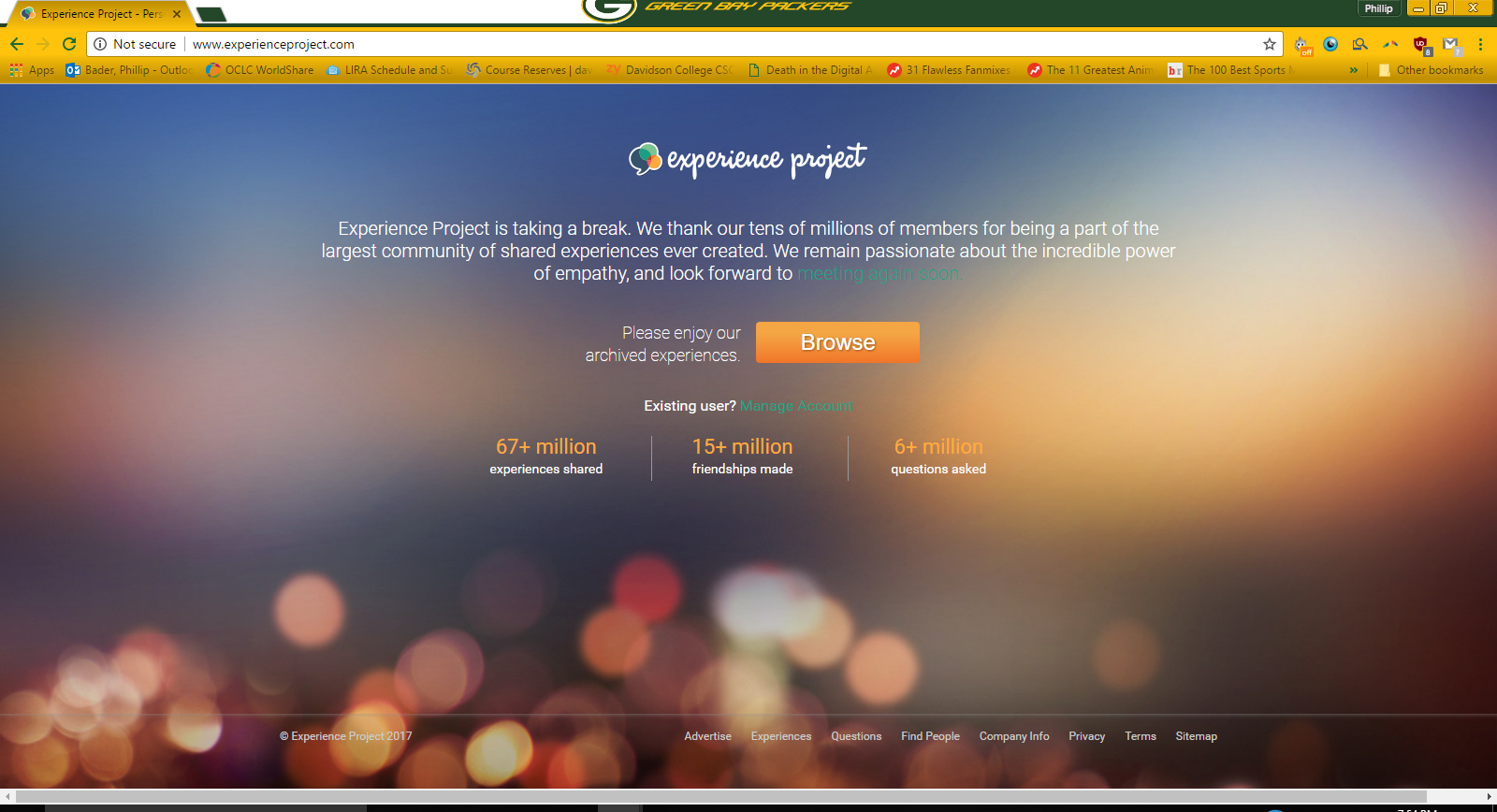
But first, some background. The way EP worked was that users could post a story,  thought, or even just a feeling, and other users could “join” that experience, enabling people to connect in ways beyond simply both going to the same high school or both rooting for the same basketball team. Unfortunately, this inventive format proved to be unwieldy and hard to decipher, and EP shut down early last year. The site still exists (you can visit it here) but only as an archive, a collection of past memories and moments. For people who never used it, it’s like “uncovering a yearbook in someone else’s attic” as the author of the article puts it.  The ups and downs of IamDRock’s and Rainbowdasher’s relationship is in plain view for all to see, in its entirety. You can read Rainbowdasher’s post about their first kiss, or see IamDRock defend the fact that Rainbowdasher even exists at all. As the article says, EP “allowed their narrative to be told in real time, with an interactive Greek chorus following along. The downside of that immediacy meant the death of the forums also signaled the death of the story.” When EP was live, users could follow along, joining in with their criticism and comments. When EP died, they were cut off.

What Experience Project currently looks like

While the author attempted to follow how the relationship fared once EP shut down, I was more interested in this idea of love or relationships becoming…outdated. Think of how many social networks are out there, from Facebook to the multitude of start-ups in Silicon Valley right now. While each one is unique, bringing something slightly different to the table, the basic service is the same: to connect people with each other. While we focus mainly on how the digital age has affected death as a cultural force, it’s easy to forget the internet has affected relationships just as much, if not more. It has never been so easy to find like-minded people, to make some sort of connection, even without ever actually meeting them. And yet, at the same time…it’s never been harder. The sheer amount of social websites and apps means that we create different versions of ourselves in each one. It has become so difficult to parse through all the filters and fronts to reach the real people behind them.

With all that going on, maybe that’s why i found IamDRock and Rainbowdasher’s tale so moving. Here are two people who, despite all odds, seemed to have made a genuine connection. But then, through no fault of their own, it was severed. If Facebook went under tomorrow, what would happen to all those relationships? Would you put in the effort to move to another website, to try and remake all those connections? At what point does a digital connection become a meaningful connection? I don’t really have an answer to any of this, I just believe it’s worth thinking about.

Social Media’s Devaluing of Death

Artist’s Statement

In discussing death and its relationship with technology, we devoted a considerable amount of time and energy to discussing how technology can expand the ways in which we both encounter and engage with death—be they via memorialized accounts, digital wills, or even cyber cemeteries. What we have not spent as much time or effort considering is whether technology can trivialize real-world death.

We have certainly talked about technology’s desensitizing aspects in discussing video games; it almost seems like an unavoidable pairing—violent video games and claims about desensitization. In fact, we read an article by Carly A. Kocurek (“Who hearkens to the monster’s scream? Death, violence and the veil of the monstrous in video games”) in which she focuses primarily on violence and attempts to mitigate that violence through dehumanization and the monstrous.  Kocurek finds that a common side effect of these attempts, however, is desensitization to violence that echoes “long-standing propaganda strategies…used to justify real-world violence against marginialised groups [sic]” (Kocurek, 88). With her article, Kocurek cautions against the unquestioning acceptance of video games’ treatment of violence, especially as it relates to the finality of death.

In addition to the dehumanization that she points out, video games also exemplify the manner in which technology warps the impact and consequences of death. In most games today, death is not permanent (games that do have “permanent” or more consequential deaths or often marketed on those aspects themselves). Rather, it is a temporary setback, often even designed as a hook to get the player to keep playing rather than discourage him or her to quit. Some games even attempt to make death entertaining—coming in the form of everything from a simple fall in a Mario game or the graphic disembowelment of Mortal Kombat. A host of games even let the player re-watch or re-experience their own death like the Kill Cam in Call of Duty or the Super Meat Boy deaths replays, crafting that enjoyment of mortality into the core element of their games.

Other evidence applies similar arguments to other forms of media. With her article “Media Exposure and Sensitivity to Violence in News Reports: Evidence of Desensitization,” Erica Scharrer suggests that video games are certainly not the only desensitizing agents in our lives; television and films also do their part to desensitize us to violence, and, as relatedly, to death. She actually goes on to say that “extreme” forms of violent media—like horror movies or violent video games—are not the only contributors to our desensitization; rather, even “daily exposure…” to commonplace depictions of violence and death as seen in places like “ordinary news media outlets” can weaken our emotional responses to and perceptions of violence and death (Scharrer, 301-302).

Still, most news outlets tend to treat these subjects with professional respect and reverence. Newspaper and local news affiliates, especially, seem to honor their material by reporting appropriately concerning the topics of death or violence—as they usually intend to foster ties with the community and also only have a limited amount of time or space to which they can devote their coverage. Essentially, there are limits imposed by these means of “daily exposure[s]” on their coverage.

The “daily exposures” that are cable news networks are a whole different manner. These businesses unabashedly milk tragedies for all their worth, relying on them for steady income and viewership. Networks liked CNN or Fox News or MSNBC trivialize death by covering it on repeat and rehashing the same sad looks, phrases, and statistics to maximize their viewership.

But cable news networks are nothing new, and clearly not what one would call technological innovation. Instead, the digital successor to the “daily exposure’ of cable news would be social media. After all, what else besides social media and could devalue everything it hosts through sheer overexposure in the manner that cable news does. With social media, death again takes on the familiar form of entertainment as it did with video games or network news, also stemming from similar reasons. Like video games, death on social media is means of temporary form of amusement, whether it comes as a silly Darwin Awards-esque video or an article to get incensed about briefly, we always end going back to back to browsing through friends’ profile pictures. It is only on social media that an article concerning a group of students dying in a fire is essentially giving the same weight as cute puppy gif.

This devaluing of death was actually the motivating idea for my Haunted Media Project. At first, I intended to tell a story about death via social media—specifically a mystery about the death of a group of students solvable through hints dropped on social media platforms. I was hoping to represent the entertainment value of death, essentially seeking to amuse the reader with a story of death in commentary on the relationship between that media, the story, and the audience.

However, I encountered several problems with that approach. First and foremost was one of logistics. It was admittedly quite difficult to juggle all the accounts that I had intended to use—hard keeping track of everything, but even more difficult registering them,  as most websites, especially Facebook and Reddit, require numerous identity verification steps  all throughout the process. As such, I re-evaluated my goals, and instead strove to represent the desensitization to death that I have described above, creating a subreddit, two websites, and about twenty-four accounts to populate these digital spaces.

Rather than tell the mystery that I first set out to do, I intended to model the devaluation of death into a fleeting form entertainment via social media. I still kept elements of my first project idea, keeping the budding fictional metropolis of Springfield, North Carolina. I made a subreddit for it (r/SpringfieldNC), drawing inspiration from the subreddits of other cities (and other subreddits in general), and proceeded to populate that subreddit with a host of fairly vacuous posts, ranging from a post about an annual Police barbecue to an unanswered request for gym recommendations. The one relevant post (and fairly meaningful one outside of the protesting picture) is the one concerning the fire at the local university, sandwiched between a post about a hot dog stand called Wonder Wieners and a question looking for a reptile guy for a kid’s party. If one were not specifically told what to look for, one would likely miss that post completely, as there is nothing besides title that sets it apart from the other posts.

Clicking on the fire post leads the reader to a barebones local newspaper article that goes over the details of the fire in brief without really saying much requiring much attention. This is meant to parallel the kinds of articles that are often linked via social media sites like Reddit. Rather than read a detailed article, many users might read the headline or post title and go directly to the comments, where the article will often be summarized (either by another user or a bot) in a single line starting with the acronym TL;DR (standing for “too long, didn’t read). Or, even more helpful than the summaries, is the user that gives live updates in the comments about culled from Police Scanners, Tweets, live broadcasts—a user overeager to get involved in the gritty details of the events depicted in my project.

Here, the over-helpful user gives a link to the site of the university where the accident happened. This site is intended to poke fun at institutional responses to tragedy—especially those that happen via the Internet. Here the university offers up a relatively cold, formulaic response to tragedy that echoes the detached nature of its online medium—complete with a flickering candle gif for people that died in a fire. The help they offer is not quite helpful at all, and the site constantly links to error pages as the University site was not prepared to handle the traffic at the magnitude it was. Additionally they talk of hosting and moderating a group memory page for the deceased individuals, but there is very little headway made there at all, suggesting an overall disinterest in the grief of others.

Of course, along with the gung-ho white knights, there come trolls. We have seen the damage trolls can do with articles like Whitney Phillips’s “LOLing at tragedy: Facebook trolls, memorial pages and resistance to grief online,” but, with the general devaluing of and detachment from death that is propagated by technology and social media, we also see can see a change in the trolls. As a result of that detachment, there’s less personal involvement (both from trolls and normal users) within the comments section of a post about death; in fact, sometimes even the users that are involved in the constructive (or at least non-trolling) discussion in the comments might still end up making a tasteless joke. Yet the divorce of the users from the subject matter and serious tone allow for those kinds of jokes, which are often received well with numerous up-votes on the site. Together, these elements are intended to model the devaluing and detaching nature of social media as it related to death and technology.

Works Cited:

Kocurek, Carly A. “Who Hearkens to the Monster’s Scream? Death, Violence and the Veil of the Monstrous in Video Games.” Visual Studies 30.1 (2015): 79–89. Taylor and Francis+NEJM. Web.

Phillips, Whitney. “LOLing at Tragedy: Facebook Trolls, Memorial Pages and Resistance to Grief Online.” First Monday 16.12 (2011): n. pag. firstmonday.org. Web. 6 Apr. 2017.

Rogers, Katie. “What Is a Constant Cycle of Violent News Doing to Us?” The New York Times 15 July 2016. NYTimes.com. Web. 6 Apr. 2017.

Scharrer, Erica. “Media Exposure and Sensitivity to Violence in News Reports: Evidence of Desensitization?” Journalism & Mass Communication Quarterly 85.2 (2008): 291–310. Print.

Instructions

  1. Go to subreddit
  2. Click around
  3. Eventually make your way to Fire post
  4. Check the comments!
  5. Follow the links! (eventually take you to here and here)