Chernobyl and the aura that surrounds disaster sites

A quick look into my post history reveals that I am a massive nerd, with a bizarre affection for nuclear power/radiation (see: Half Life, haunted media project, etc). Chernobyl is one of the topics that both inspired my haunted media project and serves as what I think to be one of the most entrancing disasters in human history.

While today’s article discusses ‘dark tourism’ as a relatively modern phenomena, I can’t help but think that it is as old as any other human tendency. We are fascinated with death. Our natural morbid curiosity gets the better of us most of the time, which is why places like /r/watchpeopledie (warning!!! vivid pictures of death) exist, and even thrive.

Image result for dark tourism
we seem to be fascinated with death, and even more so when the death happens to be unnatural.

I do think however that it became only recently that humankind developed the means for mass death on this scale. But I wanted to focus on what makes Chernobyl such an attractive tourism site for what the article describes as “between 18 and 28 […] more interested in ‘fear, fun, and thrill.'”

There have been quite a few disasters that have happened on a relatively recent scale, but these events do not occur such an ‘enchanted’ site as the Chernobyl exclusion area. Things such as the Mt. St. Helen eruption, the Southeast Asian tsunami, Rape of Nanking (and so on) don’t attract the same type of visitors to their commemorative sites. For one, they are not considered to be still dangerous. But I do think that another significant factor is the cause of the incident. In this case, it’s nuclear radiation. Because the forces at hand in Chernobyl were invisible to the naked eye, it leaves a sort of mysterious, almost sinister atmosphere on the incident.

Nuclear fallout’s association with horrific mutations and scarring of all animals, regardless of veracity, is what contributes to this perception, which is what attracts dark tourism. As humankind progresses in technology, more opportunities to ‘mess up’ will arise. Imagine not a nuclear fission plant meltdown, but a fusion plant meltdown. A software bug that single handedly wipes out digital currency. Or a genetic experiment unleashes a horribly invasive species, destroying entire ecosystems. Wait… these sound like they’re not even that crazy.
Fantasy or Reality? The Gray Line Between the Truth and the Story

In their article “Dark and Toxic Tourism in the Chernobyl Exclusion Zone,” Ganna Yankovska and Kevin Hannam describe the Chernobyl exclusion zone as a site of both dark and toxic tourism. Through interviews with tour guides and agents, Yankovska and Hannam explore the various motivations of tourists depending on nationality and age. The researchers highlight how the exclusion zone lies at the tricky crossroads between entertainment and education and as such, tour guides must interpret and alter their presentations depending on the desired effect.

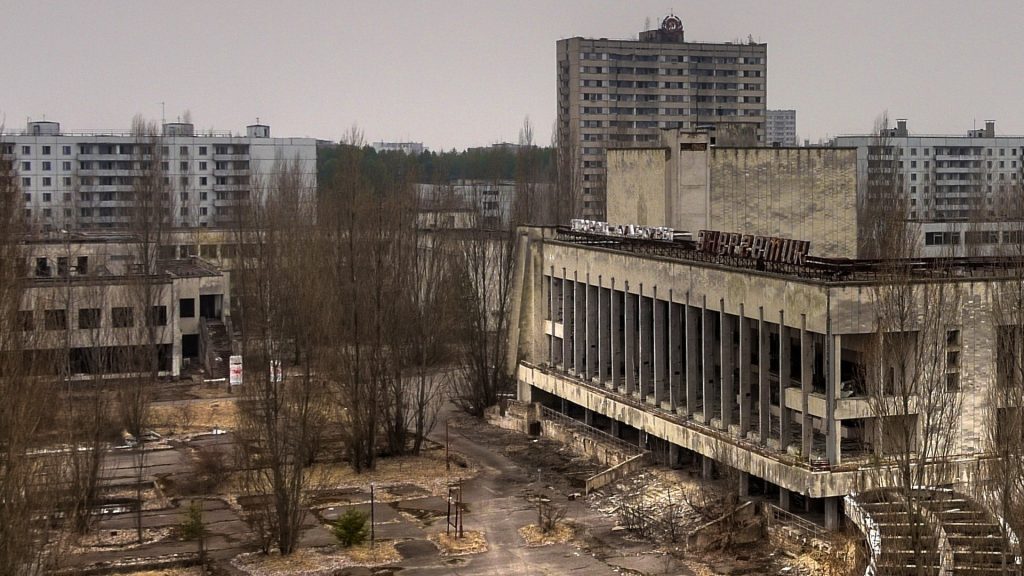
Tourists from around the world flock to Chernobyl for educational, research, and even entertainment value. Source: The Ghost Town of Pripyat after the Chernobyl Meltdown of 1986. N.d. KonsciousKloud.

In reading this article, I was reminded of one of the first articles we read this year by Walter Benjamin, “The Storyteller,” in which Benjamin explores the notion of storytelling in a contemporary context in which information, press, and technological inventions threaten “…the art of storytelling…” (Benjamin 362). The role of the storyteller—as described by Benjamin through the language of “advice,” “instruction,” “useful,” and “wisdom”— seems a particularly accurate account of the role of the Chernobyl tour guides who often cited in interviews their educational function and the wisdom they hope to imbue on tourists (Benjamin 364).

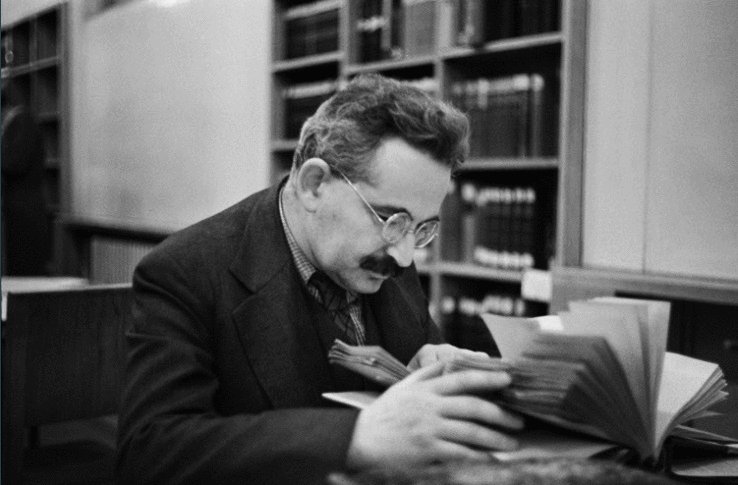
Walter Benjamin (1892-1940) was a German philosopher, essayist, and critic. Source: Untitled Photo of Walter Benjamin. N.d. RHYSTRANTER.COM.

And yet, while storytelling by tour guides often falls under this category of ‘useful wisdom,’ in the case of Chernobyl, there is an additional expectation of entertainment value and adventure that complicates the traditional role outlined by Benjamin. For example, in an interview with Yankovska and Hannam, Tour Guide C notes, “Interpretation is the main part of my work” (Ganna 935). Similarly, Tour Guide B says that “People believe in these games and horror movies too much. Consequently, they are not interested in real history and valid information anymore” (Ganna 936). These two accounts introduce certain questions: At what point are tour guides embellishing or altering history in order to appeal to demand? Is a “true” account possible within the commercial context of a museum or memorial? What is the difference (if any) between stories and history? As we get generationally further from historical events, their retelling can easily become skewed, either by simple mistake or to satiate consumer demand. We’ve talked in class about truth and its limitations and I think this article is relevant within that discussion – particularly within today’s context in which fake news and alternative facts are normalized.

This conflict between information and stories is a central theme in Yankovska and Hannam’s article. The article notes that interactions with local residents carry greater interest to tourists than the factual information itself (Ganna 935). The personal and even physical interactions thus trump the appeal of information, perhaps because they tap into “…the psychological connection of the events…” which allows “…an amplitude that information lacks” (Benjamin 366). Does this emotional, psychological component of these real-life interactions make the stories more real or truthful, or does it relegate them to a fantasy world of imagination and adventure, thereby removing them from practical application and real-world relevance? Are the local residents people or characters?

Physical interaction is a valuable tool in understanding and conceptualizing trauma, especially when that trauma is so large and geographically distant that it feels too abstract to engage with. Benjamin reminds us of the quote “‘an attic fire in the Latin Quarter is more important than a revolution in Madrid’” (Benjamin 365). Proximity is an important factor in determining how we relate to events and news. Dark tourism and toxic tourism may have a dark side (no pun intended), but they also speak to a human need to experience on a physical, intimate level a reality too hard to otherwise grasp. Sometimes, fantasy and imagination are the only way to comprehend the incomprehensible.

References:

Virtual Dark Tourism

Fallout via GOG

In their article about dark and toxic tourism, Yankovska and Hannam mention the video game franchise S.T.A.L.K.E.R., which centers around an alternate history take on the Chernobyl Exclusion Zone. For them, the games stand as representative of the popular mass-media distortion of the disastrous events at Chernobyl.

But although it certainly does misrepresent the event, I don’t think S.T.A.L.K.E.R. intends to exploit the victims of the accident. Rather, I think the game series acts as a manifestation of our fascination with disaster and devastation (particularly the kind that involve nuclear causes) as mentioned in our earlier reading by Susan Sontag (“The Imagination of Disaster”). Other game series deal with similar kinds of devastation, perhaps most notably the Fallout franchise.The game series themselves are quite dissimilar in tone and subject matter–S.T.A.L.K.E.R. uses a pseudo-horror lens to show an alternate take on a real event, whereas Fallout gives an action/adventure-RPG look at a fictional nuclear apocalypse.

However, they do overlap in their portrayal of fictional nuclear destruction on the real world. Both game series incorporate real world locations to revel in the horrifying destruction that comes with nuclear apocalypse–S.T.A.L.K.E.R. with its semi-realistic depictions of Chernobyl and Pripyat, Fallout with its imagined ruins of Washington, D.C. and Boston (among others). In this manner, the games tap into the dark and toxic tourism discussed in the article. They capitalize on the same fascination that the tours do, acting as virtual dark and toxic tours while also engaging a wider than the tours ever could.

Tourism from the Perspective of a Developing-Country Native

Yankovska and Hannam opened my eyes in Dark and toxic tourism in the Chernobyl exclusion zone. I was unaware of the negative aspects that Chernobyl faced as a result of the touring that takes advantage of a horrible radioactive disaster. The few times that I have seen the city mentioned are in movies that seek to dehumanize the area, or emphasize the disasters it was witness to. Because of these reasons I agree with the points that the article makes about the inhumanity found in Chernobyl tourism. However, i’d like to push back on the belief that tourism is “an oppressive, passive, and ignorant system.” These are  the words that my classmate Christine Choi uses in her blog post.

She later goes into depth about her statements, but never fully discusses the fact that her generalization is dangerous. Tourism in Chernobyl is horrible, that is something that cannot be argued. When you go to another country to be “fascinated” by the troubles that these people go through, you may want to think twice about using the word “human” to describe yourself.  But, and this is where I differ from Christine’s blog post, not all tourism is bad. I get the feeling that a majority of people who read the article will be extremely biased against tourism, but they need to realize that this is a case specific example. Not all tourism seeks to monetize the real world pain and suffering of others.

I would like to speak personally from the point of view of someone who has seen tourism have positive benefits. I was born in Ecuador, which is still known as a developing country. One of Ecuador’s main sources of revenue is tourism, due to its appeal as an “exotic” getaway. The Galapagos Islands alone make up such a huge part of that tourism revenue, and they are not a result of a population’s pain. Since Ecuador became a hotspot for tourism, the infrastructure of the country has become a lot more developed. Streets that were not paved are now up to standards when compared to United States roads. Sectors of the country that before were considered uninhabitable are now buzzing with new businesses and buildings. Tourism works for the country of Ecuador.

The Galapagos Islands and their beauty drive tourists here every year.

I am not only speaking from my own perspective, but that of my ancestors too. When speaking with my grandparents, they often tell me stories about the country before my time. Poverty was rampant, and the country was not developed at all. Is it possible to go a category below developing country? If so, my grandparents claim that it would be classified as such. All of this changed when the country began to focus more on its image and the gain that it stood to make from the beautiful Galapagos Islands. Tourism came. The country took off.

A statistic that demonstrates how much tourism in Ecuador has skyrocketed.

Chrsitine believes that all tourism is bad and harmful, but she does not see the error in that huge generalization. Some tourism can be bad (Chernobyl) but it is not always so.I wish to state that I am implying replying to he post because I believe that other classmates may share her sentiments. I think it would be a tragedy to think of tourism as wholly negative when it has positively impacted other countries/regions. Ecuador is still a developing country, but as a native I hope that it will reach a better status. If and when it does, you can bet that tourism will be a major reason that it occurred.

A Naive Discussion of Heterotopia and Chernobyl via one of Dr. Sample’s Favorite Sentences

I’m making a bold statement: the following sentence is in Dr. Sample’s Top 10 Favorite Sentences among the articles we have read for DIG 215:

“Chernobyl is a heterotopia that allows us to gaze upon a post-apocalyptic world in which the familiar and uncanny collide.” Stone (2013, p. 91)

This sentence is taken from “Dark and toxic tourism in the Chernobyl exclusion zone“, who originally quoted it from P. Stone’s “Dark tourism, heterotopias and post-apocalyptic places: The case of Chernobyl.” Not only is the sentence construction elegant and word choice exquisite, but the use of the word “uncanny” really seals the deal here with a spot in the top 10. Admittedly, the word caught my eye, I reread the sentence, hemmed and hawed for a bit, and then realized I had a very small understanding of what the sentence was saying. Let’s unpack the sentence in the context of today’s article, starting with “heterotopia”.

As I learned from the very helpful Wikipedia article, heterotopia is a human geography term used to describe spaces of otherness, with multiple layers of meaning yet irrelevant, simultaneously physical and mental. Often the term is used to describe moments, like looking at yourself in a mirror or coming of age while away at boarding school. From my understanding (and please help me clarify this), describing Chernobyl as a heterotopia conveys that it has become a moment for examination, a memory, that has been perversely protected by its radiation and remains in a timeless state as a “ghost town” (Yankovska and Hannam 1). This preserved town allows us to view a “post-apocalyptic world”, one that has resulted from “the darker aspects of scientific advancement and human experience” (Yankovska and Hannam 2). After all, nuclear power and weaponry are controversial topics today, with their benefits for energy production and devastating consequences. In this world the effects of the nuclear power plant explosion are everywhere, via warning signs and protective clothing visitors must wear. But signs of the everyday remain everywhere in this sort of “ghost town” because during the accident people were inaccurately promised that they would be able to return home for their belongings in a few days. Thus, the “familiar” home scene and “uncanny” nuclear accident wreckage have collided to create a memorable, unsettling scene.

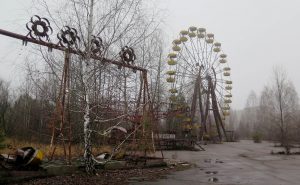
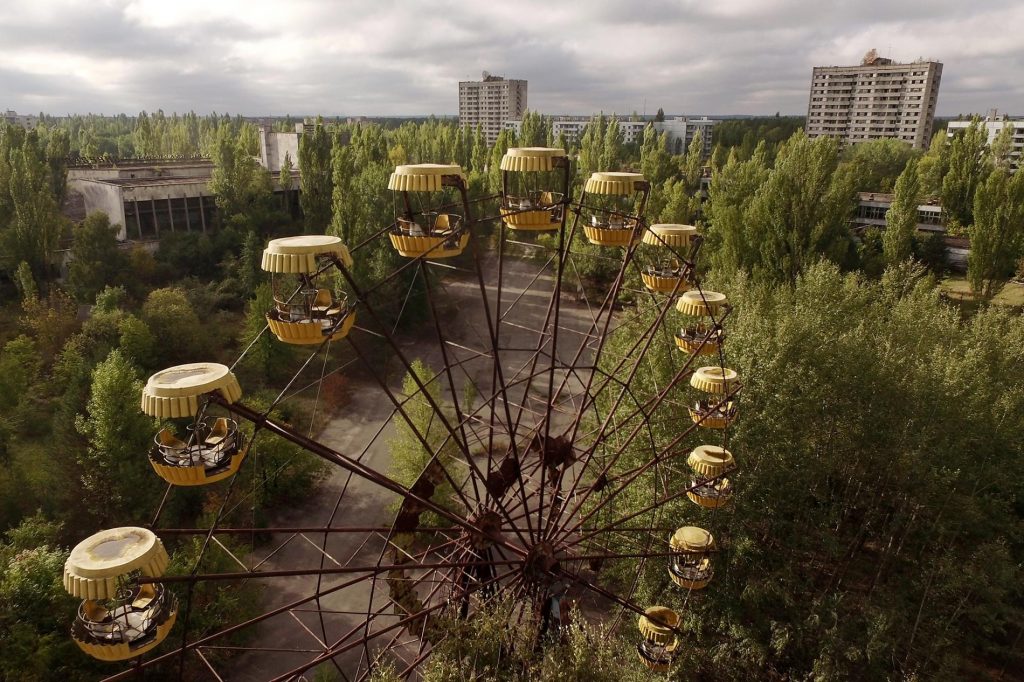
A perfect example of the collision between the familiar and uncanny: a brand-new amusement park in Pripyat that never opened. The article can be found here.

Ganna Yankovska & Kevin Hannam (2014) Dark and toxic tourism in the Chernobyl exclusion zone, Current Issues in Tourism, 17:10, 929-939, DOI: 10.1080/13683500.2013.820260

Tourism Is A Euphemism for Ignorant Travel

In reading Ganna Yankovska and Kevin Hannam’s “Dark and Toxic Tourism in the Chernobyl Exclusion Zone,” I found myself disgusted with tourism as an oppressive, passive, and ignorant system. Throughout the article we see tour guides state how many tourists come to be “entertained” and “fascinated” by a tragic event in which people still suffer from the aftermath of radiation. I find it hard to believe that these tourists go to Chernobyl to mindfully educate themselves on a disaster that has helplessly sought support and activism. We live in a day and age where Google, databases, books, and vlogs can shed light to so much more information than what they may take away from one tour. These tourists visit Chernobyl to essentially be in their version of a virtual-reality horror story. As soon as they get back on their plane to America or Western Europe, they can take their VR goggles off at any time and go right back to their ignorant and passive existence.


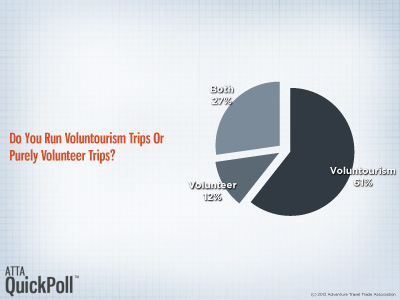
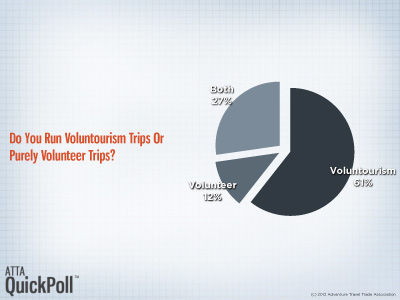
This article made me think about a similar concept commonly referred to as “voluntourism.” An article criticizing voluntourism mentions seven great criticisms to the wasteful and ineffective industry of going on “service trips” to foreign countries.

Source: Adventure Travel News

I encourage you to read all seven criticisms, but one that relates to my sentiments on the Yankovska and Hannam article is that these trips are an “egregious waste of money.” The voluntourism article gives some stats like “Two weeks on a medical trip to Tanzania can cost you $3,040, not including airfare, which is roughly $2,000. If six people go on this two week trip, that’s more than enough money to pay for a local doctor’s annual salary. Let that sink in.” Now if tourists to Chernobyl would like to genuinely help Chernobyl in its political, environmental, societal, and economic efforts, then the thousands of dollars they spend on plane tickets and tour agencies can instead be directly given to those already experienced social activists, journalists, and scientists in Chernobyl.

Dark tourism and Père Lachaise cemetery in Paris, France

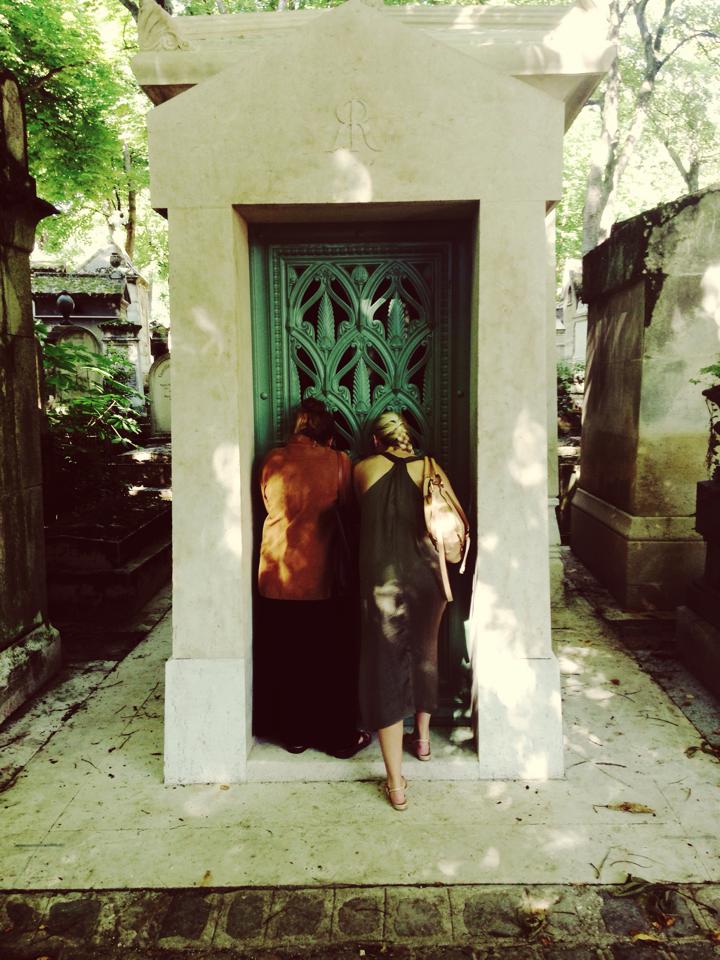
My friends peering into a tomb at Père Lachaisse.

Before reading the Yankovska and Hannam article, I didn’t consider myself someone who had participated in dark or toxic tourism, but while reading, I realized I’ve been to several places that might constitute dark or toxic tourism. The ones that came to me off the top of my head were the Anne Frank house, D-Day site, and Père Lachaise cemetery. Père Lachaise is a massive cemetery in between the 11th and 20th arrondissements, and I visited it multiple times in the summer of 2014. This would be an example of dark tourism instead of toxic, since no environmental disaster occurred on the grounds.

The reason Père Lachaise is such a draw to tourists is not only because of its size (it’s by far the largest cemetery in Paris) but also because the high number of famous people buried there: Chopin, Géricault, Oscar Wilde, to name a few. But I’d say the biggest attraction, at least to my generation, is the grave of Jim Morrison.

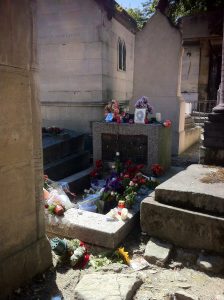
Jim Morrison’s grave

You can wander the cemetery for basically days without encountering a grave that you want to see–which is where the true dark tourism begins.

On our first trip there, my roommate and I picked up a scavenger hunt-like map with numbers and corresponding names to the most famous people at the cemetery. Though this map wasn’t particularly helpful, since the cemetery expanded in a completely arbitrary and confused manner, it still felt a bit strange to be hunting around in a solemn place like a cemetery, sometimes point and yelling when one of us found the “right” grave. The cemetery closes early–around 4–because it takes so long to clear the grounds and make sure no trespassers remain. This creates an eerie feeling as the afternoon winds down and you start to see fewer and fewer people around, until you realize it’s 4. Père Lachaise itself doesn’t do much to play up its spookiness for tourist purposes, but this probably has to do with the fact that entry is free. I’d still consider the general experience of wandering the cemetery actively looking for certain deceased people a kind of dark tourism.


An Uphill Battle to Change a lot of Minds about iRobot…

Over the summer I was asked in a focus group how I felt about the idea of self-driving cars. I was asked whether I would use it often, what I would use it for, and what I would spend my time doing if I found myself inside one. I had not thought about it before, but I took a few seconds and replied that I would hate a self-driving car. I enjoy the mindlessness of driving at times as well as the freedom and power you feel when driving at other times.

We read a few articles about deaths in Tesla’s autonomous driving mode, called autopilot. Which, in a morbid way, was completely inevitable- everyone was just waiting to see who would be the first poor soul to be killed. For me, our generation grew up thinking that driver-less cars is a science-fiction idea and it would never happen in our lifetime, but we were wrong. So car manufacturers now have to get rid of the notions and preconceived ideas we have about a driver-less car future.

Good luck to them with trying to change my views. The first exposure I had to the idea of a driver-less car was in Will Smith’s iRobot movie and the following scene:

Will Smith’s scene in iRobot with self-driving cars. Sourced from Clubic.

It’s too bad that iRobot also has the scene where robots try to take over the car and try to kill Will Smith’s character… “You are experiencing a car crash”

Credit to Youtube’s leothelion634

I know that driver-less cars are inevitable in the next twenty years or so, and I am going to have to live with that on the road. I just don’t see myself driving one because the idea of giving up that much power and autonomy to a robot which I don’t fully trust seems like it would cause me more stress than just driving myself through traffic. I don’t think I am alone with those sentiments. I know there are many people who are excited about autonomous cars, but I bet there are also a lot of people who will not change their mind quickly.


Programming Morality

The most fascinating part of the readings were, to me, the ones about “programming morality.” As we move closer and closer to a world filled with automation and artificial intelligences, it becomes clearer and clearer just how much gray area there is involved in creating those very things. The human decision-making process is already a fairly complicated one, recreating that process is even more so. As the New York Times article puts it, “These situations can be difficult enough for human minds to wrestle with; when ethicists think through how robots can deal with them, they sometimes get stuck, as we do, between unsatisfactory options.” We humans can have the benefit of acting first, then explaining later, secure in the knowledge that whatever action we take, we will have the benefit of explaining it later. Robots and other AI’s, however, do not have that luxury. Every decision must be programmed beforehand, every little choice mapped out.

My question is this: in this situation, where does the buck stop, so to speak? Who is responsible for the actions of programmed AI’s? Say a driverless car drives off the road to avoid hitting a group of children crossing the road, but injures or even kills the driver in the process. We might agree that was the “morally correct” choice, but does that help the driver’s family? If they decide to sue, are the programmers responsible? Dealing with these ethical conundrums is already hard enough without adding in the bonus ingredient of legality.

infinitywave.deviantart.com/art/Robot-Law-School-tee-366360059, accessed 4/11/17

Isaac Asimov, the science fiction writer, famously came up with the “Three Laws of Robotics,” which are still used in robotics today. They are: 1) A robot may not harm a human being, or through inaction cause a human being to be harmed, 2) A robot must obey orders given it by human beings except where such orders would conflict with the First Law., and 3) A robot must protect its own existence as long as such protection does not conflict with the First or Second Law. Now, as far as laws go those aren’t bad, they’re rather tidy and all-encompassing actually. What makes me feel weird about all of this is that these issues shouldn’t be so easy. They’re hard, they’re supposed to be hard, and I worry that in our haste to welcome the future with open arms we’ve lost sight of that. It has taken centuries of philosophy and thought to create the morality system we have today, and now we’re trying to streamline all of that as we hurry to reach the future we so desperately want. These questions take time, they take effort, they take thought. I hope that we don’t fixate on the destination and miss out on the path we need to get there.

The Commodification of Sites of Tragedy and Death

Yankovska and Hannam’s “Dark and Toxic Tourism in the Chernobyl Exclusion Zone” prompted me to attempt to recall other examples of dark tourism in the world … and I struggled – so I Googled. What I found was that “dark tourism,” which has made its name known more recently as socially unaware tourists choose to post macabre selfies from sites of death and tragedy on social media, has been around for a long time. Mark Twain wrote of Pompeii in Innocents Abroad, the Taj Mahal is a tomb on just about everyone’s travel bucket list, and tourists flock to bloody sites such as Gettysburg battlefields and Holocaust concentration camps.

An abandoned Ferris wheel stands on a public space that has become overgrown with trees since the city of Pripyat was evacuated in the wake of the 1986 Chernobyl disaster. Source: National Geographic

In “Is ‘Dark Tourism’ OK?” Robert Reid argues that while dark tourism is certainly nothing new, the way in which it is represented and marketed definitely is. Reid maintains that what makes or breaks the acceptability of a dark tourism site is the intention behind the place. The commodification of death and tragedy might leave a bad taste in our mouths, but I think it comes down to why the sites are marketed as tourist destinations in the first place. Sites such as Auschwitz, for instance, are places of historical significance and can serve as a space for healing and recognition of the gravity of events that took place there.

So my question is: where do we draw the line? Visitor centers? Cafés? Gift shops? At what point does the commodification and touristic tendencies of these sites taint the experience of the grave atmosphere of such places?