Are parasocial relationships inherently inauthentic?


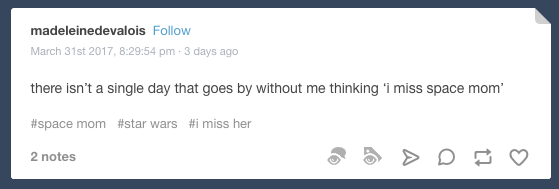
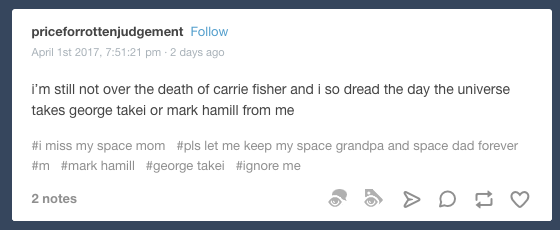
The part of our reading I found most interesting was the part addressing parasocial relationships with celebrities.  Of all the celebrity deaths of 2016, the one that provoked the greatest display of public mourning in my corner of the Internet was easily Carrie Fisher.  Just scrolling through her Tumblr tag for about five minutes, I came across these three posts.  Clearly, all three of these people feel a deep connection to her, whether as a motivating force or a parental figure (two posts refer to her as “space mom,” which is a common title of hers on the Internet).
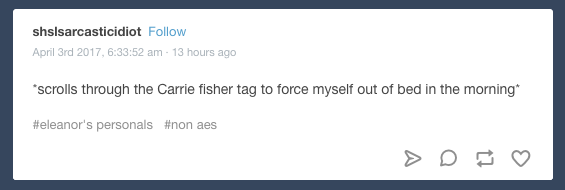
Screenshot of a Tumblr post (shslsarcasticidiot.tumblr.com/post/159147131965/scrolls-through-the-carrie-fisher-tag-to-force)
Another Tumblr post (priceforrottenjudgement.tumblr.com/post/159091343154/im-still-not-over-the-death-of-carrie-fisher-and)
People really miss Carrie Fisher… (madeleinedevalois.tumblr.com/post/159055295573)


Sherlock describes these relationships as based on “false feelings of authenticity and intimacy” (168), and I want to push back on that assessment a little bit.   She quotes another scholar who claims that an online or public presence is “an artificial build-up of ‘personality'” (168).

Carrie Fisher’s online presence is hilarious and authentic.  Her tweets do not look like they have been approved by a publicist.  I’ve included one of my favorite’s below.
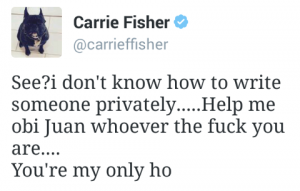
A particularly hilarious tweet from Carrie (twitter.com/carrieffisher)

Either Carrie has a crazy good publicist who manages to craft a perfectly unpolished, authentic presence on Twitter, or she’s just tweeting away of her own accord.

Additionally, she’s written two memoirs that honestly document her experiences with mental illness and addiction (I only read part of Wishful Drinking, and that was years ago, but I remember that it was extremely funny).

Do these Tumblr users have an actual, mutual relationship with Carrie Fisher?  Of course not.  But I think it’s unfairly dismissive to claim every celebrity’s social media presence is inauthentic.  I think Carrie sparked such an enormous display of grief not only because she portrayed such an iconic character, but because she was unapologetically herself.  She aged unapologetically.  She was mentally ill unapologetically.  Seeing someone own everything about themselves, even the messy parts, allows us to do the same.  I think about the following tweet a lot in reference to celebrity deaths.
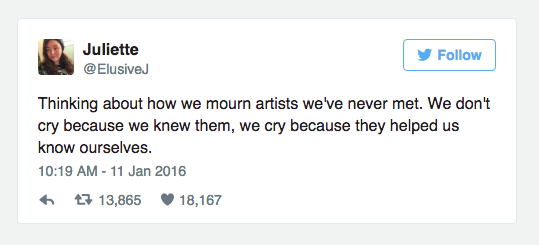
This tweet sums it up pretty nicely (www.vox.com/2016/1/12/10755600/celebrity-death-grief)

In other words, I’m not trying to claim that parasocial relationships are the same thing as true, mutual relationships.  But I do disagree with this somewhat dismissive, cynical view of celebrities’ personas as inherently crafted and inauthentic.  Sherlock acknowledges that these feelings are not necessarily false “just because they are based on a falsity” (169), so she does acknowledge the significance of these relationships, but I don’t believe that they were were necessarily based on a falsity in the first place.  I think what makes Carrie Fisher, and others like her, stand out is the authenticity of their public personas.
The Digital Afterlife is Not for Everyone

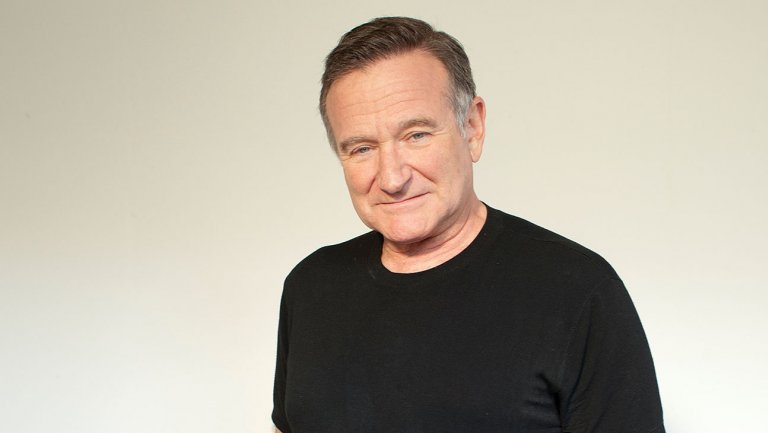
After reading about the posthumous exploitation of a plethora of famous people, I was eager to find an example of someone who refused to let their digital image be manipulated and commodified by the media. This reaction was in part inspired by the article we read, “Selling the dead,” which mentions the “dead celebrities bill” that New York state Senator Martin Golden introduced in 2011. This bill outlined that it would be a criminal offense to “use the image of any deceased New York celebrity for advertising, merchandising or other commercial purposes without permission from their legal heirs. The ban would last 70 years after their death” (Kirsta). However, the bill was not passed and its rhetoric has been adamantly opposed by media industries. As I kept this in mind, I stumbled upon the story of the great Robin Williams, who actually put in place a restriction on his image being used for twenty-five years after his death. This was mainly in an effort to ensure that his public image was not tarnished, but I was particularly interested in the tone various news sources took when describing this decision. One article features a quote from Laura Zwicker, an attorney at Greenberg Glusker who counsels high net worth individuals on estate and tax planning. She claims, “I haven’t seen that before. I’ve seen restrictions on the types of uses — no Coke commercials for example — but not like this. It could be a privacy issue.” The article also highlights the idea that maybe Williams’ representatives were aware of the novel technologies we’ve been reading about and wanted to steer clear of anything that could tarnish his legacy. An examination of this has lead me to question a couple of ideas: First, how does one dictate what amount of time is acceptable to wait until the dead can be resurrected in the digital world? Second, why does society feel the need to criticize instances in which celebrities take their digital legacies into their own hands?

Robin Williams. View source here.

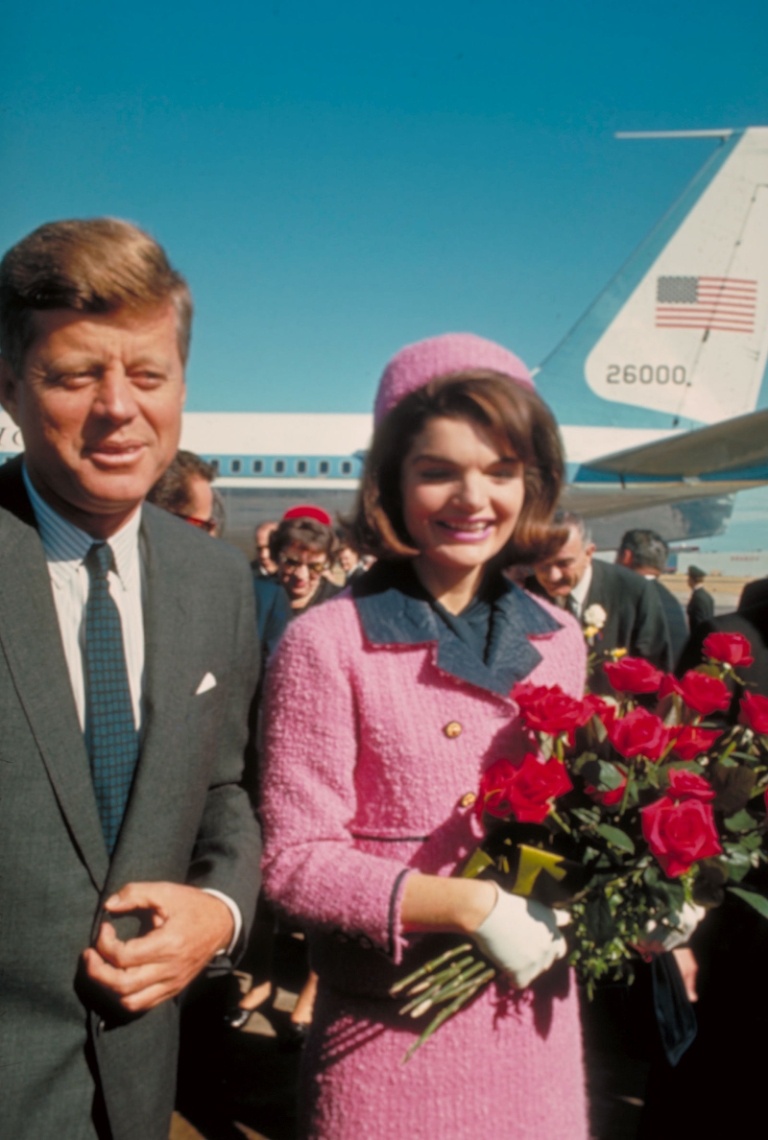
Robin Williams’ control over his legacy reminded me of the controversy behind Jacqueline Kennedy’s bloodstained pink Chanel suit, which is currently being preserved at the National Archives and won’t be seen by the public until 2103. The legal custody of the deed, which was established in July 29, 2003, and signed by Caroline Kennedy requires the National Archives to preserve the items and prevent the “undignified or sensational use of the materials (such as public display) or any other use which would tend in any way to dishonor the memory of the late President or cause unnecessary grief or suffering to members of his family” (Hallemann).  I think the decision to keep the suit locked away makes sense in that it blatantly avoids sensationalizing the tragic assassination of President John F. Kennedy.  But how does one justify that its release will be acceptable in 2103? Why can’t both Robin Williams’ image and Jacqueline Kennedy’s suit just be kept away forever? How does society believe it has a “right” to control the possession of these items?

Jackie Kennedy and her pink Chanel suit. View source here.

Public figures are well within their right to limit what is accessible after their deaths, but I believe there needs to be further conversation regarding where we as human beings should draw the line between the wishes of the deceased and our rights to gain the information we seek. 

Works Cited:

Hallemann, Caroline. “Why You Won’t See Jackie Kennedy’s Iconic Pink Suit On Display in a Museum.” Town & Country. Town & Country, 20 Mar. 2017. Web. 03 Apr. 2017.

Kirsta, Alix. “Selling the Dead.” The Telegraph. Telegraph Media Group, 03 Feb. 2012. Web. 03 Apr. 2017.

Who Owns the Story of Your Death?

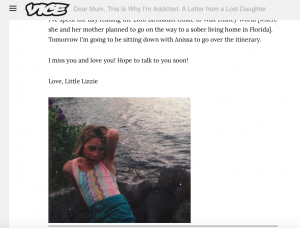
While reading, “Larger Than Life: Digital Resurrection and the Re-Enchantment of Society,” by Alexandra Sherlock, I was struck by the example that Sherlock used of Bob Monkhouse’s “resurrection” for use in a campaign for prostate cancer research. However, instead of celebrities that were famous for their work before death, I thought of when public awareness campaigns are formed around the deaths of ordinary people. Some of these stories go viral and the deceased become famous after death. An example of this I thought of was a letter that went viral this fall in which a woman shared a letter her drug addict daughter sent to her attempting to explain her addition to her mother. In reading the letter, I found it to be a compelling call for empathy and for the necessity of further access to care for those struggling with addiction. However, at the same time, I felt a little uncomfortable reading the letter. Sure, they had changed the woman’s last name, but otherwise this was an incredibly personal account of her life that she did not consent to being broadcast across the internet. There are many similar campaigns like this from parents, families, or friends where names are not changed and they become famous after their death for mistakes made during their lives. While undoubtedly these campaigns have the potential to make a positive difference in many lives, I can’t imagine I would particularly want details of my private struggles to be used without giving it the ok. Moreover, in contrast with the celebrities described in Sherlock’s piece, I can’t imagine laws being put in place that determine the fates of these people’s stories after their lives since money isn’t likely involved. I also can’t imagine that families already dealing with a crisis like alcoholism or addiction have much time for conversations about how private they wish their stories to remain if they are no longer around to lay claim to them.

A screenshot of the closing of a letter from a dead drug addict to her mother. www.vice.com/en_au/article/heroin-addiction-needles-exchange-lost-daughter-dear-mom

Works Cited

Elliot, Elizabeth. “Dear Mum, This Is Why I’m Addicted: A Letter from a Lost Daughter.” Vice, 3 Oct 2016. www.vice.com/en_au/article/heroin-addiction-needles-exchange-lost-daughter-dear-mom.

Sherlock, Alexandra. “Larger Than Life: Digital Resurrection and the Re-Enchantment of Society.” The Information Society, vol. 29, no. 3, pp164-176.

I came, I saw, I die.

www.slate.com/content/dam/slate/articles/health_and_science/Science/2016/03/160328_SCI_neurons-firing.jpg.CROP.promo-xlarge2.jpg%5B/caption%5D

“Soon, Kurzweil promises, age and disease will disappear altogether, giving way to “software-based humans” with holographically projected bodies. If Google has its way, mortality will be conquered by human machines.” writes Alex Senemar in the article What Happens To Your Data When You Die?. There are a lot of other articles and perspectives on technology and tackling our mortality, the greatest problem of humankind since it could conceive what death meant. We often hear how technology grows exponentially, and the notion is usually that we will fix the problems of today with technology of the future, versus the present methods that we have today. However, I find it harder and harder to believe that even the technology and methods of the future will truly answer any of the questions the human mind poses.


Just a few days ago I saw a video of a man who got concussed diving into the shallow end of a pool, waking up five days later with the ability to play the piano like a virtuoso. The greatest thing this case tells us is that the brain works in a way that is so complicated, that it seems that no amount of research and understanding can truly answer the questions that need to be answered in hopes of conquering our mortality. Sure, we might one day be able to simulate ourselves, and find ways to preserve personalities, characteristics, and memories. Having said that, I don’t think any of it will ever amount to the level which is natural and real, and in that case, what is the point? If you are not the same person who has died, then we are just further going down a road we aren’t meant to be treading.

Peace

Duka

The Study of Habits

Alex Senemar in his article for Medium, “What Happens to you Data when you Die?” brings up a critical point which often gets lost in discussions regarding Facebook privacy. We have to be very honest with ourselves, and admit that social media came to prominence for two reasons.

  1. Economic/capitalist motivation.
  2. Easy data collection of populations.

Senemar points out the Facebook is and always has been a social experiment, which specifically collects data regarding the movement of ideas within a culture. Facebook has integrated itself into our lives to an intimate degree, and essentially translates thoughts, feelings, and habits into data which can be modeled. Every like, sad, love, “wow”, “haha”, and “angry” react is logged to show how you as a member of society connected with something or someone else. As a video is a series of continuous pictures, Facebook is creating a comprehensive series of sociological snapshots, compiled into a data set tracking large trends along with information regarding individual data points.

When participating in sites like Facebook, it should ideally be completely apparent that the data you input will be logged, or at least much more apparent than it is right now. Increasing awareness about the fate of one’s digital footprint is much more useful than debating the semantics behind privacy rights, because the data gathered from social media is a powerful tool not just to track modern trends, but for future historians to revisit and analyze.

Ethan Shiel writes on the subject of “Bots”, examining the fear of what an unchecked bot can post after the death of its care-taker. Having the bot turn off, or censored in some other way, is robbing the future historians mentioned in the New York Times article, “Cyberspace when you are Dead” of a cultural artifact that provides insight into early 21st century life. Just as it would be foolish to scratch out a line of an old poem, censoring the processes of a bot would injure it’s attempt to convey meaning and provoke thought.

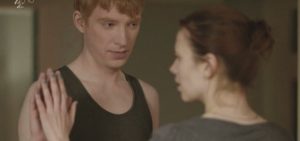
A scene from Black Mirror, where the protagonist meets a version of her dead boyfriend compiled from data gathered from his social media profile.

The pictured painted by the collection of data from a deceased generation is not perfect. Be Right Back from Black Mirror season 2 shows that data gathered from our social media profiles are only rough estimations of our lives. However, for the first time the habits society shares during a given time period can be both quantified and studied using primary source material, and when talking about the fate of our online profiles I believe it is incredibly important to remember the historical contributions that data of this scale could make.

Head in the Cloud?

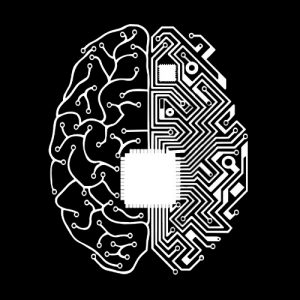
i.bnet.com/blogs/brain-machine-circuit-graphic-blk-500px.jpg

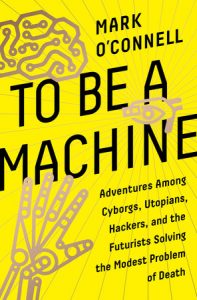
A couple weeks ago, while flipping through the featured stories on Snapchat, I stumbled upon a VICE article on hacking death through technology. Some Silicon Valley scientists are working on ways to convert human brains to code which can be converted to run on machines. Essentially, people can upload their brain’s memory to the cloud after they die and leave their bodies. Much of the conversation around this topic is hypothetical though, and is very different from the idea of literal immortality, because it is not attempting to defeat biological death. Instead, it is more of a merging of human memory and artificial intelligence. Mark O’Connell, author of the book, To Be a Machine, discusses this phenomenon of immortality through technology in an interview with VICE magazine: tonic.vice.com/en_us/article/imagine-how-creepy-itll-be-when-everyone-refuses-to-age

images.penguinrandomhouse.com/cover/9780385540414 

I found the ideas Mark O’Connell expresses to be especially interesting in light of Alex Senemar’s article, “What Happens to Your Data When You Die?” Senemar introduces the idea of how in the future, “software-based humans” will eventually rule the world and “mortality will be conquered by human machines.” He writes, “As the world grows increasingly dependent on internet technology, many human beings have already begun living like ‘cyborgs.’ Your electronics are collecting detailed information about you every second, not to mention the enormous amount of data you share about yourself while navigating the internet – meanwhile, internet corporations have harvested that data to assemble detailed profiles of your habits and behaviors, in hopes of more effectively predicting and analyzing human activity.” Although he writes that this data accumulated through the internet does not belong to the person, it nevertheless represents them. Its content can say a lot about a person. It also continues to exist after a person dies, which ties back to the idea of memories stored on a cloud transcending mortality.  This made me wonder: is it reductionist to say that a human can transcend death if their memories live on, if a person is a sum of their experiences? And to what extent does the human brain resemble data?


Work Cited

Senemar, Alex. “What Happens to Your Data When You Die?” Medium. Medium, 27 July 2015. Web. 21 March 2017.

Narcissism in the Quest for Digital Immortality

Describing his stance on preserving the cyberspace self — constructed of by the mass of tweets and blog posts and Facebook statuses we accumulate over a lifetime — Paul Kimball brings immortality into the fold.   “We’re entering a world where we can all leave as much of a legacy as George Bush or Bill Clinton. Maybe that’s the ultimate democratization,” he told NYTimes author Rob Walker. “It gives all of us a chance at immortality.”

Walker traces the story of Mac Tonnies, a pretty regular guy who happened to update his blog nearly everyday and interact with online friends. Tonnies died unexpectedly. His blog become a shrine, a memorial, a viewing port into who Tonnies was as a person when he was living. Some of his digital friends reported seeking solace in his Twitter feed many months after he passed.

Even his parents, previously pretty unfamiliar with Tonnies blog (beyond what he chose to directly show them), told Walker that the personality crafted from these digital blocks were him. ““I can hear him when I read it,” his mother said.

Contrast this with Leslie Harpold, another person who spent time cultivating her online presence. With her unexpected death, her digital friends implored her family to keep her websites and social accounts alive. The family refused, believing that Harpold’s legacy doesn’t exist online. Instead, it “is with every person who knew her and loved her…People need to appreciate that she was a real person…[and] remember her as she was.” As she was, from this perspective, is situated in her physical interpersonal relationships and physical life rather than her online life.

This tension of where the self resides is nothing new. In the digital era, it becomes more and more clear that our self doesn’t reside squarely in one place or the other — completely online or completely embodied. Rather, we are hybrid cybernetic organisms negotiating the performance of self on multiple stages — online, offline, public, private….the complexities of stage and performance go on.

The issue with how to treat our digital remains after physical death is just another nuanced stage. How do prepare our performances of self even after we die? Many of the people Walker interview placed importance on documenting themselves, “creating a master repository of me” containing all their digital content, and achieving immortality. One software developer even proposed that institutions like governments or universities take over the preservation of individual’s digital content post-mortem.

I think this is a flimsy fantasy and indicates inflated egos and resistance of the inevitable. You are not special and you will not be remembered for hundreds of years. The “legacy” Paul Kimball is hoping for will be out of reach as soon your storage methods become as obsolete as floppy disks — which will happen fast. Your content is not you, it is only a portion of your overall performative self across those many stages. A life is not solely a collection of content. To act as if it’s cheapens human life. Beyond two generations, the likelihood is that your digital content becomes completely irrelevant. To act as if it won’t is narcissistic.

To then suggest that societal institutions are responsible for preserving highly individual expressions seems extreme. Social institutions are meant to preserve history and knowledge, making these repositories accessible for current and future generations — a place to reliably access our collective knowledge. Hyper specific details of each and every life — mainly consisting of the mundane, individual life — does not seem to fall under this purview. For all of human history, the far majority have died quietly and anonymously outside immediate social bonds. The few historical figures that do stand out often function as symbolic containers — rather than as individuals — for the values and practices of that particular society; the collective is imprinted upon them, and they become an avatar for understanding the rest of that society.

But we can’t all be the avatar. That avalanche of information is too much to process. What makes human unique is our capacity for symbolic thinking — we don’t process heaps of raw data like computers do, we instead engage with a semiological process that results in symbols — encoded as things like public figures, material objects, language — becoming containers for our most abstract human concepts. We rely on this collective symbolic framework to understand the world. Spending time fastidiously preserving all tweets or all Facebook statuses seems inconsequential given that the tides of time and human memory will do their work on even the most carefully preserved content — eventually, inevitability, the majority of it slips out of living reach.

An infographic about living and dead people throughout history from LiveScience.


My Life & Wishes: An Archive for the Grievers, not the Deceased

While reading “Cyberspace While You’re Dead,” by Rob Walker, I was struck both by the author’s commentary regarding the number of Americans that don’t have a will, as well as the number that acknowledge that some sort of digital will would probably be a good idea but haven’t done that either. So I decided to see what the experience would be like. After a quick Google search, I came across the site, My Life and Wishes (www.mylifeandwishes.com), which calls itself “an online archive of everything you want your family to know after death.” As an added bonus, there’s a 30 day free trial before a subscription fee of $79 annually, so I signed up, setting the account to cancel after the free trial.

The website allows you to fill in everything from financial information and healthcare information to who should get your pet and what you want to be in your eulogy. You can also set exactly who should be able to see what information. For example I set my parents able to see financial information but my siblings to be in charge of determining where my cat ends up. Additionally, the way it prompted you for answers made me include things that I can’t imagine I would have in a real will, for example, what kind of food my pet eats.

An image from the dashboard of the My Life & Wishes account. (www.mylifeandwishes.com).

In reflecting on the experience of setting the whole thing up, I had a quite similar experience to Walker when he wrote about how his wife was relatively disturbed about receiving an email detailing her role as digital executor. My parents were both confused and slightly concerned when I explained what I up to. Knowing my parents would want little to do with it, I set up my roommate as in charge of my social media accounts. I asked her what she would do with them and she said, “absolutely nothing.” She also seemed slightly irritated that I was making her responsible for it, but that also could just be because I interrupted her Netflix to ask. Maybe in part because I don’t have a whole lot of financial information or any dependents, I felt like the whole thing was a little unnecessary. When my roommate asked me what I would want done with my social media accounts, I came to the realization I really didn’t care. I would want my friends and family to have access to whatever would help them grieve or come to terms with my death, but that’s the extent of my preferences. After all, I’d be dead, and whether my Facebook account remains active or not isn’t going to change that, but if it helps those who mean the most to me, why not let them do what they want with it.

Walker, Rob. “Cyberspace When You’re Dead.” The New York Times. The New York Times, 08 Jan. 2011. www.nytimes.com/2011/01/09/magazine/09Immortality-t.html.

The Legitimacy of Online Relationships

What struck me most about these articles, especially the New York Times one, wasn’t the concept of digital death, but the concept of a digital life.  I think people in general are very quick to dismiss any online relationship as superficial or shallow.  But this quote “Cyberspace When You’re Dead” really struck me – “But online [Tonnies] wasn’t some guy with a lot of strange ideas.  He was himself.  And he attracted an eclectic group of similarly minded friends.”

I think something unique about the digital age is the ease with which we can find like-minded people, and, often, friends.  Never has it been easier to find support groups, fan communities, or any number of specialized social groups.  Over the past few years, I’ve especially noticed LGBT youth turning to social media to find friends and mentors.  Both the privacy and ease of access of social networking sites makes them very useful for people who otherwise feel isolated or marginalized.

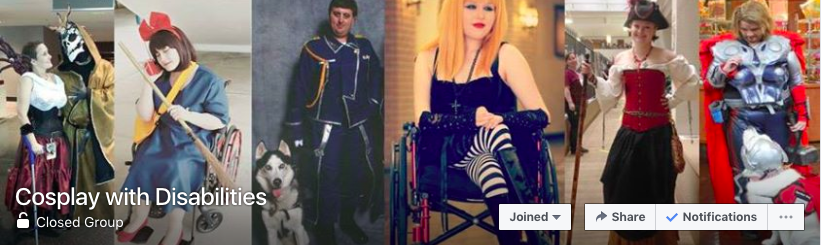
I admit that I might be a little biased – I’ve been involved in online communities for almost half my life and have had some really wonderful experiences there.  I’ve recently found a Facebook group for cosplayers with disabilities where I’m not only getting practical advice on costume and prop construction, but also forming relationships.  If you imagine it as a Venn diagram, the intersection of cosplayers and people with physical disabilities is very small.   So the idea that I instantly got  a dozen responses within a day of posting my initial question is staggering.  Like Tonnies, I immediately found similarly minded people who I never would have known if not for the internet.  On a similar note, a friend of mine is getting married in May to a man she met years ago playing an MMORPG.  Their relationships was entirely digitally mediated, whether through FaceTime or emails, up until a year ago.

The header for the Facebook group for this unique, specialized social community (www.facebook.com/groups/physchallengedcosplay/)

When discussing his interactions with Tonnies’s friends, Walker explains “each expressed a genuine sense of loss; a few sounded grief-stricken even more than a year later.”  To me, those don’t sound like superficial relationships.  Caring about what happens to your online accounts after you die indicates that the content on them matters in more than a fleeting, tweet-about-the-weather sort of way.

I acknowledge shortcomings of online friendships – the lack of eye-contact, for instance, which research has shown plays a big role in facilitating social connection and bonding.  But what I took away from this article is that online friendships are valuable.  Our online presences are part diary, part photo album, part correspondence – a unique confluence of expression and interaction.  Not all tweets are valuable necessarily, but online interactions are not inherently worthless because they happen digitally.  I know it’s trendy to denigrate all online interactions and behaviors, but I can’t imagine Tonnies’s “grief-stricken” friends would agree.

Memory in a Digital Age: Will These Memories Ever Last?

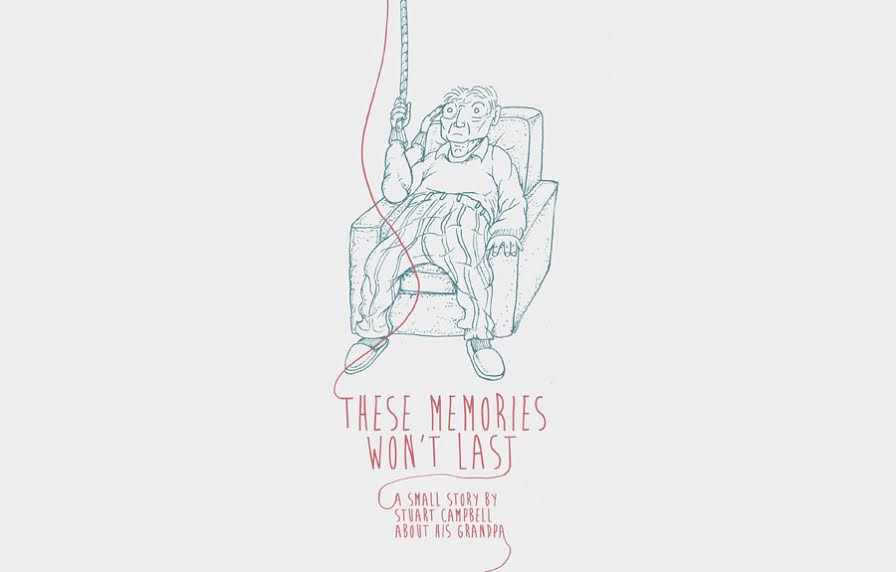
Over the past few years, I have become heavily interested in the concept of how to manage memories within our vast digital landscape. I am also particularly fascinated in the newly popularized desire for digital literature and how this medium redefines how we tell stories. In my English 220: Literary Analysis class last year, we read Stuart Campbell’s interactive comic, These Memories Won’t Last, which takes advantage of its digitized format to make an argument about the fragility of memories in digital spaces. Campbell’s piece takes the reader on a journey through the memories of his Grandfather during his time fighting in World War Two, fleeing to Australia as a refugee, and his current struggle with dementia. The central premise of the piece is the loss of memory but also the importance of sharing stories, which is shown by Campbell’s narration of his Grandfather’s memories. If you take a look at the online narrative, you can see that Campbell uses a fading effect to create a sense of urgency to read the story before the images and text disappear. You are also unable to scroll upwards, meaning that you cannot go back and re-read the text without refreshing the page to start from the beginning. Not only does the fading of images and the inability to scroll upwards correspond to the Grandfather’s inability to recount some of his memories, but it also represents how our memories can become less accessible when we project them into digital spaces.

An image of the grandpa from the story, These Memories Won’t Last. Note how the flimsy string holds the entire story together. View source here.

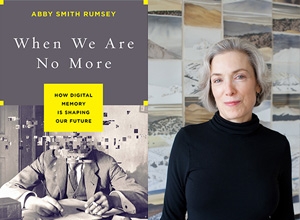
Through the form of his digital story, Campbell demonstrates the short lifespan of data in the digital world which connects to the rhetoric we are exploring in class concerning the curation of one’s “digital afterlife.” In part of Rob Walker’s article, Cyberspace When You’re Dead, he explores how online accounts that eventually become obsolete can influence the cultivation of one’s digital legacy. The fact that Campbell decides to use a flimsy string to hold his story together could comment on the issue Walker explores regarding the preservation of digital memories and enhances the argument about the fragility of memories within online spheres. As I continued to research digital memory for my English class last year, I came across an amazing book entitled, When We Are No More: How Digital Memory is Shaping our Future, written by Abby Smith Rumsey. In her book, she describes the need to reinvent how we preserve memory, questioning how historians will be able understand our own time if all of our memories exist in digital codes that may no longer be decipherable. To combat the problem regarding memory in the digital world, she writes, “The new paradigm of memory is more like growing a garden: Everything we entrust to digital code needs regular tending, refreshing, and periodic migration to make sure it is still alive…” (Rumsey 148). This claim leads me to question what spaces are best for the storage of our memories.

Abby Smith Rumsey and her book, When We Are No More: How Digital Memory is Shaping our Future. View source here.

Why do we feel compelled to store our memories on online spaces when we know that they will eventually expire? A large portion of Rumsey’s argument incorporates neuroscience into various discussions regarding how data storage differs from memory. Consolidation, for instance, is a facet of internal memory formation that is not enhanced by digital use. During this process, new perceptions are incorporated into the old and “connections between the new data coming into the brain find their home in existing mental contexts or webs of associations” (Rumsey 114). This is a process that can only be performed within someone’s brain. A computer is able to store certain memories, but it cannot make complex and far-reaching connections between specific scenarios like the brain. Relying on our devices as extensions of our brains corrupts the beautiful processes that are built within our own internal systems.

Reading These Memories Won’t Last is especially important as we discuss digital memory and what happens to your data when you die because it reflects the reality of telling a story about fading memories within a medium that is supposed to be timeless. As a result, this raises the questions: Does the human mind become the best place for human memories to be stored? Is it more effective to pass our memories on from person to person through shared stories? Think about it.

Works Cited:

Campbell, Stuart. “These Memories Won’t Last.” These Memories Won’t Last. N.p., n.d. Web. 20 March. 2017.

Rumsey, Abby Smith. When We Are No More: How Digital Memory Is Shaping Our Future. N.p.:n.d. Print.

Walker, Rob. “Cyberspace When You’re Dead.” The New York Times. The New York Times, 08 Jan. 2011. Web. 20 Mar. 2017.