Recognizing the Flaws of the Pre-Apocalyptic World

I haven’t seen or read a whole lot of post-apocalyptic narratives, but several years ago I read The Road by Cormac McCarthy and couldn’t help but compare it to what we have read thus far in Station Eleven. In The Road, a man and his son are traveling through a decidedly more brutal post-apocalyptic landscape than Station Eleven, with the two struggling to survive. Throughout the book, the man often thinks back to his wife and the son’s mother who committed suicide in order to escape what she saw as an inevitable end where she would be raped and murdered as they traveled. I felt particularly conflicted by aspect of the plot. While objectively for me this seemed like a reasonable decision, when reading the book I couldn’t shake a feeling of animosity towards this character, as though I had higher standards of bravery and morality of characters surviving the apocalypse. In contrast, when I read Frank’s suicide in Station Eleven, I had no sense of antipathy so I attempted to figure out why. After reflection, it was the line, “I remember thinking that I never wanted to see a war zone again, as long as I live (183),” that stuck with me. In contrast with other post-apocalyptic narratives, Station Eleven does not make out the world before the apocalypse to be a utopia. For Frank, the things he has already seen and lived through are likely just as bad as what is now happening, and this is probably the case for many people in the world. Even in a less drastic sense the pre-apocalyptic world for Arthur and even Miranda is distinctly un-idyllic. Kirsten’s reflections on the death that surrounded Shakespeare (57) also served as a reminder that gruesome deaths are not unique to the world after the collapse. For me, it was almost as though because Station Eleven recognized that the pre-collapse world was in many ways incredibly flawed, that it was acceptable for the characters to be more imperfectly human as well.
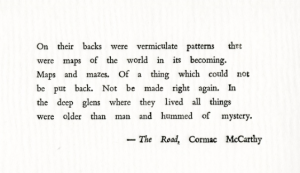
In contrast with Station Eleven, The Road’s reflections on the pre-apocalyptic world seem to only see the beauty of what was and never will be again.


Mandel, Emily St. John. Station Eleven : A Novel. First edition. ed., New York, Alfred A. Knopf, 2015.

McCarthy, Cormac. The Road. 1st Vintage International ed. ed., New York, Vintage Books, 2006.

No More Cemeteries

What I find very intriguing is how even our treatment of trash will change in the future, and how it’s already different today. For instance, it was once not too difficult to list all the video games created, and keep track of how they’re doing. Interestingly, more and more media is becoming entirely digital, and usually stream able, or a combination. Why this is important is just how money, at some point became this number with no real physical connection in our lives. The information and entertainment we consume daily and from moment to moment has also lost its physical origin or connection. There are no cartridges. Sure there are CDs, DVDs, but none of these things are as mandatory as they once used to be. You HAD to buy a video game in a store. Now it’s all doable online.


In line with that, there are so many video games today. Development has also become more accessible, and so there are more and more additions every day. Most of them actually never see any form of attention or popularity, instead, they exist, but are never even born. We can look at Steam for instance. A game might be greenlit (given the green light to start development and its journey on Steam), yet still never see a large enough player base for anybody to find out. The interesting thing is, there are SO many video games that never see the light of day and we’re just entirely unaware of them. These games can’t even die properly because they’ve never had a life. In other words, I don’t think it’s possible for another instance of “E.T. The Extra-Terrestrial” (1982) to ever happen, because games flop even harder than ET ever did, but they never even exist in a physical form, so there’s nothing to really discard, we just kind of ignore them.

static.comicvine.com/uploads/original/11119/111194123/4319704-4314324986-neA4O.png


Peace,

Duka


permutations of our conceptions of technological death

The description of the state of the E.T. cartridges which the author was researching is one of the many permutations of views that we hold regarding technology. Many of the works we have examined in class have portrayed technology as having a timeless element. There Will Come Soft Rain captured this sentiment most poignantly, as it’s narrative portrayed a technological system running many years after humanity’s demise. However, this poem also flirts with the concept of technology’s death, in a much more gruesome way than E.T.‘s burial was portrayed in the current reading. The polluted atmosphere of the Bradbury poem is common imagery held throughout almost all views on the death of technology. Where the house in There Will Come Soft Rain squirts green bile from itself as it attempts to smother a fire, I imagine much more toxic pollutants will leach from the reactive metals used in constructing game cartridges (and whatever else the article classifies as “eWaste”). What I am ultimately driving at with these two examples is that what we consider to be the death of technology, in whatever form that may take, is an incredibly damaging thing to the health of the earth, and it is important for that connotation to carry through in portrayals of technological death such as the eWaste graveyard where the copies of E.T. were buried.

In an ironic twist, the lifespan of E.T. described by the article would have gone largely unknown if it were not for the “death” which the game experienced by having several thousands copies buried in a landfill. That spectacle turned a terrible Atari game into a cultural monolith, something gamers could point to as “the worst game ever made”.  It’s persistence after death has cultural significance which some of us have studied through our last class project and deserves to be further related to other works we have studied.

The reality of technological death and “ewaste”


Fetishizing Trash: Atari and Material Lifecycles

In 1982, Atari dumped what was dubbed by numerous video game critics as the “worst game ever made” into a landfill in a nondescript New Mexico town. E.T.  The Extra Terrestrial sales bombed. So, it was loaded into trucks and driven off to be crushed, buried and forgotten about.

Years later, conspiracy theories, curiosity,  academic research and even a Canadian entertainment company bent on uncovering Atari’s trash swirl around this dumping story.

Why? By all accounts, it was terrible game. No one seemed to enjoy playing it; consumers returned the game en masse and retailers slashed the prices, unable to sell more. It was developed in only five weeks. It lacked interesting game-play and had awful graphics. Raiford Guins wrote that the little alien looked “too haggard” for comfort. (217). It seems like most of the play experience involved falling into pits over and over again.

It again begs the question — why is there all this fanfare for such a terrible game?

Typically, Guins points out, the dumping process is not publicized or even in public view. It hurts to see the objects we imbue with so much social power — objects that become fetishistic representations of self, social relationships and all kinds of other abstract human concepts — become trash. The symbols we attached are shed and all that’s left is a physical, material shell. The magic is lost and the use value comes too sharply into focus — we have to look away.

It’s perhaps why dumping grounds can elicit anxiety, sadness, and dread. Perhaps it’s also why the US exports up to 40% of our e-waste overseas. It’s easier to bear if it’s out of sight. Trash reveals the “doleful truthfulness” of objects; we are literally driven to a state of mourning when confronted with objects severed from their fetishistic dimensions. (Guins, 227).

A landfill in Austin, TX. Landfills could almost be characterized as ‘uncanny’ spaces; they unsettle the way we interact with objects in our daily lives by instead presenting them as disposable and wholly material.

Atari’s E.T. game was trash, technically — was was crushed by bulldozers and packed beneath the ground with dirt. However, something interesting happened: it wasn’t forgotten and it hasn’t seemed to take on the “doleful” characteristic of other trash.

The process of secrecy and new-found rarity drew people’s attention and maintained interest the game. The cartridge may have lost its status as a usable game with desirable gameplay, but it gained status as a concrete emblem of video game history. It fits neatly into the myth of Atari by providing a physical representation. The game itself may be buried in the ground, but mystery, rarity, and its capacity to concretize history all prevent it from decomposing as trash. E.T. may have been dead and buried in the 1980s, but today it is still alive and well in the social mind.

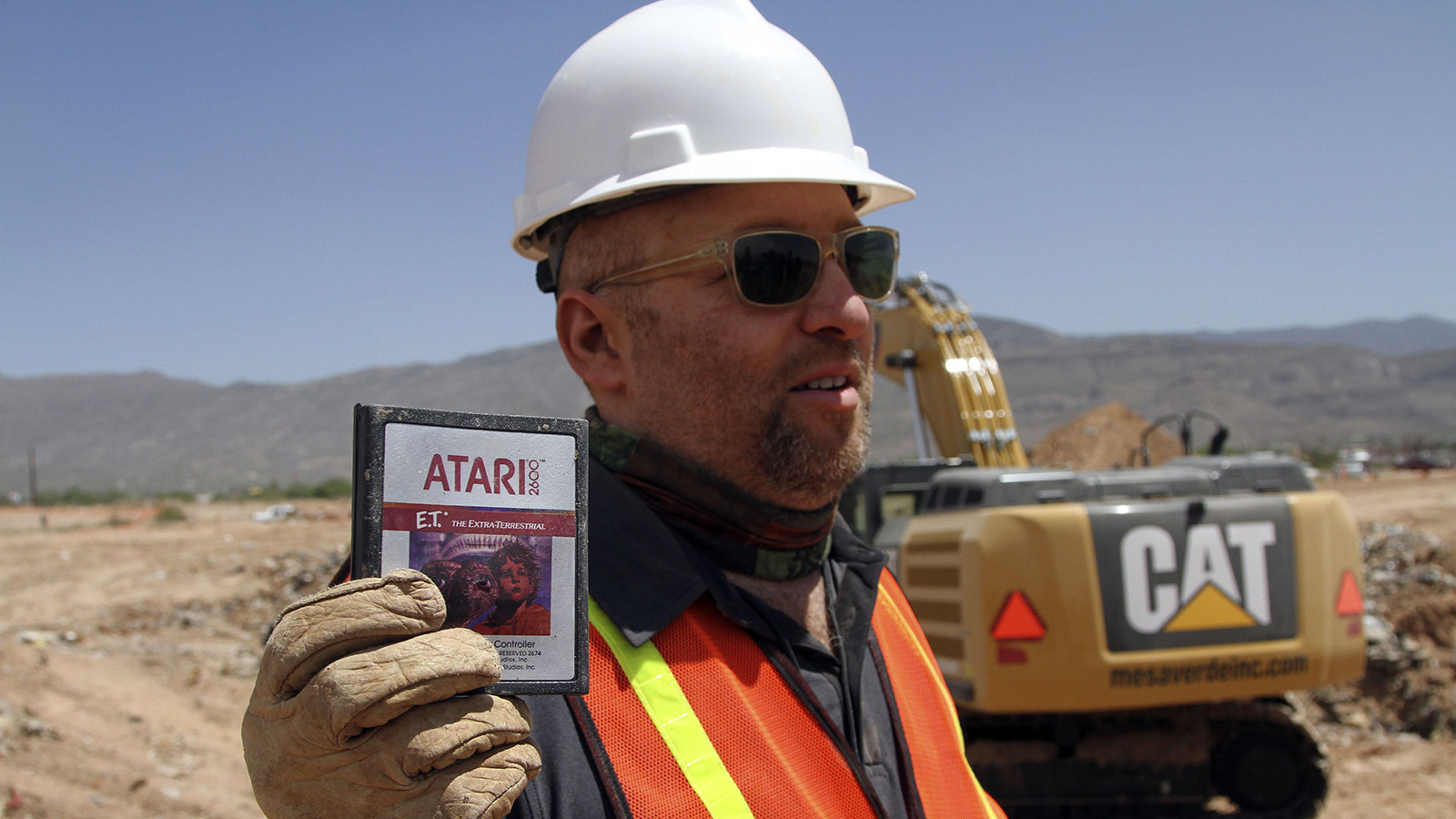
The 2014 Fuel Industries excavations of the Alamogordo, NM landfill where Atari dumped. Photo taken by Chris Kohler.
Fuel Industries actually unearthed Atari cartridges during their excavation! Photo by Chris Kohler.

Works Cited:

Guins, Raiford. “Landfill Legend.” Game After: A Cultural Study of Video Game Afterlife. Cambridge, MA: MIT, 2014. 207-35.

So Bad It’s Good?

Dr. Ford in the English department has talked about how he’s very interested in the “aesthetics of badness” and I confess that I am too.  Awful films or TV shows can be so enjoyable in that so-bad-it’s-good way and often develop serious cult followings.   But this doesn’t seem to be the case with the E.T. Atari game.  So I’m interested in what distinguishes good-bad from bad-bad.  To illustrate, I have two pieces of E.T. media to share.

(E.T. Atari let’s play video by YouTube user J.C.’s Channel.  Click the title and it will take you right back to the source)

(The musical masterpiece “ET Where R U” from “Themes for Television, Sports, & Aerobics,” directed and produced by George H Semper.  Again, the title will take you right back to the source.  The song has a really long intro, so skip to 2:45 for the good stuff.  I’m using the term “good” loosely here)

Initially, I thought that maybe any video game with bad, clumsy game play would be despised.  I’m not much of a gamer myself, but I imagine there’s a great degree of frustration when playing an unnecessarily difficult game.  However, I did a bit of research on the best worst video games, and plenty of games made the list that were criticized for having really terrible game play.

So instead, here’s my conclusion.  We can appreciate art for two reasons: 1. it is a good piece of art or 2. it makes us feel good.  To be enjoyed, you have to meet only one of the categories.   I will admit freely that the first Captain America movie is not a good film from a critical standpoint, but it brings me joy.  Similarly, I appreciate Logan as one of the best superhero movies ever made, but I have no intention of ever sitting through it again, because it was extremely depressing.

So “ET Where R U” is an awful song.  It doesn’t meet criterium one.  But it’s just absurd enough to be really funny, therefore meeting criterium two, and therefore gets to be good-bad.

Just watching the play-through of the ET video game is maddening and frankly, pretty boring.  And from an aesthetic, artistic standpoint, it’s just not that good.  So, meeting neither criteria, it’s bad-bad.

I could see, perhaps in an alternate universe, the ET Atari game being a cult classic as a good-bad game if it were any fun to play.

To illustrate my point, here’s yet another YouTube video of some “so bad they’re good” games.  The difference between the ET video and these games is clear.  They’re garbage, but redeemed because they’re funny or enjoyable.  ET, unfortunately, is just plain bad.

(Accessed from the WhatCulture Gaming YouTube channel)


Burying Our Mistakes

Reading about the landfill excavation that unearthed Atari video games made me think about other instances in history during which American companies “hid” potential setbacks, mistakes, or failures. My mind immediately raced to the “Syringe Tide,” an environmental disaster that occurred from 1987-1988 where significant amounts of medical waste, particularly hypodermic syringes were washed up onto the beaches in New Jersey, New York City, and Long Island. Hospitals decided to discard the medical waste in the ocean to avoid extra costs associated with the government regulations, figuring they could save money by burying their problem at sea. However, when the medical waste was found, hundreds of thousands of vacationers were driven away, causing places such as the Jersey Shore to lose much revenue in tourism as well widespread skepticism regarding public health in general. I also thought about the movie Erin Brockovich, a dramatization of the story of Erin Brockovich, played by Julia Roberts, who fought in a real estate case against the energy corporation Pacific Gas and Electric Company (PG&E) which polluted a city’s water supply with hexavalent chromium. It was not until Brockovich looked under the surface that she discovered how many residents in the area were poisoned by the toxic waste, leading her to succeed in one of the biggest class action lawsuits in American history. Although these examples differ in content and form, an examination of them led me to the conclusion that we bury our mistakes simply because we can, and yet, many of them are eventually uncovered.

Medicinal waste washed up on the Jersey Shore. View source here.

During Easter Break, I decided to watch the documentary entitled, Atari: Game Over which explores the burial and excavation site in Alamogordo, New Mexico more in depth. The film brought light to many of the success of Atari, considering it to be “the future of technology.” It also highlighted the idea that it has become “fashionable” to say that E.T. was the worst video game of all time, when in actuality, it was not, and was certainly not the sole reason for the company’s downfall. Many people in the documentary reiterated the point that the E.T. game was not buried because of it was the worst game ever, rather it has become known as the worst game ever because it was buried. While society has become quick to “trash” games and game designs both physically and verbally, hiding our mistakes from the public view has also become part of our history. After thinking about this more, was there a valid justification for the Atari burial site to be unearthed? If the site is looked at as being Atari’s funeral, was it ethical to dig it up? Why does society feel the need to reclaim “dead” technology?

An image from the movie, Atari: Game Over. View source here. 

The Darker Afterlife of Electronics

While the story behind “Landfill Legend,” and the dump of Atari E.T. games was charming, particularly with its myth-like status and cult following, I had always been warned that the life cycle of electronics as detailed by Raiford Guins had a far more nefarious end. My parents and older brother would chastise me about tossing batteries or electronics in the trash because of the environmental consequences. However, I recalled a NYT article I once read that argued the health risks of our electronic disposal system are more immediate than even their long-term environmental consequences. I tried to hunt it down, and whether it is the same article or not, I found one detailing the conditions of electronic dumps in third world countries. Leyla Acaroglu describes what happens to our digital devices after they’re dumped: “In India, young boys smash computer batteries with mallets to recover cadmium, toxic flecks of which cover their hands and feet as they work. Women spend their days bent over baths of hot lead, “cooking” circuit boards so they can remove slivers of gold inside.” Acaroglu paints a picture of the legacy of our electronic devices that is quite a bit darker than Guin’s statement of the legacy of the Atari dump: “the invisible presence of decaying matter deep below my feet attests to a complex life history, one pieced together and sustained by the various projects that refuse to forget (234).” While tracing the afterlife of our electronic devices certainly may tell us a lot about where they came from, it’s hard for me to focus on much other than the relatively gruesome health and environmental consequences.

An image of an electronic dump from “Where Do Old Cellphones Go to Die?”
www.nytimes.com/2013/05/05/opinion/sunday/where-do-old-cellphones-go-to-die.html%5B/caption%5D

Acaroglu, Leyla. “Where Do Old Cellphones Go to Die?” The New York Times. 4 May 2013. www.nytimes.com/2013/05/05/opinion/sunday/where-do-old-cellphones-go-to-die.html.

Guins, Raiford. “Landfill Legend.” Game After: A Cultural Study of Video Game Afterlife. USA: MIT Press, 207-235.


Photographic Paradox — Death, but Cybernetic

In “Digital Resurrection,” Alexandra Sherlock brings up a paradox first written about by Roland Barthes. A photograph is a paradox between life and death: “the moment is dead but the photograph is alive and present.” (170).

An embodied death can be overturned in our minds by the presences of images and media of that person. The absence of an animated body no longer means that person is out of reach. Indeed, we need only to turn to celebrity deaths — where estates and listening companies make millions — to see the self enduring past the physical body.

Does this change our understanding of finality? Death as an inevitable, totalizing concept is softened when we can stream living videos, images, and audio of the deceased. “It is a living image of the dead thing,” Barthes wrote: “the photograph surreptitiously induces belief that it is alive.” (Sherlock, 170).

Sherlock also addressed death as disruption. The dead body “reminds us of our own fate, resulting in the disruption of identity, system.” (169). A celebrity death is a highly publicized sort of disruption — if even this beautiful, wealthy, famous person can die, it shatters the illusion of escaping our own fate.

So it comes as no surprise that celebrity deaths are often “spun”: Tupac faked it to dip out of gang warfare and live anonymous in Cuba. The Illuminati killed Michael Jackson and Prince and Bowie. Combined with photographic paradox, it is as if celebrities are not really dead — they’ve simply reached a point where no new content is produced. It’s a tidy way to side-step the death disruption and avoid thinking about that one, inevitable fate.

This photo was circulated by conspiracists in 2011, showing that Tupac “alive” and in attendance at Occupy demonstrations.

Taken to the extreme, this type of thinking erases the concept of death from consciousness all together.

Putting too much stock in digital recreation

Many of the recent articles have addressed the idea of digital immortality. Old scrapbooks are often compared to social media profiles, but I feel that the whole “Life in the digital world is forever” concept requires a little more unpacking than these articles are willing to dive into. Specifically referring to Alexandria Sherlock’s article “Digital Resurrection and the re-Enchantment of Society”, the jump from a digital memento to symbolic immortality is made almost immediately. This opens up numerous avenues for interesting discussion, but I feel that it is not quite an accurate description of the phenomenon at hand. In last semester’s FMS 321 class, “Interactive Digital Narratives” we discussed the new layer of portrayal that modern technology allows. Along with visual, auditory, and more sensory-focused portrayal in art, we can now functionalize our art as well. Video games are an example of procedure-based art, and the digital reconstruction of humans is just another expression of that art form.

A digitally recreated Peter Cushings playing Tarik in Star Wars: Rogue One. The “aura” of this recreation has weight because it accesses the authentic Tarik.

Take the 2-Pac hologram, for example. It resembles the likeness of 2-Pac, but the art on display is a procedure-based musical performance which doesn’t embody 2-Pac’s personality, but only makes reference to it. For example, When Snoop Dogg asked 2-Pac, “What kind of party is this?” 2-Pac responded by singing “Ain’t nuthin but a gansta party” making reference to a previous song. This is an example of Benjamin’s assertion that the “aura” of something must be connected to the original. Procedure-based artistic design lends itself extremely well to this, as seen in the episode of Black Mirror where the reproduced Ashe essentially accesses the “aura” of the original Ashe (via his Facebook profile) in order to seem more authentic. It becomes a procedure-based art form to construct a recreation of a being that can interact and interface with the viewer in an authentic way. Due to these likenesses being only portrayed in their own art form (rapping, acting, ect.) they are permanently bound to that space and become the spectacle themselves.

Ultimately, it is important to be cognizant of what is actually happening with digital recreations, and not go too far off the edge with postulation.

Narcissism & Mourning Celebrity Deaths on Social Media

One of the modern phenomena Alexandra Sherlock discusses in her Larger than Life article is the widespread public mourning that often accompanies celebrity deaths. While many people do experience para-social relationships with celebrities and have been deeply touched or influenced by famous figures, I also believe that much of modern social media mourning, at least in 2016, has reached a new level of triviality. In the past, people seemed to take more time to process the death of a famous person, and generally did not feel as much pressure to publicly acknowledge or respond to the death. Even media coverage was not instantaneous the way it is today. Now, everything is at the touch of a button – whenever a celebrity dies, Twitter feeds become flooded within mere minutes. Sometimes, this sense of urgency can lead people into rushed grieving. For example, this happened with Sarah Michelle Gellar in response to George Michael’s death last year:


@SarahMGellar’s tweet
@SarahMGellar’s follow-up tweet

(Boy George is not George Michael and he’s alive and well.) I’m not suggesting that she was insincere in her grief, or wasn’t a true fan – she may very well have misheard the news. But incidents like this make me think about the pressure people sometimes feel to immediately acknowledge a celebrity death on social media. It also made me think about how often the most die-hard fans won’t post at all about their beloved musician, actor, etc. who just passed away because they don’t believe a 140-character text post could begin to do this person justice. Then I thought about the other side of the spectrum: narcissistic social media grievers. (The following tweet doesn’t necessarily relate to social media/technology, but it nevertheless somewhat expresses how I feel about this.)

@HasnaatMahmood’s original viral tweet

It’s difficult to refrain from being cynical and believing that many people use celebrity deaths as an excuse to post on social media, making it an opportunity to turn the spotlight towards them. I remember when David Bowie passed away last year, my Instagram explore feed was flooded with artsy photos commemorating the pop singer, which was to be expected. But what surprised me was the number of times I scrolled across an Instagram “model” posed with Bowie’s iconic lightning bolt painted across their face in a photograph shot in honor of Bowie’s memory. While I understand that some people embrace art as an outlet for grief, one of these models claimed to have never once listened to any of Bowie’s music, which makes me view these types of photos in a similar (although not as heinous) light to the social media narcissism we discussed in class last week pertaining to the Yolocaust article. I just question how much of the casual, click-of-a-button public mourning we see today is genuine mourning and how much of it is simply jumping on the bandwagon – and whether it is disrespectful to the memories of the dead.