
One of the modern phenomena Alexandra Sherlock discusses in her Larger than Life article is the widespread public mourning that often accompanies celebrity deaths. While many people do experience para-social relationships with celebrities and have been deeply touched or influenced by famous figures, I also believe that much of modern social media mourning, at least in 2016, has reached a new level of triviality. In the past, people seemed to take more time to process the death of a famous person, and generally did not feel as much pressure to publicly acknowledge or respond to the death. Even media coverage was not instantaneous the way it is today. Now, everything is at the touch of a button – whenever a celebrity dies, Twitter feeds become flooded within mere minutes. Sometimes, this sense of urgency can lead people into rushed grieving. For example, this happened with Sarah Michelle Gellar in response to George Michael’s death last year:
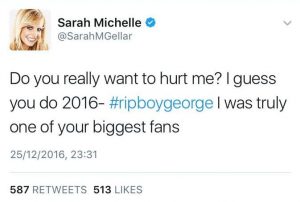

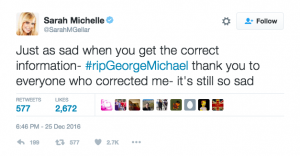

(Boy George is not George Michael and he’s alive and well.) I’m not suggesting that she was insincere in her grief, or wasn’t a true fan – she may very well have misheard the news. But incidents like this make me think about the pressure people sometimes feel to immediately acknowledge a celebrity death on social media. It also made me think about how often the most die-hard fans won’t post at all about their beloved musician, actor, etc. who just passed away because they don’t believe a 140-character text post could begin to do this person justice. Then I thought about the other side of the spectrum: narcissistic social media grievers. (The following tweet doesn’t necessarily relate to social media/technology, but it nevertheless somewhat expresses how I feel about this.)
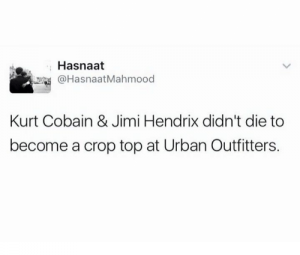
It’s difficult to refrain from being cynical and believing that many people use celebrity deaths as an excuse to post on social media, making it an opportunity to turn the spotlight towards them. I remember when David Bowie passed away last year, my Instagram explore feed was flooded with artsy photos commemorating the pop singer, which was to be expected. But what surprised me was the number of times I scrolled across an Instagram “model” posed with Bowie’s iconic lightning bolt painted across their face in a photograph shot in honor of Bowie’s memory. While I understand that some people embrace art as an outlet for grief, one of these models claimed to have never once listened to any of Bowie’s music, which makes me view these types of photos in a similar (although not as heinous) light to the social media narcissism we discussed in class last week pertaining to the Yolocaust article. I just question how much of the casual, click-of-a-button public mourning we see today is genuine mourning and how much of it is simply jumping on the bandwagon – and whether it is disrespectful to the memories of the dead.