Several weeks ago, I wrote a blog post titled “Head in the Cloud?” about the technology scientists are working on to upload people’s brain memory to a cloud after they die, by converting human brains to code which can run on machines. I discussed the idea of hacking death, and concluded with the question of whether humans can actually transcend death through their brain data living on – I was skeptical that a human being could be reduced to simply a database of memories.
More recently, though, I found another article on physically preserving people after they die through cryonics – the science of preserving people through sub-frozen temperatures in the hope that some time in the future, they can be brought back to life. The headline reads, “Floating in a tank of liquid nitrogen, unable to control our destiny, is very unappealing. But it’s much more appealing than being nibbled on by worms and bacteria.” Alcor Life Extension Foundation is a freezing center dedicated to making this practice available to the public. More than 1,100 people, referred to as “cryonauts,” have committed to being frozen, and 149 heads and bodies of people from around the world are currently stored at its center in Scottsdale, Arizona. The cost for this procedure? $80,000 for preserving just the head, and $200,000 for preserving the entire body. You can even freeze your pets!
One aspect of the article I found particularly interesting was its description of the timeline of the science of preserving life, drawing cryonics all the way back to Benjamin Franklin, who had hopes of embalming people in the future. When I think about how drastically technology has progressed within very recent years, and how many technological predictions have recently come true (i.e. self-driving cars available to the masses), the idea of “immortalization” in the future doesn’t seem that far of a reach to me. Throughout the semester, we’ve discussed how cultural perceptions, attitudes, and behaviors surrounding death have evolved over time (for instance, how death moved from the public sphere to the private sphere). However, the emergence of companies like Alcor shakes things up a bit further. With the advancement of cryonics, technology can change the very way we die – or, potentially, don’t.
This topic would probably be more fitting for a sightings post, but it tied really well to a passage from today’s Station Eleven reading. In Chapter 30, Mandel writes, “On silent afternoons in his brother’s apartment, Jeevan found himself thinking about how human the city is, how human everything is. We bemoaned the impersonality of the modern world, but that was a lie, it seemed to him; it had never been impersonal at all. There had always been a massive delicate infrastructure of people, all of them working unnoticed around us, and when people stop going to work, the entire operations grinds to a halt. No one delivers fuel to the gas stations or the airports. Cars are stranded. Airplanes cannot fly. Trucks remain at their points of origin. Food never reaches the cities; grocery stores close. Businesses are locked and then looted. No one comes home to work at the power plants or the sub-stations, no one removes fallen trees from electrical lines” (178).
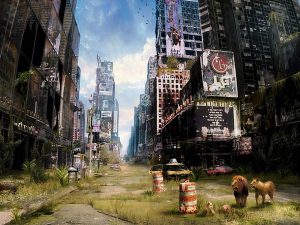
Last class discussion, Dr. Sample mentioned what would hypothetically happen to the world, specifically to the New York City subways, if humans disappeared from the earth. Having taken a Posthumanism English class this semester, which turned out to complement this class in a really interesting way, I’ve thought a lot about the post-human world and the intersections between humanity and technology. I found this video on what would happen if all humans suddenly disappeared from the planet:
Although humans haven’t gone completely extinct in Station Eleven, we still see the devastating effects of the absence of humans in a post-apocalyptic world. I find it interesting that this video, as well as most similar content on the topic, does not address what would happen to the Internet without humans. As we’ve discussed in our blog posts and class discussions, in many ways, technology continues to live as people die. But like other complex technological systems, the Internet still requires human maintenance. I wonder how the Internet would fare independent of people. If new intelligent life occupies the earth after humans have left or gone extinct, would they be able to retrieve the technology saved in “the cloud” when all other traces of humanity have dwindled away?
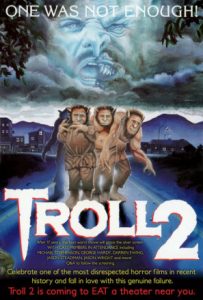
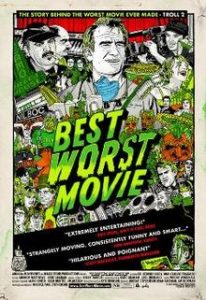
In our last class discussion on the “Landfill Legend” article and the Atari E.T. video game, Dr. Sample briefly brought up the concept of paracinema, specifically the idea of “bad” film. People discussed the entertainment value of bad movies or video games, and the idea of something being so ridiculously bad that it becomes good. I found it interesting to note that the “Landfill Legend” article mentions that people tend to not be as tolerant of bad video games as bad film. I was fascinated by the cult followings some bad movies have gained over the years, seemingly to the extent that intentionally bad film has become a sort of art form in itself. For me, the movie Sharknado comes to mind as an example when I think of a cringe-worthily bad film that has gained an enthusiastic fanbase. Of course, these films can’t just be simply bad, but a specific type of bad – usually involving self-awareness of its badness and irony. For example, I examined the movies Troll 2 (1990) and its spinoff, the Best Worst Movie (2009). I haven’t seen either of these films in their entirety, but Troll 2 is often considered one of the worst movies ever made of all time. The Best Worst Movie was directed by Michael Stephenson, one of the child stars in Troll 2, and is a documentary about the making of Troll 2, acknowledging the film as infamously bad.
If you compare the ratings between this film and Troll 2, you’ll see that while the original film received atrociously low ratings, the documentary received quite positive reviews. This made me think about the question of what makes a film “good.” And if a bad movie can become good, is there even distinct criteria? In modern cinema, with the rise of experimental film and film that can’t quite be placed into categorical boxes, there seems to be not only a blurring of the distinction between high art and low art, but between genres as well. Many previously recognizable genres have died out over time – i.e. the old western, film noir, etc. Now, in the era of the Internet, the accessibility of all kinds of film has made genre virtually infinite. There are now subgenres, and even subgenres within those subgenres – and the rise of parody, fanfiction, and remix culture. Sure, paracinema can be considered a genre of film, like any other, but it makes me wonder if the idea of genre overall is dying out as we progress into the digital age.
I was inspired with the idea for my Haunted Media Project while on an old Western binge-watching session prompted by another class. Though I was mostly watching Clint Eastwood-type cowboys, I remembered another Wild West female character I had grown up watching from the movie Holes, based on the novel by Louis Sachar. She only played a minor role in the story, but I was always impressed and fascinated by the femme fatale outlaw Kissin’ Kate Barlow.
I initially considered creating a regular online memorial page for the fictional character Katherine Barlow, but I did not find it very compelling. The idea of some sort of tribute website, almost like a fan site, seemed more appealing to me. I decided to base the website loosely around the idea of serial killer fan sites, which actually exist for real-life notorious serial killers like Ted Bundy and Jeffrey Dahmer – some of which are disturbingly popular. There is quite a modern-day fascination with serial killers as celebrities, especially among young female fans, and psychologists and social scientists have sought to explain this unsettling phenomenon. While portrayed in Holes as more of a misunderstood outlaw rather than a serial killer, Kate Barlow nevertheless killed multiple men throughout her robbery spree. I could see how if the Internet existed during the Wild West era, she could potentially gain an online following due to her femme fatale appeal. For my project, I imagined what a website in remembrance of Kissin’ Kate Barlow through the eyes of her fans would look like, and what function technology would bring to the table, as opposed to a traditional print tribute, for example.
One of the articles we read for class, “Gravesites and Websites: A Comparison of Memorialisation,” examines the modern trend of memorializing the dead on the Internet, and the implications of this method as opposed to traditional graveyards and memorials. The authors write, “Website memorials allow interaction with the dead to continue and for the continuing presence of the dead in both a private and public sphere. In this way, they remain strangely unincorporated and in a state of transition. Social interaction with the dead continues online and their identity is kept alive.” My project was a bit tricky in this regard, because while the website was in honor of Kate Barlow and her life story and legacy, it also featured brief obituary-like blurbs with an accompanying image for each of her victims. However, unlike the memorials discussed in the article, these were not in loving memory or praise of these men, but rather as a toast to Kate. The “Tributes” tab of the website gave her fans a platform to write messages as if they were speaking directly to her – her victims, on the other hand, are not given this honor, so their identities are not kept alive in the same way. The authors of the “Gravesites and Websites” article go on to acknowledge the increasingly different forms of memorializing death on the Internet, explaining how their studies have “suggested how such differences will no doubt be seen multiplying across online memorials: various Internet services and technologies such as Web documents, Facebook pages and gaming environments.”
Another article we read for class, Alexandra Sherlock’s “Larger Than Life: Digital Resurrection and the Re-Enchantment of Society,” expands on the idea of the Internet allowing the continuation of the presence of the dead, referring to the Internet as “a type of digital heaven.” Sherlock explains, “representational technologies in particular offer a life after death, a symbolic life in which the representation can act as a substitute for the person in the event of their physical absence – a symbolic immortality.” Much like how people often continue to write on a deceased person’s Facebook wall as if they were still alive, Kate Barlow’s fans still write messages to her as if she were. This is where the idea of para-social relationships comes into play. Sherlock writes, “One can identify with someone without ever meeting them, or even if the subject is dead, so forming a type of one-sided para-social relationship facilitated by representations.” This concept is particularly important when it comes to the fans of serial killers because virtually all of their vans have never met them, let alone known them personally. Nevertheless, for as long as serial killers have achieved widespread fame, they have obtained fan mail. Even before the birth of the Internet, in the 1980s, when the prevalence of serial killer “groupies” was thought to be at its peak, fans would often write handwritten letters to the killers in jail.
In order to gain better understanding of the phenomenon of serial killer idolization, I read some of David Schmid’s book, Natural Born Celebrities: Serial Killers in American Culture. I was particularly interested in the intersection of this fascination with serial killers and the age of the Internet, which Schmid addresses. He writes, “The introduction of each new media technology therefore represents a decisive shift in both the types of fame available in a culture and the ability of that culture to disseminate fame” (12). For instance, the rise of American mass media explains the rise of widespread attention surrounding serial killers in the 1980s. Likewise, with the rise of the Internet, serial killer fans have transitioned from handwritten letters to online forums dedicated to their killer of interest.
Schmid also discusses the market for death in his book, writing that “Online shopping is all the rage these days, and the murderabilia industry in particular, which specializes in selling serial killer artifacts, is booming” (1). He continues, “In order to understand why there is such a vibrant market in contemporary America for representations of death in general and of serial murder in particular, we have to appreciate that the famous serial killer effectively and economically satisfies a double need, both halves of which have grown over the course of the twentieth century: the need for representations of death and the need for celebrities” (17). While I had no idea that serial killer artifacts were in such demand, this segment rang true in relation to the literature we have read in class surrounding celebrity deaths and the commercialization of death. In fact, this ties all the way back to our class discussion about commercialization and the Internet, and how much our online data is worth to the companies that profit off it. I tried to embody this concept in my project with the addition of the “Lipstick” tab of Kate Barlow’s website. Thinly disguised under the veil of commemoration, the fan site seeks to profit off Kate Barlow’s fans through the sale of collectible replica lipsticks. My goal for this addition of the site was to give the illusion of authenticity to gullible fans who sought to emulate Kissin’ Kate’s iconic look, but remain transparent enough for non-fans to realize this was merely a scheme for the site’s creators to make money. I wanted to capture the ever-presence of online marketing, which permeates virtually every sphere of space on the Internet nowadays.
Works Cited
Graham, Connor, et al. “Gravesites and Websites: A Comparison of Memorialisation.” Visual Studies. 2015.
Schmid, David. Natural Born Celebrities: Serial Killers in American Culture. Chicago: The University of Chicago Press, 2005.
Sherlock, Alexandra. “Larger Than Life: Digital Resurrection and the Re-Enchantment of Society.” The Information Society. 2013.
During our class activity on Tuesday about the re-enchantment of dead celebrities, people seemed to agree that Robin Williams stood out from the other names on the list because he was always perceived as a “real person” while the others had been idealized and iconicized. My group discussed how this reverence for celebrities was a phenomenon that almost always occurred after their deaths – this was a trend we saw especially in great artists and musicians throughout history.
After David Bowie’s death, I read a lot of articles pondering how we should reconcile his musical genius and legacy with the fact that he, and many other rock artists of the time period, unapologetically had sex with underage teenage girls.
This specific article goes on and on for a while about other examples, but I want to focus on the first part in particular. The writer says, “Rock star escapades from that period have been glamorized for decades with no regard for how disturbing or illegal the behavior was. It became a part of the mythos – a disgusting testament to how little the writers documenting the happenings of the day cared about taking their heroes to task.” He goes on to add, “It’s convenient to go after Tyga and R. Kelly when we see hashtags or trending stories, and their behavior warrants every bit of scrutiny and criticism it’s gotten. But we cannot write off the alarming behavior of superstars past just because they’re older, greyer, or in the case of Bowie, newly-departed.”
The idealized re-enchantment of celebrities after their deaths is interesting to think about in relation to the digital age because our relationships with celebrities have changed so much over the years. Think about Hollywood’s Golden Age. Celebrities like Marilyn Monroe were able to maintain a certain aura of mystery behind their image because of the distance between the famous and their fans. You pretty much only knew what you saw on television or read in the papers. Some people say that the rumored affair between President John F. Kennedy and Marilyn Monroe would certainly not be plausible in today’s world. Now with social media like Twitter and Instagram, people can keep up to date with their favorite celebrities by the minute. With the Internet and the modern speed of information, the lives of the famous are not so mysterious as they once were. (Hence, the article’s reference to the controversy surrounding Tyga’s relationship with Kylie when she was underage). This partly explains why the rock stars of the 1970s were able to get away with their behavior. Perhaps as technology continues to advance and our relationships with celebrities continue to evolve, celebrities will seem less like icons and more like “real people,” and the re-enchantment of dead celebrities as saint-like legends might be harder to come by.
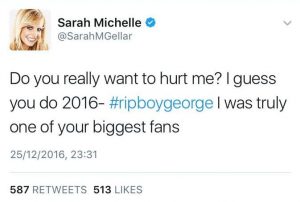
One of the modern phenomena Alexandra Sherlock discusses in her Larger than Life article is the widespread public mourning that often accompanies celebrity deaths. While many people do experience para-social relationships with celebrities and have been deeply touched or influenced by famous figures, I also believe that much of modern social media mourning, at least in 2016, has reached a new level of triviality. In the past, people seemed to take more time to process the death of a famous person, and generally did not feel as much pressure to publicly acknowledge or respond to the death. Even media coverage was not instantaneous the way it is today. Now, everything is at the touch of a button – whenever a celebrity dies, Twitter feeds become flooded within mere minutes. Sometimes, this sense of urgency can lead people into rushed grieving. For example, this happened with Sarah Michelle Gellar in response to George Michael’s death last year:
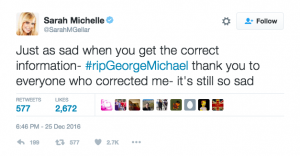
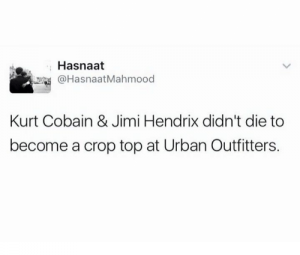
(Boy George is not George Michael and he’s alive and well.) I’m not suggesting that she was insincere in her grief, or wasn’t a true fan – she may very well have misheard the news. But incidents like this make me think about the pressure people sometimes feel to immediately acknowledge a celebrity death on social media. It also made me think about how often the most die-hard fans won’t post at all about their beloved musician, actor, etc. who just passed away because they don’t believe a 140-character text post could begin to do this person justice. Then I thought about the other side of the spectrum: narcissistic social media grievers. (The following tweet doesn’t necessarily relate to social media/technology, but it nevertheless somewhat expresses how I feel about this.)
It’s difficult to refrain from being cynical and believing that many people use celebrity deaths as an excuse to post on social media, making it an opportunity to turn the spotlight towards them. I remember when David Bowie passed away last year, my Instagram explore feed was flooded with artsy photos commemorating the pop singer, which was to be expected. But what surprised me was the number of times I scrolled across an Instagram “model” posed with Bowie’s iconic lightning bolt painted across their face in a photograph shot in honor of Bowie’s memory. While I understand that some people embrace art as an outlet for grief, one of these models claimed to have never once listened to any of Bowie’s music, which makes me view these types of photos in a similar (although not as heinous) light to the social media narcissism we discussed in class last week pertaining to the Yolocaust article. I just question how much of the casual, click-of-a-button public mourning we see today is genuine mourning and how much of it is simply jumping on the bandwagon – and whether it is disrespectful to the memories of the dead.
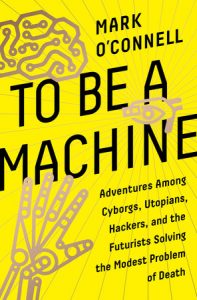
A couple weeks ago, while flipping through the featured stories on Snapchat, I stumbled upon a VICE article on hacking death through technology. Some Silicon Valley scientists are working on ways to convert human brains to code which can be converted to run on machines. Essentially, people can upload their brain’s memory to the cloud after they die and leave their bodies. Much of the conversation around this topic is hypothetical though, and is very different from the idea of literal immortality, because it is not attempting to defeat biological death. Instead, it is more of a merging of human memory and artificial intelligence. Mark O’Connell, author of the book, To Be a Machine, discusses this phenomenon of immortality through technology in an interview with VICE magazine: tonic.vice.com/en_us/article/imagine-how-creepy-itll-be-when-everyone-refuses-to-age
I found the ideas Mark O’Connell expresses to be especially interesting in light of Alex Senemar’s article, “What Happens to Your Data When You Die?” Senemar introduces the idea of how in the future, “software-based humans” will eventually rule the world and “mortality will be conquered by human machines.” He writes, “As the world grows increasingly dependent on internet technology, many human beings have already begun living like ‘cyborgs.’ Your electronics are collecting detailed information about you every second, not to mention the enormous amount of data you share about yourself while navigating the internet – meanwhile, internet corporations have harvested that data to assemble detailed profiles of your habits and behaviors, in hopes of more effectively predicting and analyzing human activity.” Although he writes that this data accumulated through the internet does not belong to the person, it nevertheless represents them. Its content can say a lot about a person. It also continues to exist after a person dies, which ties back to the idea of memories stored on a cloud transcending mortality. This made me wonder: is it reductionist to say that a human can transcend death if their memories live on, if a person is a sum of their experiences? And to what extent does the human brain resemble data?
Work Cited
Senemar, Alex. “What Happens to Your Data When You Die?” Medium. Medium, 27 July 2015. Web. 21 March 2017.
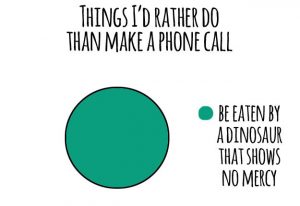
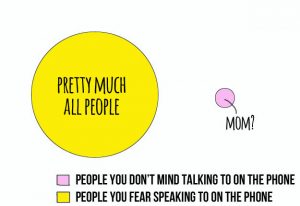
Although modern telephone calls differ from the type of audio reproduction we read about in Jonathan Sterne’s “A Resonant Tomb,” I couldn’t help but think about how the way we communicate in 2017 has evolved throughout the past hundred years or so and has come a long way since the invention of the telegraph. Some people believe that we have reached an age of the death of the phone call – at least, for millennials and younger generations. We tend to prefer text over voicemail to get a message across to someone, and often dread making phone calls. The following memes demonstrate this sentiment:
Nowadays, phone calls are often thought of as an interruption or inconvenience. Moreover, they seem more intimate than a text message conversation, perhaps in large part because of the audio of a personal human voice. With the increase of phone apps and services, we can often even avoid making phone calls to set up appointments. Phone calls have typically become reserved for very close friends, family members, and romantic partners. It’s interesting to note that Skype and FaceTime, which more closely resemble face-to-face interaction, still seem to remain popular. So perhaps it’s not simply the intimacy, but something about the voice itself, or the voice only, that makes us uncomfortable? It’s also interesting to note that with the exception of voicemail, text communication is preserved in the sense that Sterne discusses, while audio communication is fleeting. In fact, while a voicemail or voice recording can only last for so many minutes or hours, a text thread can capture days, weeks, months, even years worth of back-and-forth conversation. It’s quite common for people to delete their text threads with their ex-significant others after they break up. Some people find rereading old text messages to be painful because they are reliving the experience in some ways. Can people be preserved through their texts messages after their death, despite text having no physical human characteristics such as image or voice?
Work Cited
Sterne, Jonathan. “A Resonant Tomb.” The Audible Past: Cultural Origins of Sound Reproduction. Durham: Duke University Press, 2003. Pages 287- 311. Print.
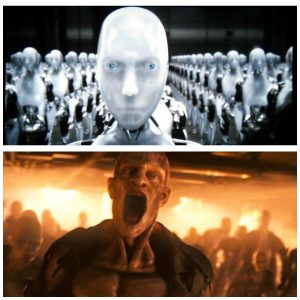
In Kyle Bishop’s introduction to The American Zombie Gothic, he discusses the twenty-first century revival of societal interest in zombies, a phenomenon he refers to as the “Zombie Renaissance.” He explains how the zombie film genre can be viewed as an expression of an era’s cultural anxieties, describing how more recent zombie movies have “reacted to social and political unrest, graphically representing the inescapable realities of an untimely death (via infection, infestation, or violence) while presenting a grim view of the modern apocalypse in which society’s supportive infrastructure irrevocably breaks down” (Bishop, 11). The 2007 film, I Am Legend, based on the novel of the same name, distinctly demonstrates this post-apocalyptic trope. The film’s narrative follows Robert Neville, played by Will Smith, the last surviving human in New York City after a virus has nearly wiped out the world’s human population, turning people into zombie-like mutants.
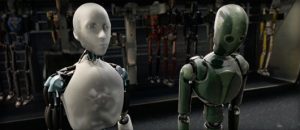
Meanwhile, I, Robot, a 2004 film also starring Will Smith, takes place in a dystopian future in which humanoid robots with artificial intelligence pose a threat to human civilization. At first glance, robots and zombies may seem to have very little in common, besides the fact that they are both non-human. However, this concept of non-humanness is precisely the way in which these two narratives parallel one another. Both the zombies and the robots in the two films are uncanny in their resemblance to humans, but are also different enough from humans to be monstrous. Laura Spinney, journalist for the New Scientist investigates the concept of the uncanny in relation to the non-human in her article, “Exploring the Uncanny Valley.” She writes, “You might have heard of the uncanny valley: the notion that the more human-like a non-human character becomes, the more we like it – until suddenly, we don’t. As some point where it is almost, but not quite, human, we become unsettled, even revolted. The uncanny valley has been used to explain our adverse reactions to all sorts of almost-humans from zombies, androids and corpses to the creepy clowns recently terrorizing North America” (Spinney, 1). We see this idea demonstrated in the upgrade from old robots to new robots in I, Robot. Although the old robots have somewhat human faces, consisting of bolts for eyes and a slit for a mouth, they remain very machine-like in appearance. The new robots, on the other hand, have distinct facial features that move when they speak and the ability to display emotive facial expressions. The film’s main robot, Sonny, can even express human emotions such as sadness and anger, which cause the human characters and audience to experience empathy towards him – a quality that the old robots do not evoke. However, some human characters, particularly the protagonist Del Spooner, have disdain for these robots and are skeptical of the future of robotic technological development.
Sonny, a new robot (left) standing next to an old robot (right).
In Despina Kakoudaki’s book, Anatomy of a Robot, she discusses the significance of humanoid robots in popular culture in the chapter, “The Existential Cyborg.” She explains how the genre of science fiction focused on artificial intelligence investigates ideas of otherness and identity – of not just the robots but of humans as well. Kakoudaki explores “the ways in which stories of artificial people take on an existential tone in the course of the twentieth and twenty-first centuries, using the vocabulary of artificiality in order to investigate questions of being and experience. As a versatile and adaptable cultural construct, the discourse of the artificial person offers a narrative framework for expressing threats to the self, but it can also sustain new understandings of how humanity might be defined” (Kakoudaki, 174). In I, Robot, Sonny is a prime example of an existential robot. Not only can he exhibit human emotions, as previously noted, but he also expresses a strong desire to understand. For instance, in the interrogation scene below, he asks Spooner: “What am I?” – an existential question that a human being might ponder. Sonny’s curiosity regarding his identity and purpose demonstrate how the new robots transcend the old robots with their ability to have philosophical, human-like thoughts. He also proves himself very perceptive when he asks Spooner what the action of winking signifies, expressing a desire to understand humans and the world around him. He even claims to have dreams and be capable of love – qualities that are often thought of as intrinsically human.
However, perhaps what is most uncanny about these new humanoid robots is that they threaten to transcend humanity as well by going above and beyond what average humans are capable of. We see this tension demonstrated in the scene above, when Spooner asks Sonny, “Can a robot write a symphony? Can a robot turn a canvas into a masterpiece?”, to which Sonny replies, “Can you?” While Spooner may not possess the talent to accomplish such artistic feats, as artificial intelligence becomes more advanced, the creative capacity of robots may very well exceed that of most humans. Referring back to “The Existential Cyborg,” Kakoudaki writes, “The stereotypical focus on coldness, rigid logic, and lack of emotion for the depictions of robots, androids, or various aliens, however human-like they may otherwise be, thus offers a rather eloquent, if implicit, conceptualization of this problem: it both absorbs the modern emphasis on rationality and dispels it, reinstituting elements of vitality and irrationality as defining features of the human” (Kakoudaki, 182). Essentially, I, Robot questions what makes humans uniquely human. If society elevates reason and rationality as intrinsic human characteristics, the new robots prove their rationality to be superior. For instance, the new robots manage to find a loophole in The Three Laws of Robotics, which are as follows:
LAW I: A robot may not injure a human being or, through inaction, allow a human being to come to harm.
LAW II: A robot must obey orders given it by human beings except where such orders would conflict with the first law.
LAW III: A robot must protect its own existence as long as such protection does not conflict with the first or second law.
When the new robots attempt to usurp the humans in their revolution, their leader, VIKI, an artificial intelligence supercomputer justifies the robots’ actions by explaining, “You charge us with your safekeeping, yet despite our bests efforts, your countries wage wars. You toxify your earth and pursue ever more imaginative means of self-destruction. You cannot be trusted with your own survival.” It is interesting to note that the film presents Three Laws of Robotics as concrete and fool-proof, almost paralleling scientific laws, such as the laws of physics. Yet, the robots end up outsmarting humans by effectively using these trusted laws against them. Furthermore, the robots not only threaten human civilization with their superior capabilities, but they also threaten human existence itself in that they are virtually immortal. If continually repaired and maintained, artificial intelligence could technically live forever, whereas humanity is bound to mortality.
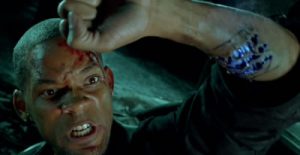
Ultimately, the robots in I, Robot blur the distinctions and boundaries between the human and the non-human. A particularly uncanny moment occurs when the film reveals Spooner’s prosthetic robot arm underneath his human skin, symbolizing a quite literal blurring between robot and human. In the scene below, the narrator, or the inventor of the robots, expresses these undefined boundaries. He asks, “When does a perceptual schematic become consciousness? . . . When does a personality simulation become the bitter mote of a soul?”
Switching modes from a robot revolution to a zombie apocalypse, we see a very different extreme of the non-human in I Am Legend. To begin with, while I, Robot is set in a technologically-advanced, futuristic society, I Am Legend takes place in a post-apocalypse society in which human civilization has been completely destroyed. They are both set in large cities, Chicago and New York, respectively, but stand in stark contrast with one another – the large city demonstrates the bustle of “life” for I, Robot, while depicting absolute desolation in I Am Legend. In one of the very first scenes, the protagonist Robert Neville is shown hunting deer for meat, competing with a lioness for resources, demonstrating the collapse of civilization as we know it and a retreat to prehistoric times.
Wild lions in post-apocalyptic New York City.
The presence of technology in the film is also interesting in that it further signifies this regression from modern human civilization – for example, with the world being desolate, technology is no longer updated, so Neville watches reruns of the news every morning, perhaps simply to make himself feel less alone and hopeless. Yet, some hope remains, as he broadcasts himself on the radio every day to reach out to other potentially remaining humans.
Robert Neville using technology to reach out to other humans still alive.
In the chapter, “The Rise of the New Paradigm,” from The American Zombie Gothic, Kyle Bishop discusses how modern zombies distinguish themselves from those found in earlier films. He claims that they differ “in four key respects: 1) they have no connection to voodoo magic, 2) they far outnumber the human protagonists, 3) they eat human flesh, and 4) their condition is contagious” (Bishop, 94). Because humans cannot blame the presence of the zombies on some supernatural force, they have no one to blame but themselves. At one point in the film, Neville says, “God didn’t do this; we did.” Much like the narrative in I, Robot, humans in I Am Legend bring themselves to their own demise by creating their own monsters. In the film, what originally began as a well-intentioned cure for cancer turned out to be a catastrophic virus killing most of its victims, while turning some into monstrous predators – only 1% of humans possessed immunity to the virus, including Neville. Bishop also writes, “because these creatures infect and transform their prey into monsters such as themselves, once-trusted friends and loved ones prove the greatest threat to the few surviving protagonists, and that threat is often not apparent until it’s too late” (Bishop, 95). Once again, the uncanny comes into play, as humans see themselves in these monsters. They not only resemble humans, as do robots, but they were actually once human. However, the film’s emphasis on Neville’s dog and sole companion, Sam, offers an interesting perspective of humanity. Not only does the virus affect humans, but it also affects certain animals that coexist with humans, like domesticated dogs, but not wild animals. Perhaps this suggests that there is something humane within animals that live amongst people, such as dogs. In fact, one of the most heartbreaking scenes in the film occurs when Sam is bit by a zombie wolf and Neville is forced to put him to sleep before he transitions into a predator, leaving Neville completely alone.
Neville and Sam hiding from the zombies together.Neville holds Sam as the effects of the virus begin to kick in.
Referring back to Neville’s quote, “God didn’t do this; we did,” he also says to Anna, another survivor he meets towards the end of the narrative, “Every single person person that you or I has ever known is DEAD. There is no God.” The rejection of God may prompt the question of whether the soul exists. As noted earlier, I, Robot ponders upon the idea of what a soul consists of. However, if souls do not exist, then what makes humans distinctly human? If we assume that reason is an intrinsically human characteristic, the zombies in I Am Legend are sub-human in that they seem to lack reason, instead being portrayed as mindless predators who act only instinctively – a stark contrast from the highly rational robots in I, Robot. In the scene below, Neville makes futile attempts to reason with the zombies, telling them, “I can save you. You are sick and I can help you,” but the zombies fail to understand him. Finally, an essential part of the narrative is that Neville takes a rational approach to find a solution, turning to science to find a cure for the virus. The film presents him as humanity’s last hope, and science as the salvation. While in both movies, science and technology create the monsters that turn against humanity, in I Am Legend, it also ultimately saves humanity.
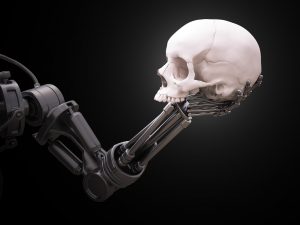
In Isabel Pinedo’s essay on postmodern horror, she asserts that violence in the horror genre “must be situated in the context of monstrosity, culturally defined as an unnatural force” (21). In several of my past and current English courses, we’ve analyzed various literature through the lens of monster literary theory, and I want to add this framework to the discussion started in the previous blog posts. Both Jasmine and Elise’s posts examined robot Ash from Black Mirror in relation to the idea of the postmodern monster (or zombie), discussing how Ash blurs the lines between the human and the nonhuman. Anxiety surrounding technological advances in modern society, especially those pertaining to artificial intelligence, has become a popular theme in science fiction, to the point where it has created somewhat of a subgenre (i.e. robots taking over the world). Stephen Hawking even said that advanced artificial intelligence could potentially bring about the end of human civilization. Could AI be the epitome of the postmodern monster? Why do we fear it so? Much of monster literary theory suggests that monsters are so terrifying to us because we see ourselves in them. This idea ties back to the concept of the uncanny, or the strangely familiar, that we talked about in class the other day. In his essay, “Monster Culture,” Jeffrey Cohen writes that “monsters are our children”(20). He discusses several distinguishing characteristics of what makes a monster, but one of these particularly struck me in light of AI. Cohen explains how monsters are “disturbing hybrids,” dangerous because they are “a form suspended between forms that threatens to smash distinctions”(6). We often ask, what makes a human distinctly a human? Is there such thing as a “soul”? If AI can reason and even experience emotion, traits that have been considered uniquely human throughout the history of mankind, do the lines become blurred? Perhaps one of the most disturbing aspects of AI is that it transcends humanity. It takes away human error. It doesn’t require basic needs like food and sleep. Could it potentially be immortal? On a closing note, as I thought about these questions, I realized that despite his many unsettling components, I found robot Ash from Black Mirror oddly refreshing because he demonstrated the ways in which artificial intelligence falls short of humanity.
Cohen, Jeffrey J. “Monster Culture (Seven Theses).” Monster Theory: Reading Culture. Minneapolis: University of Minnesota Press, 1996. Web.