
Zombies have become such a popular concept in popular culture that it is now ubiquitous as an entire genre of media: be it literature, film, or interactive. However as a tool for effective storytelling, different zombies serve different purposes. Rarely are the zombies the actual cause for discussion, rather we tend to focus on characters that have yet to become zombies. Interestingly, when Dr. Sample assigned the first two episodes of Dead Set to us, he remarked that it involved ‘fast zombies’. The development of the zombie genre has allowed for a crude classification of these undead flesh eaters. The immense diversity in zombie depictions have created film classics such as Shaun of the Dead and 28 Days Later, two movies that could not possibly be more different in tone.

So ‘zombie’ serves as a sort of umbrella term. Judging whether zombies are haunted or not might not be as simple as one might expect. In determining this, one must consider not only the zombies themselves, but also how they are depicted in the medium as well. Did the viewer/reader know the infected before they turned? Are there vivid descriptions of their faces, their eyes, and other things that one would normally associate with being human? If so, the answer is likely yes. Some of the most disturbing depictions of zombies are when the zombie itself retains a part of their former life, such as particular idiosyncrasies– a facial twitch, a walking gait, or a particular location. The undead husk invokes memory of the once living human, and both the remaining characters and the viewer are haunted.
In Shaun of the Dead, the zombies are slow and dumb, and are often dispatched with cricket bats blows to the head. While the viewer sees former friends turned zombies, the interactions are brief, which perhaps contributes to the levity of the film. The zombies simply serve as a plot device that spurs character development, which also agrees with the generally comical tone of the film. On the other hand, Consider Dead Set. The viewer is given at least a brief introduction to quite a few characters before they turn–this feature is a privilege that an episodic format allows due to its longer total length compared to say, standalone films. Perhaps this is why one of the most critically acclaimed zombie works, The Walking Dead, is a television show while the best zombie movies tend to slashed-type hack ’em ups. One thing is for certain–when you talk about zombies, be sure you know exactly what you’re talking about.
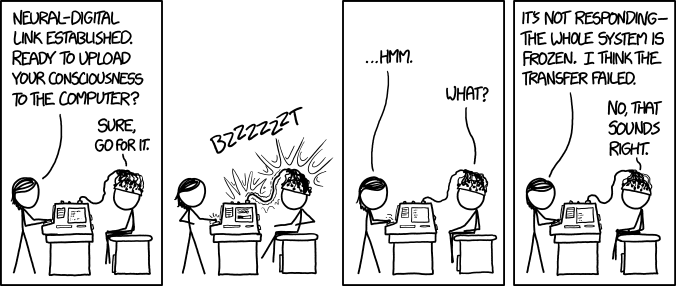 Neural uploads would include all of the subject’s flaws as well. But since data is divisible, why not pick choose the best qualities? Source:
 Arnim Zola as depicted in Captain America 2: The Winter Soldier. Source:
