
When distinguishing between robots and humans, one trait is discussed without fail: consciousness. The digital age has allowed for unprecedented expansion into the novel field of artificial intelligence (AI), but with its advancement come some startling implications. If an artificially created being is truly intelligent in that it may think for itself and learn, could it be considered ‘conscious?’ In this case, consciousness refers to the phenomenon which only we ourselves may be sure we experience. When a human touches a fur rug, there is a peculiar sensation that accompanies this act. The inherent difficulty in detecting true consciousness is that a sufficiently powerful AI would mimic it flawlessly.
However, if this experience can be quantified, studied, and replicated, it would have serious ramifications on our current definitions of sentience. For those who believe that consciousness is an entirely materialistic phenomenon—that is, our perception of reality is due to the complex molecular, and even quantum interactions that occur according to natural laws inside of our bodies—the answer seems to be yes. The underlying assumption here is that then given a powerful enough computer, consciousness could be artificially replicated. There are compelling arguments, however, that suggest that consciousness stems from something unquantifiable by physical methods (see: Mary the neuroscientist and the knowledge argument).
Suppose then that consciousness is indeed due to physical causes, and that the materialists are correct. Besides the obvious ethical consequences of creating immortal, sentient beings, many more interesting situations are possible. If the mind is a sum of information, then that information may be stored, copied, and replicated. In Netflix’s Black Mirror season 2 episode 1, “Be Right Back“, the protagonist Martha finds herself in a similar predicament. However, Black Mirror’s version of what may be called a neural upload is clearly dystopian, as her husband Ash Starmer’s duplicate displays several unsettling behaviorisms through an evidently rudimentary product. While the episode superbly demonstrates the potential downfalls of an imperfect neural upload, the point remains that Martha’s main point of dissatisfaction was that the replicate was incomplete. The viewer is left unsure of how Martha would have reacted should the replicate have been a carbon copy of Ash.
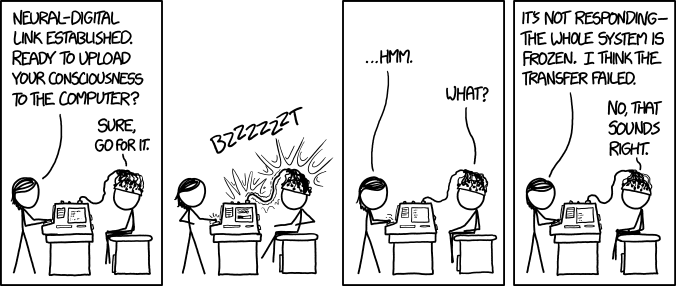 Neural uploads would include all of the subject’s flaws as well. But since data is divisible, why not pick choose the best qualities? Source: xkcd.com/1666/%5B/caption%5D
Examples of this hypothetical pervade popular culture as well. In Marvel’s Captain America, Arnim Zola is a Nazi and Hydra scientist who uploads his consciousness onto a supercomputer upon discovering his terminal illness. This character seems to retain all of his thoughts, desires, and emotions in a digital form. William Gibson’s Neuromancer, the father of cyberpunk novels, not only deals heavily with sentient artificial intelligence but also involves Dixie Flatline—a character long ‘dead’ but preserved in a computer. The list goes on, and the numerous examples often begin to demonstrate the ramifications of different degrees of success in neural uploads.
 Arnim Zola as depicted in Captain America 2: The Winter Soldier. Source: vignette3.wikia.nocookie.net/marvelcinematicuniverse/images/1/18/Catws_03787.jpg/revision/latest?cb=20150304193103%5B/caption%5D

We consider the extreme ends of the spectrum: what if when Ash had died and Martha ordered a replacement, a molecule-by-molecule reconstruction of Ash was shipped to the small country cottage? The digitalization of consciousness seems to trivialize death, something that paradoxically defines life. Something fundamental to the human experience is lost. Even in Black Mirror, Martha never truly overcomes her crippling grief and rather stows yet another dead Starmer in the attic.