A cursory look over my post history on this site doesn’t reveal much about myself that I didn’t know. One thing that did stick out, however, was that I apparently absolutely adore comparing things. I think that the idea of comparing too things is attractive to me because it involves a true understanding of two not always entirely different topics, and searching for underlying meanings that may produce overlaps. Due to the nature of the course, many of the things I’ve compared follow a general, analog versus digital structure.
For example I’ve done a post on public online grieving, which was being implicitly compared to more traditional expressions of grief. I’ve compared the concept and act of repairing a broken analog and digital object. The list continues, but the most surprising thing that I picked up was that I didn’t consistently ‘favor’ one side or the other. Going into the class, I probably would have had strong opinions on whether some things should digital and others analog. But in retrospect, I think that I was more flexible than I thought. For example, in my blog post about repair, one of my observations include that as modern technology become more sophisticated, we rely less and less on single individuals who of capable of repairing it. I meant that statement in a truly neutral way; I don’t think that specialization in repairing abilities really spells anything catastrophic or amazing for modern, digital society.
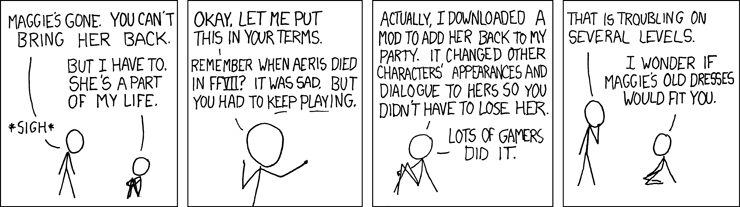
Finally, one last thing: my choice of the digital media in the ‘required integrated digital media’ criteria in the blog posts. While I’ve done a lot of screenshotting from that day’s material, I found that as the semester progressed, I used more and more pictures and tidbits that I had prior knowledge of before the assigned material. Things I like xkcd comics I remembered from a while back, a still from a movie, or an interesting photo from reddit.
And I definitely know the reason for this interesting phenomenon: I usually post my blogs not too long before the deadline (sorry Dr. Sample), but I usually try to read everyone else’s blog post before I do mine. In my efforts to try and appear *unique* and *original*, I ended up using things that I’ve seen from my own experiences! And it ended up pretty okay, I think. Thank you to any readers that followed this rollercoaster of a class!
I’ve written previously about online public grief and how I think that it is an inappropriate method to mourn. I have since then run into a phenomena that doesn’t exactly change my views, but absolutely does give more credibility that to the opposing side.
Enter gatekeeping. The Urban Dictionary defines gatekeeping as “when someone takes it upon themselves to decide who does or does not have access or rights to a community or identity.” Upon reading this definition, I realized that I’ve been seeing this online for quite some time now, and very often at that. The idea resonates very strongly with the concept of snobby, ‘elitist’ preferences. Have you ever heard someone berate music tastes? How can you say you like abc music when you don’t even listen to xyz?!?
The premise is that unless one meets some arbitrary rules or thresholds, they are not “allowed” to identify with a particular group or collective. A similar statement may be made of ‘grief police’, who publicly condemn those who publicly express grief online. You’re not seriously mourning! True mourners stay off the internet and express grief alone! While I still hold true to the assertions that I made in my previous post, I do concede that there is a non-insignificant amount of people who engage in grief policing that fall into the ‘gatekeeping’ category. These are individuals that want maintain a sense of exclusivity and elitism for the right to mourn. They come up with absolutely arbitrary cutoff points-which oftentimes, and very conveniently so, happen to just barely include themselves.
When I made my previous post, I alluded to the fact that while public online grieving might be inappropriate, it does not necessarily imply that the strong reaction that it garners is appropriate. In the lieu of having discovered (or rather, having become aware of its consistent presence in social interactions) gatekeeping, I definitely agree that those who bully people online into hiding their public online grief are just as bad as those I mentioned are milking the opportunity of loss for attention.
r/place is a place dedicated to pixels. On April Fools Day 2017, Reddit administrators created r/place, an interface where users could place one pixel on a massive canvas once every 5 minutes. At first, the canvas was dominated by primitive, random or algorithmic drawings. However, once internet warriors formed factions to coordinate group efforts to draw more complex creations, the results were absolutely extraordinary:
This video (90fps!!! 4K!!!) gets better literally every single watch. There are literally thousands of small, intricate, drawings that end up populating the final product. But what is more relevant to the subject of the course (and in my opinion, more interesting) is the journey upon which each region of the canvas embarks. As r/place became more and more popular, each pixel became valuable real estate, and drawings fought tooth and nail for survival, or sometimes what can only be described as… pure aggression.
There were so many French jokes here that I could make that I’d rather leave it up to your imagination.
So how does this relate to death in the digital age? Simply put, There were thousands of little deaths on the canvas throughout the 72 hours it was active. Often, larger, more coordinated groups were able to overwhelm smaller and less dedicated groups and claim larger territories for their pixel art. And what’s especially fascinating is that much of the dialogue both internal to these groups and between them are recorded in the various subreddits that popped up during r/place’s lifetime.
Other, less populated subreddits’ posts are dominated largely by confusion, panic, fear, and posts blaming other subreddits.
I found the reaction of various factions to losing their territory on the canvas to be eerily similar to how groups of people might react in the real world to impending doom. Often, when drawings were being vandalized or drawn over, there was a certain point where it was clear that the battle would lost (when around a third of the pixels were gone, more or less). It was during these times that the losing subreddit would behave in ways that reminded me of the stages of grief. In any case, r/place is an absolutely fascinating case study for internet group dynamics and how individuals can form vast social networks in very short time spans, and how these networks can behave as an individual.
There’s a certain amount of satisfaction that comes with repairing a broken object. As a kid, I used to take apart disposable cameras and try and put them back together so that they would work again (I was rarely successful). There’s a feeling that comes with knowing the mechanism behind the gadget, knowing the combination of intricate moving parts. Repairing an object has similar appeal. By restoring function, or by assigning a new one, you kind of triumph over the broken nature of the object, and cement the fact that you know how it works.
I googled “disassembled disposable camera” to see if this was a thing that other people had done. Of course it was.
Today’s reading suggests that repair of digital objects is a little different, and I have to agree. While I’ve always thought that the distinction between digital and analog has been somewhat artificial, there is a clear difference in repairing an analog device versus a digital one. We repair digital objects all the time. BUT, the aspects we repair are more often than not, analog. When a phone or tablet screen cracks, we replace it. When a keyboard loses function in some keys, we could solder. But rarely does the average consumer repair an aspect of their gadgets that is truly digital.
When my iPhone is noticeably glitch, there’s really no other discourse for me other than prayers and googling the problem for a quick patch. This trend exists because the digital is so immensely complex. While the physical assembly of a smart phone may be accomplished relatively trivially, the core of what makes the smartphone smart, is very much not. No one single person knows all of the code that goes in iPhone firmware, as it would be an insane task. Instead, a team of specialized workers each have their own area. This makes it very unlikely that the user will know what to do if their smartphone suddenly has its software completely bricked. A similar trend exists in other, more specialized trades today. Whereas in the past, a car mechanic could construct an entire automobile from scratch, that would be absurd today with all the different models and the immense complexity of modern cars. As the collective knowledge of information increases, the individual becomes increasingly powerless in repair.
A quick look into my post history reveals that I am a massive nerd, with a bizarre affection for nuclear power/radiation (see: Half Life, haunted media project, etc). Chernobyl is one of the topics that both inspired my haunted media project and serves as what I think to be one of the most entrancing disasters in human history.
While today’s article discusses ‘dark tourism’ as a relatively modern phenomena, I can’t help but think that it is as old as any other human tendency. We are fascinated with death. Our natural morbid curiosity gets the better of us most of the time, which is why places like /r/watchpeopledie (warning!!! vivid pictures of death) exist, and even thrive.
we seem to be fascinated with death, and even more so when the death happens to be unnatural.
I do think however that it became only recently that humankind developed the means for mass death on this scale. But I wanted to focus on what makes Chernobyl such an attractive tourism site for what the article describes as “between 18 and 28 […] more interested in ‘fear, fun, and thrill.'”
There have been quite a few disasters that have happened on a relatively recent scale, but these events do not occur such an ‘enchanted’ site as the Chernobyl exclusion area. Things such as the Mt. St. Helen eruption, the Southeast Asian tsunami, Rape of Nanking (and so on) don’t attract the same type of visitors to their commemorative sites. For one, they are not considered to be still dangerous. But I do think that another significant factor is the cause of the incident. In this case, it’s nuclear radiation. Because the forces at hand in Chernobyl were invisible to the naked eye, it leaves a sort of mysterious, almost sinister atmosphere on the incident.
Nuclear fallout’s association with horrific mutations and scarring of all animals, regardless of veracity, is what contributes to this perception, which is what attracts dark tourism. As humankind progresses in technology, more opportunities to ‘mess up’ will arise. Imagine not a nuclear fission plant meltdown, but a fusion plant meltdown. A software bug that single handedly wipes out digital currency. Or a genetic experiment unleashes a horribly invasive species, destroying entire ecosystems. Wait… these sound like they’re not even that crazy.
Upon reading about the US government Department of Energy’s preparations for burying nuclear waste, I became fascinated with the idea of creating a message that outlives entire languages, cultures, and civilizations. Although we currently live in the digital age, there is the looming possibility that what the world may look like 100, 1000, or 10,000 years may not be entirely progress, but regression. When one attempts to create a coherent message designed to survive as long as cave paintings are old now, it is interesting to think about how perspectives might be different due to the long-lasting presence that digital media has had. In a world where the internet is not really novel, is grief examined differently? Are tragic events viewed differently?
I decided to examine what a future civilization’s discovery of a nuclear waste disposal site might resemble. Because there are so many details that can go wrong, I thought it would be apt to assume the worst and have this future civilization undergo a catastrophic event in which thousands are accidentally exposed to dangerous radiation. How did these people cope with the loss of hundreds? Our brief examination of how people express grief online in social media was highly relevant. As digital media becomes more and more prevalent, it becomes the norm in everyday life. While some, myself included, might consider tweeting at a funeral distasteful, there’s no reason to think that this will not be the norm 100 years from now. I thought that my example created a great thought experiment in which a futuristic, globally connected world with technology that far surpasses humankind’s current capacities, handles a highly publicized catastrophic event.
In order to capture and depict the digital grieving in this future world, I decided to take in indirect approach. While I considered creating a mock memorial page dedicated to the victims of the incident, or creating a model replica of a physical memorial erected in memory of the incident, I created an ‘objective’ depiction of this hypothetical tragedy through a particular medium: a Wikipedia article. Of course, while Wikipedia’s existence (and really the existence of culture as we know it today) into the next millennia or two is up for debate, I used simply because it is a familiar way in which the everyday digital consumer searches for and receives information about their world. I also decided on this medium specifically because of its unique, collective method of recording and recounting history, which has historically been a very individualistic craft (Rosenzweig 117). Rosenzweig argues that the supposed objectivity of Wikipedia articles is misunderstood—the true meaning of a ‘neutral point of view’ as described by Wikipedia denotes the description of both sides of an argument rather than a presentation of an argument itself (122, 123). While this sounds sound in theory, I’ve personally found that it is much harder in practice, and some Wikipedia articles in my anecdotal experience seem to reflect this as well. Nevertheless, I thought that the potential for this dread bias to enter into what is a supposedly objective medium provided an interesting way to describe a tragic event in the digital age.
In actually creating these mock Wikipedia pages, I was heavily inspired by similar, real Wikipedia articles which describe events of mass death, such as the article detailing the events of the 2001 September 11th attacks in New York City, as well as the article describing the resulting memorial. While Wikipedia, as well as other informative sources, use objectivity and fact checking as a critical feature of their articles (Rosenzweig 123), one can’t help but gain a feeling of dread, loss, and tragedy when reading about these catastrophic events. The way they callously detail the number of victims, the perpetrators, the date, and afternoon is chillingly terse. Even more unsettling is if other related articles (or the article itself) contains a section detailing how this loss of life was memorialized. This is particularly fascinating because it is an ‘objective’ description of something that is inherently emotion (grief, sadness, and memorialization). I thought this was an incredibly fascinating way of examining how the grief surrounding this event is expressed.
Wikipedia articles can be strangely poignant when addressing mass casualty events, paradoxically because of their objective tone–the journalistic report of human death sounds as if it attempts to lessen its emotional impact, which of course seems to often produce the opposite effect on concerned readers.
The final product consists of two brief mock Wikipedia articles, one detailing the events that lead to the catastrophic opening of the vault containing radioactive material and its aftermath, and another detailing the construction of a memorial dedicated to the incident and its digital features. In particular a key feature that I gave to this monument was a blurring of the line separating the digital and the analog. While the memorial itself has physical form (it is a replica of the warning message that went unheeded on the waste disposal site), it also has digital capability. Today, when some tweets or posts to Facebook or Reddit, the most compelling thoughts are the ones that tend to be most visible: the system rewards the submissions that garners the most attention from other users (retweets, likes, and upvotes). This memorial takes the public’s digital submissions and displays in on the statue itself, so that the submissions incurring the most positive response are shown on the outskirts of the memorial (more accessible to those looking within from outside), those incurring the most negative response would be displayed in the center (requires someone to actively seek out these submissions), while those that don’t raise any sort of response are not displayed at all. How would an ‘objective’, journalistic record of history such as Wikipedia describe this monument in an age when digital media is the norm? This is the essence of my haunted media project.
Current records of online grief are controversial, to say the least. Garber suggests that internet grieving is something that will grow on society to one day become a hardened social ritual, and that ‘grief policing’ assumes the worst of people rather than the best (Garber, accessed 2016). In the case of the 3/30 Memorial, would there be angry backlashers ‘policing’ what they perceive to be rather crude or immature inappropriate submissions that make it to the forefront on the monument’s display? I think so. One of the primary arguments that internet grieving is a natural thing is that it is merely a digital representation of what happens locally—the only difference is that these thoughts and actions are now visible to anyone with a smart phone (Garber). Phillips examines the phenomena of RIP trolling, and concludes that the activity may be attributed partly to an ‘amplification process’ in which each tragic event recorded online contributes to an ever escalating ‘troll’ response. Those emotionally unaffected by the event (the overwhelming majority of people online in a global network on any given moment) contribute crass remarks because they have the emotional distance to do so (Phillips, accessed 2015).
While Garber suggests that the internet provides a large, digitally connected forum in which ‘community grieving’ is possible. I must disagree and bring up the crucial point (also a primary point made by Phillips) that it provides just as large of a forum for grief policing. In considering Phillips’s thoughts, it seems then that internet RIP trolling is something that is unique to globalized, digital media. It is an inherent characteristic of a global communication network. In this sense, I do think that the 3/30 Memorial would display quite the amount of ‘trollish’ submissions—as any public, digital media forum would, whether in our time, or the future.
The emergence of digital media and globalized information networks truly are the agent of permanent social change. While I argue that basic human nature remains the same (hence the apparent immortality of RIP trolling and the derision of tragic events), there are aspects that are changed due to digital media, and the mock Wikipedia articles serve to demonstrate this change. Biddle demonstrates that suicide rates, methods, and success rates have undergone significant changes since the dawn of the internet (800-801). Biddle shows that while many people whose suicide have been attributed to internet exposure (such as online forums discussing suicide methods), there is indeed a subset of those who commit suicide who had a significant chance of avoiding suicide had the digital media available to them had not existed. Those who might have only considered suicide temporarily are exposed to chat room in which ‘peers’ pressure, and even drive, others to commit suicide (801-802).
I thought that this phenomena, and doubtlessly countless others which have risen as a result of the dawn of the digital age, could partially be attributed to Phillips’s amplification process. However, Biddle’s research also holds strong weight in Garber’s argument that online communication provides an outlet for permanent social change in which previously unquestioned social norms are often challenged relatively quickly and aggressively. I thought that this would be reflected in the 3/30 Memorial as well. There must be some messages and thoughts uploaded to the memorial that would have never have been even conceived of had it not been for the possibility that these thoughts and inklings could be displayed publicly. In this way, the mock Wikipedia page describing the 3/30 Memorial also demonstrates how digital media permanently warps social spheres and changes the very meaning of what one might consider ‘inappropriate’ in the digital age. While trolls have always existed, whether digital or not, it seems that the 3/30 Memorial in this project also serves to represent a shift in thinking regarding death and grief.
References
Garber, Megan. “David Bowie and the Rise of the Grief Police – The Atlantic.” N.p., n.d. Web. 6 Apr. 2017.
Phillips, Whitney. “LOLing at Tragedy: Facebook Trolls, Memorial Pages and Resistance to Grief Online.” First Monday 16.12 (2011): n. pag. firstmonday.org. Web. 6 Apr. 2017.
Rosenzweig, Roy. “Can History Be Open Source? Wikipedia and the Future of the Past.” The Journal of American History, vol. 93, no. 1, 2006, pp. 117–146., www.jstor.org/stable/4486062.
This article detailing the theoretical ‘singularity’ (coined by me and deliberately so) brings up the interesting phenomena in which Memorial Pages of the dead outnumber the profiles of the living on Facebook. In our previous discussions, we have talked about antiquated equivalents to modern day social media platforms. For example, text messaging now may be analogous to telegraph or letter sending in the past. These memorial pages contain vast, diverse accounts of a person’s life. Looking at one of these pages may be akin to flipping through a photo album of a recently deceased loved one.
As we have stated repeatedly, one of the primary differences between today’s media and the media of old is the accessibility/the ease with which something may be done. Perhaps the reason why the concept of memorial pages may seem disconcerting is because many of the things posted on Facebook are often whimsical, spur of the moment thoughts and events, rather than a hand-written letter or pencil sketched portrait.
Services such as ancestry.com offer insight into one’s family tree, at times discovering quite the history.
Is this the reason why looking at photos of a long-deceased great grandparent might not seem so strange? It might also be because it’s not such a personal look into their lives. Exploring the concept of ancestry, recent advances in digitalization of historical databases have made some able to easily ‘look up’ their ancestors through services such as ancestry.com. In the not too far future where the majority of Facebook users are dead, even basic information parsers might not be necessary–one could simply keep click on the ‘parents’ section of their parent’s profiles, and so on.
So unlike ancestry.com, where you might be supplied to years of birth and death, occupation, and a nice posed photo, in the future the curious will be able to see that embarrassing Facebook status from 6th grade about the gurl that got away. Regardless of what you might think of memorial pages, that seems quite frankly utterly terrifying for all parties involved.
Megan Garber suggests in a brief online article, “Enter the Grief Police”, that public, online forms of grieving are analogous to a virtual wake. Her primary points to support this argument are that:
The notion that to oppose online grieving is to support the claim that there is one true ‘correct’ way to grieve.
The notion that public, online grieving is a natural extension of what may be called a ‘deep, communal concern’.
To ‘grief police’ is to dislike newly emerging social rituals that would otherwise be acceptable.
There are many ways to grieve. However, a distinction must be made between real grief, and a 140 character hashtag riddled soundbite.
If you haven’t realized by the tone of my prose by now, I will now systematically disagree with the above points. Firstly, of course there is no true way to grieve. It is up to the individual in question, as well as the loved ones surrounding that individual. What is important however is that it is intensely personal, and could not possibly by defined by a certain method. It is because of this that online grieving should be taken with caution–because it is so public, and so accessible to others, there’s little barrier to both entry and reception. If a somebody did not want to see a deceased loved one’s face online, as outlined in “Inadvertent Algorithmic Cruelty”, it is up to them. But, the public nature of this act makes it difficult to avoid, thus making it both an inherently unpersonal act, as well as disrupting the grief of others.
Secondly, I do not believe that a deep communal concern over a death necessarily results in public online grieving. In the large cases such as David Bowie’s death, I do not think that there was a deep, sincere sense of loss for the majority of people involved. While certain individuals may have been personally familiar with Bowie, it’s hard to imagine that these people could be as affected as immediate family. And if there was concern, it seems that a primary motivator in making these statements of mourning public would be so that others may see them–in an effort to garner sympathy for their loss, to put it bluntly. The fact that the statements are public once again detract from the thinking that public online grieving reflects a deep concern.
Lastly, I do admit that public online grieving is indeed a social ritual as much as a wake or funeral is. However, once again the difference is the invitatory, much-too-accessible nature of public online grieving. People are invited to wakes and funerals. In these cases, the small scale of the mourning event is what allows for intimate consolation and condolences. No one in a funeral approaches a widow and yells their condolences loudly so that everyone may hear. It’s an ass move because it’s not about those invited to the wake, it’s about the recently deceased and those closest to them. If this was the design of the wake then that is a different story, but the point is that to take this decision out of the hands of the deceased and those closest to them should be frowned upon.
Shut Up and Dance is the third episode of the third season of the show Black Mirror. On the surface, it explores themes such as cybercrime, privacy, internet anonymity, and vigilante justice. No Country for Old Men is an American movie released in 2007 directed by the Coen brothers as a cinematic adaptation of the Cormac McCarthy novel of the same name. While both works are stunning examples of post-modern horror and share striking similarities, they have quite the different approach to what will be addressed as ‘generating fear’—that is, the two works provide opposite, but equally effective reasons for the viewer to feel fear. This short study will first provide a brief plot summary of both works, examine the tone and pacing, and finally discuss how this affects the generation of fear for each. I will argue that while Shut Up and Dance generates fear by depriving the viewer of contextual knowledge, No Country for Old Men achieves the same end by providing it. Finally, I will argue that these two methods each demonstrate how effective the other is as a representation of two extremes of a spectrum, and the resulting implications of these conclusions on storytelling.
Shut Up and Dance tells the story of a Kenny, a young adult whose laptop is hacked to record a video of him while masturbating. Using this video as leverage, the hackers responsible for this send Kenny instructions to obey their will via text. Throughout the course of the day, he meets people who are not the hacker but also apparent fellow victims, presumably with some similar stake in performing to the satisfaction of the hackers. Kenny eventually runs into Hector, who fears divorce and losing custody of his children due to an extramarital affair. The text messages instruct the two of them to rob a bank using a gun that another victim delivered to them. Kenny successfully holds up the store, and the two later receive instructions to go separate ways. In a dramatic scene where the hackers order Kenny and yet another victim to fight to the death, it is revealed that both had been in possession of child pornography. Kenny first attempts suicide and then later is seen bloodied, presumably having murdered the other man. Despite all of the victims’ strict adherence to the hacker’s instructions, every single hacking victim suffers from an information dump, and each are apprehended appropriately for their wrongdoings. The classic traits of postmodern horror are present: fear, violence, and a transgression of violence (Pinedo, 1996).
The last thing that every single victim receives from the hacker. The trollface is synonymous with an aloof, detached, and destructive sense of black humor.
No Country for Old Men (2007) is quite different in tone. When the Texan protagonist Llewelyn Moss finds a briefcase of money from a drug deal gone bad, he becomes wanted by the Mexican drug cartel. A hitman named Anton Chigurh threatens to kill his wife Carla Jean if Moss does not comply and surrender the money. Llewelyn then orders a reluctant Carla to go into hiding as he flees with the briefcase. After several close encounters between Moss and Chigurh resulting in both being injured, Carla seeks protection from the local sheriff, Bell. Unfortunately, this conversation unknowingly reveals Moss’s location to the Mexican cartel, and he is later found dead, killed off-screen. Chigurh later finds Carla at her home, and the film strongly implies that he kills her. Sheriff Bell plans to retire as he feels overwhelmed with the increasing violence of the neighborhood, noting that Terrell Country is “no country for old men.”
While Shut Up and Dance might also be described as a ‘thriller’, this is certainly not the case of No Country for Old Men. While there are shootouts and action (actually even more so than Shut Up), No Country takes on an excruciatingly slow, intensely unnerving tone and pace. The horror is exacerbated not by gore or violence, but the threat of violence. Take, for example, a scene in which Moss and Chigurh confront each other:
A scene involving two very resourceful characters. Moss is a Vietnam veteran and knows his way around a gun. However, he is clearly outmatched, and watching Chigurh’s mind work is arguably more terrifying than the actual firefight itself. This will be touched on later as well!
There is no soundtrack to warn of an impending clash. The viewer hears exclusively diegetic sounds throughout the film, and the effects are apparent in this scene. What would Moss hear as he prepared for Chigurh’s assault? Nothing. So the viewer gets nothing as well, and is forced to endure the agonizing wait. When the wait ends, the release is not nearly as exhilarating or cathartic as one would hope. Some stray shots are fired, but both parties escape. And this is what at its core makes No Country such a novel post-modern horror film—the horror is generated entirely by the viewer’s wish for a traditional confrontation which never occurs. The predator/prey interactions never result in a conclusive finish, and each iteration piles increasing amounts of fear of the next one. Of course, when Moss when is killed by the Mexican cartel, it is an infuriatingly unceremonious, off-screen death. There is no closure, only continued fear and terror of Anton Chigurh. These classic postmodern traits indicate that two wildly different forms can accomplish the same effects through different methods.
Shut Up and Dance chooses to keep the viewer in the dark about a sinister secret that the protagonist guards, choosing to reveal this at the last minute as a plot twist. However, before this dramatic moment the viewer is forced to endure the humiliating power that the hackers hold over Kenny. Part of what makes the hackers so scary to both Kenny and the viewer is that so little is revealed about them. The only interaction that is witnessed throughout the course of the episode are text messages, and the remnants of the instructions received by other victims.
Because so little is known about the hacker, its nature becomes ambiguous. It is unclear what exactly the hacker is capable of doing. The writers of Shut Up and Dance play this angle appropriately by making the first of the text-message instructions relatively innocuous, and slowly ramping up the danger involved. Throughout the course of the day, Kenny delivers a cake, goes for a joyride, and robs a bank at gunpoint, and murders a man with his bare hands. The reason the viewer feels fear is because the intentions of the hacker are only revealed incrementally via the instructions, which undergo a drastic transformation throughout the episode. When the big plot twist is revealed (Kenny’s computer is filled with child pornography!), the viewer is left in even more confusion. The entirety of the episode draws on post-modern horror effects by inducing fear of the unknown without ever explaining these unknowns.
This leads to the fundamental differences in the approach to post-modern horror taken by No Country and Shut Up. Shut Up chooses to keep the viewer in the same boat as Kenny. The hacker then comes to represent a fear and a complete loss of rationality because so little is known about them. When Kenny first discovers that his computer has been compromised, he becomes absolutely hysterical, crying and screaming at his phone. This irrational behavior partially stems from the fact that he has no idea who to even blame—his overlord is merely a nameless figure with a seemingly infinite presence. Of course, the final twist is that Kenny was guilty of some heinous crimes, and that he knew that he was from beginning. However, this does not detract from the powerful sympathy the viewer feels towards Kenny. In this way, Shut Up and Dance fulfills its own post-modern criteria–the viewer had been rooting for a pedophile the entire time! This gross perversion of the narrator-viewer relationship serves to deprive the viewer of neither the victory nor defeat of a traditional ending.
On the other hand, No Country opts to give the viewer full knowledge of the situation that Llewelyn finds himself in. From the first scene, the film demonstrates the full extent to which Chigurh will go to achieve what he will do. In stark contrast to generating fear by creating a mysterious antagonist, the film chooses to generate fear by exposing the viewer to the terrifying, unstoppable force that relentlessly pursues the protagonist. Instead of wondering what Chigurh is capable of, the viewer feels fear for the Moss’s rapidly declining odds against the murderous sociopath. Twice in the film he allows victims to wager their life on a coin toss, and he plays God in that moment for whoever calls heads or tails. This unfeeling, unsympathetic, and merciless God who simply offers the chance because it amuses him embodies what the viewers learn to fear (Cagle, 2014).
Anton Chigurh, one of cinema’s most iconic antagonists, is a perfect medium through which No Country achieves this effect. The film goes out of its way to demonstrate Chigurh’s thought process. In one scene, he prepares for a gunfight against Mexican cartels that he knows to be sheltered in a small motel:
Chigurh’s silence and brutal efficiency is honestly chilling. But what is really unsettling is how deliberately he practices the motions needed to secure a job well done, showing that he is a rational human that is capable of premeditated actions.
In order to ensure that he has the upper hand, Chigurh rents out a room in the motel as well. He studies the room layout and checks walls for potential penetrating shot opportunities. Then he practices the motions of abruptly throwing the door open and flipping the switch. This practice results in three dead cartel members, and an unscathed hitman. This scene is so scary not because of the action (which is scant) but the fact that Chigurh smart (Cagle, 2014). This is one of the best examples of the film that stand out to demonstrate the value in giving the viewers everything.
As the film continues to characterize Moss and reveal his backstory, no further information is given on Chigurh. But the knowledge of the inevitable results in a continued, indirect dehumanization of Chigurh (Bayless and Redmon, 2013). While Bayless and Redmon primarily discuss differences between the film and the original McCarthy novel, they raise many interesting points. For example, they remind the viewer that the Coen brothers take very deliberate steps towards humanizing Chigurh to some extent. The scene in which the now iconic captive bolt pistol is explained, they argue, serves to “push the audience to align Chigurh with humans rather than animals. He is clearly the one holding the air-gun and not the one on which it is being used. This reminder forces audiences to acknowledge Chigurh’s humanity and the specifically human agency behind the horrific actions this character performs” (Bayless and Redmin, 2013). Again, this reinforces the argument that full disclosure in No Country is effective in inducing horror in an indirect way. In this case, the viewer is left horrified by the possibility of a human being’s capacity to kill mercilessly, or to see others as animals. Without the scene in which the weapon is explained, Chigurh becomes an embodiment, rather than somebody that you might simply spot in a crowd. The possibility of an actual living Chigurh out in the real world is legitimately frightening.
A similar, representative moment in Shut Up is when the cake that Kenny received from another victim is revealed to contain a handgun. This is the first indication that the hacker has very, very sinister intentions, and both Kenny, Hector, and the viewer immediately have the same reaction—how many victims are there? For each victim to have completed a small role, how many unknowing hands did this handgun pass through? How many more will touch? The possibilities are endless, highlighting the strength of this style of horror.
Upon seeing the handgun, the viewer is instantly compelled to think about its recent history. How many iterations of the same hack and instruct protocol were conducted to get this gun in a car with two people in front of bank? Maybe countless.
The effectiveness of both of No Country for Old Men and Shut Up and Dance suggests that these two approaches to generating fear are both viable methods. Juxtaposing these two works together tells us that in order to scare an audience, there are no half measures: give full disclosure of a genuinely horrific phenomenon, or give away nothing and let the imagination run wild.
These assertions have multiple implications for the art of storytelling. The storyteller, whether it is an author, director, or an actor, must make a deliberate decision as to how much context the audience will receive. Both examples given above suggests that the either end of the spectrum may prove sufficient. But each method of storytelling requires a different set of narrative criteria. In providing little to no context such as in Shut Up and Dance, the underlying sinister nature of the source of fear must be incrementally exposed, so as to build continuous tension and fear throughout the entirety of the story, and prevent shock value from wearing off early into the story. On the other hand, choosing to present the audience with full disclosure of impending doom requires characterization alongside this overwhelming force to refresh the fear that the viewer feels for the characters. In addition, the nature of this force must be absolutely horrifying such that it is clear that the victim is outmatched. This foundation provides the basis for the generation of sufficient fear as the inevitable loss draws nearer towards the end of the story. T
he final, and perhaps the most important supporting criteria, is that there must be no cathartic solution. I think that this is what distinguishes a ‘thriller’ type film from a postmodern horror one, and Cagle (2014) would agree. A central aspect of postmodernism is the lack of conclusive ending, and No Country is a flawless example of such. While the ending gives the slightest hint of change regarding Chigurh’s character, the rest of the film is frustrating in that not much is resolved. His argument that No Country “refuses to develop toward a proper resolution between opposing forces” (Cagle, 2014) is indicative of the continued rise in tension I described earlier, with no final crescendo, leaving the viewer in the uncomfortable, on-edge mood.
Shut Up and Dance and No Country for Old Men achieve the same postmodern horror effect on their viewers, but through different methods respectively. While both are effective, each requires a unique set of skills to tell a good story. Both of the works examined above do this almost flawlessly, and the result is a masterful depiction of postmodern horror.
Bibliography
Isabel Pinedo. “Recreational terror: postmodern elements of the contemporary horror film.” Journal of film and video, Vol 48, No. 1/2, 1996, 17-31.
Jeremey Cagle. “”I hope it has a good endin’ “: rewriting postmodern play in Cormac McCarthy’s No Country for Old Men.” The Cormac McCarthy journal, Vol 12, 2014, 1-19.
Ryan S. Bayless and Allen H. Redmon. “”Just call it”: identifying competing narratives in the Coens’ ‘No Country for Old Men.'” Literature/Film quarterly, Vol 41, No. 1, 2013, 6-18.
The concept of recording an action is relatively new to us. While written history had existed for a time, it was only with the phonograph that an actual event could be played back, if desired. The class reading for tomorrow morning partially examined the impact of the first audio recordings. The concern, while now antiquated, seems warranted at the time. The idea of communicating with the dead seems understandable when one was to first be presented a human being’s voice played back to them through a tube. It is this disembodiment of what is normally considered to define ‘humanness’ that will be examined here.
The pinnacle of commercial technology then…versus the pinnacle now. technology’s come a long way just to incorporate another sensation (sight)!
Now, the prevalence of digital technology not only allows for high fidelity audio recordings, but also visual recordings. It might not be so unreasonable to then extrapolate and predict that digital technology will allow for further ‘recording’ of human experiences. I imagine the endgame to encompass something along these lines: a digital recording of a short event, completely digitally recorded to minuscule detail, able to be viewed in augmented, virtual reality. The next obvious step being that whatever may be recorded can also be fabricated. So the governments would possibly have a tough time with underground fake memory markets reminiscent of Ghost in the Shell!
Anyways, if the people of Edison’s time were to be presented with such a device, they would doubtlessly be bewildered by what should appear as communication with the dead. This is because the dead are associated with a disembodiment–few depictions of ghosts involve a physical, tangible body. They are usually ethereal or otherworldly in some other aspect. An audio recording is a disembodied voice, which is creepy and invokes the ‘am I talking to the dead?’ feeling. A picture might similarly have the same effect. But if all these senses were to be put together, one might have actually accomplished with Edison sought for so long–just with a little twist.

 A word cloud of every single post that I’ve made onto the course website, to date. Generated using www.wordclouds.com/.%5B/caption%5D