(You can’t) Have it your way: The Data Double Standard

Tuesday’s class ended with a discussion of involuntary data collection, or the process by which organizations gather information on individuals without expressed permission. Thinking of my upcoming spring break trip, I argued that airlines participate in this form of data collection without explicitly letting customers know. A November 2013 Wall Street Journal article on the subject notes the numerous pieces of data airlines obtain from travelers: American Airlines informs gate agents about past traveling history and frequent flyer status, JetBlue informs crew members about birthdays, and British Airways allows flight attendants to write comments about traveler behavior, including fear of flying. This involuntary data collection shouldn’t be surprising. We often provide our personal information to companies in exchange for some benefit, including airline miles, elite status, and a more personalized experience- as outlined by the WSJ article. Airlines are the big fish in this example; we have minimal power in keeping our data from them.

Growing technology-and easier access to data-has recently created a flip flop in this hierarchy: now, the customer can involuntarily mine data on the airline. Aktarer Zamen, a 22 year-old entrepreneur, faced lawsuits by United Airlines and Orbitz Travel in December after the two large companies outlined objections surrounding his site, Skiplagged.com. Skiplagged plays upon airlines’ use of supply and demand. Flights do not necessarily increase in price as distance increases. For example, a flight from Nashville to Boston with a layover in Atlanta may be cheaper than just taking the first flight from Nashville to Atlanta. Skiplagged would find this discrepancy and tell a customer traveling to Atlanta to book through Boston but not board the second flight. Zamen’s website mines airline data to, like the airlines who work to “personalize the flying experience” (WSJ), “help travelers” receive the best possible product (CNN). Whereas airlines mine the customer’s data, Skiplagged serves as an example of a customer mining the airlines’ data.

Airlines clearly stand aware of how powerful the data they mine from customers must be. If they weren’t, there would be no reason for them to be afraid of Skiplagged and other startups that mine data on them. In the future, airlines and large travel sites may not be the only fish mining data in the travel pond.

Screen Shot 2015-02-18 at 4.02.14 PM

http://www.wsj.com/articles/SB10001424052702304384104579139923818792360

http://money.cnn.com/2014/12/29/news/united-orbitz-sue-skiplagged-22/index.html

Observations

Tuesday:

15 open computers on desks

1 hat

3 girls no hats or headbands

Moved multiple times during class

Forced participation

Thursday:

25 open computers on desks

3 hats

3 girls 2 headbands no hats

Stationary during class except to get fit bits

R65 Skype call

0 people making eye contact with R65 camera

Voluntary participation

Freedom of Choice

In Alice Marwick’s article “How Your Data Are Being Deeply Mined,” she gives an example of a consumer shopping for shampoo. In this scenario the customer is undecided in his/her choice and is picking up several different bottles. In this futuristic store the consumer’s eye movements would be tracked and a coupon for a specific bottle could be printed from the shelf, urging the customer to make a specific decision.

This scenario brings up a theme that is not only related to data collection, but has been in a pressing concern in America since its beginnings. This is the freedom of choice and whether or not anyone but the individual has or should have the power to make decisions for them. People in the United States have always held the power of choice as very important. From resisting taxation without representation before the Revolutionary War to resisting Bloomberg’s decision to ban certain drink sizes in NYC, American people have always valued the ability to make their own decisions. In the shampoo example, a customer’s data in combination with their eye movements results in a third party trying to make their decision for them. It’s as though the advertising company knows better than the consumer. Based on the historical examples in this country I don’t think this will go over well if it ever becomes a reality.

http://archive.onearth.org/blog/does-the-food-lobby-really-care-about-consumer-choice

Marwick addresses this problem briefly when talking about how Target began sending pregnant women coupons directed towards their specific needs. Instead of responding positively, the women didn’t like that Target knew they were pregnant. Target was forced to mix other advertisements in with those directed towards pregnancies in order to get the women to use the coupons. I feel as though the same end may come to shelf coupons. Instead of pushing one produce heavily I think they will have to give multiple options so consumers still feel as though they have the ultimate power in their decision.

Does your location affect how much information is gathered on you?

While reading about the “cave dwellers” and the staggering amounts of information the Obama campaign generated on potential voters, I thought back to an article I read about swing states and how focused presidential campaigns are on them. This got me thinking about how people living in these states were likely targeted much more often than voters in other states that were almost guaranteed to go one way or the other.

The presidential candidates focused all of their public campaign event efforts into only 12 states during the 2012 election- why wouldn’t they focus all their data mining efforts to these states? This would give them less data do sift through and perhaps build even more detailed files on individuals as well as models predicting election results in those states.

Thinking about how geographically targeted political data mining is lead me to wonder about the effects geographic location has on your susceptibility to data mining as a whole. Are there certain areas whose residents see more information being gathered on them then others? Or is it a more arbitrary matter?

I would think that you would see a positive correlation between certain areas and the amount of information gathered on individuals in it, and that this correlation would have everything to do with the type of individuals who live in it. Population and other factors probably wouldn’t show much relation, but a very technologically savvy city like Champaign, IL would see more data mining efforts than a less connected city like Cheyenne, WY.

Perhaps there is no correlation at all and almost everyone is subject to big data mining, but I think it poses an interesting question.

Educating Digital Humanists

starterThe digital humanities face a variety of challenges as Big Data becomes more essential to the field. One of these difficulties is the broad skill set that a digital humanist must acquire to organize and analyze these large data sets. Lev Manovich states in his chapter Trending: The Promises and the Challenges of Big Social Data, that most social and humanities researchers do not have the skills in computer science, statistics and data mining needed to take advantage of Big Data. There is a divide between those interested in the social implications of Big Data and those who can properly analyze it.

Typically when one thinks of a humanities or anthropology student, they do not associate computer science or statistics classes within their course schedule. A math or computer science student is typically not required to ask humanities questions in their studies. Although I know little about the humanities program at Davidson, I’ve found that there are two course sequences offered, The Western Tradition, and Cultures and Civilizations. These courses “encourage and reward clear thinking, speaking and writing.” Perhaps they could also benefit from computer science and data analysis skills that will be important for future social science discoveries.

From our conversations with Micki Kaufman, we learned she took a very non-traditional route to gain the skills see needed to become a digital humanist. Many of the skills she acquired over time through practice and experience with computer programs came not from her History studies at Columbia, but from the necessity to learn these skills so she could pursue her interests. The changing experiences of humanities with the advance of Big Data may require a rethinking of how students interested in these fields are educated.

Image URL: http://www.bc.edu/libraries/newsletter/2012summer/humanities/starter.jpg

Fitness Trackers and Insurance Companies

http://img2.wikia.nocookie.net/__cb20130207064022/creepypasta/images/a/a8/Precipice.jpg

When I was younger, I always wanted a trampoline. Each year for my birthday and Christmas, I would always write it on my list even though my parents had already explained that our insurance company wouldn’t allow it. Presumably, if they somehow found out we had a trampoline in our backyard, rates would skyrocket in preparation for the eminent injury that would occur as a result of its use. Fitness trackers may pose a similar threat. Though only touched on in a single paragraph by Marwic in “How Your Data Are Being Deeply Mined” fitness trackers may pose a future threat to buyers of health-insurance.

It is well known that previous or current health conditions are considered by health insurance companies before they prescribe a rate to consumers. Fitness trackers can observe and store data on diet, exercise, sleep, and several other factors that can all be predictors of a person’s general well being. Many trackers today also connect to applications that are in some way connected to the internet and social networks. This opens the door for data mining of one’s fitness data. This is a slippery slope as fitness data may be sold to insurance companies who may use it to make insurance rate decisions even in the absence of preexisting conditions. While I am unaware of any current application along these lines, I have no doubt that as our technology continues to develop, situations such as this will arise.

Online Personas

1313897240072_6858395

One point that Lev Manovich makes in his chapter titled Trending: The Promises and Challenges of Big Social Data that I found particularly interesting was his second objection to the “collapse of the deep data/surface-data divide” regarding the authenticity of interactions in social networks and the image presented by people online. He states that what people post and their participation online may not be an accurate or exact portrayal of their true personality and behavior. That may seem fairly obvious on the surface; however, when choosing to analyze and explore the vast amounts of data that can be accumulated through tweets, Facebook, Flickr, and Instagram photos, social network posts, etc., Manovich suggests that we bear in mind the data should be considered an “interface people present to the world,” not a clear view into people’s ideas, thoughts, and actions, and analyze the data accordingly.

The extent to which people curate their public persona online varies depending on the site, from a likely large extent on dating sites to a smaller extent on Twitter. But modifying our public personas online to such a large extent in some cases, I believe, mitigates one main purpose of social media, which is, according to Alice Marwick’s article, saving and exploring data about ourselves and others. Presenting fictional or exaggerated images or posts does not create the same level of discovery and connection between yourself and others on social media as your real images and posts do. Also, we may still have control over what we post, like, tweet, and so on, but companies and the government can still glean useful data from our cultivated online personas.

PhotoURL: http://www.someecards.com/usercards/viewcard/MjAxMS1mOWU1ZDk5OWU1MWQ3MDFj


Colors and Moods, More participation = More Confidence?

As this was my first time being an observer of the group, I was unsure as to what I would need to record. One of my primary observations was the color of shirts/ jackets/ upper body clothing that people wore to class on both days. The dominating colors for Tuesday were:

  • Black = 7 people
  • Grey= 6 people
  • Blue = 4 people
  • The rest were scattered.

The dominating colors for Thursday were:

  • Black= 5
  • Grey= 3
  • Rest of colors were scattered.

It is interesting to see that the number of dark colors decreased from one day to another, although one could say that this was due to the weather. I would like to propose the idea that perhaps this change occurred because the Thursday class was much closer to friday and the weekend. Subconsciously people may associate the days after Monday with darker colors/moods and latter days with more color and life. While this may be a trivial observation with a more-trivial analysis, it is interesting to see the change.

Another observation made was the participation of the class with the new “everyone raise your hands” policy implemented. This technique was invented so there would be more class discussion without the awkward silence in between Dr. Sample’s questions. Out of everyone who raised their hands, only 19 people form the entire class talked in Tuesday’s class. After the policy had been implemented and the fishbowl constructed, there was a rise in participation. For each question asked there an average rotation of 3 people in the seats, along with 5 people in the fishbowl being the highest number at any given time. This was more participation than had been seen before, but there were few questions asked by the students themselves. On Thursday’s class, there was more active questioning on behalf of the class. While talking about fit bits, mostly the entire class was engaged in the video chat, and more questions were asked than was the norm seen in Tuesday’s class. Firstly, 5 people asked questions about the functionality, durability, and overall advantage if the device, indicating that they were highly interested in the subject. Even more people were researching the fit bits on laptops, as every table had every person on a laptop with the exception of 1. One can potentially draw the conclusion that since the installment of the new “hands up” policy more people have gained confidence in speaking their minds and becoming involved, since everyone has a chance of being call upon.

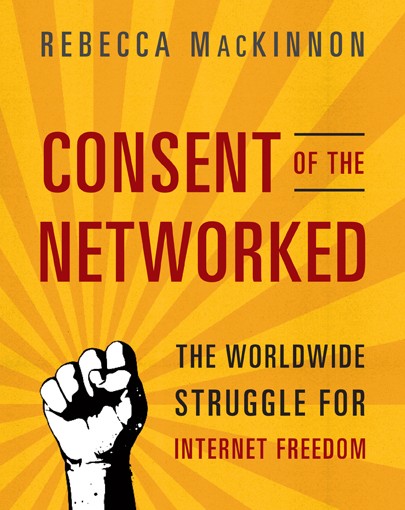
The Consent of the Networked

Politically, “consent of the governed” refers to the idea that a government’s power derives from the people that legitimize it. In practice, this means that a democratic system can only stand with the support of the people. In today’s technologically centered and ever-progressing society, “consent of the governed” must retain its motivation, but take on new interpretation in the context of data-mining and social media. In “How Your Data Are Being Deeply Mined,” Alice Marwick examines the consequences of modern data culture in terms of personal privacy and the impossibility of living a life “off the record,” so to speak. With the reality that data brokering is becoming more invasive and less transparent, Marwick ends her discussion by highlighting that, “Those of us concerned with privacy must continue to demand that checks and balances be applied to these private corporations.”

In her book, Consent of the Networked, Rebecca McKinnon emphasizes this idea. She argues that we, as consumers, must require the same regulations and rights in the digital context that we require in the physical context. This suggests that as society and technology evolve innovatively, so must our laws. This will be even more important as artificial intelligence progresses indefinitely. Matthew Gold, in Trending: The Promises and the Challenges of Big Social Data states that as technology progresses it will, “Combine the human ability to understand and interpret­ which computers can’t completely match yet-and the computer’s ability to analyze massive data sets using algorithms we create.” As computers progress to the point that they have the cognitive ability of humans, and data-mining increases exponentially, we have a responsibility to demand the same regulation of computers as we would of humans. Further, in order to maintain the consent of the networked,  governments must produce internet policies regarding data as innovative as the technology itself. Only then will it protect the peoples’ civil liberties in the digital world.

Logging In-Class Laughter

While I collected data on some of the standard measures that have already been reported, I would like to use this Observations post to bring to attention the amount of laughter that occurred in class this week. On both Tuesday and Thursday, I counted 7 instances of laughter. The criteria that I used to determine a “laugh” was simply that more than one person in class had to snicker, chuckle, giggle or smirk at a particular event. While this may not be the best way to gauge exactly how funny various things were, I felt that but making it necessary for more than one person to be laughing at once, it would eliminate the potential that one person simply found something funny based on an inside joke or personal experience that related to whatever was happening in class.

Tuesday, February 10:

  • Instance 1: A majority of the class laughed when Dr. Sample proposed that everyone raise their hand when he asked a question
  • Instances 2, 3, and 4: The entire classes laughed during the first round of questions when those called on by Dr. Sample passed the question on to one another
  • Instance 5: Many laughed when Mr. Sample mentioned that were would be trying something out another exercise (referring to the Fish Bowl exercise)
  • Instance 6: Several people laughed during the Fish Bowl experiment when the first person “tapped in” to the conversation in the middle of the room and relieved someone of their duties
  • Instance 7: A general chuckle occurred when someone pointed out that the undecided group, positioned in the middle of the room, did not initially have a seat to represent their opinion at the middle table
    • “No taxation without representation” murmured someone in the class

Thursday, February 12:

  • Instance 1: A few students laughed at the beginning of the Skype call with the r65 Lab workers as the group waved and said hello
  • Instance 2: A couple of students laughed when the audio on the Skype call cut out for a few seconds and Mark Williams mentioned that he, “Didn’t quite get all of that,” referring to a statement made by Dr. Sample
  • Instance 3: A few in the class laughed as Alex of r65 labs received a text and cleared it immediately while his phone was on screen-sharing mode
  • Instance 4: Many in the class chuckled when Alex turned off screen-sharing from his laptop, realizing that we were looking at ourselves through his Skype feed
  • Instances 5 and 6: Many groups at tables laughed when the Misfit bands were passed around
    • Specifically, one group snickered as Dr. Sample suggested the reason we are allowed to keep the bands is because r65 Labs doesn’t want them back after they’ve been on our dirty wrists for 10 weeks
    • The group I was sitting with laughed when we were deciding whether to wear the Misfit in addition to, or in place of a watch
      • One noted, “This thing does everything besides telling the time”
  • Instance 7: People laughed at my table when we read aloud the questions others had written about their data sets