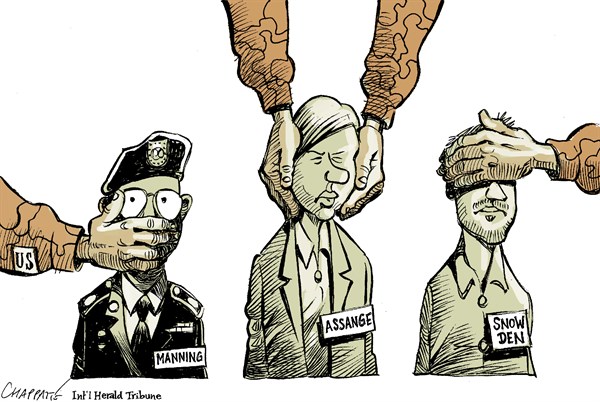
The “NSA Files Decoded” article notes that the NSA dramatically expanded the scope of its surveillance operations after 9/11, in an attempt to close the perceived gaps in America’s security network that may have allowed the attack to succeed. Put simply, September 11th, 2001 was a huge “wake-up call” for the NSA, and served as the catalyst for a great deal of reform and restructuring within the organization.
The Snowden leaks, I’m sure, have forced the NSA to re-evaluate its operations yet again. Whereas 9/11 pointed to a weakness in how the NSA and similar organizations collect information, Snowden’s actions seem to reveal a weakness in how these groups protect their intel.
I, for one, am amazed (and impressed) that a single man was able to leak so much. Of course, “knowing” (or, at least, having access to) necessarily comes before “leaking”, and Snowden definitely knew a lot. Regardless of whether the leaks end up producing any limitations on the organization’s activities, I’m sure that the NSA must be taking every measure possible to prevent this sort of incident from happening again. They can’t really afford “another Snowden,” so to speak.
To this end, the NSA is almost surely re-evaluating exactly who has access to their intel, and just how much access these individuals are granted. Yet they can only do so much. For now, humans are a necessary danger. To make sense and use of the mountains of information they collect, the NSA needs at least some high-authority individuals with the keys to the kingdom. And while these endowed individuals exist, so too does the possibility for more whistleblowers. Whistleblowers who, when acting responsibly, keep tabs on and boldly announce what even the most advanced AI can’t yet compute: the (im)morality of the actions they are witness to. The world needs more Snowdens/leakers/whistleblowers/whatevers – I just hope that there’s still room for them.


 cabard
You make an interesting point about the psychological aspects of mass surveillance on the people doing the surveillance. It’s easy to imagine the NSA as some shapeless entity gathering huge amounts of data about people, and although computer algorithms might be doing most of the heavy lifting, like you said, people have to decide what’s important–and what’s necessary. People like Snowden and the senators that speak in the “NSA Decoded” article prove that there are plenty of people in positions of authority that won’t condone how the NSA has been gathering personal information. What really concerns me is something we talked about last semester during the segment on UAVs, or unmanned aerial vehicles. The operators of these devices receive orders from higher ups, so responsibility of whatever outcome occurs from their use is vague at best. When it comes to gathering information, an official within the NSA may order someone below him or her to track an individual without really seeing the consequences. And even then, in the case of the drones, at least someone, namely, the drone pilot, sees the result of a missile strike. In the case of mass surveillance though, it’s hard for someone behind a computer to empathize with a bunch of metadata and numbers. I guess it’s a good thing that Snowden was empathetic, but perhaps if the chain of command becomes more and more fragmented, fewer individuals will have access to such vast amounts of data–and those that do might not even care.
Your mention of the drone exercise from DIG 101 reminds me of one of the themes from that class that really floated to the surface over the course of the semester—to me at least. This is the theme of distance, and how the more technically sophisticated we become, the greater the distance (both literal and figurative distance) between our decisions and the consequences of those decisions.