Overview
The play , critical play, and speculative design hacks mostly depended upon physical objects. This hack focuses on the virtual side of our world, on software. Your mission is simple: “invade” a piece of software and use it for or make it do something beyond its conventional uses. You have a complementary mission as well: reverse, challenge, or complicate the cultural politics or assumptions of the software.
To see the cultural biases of software at work, you need only look at the metaphors ingrained in our applications: you use Office on your desktop, you drag files to the recycle bin, you browse the web. These metaphors suggest computers are for white collar office work—even when they’re not. Every piece of software privileges certain forms of knowledge, power, and authority, while obscuring or silencing other forms of knowledge, power, and authority. To complete this hack you’ll have to consider the implicit or explicit ideology of some piece of software, and then figure out a way to challenge it.
The actual mechanics of this assignment are entirely up to you. This hack is inspired by Mystery House Taken Over and a Spreadsheet Invasion assignment but I’ve opened the door to any kind of software: iOS apps, MS Office, Adobe creative apps, video games, social media, and so on. You could literally hack the code of software, such as Sonny Rae Tempest’s Zork N plus 9, which replaces every noun in the classic interactive fiction game Zork. Or you could obviously misuse software, the way a former Davidson DIG 401 student recreated his Outlook calendar in Minecraft. Or you could install some odd piece of software onto your Davidson Domain and use it against the grain.
Whatever you do, think of your hack as an intervention, which can take place on any number of levels. Borrowing from the growing field of platform studies, we can imagine software having at least five layers:
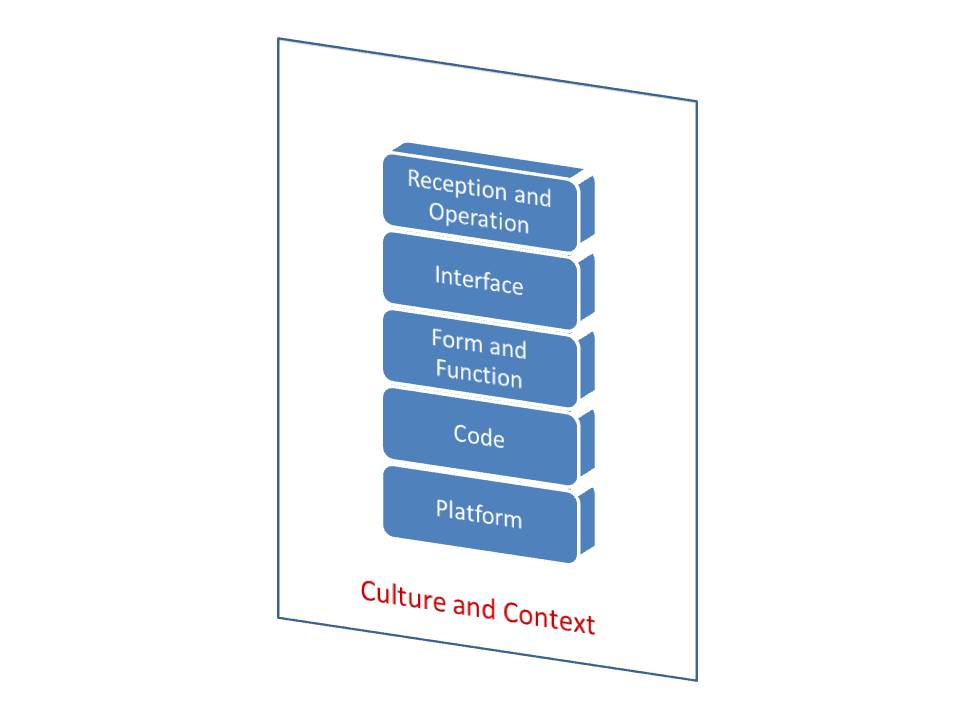
I’ve provided an explanation of these various layers elsewhere. The point to make here is that any of these layers are ripe for intervention. And the hack need not be strictly digital. Given that the operation and the social context of software is a key part of its identity, changing the context or operation can count as a hack.
However you approach this hack, keep in mind how Steven Levy describes hacks in Hackers: “to qualify as a hack, the feat must be imbued with innovation, style, and technical virtuosity” (8). Also keep in mind Gabriella Coleman’s observation that an important element to the craft of hacking is craftiness—a combination of cleverness and wit (100).
Expectations
This hack is a solo project. As usual, you’ll create an exhibit on your domain that includes an artist statement of about 1,000 words. In this statement you’ll delve into the more theoretical elements of your hack, drawing out your meditation on your software intervention.
In addition to the software invasion itself and the artist statement, you should also document the development of your hack. Post still images, short videos, sketches, etc. onto your domain. The material related to this hack will make up the first exhibit for your end-of-the-semester portfolio.
We’ll present the hacks in class on March 31, and the artist statement and documentation will be due by Sunday.
Criteria
I’ll approach your hack using the following criteria:
- Unexpectedness (the extent to which the project defies expectations or produces surprising results or reactions)
- Craft (the degree of style, technical virtuosity, and craftiness, as well as digital representation)
- Intention (the sense of intentionality and deliberateness of the work)
- Theme (the level of engagement with the concepts of critical play, agonistic design, hacking, and so on)
- Argument (the degree to which your project acts as an intervention or subversion of software)
Works Cited
Coleman, E. Gabriella. Coding Freedom: The Ethics and Aesthetics of Hacking. Princeton University Press, 2012.
Levy, Steven. Hackers: Heroes of the Computer Revolution. Sebastopol, CA: O’Reilly Media, 2010.