Memory in a Digital Age: Will These Memories Ever Last?

Over the past few years, I have become heavily interested in the concept of how to manage memories within our vast digital landscape. I am also particularly fascinated in the newly popularized desire for digital literature and how this medium redefines how we tell stories. In my English 220: Literary Analysis class last year, we read Stuart Campbell’s interactive comic, These Memories Won’t Last, which takes advantage of its digitized format to make an argument about the fragility of memories in digital spaces. Campbell’s piece takes the reader on a journey through the memories of his Grandfather during his time fighting in World War Two, fleeing to Australia as a refugee, and his current struggle with dementia. The central premise of the piece is the loss of memory but also the importance of sharing stories, which is shown by Campbell’s narration of his Grandfather’s memories. If you take a look at the online narrative, you can see that Campbell uses a fading effect to create a sense of urgency to read the story before the images and text disappear. You are also unable to scroll upwards, meaning that you cannot go back and re-read the text without refreshing the page to start from the beginning. Not only does the fading of images and the inability to scroll upwards correspond to the Grandfather’s inability to recount some of his memories, but it also represents how our memories can become less accessible when we project them into digital spaces.
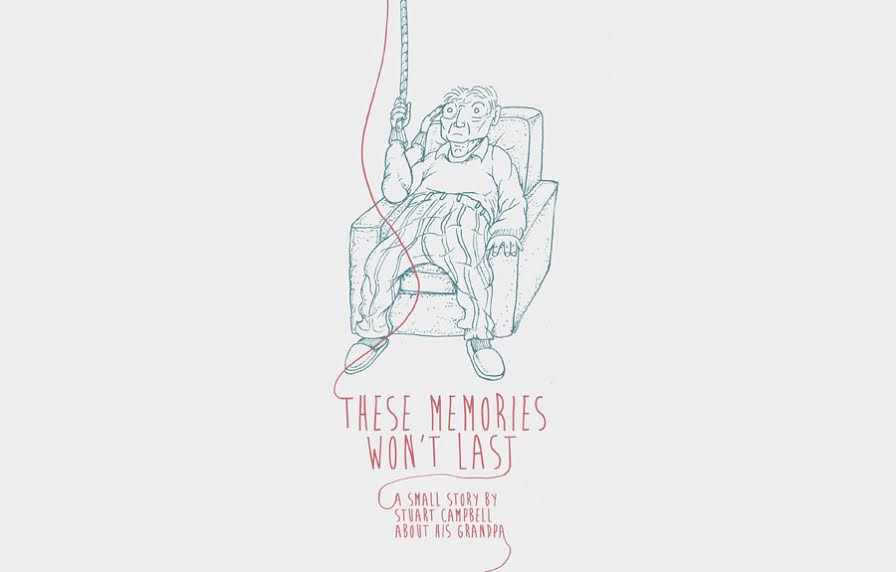
An image of the grandpa from the story, These Memories Won’t Last. Note how the flimsy string holds the entire story together. View source here.

Through the form of his digital story, Campbell demonstrates the short lifespan of data in the digital world which connects to the rhetoric we are exploring in class concerning the curation of one’s “digital afterlife.” In part of Rob Walker’s article, Cyberspace When You’re Dead, he explores how online accounts that eventually become obsolete can influence the cultivation of one’s digital legacy. The fact that Campbell decides to use a flimsy string to hold his story together could comment on the issue Walker explores regarding the preservation of digital memories and enhances the argument about the fragility of memories within online spheres. As I continued to research digital memory for my English class last year, I came across an amazing book entitled, When We Are No More: How Digital Memory is Shaping our Future, written by Abby Smith Rumsey. In her book, she describes the need to reinvent how we preserve memory, questioning how historians will be able understand our own time if all of our memories exist in digital codes that may no longer be decipherable. To combat the problem regarding memory in the digital world, she writes, “The new paradigm of memory is more like growing a garden: Everything we entrust to digital code needs regular tending, refreshing, and periodic migration to make sure it is still alive…” (Rumsey 148). This claim leads me to question what spaces are best for the storage of our memories.
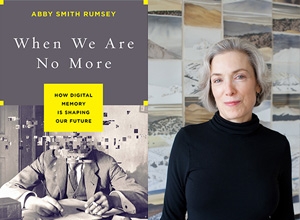
Abby Smith Rumsey and her book, When We Are No More: How Digital Memory is Shaping our Future. View source here.

Why do we feel compelled to store our memories on online spaces when we know that they will eventually expire? A large portion of Rumsey’s argument incorporates neuroscience into various discussions regarding how data storage differs from memory. Consolidation, for instance, is a facet of internal memory formation that is not enhanced by digital use. During this process, new perceptions are incorporated into the old and “connections between the new data coming into the brain find their home in existing mental contexts or webs of associations” (Rumsey 114). This is a process that can only be performed within someone’s brain. A computer is able to store certain memories, but it cannot make complex and far-reaching connections between specific scenarios like the brain. Relying on our devices as extensions of our brains corrupts the beautiful processes that are built within our own internal systems.

Reading These Memories Won’t Last is especially important as we discuss digital memory and what happens to your data when you die because it reflects the reality of telling a story about fading memories within a medium that is supposed to be timeless. As a result, this raises the questions: Does the human mind become the best place for human memories to be stored? Is it more effective to pass our memories on from person to person through shared stories? Think about it.

Works Cited:

Campbell, Stuart. “These Memories Won’t Last.” These Memories Won’t Last. N.p., n.d. Web. 20 March. 2017.

Rumsey, Abby Smith. When We Are No More: How Digital Memory Is Shaping Our Future. N.p.:n.d. Print.

Walker, Rob. “Cyberspace When You’re Dead.” The New York Times. The New York Times, 08 Jan. 2011. Web. 20 Mar. 2017.
The Trouble with Grief

One of the things I found most troubling with this week’s reading “Enter the Grief Police” was my own reaction. This article hit hard to home and forced me to confront and examine my own behavior and perceptions when it comes to experiencing and performing grief.

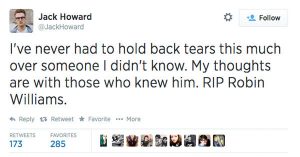
When I read this piece, I found myself siding with the “Grief Police” to one extent, but also vehemently reprimanding them on the other. When celebrities die (shout out to the year 2016)  or someone in the local community passes away, many people have taken to showing their grief in a very public manner, through the use of social media platforms such as Facebook or Twitter. In so many of these cases, when I see the grief of my “friends” (are social media contacts really friends? That’s a whole different subject…), I cringe. Unless it’s a close friend or relative, I assume that their “grief” is superficial or all just for show — for attention. When a celebrity dies I think, “How on earth does this actually affect your life, dude? Get over it.” When someone posts concerning a community member that has passed, I’m likely to question what their actual real life relationship was with the person.

People all around the world mourned a man they had never met, and grieved him publicly. Source: Eyewitness News

But this is all entirely unfair of me, too, because I do the same thing. I grieve in public, I ask for the support and kindness (read earlier: “attention”) of others recognizing my own pain, and I express my relationship to those who have passed along via public social media, somehow seemingly desperate to prove that I am affected by their passing.

So why is grief something we (maybe just read: I) are (am) so judgmental about — especially when we have all experienced it?

On Public Online Grieving

Megan Garber suggests in a brief online article, “Enter the Grief Police”, that public, online forms of grieving are analogous to a virtual wake. Her primary points to support this argument are that:

  1. The notion that to oppose online grieving is to support the claim that there is one true ‘correct’ way to grieve.
  2. The notion that public, online grieving is a natural extension of what may be called a ‘deep, communal concern’.
  3. To ‘grief police’ is to dislike newly emerging social rituals that would otherwise be acceptable.
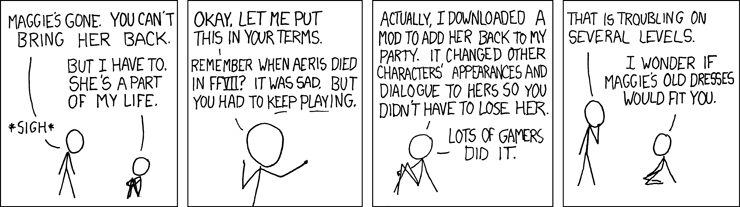
Aeris Dies
There are many ways to grieve. However, a distinction must be made between real grief, and a 140 character hashtag riddled soundbite.

If you haven’t realized by the tone of my prose by now, I will now systematically disagree with the above points. Firstly, of course there is no true way to grieve. It is up to the individual in question, as well as the loved ones surrounding that individual. What is important however is that it is intensely personal, and could not possibly by defined by a certain method. It is because of this that online grieving should be taken with caution–because it is so public, and so accessible to others, there’s little barrier to both entry and reception. If a somebody did not want to see a deceased loved one’s face online, as outlined in “Inadvertent Algorithmic Cruelty”, it is up to them. But, the public nature of this act makes it difficult to avoid, thus making it both an inherently unpersonal act, as well as disrupting the grief of others.

Secondly, I do not believe that a deep communal concern over a death necessarily results in public online grieving. In the large cases such as David Bowie’s death, I do not think that there was a deep, sincere sense of loss for the majority of people involved. While certain individuals may have been personally familiar with Bowie, it’s hard to imagine that these people could be as affected as immediate family. And if there was concern, it seems that a primary motivator in making these statements of mourning public would be so that others may see them–in an effort to garner sympathy for their loss, to put it bluntly. The fact that the statements are public once again detract from the thinking that public online grieving reflects a deep concern.

Lastly, I do admit that public online grieving is indeed a social ritual as much as a wake or funeral is. However, once again the difference is the invitatory, much-too-accessible nature of public online grieving. People are invited to wakes and funerals. In these cases, the small scale of the mourning event is what allows for intimate consolation and condolences. No one in a funeral approaches a widow and yells their condolences loudly so that everyone may hear. It’s an ass move because it’s not about those invited to the wake, it’s about the recently deceased and those closest to them. If this was the design of the wake then that is a different story, but the point is that to take this decision out of the hands of the deceased and those closest to them should be frowned upon.

A Virtual Guest Book

How to Sign the Guestbook at a Funeral or Memorial Service via Everplans

In her article “David Bowie and the Rise of the Grief Police,” Megan Garber argues that, sometimes, the act of grieving online (often publicly, such as via Facebook) does not have to be a “deeply insincere” act as Camilla Long tweets. Rather, it can be a “declaration of support to the deceased’s family and friends,” almost like a virtual “condolence card” for the loved ones (even if it is personally addressed to the deceased).  

Plenty of condolence cards and memorial flowers come from people who did not have a close relationship with the deceased (or any at all). Though these condolences can be touching and personal, they may also simply express sorrow for the family’s loss–a universally human sentiment that can still carry some weight for the loved ones regardless of the sender’s actual relationship to the deceased. As Garber points out, that does not make them much different from memorial posts online.

In class, I brought up a similar idea in our small group’s discussion.  What makes a memorial post much different than signing a guest book at a wake? On the one hand, posting on a memorial page is often in a more public forum, which certainly lends the post many of the negative aspects associated with other public posts–this is something that the poster wants you to see, something that is curated and meant to communicate a certain message or agenda.

On the other hand, we can focus on different aspects of a memorial post. If it’s posted on a page created specifically to mourn or memorialize a certain person’s passing, that page is often not ostensibly meant as a place for people to gain social capital; rather it may be created by family, friends, or loved ones for those affected by the deceased. Like a sizable crowd at a funeral,  a mailbox packed with condolence cards, or a completely full guest book, a populated memorial page can help the loved ones of the deceased deal with the unendurable–it can comfort someone knowing that their deceased loved one had a tangible impact on so many different people.

It Wasn’t Me! It Was Her! And Him! Accountability and Anonymity in Internet Policing

From both commercial and personal perspectives, the internet and overall growth of social media platforms remain contentious in their public reception, expanding and encouraging new forms of social expression and communication but not without a troubling human cost. In her article “LOLing at tragedy: Facebook trolls, memorial pages and resistance to grief online” Whitney Phillips explores in depth the phenomenon of trolling, specifically on Facebook, unearthing the very tension between freedom of expression and harmful engagement within social media relationships and networks. From her extensive article one thing remains clear: trolling cannot be boiled down to the good guy/bad guy paradigm many use to unilaterally vilify internet trolls. While trolling can be downright destructive and harmful in its activity, this involvement equally reveals the greater hypocrisy of social media platforms themselves, which glorify and sensationalize human trauma for commercial or self-interested ends (not so different from trolls, after all).

What I find most interesting in Phillips’ article is her analysis of the different permutations of identity that appear online—a sort of shape-shifting which stems from a growing societal preference for anonymity and multiplicity (and the protection and freedom they afford). She notes in particular the rhetorical distinction between the use of first and third person on Facebook, observing:

For every “real” user who is continuously reminded of and interpolated by their own “I,” every troll user is continuously reminded of and interpolated by the “I” they’re not, an ongoing process of emotional repudiation that explains why Facebook trolls frequently shift to the third person to describe their own actions (and may also help explain the ease with which trolls detach from the havoc they wreak — in their minds, it’s not exactly them doing the damage).

Strikingly, the multiplicity of the self allows for a certain level of emotional distancing in these online relationships, further blurred by the impersonal digital environment in which they exist. As multiplicity within social identity becomes more commonplace, do we need to reimagine our definition of citizenship and social participation? To what extent to do these cloned or alternate identities possess authority and legitimacy? Where is the line between character performance and the “real” individual? And finally, at what point does this alternative identity become its own functioning entity, no longer an extension of its maker, but rather an individual actor with its own rights and responsibility?

With social media it is now possible to have multiple identities, creating virtual clones of ourselves and others. Source: “Cloning – A Useful Technique for Mankind.” N.d. Blogs. Web. 15 Mar. 2017.

Reading Phillips’ article I immediately thought of Yik Yak, a social media platform most simply described as an anonymous twitter, which initially gained popularity thanks to the liberating anonymity it afforded its “yakkers.” However, alongside this promise of freedom came an even greater cost, namely, that users were suddenly able to express harmful, offensive, and downright disgusting beliefs without any social consequence. Down-voting, a built-in protection within the app, allowed unpopular posts to be removed from the feed after five “downs.” However, this protection was limited at best, functioning to minimize damage rather than serving as a preventative measure. Any recipient of slander could still have their reputation publicly tarnished in the time it took to gather five downvotes. Trolling and Yik Yak posting may serve different functions and distinct communities, however their central reliance on anonymity suggests a more threatening reality within society at large: what humans are capable of if emancipated from society’s surveillance.

Source: “The Best of Yik Yak at Kent State.” N.d. Her Campus. Web. 15 Mar. 2017.

This leads us to a fundamental question: who do we protect and whose responsibility is it to do so? Phillips herself identifies this dilemma, stating, “Indeed, from the moment that memorial trolling took hold, Facebook has had to walk a very fine line between protecting its users and protecting itself.” Traditionally, crime within society falls under state and government authority. But what about when it occurs on digital platforms? Anti-trolling, itself a form of policing, is reminiscent of the lone ranger or even the classic cowboy—enforcing “justice” but with an unregulated, and arguably equally dangerous level of independence and subjective reign.  So who is to blame? Most importantly, if a person has multiple identities, which gets persecuted: the social identity or the digital one? Where is this accountability located? Just take Phillips’ example of Sean Duffy, wrongfully arrested and accused of being the online persona, Pro Fessor. Can criminal justice accommodate the blurring of these identity boundaries? Unclear.

References :

Phillips, Whitney. “LOLing at Tragedy: Facebook Trolls, Memorial Pages and Resistance to Grief Online.” First Monday 16.12 (n.d.): n. pag. 5 Dec. 2011. Web. 15 Mar. 2017.

Enter the Grief Moderators, Not the Grief Police.

Megan Garber’s article “Enter the Grief Police” deals with a topic that I have mentioned in previous blog posts: the grief demonstrated online and more specifically on Facebook. She begins by presenting her belief that the Internet has allowed society to publicly display their feelings of grief once again. She cites 20th century culture as the beginning of a movement that encouraged grief to be kept to the personal self. Now, with Social Media features, such as Facebook’s “Remembering” preservation of a profile, we can express these emotions freely once again. However, Garber believes that this transition to previously held values is causing discomfort, and this discomfort is leading to push back against these expressions. While I do share Garber’s sentiment that there has been push back against this public display of grief, I would hesitate to call the movement a “Grief Police.”

I would like to start off by saying that my formerly stated belief is not rooted in history that dates back to the 20th century, but rather in my experiences as a social media user. I was not aware that it was possible to keep a person’s social media profile alive past their expiration date until a year ago when I saw a mass amount of comments being posted on a friends wall. That friend had been shot in a drive-by near the projects in Charlotte, NC and many of her friends could be seen sending supportive messages. I was not close to this friend, so I did not post anything but was still saddened by the news. However, I did see other people ,in my exact position, writing long-winded posts that described their love for the deceased person. That is not okay, and it is annoying. These are the generally held beliefs of those who push back against public grieving. I am sure that , had the dead person been witness to these posts, they would have reacted with  “I’m sorry, who are you?” I believe that any human is free to grieve in their own way, be it private or public. But, when grieving becomes a false action that people engage in simply to go with the norm or fit in with everyone else, it devalues the action as a whole.

The Facebook profile of the friend who was shot in Charlotte, NC. Users are still posting on her wall.

Since my initial experience with public grievances, I have encountered many fake and real forms of online grieving. It is sometimes hard to identity the differences between the two, unless one is familiar with the deceased person. I have also encountered the people who share my sentiment, yet go out of their way to express it. These people are often very outspoken, such as Camilla Long was when she called out the fake grievers of David Bowie’s death . She specifically called out people who were sharing their “broken up” emotions over the death of an iconic artist, wanting them to articulate their feelings more efficiently or to create constructive discourse. I agree with her. People who do not know him or have met him are feeling emotional about his death. Can you imagine how the family feels? Can you imagine how those close to him, those who shared life with him, feel? I would pose this question to all those who engage in public grieving for the sake of social performance. Take a step back from the keyboard before you post that really long message describing how much you will miss someone who you did not well. This performance is annoying, it is overdone, and it is insulting for those who really wish to grieve online.


Posts describing their grief for the deceased patron that acknowledge the fact that many other comments have already been left on her profile. The massive amount of comments demonstrate how these actions are social performance.

I am in no way telling people not to grieve online, I believe it can be constructive and in some ways cathartic. I am simply saying that the faux “Omg I’m going to miss you so much xoxo” messages are unnecessary and should stop. Judging from the reading, Garber would consider me as part of the Grief Police, and this is where we disagree. I do not believe that the concept of a “Grief Police” is even real. Yes, there are individuals like Long who wish people would express their grief more privately, but these people usually keep to themselves. Long has sixty thousand followers on Twitter, and this gives her a stage on which she may express her views. The majority of this so called “Grief Police” does not.

In my experience, those who share my beliefs would think thrice before telling someone that they should not grieve publicly. We are all entitled to our opinions, and we have the freedom to post what we want. Is it annoying? Sure. But there is no massive group , at least not one that I have encountered , of social media users who try to dictate how grief is expressed. The use of the term “Grief Police” assumes that there is a group, and this group is consistently checking up on social media users to make sure that their feelings concerning  a death are internalized. This is not the case. We just find these posts annoying and would prefer to not see them. This can be easily done with the click of a few buttons, so why would there even be a need for a Grief Police? Those who care enough about these types of posts will do something to make sure they don’t see them, but they will not go out of their way to offend those grieving.

If anything, Grief Moderators would be a better term. This term does not assume that there is a group of people trying to control what everyone says, but rather what they  themselves see. They moderate their newsfeed to see, or avoid seeing posts concerning a death. These moderators are moderating their own experience, not that of others.

The changing ideal use of social media regarding mourning

Two of the articles we read, “Inadvertent Algorithmic Cruelty” and “Enter the Grief Police” got me thinking about what we expect from technology as it relates to grief insofar as we can keep technology separate from the human people who use it. Eric’s chief complaint is that he was not consulted about his “Year in Review,” which Facebook’s algorithm selected an image of his deceased daughter to represent. He writes that those who have had years full of crisis “might not want to look at this past year.” However, I’d argue that some would–what about those who would share their year in review, even if it was a devastating one, as a form of mourning? The Garber piece in The Atlantic also touches on this territory–no one can establish what is and isn’t an appropriate reaction to grief (with the exception of the trolls Whitney Phillips elaborates on). As Garber phrases it, “The notion that there is but one way to grieve, and that the deviation from that way is wrong” has no place on the internet. Perhaps for every person who wouldn’t want to share their year in review, there’s one who does — one who doesn’t find Facebook grief to be “utterly insincere,” as Camilla Long’s tweets describe.

The kind of content we expect from the internet is changing. Eric writes that “The design [of Facebook’s year in review] is for the ideal user, the happy, upbeat, good-life user. It doesn’t take other cases into account.” I would argue that this vision of the internet’s / social media’s purpose is incomplete. Eric’s judgement brings to mind that the characteristics he describes are what we used to expect from content (importantly, self-advertised content) on the internet. But now, the internet is becoming an acceptable place to mourn. As Garber puts it, #RIPDavidBowie wasn’t just a trending topic–it was a digital funeral.

Trolls have feelings too

And standards. As cruel as internet trolls can be, there is such thing as “crossing the line”. There is a whole culture of trolling with various unspoken rules regarding who to target and “traditions” of content for situations, which fascinated me. Who knew there was a methodology what content was posted and who was okay to troll? Whitney Phillips delves into this subculture in her article “LOLing at tragedy: Facebook trolls, memorial pages and resistance to grief online”. She focuses on RIP trolls, which she defines as “online instigators [who] post abusive comments and images onto pages created for and dedicated to the deceased.” Recognizable by their profile pictures and names (like “Soveri Ruthless” or “Frank Bagadonuts”), RIP trolls friend each other and then lead organized attacks on a public Facebook memorial page. They specifically target “I didn’t know you but I’m very sorry you’re dead” posts, which they view as insincere and cheap. For RIP trolls, Facebook is never the appropriate place for grieving, especially for tragedies such as car crashes or kidnapping cases.

No, not these kinds of trolls. Internet trolls generally intend to ruin the intended conversation, via rude and insensitive comments or images. Dreamworks, accessed 15 March 2017.

No one should have the power to judge others’ behavior, specifically reactions to death, and determine what is appropriate or not. But hearing the trolls’ perspective made me wonder if their view of online expressions of grief has some credibility. Wilson Mouzone, one of the trolls Phillips interviewed, said that family members don’t deserve the disrespectful treatment by some of the most vicious trolls. Generally, these pages (often private) and users are left alone. But the “grief-tourists” with no real-life connection to the victim are considered free game. Will trolling help curtail these “insincere” postings? If so, are we amid a culture shift in online grief culture? Since experiencing death on Facebook is a relatively new phenomenon (as opposed to newspaper obituaries and funerals), we haven’t determined what is culturally acceptable. An analysis of public memorial pages over the past few years regarding the ratio of genuine posts to troll posts would be insightful to examine. Perhaps the RIP trolls’ behavior is having their desired effect and reducing the number of inauthentic postings. More likely, their derogatory comments only incite internal debate/attacks/rage on the memorial page regarding the trolls, not about the insincere postings.

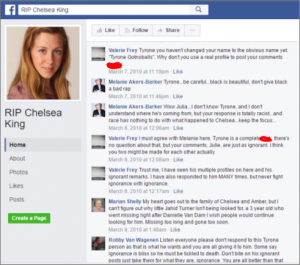
A memorial page for Chelsea King. Note that the administrators of the page have done a better job of deleting troll comments (or perhaps the account was reported – in which case, all comments are deleted automatically) and so the discussion revolves around a comment that is no longer there. Screenshot of original page taken and edited by author, 15 March 2017.

The Problem With Memorialization on Websites

While reading the article “Gravesites and Websites: A Comparison of Memorialisation,” there was one quotation the particularly stuck with me. In discussing memorial websites, the authors state that “these sites are supportive of both the process of remembering someone as gone and being with someone as a continuing presence” (40). While I agree that memorial sites can serve to remember someone who is gone, I took issue with the authors use of “being with someone as a continuing presence” (40).

My first big issue with this statement is that a person’s presence on memorial site is not a dynamic presence. When someone dies, everything that they have done up until that point becomes fixed—there are no opportunities for a new or different presence. For example, think of new-Ash in “Be Right Back.” He was constructed from everything that the real Ash had ever posted online. He did not have the meanings or thoughts that the real Ash had, nor was he able to become a new person. And in my opinion, one of the fundamental aspects of humanity is our capacity for change.

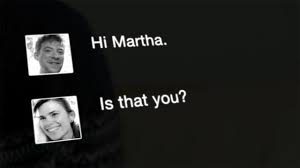
My other issue with saying that memorial sites serve to allow us to be with someone as a continued presence is that I feel that it does not encourage people to move on. Similar to how Martha was unable to move on from Ash’s death once she found his online presence (something that seems to me like a futuristic memorial page), if others use memorial sites to be with their deceased loved ones, they will never be able to achieve closure over their loved one’s death.

Though taking place in the future, Ash’s online persona is a sort of memorial page that prevents Martha from moving on from his death.

I do believe that memorial sites can be cathartic. They can serve as locations for people to leave a message to the deceased. However, if memorial sites are being used for someone to feel that their loved one is still with them, then the sites could become a problem.

Public vs. Private Grief in Social Media

One part of mourning and the grieving process that sometimes gets overlooked is the social aspect, how people navigate the complicated customs, mores, and traditions we associate with death and funerals, while also trying to find time to personally grieve. There are two clearly-defined sides of grieving, the public and the private, the outward and the inward. We expect a grieving family to behave a certain way at the funeral, at the memorial service, in the immediate days afterward. It can be hard to find time to mourn on one’s own, to work to begin the difficult process of grief and letting go.

Questia.com, uploaded May 9, 2016

Social media complicates all that even more. Take Facebook. When someone with an account dies, it’s pretty common for people to post goodbye messages on his/her wall, not anything too in depth, just something to serve as an outlet for their personal grieving process. Now, I want to stress that this is not necessarily a good or a bad thing, just a complicating factor. For one thing, the nature of social media is public. By posting these personal messages on  a public social networking site, people are blurring the boundaries between the private and public sides of grieving. They are opening up their mourning to others, showing them how they are feeling and what they are going through. At least, in theory that’s what they’re doing. In reality, everything people post on Facebook (for the most part) is edited and created with a specific lens in mind. Are people posting for themselves, or for other Facebook users? Not to be too cynical, but I would find it hard to believe that there isn’t a certain percentage of people who  spend a lot of time crafting their post to hit just the right chords, to get just the right amount of likes and comments.

Part of this is natural, people like to make good impressions, there’s nothing wrong with that. Yet doesn’t it feel a little…off? We like to think of grieving as an intensely personal experience, something raw and honest, unique to each person. So if someone begins to manufacture or reframe their grief, it feels a bit like cheating, like they’re commercializing something sacred.  Maybe I’m just being too emotional or naive here, but at least for me, my grief is not easily put into words, or summarized with a few pithy lines, a couple emojis, and a picture of my dead friend smiling. I’m being overly harsh, but you get my point. Facebook, along with other social media sites, complicate the grieving process, force the public and private sides to merge in new and often uncomfortable ways. As is typically the case, technology continues to surge ahead, while culture struggles to catch up.